‘Manners for machines’: how new rules could stop AI scrapers destroying the internet

Source: The Conversation (Au and NZ) – By T.J. Thomson, Associate Professor of Visual Communication & Digital Media, RMIT University

Australians are among the most anxious in the world about artificial intelligence (AI).

This anxiety is driven by fears AI is used to spread misinformation and scam people, anxiety over job losses, and the fact AI companies are training their models on others’ expertise and creative works without compensation.

AI companies have used pirated books and articles, and routinely send bots across the web to systematically scrape content for their models to learn from. That content may come from social media platforms such as Reddit, university repositories of academic work, and authoritative publications like news outlets.

In the past, online scraping was subject to a kind of detente. Although scraping may sometimes have been technically illegal, it was needed to make the internet work. For instance, without scraping there would be no Google. Website owners were OK with scraping because it made their content more available, according with the vision of the “open web”.

Under these conditions, scraping was managed through principles such as respect, recognition, and reciprocity. In the context of AI, those are now faltering.

A new online landscape

Many news outlets are now blocking web scrapers. Creators are choosing not to use certain platforms or are posting less.

Barriers are being put in place across the open web. When only some can afford to pay to access news and information, then democracy, scientific innovation and creative communities are all harmed.

Exceptions to copyright infringement, such as fair dealing for research or study, were legislated long before generative AI became publicly available. These exceptions are no longer fit for purpose in an AI age.

The Australian government has ruled out a new copyright exception for text and data mining. This signals a commitment to supporting Australia’s creative industries, but leaves great uncertainty about how creative content can be managed legally and at scale now that AI companies are crawling the web.

In response, the international nonprofit Creative Commons has proposed a new voluntary framework: CC Signals.

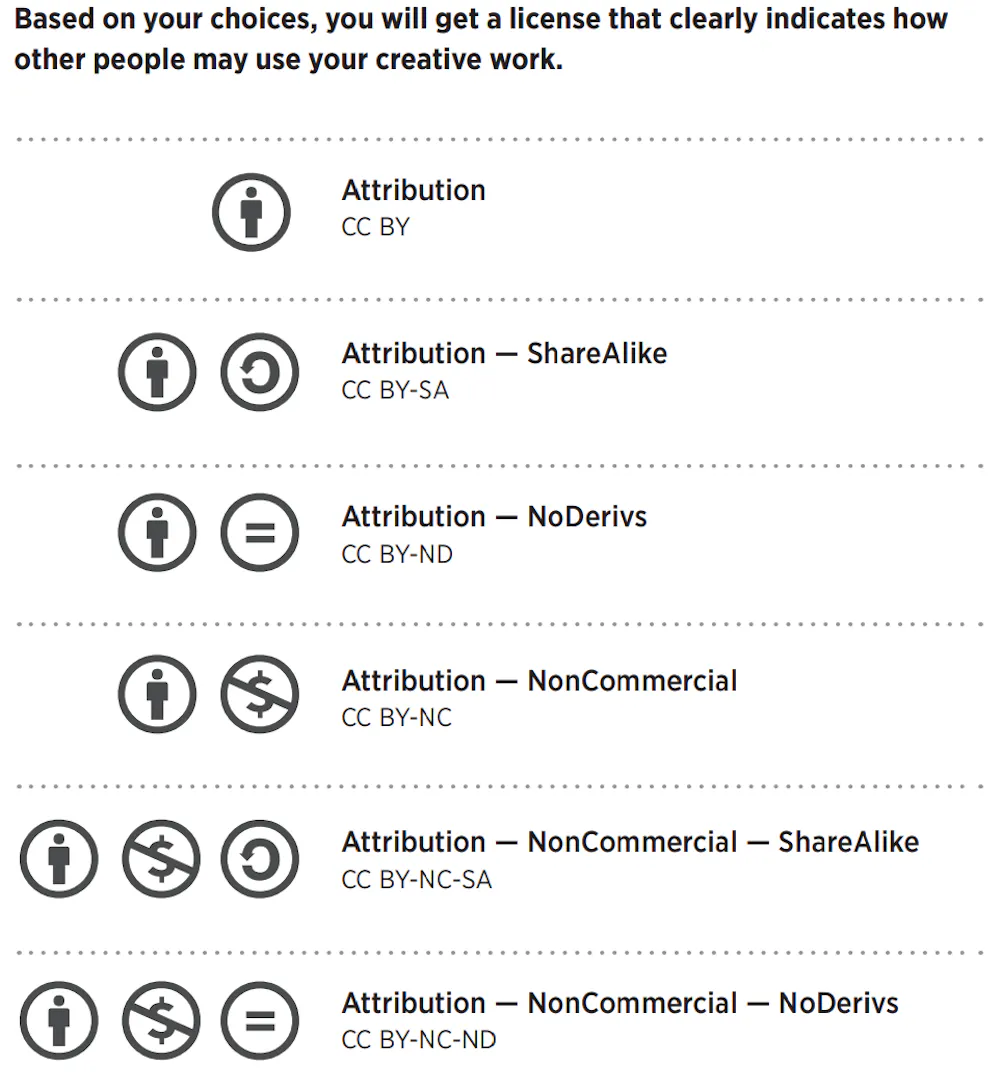
Creative Commons licences allow creators to share content and specify how it can be used. All licences require credit to acknowledge the source, but various additional restrictions can be applied. Creators can ask others not to modify their work, or not to use it for commercial purposes. For example, The Conversation’s articles are available for reuse under a CC BY-ND licence, which means they must be credited to the source and must not be remixed, transformed, or built upon.


Summary of CC licences. Creative Commons

How would CC Signals work?

The proposed CC Signals framework lets creators decide if or how they want their material to be used by machines. It aims to strike a balance between responsible AI use and not stifling innovation, and is based on the principles of consent, compensation, and credit.

Simplistically, CC Signals work by allowing a “declaring party” – such as a news website – to attach machine-readable instructions to a body of content. These instructions specify what combinations of machine uses are permitted, and under what conditions.

CC Signals are standardised, and both humans and machines can understand them.

This proposal arrives at a moment that closely mirrors the early days of the web, when norms around automated access (crawling and scraping) were still being worked out in practice rather than law.

A useful historical parallel is robots.txt, a simple file web hosts use to signal which parts of a site can be accessed by the bots that crawl the web and look for content. It was never enforceable, but it became widely adopted because it provided a clear, standardised way to communicate expectations between content hosts and developers.

CC Signals could operate in much the same spirit. But, as with any system, it has potential benefits as well as drawbacks.

The pros

The framework provides more nuance and flexibility than the current scrape/don’t scrape environment we’re in. It offers creators more control over the use of their content.

It also has the potential to affect how much high-quality content is available for scraping. Without access to high-quality data, AI’s biases are exacerbated and make the technology less useful.

The framework might also benefit smaller players who don’t have the bargaining power to negotiate with big tech companies but who, nonetheless, desire remuneration, credit, or visibility for their work.

The cons

The greatest challenge with CC Signals is likely to be a practical one – how to calculate, and then enforce, the monetary or in-kind support required by some of the signals.

This is also a major sticking point with content industry proposals for collective licensing schemes for AI. Calculating and distributing licence fees for the thousands, if not millions, of internet works that are accessed by generative AI systems around the world is a logistical nightmare.

Creative Commons has said it plans to produce best-practice guides for how to make contributions and give credit under the CC Signals. But this work is still in progress.

Where to from here?

Creative Commons asserts that the CC Signals framework is not so much a legal tool as an attempt to define “manners for machines”. Manners is a good way to look at this.

The legal and practical hurdles to implementing effective copyright management for AI systems are huge. But we should be open to new ideas and frameworks that foreground respect and recognition for creators without shutting down important technological developments.

CC Signals is an imperfect framework, but it is a start. Hopefully there are more to come.

ref. ‘Manners for machines’: how new rules could stop AI scrapers destroying the internet – https://theconversation.com/manners-for-machines-how-new-rules-could-stop-ai-scrapers-destroying-the-internet-278669

Evening Report: https://eveningreport.nz/2026/03/26/manners-for-machines-how-new-rules-could-stop-ai-scrapers-destroying-the-internet-278669/

Giant dragonflies once roamed Earth’s skies. New research upends the textbook theory of why they went extinct

Source: The Conversation (Au and NZ) – By Roger S. Seymour, Professor Emeritus of Physiology, Adelaide University

Insects first took to the skies about 350 million years ago, some 200 million years before birds first flapped their wings.

By the end of the Carboniferous period, 300 million years ago, some flying insects had become gigantic. Huge dragonfly-like insects called griffinflies had wingspans of 70cm – five times the size of the largest modern dragonflies.

These giant insects lived in a time when Earth’s atmosphere contained more oxygen than it does today: around 30%, compared with the modern 21%.

Because large flying insects lived in a time of high oxygen levels, scientists have proposed that they required these high external oxygen levels to power the rapid burn of energy during flight.

In new research published today in Nature, we studied the muscles of dozens of modern flying insects and made a surprising discovery: there is no reason the griffinfly could not survive in today’s atmosphere.

The structure of the insect flight respiratory system

Flying takes more energy than running or swimming, because a flapping flier must constantly work against gravity to remain in the air.

Consequently, the flight muscles use a lot of oxygen, and the rate of oxygen consumption increases roughly in proportion to the weight of the flier. The highest rate of oxygen consumption per gram by any known tissue occurs in a flying bee.

Tracheal system (green) supplying oxygen into the flight muscles (red) of a vinegar fly. Jayan Nair and Maria Leptin / European Molecular Biology Laboratory, CC BY

Oxygen is supplied to insect flight muscles through the “tracheal system”, a tree-like branching system of air-filled tubes that lead to the smallest branches, called “tracheoles”, where oxygen moves into the muscle tissue.

Each tracheole is a dead end, which means oxygen delivered to the muscle travels primarily by diffusion. First it diffuses through the air inside each tracheole, and then through the muscle tissue itself.

The old hypothesis

In modern insects, oxygen levels near the oxygen-consuming mitochondria that power the flight muscle are very close to zero. This implies that the structure of the tracheal system was just adequate to supply sufficient oxygen.

A larger insect would need a greater supply of oxygen, which would mean a greater driving force for diffusion, which in turn means more oxygen in Earth’s atmosphere.

The extinct griffinfly (left) next to one of the largest living dragonflies, the giant petaltail (right). Estelle Mayhew / Aldrich Hezekiah

The idea that the structure and function of the insect tracheal system limits body size has prevailed for the past 30 years and appears in educational textbooks.

Our interest in the theory arose 15 years ago, when we looked at thin slices of the flight muscle of locusts. The tracheoles appearing between and within the muscle fibres were few and took up only about 1% of the area, compared with the mitochondria that were occupying about 20%.

New evidence

We initially thought all an insect had to do to increase its oxygen delivery would be to increase the number of tracheoles. After all, this is where oxygen is supplied to the mitochondria.

To be sure the locust was not exceptional and to properly understand the effect of body size, we measured 44 species of flying insects of different body masses and metabolic rates. The project required five years and 1,320 transmission electron micrographs.

But the results were essentially the same: the tracheoles occupied only about 1% of the cross-sectional area of the flight muscles regardless of body size. In contrast, the blood-filled capillaries in the flight and cardiac tissue of some birds and mammals occupy about 10% of the area.

Under the electron microscope, thin slices of insect muscle (left) and mammal muscle (right) show the tracheoles and capillaries in white. Antoinette Lensink and Edward Snelling

This shows there is plenty of scope to increase the number and volume of tracheoles without weakening the muscle. So the structure of the tracheal system is not an important constraint on body size.

Evidence from developing insects shows insects can grow more tracheoles in flight muscle in lower oxygen levels, and they pass this trait to their offspring. The conclusion is that the body size of flying insects has never been limited by the structure or function of their tracheal systems.

There is no physiological reason why insects the size of griffinflies could not fly in today’s atmosphere. And yet they don’t exist today.

The simpler reasons may be that larger animal species are more prone to extinction than smaller ones – and 300 million years ago, the griffinfly had no bird or mammal predators to watch out for.

ref. Giant dragonflies once roamed Earth’s skies. New research upends the textbook theory of why they went extinct – https://theconversation.com/giant-dragonflies-once-roamed-earths-skies-new-research-upends-the-textbook-theory-of-why-they-went-extinct-278997

Evening Report: https://eveningreport.nz/2026/03/26/giant-dragonflies-once-roamed-earths-skies-new-research-upends-the-textbook-theory-of-why-they-went-extinct-278997/

Australia must brace for clusters of natural disasters, not just isolated fires and floods

Source: The Conversation (Au and NZ) – By Zahra Shahhoseini, Research Fellow in Public Health, Monash University

Around the world, communities are battling more extreme weather events. That includes residents in the path of Cyclone Narelle, which is threatening to form again over Western Australia.

But another concerning trend is that natural disasters are increasingly arriving in clusters, not in isolation.

Fires, storms, floods and heatwaves are are no longer neatly separated by season or geography. They are more often occurring together or are affecting different parts of the country at the same time.

Scientists describe these as compound or overlapping hazards. This is where two or more natural disasters happen simultaneously or in close succession. And they often affect the same places.

So how can we prepare for overlapping disasters? And what does it mean for our emergency services?

The danger of multiple disasters

International research suggests people are most at risk when a new disaster strikes and they haven’t yet recovered from an earlier event. To understand risk, it helps to understand these three terms:

  • hazard, which is the dangerous event itself
  • exposure, which refers to the people and things that could be affected
  • vulnerability, which is a measure of how susceptible to harm people and things are.

When disasters overlap, all three components of risk will likely increase.

Overlapping hazards are different from so-called cascading hazards. Cascading hazards refer to when an initial event triggers a series of system failures. These failures often cause infrastructure breakdowns and social disruption, both of which can actually be worse than the original disaster event.

An example of this is the 2011 Tōhoku disaster in Japan. In this case, an earthquake triggered a tsunami which then inundated the Fukushima nuclear plant. These cascading hazards led to a nuclear crisis, mass evacuations, and long-term contamination. So it was the consequences of the earthquake, not the earthquake itself, that caused the most harm.

Overlapping hazards are often harder to manage. One reason is it’s hard to coordinate public warnings when multiple disasters strike. For example, a bushfire warning might instruct people to evacuate immediately, but a simultaneous flash flood may block the very roads needed to escape.

Overlapping hazards also stretch our emergency resources, often across multiple fronts at once. And recovery from one event is frequently interrupted by the next. This is why we can no longer rely on current disaster response frameworks, which tend to be built around isolated events.

A history of overlapping hazards

In Australia, we are fairly used to dealing with overlapping disasters.

In January this year, inland bushfires were burning in Victoria’s west under hot, dry conditions. Meanwhile, an intense coastal storm was brewing in that same region. This saw emergency operations move from fire suppression and evacuation to flood rescue, as flash flooding inundated sections of the Great Ocean Road and washed vehicles into the ocean.

In December 2025, Western Australia was hit by a tropical cyclone that caused flash flooding and widespread power outages. Within days, authorities were issuing fire danger warnings as a heatwave swept across the state’s southeast.

In late 2024, severe hail and flash flooding arrived in the aftermath of a bushfire in New South Wales’ Yass Valley. Residents barely had time to recover from the initial fire.

Research examining more than five decades of insurance losses shows Australia experiences the most overlapping hazards in December, January and February. This is when bushfire, tropical cyclone and severe storm seasons overlap. This makes summer the most high-risk period, particularly for disaster-prone regions.

When disasters converge

In Australia, natural disasters most often come in three combinations:

  • heatwaves alongside drought
  • heat followed by heavy rain
  • strong winds combined with heavy rain.

Heatwaves and drought often occur together because dry soils reduce evaporation and push temperatures higher. This creates persistent hot and dry conditions, increasing the risk of bushfires. These hot conditions also put pressure on the agriculture and health care sectors. Recent Australian research suggests this combination of heatwaves and drought will only become more common and extreme.

In Australia, heavy rainfall is more likely to come after a heatwave. This is because extreme heat alters atmospheric conditions in a way that means subsequent rain often falls in shorter, heavier bursts.

Strong winds and heavy rainfall often occur together, most commonly when tropical cyclones develop. East coast lows, a type of intense weather system that usually forms off Australia’s eastern coast, may also create the right conditions for these overlapping hazards.

The role of climate change

Climate change acts as a “threat multiplier”, increasing the likelihood of extreme events occurring together or in rapid succession. Research shows extreme weather is becoming more frequent and intense.

In Australia, we have already recognised this trend, creating national frameworks to deal with a rising number of simultaneous, and often large-scale, disasters.

But sound policy does not guarantee effective emergency management. As the risk of overlapping hazards increases, we must actively involve communities in disaster planning. Through education programs and clear messaging, we can help them understand how disasters may combine. We can also give them strategies to make decisions when weather conditions change rapidly.

In our changing climate, overlapping hazards will only become more common. So there’s no better time to help our communities and first responders prepare.

ref. Australia must brace for clusters of natural disasters, not just isolated fires and floods – https://theconversation.com/australia-must-brace-for-clusters-of-natural-disasters-not-just-isolated-fires-and-floods-272333

Evening Report: https://eveningreport.nz/2026/03/26/australia-must-brace-for-clusters-of-natural-disasters-not-just-isolated-fires-and-floods-272333/

Driving in the wrong direction: why NZ’s oil consumption is at a 5-year high

Source: The Conversation (Au and NZ) – By Robert McLachlan, Professor in Applied Mathematics, Te Kunenga ki Pūrehuroa – Massey University

New Zealand’s latest quarterly energy report shows electricity production was above 90% renewable and emissions from generation fell to the lowest level on record.

But it also shows New Zealand’s oil consumption, which had fallen markedly after the COVID pandemic, has crept back up to reach its highest quarterly level in five years.

Oil now comprises its highest quarterly share of New Zealand’s overall energy emissions on record.

Of the total carbon emissions from the burning of fossil fuels, 77% were from oil (mostly used for transport), 12% from industrial and domestic gas usage, 6% from coal, and just 5% from electricity generation.

Developing a coordinated energy strategy to reduce oil dependence would not only provide an effective climate response, but also protect New Zealand from recurring oil price and supply shocks.

The previous government had committed to a comprehensive strategy to transition to a renewable energy system in New Zealand’s first emissions reduction plan in 2022.

But the current government’s focus has shifted on energy security and it aims to boost energy supply by importing liquefied natural gas.

Missed opportunities to reduce oil dependence

Parts of New Zealand’s economy, particularly inflation and tourism, remain strongly linked to the price of oil.

During two previous periods of high oil prices, New Zealand missed the chance to weaken the country’s dependence on oil.

The 1978 oil shock was a severe hit to the economy; New Zealand’s oil consumption did not recover to its previous level until 1990.

The soaring oil prices hit New Zealand at a time of extensive government control of the economy under the National government of Robert Muldoon, whose “Think Big” strategy included building an experimental plant to produce petrol from natural gas.

This was intended to build energy independence, but unfortunately it proved to be costly and ineffective.

The 2008 financial crisis also involved extreme oil price spikes and a prolonged recession. Oil consumption did not recover until 2015. One planned response was to introduce fuel economy standards for new cars – a form of regulation already in place in most OECD countries.

Had these standards been put in place and gradually strengthened over time, New Zealand would now be in a much better place, with less pollution and less economic dependence on oil.

However, a change in government in late 2008 led to the cancellation of the planned standards. New Zealand now uses nearly twice as much transport oil per capita as the UK, where such standards have been in place since 2001.

New law changed NZ’s trajectory

The Climate Change Response (Zero Carbon) Amendment Act of 2019 was a turning point. Before that, total fossil fuel emissions were flat or trending up. Afterwards, a wave of investments in renewable electricity, in the decarbonisation of industry and in low-emission transport turned the trend around.

This was perhaps not just due to the specifics of the act, which includes five-yearly carbon budgets, but to strong pro-climate signalling from the government of the day.

A critical mass of society, from car buyers and dealers to New Zealand’s biggest companies, were investing to take steps away from fossil fuels.

Under the current government, both messaging and policy have changed. As Climate Change Minister Simon Watts has repeatedly stressed, New Zealand’s main climate tool is now the emissions trading scheme (ETS). However, this now covers only 35% of net emissions and is not an effective way to reduce oil use.

At the current price of NZ$40 per tonne of carbon dioxide emissions, the ETS adds only nine cents per litre to the price of petrol. Given New Zealand’s high car dependency, this has virtually no effect on existing drivers or on car buyers.

How to cut oil use in transport

In New Zealand, 80% of oil goes into air and land transport. An oil transition plan really means a transport plan.

There is a known way to turn off the tap on oil. The “avoid, shift, improve” framework is supported by three decades of experience.

Changing work patterns such as shorter work weeks and working-from-home arrangements can help avoid unnecessary travel. Better infrastructure for walking and cycling and public transport helps to shift transport and dramatically reduce oil use.

The remaining private vehicle travel can be improved through electrification. This requires a combination of incentives and stronger emissions standards, as the International Energy Agency reinforced this week.

At present, New Zealand is still moving in the wrong direction. Over the past decade, the total distance driven by light vehicles increased by 20%, while the distance driven by utility vehicles is up 55%.

Each utility vehicle has 50% higher carbon emissions than a (fossil-fueled) passenger car. These trends have outweighed the improvements from the rise of hybrid and electric vehicles.

There is a limit to how quickly New Zealand’s fleet can realistically be electrified. For a country with the world’s highest rate of car ownership, mass purchasing of new cars is not a good transport solution by itself.

But in any event, phasing out fossil fuels is required for a safe future and should happen in ways that build energy resilience and independence.

ref. Driving in the wrong direction: why NZ’s oil consumption is at a 5-year high – https://theconversation.com/driving-in-the-wrong-direction-why-nzs-oil-consumption-is-at-a-5-year-high-278524

Evening Report: https://eveningreport.nz/2026/03/26/driving-in-the-wrong-direction-why-nzs-oil-consumption-is-at-a-5-year-high-278524/

Are video games art or products? This tension lies at the heart of Australia’s gaming industry

Source: The Conversation (Au and NZ) – By Zainab Darbas, PhD Candidate, School of Media, Film and Journalism, Monash University

In 2004, a largely anonymous team of Australian video game developers released a prototype video game titled Escape from Woomera.

In this 3D adventure, the player takes on the role of Mustafa, an Iranian refugee fleeing violent repression who is being held in a virtual re-creation of the (now-shut) Woomera Immigration Reception and Processing Centre.

Mustafa is facing deportation back to Iran – which will mean almost certain death. He and the player must escape.

A screenshot from the unfinished point-and-click adventure game Escape from Woomera. Wikimedia, CC BY

Escape from Woomera was one of the first Australian video games ever to receive government funding to support its development. In 2003, the creators received a A$25,000 grant from the national arts body, the Australia Council for the Arts (now Creative Australia).

The game itself, and the fact it was awarded public funding, were highly controversial. They sparked conversations about what kind of art the government should fund, and why. Should the goal be to nurture new artistic talent? Or to preserve Australian-made content? Or build profitable industries?

A photo of the entrance of the Woomera Immigration Reception and Processing Centre. The photo was taken in April 2003, the same month the centre was closed. Wikimedia, CC BY

More than two decades on, Australia has a robust ecosystem of video game development supported by grant programs across the country. My research looked at the scope and structure of these programs and examined how they affect game developers.

My findings reveal that the structures of funding programs emphasise generating profit and growing the video game industry. This is at odds with the approach taken by many game developers, who view themselves as artists, and their games as a cultural form.

This fundamental mismatch is a source of tension for game developers who rely on public funding to support their work.

Competing priorities of public funding

I read through more than 50 annual reports, strategic documents and other materials from Australian arts funding bodies to analyse funding policies for Australian video games.

The documents emphasised the economic potential of the video game industry, frequently citing growth rates, expenditure figures and returns on investment as justification for continuing to fund game development. However, they also promoted Australian video games as complex, experimental and culturally valuable.

This shows how funding agencies juggle competing priorities. While they value games with artistic merit that contribute to the cultural landscape, agencies must also demonstrate that their public funding programs generate financial returns.

These agencies’ economic priorities heavily influence how public funding programs are structured – which can make them seem highly formal and business-like.

Company or community?

This formality creates difficulties for game developers, whose work practices are often artistic, informal and adaptive. I interviewed 11 game developers to understand their experiences with public funding.

They generally held positive sentiment towards the funding available to them, describing it as a “lifeline”, “fantastic” and “awesome”. Several developers spoke highly of the range of funding programs available for projects of various scope.

At the same time, they had criticisms. They found the application processes for public funding overly formal, forcing them to adapt their artistic practices to a rigid, business-like structure. As one interviewee explained:

If you want to go for funding, you’re talking about needing to start a company. You need to get a lawyer. People don’t know that.

Tensions were particularly acute around providing diversity information. Most funding applications ask applicants to submit information about diversity, equity and inclusion in a highly formalised format.

The developers I spoke to felt “icky”, “gross”, “weird” and “uncomfortable” while completing these forms, describing them as “tokenising”, “dehumanising” and “impersonal”. As one interviewee said:

The language it asks you to use is so corporate, you know, and it’s like, who is this talking to? Who is this for? And the answer is always a company. I’m not a company, I’m a person.

More than just products

The interviewees recommended several changes funding agencies could make to improve their application processes. They could, for instance:

  • provide example funding applications and information sessions to help guide applicants

  • provide more feedback on both successful and unsuccessful applications

  • allow more flexible formats for submitting the required documentation, especially for diversity information

  • provide venue space and smaller, more accessible funding options for developers to run events for skill-sharing and community support.

These changes would signal to game developers and the wider public that our public institutions value video games as more than just money-making products.

Australian-made games such as Untitled Goose Game and Cult of the Lamb – which have achieved international critical success in recent years – wouldn’t exist without public funding.

[embedded content]

Yet many video game developers struggle to find options for secure public funding. And when it isn’t available, they are forced to take a chance on over-saturated crowdfunding platforms such as Kickstarter.

It’s important that public funding programs work to support game developers on their own terms, so they can keep creating excellent games that enrich our cultural landscape.

ref. Are video games art or products? This tension lies at the heart of Australia’s gaming industry – https://theconversation.com/are-video-games-art-or-products-this-tension-lies-at-the-heart-of-australias-gaming-industry-275314

Evening Report: https://eveningreport.nz/2026/03/26/are-video-games-art-or-products-this-tension-lies-at-the-heart-of-australias-gaming-industry-275314/

This is how the 1970s oil shock played out. There are lessons for the economy today

Source: The Conversation (Au and NZ) – By Laura Panza, Associate Professor, Economic History, The University of Melbourne

On October 6 1973, the Yom Kippur War – mainly involving Egypt, Syria and Israel –triggered one of the biggest energy crises of the 20th century. Eleven days later, several Arab members of the Organization of the Petroleum Exporting Countries (OPEC) announced they would stop selling oil to countries supporting Israel and would cut production.

The effect was immediate. Within a few months, global oil prices quadrupled.

After decades of price stability, the world faced a severe shortage. Petrol stations ran dry, with some displaying a red flag to signal empty pumps; drivers queued for hours.

In parts of the US, fuel was rationed by licence plate number. By March 1974, time spent waiting in line had raised the cost of petrol by around 50%, because drivers were also “paying” through lost time — hours that could otherwise have been spent working.

Across Europe, governments imposed fuel-saving measures. The Netherlands and West Germany introduced car-free Sundays, while Britain cut speed limits to reduce petrol consumption.

Today, as the United States and Israel continue a widening war against Iran, energy markets have again reacted: disruptions in the Strait of Hormuz, a key artery for global oil, have pushed prices above US$100 per barrel, echoing the supply shocks of the 1970s.

These pressures make it timely to revisit 1973 and why its effects were so economically severe.

When OPEC gained influence

The scale and persistence of the 1973 oil shock reflected not just the embargo itself, but how it interacted with the economic system at the time.

One important shift was that the US stopped being the world’s main “backup supplier” of oil. For decades, American production had been large enough that output could increase when global supply tightened, but production peaked around 1972.

Without this buffer, markets became far more sensitive to disruptions. At the same time, oil-producing countries in the Middle East gained political leverage by coordinating production through OPEC, strengthening their influence over prices.

Moreover, the international monetary system that had kept postwar inflation under control had collapsed in 1971. This agreement, known as Bretton Woods, had tied currencies to the US dollar. The result was that oil prices, like most commodity prices, were already rising before the embargo began.

Inflation surged, and so did wages

Higher oil prices pushed up the cost of almost everything. Transport became more expensive. Electricity bills increased. Businesses faced higher production costs and passed these costs onto consumers.

Inflation surged across many advanced economies. Workers tried to protect their living standards by asking for higher pay. In many countries, strong labour unions negotiated big wage increases to keep up with rising prices.

Expectations made the shock worse: fearing shortages, firms and households stocked up, reducing available supply and pushing prices even higher.

At the same time, economic growth slowed sharply. Factories produced less, unemployment rose and investments fell.

The economic consequence of this shock was a decade of stagflation: high inflation amid stagnating growth.

Governments tried several ways to respond. Some countries, such as the US, introduced price controls to limit how much petrol companies could charge. Others, such as the UK and France, imposed rationing rules to manage shortages.

A gas station owner in June 1973 lets his customers know he’s out of gas. AP

Trouble for central banks

Central banks also faced difficult choices: raising interest rates could reduce inflation by slowing borrowing and spending. But higher rates also risked pushing the economy deeper into recession.

During the 1970s, many central banks including the US Federal Reserve struggled to strike the right balance. The Fed kept cutting interest rates to support the economy, but this only added to inflation.

The result was an “inflationary psychology” where expectations of higher prices become self-fulfilling.

The world today has stronger defences against an oil shock. Central banks now have clear mandates to keep inflation low and the credibility to act quickly. Research suggests the economic impact of oil price shocks has declined over time because wages adjust faster, central banks act decisively to keep inflation in check, and oil now makes up a smaller share of the economy.

Recent shocks confirm this transformation: the Russian invasion of Ukraine pushed up energy prices and inflation, but did not trigger a deep recession.

There is another difference as well. Today, high oil prices may encourage investment in renewable energy, and have the potential to accelerate the shift toward cleaner energy sources.

Modern economies are better prepared

The events of 1973 still offer an important lesson.

The damage caused by an energy shock depends not only on the size of the disruption but also on the economic environment in which it occurs. In the 1970s, heavy dependence on oil, rigid wage systems and uncertain economic policy amplified the crisis.

Modern economies are better prepared. Constraints on energy supply, however, remain real and the disruption to the Strait of Hormuz highlights this uncertainty. The duration and objectives of the current conflict remain unclear, and uncertainty itself is costly to businesses and the economy.

History is therefore less useful for prediction than for perspective. The size of a supply shock is only one piece of the puzzle; what matters is the system it hits, how long the shock persists and how it affects expectations.

ref. This is how the 1970s oil shock played out. There are lessons for the economy today – https://theconversation.com/this-is-how-the-1970s-oil-shock-played-out-there-are-lessons-for-the-economy-today-278876

Evening Report: https://eveningreport.nz/2026/03/26/this-is-how-the-1970s-oil-shock-played-out-there-are-lessons-for-the-economy-today-278876/

Eugene Doyle: Kharg Island – into the valley of death

COMMENTARY: By Eugene Doyle

Described by analysts as a suicide mission, there are nonetheless rumours the US President has his eye on securing for the long-term the Iranian oil facilities on Kharg Island.

“Just take the oil” has long been his motto. But I am beginning to wonder if a desperate Donald Trump is preparing to deliberately throw US Marines into a meat grinder in Iran.

The attack on Iran has so far garnered little support from key parts of the MAGA base. Dead servicemen have traditionally helped to mobilise the American public into a war frenzy.

Could the sacrifice of a Marine expeditionary force be a price the 47th President thinks is worth paying? Would such a ploy work and revive his fortunes with the public?

Or will he have to pay the butcher’s bill in the US mid-terms?

The God of War
Money changer of dead bodies
Held the balance of his spear in the fighting
And from the corpse fires of Troy
Sent to their dearest the dust
Heavy and bitter with tears shed
Packing smooth the urns with ashes
Of what once were men.
They praise them through their tears
How this one went down splendid in the slaughter
How this one knew well the craft of war.
There by the walls of Troy
The young men in their beauty keep
Graves deep in the alien soil
They hated and they conquered.”

— Aeschylus 480 BCE

Aeschylus, the father of Western drama, a Greek who fought at the Battle of Marathon, knew a lot about wars, resistance to imperial armies, and the cruelty of wars of aggression launched by leaders with little consideration for the young men who are sent on missions of conquest — or the other young men, like him, who stood their ground and fought them.

I have read those lines so many times over the years that I know them by heart. They may even have informed the spirits of later war poets like Wilfred Owen and Siegfried Sassoon.

Aeschylus’s fine observations should give the Americans pause before, as we fear, they send boots and bodies into the valley of death on Kharg Island, the home to the oil so essential to Iran’s long-term survival as a viable state.

Another poet, Shakespeare, cautioned leaders like Trump and Macbeth against their “violent loves” which out-run “the pauser, reason”. Before he did the bloody deed Macbeth had enough insight to know that his actions would lead to uncontrollable consequences.

He understood that his actions were motivated not by love of kin or country but by vulgar self-interest.  He also realised that he stood “upon this bank and shoal of time” where “We still have judgement here”, meaning that there was still time to pause, to reconsider before the gates of hell opened and the dogs of war came rushing out.

I fear we are at such a moment — that a missile war will turn into a ground war and more. I also fear that like many presidents before him, Trump has neither the brains nor the humanity to step back.

Kharg Island in the Persian Gulf — or some other target the Americans choose to fling thousands of Marines at — may be the moment when we see a huge increase in servicemen dying for the US-Israeli Empire.  Throwing a first wave of Marines onto the sacrificial altar of Iran’s shores may be a deliberate act by Trump to dupe a gullible and patriotic US population into believing that more war, more killing is now justified.

US elites desperate
I hope not.  But the US elites are so dark and desperate that piles of Marine body bags may seem a good investment to swing the popular mood towards war. Again, I hope not. How long can people fall for this stuff?

Like the Greeks at Marathon, Thermopylae and Salamis, the Iranians know the Empire will not turn back home unless compelled to do so.  Iranians, for their part, will fight with tremendous skill and courage to defeat the invaders. Nationalism – the love of one’s country — is such a powerful thing that, in the words of a compatriot of mine, “it banishes fear with the speed of a flame and makes us all part of the patriot game”.

But enough poetry, here are a few hard facts. Iran has a well-trained army of over 600,000 men. They have hundreds of thousands of militia members, many of them combat veterans of theatres like Syria and Iraq. They have 350,000 reservists. Yes, they have 1500 battle tanks, but likely more deadly to American forces are the thousands of artillery systems that are the centrepiece of Iran’s land defences and have yet to see action.

Wherever the Americans and Israeli invaders attack, hundreds of artillery pieces will be trained on them, thousands of drones will, as in the Russia-Ukraine war, make progress slow and bloody.

Every day the US President and Secretary of War tell us that Iran’s military potential has been, to use Trump’s favourite word, “obliterated”.  Every day the Iranians hit sites across the Middle East and have yet to deploy a single of their cruise missiles which US analysts say they hold in large numbers.

How, everyone is asking, could the Americans get to Kharg Island near the bottom of the pocket of the Persian Gulf?  If it is a seaborne assault, they might charge through the Strait of Hormuz, traveling 1000km along the Iranian coast in vessels under a blizzard of fire.

Or they could dispense with consent (geopolitical Epsteinism) and force an Arab country to submit to an expeditionary force moving through their territory.  Assembling the troops and the landing craft would be a huge, highly visible operation that would invite Iranian short-range missile and drone attacks that could wreak havoc before they even get near Iran.

Frightening way to land
Choppers and parachutes would be a frightening way to make land.

The Iranians have made clear, if the Americans come for Kharg Island, they will turn the region’s energy facilities into ashes. They showed their potential after the Israelis attacked the Pars gas field last week, striking back within a couple of hours and taking out 20 percent of the world’s biggest LNG production trains at Ras Laffan.

Hours after the US-Israelis attacked the Natanz nuclear facility (I thought that had been “obliterated” last year?), Iran pierced Israel’s missile defence shield and dropped a warning note — a massive missile — a few kilometres from Israel’s Dimona nuclear plant.  World energy will be in turmoil for years if the Americans attack and Iran makes good on their threats.

Alternatively, the US-Israeli invasion force might hit the beaches near the Pakistani-Iranian border — or somewhere entirely different.  There has been recent noise about smaller islands closer to the Strait of Hormuz. Wherever they choose, they will be met by Iranians who will be fighting on home territory and for their homeland.

Another consideration is the civilians. Kharg Island, for example, is home to 10,000 of them. As we have learnt over the decades – from Korea and Vietnam through to the genocide in Gaza – the US and Israelis have utter contempt for civilians’ lives.

For example, in the Russia-Ukraine war, child deaths represent somewhere between 1 percent and 3.6 pecent of the total killed in Ukraine in 2025, according to the Office of the United Nations High Commissioner for Human Rights and UNICEF.

The UN says about 43 civilians are killed per week in Ukraine. In Gaza, the UN Human Rights Office found that children and women accounted for nearly 70 percent of the total deaths, evenly split between women and children.

Nothing makes sense about the US attack on Iran. Nor do we really know what Trump has in mind for Kharg Island. If he succeeds in seizing it, will he ever willingly give it back?

There are clues. I will give the last word to Donald J Trump. In a televised address at CIA headquarters in 2017 Trump lamented that the US let the Iraqis hold on to their oil after the Gulf War.

“We should have kept the oil. But OK, maybe we’ll have another chance.”

Eugene Doyle is a writer based in Wellington, New Zealand. He has written extensively on the Middle East, as well as peace and security issues in the Asia Pacific region, and is a contributor to Asia Pacific Report. This article was first published on his Solidarity blog.

Article by AsiaPacificReport.nz

Evening Report: https://eveningreport.nz/2026/03/26/eugene-doyle-kharg-island-into-the-valley-of-death/

Tributes pour in for Lionel Jospin, ‘father’ of the Nouméa Accord

OBITUARY: By Patrick Decloitre, RNZ Pacific correspondent French Pacific desk

Political leaders and institutions have paid tributes for Lionel Jospin, the “father” of the 1998 Nouméa Accord, who died at the weekend aged 88.

Jospin was a socialist prime minister who played a significant role in supervising the signature of the 1998 Accord, which paved the way for increased autonomy for the French Pacific territory.

Ten years after the signing of the 1988 Matignon-Oudinot agreements which contributed to restoring civil peace after half a decade of quasi civil war, the Nouméa agreement was more focused on furthering the process.

Former French prime minister Lionel Jospin . . . played a significant role in supervising the signature of the 1998 Accord, which paved the way for increased autonomy for the French Pacific territory. Image: Wikipedia

Its emphasis was to ensure a gradual transfer of more powers from Paris to Nouméa, the creation of a local “collegial” government, the setting up of three provinces (North, South and Loyalty islands) and the notion of “re-balancing” resources between the North of New Caledonia (mostly populated by the indigenous Kanak population) and the South of the main island, Grande Terre, where most of the economic power and population are based.

There was also the embryonic concept of a New Caledonia “citizenship”. One of the cornerstones of this re-balancing was the construction of the Koniambo nickel processing factory, in the North of the main island.

But the project is now dormant after its key financier, Glencore, decided to mothball the plant due to a mix of structural cost issues and the rise of other global nickel players, especially in Indonesia.

In 1988, the Matignon Accord was negotiated and signed by then French Socialist PM Michel Rocard.

Agreement signed
A decade later, it was under Jospin that the Nouméa agreement was signed between pro-France leader Jacques Lafleur and pro-independence umbrella leaders, including Roch Wamytan (Union Calédonienne).

The Nouméa Accord also designed a pathway and envisaged that a series of three referendums should be held to consult the local population on whether they wished for New Caledonia to become independent.

The three referendums were held between 2018 and 2021.

Although the pro-independence FLNKS called for a boycott of the third referendum in December 2021, the three results were deemed to have resulted in three refusals of the independence.

Since then, under the Accord, political stakeholders have attempted to meet in order to decide what to do under the new situation.

Since July 2025 and later in January 2026, negotiations took place and produced a series of the texts since referred to as “Bougival” and “Elysée-Oudinot”.

But the FLNKS has rejected the proposed agreements, saying this was a “lure” of independence and only purported to make New Caledonia a “State” within the French realm, with an associated “nationality” for people who were already French citizens.

Celebrated accord preamble
One of the most celebrated passages of the Nouméa Accord is its preamble, which officially recognises the “lights” and “shadows” of French colonisation.

The approval of the 1998 text came as a result of tense negotiations between the pro-independence FLNKS and, at the time, the pro-France RPCR was the only force defending the notion of New Caledonia remaining part of France.

RPCR has since split into several breakaway parties.

FLNKS has also split since the riots that broke out in May 2024, materialising a divide between the largest party Union Calédonienne (now regarded as more radical) and the moderate PALIKA and UPM pro-independence parties.

In 1998, some of Jospin’s key advisers were Christian Lataste and Alain Christnacht, who later served as High Commissioners of France in New Caledonia.

“He was someone who was negotiating, was discussing and who respected his interlocutors and the Kanak civilisation,” Nouméa Accord signatory Roch Wamytan told local public broadcaster NC la 1ère.

‘Obtaining solutions’
“He also had this method for obtaining solutions and a consensus, out of a contradictory debate”.

PALIKA party (still represented by one signatory, Paul Néaoutyine) also paid homage to Jospin, saying they would remember the late French leader as a “statesman”, a “man of his word” who managed to foster a “historic compromise”.

“Through the Nouméa Accord, he managed to see the realities of colonial history and open the way for emancipation,” the party stated in a release.

“The historic (Nouméa) accord was a major step in (New Caledonia’s) decolonisation and re-balancing process,” New Caledonia’s government said in an official release on Tuesday.

“It allowed to set the foundations of a common destiny between (New Caledonia’s communities, founded on the recognition of the Kanak identity and the sharing of skills”, the release went on, stressing the importance of a “climate of dialogue, respect and responsibility, which are essential for New Caledonia’s institutional and political construction”.

‘One of its greatest’ — Macron
In mainland France, tributes have also poured from all sides of the political spectrum.

French President Emmanuel Macron hailed “a great French destiny”.

“France is aware it has lost one of its greatest leaders,” former French President François Hollande wrote on social networks.

Manuel Valls, who was Overseas State Minister between December 2024 and late 2025, said as a young adviser in the late 1980s and later on, he had been inspired by both PMs Michel Rocard and Lionel Jospin when he was fostering negotiations and the resumption of talks between New Caledonia’s antagonist politicians in 2025.

The Nouméa Accord is still deemed valid until a new document is officially enshrined in the French Constitution.

Attempts to translate the Bougival-Elysée-Oudinot into a constitutional amendment are still underway in the coming days, this time through debates at the French National Assembly (Lower House), with a backdrop of parliamentary divisions and the notable absence of any conclusive majority.

In February 2026, the French Senate endorsed a Constitutional amendment bill to enshrine the project into the French Constitution.

But the text now required another endorsement from the Lower House, the National Assembly, and later another green light, this time from the National Assembly, then both Houses of the French Parliament (the Senate and the National Assembly, in a joint sitting of the French “Congress”.

This article is republished under a community partnership agreement with RNZ.

Article by AsiaPacificReport.nz

Evening Report: https://eveningreport.nz/2026/03/25/tributes-pour-in-for-lionel-jospin-father-of-the-noumea-accord/

How far can Iran’s ballistic missiles reach? A defense expert explains how the missiles work, and what Iran can and can’t hit

Source: The Conversation (Au and NZ) – By Iain Boyd, Director of the Center for National Security Initiatives and Professor of Aerospace Engineering Sciences, University of Colorado Boulder

Iran fired two ballistic missiles on March 20, 2026, at the Indian Ocean island of Diego Garcia, which hosts a strategically important joint U.S.-U.K. military base, according to U.S., U.K. and Israeli officials. One missile broke apart during flight, and the other appears to have been destroyed by U.S. missile defenses.

Iran has denied responsibility for the launches.

Diego Garcia is about 2,500 miles (4,000 kilometers) from Iran, which is about twice as far as the top range Iran has declared that its ballistic missiles have. Parts of Western Europe, Asia and Africa lie within a 2,500-mile (4,000-km) radius of Iran, raising concerns about the vulnerability of these areas.

However, there’s no evidence that Iran has developed a new type of missile or that it can otherwise hit targets at the longer range. Iran most likely modified an existing type of missile, but increasing a missile’s range poses significant challenges.

Ballistic missile basics

A ballistic missile is launched on a rocket and, after separating from it, subsequently flies mostly under the influence of gravity to its destination. The name refers to the characteristic arc of projectiles whose trajectories are largely shaped by gravity. The range of these missiles is determined by the size of the rocket.

Short-range ballistic missiles can fly about 300 to 600 miles (500 to 1,000 km) and can be launched from mobile trucks. They are used for destroying key defensive infrastructure such as radars.

Medium-range ballistic missiles have ranges of about 600 to 1,800 miles (1,000 to 3,000 km). They are used to attack more strategic targets such as command and control centers where military leaders coordinate operations. Intermediate-range ballistic missiles operate over about 1,800 to 3,400 miles (3,000 to 5,500 km), putting much larger geographical regions at risk.

Intercontinental ballistic missiles, or ICBMs, have a range of about 3,100 to 6,200 miles (5,000 to 10,000 km), making it possible to strike targets over an enormous area. These very long-range weapons require multiple rocket stages. They fly very high, exiting the atmosphere and entering into space, before arcing back toward Earth.

At the height of the Cold War, both the Soviet Union and the United States had thousands of ICBMs armed with nuclear warheads aimed at each other. Each weapon could obliterate an entire city, and nuclear-armed ICBMs have been the basis of mutually assured destruction in which both sides were deterred from ever using the missiles.

Iran’s inventory

Iran has an extensive ballistic missile program. The country has been developing a number of short-range ballistic missiles for many years. The suite of weapons includes the Fateh, Shahab-2 and Zolfaghar systems.

The ranges of these missiles – up to 500 miles (800 km) – are insufficient for Iran to use them against Israel directly because the closest distance between the two countries is about 550 miles (900 km). However, Iranian-backed militias have deployed these weapons in neighboring countries, such as Lebanon and Syria, and have launched them from there in attacks against Israel.

Iran has also developed intermediate-range ballistic missiles such as the Shahab-3, Sejjil and Khorramshahr weapons. These missiles have ranges of up to 1,250 miles (2,000 km), which means they can reach Israel directly from Iran.

Harder to go farther

Scaling up from short range to medium range to intermediate requires larger and larger rockets, which presents a number of increasingly difficult technical challenges. Larger rockets create more dynamic vibrations that the missile structure and all its components must survive. This requires an advanced manufacturing and testing infrastructure.

The size of the rocket also determines how much payload the missile can deliver. This challenge is very well-illustrated by the enormous Saturn V rocket that took astronauts to the Moon. Of the total launch mass, less than 2% was delivered to the lunar surface, with propellant taking up almost all the remaining mass.

ICBMs also have a small payload mass, and this in part explains why militaries more often load them with nuclear warheads than conventional chemical explosives. Pound for pound, nuclear warheads produce much larger effects. It is usually not worth the very high cost of sending an ICBM many thousands of miles just to blow up a single building.

Finally, maintaining control of the missile and hitting a target with sufficient accuracy becomes increasingly more difficult as range is extended. Missile navigation systems based on gyroscopes have slight errors that increase with time, and GPS-guided missiles can be jammed.

Limits on Iran’s reach

Having successfully launched satellites into space using two-stage rockets, however, perhaps it is not too surprising that Iran has been able to build on those successes to achieve longer ranges for its missiles. The simplest modification to extend a missile’s range is to reduce its payload.

Iran has reportedly demonstrated this with the Khorramshahr, using a smaller warhead that gives it a range of 1,800 miles (3,000 km). Some observers suggest that the missiles Iran fired at Diego Garcia most likely were further-modified Khorramshahrs.

One of the Iranian missiles fired at Diego Garcia was possibly shot down by a missile fired from a U.S. Navy ship like this Arleigh Burke-class guided missile destroyer. U.S. Navy Photo by Fire Controlman 2nd Class Kristopher G. Horton

In the Iranian attack on Diego Garcia, however, one of the missiles failed in flight and the other appeared to have been destroyed by U.S. defenses. The missile failure may indicate that Iran is attempting to operate these systems at distances they are not reliably capable of.

The apparent ability of the U.S. to defend against the second missile suggests that the Iranian intermediate range ballistic missiles do not pose a significant military threat. This conclusion is further supported by the earlier high-volume attack by Iran in December 2025 when it launched hundreds of missiles and drones in a concerted raid against Israel. Almost all were shot down by a combination of Israeli and U.S. defenses.

Surprising but not so threatening

Ultimately, while Iran’s long-range attack on Diego Garcia caught the world off guard, it was likely intended more for its psychological and political effects than for posing a real military threat.

It is worth noting that an additional challenge with fielding intermediate-range ballistic missiles is the cost, which scales with the size of the rocket required. A two-stage rocket that can fly 2,500 miles (4,000 km) is probably one of the most expensive weapons that Iran possesses: It is therefore unlikely to have many of them. When launched in small salvos, these missiles are highly susceptible to the sophisticated air defense systems of the U.S. and its allies.

Still, the attack has certainly gotten the attention of the world and may increase pressure for diplomatic approaches to end the conflict with Iran quickly.

ref. How far can Iran’s ballistic missiles reach? A defense expert explains how the missiles work, and what Iran can and can’t hit – https://theconversation.com/how-far-can-irans-ballistic-missiles-reach-a-defense-expert-explains-how-the-missiles-work-and-what-iran-can-and-cant-hit-279072

Evening Report: https://eveningreport.nz/2026/03/25/how-far-can-irans-ballistic-missiles-reach-a-defense-expert-explains-how-the-missiles-work-and-what-iran-can-and-cant-hit-279072/

One Nation surge 2.0: this time there are structural issues at play

Source: The Conversation (Au and NZ) – By Zareh Ghazarian, Associate Professor in Politics and International Relations, School of Social Sciences, Monash University

One Nation’s performance in the South Australian election has been rightly identified as a significant moment in Australian politics. Since the end of the second world war, the Labor and the coalition between the Liberal and National parties have dominated national and state parliaments.

Last weekend’s result indicates the major political forces, especially the Coalition, have a lot of work to do to convince voters to support them in forthcoming electoral contests.

But while Australian electoral appetites and political conditions have changed, there’s no doubt the parties have too.

Minor party success: a long time coming

There have been signs Australians have been tempted to support non-major parties over recent decades. In the Senate, the emergence of the Australian Democrats in the aftermath of the Whitlam dismissal signalled that the domination of the major parties was under threat. Since then, parties including the Australian Greens, One Nation and the Jacqui Lambie Network have held seats in the chamber.

While their victories have been aided by the voting system used in the Senate, the voting patterns of Australians has been clear. In 1993, 86.5% of Australians voted for a major party in the Senate. In 2025 it was just 64.8%.

The number of Australians voting for a non-major party candidate has also been growing in the House of Representatives, a chamber in which minor parties have traditionally found it very difficult to win representation.

In 1993, the vote for non-major party candidates was just 10.8%, but in 2025 it was 33.6%. This was the first time the non-major party vote was higher than the first preference vote for the Coalition.

These results show Australians have been growing more comfortable in voting for a minor party that has advanced specific issues, and that have often been ignored by Labor and the Coalition. The idea that major parties will continue to enjoy the support of “rusted on” voters appears shaky.

[embedded content]

One Nation as a viable alternative?

The core policy focus of One Nation has remained steady since it emerged in 1997. It is sceptical about the benefits of globalisation and immigration, and has consistently pursued what it has seen as straightforward responses to policy challenges.

In One Nation’s first iteration, these messages resonated with communities, especially after the impact of the recession and economic rationalist settings of successive governments in the 1990s.

In its first contest, One Nation won about 23% of the primary vote in the 1998 Queensland state election, ending up with 11 seats in the parliament. Its progress in national politics was halted when the major parties deprived One Nation of preferences. The party also experienced internal instability and looked like a spent force throughout the early 2000s.

During this time the Coalition was also looking like a powerful and cohesive entity. While the Howard government was defeated in 2007, the coalition parties remained competitive until they returned to power in 2013. Since then, the Liberal Party has experienced leadership changes and struggles over major policy matters including climate change.

In the 21st century, One Nation hasn’t fallen into traps that can unsettle parties. The party hasn’t appeared confused about its policy focus, nor has it demonstrated leadership turmoil at a national level. The party looks to be steady and focused on key policy debates.

This has contrasted with the Coalition. At the national level, the partnership has ended and restarted twice in the past year. Additionally, ongoing debates about the Liberal Party’s policy direction has continued to fuel internal instability across the states. The chasm between Liberals who favour more socially progressive policies and those who wish to steer the party further to the right of politics continues to be apparent.

The Liberal Party in trouble

Within this context, voters who decided to support a right-of-centre party in South Australia were comfortable voting for One Nation.

The outcome of the election doesn’t seem to be the result of voters raging against established parties.

Labor, which had been in government for one term, would have expected to lose some support. Its primary vote in the lower house of 37.7% was just 2.3% lower than what it achieved four years ago. Its primary vote in the upper house actually rose by 0.3% to 37.3%.

In contrast, the Liberal Party’s primary vote fell by almost 17%, to just 19% in the lower house. The move away from the Liberal Party appeared to go almost entirely to One Nation, which enjoyed a lift in its primary vote of almost 20% to 22.1%. A similar outcome can be seen in the upper house as the Liberal vote fell by 17%, while One Nation’s vote went up by almost 20% to 23.9%.

It should also be noted that One Nation remains in the box seat to win seats in the upper and lower houses thanks to the Liberal Party’s preferences.

Those with longer memories will recall we’ve been here before. One Nation’s initial success in Australian politics was short-lived. This time, however, the party appears to be in a much more secure position. Organisationally, it appears robust and its electoral support seems to be on an upward trajectory.

The next contest for One Nation will be the byelection in federal seat of Farrer. The biggest test for the resurgent party will be in November when Victorians go to the polls.

As long as the Liberal Party continues to demonstrate policy uncertainty and internal instability, One Nation will be there to capture the support of right-of-centre voters in Australia.

ref. One Nation surge 2.0: this time there are structural issues at play – https://theconversation.com/one-nation-surge-2-0-this-time-there-are-structural-issues-at-play-279088

Evening Report: https://eveningreport.nz/2026/03/25/one-nation-surge-2-0-this-time-there-are-structural-issues-at-play-279088/

Need to parent differently now your kid’s a teen or tween? 5 techniques that actually work

Source: The Conversation (Au and NZ) – By Simone Hain, Research Psychologist, University of Technology Sydney

As your child approaches their teenage years, they’ll want more independence, their emotions will run higher and you might see more disagreements in your household.

This is normal. Adolescence – which starts at around ten – is a time of rapid brain, social and emotional development. Teens also start turning away from parents and more towards friends.

But supportive parenting is one of the strongest protective factors for young people’s mental health. Close parent-child relationships reduce the risk of mental health problems and help teenagers cope with stress.

What if the parenting strategies you used in your child’s younger years no longer cut it? Here are five evidence-based strategies to stay connected and support your adolescent during this time of growing dependence.

1. Coach them on emotions

Teens often have intense emotions but may not yet know how to manage them. Emotion coaching means helping your child recognise and understand feelings instead of dismissing them.

If your child comes home upset after an argument with friends, a common response might be to tell them, “Don’t worry about it.”

Emotion coaching focuses on understanding the feeling before trying to solve the problem. For example, “That sounds really upsetting. Do you want to tell me what happened?” This helps them feel understood and learn they can handle emotions.

Emotion coaching is linked with better emotional regulation, stronger parent-child relationships and fewer behavioural problems.


Read more: Parents are increasingly saying their child is ‘dysregulated’. What does that actually mean?


2. Actively listen

Teenagers quickly notice when parents are distracted. Active listening means giving your full attention and showing you genuinely care about what your child is saying.

Simple actions such as putting away your phone, making eye contact and reflecting back what you hear can make a big difference. You might say: “It sounds like you felt left out when that happened,” and ask follow-up questions.

You don’t have to agree with everything your child says. The goal is to show you are trying to understand.

Adolescents who feel heard by their parents are more likely to talk about challenges such as friendships, school stress and risky situations.

3. Avoid judgement

Many teenagers stop sharing problems because they expect criticism. Sometimes criticism is obvious, other times it’s unintended. When parents respond with worry or advice, for example, “You shouldn’t have done that. That was risky.”

Parents can model calm, non-judgemental responses to mistakes. Instead of scolding, you might say: “Thanks for telling me. Can you walk me through what happened?”

This doesn’t mean ignoring problems. It means separating the behaviour from blame or shame and keeping the conversation open.

Teens who feel their parents accept them are less likely to engage in risky behaviour and more likely to seek support.

4. Set clear boundaries

As children grow, they push for independence. Clear and consistent boundaries help teenagers feel safe while learning responsibility. Boundaries might include expectations around screen time, schoolwork, curfews, or respectful behaviour.

Teens are more likely to cooperate when rules are explained and discussed rather than imposed without conversation. For example: “You can go out with friends. Let’s agree on a time to be home so we know you’re safe.”

It also helps to talk about consequences if rules are broken. Short-term logical consequences are often easier for parents to follow through. If a rule about phone use is broken, for example, a consequence might be losing access to their phone the next day instead of the whole week.

Young people do best when parents combine warmth with clear expectations. But rules may need adjusting as teens mature.

5. Help teens solve their own problems

Parents naturally want to step in and fix difficulties. But adolescence is a key period for developing independence and, importantly, managing challenges.

Teenagers with stronger problem-solving skills cope better with stress and are less likely to develop mental health difficulties.

So instead of offering solutions immediately, guide your child through the process. Ask questions such as: “What do you think your options are?” or “What might happen if you tried that?”

This builds confidence and resilience. Parents can still offer support and advice but letting teenagers take the lead prepares them for adult life.


Read more: We talk a lot about being ‘resilient’. But what does it actually mean?


What if you or your teen need more support?

Ups and downs are normal, but sometimes you or you teen may need extra help.

If your teen has ongoing mood changes, is withdrawing from friends, refusing school, having problems sleeping, or they’re talking about hopelessness, talk to your GP, the school counsellor or a psychologist. Raise your concerns with your teen before booking an appointment so they feel part of the process rather than a problem to be fixed.

If there’s constant conflict at home that doesn’t improve, or you’re looking for more tips and guidance, online programs for parents of teens can be useful. These include Teen Triple P (low cost) and SuperParent Powers (free). Websites such as Family and Child Connect and Raising Children Network also offer practical advice and support for families facing challenges.

For more tailored support, families can access clinical care through state-run Child and Adolescent Mental Health Services (CAHMS or CYMHS), as well as community-based family support services for parenting and relationship challenges through the Family Relationship Advice Line (1800 050 321) or Parentline (different numbers in each state).

The teenage years can be challenging, but they’re an important developmental period. This stage often brings new opportunities to build trust, foster independence and watch your child develop their own values, strengths and identity. Small shifts in parenting can help you stay connected and support them as they transition to adulthood.

ref. Need to parent differently now your kid’s a teen or tween? 5 techniques that actually work – https://theconversation.com/need-to-parent-differently-now-your-kids-a-teen-or-tween-5-techniques-that-actually-work-277251

Evening Report: https://eveningreport.nz/2026/03/25/need-to-parent-differently-now-your-kids-a-teen-or-tween-5-techniques-that-actually-work-277251/

Fake news on everything from whales to wind farms: Australia is flooded with climate misinformation

Source: The Conversation (Au and NZ) – By Christian Downie, Professor of Political Science, School of Regulation and Global Governance, Australian National University

Australia is facing a wave of misinformation and disinformation on climate change and energy. This is being fuelled by the growth in artificial intelligence and allowed to spread freely on social media, according to the findings of a Senate inquiry.

This misinformation presents a threat to action on climate change, but also challenges the health of Australia’s democracy, the committee found. AI was even used to generate fake content in some of the submissions to the inquiry.

Drawing on 247 written submissions and 11 days of public hearings – including some extraordinary revelations I’ll get to shortly – senators from all sides of politics heard about the challenge our society faces to combat misinformation and disinformation.

Why does misinformation matter?

First, it’s important to understand why misinformation matters, and why about 74% of Australians are concerned about it.

Misinformation is the spread of false information, regardless of whether there is an intent to harm or mislead. But when an individual or organisation spreads misinformation with the intent to influence public opinion, this is known as disinformation.

Both are important. In democratic societies, public opinion is the link between what people want, their electoral behaviour, and what politicians do on their behalf. Democratic representation is therefore predicated on knowing and understanding public opinion.

If misinformation starts to warp or sever this link, our democratic societies can unravel. We only have to look across the Pacific to the United States to see what this looks like in real time.

The inquiry was told about previous misinformation examples, including anti-offshore wind campaigns that spread misinformation claiming turbines killed whales and would block out the sunrise – neither of which are true. Enrique/Pexels

What is happening in Australia?

The inquiry uncovered countless instances where misinformation – and often disinformation – was affecting public opinion on everything, from wind farms and whales to electric vehicles and batteries.

Indeed, one of the motivations for the Senate inquiry was evidence that emerged in 2025 highlighting how anti-offshore wind campaigns had spread misinformation. They claimed turbines killed whales and would block out the sunrise – neither of which is true.

It is not only wind farms that have been the target. Misinformation about batteries is rife too. For example, testimony from a NSW farmer told how a 500 kilowatt-hour community battery in Narrabri, initially supported by the local council, was later blocked following a campaign driven by misinformation on Facebook. These pages claimed the battery would blow up, catch fire, and might even shut down the town – assertions that were not supported by evidence.

For many people, misinformation and disinformation have become part of daily life. Survivors of the 2019 Black Summer bushfires submitted evidence describing how misinformation had created rifts in local NSW communities and driven family members apart. Those advocating for action on climate change had faced a torrent of abuse on social media, as lies about the causes of the fires spread online.

Who is funding and spreading it?

In my own testimony before the committee, I described how research from more than 100 scholars around the world has uncovered a network of organisations that exist to influence the public, media and political arenas to slow, stop or reverse effective climate action. This is what we refer to as climate obstruction.

In Australia this is not just gas and coal companies. But there are other players too, such as trade associations, think tanks and PR firms, among many others, that have a history of opposing climate policies.

For example, Australians for Natural Gas, which appears to be a grassroots organisation that supports pro-gas policies, was in fact set up by the chief executive of gas company Tamboran Resources, with help from PR firm Freshwater Strategy, according to an investigation by the ABC.

My own research has shown industry lobby groups historically opposed to climate policies in the US spent US$3.4 billion (A$4.88 billion) on political activities, especially public relations, between 2008 and 2018. In Australia, our knowledge of who is funding disinformation is hampered by a lack of transparency.

A number of participants to the Senate inquiry refused to reveal who was funding their operations.

The role of AI and social media

The committee’s report makes it clear that social media and AI are fuelling misinformation. Senators heard how the algorithms on social media platforms like Facebook, Instagram and TikTok often prioritised engagement over accuracy, “creating echo chambers that reinforce existing beliefs and can amplify misleading content”.

What is worse is that social media corporations are doing little to address it. Under a grilling from senators, Meta, which owns Facebook and Instagram, conceded it spends more on lobbying than fact-checking in Australia.

AI was also used to generate fake content in Senate submissions to the very inquiry investigating misinformation. It was uncovered that Rainforest Reserves Australia (RRA), a conservative campaign group opposing renewable energy, had included information about wind farms that do not exist. It also cited academic articles that do not exist.

In one of the more ridiculous moments, when RRA was confronted by the media about its AI-influenced submissions, it sent a 1,500-word response. Later, it acknowledged this had itself been generated with the help of AI. You can’t make this stuff up!

AI is also making it easier for groups to spread false information by generating fake social media posts, pictures and videos.

Combating climate misinformation

While the committee acknowledged “there is no simple fix for the spread of false and misleading information”, it recommended a series of important actions. These included:

  • greater transparency around political donations and lobbying
  • strengthening media literacy
  • funding independent monitoring programs to track misinformation across platforms
  • funding independent media, among many others.

Additional comments from senators went further. These included banning donations from fossil fuel industries and legislating truth in political advertising. Significantly, they also called for powers to compel social media companies to remove fake content and bots used in coordinated campaigns to obstruct climate action.

The federal government should act on these worthy recommendations before the next election. Otherwise, this problem will only grow. As the senators pointed out, nothing less than the health of our democracy is at stake.

ref. Fake news on everything from whales to wind farms: Australia is flooded with climate misinformation – https://theconversation.com/fake-news-on-everything-from-whales-to-wind-farms-australia-is-flooded-with-climate-misinformation-278989

Evening Report: https://eveningreport.nz/2026/03/25/fake-news-on-everything-from-whales-to-wind-farms-australia-is-flooded-with-climate-misinformation-278989/

Policy by trial and error: how Silicon Valley culture has infiltrated governments

Source: The Conversation (Au and NZ) – By Fleur Johns, Dean and Head of School, University of Sydney Law School, University of Sydney

United States foreign policymaking under the second Trump administration is frequently described as erratic and incoherent.

We’ve seen the launch of trade wars and actual wars, all without consulting allies first. This administration advances foreign policy through trial actions that are adjusted or abandoned, depending on what happens. The administration has a political vision, but many decisions are not easily reconciled with it.

Trump’s approach is not, however, idiosyncratic or perverse. It’s an extreme expression of a decades-long broader shift in governance around the world, including in Australia.

Trump’s foreign policy is symptomatic of a turn towards governance by prototype, an approach that is traceable to Silicon Valley. But governments aren’t in charge of products or websites. The mistakes of government can cost, at best, huge amounts of taxpayer money, or at worst, human lives.

‘Prototyping’ policy

Governance by prototype is a way of exercising power that relies less on comprehensive strategies and long-term plans, and more on rapid rollout and fast feedback.

Prototyping, in this sense, means deploying partial and temporary interventions designed to generate information quickly about what “works”.

These prototypes are not policies in the traditional sense. They are intentionally incomplete measures, such as experimental diplomatic signals, test communications, or what commentators sometimes call “minimally viable” policies, borrowing from business development lingo. They are developed just enough to be put into use so governments can see how people react.

Many examples of prototyping in policy take the form of digital applications or measures introduced by bypassing full parliamentary or congressional votes.

The COVIDSafe app was delivered quickly, but ultimately did little to help contact tracing. David Hunt/AAP

In Australia, the COVIDSafe app is one noteworthy example from the past decade. In the United States, Trump’s 2017 travel ban, and its rapid cancellation and replacement a short time afterwards, offer further illustrations of policy prototyping.

Prototyping treats governing as an ongoing experiment rather than delivery on a considered, declared course of action. Interventions are launched as probes. Feedback is continuously gathered from voters, consumers, financial markets, allies and even adversaries.

Silicon Valley comes to government

This turn toward governance by prototype did not arise by accident, and it’s not unique to Donald Trump.

It has been shaped by business thinking from the technology sector, particularly the “lean start-up” approach associated with Eric Ries.

[embedded content]

This method tells organisations not to spend years designing a perfect product before release. Instead, they should launch something basic as quickly as possible. They can then observe how people use it, learn from that and make repeated adjustments. What might once have been seen as failure is re-framed as valuable feedback.

This way of thinking moved from Silicon Valley into government, facilitated by decades of contracting out, public-private partnerships, and increasing reliance on consultants. These are all trends that have been happening since the austerity politics of the 1980s.

As governments outsource work and expertise, they also absorb private-sector assumptions, including prioritising speed over deliberation, closing deals over community-building and market responsiveness over long-term commitment.

Shifting the burden

Methods devised to build digital products more cheaply are informing the exercise of public power, with profound and concerning implications.

Australia’s Robodebt scheme illustrates the dangers of this style of governing. Robodebt was rolled out as an experimental system reliant on automated data matching and income averaging to generate welfare debts, on the apparent assumption that problems could be identified and fixed later.


Read more: NACC investigation into Robodebt reveals public service corruption, but it will take much more to fix the system


As many Australian researchers have shown, the burden of testing the system was effectively shifted onto welfare recipients, who were expected to disprove debts generated by flawed methods.

Seen through the lens of governance by prototype, Robodebt sounds a warning about what happens when governments treat core public functions as beta tests. Legality should be continuously defended, not merely managed after the fact.

A less consistent world

The political importance of this shift lies in how responsibility and authority are redistributed. Governance by prototype is presented as practical, flexible and responsive.

Yet it can also re-centre power in opaque systems and processes, making decisions difficult to challenge. Traditional, comparatively slow spaces for democratic debate, such as the United States Congress or Australian parliament, may more easily be bypassed.

This matters internationally as well as domestically. Respectful alliances depend on reliability, shared expectations and planning together over time. A foreign policy built around probes and rapid pivots corrodes those foundations, even when a move “works” in the narrow sense of generating a desired short-term change. The US’s illegal seizure of Venezuela’s President Nicolas Maduro is a case in point.

Foreign policy under the second Trump administration can be seen as an example of governance by prototype. Graeme Sloan/EPA

The issue, then, is not only that US foreign policy under Trump is unpredictable. It is that familiar ways of criticising governmental decisions have lost some of their force.

Governing this way means policy is framed as experimental and reversible. Failures aren’t mistakes, but information. Responsibility is spread across platforms, partners and processes. All of this makes appeals to consistency, legality and stability far less effective.

Recognising governance by prototype is essential to understanding why some of the most consequential decisions of our time take the forms they do. If democratic electorates do not insist that policy experimentation remains answerable to law, parliamentary oversight, and people’s long-term interests, “prototyping” could effect structural change in how we are governed nationally and globally without our even noticing.

ref. Policy by trial and error: how Silicon Valley culture has infiltrated governments – https://theconversation.com/policy-by-trial-and-error-how-silicon-valley-culture-has-infiltrated-governments-278796

Evening Report: https://eveningreport.nz/2026/03/25/policy-by-trial-and-error-how-silicon-valley-culture-has-infiltrated-governments-278796/

Australia’s new military AI policy comes at a crucial time. The challenge is turning it into practice

Source: The Conversation (Au and NZ) – By Zena Assaad, Senior Lecturer, School of Engineering, Australian National University

Artificial intelligence (AI) is playing a central role in the ongoing Middle East war. The United States, for example, has confirmed it is using the technology to identify potential targets and accelerate decision-making.

This is part of a growing trend. And in some cases it’s leading to mounting civilian deaths.

Against this backdrop, Australia’s Department of Defence has just released a new AI policy.

The policy aims to govern the Australian military’s use of AI. So what does it include? And how does it compare to the military AI policies of other countries?

Three main requirements

Australia’s policy establishes three overarching requirements for the Department of Defence’s use of AI.

Firstly, the use of AI must comply with Australian law and international obligations.

Secondly, the use of AI must be underpinned by individual accountability and bounded by consideration of impacts on people. It must also be explainable, reliable and secure, and designed to mitigate unintended bias and harm.

Thirdly, any risks associated with the use of AI must be managed with proportionate control measures, such as testing, training and evaluation.

The policy’s emphasis on proportionate controls is notable.

AI is not a standalone item. It is an enabling technology with many applications that can be embedded across a range of different military functions, such as targeting, logistics, training and maintenance – each raising different risks.

The policy aims to cover all AI technologies, from chatbots to the most advanced “frontier” general-purpose AI models.

The approach echoes the Australian government’s Policy for the Responsible Use of AI in Government, which took effect in September 2024.

That policy explicitly carves out the defence portfolio and national intelligence community. The new policy fills that gap.

Thin on details

The policy says little about how the Army, Navy and Air Force – or other defence entities such as the Australian Strategic Capabilities Accelerator – will actually enact its requirements.

It also says testing and evaluation of the defence department’s use of AI will serve as a key control measure. But it offers no detail on how this will be conducted for military AI – a domain where testing poses well-documented challenges around unpredictable behaviours and unreliable performance in military operating environments.

The Defence AI Centre, established in 2024, is identified as the governance hub. But the policy is thin on implementation, compliance, monitoring, resourcing, or reporting.

How these settings evolve and whether guidance on the implementation of them will follow – and be made public – remains to be seen.

Drawing on precedent

Australia’s policy draws on those of its closest allies.

For example, the United Kingdom adopted its Defence AI Strategy in 2022 and issued the Dependable AI in Defence directive in 2024.

The UK has moved further to appoint “responsible AI” officers within each Ministry of Defence component. It also published a progress report in 2025.

In 2020, the United States Department of Defense adopted AI ethics principles. Two years later, it developed a detailed implementation strategy. Then in January 2026, the current administration announced its AI Strategy for the Department of War. This shifted emphasis toward speed and lethality, mandating “any lawful use” of AI (which doesn’t always equal ethical use) and directing removal of barriers to rapid deployment.

Australia’s defence AI policy generally aligns with the core elements of these like-minded militaries: AI must be used lawfully, humans must remain accountable, and risks must be anticipated, avoided and mitigated.

One notable difference in Australia’s policy is its reference to Article 36 of Additional Protocol I of the Geneva Convention. The policy mandates legal reviews of AI in weapon systems – a meaningful commitment few states have enacted.

Another difference is that Australia’s policy lacks the implementation roadmaps found in the US and UK policies. It reads more like a statement of intent.

It is not clear what consequences, if any, this variation in policy and institutional depth may have for AUKUS Pillar II, which involves cooperation on acceleration and rapid integration of AI and autonomous technologies.

The heightened significance of national frameworks

International efforts to govern military AI are potentially losing momentum. Multinational discussions on autonomous weapons are also deadlocked.

This means national policy frameworks take on greater significance, shaping procurement and signalling to partners what a state considers acceptable practice.

Contemporary uses of military AI in ongoing conflicts – in Iran, in Lebanon, in Gaza, in Ukraine – remind us governance is not an abstract policy exercise.

Australia’s new policy settings are an important step. The test will be whether they are followed by implementation measures robust enough to effectively govern the development and use of military AI.

ref. Australia’s new military AI policy comes at a crucial time. The challenge is turning it into practice – https://theconversation.com/australias-new-military-ai-policy-comes-at-a-crucial-time-the-challenge-is-turning-it-into-practice-278992

Evening Report: https://eveningreport.nz/2026/03/25/australias-new-military-ai-policy-comes-at-a-crucial-time-the-challenge-is-turning-it-into-practice-278992/

ER Report: A Roundup of Significant Articles on EveningReport.nz for March 25, 2026

ER Report: Here is a summary of significant articles published on EveningReport.nz on March 25, 2026.

Fiji’s human rights watchdog raises concerns over new Israeli embassy plans
RNZ Pacific Fiji’s human rights watchdog has warned that the country’s pro-Israel foreign policy and diplomatic engagement works against its international obligations and could be enabling “genocide, war crimes, and crimes against humanity” in Gaza. The Fiji Human Rights and Anti-Discrimination Commission (FHRADC) released a statement on Tuesday in response to the Fiji government announcing

Labor’s slide continues in federal polls, as special DemosAU poll has Coalition winning just nine seats
Source: The Conversation (Au and NZ) – By Adrian Beaumont, Election Analyst (Psephologist) at The Conversation; and Honorary Associate, School of Mathematics and Statistics, The University of Melbourne Labor is still ahead, but the latest federal polls suggest a move against them. A DemosAU MRP poll has One Nation winning 52 of the 150 House

Is your ‘sustainable’ super funding fossil fuels or weapons? How to check the fine print
Source: The Conversation (Au and NZ) – By Jason Tian, Senior Lecturer, Finance School of Business, Law and Entrepreneurship, Swinburne University of Technology Many Australians don’t realise their superannuation savings – worth A$4.5 trillion and growing – may be invested in fossil fuel companies, gambling, or even weapons manufacturers. If you’ve switched how your super

A host nation at war with a participant: uncertainty and tension swirl around soccer’s World Cup
Source: The Conversation (Au and NZ) – By Daryl Adair, Associate Professor of Sport Management, University of Technology Sydney On March 11, Iranian Sports Minister Ahmad Donyamali announced he saw “no possibility” of the country’s men’s national soccer team taking part in the World Cup scheduled for North America in June and July this year.

‘Israel First’ – ex-Israeli negotiator Daniel Levy on why Netanyahu led Trump into illegal Iran War
Democracy Now! AMY GOODMAN: This is Democracy Now!, The War and Peace Report. I’m Amy Goodman in New York, joined by, for the first time in six years except for yesterday, Juan González, also in New York. It’s great to be with you again, Juan. JUAN GONZÁLEZ: Thanks, Amy. And welcome to all of our

We showed a 20% tax on junk food would save more lives than a sugar tax
Source: The Conversation (Au and NZ) – By Tazman Davies, PhD Candidate, Food Policy, George Institute for Global Health Every Australian shopper knows the pull of cheap junk foods lining supermarket shelves. Meanwhile, the cost of fresh fruit and vegetables continues to climb. So it’s little wonder conditions such as obesity and type 2 diabetes

The price of meth has been plunging in NZ. Are Mexican cartels driving the drop?
Source: The Conversation (Au and NZ) – By Chris Wilkins, Professor of Policy and Health, Te Kunenga ki Pūrehuroa – Massey University Methamphetamine has become dramatically cheaper over the past seven years, even as authorities report record seizures, according to the latest New Zealand Drug Trends Survey. The annual online survey of over 8,800 people

A brief history of denim – and why the ‘perfect pair’ of jeans remains elusive
Source: The Conversation (Au and NZ) – By Rose Marroncelli, Lecturer, Nottingham Trent University Denim is present in practically every country in the world and is widely adopted as one of the most common forms of everyday attire. Its appeal spans generations and social groups: jeans are worn worldwide by those who follow fashion and

Iran war lacks strategy, goals, legitimacy and support – in the US and around the world
Source: The Conversation (Au and NZ) – By Jason Reifler, Professor of Political Science, University of Southampton Approximately one month into the Iran war, public opinion on both sides of the Atlantic is decidedly opposed to this conflict. A recent CBS/YouGov poll shows that 60% of the public oppose military action against Iran, as do

This Mediterranean-style diet could keep your brain sharp as you age – new study
Source: The Conversation (Au and NZ) – By Eef Hogervorst, Professor of Biological Psychology, Loughborough University The Mediterranean diet – rich in olive oil, fish, vegetables and legumes – has long been linked to better heart health. Growing evidence suggests it may also help support brain health as we age, with a brain-focused variation of

Netflix’s new Pride and Prejudice features Harewood House as Pemberley – here’s what the estate reveals about Austen’s world
Source: The Conversation (Au and NZ) – By Robert W Jones, Professor of Eighteenth-Century Studies, University of Leeds It is a truth, though not one universally acknowledged, that a country house possessed of spacious grounds must be in want of a large fortune. A film or television company might offer one, or at least an

Our interest in electric vehicles has grown due to oil price spikes. And it’s likely to remain
Source: The Conversation (Au and NZ) – By Tauel Harper, Associate Professor in Communications and Media, Murdoch University The US military action in Iran may have an unintended secondary effect – ending the cultural dominance of the internal combustion engine and ushering in the age of electric vehicles. Back in the 1970s, a sudden increase

Why are public schools asking parents to pay fees?
Source: The Conversation (Au and NZ) – By Emma Rowe, Associate Professor in Education, Deakin University At this time of the school year, many schools are asking families to pay fees. These are not private schools, but public schools. The fees are voluntary and go towards a range of items such as stationery, textbooks and

Israel wants to destroy Iran’s nuclear program. But should it have nuclear weapons itself?
Source: The Conversation (Au and NZ) – By Marianne Hanson, Associate Professor of International Relations, The University of Queensland Israel’s avowed goal in the Middle East war is to prevent Iran from acquiring nuclear weapons. Yet, the double standard associated with this is hardly sustainable in the long run. The worst-kept secret in the world

Gone but not forgotten: how fuzzy memories improve decision-making
Source: The Conversation (Au and NZ) – By Paul M. Garrett, Post Doctoral Research Fellow, Melbourne School of Psychological Sciences, The University of Melbourne You’ve only been in the shopping centre for a few minutes, but back in the car park, you suddenly freeze. Where did I park? The memory feels gone. You guess and

Medicinal cannabis has gone mainstream. But Australia’s struggling to cope
Source: The Conversation (Au and NZ) – By Christine Mary Hallinan, Senior Research Fellow, Department of General Practice and Primary Care, Faculty of Medicine, Dentistry and Health Sciences, The University of Melbourne Medicinal cannabis has become a routine part of health care in Australia far more quickly than many expected. What began in 2016 as

I AM: a powerful declaration of Indigenous identity at the Art Gallery of Western Australia
Source: The Conversation (Au and NZ) – By Jennifer Moyle Ogbeide-Ihama, Academic Lead Indigenous Knowledges, School of Arts and Humanities, Edith Cowan University Ngank, the sun, warms a morning in Bunuru, the second summer season, on Boorloo Whadjuk Noongar lands. I’m sitting outside the Art Gallery of Western Australia, here to see the I AM

Australia has plenty of diesel for now. But running out could upend our economy
Source: The Conversation (Au and NZ) – By Lurion De Mello, Senior Lecturer in Finance, Macquarie University It’s been hard to ignore growing fears of a looming fuel shortage in Australia. Conflict in the Middle East has led to what the International Energy Agency has called the “largest supply disruption in the history of the

Australia has dedicated more than 20% of its land to conservation but not where it matters most
Source: The Conversation (Au and NZ) – By James Watson, Professor in Conservation Science, School of the Environment, The University of Queensland On paper, Australia is a conservation success story. Over the past 15 years, we’ve dedicated vast areas of land to conservation. Our primary goal has been to protect our unique plants, animals, and

Prosecco makers lose out as Australia seals EU free-trade deal after 8 long years of talks
Source: The Conversation (Au and NZ) – By Hazel Moir, Honorary Associate Professor; economics of patents, geographical indications and other “IP”; trade treaties, Australian National University Nearly eight years ago Australia and the European Union (EU) launched trade negotiations. Finally, today Australian Prime Minister Anthony Albanese and EU President Ursula von der Leyen signed an

Evening Report: https://eveningreport.nz/2026/03/25/er-report-a-roundup-of-significant-articles-on-eveningreport-nz-for-march-25-2026/

Fiji’s human rights watchdog raises concerns over new Israeli embassy plans

RNZ Pacific

Fiji’s human rights watchdog has warned that the country’s pro-Israel foreign policy and diplomatic engagement works against its international obligations and could be enabling “genocide, war crimes, and crimes against humanity” in Gaza.

The Fiji Human Rights and Anti-Discrimination Commission (FHRADC) released a statement on Tuesday in response to the Fiji government announcing plans to establish a resident embassy for Israel in Suva.

The FHRADC said that the announcement “raises important questions” and is calling on the government to uphold its human rights obligations “in all aspects” of its diplomacy.

As a state party to the Genocide Convention, Fiji is bound by international human rights law and international humanitarian law, the FHRADC said.

It added under the Convention of the Prevention and Punishment of the Crime of Genocide, the country “is obligated to support international efforts to prevent genocide” and ensure those responsible for such crimes are held responsible.

“This includes ensuring that Fiji’s foreign policy and diplomatic relations do not assist, enable, or legitimise conduct by parties or states involved in serious violations of international law.”

The International Court of Justice (ICJ) in 2024 said that claims are “plausible” that the rights of Palestinians in Gaza under the Genocide Convention are being “violated . . .  by Israel’s large-scale military operation in Gaza” a position firmly rejected by Israel, which has maintained its actions are necessary for self defence against Hamas.

“The duty to prevent genocide is a jus cogens obligation, a non-derogable principle of international law,” FHRADC commissioner Alefina Vuki said.

Legal responsibility
She said according to international law every state had “the legal responsibility to intervene and prevent the intentional or deliberate destruction of a group of people”, suggesting Fiji had failed to do this.

“No government can ever justify or excuse its failure to carry out this responsibility. States must ensure diplomatic relations that uphold, rather than undermine the duty to prevent genocide, war crimes and crimes against humanity,” she said.

Fiji opened its permanent diplomatic post in Jerusalem in September last year.

Fiji Prime Minister Sitiveni Rabuka said at the time that the opening of Fiji’s embassy in Jerusalem “reflects our desire to build bridges — not walls — between nations, cultures, and peoples”.

Fiji’s UN AMbassador Filipo Tarakinikini presents his credentials as the new Fiji non-resident Ambassador to Israel to Israeli President Isaac Herzog in April 2025. Image: FB/Fiji Govt

Fiji is one of a handful of countries to open a diplomatic mission in Jerusalem rather than Tel Aviv, which is controversial.

Diplomatic actions
According to FHRADC, the Fiji government has the “sovereign prerogative to determine bilateral relations”.

However, Vuki said Fiji must ensure that its “diplomatic actions do not violate international norms relating to occupation, self-determination, and the protection of civilian populations”.

“Any strengthening of bilateral relations must be carefully balanced against Fiji’s responsibilities as a member of the international community,” she said.

The FHRADC has offered to provide “independent and technical advice” to support the Fijian government with its foreign policy to keep it aligned to its international human rights commitments.

This article is republished under a community partnership agreement with RNZ.

Article by AsiaPacificReport.nz

Evening Report: https://eveningreport.nz/2026/03/25/fijis-human-rights-watchdog-raises-concerns-over-new-israeli-embassy-plans/

Labor’s slide continues in federal polls, as special DemosAU poll has Coalition winning just nine seats

Source: The Conversation (Au and NZ) – By Adrian Beaumont, Election Analyst (Psephologist) at The Conversation; and Honorary Associate, School of Mathematics and Statistics, The University of Melbourne

Labor is still ahead, but the latest federal polls suggest a move against them. A DemosAU MRP poll has One Nation winning 52 of the 150 House seats and the Coalition just nine. A Victorian poll has the Coalition gaining a 52–48 lead over Labor.

At the South Australian election, One Nation won 22.2% of the statewide primary vote, beating the Liberals (19.1%). This shows we should take polls with One Nation doing well seriously. They won’t necessarily fade before an election or underperform their polls.

Morgan’s consumer confidence has fallen steeply in the last four weeks to a record low of 63.1, worse than during the COVID pandemic. I believe this slump explains why Labor is not polling well.

YouGov poll

A national YouGov poll for Sky News, conducted March 17–24 from a sample presumably of 1,500, gave Labor 29% of the primary vote (down one since the early March YouGov poll), One Nation 27% (up one), the Coalition 19% (steady), the Greens 13% (steady), independents 6% (up one) and others 6% (down one).

By respondent preferences, Labor led One Nation by 53–47, a two-point gain for One Nation. This is the closest Labor lead over One Nation in this poll. Labor led the Coalition by 54–46, a one-point gain for the Coalition.

Essential poll

A national Essential poll, conducted March 18–22 from a sample of 1,008, gave Labor 31% of the primary vote (up one since the late February Essential poll), the Coalition 24% (down two), One Nation 24% (up two), the Greens 10% (down one), all Others 5% (down two) and undecided 7% (up three).

By respondent preferences, the Coalition led Labor by 47–46 including undecided (48–47 previously). If using 2025 election flows, Labor would lead by nearly 52–48. Essential’s polls have weak respondent flows to Labor and low votes for Others.

Anthony Albanese’s net approval slumped six points to -12, with 51% disapproving and 39% approving. Angus Taylor’s initial net approval was -17 (47% disapprove, 30% approve), compared with Sussan Ley’s -9 in December.

Anthony Albanese’s approval rating has slumped in a new Essential poll. Mick Tsikas/AAP

By 42–26, respondents disapproved of the US and Israel’s decision to initiate strikes on Iran. By 34–26, they approved of Australia’s response to Iran.

China and the US were the two countries respondents thought Australia should become less close to, rather than get closer to. By 65–35, respondents thought Australia should prioritise strengthening its relationship with other middle powers over maintaining its relationship with the US.

Morgan poll

A national Morgan poll, conducted March 16–22 from a sample of 1,664, gave Labor 27% of the primary vote (down 1.5 since the March 9–15 Morgan poll), the Coalition 25.5% (up 1.5), One Nation 23.5% (up one), the Greens 13.5% (up one) and all Others 10.5% (down two).

By respondent preferences, Labor led the Coalition by 52.5–47.5, a 1.5-point gain for the Coalition. By 2025 election preference flows, Labor led by 51–49, a one-point gain for the Coalition.

DemosAU MRP poll has Coalition winning just 9 lower house seats

MRP polls use modelling and large sample sizes to estimate the results in all 150 House of Representatives seats. A DemosAU MRP poll was conducted with a long fieldwork period (January 13 to March 3) from a sample of 8,424.

Point seat estimates gave Labor 83 seats (down 11 since the May 2025 election and down 15 since the October to November DemosAU MRP poll), One Nation 52 (up 52 since the election and up 40 since the last poll), the Coalition nine (down 34 and down 20), the Greens one (steady and up one) and all Others five (down seven and down six).

National primary votes in this poll were 29% Labor (down four since the last MRP poll), 27% One Nation (up ten), 21% Coalition (down three), 12% Greens (down one) and 11% for all Others (down two). The long fieldwork period means this should not be taken as an indication of recent poll trends.

Single-member systems can be brutal. If the Coalition finished third on primary votes, they would win few seats with One Nation winning the safe rural and regional conservative seats. While Labor’s 83 seats is well down from both the last election and the last poll, it’s still more than the 76 needed for a majority.

This poll is an estimate of what would have happened had an election been held between January and February. The next election is over two years away.

Resolve questions on the Iran war

I previously covered the mid-March national Resolve poll for Nine newspapers. In additional questions, by 39–28 respondents opposed the US and Israel’s attack on Iran. By 61–13, they supported Australia staying out of the situation entirely.

By 47–9, respondents supported regime change in Iran. By 48–24, they opposed Australia offering military support to the US. By 85–9, they were concerned about the impact of the Iran war on the cost of living in Australia.

Victorian Freshwater poll: Coalition gains to take lead

The Victorian state election is in late November. A Freshwater poll for The Herald Sun, conducted March 19–23 from a sample of 1,060, gave the Coalition 30% of the primary vote (up three since the February Freshwater poll), Labor 27% (down one), One Nation 20% (down three), the Greens 14% (up one) and all Others 9% (steady).

By respondent preferences, the Coalition led by 52–48, a two-point gain for the Coalition. But if Labor replaced Jacinta Allan as premier, this poll suggests a 50–50 tie.

Allan’s net favourability was steady at -33 (55% unfavourable, 22% favourable), while Liberal leader Jess Wilson was up four points to net +18 (32% favourable, 14% unfavourable). Wilson led Allan as better premier by 47–31 (46–30 previously). By 54–33, respondents thought it was time to give Wilson a chance rather than saying Allan had done enough to deserve re-election.

The Victorian Liberals were at +3 net favourability, One Nation at net zero, Victorian Labor and the Victorian Greens were both at -12.

Further SA results

The Poll Bludger’s SA lower house count has Labor winning 33 of the 47 seats, the Liberals four, One Nation two and independents three, with five undecided. Assigning undecided seats to the most likely winners gives Labor 34, the Liberals five, One Nation four and independents four.

Labor has held the seat of Light against a One Nation challenge and an independent has gained Finniss from the Liberals.

Eleven of the 22 upper house seats are elected by statewide proportional representation with preferences. A quota for election is one-twelfth of the vote or 8.3%.

With 54% of enrolled voters counted for the upper house, Labor has 4.46 quotas, One Nation 2.86, the Liberals 2.09, the Greens 1.28 and Legalise Cannabis 0.30. Labor will probably win the final seat, with Labor and the Greens holding a 12–10 combined majority.

NSW Resolve poll additional questions

On Friday I covered a New South Wales Resolve poll for The Sydney Morning Herald. In further questions, by 54–18 respondents thought Premier Chris Minns had handled protests over the visit of Israeli President Isaac Herzog well rather than poorly. By 49–18, they supported the Sydney-Newcastle fast train project going ahead.

ref. Labor’s slide continues in federal polls, as special DemosAU poll has Coalition winning just nine seats – https://theconversation.com/labors-slide-continues-in-federal-polls-as-special-demosau-poll-has-coalition-winning-just-nine-seats-278882

Evening Report: https://eveningreport.nz/2026/03/25/labors-slide-continues-in-federal-polls-as-special-demosau-poll-has-coalition-winning-just-nine-seats-278882/

Is your ‘sustainable’ super funding fossil fuels or weapons? How to check the fine print

Source: The Conversation (Au and NZ) – By Jason Tian, Senior Lecturer, Finance School of Business, Law and Entrepreneurship, Swinburne University of Technology

Many Australians don’t realise their superannuation savings – worth A$4.5 trillion and growing – may be invested in fossil fuel companies, gambling, or even weapons manufacturers.

If you’ve switched how your super is invested to avoid any of those industries, you’re not alone.

The latest official superannuation statistics show most of Australia’s major super funds now offer investments designed to reduce exposure to everything from coal and oil to other industries like tobacco, weapons, gambling and alcohol.

But if you care about particular issues – from climate change to weapons of war – it’s worth reading the fine print to be sure where your money is going.


CC BY-NC

It’s easy to put off thinking about superannuation when retirement is years away. In this five-part series, we ask top experts to explain how to sort your super in a few simple steps, avoid greenwashing, and set goals for retirement.


What even counts as ‘sustainable’?

There’s no single definition of what makes a super option “sustainable” or “responsible”. So it’s not easy for consumers to compare different funds.

That’s why the federal government is currently consulting on clearer labelling rules for financial products marketed as “sustainable” (and a long list of similar terms) – including for superannuation.

For now, each fund sets its own criteria.

A few funds, such as Australian Ethical and Future Super, only offer sustainable options, with tighter investment restrictions than most super funds. Even so, the fine print matters.

For instance, in Australian Ethical’s case, weapons makers and tobacco producers are excluded outright. But a diversified company earning a small share of revenue from fossil fuels or alcohol may still be held, if its positives are judged to outweigh its negatives.

Among the biggest super funds, which most Australians have their super in, there’s a wide variety of “sustainable” options on offer.

Check what’s screened in or out

Most super sustainable options in Australia use some combination of “negative screening” (excluding sectors like fossil fuels, gambling or weapons) and “positive screening” (favouring companies with strong environmental, social and governance practices). But those thresholds vary widely.

A common approach is to set a revenue threshold, rather than an outright ban. This means a company can still be held as long as its income from a screened activity stays below a set percentage.

For example, HESTA’s “sustainable growth” option has a long list of exclusions, including companies with thermal coal, oil and gas reserves, tobacco and controversial weapons. Its thresholds vary for each category, from outright bans (such as on uranium miners) to restrictions on revenue (such as weapons).

Australia’s biggest super fund, AustralianSuper, has a “socially aware” option with some of the same exclusions. But its thresholds also vary. Last year, AustralianSuper attracted criticism for buying back into Whitehaven Coal for its wider, non-sustainable investment portfolio – a reversal of its 2020 sale of stocks in the coal miner.

The Australian Financial Review recently reported Australia’s third-largest pension fund Aware Super was lifting some restrictions on investments in carbon-heavy companies, under a new benchmark system to track which companies are doing most to cut emissions.

However, Aware Super told The Conversation that current fossil fuel screens in place for its “socially conscious” investment options “remain unchanged”.

Just last month, the Environmental Defenders Office lodged a complaint with the Australian Securities and Investments Commission (ASIC) about industry fund UniSuper. The complaint came after UniSuper halved the environmental revenue threshold for its “global environmental opportunities” product – from 40% to 20%.

UniSuper has said those changes were made “to expand the investible universe while maintaining the option’s environmental theme”.

Watch out for greenwashing

Australia’s corporate regulators are responding to more greenwashing allegations – with some resulting in fines.

ASIC has had several wins against major funds for misleading sustainability claims.

In a landmark first Federal Court greenwashing case in 2024, Mercer Super was fined $11.3 million after admitting it made misleading statements about its “sustainable plus” options.

Vanguard was then hit with a record $12.9 million penalty, after it was found to have misled investors about its $1 billion ethical bond fund.

And last year, Active Super was ordered to pay $10.5 million in a third greenwashing case. The court found Active Super’s marketing claimed it had eliminated investments in areas like gambling, coal mining and oil tar sands – when it hadn’t.

The Australian Competition and Consumer Commission (ACCC) has again made greenwashing one of its enforcement priorities for the next year. The watchdog predicts misleading environmental claims will “continue, if not increase” as Australia transitions toward “net zero” emissions.

It pays to ask questions

None of this means sustainable investing is a bad idea.

In fact, research suggests companies investing in sustainable and socially responsible activities tend to be better governed – and that this is more often than not good for shareholders too.

But the labels and screening methods matter enormously.

If you’ve chosen a “sustainable” or “socially responsible” option because you care about particular issues, it’s worth checking if the fine print in your fund meets your expectations.

If you think your fund’s claims don’t stack up, try contacting your fund. If that doesn’t work, you can report concerns to ASIC or the ACCC.

Disclaimer: This article provides general information only and is not intended as financial advice.

ref. Is your ‘sustainable’ super funding fossil fuels or weapons? How to check the fine print – https://theconversation.com/is-your-sustainable-super-funding-fossil-fuels-or-weapons-how-to-check-the-fine-print-276879

Evening Report: https://eveningreport.nz/2026/03/25/is-your-sustainable-super-funding-fossil-fuels-or-weapons-how-to-check-the-fine-print-276879/

A host nation at war with a participant: uncertainty and tension swirl around soccer’s World Cup

Source: The Conversation (Au and NZ) – By Daryl Adair, Associate Professor of Sport Management, University of Technology Sydney

On March 11, Iranian Sports Minister Ahmad Donyamali announced he saw “no possibility” of the country’s men’s national soccer team taking part in the World Cup scheduled for North America in June and July this year.

That prognosis came in the wake of US and Israeli military attacks on Iran, which have triggered a crisis across the Middle East.

Never before has a World Cup host nation been at war with one of the countries participating in the tournament.

The failure to find a diplomatic solution to longstanding multilateral tensions has not only impacted the supply of oil and trade routes, it has complicated one of the world’s largest sporting events.


Read more: Trump’s war language is aggressive and extreme. It also offers some insight into his thinking


Prizing peace, enacting war

In 2025, Gianni Infantino, president of soccer’s governing body – Fédération Internationale de Football Association (FIFA) – announced the inaugural “FIFA Peace Prize”.

FIFA, he said, intended to recognise:

the enormous efforts of those individuals who unite people, bringing hope for future generations.

In January 2026, US President Donald Trump was deemed the most worthy recipient of this accolade.

That is despite a litany of conduct at odds with the award, such as the US partnering Israel in the Gaza conflict, as well as the Trump administration’s “rapid authoritarian shift”, which has brought a substantial decline of civic freedoms at home.

Two months after Trump received his “peace prize”, the US partnered with Israel to provoke war against Iran.

Little wonder some critics have argued Trump’s award ought to be revoked.

Will Iran be welcome at the World Cup?

After meeting Infantino on March 10, Trump provided assurance the Iranian team would be “welcome to compete”.

Soon after, though, Trump wrote on his Truth Social media platform there would not be a welcome mat:

I really don’t believe it’s appropriate that they be there, for their own life and safety.

This veiled warning prompted a rebuke from the Iranian team, which insisted: “no individual could exclude a country from the World Cup”, and that it was the responsibility of a host nation to provide security guarantees for participants.

The players want to take part, even if their national sports minister feels it is a forlorn hope.

At this stage, scheduled friendly games against Nigeria and Costa Rica in Turkey, intended as preparation for the World Cup, are going ahead.

Pitch perambulations

Iran is scheduled to play three group-stage games in California and Seattle at the World Cup.

Competing in the United States is a sticking point for the Iranian Football Federation (FFIRI), which is responsible for the team.

FFIRI head Mehdi Taj stated:

We will prepare for the World Cup. We will boycott the United States but not the World Cup.

The Iranian hope, therefore, is the team be permitted to play in either Canada or Mexico, which are co-hosting with the US.

Mexico appears willing to play ball: on March 17, President Claudia Sheinbaum stated: “the nation stands prepared to host Iran’s group-stage matches should circumstances require”.

FIFA though said it was unwilling to move Iran’s matches from the US.

For the Iranians, the ability to take part seems more important than chasing a trophy: teams that make the final will play at New Jersey’s MetLife Stadium and Iran does not wish to play in the US.

Meanwhile, FIFA is privately pondering contingency arrangements should Iran not take part.

This includes making Iran’s place in the tournament vacant – which would mean a walkover for opponents – or replacing it with a team from either Iraq or the United Arab Emirates, both of which narrowly missed qualifying via the Asian Football Confederation pathway.

That said, Iraq is already scheduled to play the winner of a match between Bolivia and Suriname for a spot in the World Cup.

The UAE lost to Iraq in the relevant Asian Confederation match, yet should Iraq win its intercontinental playoff match, the team from the Emirates might be given a FIFA free kick into the World Cup.

Political football

FIFA states it is a “politically neutral” body.

But this has not stopped it excluding Russia from qualifying matches for the 2026 World Cup.

FIFA insists it did so for operational reasons: many countries refused to play against Russia, and if games were scheduled there would be concerns about security.

Privately, Infantino might be relieved Israel did not qualify for the World Cup, as both of these considerations may have come to light in the wake of the Gaza war and more recent attacks against Lebanon and Iran.

The withdrawal (or banning) of a team from the World Cup or qualifying matches has happened on a few occasions:

In each of these cases there were no follow-up penalties by FIFA.

If Iran withdraws from the World Cup, will FIFA sanction the FFIRI and, by extension, the national men’s team? A yellow card is feasible – a financial penalty. A red card is also possible – such as exclusion from the 2030 World Cup.

However, FIFA has the discretion not to impose any penalty, especially as the circumstances go beyond sport and have no parallel in World Cup history.

ref. A host nation at war with a participant: uncertainty and tension swirl around soccer’s World Cup – https://theconversation.com/a-host-nation-at-war-with-a-participant-uncertainty-and-tension-swirl-around-soccers-world-cup-278191

Evening Report: https://eveningreport.nz/2026/03/25/a-host-nation-at-war-with-a-participant-uncertainty-and-tension-swirl-around-soccers-world-cup-278191/

‘Israel First’ – ex-Israeli negotiator Daniel Levy on why Netanyahu led Trump into illegal Iran War

Democracy Now!

AMY GOODMAN: This is Democracy Now!, The War and Peace Report. I’m Amy Goodman in New York, joined by, for the first time in six years except for yesterday, Juan González, also in New York. It’s great to be with you again, Juan.

JUAN GONZÁLEZ: Thanks, Amy. And welcome to all of our listeners and viewers across the country and around the world.

As the US and Israel’s unprovoked war on Iran enters its 25th day, President Trump is claiming that Iran has begun negotiations with the United States, but the Iranian government has dismissed the claim as “fake news”, accusing Trump of trying to manipulate financial and oil markets.

Over the weekend, Trump threatened to, quote, “obliterate” Iranian power plants if Iran did not fully reopen the Strait of Hormuz by Monday night. But on Monday, Trump reversed course, extended his deadline to five days and repeatedly claimed the US was now in productive conversations with Iran.

PRESIDENT DONALD TRUMP: “With Iran, we’ve been negotiating for a long time. And this time, they mean business. And it’s only because of the great job that our military did, is the reason they mean business. They want to settle, and we’re going to get it done, I hope.”

JUAN GONZÁLEZ: Earlier in the day, President Trump claimed he might personally take joint control of the Strait of Hormuz with Iran’s next ayatollah.

PRESIDENT DONALD TRUMP: “It will be jointly controlled.”

REPORTER: “By whom?”

PRESIDENT DONALD TRUMP: “Maybe me. Maybe me.”

REPORTER: “You want the United States to be in control of the Strait of Hormuz?”

PRESIDENT DONALD TRUMP: “Me and the ayatollah, whoever the ayatollah is, whoever the next ayatollah — look, and there’ll also be a form of a — a very serious form of a regime change.

“Now, in all fairness, everybody has been killed from the regime. They’re really starting off. There’s automatically a regime change.

“But we’re dealing with some people that I find to be very reasonable, very solid. The people within know who they are. They’re very respected.

“And maybe one of them will be exactly what we’re looking for. Look at Venezuela, how well that’s working out. We are doing so well in Venezuela with oil and with the relationship between the president-elect and us. And maybe we find somebody like that in Iran.”

AMY GOODMAN: Despite Trump’s claims of US-Iran negotiations, US Central Command says US forces, “continue to aggressively strike,” Iran.

Meanwhile, Iran has retaliated by striking other Gulf nations and Israel. Israeli officials said Iran has launched seven missile barrages since midnight, targeting Tel Aviv and other cities. The Israeli military said one of the missiles that hit Tel Aviv carried a 220-pound warhead. Israel’s Health Ministry said nearly 4800 people have been injured by Iran’s attacks on Israel since the war began.

We go now to London, where we’re joined by Daniel Levy, president of the US/Middle East Project, former Israeli peace negotiator under Israeli Prime Ministers Ehud Barak and Yitzhak Rabin. His recent piece for Zeteo is headlined “Why Netanyahu Duped Trump Into the Illegal War With Iran.”

Well, Daniel Levy, thanks so much for being with us again. Why don’t you explain that headline?

DANIEL LEVY: Well, good to be with you, Amy and Juan.

Netanyahu himself and other Israeli leaders, although he’s been at the helm for much of the last three decades, have, during an awfully long period, told us Iran is at the precipice of becoming a nuclear power.

By the way, we should always remind ourselves, Israel is the only nuclear-armed state in the region. But they’ve been telling us, “It’s imminent. We have to act now.” And they’ve been trying to pull successive American presidents into that war, to launch such a military campaign.

They’ve never succeeded. You have had American presidents across the decades, from whichever party has been in power, who have created an extremely indulgent, permissive environment for Israel in the region, and in particular when it comes to Israel’s consistent war crimes against the Palestinians.

What you have not had is a president who could be led into this kind of a military operation. And we’re seeing right now, in almost the last month of this war, precisely why. But this president is made of different stuff, less serious stuff, apparently, and Netanyahu saw his opportunity.

But the reason, I think, why this was of such significance for Netanyahu is we are in a new era. It’s not an era of a Pax Americana with — alongside all that indulgence of Israel, there were still certain brake mechanisms. This time, Israel sees us in an era of what I would call a Pax Greater Israel.

This is about how far Israel can extend its dominion, how much of a hard-power, dominant hegemon it can be in the region, seizing parts of Syria or of Lebanon, trying to finish an eradicationist approach to the Palestinians. And crucially, to do that, you have to weaken Iran militarily, to remove some kind of deterrent.

You can only do that with the US, so you need to pull the US into this war. If that means further accelerating American decline and even accelerating Israel’s loss of support in America, then it’s a price to pay. It’s kind of “use it or lose it,” because those things are happening anyway.

In saying all of this, I don’t want to suggest that America has no agency in this. There are things to do with the Trump administration, the neocons, the people who still have positions of influence in the US that have brought them into this. But that’s what Netanyahu is trying to achieve, to achieve Greater Israel, domination in the region, including the weakening of the Gulf, which is intentional, at the expense of America bleeding further reputational, political, economic assets in this war.

[embedded content]
Trump’s ‘Israel First’ Iran War                       Video: Democracy Now!

JUAN GONZÁLEZ: And, Daniel Levy, you’ve also written that, quote, “The idea that this is a war to serve American rather than Israeli interests resonates primarily in three spaces: the gullible, the true believers (especially of end times religious [thinking]), or those who are paid-up members of Israel’s echo chamber.” Could you elaborate?

DANIEL LEVY: Yes. I think there is a lot of attention being paid to this question of who does this serve. Now, you can make the case that you also have a US government that is locked into its own kind of logic of war.

You have, if I may suggest, a decline anxiety in the US. You have an attempt to reassert primacy and preponderance. I don’t think that is or can go well. You have Marco Rubio, for instance, telling the Europeans, “Join us in the next Western century of imperial domination.”

That can perhaps play out in the Western Hemisphere — the crime committed with the kidnapping of a leader in Venezuela, the illegal blockade on Cuba. But if you travel too far afield to find monsters to slay, and if you have an incoherent strategy and an incompetent administration implementing that strategy, then things are going to go very badly wrong, which was entirely predictable in this illegal war of choice launched by the US and Israel.

And therefore, if you look at this, and even if you factor in the attempt to assert American interest, this war would not have happened if Israel’s leader had not been there whispering in the president’s ear, making the case.

[There were] seven bilateral meetings in the first 13 months of the second Trump term between Trump and Netanyahu, two meetings in the eight weeks leading up to the launching of this illegal war, daily phone calls, we are told, now information coming out in The New York Times that the Mossad apparently bamboozled Americans with the idea that if you could decapitate some of the regime leadership, the Mossad could foment a coup on the streets, that you could arm Kurdish groups from the outside to take geographical parts of Iran to start dismantling the central state.

You really have to be, therefore, either extremely gullible, as I suggested, or a true believer that, well, this is high risk, but it’s worth it, because what maybe you’re ideologically committed to, the Greater Israel cause, maybe that comes from a place of evangelical dispensationalist belief in the end times, or you simply are part of an echo chamber whose wheels are greased very consistently.

And we see that play out over so many years in American politics. That’s what I’m suggesting. And I do think that the attempt to suggest this is more than Israel first, that somehow this serves America’s interest, are not going to go well, and Israel will pay a tremendous price for that over time.

JUAN GONZÁLEZ: I wanted to ask you also — there appears to have been a shift in the last few days in how the Israeli government permits damage within Israel from Iranian attacks to be publicised by the press, because, clearly, during the first two weeks of the war, Israel essentially prevented any kind of images, from the US media especially, going out to the world.

Now, in the last few days, it’s almost as if Netanyahu and the government want their own people and the rest of the world to see some of this damage. I’m wondering your thoughts about this. Has there been a change in approach or tactics by the Israeli government?

DANIEL LEVY: So, I’m not so sure. I think it’s an interesting question to dwell upon. But what one might be seeing is an inability, and therefore a degradation of credibility if Israel tries to claim that none of this destruction is happening — in other words, an inability to prevent those images from coming out — when those strikes are now causing very significant damage. I don’t want to exaggerate that, either. I don’t think that is what causes this unnecessary war to come to an end.

But what one perhaps has to look to is, if you remember, early on in the war, one of the real questions, as this became a war of endurance, almost a war of attrition, was: Could the US and Israeli side sufficiently deplete Iran’s missile-launching capacity before Iran both sufficiently degraded the interception capacity on the Israeli and US side — so they have to be a bit more selective in terms of what they use the interceptors for, because they can’t take everything out and they are going to run out — and also Iran apparently holding back some of its heavier kit, because in its strategy, it assumed this could go on for a long time, and it had to have a plan for week one, week two, week three? And so, I think, to the extent to which we’re seeing more images, it is likely because that equation hasn’t played well for the US and Israel, and because we’re seeing more damage being done.

I think you have a war where Israel has a strategy. It’s an extremely ambitious overreach strategy in terms of not regime change, but regime collapse, state collapse, implosion, the dismantling of the Iranian state, where Iran has a strategy of escalating horizontally, testing American endurance and holding out and winning that way.

But I think you’d be really hard pushed to find a coherent strategy on the US side.

AMY GOODMAN: I wanted to play a clip of President Trump speaking to reporters about US aims in negotiations.

PRESIDENT DONALD TRUMP: “No nuclear bomb, no nuclear weapon, not even close to it, low key on the missiles. We want to see peace in the Middle East. We want the nuclear dust.

“We’re going to want that, and I think we’re going to get that. We’ve agreed to that. … If this happens, it’s a great start for Iran to build itself back, and it’s everything that we want.

“And it’s also great for Israel, and it’s great for the other Middle Eastern countries.”

AMY GOODMAN: So, Daniel Levy, you are a former Israeli negotiator under two Israeli prime ministers. If you can respond to what he’s saying, and also to what Iran is saying, that the idea that there’s any negotiation going on is fake news intended to “manipulate financial and oil markets and to escape the quagmire in which America and Israel are trapped,” said the speaker of Iran’s parliament?

DANIEL LEVY: So, there are a couple of things going on here, and I want to try and disentangle those. First of all, the question of: Are negotiations taking place? And what I think is very clear is that there are channels of communication via third countries.

Those have been available all the time. Partly, one has to understand that countries in the region, who were not a party to launching this war nor to the decision to go to war, who, in fact, cautioned against this war, in the Gulf and elsewhere, they are feeling tremendous blowback and taking hits from this war, and they are keen to bring it to an end.

There may be some who, for some reason, still believe America can do the job and that they should trust America’s competence and coherence in attempting to do so. I think most are not in that camp. They know the cost is too high, and they are experiencing daily what it means to rely on America for your security, and the answer is not good.

So, there are a number of states, also beyond that — Türkiye has been super active, Pakistan, for instance, Egypt — who are maintaining open channels with both parties and obviously sending messages, because, by the way, the whole world is suffering from this — higher fuel, food, fertiliser prices, etc. So there are active channels. Are they talking directly? I don’t know. I doubt it. But I also think it doesn’t matter very much.

What matters is the question you kind of raise there, Amy, which is: Are these talks, first of all, intended to produce an outcome? Was this another American deployment of diplomacy as a ruse?

We saw in the lead-up to this war that America played with negotiations, attempted that as a distraction, but actually intended to go for the military option. So, is this trying to buy some time while the US waits for a third aircraft carrier, more of your taxpayer dollars, to be deployed in the West Asia-Middle East region?

Was this a Monday-morning pre-stock market intervention on the part of the president? Because if there’s one thing he does pay attention to, it’s that. So, was he trying to calm the markets, give himself a few more days, or is this a serious attempt to chart a path to deescalation?

If it is the latter, then that would have to include an acknowledgment that in negotiations you have to listen to the other side. You have to take into account their interests. If you go in with maximalist positions, often designed by the worst elements of maximalism in your administration and by the Israelis intentionally trying to make sure that talks cannot succeed, then — guess what — the talks won’t succeed.

So, if you think you can impose on Iran in these talks things that you couldn’t achieve in your military assault or things that they weren’t willing to accept beforehand, then the talks are doomed to fail.

The one thing that may be working to our benefit is not who might host these talks. It’s certainly not the fact that Jared Kushner and Steve Witkoff might be involved, because that would be very bad news indeed, given their record of failure, if they’re the only people.

But the one piece of good news is that the loose and perhaps nonexistent relationship between what Trump says and the realities out there in the real world, that relationship means that Trump can claim what he likes, because what we’re probably looking for is three victory speeches, given in Tehran, Jerusalem and Washington, DC.

They won’t align. They won’t match up. But they might allow for a cessation and then for some of these issues to be addressed afterwards.

But as long as that doesn’t happen, we still have to contend with the fact that Israel has been driving a lot of the escalatory logic in this war. It will continue to attempt to prevent a ceasefire. It’s not alone. There are certainly American sources trying to do that, as well.

Israel is still on the impunity high from its Gaza genocide, which has led us here. And we have to contend with the fact that each time you try and get a “mission accomplished” victory image, you might escalate, leading to a further cycle of escalation, and then that can collapse any putative path out of this.

JUAN GONZÁLEZ: Daniel Levy, we only have about a minute left, but I wanted to ask you — while the war is continuing in Iran and Israeli forces are in Lebanon, the settlers in the West Bank continue to perpetuate violence against Palestinians, and the IDF continues to attack Palestinians in Gaza. I’m wondering your sense of how this has basically faded from the international view while the war against Iran continues.

DANIEL LEVY: Well, I wish I could say that it needed the war in Iran in order to shift attention away from this, in order for Israel to be able to continue to not be held accountable and to get away with these daily violations of international law and with these appalling atrocities against the Palestinians, but it didn’t take the war.

Israel is doing that, and it will continue to do that unless and until it is held to account, it is contained and deterred. And, of course, you also see 1 million displaced in Lebanon and the attempt, apparently, to reestablish a zone of Israeli domination there, still in control of territory in Syria, as well.

But I also want to challenge this notion that the problem in the West Bank is the settlers. There is no armed settler militia without the IDF. The settlers roam the West Bank with the active backing of Israel’s military.

Occasionally, they may call a handful of people to account and say, “No. Stop.” But most of the occupation and the entrenchment of a matrix of control and an apartheid regime, that is run not by lone settlers. That is run by the Israeli state. That is run by the IDF.

It is the IDF and the Israeli state that run that regime of control, that also, as you mentioned, despite the so-called ceasefire, are in control of about 60 percent directly of Gaza, carrying out daily military assaults, daily killings of Palestinians in Gaza, still not allowing the necessary humanitarian assistance or shelter into Gaza, and, in parallel, conducting the largest military intervention in the West Bank, the largest displacement and destruction, often focused on refugee camps, like Jenin, Tulkarm, Nur al-Shams, that we have seen since 1967.

I think this will ultimately end very badly for Israel and generate tremendous blowback. But in the meantime, it is again the Palestinians bearing the brunt.

AMY GOODMAN: Daniel Levy, we want to thank you so much for being with us, president of the US/Middle East Project, former Israeli peace negotiator under Israeli Prime Ministers Ehud Barak and Yitzhak Rabin. We’ll link to your piece in Zeteo, “Why Netanyahu Duped Trump Into the Illegal War With Iran.” You can follow Levy’s writings on his Substack.

Republished from Democracy Now! under a Creative Commons Attribution-Noncommercial-No Derivative Works 3.0 United States Licence.

Article by AsiaPacificReport.nz

Evening Report: https://eveningreport.nz/2026/03/25/israel-first-ex-israeli-negotiator-daniel-levy-on-why-netanyahu-led-trump-into-illegal-iran-war/