Valentino shaped the runway – and the red carpet – for 60 years

Source: The Conversation (Au and NZ) – By Jye Marshall, Lecturer, Fashion Design, School of Design and Architecture, Swinburne University of Technology

Valentino, who died on Monday at 93, leaves a lasting legacy full of celebrities, glamour and, in his words, knowing what women want: “to be beautiful”.

The Italian fashion powerhouse has secured his dream of making a lasting impact, outliving Karl Lagerfeld and Yves Saint Laurent.

Valentino was known for his unique blend between the bold and colourful Italian fashion and the elegant French haute couture – the highest level of craftsmanship in fashion, with exceptional detail and strict professional dressmaking standards.

The blending of these styles to create the signature Valentino silhouette made his style distinctive. Valentino’s style was reserved, and over his career he built upon the haute couture skills he had developed, maintaining his signature style while he led his fashion house for five decades.

But he was certainly not without his own controversial views on beauty for women.

Becoming the designer

Born in Voghera, Italy, in 1932, Valentino Clemente Ludovico began his career early, knowing from a young age he would pursue fashion.

He drew from a young age and studied fashion drawing at Santa Marta Institute of Fashion Drawing in Milan before honing his technical design skills at École de la Chambre Syndicale de la Couture Parisienne, the fashion trade association, in Paris.

He started his fashion career at two prominent Parisian haute couture houses, first at Jean Dessès before moving to Guy Laroche.

He opened his own fashion house in Italy in 1959.

His early work had a heavy French influence with simple, clean designs and complex silhouettes and construction. His early work had blocked colour and more of a minimalist approach, before his Italian culture really came through later in his collections.

He achieved early success through his connections to the Italian film industry, including dressing Elizabeth Taylor fresh off her appearance in Cleopatra (1963).

Elizabeth Taylor wearing Valentino while dancing with Kirk Douglas at the party in Rome for the film Spartacus.
Keystone/Getty Images

Valentino joined the world stage on his first showing at the Pritti Palace in Florence in 1962.

His most notable collection during that era was in 1968 with The White Collection, a series of A-line dresses and classic suit jackets. The collection was striking: all in white, while Italy was all about colour.

He quickly grew in international popularity. He was beloved by European celebrities, and an elite group of women who were willing to spend the money – the dresses ran into the thousands of dollars.

In 1963, he travelled to the United States to attract Hollywood stars.

The Valentino woman

Valentino’s wish was to make women beautiful. He certainly attracted the A-list celebrities to do so. The Valentino woman was one who would hold themselves with confidence and a lady-like elegance.

Valentino wanted to see women attract attention with his classic silhouettes and balanced proportions. Valentino dressed women such as Jackie Kennedy, Audrey Hepburn, Julia Roberts, Gwyneth Paltrow and Anne Hathaway.

His aristocratic taste inherited ideas of beauty and old European style, rather than innovating with new trends. His signature style was formal designs that had the ability to quietly intimidate – including the insatiable Valentino red.

Red was a signature colour of his collections. The colour provided confidence and romance, while not distracting away from the beauty of the woman.

French influence

Being French-trained, Valentino was well acquainted with the rules of couture.

With this expertise, he was one of the first Italian designers to be successful in France as an outsider with the launch of his first Paris collection in 1975. This Paris collection showcased more relaxed silhouettes with many layers, playing towards the casual nature of fashion.
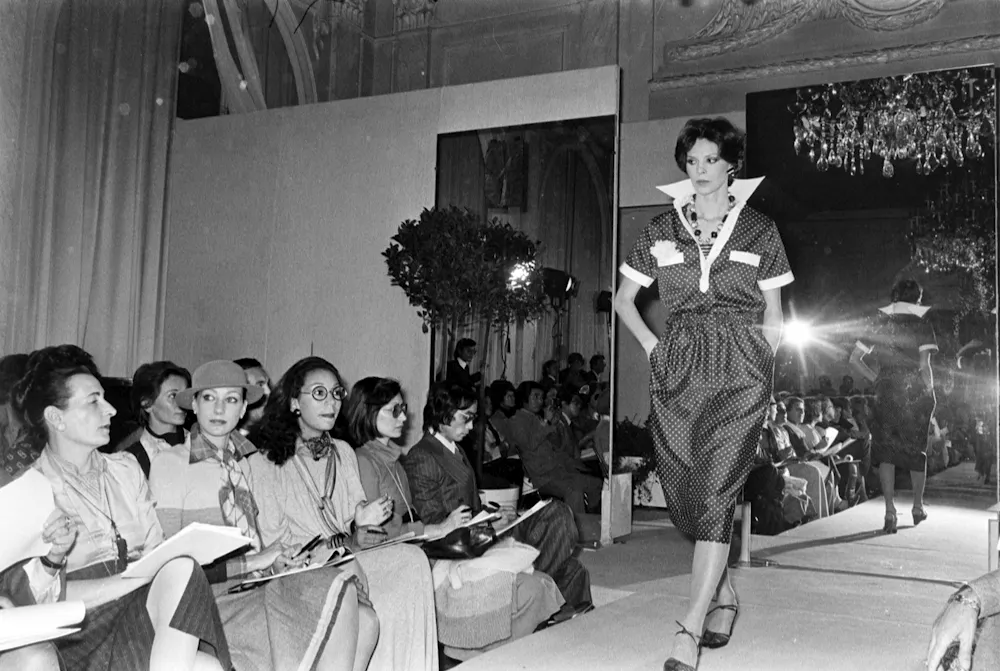
A model in the Valentino Spring 1976 ready to wear collection walks the runway in Paris in 1975.
Guy Marineau/WWD/Penske Media via Getty Images

While his design base was in Rome, many of his collections were shown in Paris over the next four decades. His Italian culture mixed with the technicality of Parisian haute couture made Valentino the designer he was.

Throughout his career, his designs often maintained a classic silhouette bust, matched with a bold Italian colour or texture.

Unlike some designers today, Valentino’s collections didn’t change too dramatically each season. Instead, they continued to maintain the craftsmanship and high couture standards.

Quintessentially beautiful” is often the description of Valentino’s work – however this devotion to high beauty standards has seen criticism of the industry. In 2007, Valentino defended the trend of very skinny women on runways, saying when “girls are skinny, the dresses are more attractive”.

Critics said his designs reinforce exclusion, gatekeeping fashion from those who don’t conform to traditional beauty standards.

The Valentino runways only recently have started to feature more average sized bodies and expand their definition of beauty.

The $300 million sale of Valentino

The Valentino fashion brand sold for US$300 million in 1998 to Holding di Partecipazioni Industriali, with Valentino still designing until his retirement in 2007.

Valentino sold to increase the size of his brand: he knew without the support of a larger corporation surviving alone would be impossible. Since Valentino’s retirement, the fashion house has continued under other creative directors.

Valentino will leave a lasting legacy as the Italian designer who managed to break through the noise of the French haute couture elite and make a name for himself.

The iconic Valentino red will forever be remembered for its glamour, and will live on with his legacy. A true Roman visionary with unmatched craftsmanship.

Jye Marshall does not work for, consult, own shares in or receive funding from any company or organisation that would benefit from this article, and has disclosed no relevant affiliations beyond their academic appointment.

ref. Valentino shaped the runway – and the red carpet – for 60 years – https://theconversation.com/valentino-shaped-the-runway-and-the-red-carpet-for-60-years-273891

Evening Report: https://eveningreport.nz/2026/01/20/valentino-shaped-the-runway-and-the-red-carpet-for-60-years-273891/

To sustain prosperity as its population shrinks, China will have to invest big at home

Source: The Conversation (Au and NZ) – By Yixiao Zhou, Associate Professor in Economics and Director of China Economy Program, Australian National University

China’s economy met the government’s official growth target in 2025, with official figures showing real gross domestic product (GDP) expanded by 5%.

Exports played an outsized role in delivering this headline growth. Despite a simmering trade war with the United States, China finished up the year with a record-breaking trade surplus of US$1.2 trillion as it lifted exports to new markets in the rest of the world.

Yet behind these headline figures, China’s economy continues to face some stubborn headwinds. Consumer spending remains subdued. Exports – while strong – face mounting global uncertainty. And government expenditure is constrained by public sector debt pressures.

Adding to this, China’s population continued to shrink for the fourth straight year in 2025 as the birth rate reached a record low, reinforcing concerns an ageing population will hold back the economy in coming years.

A shrinking population isn’t necessarily incompatible with rising living standards. What matters is whether productivity growth can compensate for a smaller workforce.

For China, that means domestic investment, rather than consumption or expansionary government spending, is likely to be the key mechanism for sustaining growth.

Problems at home

Recent data suggest China’s weak household consumption is not merely a temporary, post-pandemic phenomenon but instead reflects deeper structural factors.

While China’s GDP growth reached its annual target in 2025, retail sales grew by only 0.9% year-on-year in December, the slowest pace since late 2022.

This highlights the fragility of consumer demand, despite policy measures aimed at supporting spending.

Although the services sector continues to expand and accounts for more than half of GDP, household consumption as a share of the economy remains low by international standards.

High savings rates, lingering uncertainty linked to the property downturn, and concerns about job and income security continue to weigh on spending decisions.

This is consistent with long-running trends identified in academic research. Policies to stimulate consumption can boost spending in the short term, but they have not fundamentally altered households’ preferences to save rather than spend.

Strong exports

Manufacturing output remained resilient, and net exports contributed significantly to overall expansion. This helped offset weak domestic demand.

China’s exports to the US did fall in 2025. But a shift to new markets in Southeast Asia, South America, Europe and Africa more than offset this decline.

However, China’s reliance on net exports as a source of growth is vulnerable. While exports contributed unusually heavily to growth in 2025, this pattern may be difficult to repeat amid protectionist pressures and potential tariff escalations.


Read more:
Have US tariffs failed to bite? China’s trade surplus hits a record US$1.2 trillion


Constraints on government spending

In theory, government spending could step in to stabilise demand. Right now, that’s difficult in practice.

Local governments face high debt burdens, falling revenues from land sales and rising pressures related to social programs and maintaining infrastructure.

This limits their capacity for large-scale government spending without making financial risks worse.

Despite this, China continues to generate very high national savings. In 2024, China’s national savings reached 43.4% of GDP. Meanwhile, consumption as a share of GDP – the reverse side of the savings rate – remained around 20 percentage points below the global average.

Turning savings into investment

If a country’s savings are not absorbed domestically through productive investment, they end up fuelling a current account surplus. This can expose an economy to tensions with trading partners.

In 2025, investment in fixed assets (long-term investments such as buildings and equipment) fell 3.8%, with property investment plunging by about 17%.

This signals both the scale of the investment decline in the real estate sector and the need to pivot investment toward higher-returning sectors, such as manufacturing, services and technology.

In the long run, channelling China’s high national savings into efficient domestic investment could have greater impact than government stimulus measures. That’s as long as capital is allocated to productive firms and sectors rather than bridges to nowhere.

A shrinking population

China’s shrinking population adds a further important dimension to this challenge. Population contraction is not necessarily incompatible with rising living standards.

But it creates a need to boost productivity, through technological progress, innovation and upskilling the labour force.

Official statistics already show technology-intensive services and high-value manufacturing segments are expanding faster than the rest of the economy.

China’s 2025 growth outcome masks a set of enduring structural realities. Consumer spending is likely to remain subdued, exports face increasing global uncertainty, and fiscal policy is constrained by debt burdens.

The key policy challenge, therefore, is not to reverse demographic trends at any cost. It is to accelerate the transition toward a more productive, capital- and knowledge-intensive growth model.

Yixiao Zhou does not work for, consult, own shares in or receive funding from any company or organisation that would benefit from this article, and has disclosed no relevant affiliations beyond their academic appointment.

ref. To sustain prosperity as its population shrinks, China will have to invest big at home – https://theconversation.com/to-sustain-prosperity-as-its-population-shrinks-china-will-have-to-invest-big-at-home-273894

Evening Report: https://eveningreport.nz/2026/01/20/to-sustain-prosperity-as-its-population-shrinks-china-will-have-to-invest-big-at-home-273894/

Bull sharks are spending longer in Sydney Harbour and other summer grounds. Here’s how you can stay safe

Source: The Conversation (Au and NZ) – By Vic Camilieri-Asch, Postdoctoral Research Fellow, Queensland University of Technology

Four people have now been bitten by sharks in the last two days in New South Wales, including three in Sydney Harbour. Two people are in critical condition.

The shark species responsible isn’t yet known. But some of these incidents likely involved the highly adaptable bull shark (Carcharhinus leucas). This unique fish species can tolerate a wide range of water salinity, from oceans to brackish estuaries, and even freshwater rivers.

Bull sharks have long been found in warmer Australian waters, ranging from south-west Western Australia, all the way around the Top End and down the east coast as far as the New South Wales-Victorian border.

The movements of bull sharks in Sydney Harbour have been studied for several years. Their presence is more likely when waters are warmer over summer. But they’re staying longer than before. Last year, researchers found that bull sharks were spending on average an extra day per year in their summer grounds (shallower coastal waters, estuaries and rivers) as ocean temperatures rise due to climate change.

Record heavy rains in Sydney flushed plenty of nutrient-rich water from farms and wastewater treatment plants into the river system, including the harbour. This nutrient runoff attracts more prey such as baitfish and larger fish, and in turn larger predators such as sharks. Stormwater also makes harbour waters murkier, which means that bull sharks rely more on hearing and electroreception than sight to locate food sources. This can lead to bites due to mistaken identity.

Although human activity (noise and movements) in the water can attract sharks, humans are not a food source for bull sharks. Almost all encounters and negative interactions from these sharks come from an exploratory bite. Unfortunately for those affected, the bites can be very serious.

What could be behind these incidents?

Bull sharks are unique among sharks in that they can tolerate fresh, brackish and salt water. Most other shark species don’t use estuaries or rivers as part of their home range or lifecycle. This ability to tolerate and adapt to different salinity levels is one reason bull sharks are found in both coastal waters and river systems around the world, including estuaries.

Once mature, female bull sharks will return to their home rivers to give birth to live young. Newborns are small adult replicas. As they grow, juvenile and sub-adult bull sharks travel down river systems and tend to live in the lower estuaries for the first five years of their life to avoid larger predators. During that time, they opportunistically feed on a range of prey to get bigger before moving into the open ocean.

Bull sharks are very opportunistic feeders. Scientists have found an astonishing variety of things in bull shark stomachs, such as wood, metal and other inorganic matter, though fish are their prey of choice.

Estuaries and harbours tend to have murkier water than the open ocean, as rivers often carry plenty of sediment and nutrients. This means bull sharks have to rely on senses other than sight, such as sound, which travels well underwater, smell, as well as their close-range ability to sense weak electrical fields caused by the movements of living creatures. Many shark bites are likely due to the habit bull sharks have of opportunistically biting in case it might be food.

Over the last week, pulses of stormwater have made Sydney Harbour murkier and more nutrient-rich, attracting baitfish and the predators who follow them.

Bull sharks, like other sharks, learn patterns quickly. Many species of shark have learned to associate the specific sound made by fishing boat engines with food. When fish are hooked or trapped in a net, sharks may be able to get a free feed. Dolphins do the same thing.

How can people stay safe?

Authorities have shut down at least 20 beaches in Sydney’s Northern Beaches for 48 hours.

This is a good move, as it will give the murkiness some time to clear. But it may take longer than this to fully clear.

As shark experts, we would recommend going further:

  • avoid swimming in murky water wherever possible
  • avoid swimming in Sydney Harbour after heavy rain
  • avoid surfing at nearshore beaches until the dirty water clears
  • avoid swimming where people are fishing, especially where fish cleaning occurs
  • avoid swimming where baitfish are common, including where other marine predators such as dolphins are hunting
  • monitor local council and state fisheries websites for updates on staying shark smart this summer.

It’s important not to overstate the risks. Almost all the negative interactions reported in the Australian database of shark incidents come from exploratory bites, or incidental bites of people fishing or even feeding sharks.

Queenslanders have had to adapt to the year-round presence of bull sharks in their rivers and coastal waters for many years. People don’t swim in bull shark hotspots such as the Gold Coast canals or the Brisbane River. Authorities recommend avoiding swimming and surfing up to a few days after heavy rain.

As the oceans warm, bull sharks are likely to spend more time in Sydney Harbour as well as other NSW estuaries. Sydneysiders and NSW residents may have to adapt to their extended presence.


Read more:
4 shark bites in 48 hours: how what we do on land may shape shark behaviour


Vic Camilieri-Asch receives funding from various state, national and international government organisations and foundations, consults for industry councils via a small consultancy (Shark Ethology Australia)

Bonnie Holmes receives funding from state and local government organisations and foundations

ref. Bull sharks are spending longer in Sydney Harbour and other summer grounds. Here’s how you can stay safe – https://theconversation.com/bull-sharks-are-spending-longer-in-sydney-harbour-and-other-summer-grounds-heres-how-you-can-stay-safe-273897

Evening Report: https://eveningreport.nz/2026/01/20/bull-sharks-are-spending-longer-in-sydney-harbour-and-other-summer-grounds-heres-how-you-can-stay-safe-273897/

Should Australia join Trump’s ‘Board of Peace’? Here are 5 key points to consider

Source: The Conversation (Au and NZ) – By Amin Saikal, Emeritus Professor of Middle Eastern Studies, Australian National University; The University of Western Australia; Victoria University

US President Donald Trump has announced the formation of his “Board of Peace”, inaugurating the second phase of his 20-point peace plan for Gaza.

The board has already caused controversy. Moreover, the implementation of the second phase is set to be more complex and problematic than the first phase that forged a very shaky ceasefire between Israel and Hamas.

Australia has been invited to join the board. It has welcomed the advent of the board and second phase. But it has yet to state if it will accept the invitation. There are a number of issues for the Albanese government to consider here.

From the scant information available, the Board of Peace is to be chaired permanently by Trump, with a veto power. It is to be the ultimate decision-making authority in overseeing the application of the second phase.

Its initial members are largely made up of Trump loyalists, some of them well-known for their pro-Israel stance. In addition to Trump’s son-in-law Jared Kushner, US Secretary of State Marco Rubio and US Special Middle East Envoy Steve Witkoff, they include former British Prime Minister Tony Blair. It is not yet clear to what extent Israel has been consulted on the board or what its role will be.

Many Palestinians and their supporters distrust Blair for his “pro-Israeli” stance, which was evidenced when he headed the Quartet (comprised of the United States, Russia, the European Union and the United Nations). The Quartet was set up in 2002 to mediate the Israeli–Palestinian conflict, but was abandoned as ineffective in 2012. Blair is also widely criticised for his role in the 2003 US invasion of Iraq, which left the country in a mess.

No Palestinian is appointed to the board at this stage, but invitations to join the board have gone out to about 60 countries, with a reported membership fee of US$1 million (A$1.49 million) for three years and US$1 billion (A$1.49 billion) for a permanent seat.

The board’s charter outlines its pre-eminence in resolving conflicts, with no mention of Gaza or a two-state solution. This has led some critics to claim Trump envisions the body to function as an alternative to the UN Security Council, given his opposition to the UN and other international organisations.

The Palestinians were not consulted about the board, which appears to be a “colonial solution” imposed on the Palestinians, negating their right to self-determination.

Five critical issues need to be addressed in the second phase of the peace plan: stabilisation, governance, demilitarisation, Israeli withdrawal from Gaza, and reconstruction. Each one appears highly problematic to achieve.

1. Stabilisation. No international peacekeeping force has yet been established. Neither the size nor the composition of the force is finalised. Washington has been in discussions with several countries, but none has fully committed and received Israel’s approval.

Israel has already objected to the participation of two Muslim countries, Turkey and Pakistan. The only Muslim state that has indicated a commitment is Indonesia. One of the significant tasks of the force is to create security and train a Palestinian police force for maintaining civil order.

2. Governance. In the realm of governance, a 15-member technocratic committee for administration of Gaza has been designated, with the former deputy minister of reconstruction and development of the Palestinian Authority, Ali Sha’ath, named as its head. Sha’ath is a trained civil engineer and well-experienced for the job. But the committee has not been fully formed, although some Gazan figures, who are not linked to Hamas, have been approached.

3. Demilitarisation. Demilitarising Gaza and Israeli withdrawal will be the most contentious items. Under the plan, Hamas is obliged to totally disarm, but the group has always said it would do so when an independent Palestinian state comes into existence. Yet the US and Israel want Hamas removed immediately from the scene.

In fact, the peace plan makes no mention of a “two-state solution” or linkage between Gaza, the West Bank and East Jerusalem, which the Palestinians aspire to have as their future independent state. And Trump has said if Hamas refuses to disarm, there will be “hell to pay”.

4. Israeli withdrawal. Similarly, a thick cloud shrouds Israel’s position on total withdrawal from Gaza. Prime Minister Benjamin Netanyahu has never explicitly committed himself to a pullout. He has stressed Israel’s security and the need for its control of Gaza.

The Israel Defence Forces (IDF) still occupies 53–58% of the Strip, and since the start of the ceasefire, it has gained more territory beyond the designated yellow line, in repeated violations of the ceasefire. In the process, more than 450 Palestinians have been killed. Israel has blamed Hamas for killing three of its soldiers and for ceasefire breaches. It has also accused Hamas of deliberately delaying the return of the last hostage’s body, though it may be buried under rubble and might never be found.

5.Reconstruction. With Israel having dropped about 85,000 tons of bombs, destroying about 80% of Gaza, the task and cost of rebuilding the Strip will be gigantic.

An estimated US$70 billion (A$104.25 billion) is required, and as yet no country, including the oil-rich Arab states, has volunteered to make a substantial contribution. In the past, Trump has floated the idea of turning Gaza into a Middle East Riviera. Kushner, who is a favoured investor in the area and closely allied with some of the oil-rich Arab states, Saudi Arabia in particular, has mentioned the private sector could shoulder the heavy burden in this respect. However, nothing as yet is on the table.

Meanwhile, the two million displaced Gazans are in desperate need of food, shelter and health care, with more than one-third living in conditions of famine. The latest storms and floods have worsened their living conditions. Israel has not opened the Rafah crossing with Egypt, and has banned all humanitarian organisations that could ease the situation, including most importantly, the United Nations Relief and Works Agency. The Gazans’ desperation is beyond description.

Having said all this, the fate of the peace plan is very much in the hands of the all-powerful Trump. The president has a lot of leverage over Netanyahu and Israel, given all the help he has provided to ensure their survival. He is also in a position to lean heavily on Hamas and the three mediators – Egypt, Qatar and Turkey – to ensure the success of the plan.

But whether he will do this or allow Netanyahu, whom he has praised as a “war leader” without whom Israel would not “exist”, to sink the plan in pursuit of realising his ambition of “Greater Israel”, is an open question.

Amin Saikal does not work for, consult, own shares in or receive funding from any company or organisation that would benefit from this article, and has disclosed no relevant affiliations beyond their academic appointment.

ref. Should Australia join Trump’s ‘Board of Peace’? Here are 5 key points to consider – https://theconversation.com/should-australia-join-trumps-board-of-peace-here-are-5-key-points-to-consider-273794

Evening Report: https://eveningreport.nz/2026/01/20/should-australia-join-trumps-board-of-peace-here-are-5-key-points-to-consider-273794/