A rift within French Polynesia’s ruling party Tavini Huiraatira deepened during Easter weekend with a mass resignation from a group of 14 members.
The resignation was tendered by a group of young members of the local Territorial Assembly.
In their resignation letter, the members of the local parliament, writing to Tavini’s historic 81-year-old leader Oscar Temaru, insist that their decision was “carefully considered” and “does not question the respect we have [towards Temaru].”
The mass resignation reduces Tavini’s majority to 22 within the Territorial Assembly (out of a total of 57 MPs).
This also means Tavini no longer has an absolute majority within the House.
The Assembly is scheduled to convene at its next sitting this week on 9 April 2026.
Crucial Assembly meeting on Thursday Any motion of no confidence requires the approval of at least 35 MPs.
The other components of the Assembly include 16 from the opposition pro-France (autonomists) and 5 others who are independents.
The 14 resigning MPs belong to a group of “moderate” members of the Tavini, who were mostly elected at French Polynesia’s last territorial elections in May 2023.
Tensions have since surfaced between the newly-elected members of the “new generation” and the founding members of the Tavini, including party president Oscar Temaru and the party’s number two, Antony Géros (who is also the Speaker of the Territorial Assembly).
At the recently-held municipal elections, Géros lost his position of Mayor of the small city of Paea and in the capital city of Pape’ete, pro-autonomy figure Rémy Brillant won — well ahead of two pro-independence figures, Tavini-backed Tauhiti Nena (who secured 11.03 percent of the votes) and 25-year-old Tematai Le Gayic, 25 (who scored much better with 23.3 percent).
In the wake of the municipal elections, Le Gayic was the first to signal the split with his party.
The next territorial elections are scheduled to be held in 2028.
The group of dissident MPs is perceived as close to Brotherson, 56, who became French Polynesia’s President in May 2023.
Géros was not chosen at the time.
Less confrontational approach Brotherson has since embodied a less confrontational approach, especially with regards to his perceived good relationship with the French government, as opposed to a more confrontational approach from his party’s historic leadership.
Among the most often cited causes of the rift between Tavini’s old guard and the younger group of MPs are such issues as French Polynesia’s undersea mineral resources exploitation (which Temaru favours, as a key to the French Pacific territory’s independence).
French Polynesia’s Territorial Assembly in session . . . Image: Assemblée de la Polynésie française/RNZ Pacific
The younger Tavini MPs, as well as French Polynesia’s Tavini President Moetai Brotherson (who is also Temaru’s son-in-law), are opposed to this exploitation of resources.
This anti-deep sea mining exploitation is also the official stance of the French government, which is warning of potential environmental damage from such operations.
Brotherson’s general stance over independence is also more nuanced and contrasts with the party’s support for a short timeline and process.
Since the resignation, Tavini has held several “emergency” meetings in a bid to reconcile the two opposing factions.
But none of those have been conclusive.
Some of the views expressed by militants support a resignation from Brotherson, which he is opposed to.
Others recommend a one-on-one meeting between Temaru and Brotherson to try and iron out their differences.
“If nothing comes out of this meeting, then Tavini Huiraatira will take action on April 9,” the party wrote on social networks at the weekend.
“If we start entertaining diverging views of the party’s objectives, we’re in trouble”, an irate Géros told local media.
Biblical references Temaru and his son-in-law have separately commented on the Easter weekend crisis.
On Good Friday, they both used biblical, religious metaphors and direct references to Easter.
“Forgive them, for they know not what they are doing” said Temaru, quoting crucified Jesus Christ during his Easter martyrdom.
But he also admitted there were “reasons to be worried”.
Meanwhile, Brotherson posted on social networks: “While some are meeting in tribunal mode, on this Good Friday, I prefer to leave it to God.”
This article is republished under a community partnership agreement with RNZ.
Reports from West Papua say as many as five people have been shot dead in Dogiyai regency in an alleged retaliatory attack after a policeman was killed.
A joint police and military operation was launched in the regency in Indonesia’s Central Papua province to respond to the killing, by apparent stabbing, of a police officer — a Papuan — in Kamu District’s Moanemani town on Tuesday.
According to Papuan news media outlet Suara Papua and the Human Rights Monitor group, security forces are alleged to have indiscriminately opened fire in a series of villages in Moanemani.
The Papua-based human rights and peace NGO Solidaritas Rakyat Papua, cited by Suara Papua, reported that four Papuan civilians including a 12-year-old boy, were shot dead by the security forces, and another four were injured, adding that one police officer was earlier killed and another injured.
However, Human Rights Monitor reported that at least six Papuans were shot dead in the alleged retaliatory operation, while at least two others sustained gunshot injuries.
The Indonesian Embassy in New Zealand confirmed the officer’s death, attributing it to an “armed criminal group”, the government’s label for West Papuan independence fighters.
But it said it was not yet able to confirm further casualties as the incident was still being investigated.
The United Liberation Movement for West Papua (ULMWP) statement claimed on Thursday that at least five Papuans had been killed in the unrest in Dogiyai. The dead Papuans were named in the statement.
The embassy accuses the ULMWP of often claiming its members as civilian casualties.
Human Rights Monitor said the violent crackdowns occurred amid escalating tensions and heavy deployment of security forces across Dogiyai Regency in the past month.
This article is republished under a community partnership agreement with RNZ.
ER Report: Here is a summary of significant articles published on EveningReport.nz on April 6, 2026.
Richard David Hames: When will we make war untenable for the power elites? COMMENTARY: By Richard David Hames An Easter message. There’s no mystery about why wars start. They happen because someone, somewhere, decides that negotiation is more dangerous to them than to the people being bombed. Look at what was happening this “Good” Friday. Iran. Gaza. The West Bank. Lebanon. Thirty-six days of missiles and a Strait
The unseen challenges of life on the Moon Source: The Conversation (Au and NZ) – By Damian Bailey, Professor of Physiology and Biochemistry, University of South Wales For the first time since the Apollo era, humans are preparing not just to visit the Moon, but to live and work there for weeks, months – and eventually years. But what would it really be
Silence: a brief literary history Source: The Conversation (Au and NZ) – By Kate McLoughlin, Professor of English Literature, University of Oxford Literature expresses complex and nuanced ideas – the powerful feelings that define us as human beings and the detailed observations that illuminate all aspects of our lives. It does so with words put together with consummate skill. So,
How medieval chess created a space in which players – regardless of race – could engage as equals Source: The Conversation (Au and NZ) – By Krisztina Ilko, Junior Research Fellow, Queens’ College and Affiliated Lecturer at the Faculty of History, University of Cambridge In the medieval European imagination, racial difference was often highly polarised. Black people were perceived either as exotic status symbols – including saints and wealthy rulers such as the
Despairing at the state of the world? The ancient Greeks and Romans knew the feeling Source: The Conversation (Au and NZ) – By Konstantine Panegyres, Lecturer in Classics and Ancient History, The University of Western Australia If you’re feeling fed up with the way things are in the world, then, no matter your politics, you are experiencing an emotion people have felt for millennia. Perhaps you feel helpless. Maybe you
Lebanon’s political elites are using displacement and humanitarian crisis to delay elections again Source: The Conversation (Au and NZ) – By Jasmin Lilian Diab, Assistant Professor of Migration Studies; Director of the Institute for Migration Studies, Lebanese American University Lebanon was meant to be preparing for key parliamentary elections in May 2026. Then came the return of war. Two days after the U.S. and Israel launched their military
Israel isn’t just responding to threats – it’s reshaping the Middle East Source: The Conversation (Au and NZ) – By Spyros A. Sofos, Assistant Professor in Global Humanities, Simon Fraser University Discussions about Israel’s role in the Middle East still revolve around threats and responses. Yet recent developments suggest that Israel isn’t only reacting to events, but is increasingly shaping the conditions in which they occur. This
Bypass the Strait of Hormuz with nuclear explosives? The US studied that in Panama and Colombia in the 1960s Source: The Conversation (Au and NZ) – By Christine Keiner, Chair of the Department of Science, Technology, and Society, Rochester Institute of Technology With the world struggling to get oil supplies moving from the Middle East, former House Speaker Newt Gingrich raised eyebrows with a social media post highlighting a radical idea: Use nuclear bombs
When is the best time to get your flu shot? 2 infectious diseases experts explain Source: The Conversation (Au and NZ) – By Meru Sheel, Professor of Infectious Diseases and Global Health, University of Sydney We usually have to wait until winter approaches before we see an increase in cases of influenza, or the flu. But we have already seen a lot of flu this year, with 25,000 cases reported
Trump welcomes Columbus to the White House – and reignites America’s history wars Source: The Conversation (Au and NZ) – By Garritt C. Van Dyk, Senior Lecturer in History, University of Waikato Christopher Columbus is back. At least, a statue of him is back, reinstalled by US President Donald Trump on the White House grounds in late March – part of the president’s stated mission to cancel “cancel
How will the Iran war change the Middle East? We asked 5 experts Source: The Conversation (Au and NZ) – By Scott Lucas, Professor of International Politics, Clinton Institute, University College Dublin On February 28, the US and Israel launched a war against Iran following weeks of US military build-up in the region and threats from US President Donald Trump. In the ensuing weeks, Iran has retaliated by
The sound of our cities: why the Australian pedestrian button belongs in our archives Source: The Conversation (Au and NZ) – By Miles Park, Honorary Senior Lecturer, Industrial Design, UNSW Sydney The PB/5 pedestrian crossing button is an immediately identifiable product in our physical and aural urban landscape. Now inducted into the National Film Sound Archive of Australia’s 2026 Sounds of Australia, it is one of very few physical
Want a dog-friendly workplace? Here’s what you’ll need to get right Source: The Conversation (Au and NZ) – By Giuseppe Carabetta, Associate Professor of Workplace and Business Law, UTS Business School, University of Technology Sydney Dogs are increasingly appearing in Australian workplaces. From “take your dog to work” days to permanent pet-friendly offices, the trend is often framed as an easy win for staff morale. Evidence
How one local council helped 1,200 low-income residents finance solar and home energy upgrades Source: The Conversation (Au and NZ) – By Paris Hadfield, Research Fellow, Monash Sustainable Development Institute, Monash University Most of Australia’s existing homes are old, uncomfortable, and expensive to run. Too many are energy inefficient, and rising electricity and gas prices are making things worse. Mainstream programs are supporting home energy upgrades. But the transition
Farmers are boosting their profits and production – with nature’s help Source: The Conversation (Au and NZ) – By Jim Radford, Associate Professor, Ecology and Environment, La Trobe University Farming is a vital industry, contributing an estimated A$100 billion to the Australian economy this year alone. Nearly 60% of Australia is used for agriculture. The lion’s share of that land is used to graze livestock, such
Choosing a school holiday program can be tricky. Here’s how to identify a good one Source: The Conversation (Au and NZ) – By Alyssa Milton, Associate Professor, Principal Research Fellow, Faculty of Medicine and Health, University of Sydney When the bell rings at the end of each term, there is a happy buzz as kids leave school for the break. But for many parents, the start of the holidays brings
Pope’s message for peace: ‘The Church cannot remain silent when power is used without moral responsibility’ Asia Pacific Report As tensions rose ahead of Easter, US President Donald Trump publicly criticised Pope Leo XIV, accusing the pontiff of “interfering in political matters he does not fully understand”. During a rally, Trump reportedly said: “The Vatican should focus on religion, not tell strong nations how they should defend themselves. America will always
Eugene Doyle: Who will pay billions in reparations to Iran? We will COMMENTARY: By Eugene Doyle In the coming years, if Iran survives as a sovereign state and retains control over the Strait of Hormuz, countries like Australia, New Zealand, the UK, South Korea and Japan will be made to pay hundreds of billions of dollars in reparations for the US-Israeli war on Iran. For this to
An Easter message. There’s no mystery about why wars start. They happen because someone, somewhere, decides that negotiation is more dangerous to them than to the people being bombed.
Look at what was happening this “Good” Friday. Iran. Gaza. The West Bank. Lebanon.
Thirty-six days of missiles and a Strait of Hormuz sealed shut while oil companies post record profits and defence contractors book forward orders through 2031. No one in those boardrooms is losing sleep over a negotiated settlement.
That would be the one outcome they cannot monetise.
The choice of war over negotiation is always deliberate. It’s what happens when the institutions built to make negotiation workable — the United Nations, the International Criminal Court, and the mechanisms of international law — are systematically defunded, vetoed into paralysis, or simply disregarded by those states powerful enough to ignore them without consequence.
When accountability is optional, war is always cheaper than compromise. For the people making the decision, not for the people paying for it in blood.
And here is what makes this moment different from others: we’re not even pretending anymore. Israeli ministers speak of erasure openly. American officials wave away civilian casualties with the language of collateral necessity.
Actions become shameless The international community issues statements of concern and then approves the next arms shipment. The gap between what is said and what is done has closed — not because the words have become honest, but because the actions have become shameless.
Negotiation requires recognising the humanity of the other party. That’s precisely why it’s rebuffed. You can’t negotiate with someone you have spent 20 years or more dehumanising. Make them monstrous enough and war stops requiring justification. It becomes necessary.
But nothing about this is inevitable. Wars end when the people with the power to end them decide the cost of continuing exceeds the cost of stopping.
That calculation is being made right now, every day, by people who are not dying. The question is not when they will choose peace. It’s when the rest of us will make their continuing refusal untenable.
Richard David Hames is an Australian philosopher-activist, strategic adviser, entrepreneur and futurist, and he publishes The Hames Report on Substack. This article is republished with the author’s permission.
Source: The Conversation (Au and NZ) – By Krisztina Ilko, Junior Research Fellow, Queens’ College and Affiliated Lecturer at the Faculty of History, University of Cambridge
In the medieval European imagination, racial difference was often highly polarised. Black people were perceived either as exotic status symbols – including saints and wealthy rulers such as the Queen of Sheba – or as subjugated figures, considered inferior to white Christians.
Yet, as my research demonstrates, the game of chess offered an alternative lens, creating a space in which players – regardless of their skin colour – could engage as equals.
Evidence from the Libro de Axedrez, Dados e Tablas (Book of Chess, Dice and Tables), a gaming manual completed for King Alfonso the Wise in Seville in 1283, reinforced my idea. The manuscript contains 103 chess problems, each of which is accompanied by text revealing the winner and an image. These illustrations show a wide array of figures, ranging from Jewish men to Muslim women. They include Asian, white and Black players.
One of its most striking illustrations shows a Black and a pale-skinned player facing each other across a chessboard. The latter has a shaved head, showing that he is a learned cleric. Yet, despite this signifier of intelligence, the text reveals that the Black player will win. In the “game of logic”, the triumph will be achieved by demonstrating superior strategic skills. The player’s mental prowess matters above all. As the Libro de Axedrez reasons, chess is an embodiment of wisdom, and those who study it become able to conquer others.
Another image in the manuscript shows five Black people framing the chessboard. In western medieval visual culture, scenes with only Black figures are rare and typically have negative connotations. However, this particular image envisions them in a highly intellectualised setting and in a seemingly amicable atmosphere.
Libro de Axedrez
While chess did not eradicate the dominant social norms when it came to race, it did empower players to challenge them within its own ludic realm.
The representation of chess as an encounter between people of different skin colour was not limited to Europe. The Shahnama, an epic poem narrating the history of the Iranians from creation to the Islamic conquest, recounts the game’s introduction to Iran.
According to the Shahnama, an unnamed Indian king sent an embassy to the Sassanian king with a chessboard accompanied by a challenge: figure out the rules or pay tribute. Fortunately, the king’s advisor, Būzurjmihr, succeeded. A 14th-century copy of the epic places this scene in a late medieval Mongol setting. Here, the paler Būzurjmihr is contrasted by the Indian envoy’s darker skin colour.
It has been argued by scholars that the latter’s dark skin and “baggy clothes” were meant to underscore his defeat. However, I believe some clues suggest otherwise. His “baggy” tunic is sumptuously adorned with gilding, in contrast to the simple blue robe of Būzurjmihr, despite him being the highest-ranking diplomat of the court. His darker skin certainly reflects his foreign origins but hardly makes him a negative character. He is, in fact, a champion of the Indian rajah, who transmits the game of logic and is presented as a guardian of much-coveted Indian knowledge.
The chess pieces themselves
In addition to representations of chess contests, medieval perceptions of race can also be studied via chess through investigating the playing pieces.
Chess spread across Afro-Eurasia from sixth-century India to the rest of the known world. Chess is a game of war, and the figures are meant to represent soldiers. Yet, as the game travelled, the form of the figures kept changing, reflecting the societies that produced them.
For example, a long-haired chess king made in Mansura or Multan (modern-day Pakistan) in the ninth or tenth century reflects ideals of Indian kingship. The famous Lewis Chessmen meanwhile, discovered in Scotland’s Outer Hebrides but probably carved in Norway, are often perceived as the most emblematic representatives of a medieval chess set. Yet, in this light, they are only a relatively late and geographically peripheral testimony of a longstanding tradition.
Medieval chess was not as black and white as the modern game. Some chessboards were white and red, or blue and gold. Nonetheless, the chequered squares, and the figures themselves, were differentiated through contrasting colouring. This allowed people to project ideas of skin colour and racial perceptions onto the game.
A 13th-century poem describes how chess pieces “are the people of this world, who are drawn out of one bag, like a mother’s womb, and are positioned in various places of this world”. Therefore the pieces could become representations of the different peoples of the globe. But the outcome of their encounters on the board was still decided by the rules of logic, not their skin colour. In this way chess embodied a “just world”, in which intellect, instead of religion or race, mattered the most.
Literature expresses complex and nuanced ideas – the powerful feelings that define us as human beings and the detailed observations that illuminate all aspects of our lives. It does so with words put together with consummate skill.
So, surely silence is a nothingness, an affront to the communication of both rational argument and strong emotion – literature’s opposite, even its anathema?
Well, no. In my new book Silence: A Literary History, I’ve set out to show that, over 1,200 years, English literature has spoken to us – and spoken to us eloquently – through silences as well as through words. Without silences, both formal and thematic, we wouldn’t have the exquisite hush of medieval lullabies, the suspenseful secrets of the realist novel, or the jagged fragmentation of modernist poetry.
We would lose implicitness, a good deal of ambiguity, much precision, a powerful mode of protest and a variety of moods. Iago would explain exactly why he wanted to destroy Othello in Shakespeare’s play. The dog would bark in the night time in The Hound of the Baskervilles, by Arthur Conan Doyle. And D.H. Lawrence’s sex scenes would come with a running commentary.
The start of silence
If silence has a starting point in English literary history, it’s a man at sea. The 9th-century poem The Wanderer, composed in the Old English language of the Anglo-Saxons, communicates the sheer strangeness of silence via an alien grey seascape in which the protagonist is utterly alone.
This silence is composed not of complete noiselessness – the hail beats on the waves and a seabird occasionally mews – but of an intense and total absence of human voices.
[embedded content]
A reading of The Wanderer.
The poem conveys the difficulty of this silence – its wretched, aching loneliness and its perpetual reminder of lost happiness. But it also portrays silence as a duty, the mark of a seasoned warrior forged by Graeco-Roman stoicism, the Germanic hero ethos and Christian asceticism.
And it confronts readers, here at the very beginnings of English literature, with a silent inner voice: the necessary basis of an interior life.
Scroll on 1,200 years. En route, we will take in the tongue-tied silences of Renaissance love poetry, the green silences of 18th-century pastoral scenes and the dumbfounded wonder of the romantic sublime.
We will pause, awestruck, at Tennyson’s great epic of speechless grief, In Memoriam. We will relish the social silences of the Victorian novel, from the hilariously awkward to the emotionally profound.
The fascism-bordering silences of Modernism will make us shiver, before we ponder 20th-century experiments with visual, acoustic and dramatic silences. And we will arrive at the genre-defying, multimedia poetry collection that is Jay Bernard’s Surge (2019).
Voices that we cannot hear
In 2016, Bernard took up a residency at the George Padmore Institute in London, an archive dedicated to radical Black history in Britain. The New Cross fire, which in 1981 had killed 13 young Black people, was playing on their mind. And then on June 14 2017, as Bernard puts it: “Grenfell happened”.
Bernard was sickened by the similarities: “The lack of closure, the lack of responsibility and the lack of accountability” at the centre of both conflagrations.
Surge’s response takes its title from a remark by the Black activist Darcus Howe, one of the organisers of the Black People’s Day of Action in 1981: “When you surge and you don’t deal with the question, barbarism expresses itself.”
[embedded content]
Jay Bernard talks about their work.
Speaking over the barbarism, Surge registers a gamut of other silences as it winds between the New Cross and Grenfell fires, and historic and ongoing injustices to Black people.
There is the “muffling” of the New Cross fire by the police, and the details that were literally “tippex’d out” of the file. The silence of the media cannot dispel the weighty silences of the ghostly dead. Then there are the silences that surround transness: hiddenness, rejection and defiance of conventional categories.
With this last issue, we can scroll back up the centuries again. The 13th-century romance Silence, written in Old French by a Cornishman, Heldris de Cornualle, relates the legend of a girl-child being brought up as a boy called Silence because women are forbidden to inherit their parents’ estates. This causes a furious argument between the characters of Nature and Nurture, which anticipates our own age’s differences over transness by eight centuries.
“They have insulted me,” complains Nature, “by acting as if the work of Nurture / were superior to mine!”
But Reason, on behalf of Nurture, urges Silence to resist Nature’s blandishments, or “you will never train for knighthood afterwards. / You will lose your horse and chariot.”
Nature is the winner in the story, but the poem is able to accommodate Silence as both male and female – effortlessly embracing apparent contradictions in such lines as “he was a girl”.
Woman Reading in the Reeds, Saint-Jacut-de-la-mer by Édouard Vuillard (1909).The Fitzwilliam Museum
I believe noticing silences in literature makes us better readers. We come to recognise that some things are better left unsaid – indeed, that some things can’t be said. As a result, our antennae become attuned to literature’s stock-in-trade: the indirect and the inexplicit.
Importantly, we become aware of who hasn’t spoken. All this means we gain a better understanding of what communication is, and how we interact with other people. As our reading acquires a new, slower tempo and a new rhythm, our interpretations change.
What can silences speak to us about? Some of the profoundest aspects of our existence: our understanding of what makes a self; our sense of sacredness; our most powerful and intimate feelings; our place in the natural world; our capacity for wonder. All we have to do is notice.
The excerpt from Silence: A Thirteenth-Century French Romance was translated by Sarah Roche-Mahdi. This article features references to books that have been included for editorial reasons, and may contain links to bookshop.org. If you click on one of the links and go on to buy something from bookshop.org The Conversation UK may earn a commission.
For the first time since the Apollo era, humans are preparing not just to visit the Moon, but to live and work there for weeks, months – and eventually years.
But what would it really be like to spend an extended period on the lunar surface? The answer is exhilarating – and brutally unforgiving. An exciting new era of deep-space exploration is opening up. The US Artemis programme aims to set up an outpost on the Moon’s surface. It marks a fundamental shift in how we explore space.
Rather than just leaving “flags and footprints” as the Apollo missions did, Nasa wants to establish a sustained human presence on the Moon, beginning at the lunar South Pole.
The programme unfolds in stages. In 2022, the Artemis I mission successfully tested the Space Launch System (SLS) rocket and Orion spacecraft as an integrated system on an uncrewed mission around the Moon.
On April 1, 2026, Nasa launched Artemis II a ten-day mission, carrying four astronauts around the Moon.
The four Artemis II astronauts arrived at Kennedy Space Center in Florida on March 27, 2026 to begin final preparations for launch.NASA/Jim Ross
As Nasa’s first crewed flight of Orion and SLS, Artemis II is a pivotal mission designed to verify that life-support systems, navigation, thermal protection and deep-space operations all function safely with humans onboard.
Before astronauts can live on the Moon, the journey there must be proven reliable.
Beyond these early missions, Nasa’s long-term vision extends far beyond a single landing. Nasa plans to spend US$20 billion (£15 billion) on a lunar surface base, intended to support repeated and progressively longer surface stays. This is designed to teach us how to operate sustainably beyond Earth – knowledge that will ultimately feed forward to future human missions to Mars, the horizon goal.
Health challenges
Living on the Moon will challenge every organ system in the human body. The lunar environment exposes astronauts to a unique space exposome – the combined set of physical, chemical, biological and psychological stressors encountered beyond Earth.
Regular exercise will be critical for staying healthy on the Moon. Here, Japanese astronaut Satoshi Furukawa works out on the International Space Station.Nasa
These include reduced gravity (about one-sixth of Earth’s), chronic exposure to cosmic radiation, extreme temperature swings, toxic lunar dust, isolation, disrupted sleep-wake cycles, and prolonged confinement.
Unlike astronauts in low-Earth orbit, lunar crews operate largely outside Earth’s protective magnetic field. This increases exposure to space radiation, which can damage DNA, disrupt immune function and affect the brain and cardiovascular system in subtle but potentially serious ways.
Reduced gravity also fundamentally alters how blood, oxygen and fluids move around the body. Microgravity can disrupt how blood, oxygen and glucose are delivered to the brain, potentially increasing vulnerability to neurological and vascular dysfunction over time.
To properly understand these risks, we need to look beyond individual organs and instead consider the space integrome – the way that the brain, heart, blood vessels, muscles, bones, immune system and metabolism interact as an integrated whole under space conditions. A small disturbance in one system sends ripples through others.
One of the most challenging aspects is that many space-related physiological changes develop insiduously. Astronauts may feel well while complications simmer beneath the surface, only becoming apparent months or even years later.
That is why Nasa places such emphasis on long-term physiological monitoring and human risk mitigation in its Artemis science strategy.
The encouraging news is that humans are remarkably adaptable. The challenge is guiding that adaptation in safe and sustainable ways. Space countermeasures are the tools used to reduce risk and preserve astronaut health.
Exercise remains the cornerstone. On the International Space Station, astronauts spend around two hours per day exercising to protect muscle mass, bone density and cardiovascular function. On the Moon, however, exercise systems must be redesigned for partial gravity, where familiar Earth-based loading no longer applies.
Lunar regolith (soil) could be used to create structures that protect habitats from radiation and micrometeoroids.Foster + Partners
Nutrition is another powerful countermeasure. Diet influences bone health, muscle maintenance, immune resilience and even how the body responds to radiation.
Personalised nutrition strategies, tailored to individual physiology rather than a “one-size-fits-all” menu, are likely to become increasingly important during long lunar missions.
Artificial gravity is also being explored. Short-radius centrifuges could expose astronauts to brief periods of increased gravitational loading, potentially helping stabilise cardiovascular and neurovascular systems. While still experimental, this approach may prove valuable for future surface missions.
Vegetables grown in a lunar base greenhouse could enhance astronaut nutrition.Nasa
Radiation protection will rely on multiple layers of defence: habitat shielding – potentially using structures made of lunar soil – early warning systems for solar storms, and operational strategies that limit exposure during high-risk periods.
Crucially, countermeasures should be proactive rather than reactive. Continuous physiological monitoring, wearable sensors and advanced data analytics may allow mission teams to detect early warning signs and intervene before small problems become mission-limiting ones.
Spending extended time on the Moon will be awe-inspiring. Imagine watching Earth hang motionless above a stark, silent horizon, or working under a sky that never turns blue.
But it will also be demanding, uncomfortable and unforgiving. The Moon is not just a destination – it is a test of our biology.
If we can learn how to keep humans healthy, resilient and productive on the lunar surface, we take a decisive step toward becoming a truly spacefaring species. Artemis shows that exploration is no longer about brief heroics.
It is about sustainability, adaptability and understanding ourselves as deeply as the worlds we seek to explore.
In learning how to live on the Moon, we may ultimately learn as much about life on Earth as we do about our future beyond it.
Animal life is extraordinarily diverse and complex, having colonised almost all environments on Earth – from hostile hydrothermal vents in the deep sea to the skies across our continents.
But the planet was not always teeming with complex animal life. For the first 3.7 billion years after it originated, life was small, simple and largely confined to the oceans. This microbe-dominated world was a tumultuous place, with several major swings in its climate.
But all this appears to have changed about 538 million years ago (mya) during the Cambrian period. This critical juncture in the history of life saw animals bursting on to the scene in an event known as the “Cambrian explosion”.
All sorts of animals easily recognisable as groups alive today appeared in the fossil record, from echinoderms (starfish, sea cucumbers, urchins) and arthropods (spiders, crustaceans, insects) to various types of worm. This seemingly abrupt appearance of animals in a geological “blink of an eye” has puzzled scientists from Charles Darwin onwards.
Many of these new lifeforms belonged to a group of animals called Bilateria, so-named for their symmetrical left and right sides. This group now contains all animals with brains and complex musculature.
However, a longstanding question for palaeontologists has been whether this astonishing diversification event happened all at once during the Cambrian explosion – or if ancestors of Cambrian and modern animal groups can be traced further back in time. Our new study, published in the journal Science, could help to resolve this question.
Strange bodies
The preceding Ediacaran period (635-538 mya) was much more enigmatic than the Cambrian. Many organisms from that period have defied efforts to classify them. Their strange bodies – often resembling shapeless sacs or thin, quilted pillows – have no obvious counterparts among living species, let alone modern animals.
As a result, interpretations of Ediacaran creatures have encompassed almost all multicellular forms of life – from fungi and lichens to an extinct kingdom unrelated to anything multicellular alive today. These Ediacaran organisms lived in close association with mats of microbes that smothered the seafloor – a type of ecosystem that did not survive the advent of grazing bilaterians.
More recent evidence relating to their reproductive strategy and how they grew and developed has suggested they were, in fact, animals – albeit very simple ones without any direct, living descendents.
This fossil (plus artist’s reconstruction), found in the Jiangchuan biota (~554-539mya), is an early cnidarian: the phylum that includes jellyfish, sea anemones and corals. Scale bar: 2mm.Gaorong Li and Xiaodong Wang., CC BY-SA
It isn’t until the very end of the Ediacaran period that the fossil record gives hints that more complex – and recognisable – animals were around. And most of the evidence for these bilaterian animals has come from fossilised burrows and trails, suggestive of complex animal life but telling us little about the animals that made them.
This has led to much debate about the nature of the transition from the Ediacaran to the Cambrian period – the start of which geologists have defined by the action of complex animals churning up ocean sediment for the first time.
A discovery to fill the fuzzy gap
In spring 2023, one of us, Gaorong Li – then a PhD student at Yunnan Key Laboratory for Palaeobiology (YKLP) – made a discovery that helps to clarify this fuzzy gap between the weird Ediacaran world and the recognisable, complex animal-dominated Cambrian period.
Along with my PhD supervisors Wei Fan and Peiyun Cong, we explored Ediacaran rocks in the Chinese region of Eastern Yunnan. We were principally looking for fossil algae (seaweeds), the focus of my PhD thesis, in rocks known for well-preserved fossils called the Jiangchuan biota.
What we found in addition was a bizarre worm that lived tethered to the seafloor by an anchoring disc, and which could turn its strange proboscis inside out to collect food. These specimens were clearly complex animals, but not as they are known today.
We nicknamed it the “bugle worm”, and our team are still figuring out exactly where this strange beast fits into the classification of animals. Previously, it had been described based only on the disc anchoring it to the seafloor and named Cycliomedusa – but we found the whole organism, revealing it as something unexpected and strange.
As we continued splitting more and more rocks, it became clear there were more animals hiding in the Jiangchuan biota. In 2024 – now joined by a team from the University of Oxford including the co-authors of this article, Luke and Frankie – we went back into the field and pieced together this new fossil community.
We found some fossilised organisms characteristic of both the Ediacaran and Cambrian periods. But surprisingly, we also found some that had previously only been known from the time of the Cambrian explosion. These included a primitive animal similar to the Cambrian organism Mackenzia, as well as various worms and swimming predators called ctenophores.
Most striking of all, we found the oldest evidence for the group to which we humans belong: the deuterostomes.
A deuterostome cambroernid fossil from the Jiangchuan Biota (~554-539mya), plus artist’s reconstruction (scale bar: 2mm).Gaorong Li and Xiaodong Wang, CC BY-SA
Several of these specimens have a stalk and tentacles, and closely resemble a group of Cambrian fossils called cambroernids. These now-extinct animals are related to living starfish and acorn worms – the closest invertebrate relatives to humans. This shows our own evolutionary story has its roots in the Ediacaran period.
The discovery of diverse, complex animals in the Jingchuan biota suggests several animal groups shared the world with the weird and wonderful Ediacarans for millions of years. Diverse complex animal life has a more ancient heritage than the Cambrian explosion.
Discussions about Israel’s role in the Middle East still revolve around threats and responses. Yet recent developments suggest that Israel isn’t only reacting to events, but is increasingly shaping the conditions in which they occur.
This involves both direct interventions that affect the security and cohesion of neighbouring states — as seen in its policies on Syriaand Iran — and the cultivation of regional relationships that sustain ongoing tension.
Understanding how these two dynamics interact is key to making sense of the region’s current trajectory. They’re distinct but interconnected. Together, they expand Israel’s room to manoeuvre and redefine its regional position.
What’s emerging is a more assertive approach to regional order in the Middle East, combining the use of force, selective military interventions, security partnerships and the management of surrounding political conditions.
Weak, fragmented states
This approach is most visible in Gaza, Lebanon, Syria and now Iran. Military operations increasingly extend beyond immediate tactical goals, contributing to the erosion of governance capacity, infrastructure and territorial cohesion.
The objective is not only deterrence, but the creation of political environments where state authority remains weak, fragmented and unable to consolidate.
This logic is not always tied to imminent threats. It reflects a broader preference for environments in which adversaries — actual or potential — remain divided and constrained.
These developments are happening in a changing international environment, particularly Israel’s current relationship with the United States, which grants greater operational autonomy and lowers the political costs of unilateral action.
U.S. President Donald Trump shakes hands with Israel’s Prime Minister Benjamin Netanyahu at the end of a news conference in Palm Beach, Fla., in December 2025.(AP Photo/Alex Brandon)
Regional fragmentation
A second part of this strategy works at the regional level by maintaining divisions and tensions. This is especially visible in the Eastern Mediterranean.
Israel’s deepening partnerships with Greece and the Republic of Cyprus are evolving into an alliance: an integrated security framework based on shared technologies, intelligence co-operation, joint exercises and converging strategic interests.
Greece’s acquisition of Israeli defence systems — in areas such as air defence, surveillance and drone warfare — makes it easier for their forces to work together, and connects Israel more closely to the region’s security system.
Greek Defense Minister Nikos Dendias, left, and his Israeli counterpart Israel Katz review an honour guard before a meeting in Athens in January 2026.(AP Photo/Thanassis Stavrakis)
This relationship doesn’t just reflect shared interests; it actively shapes the strategic environment.
That means Israeli co-operation with Greece and Cyprus encourages them to adopt a more assertive stance in disputes with Turkey over maritime boundaries, energy exploration and airspace.
But these partnerships don’t need open conflict to work. Israel’s goal isn’t necessarily to fight Turkey, but to position itself in a region where tensions remain constant.
Examples from further afield
This regional approach supports the internal dynamics described earlier. Weakening states limits adversaries from within, while regional divisions limit them from the outside by preventing stable alliances.
A comparable pattern can be observed in the Horn of Africa. Israel’s recognition of Somaliland as an independent state introduces a new political entity in a strategically sensitive area near the Bab el-Mandeb Strait. The waterway separates the Arabian Peninsula from Africa and leads to the Red Sea and the Suez Canal.
U.S. Navy personnel on the USS Stout, a guided missile destroyer, man their gunnery stations as the ship passes through the Strait of Bab-el-Mandeb in 2016.(United States Navy), CC BY-SA
This move overlaps with Turkish influence in Somalia, where the Turks have built close ties and taken on a major role in providing military and naval security. But Somaliland is a breakaway region, not an internationally recognized state. Israel’s recognition risks creating new tensions along the Somali coast, complicating the maritime space Turkey is helping to secure.
As in the eastern Mediterranean, the aim isn’t direct confrontation, but insertion into a complex regional landscape that adds new forces to the mix, diversifies alignments and complicates the consolidation of rival influence.
This is making the international environment inherently unstable and persistently hostile. Peace is not a durable end state, but a temporary and reversible condition. As a result, power — including the use of force — is treated not as a means to an end, but as the primary and only guarantee of survival.
By weakening states and keeping the Middle East and the eastern Mediterranean region divided, Israel is creating a situation where neither countries nor alliances can fully stabilize. With this approach, the Israeli advantage comes from managing or manipulating ongoing tensions — not resolving them.
Source: The Conversation (Au and NZ) – By Jasmin Lilian Diab, Assistant Professor of Migration Studies; Director of the Institute for Migration Studies, Lebanese American University
Lebanon was meant to be preparing for key parliamentary elections in May 2026. Then came the return of war.
Two days after the U.S. and Israel launched their military operation in Iran on Feb. 28, Hezbollah and Israel resumed their own full-scale hostilities. That marked the final collapse of a much-violated ceasefire that for a little over a year had barely kept a lid on fighting. With Israel’s full-scale bombardment of the country and invasion of southern Lebanon again underway, the Lebanese parliament on March 9 postponed scheduled elections by extending its own mandate by two years.
Its justification was a now familiar one: war, instability and a security situation deemed incompatible with democratic process. As conflict escalates across the region and further destabilizes Lebanon with the possibility of long-term Israeli occupation, officials insist that elections are simply not feasible.
But this is not the first time Lebanese elections have been postponed.
Since 2013, the Lebanese government has delayed parliamentary elections multiple times, citing among other factors the war in neighboring Syria, political deadlock and disputes over electoral law. Each delay has been framed as temporary, necessary and exceptional. Yet taken together, they reveal a pattern: Elections in Lebanon seem to be always approaching – and continually postponed.
This is not simply a story of crisis interrupting democracy. It is a story of how crisis is used to govern it.
Crisis as justification and opportunity
There is little question that the latest postponement of elections comes amid trying conditions – airstrikes, displacement and mounting insecurity – that make the logistics of an election extremely difficult.
A man stands atop the rubble as smoke rises from a building destroyed in an Israeli airstrike in Beirut’s southern suburbs on March 14, 2026.AP Photo/Hassan Amma
Indeed, on its face the parliament’s decision appears pragmatic. Elections require mobility, stability and functioning institutions, all of which are currently under strain.
But arguments for postponement obscure an important reality: Political crises in Lebanon have contributed to a self-fulfilling logic that protects the political status quo.
The extension of parliament’s term was announced by Speaker Nabih Berri, a central figure in the country’s political order since Lebanon’s civil war ended in 1990. That order has long been defined by power-sharing among entrenched elites, as well as a system widely criticized for enabling corruption, patronage and institutional paralysis.
The current system was formalized in the Taif Agreement, which formally ended Lebanon’s devastating 15-year civil war. The accord distributed power along sectarian lines, with key state positions allocated to religious communities. While intended to ensure representation, it instead entrenched elite bargaining and veto power, making consensus both necessary and perpetually elusive.
Over time, this has produced a political system defined less by governance than by managed deadlock – where institutional paralysis is not incidental but built into the system itself. This fragility is compounded by the interplay of domestic and external forces, including the significant political and military role of Hezbollah. Emerging out of the Lebanese civil war and the broader context of Israeli occupation in the 1980s, Hezbollah developed as an armed resistance movement and later consolidated its position as both a political actor and a military force operating alongside the state, complicating the already tenuous balance of power.
This fragility is further reflected in repeated institutional deadlock, including prolonged presidential vacuums like between 2014 and 2016. Then, Hezbollah and its allies blocked consensus over a candidate, leaving the country without a head of state for over two years.
The politics of delay
Within Lebanon’s fractured political context, postponing elections has serious consequences. Fundamentally, it changes when and how political accountability happens in ways that benefit those already in power. In Lebanon, elections increasingly function as deferred events: always anticipated but continually postponed.
This prolongs the tenure of a political class that has faced sustained public anger since the 2019 uprising, when mass protests erupted across the country over economic mismanagement, corruption and deepening inequality. The movement forced the resignation of the government and exposed the fragility of the state’s political and economic order.
While this challenges individual leaders and the broader system of governance, it did not translate into sustained structural reform or a meaningful reconfiguration of power. Instead, the post-2019 period has been marked by deepening economic collapse, institutional paralysis and repeated political deadlock that has included prolonged delays in government formation.
Civil defense workers carry an injured protester after a clash with riot police during 2019 demonstrations in Beirut.AP Photo/Hussein Malla, File
Election delays also narrow the space for political alternatives. New parties, independent candidates and reformist movements rely on electoral cycles to gain visibility and legitimacy. Postponing elections thus also defers possibilities for political transformation.
Finally, postponement reinforces a system in which accountability is continually suspended. Without elections, there is no formal mechanism through which citizens can register discontent or enact change.
In this sense, delay is not simply a byproduct of instability. It is a political outcome with clear beneficiaries in power, both within the Lebanese state and among actors such as Hezbollah, whose influence is often reinforced in periods of internal and external crisis.
Crucially, elections are never canceled outright. They are deferred, extended, rescheduled. While the promise of democratic participation remains, its realization is continually pushed into the future.
Displacement and exclusion
The current crisis also raises deeper questions about who is able to participate in Lebanon’s political life. Escalating violence in the south has displaced thousands, disrupting livelihoods, mobility and access to basic services. Participation in elections becomes not only difficult but, for many, secondary to survival.
This dynamic is not new. Periods of conflict in south Lebanon, from the prolonged Israeli occupation prior to 2000 to the 2006 Israel-Hezbollah war, have repeatedly disrupted electoral participation, displacing communities and reshaping who is able to vote, where, and under what conditions. Electoral processes have, at times, proceeded despite such disruptions, but often in ways that marginalize those most affected by violence.
This follows a broader pattern in which those most affected by crises in Lebanon are also those least able to shape the country’s political outcomes.
Lebanon’s electoral system has long been marked by exclusion: from diaspora voters who face logistical and administrative barriers to those displaced – entirely excluded from the political process.
Today, renewed conflict, including Israeli military operations in the south, intensifies these constraints.
The postponement of elections, then, is marked by both genuine logistical constraints and facilitating the interests of entrenched political elites.
It also risks deepening existing inequalities. Large segments of the population, particularly those in the majority-Shiite south, will face disproportionate barriers to participation as displacement, insecurity and the destruction of infrastructure make voter registration, campaigning and access to polling stations significantly more difficult.
These are the same communities whose political representation is most directly shaped by cycles of violence, displacement and uncertainty.
All this does not mean that elections no longer matter in Lebanon. On the contrary, their repeated deferral points to their continued importance. But it also highlights the fragile nature of democratic processes within a system shaped by entrenched power and persistent instability.
At the same time, there are ongoing, if uneven, efforts to reckon with this paralysis. Reform-oriented political actors and segments of civil society have continued to push for electoral transparency, diaspora participation in elections and institutional reform.
International actors, including the International Monetary Fund and the European Union, have also tied financial assistance and recovery frameworks to governance reforms, including calls for credible and timely elections. Yet these pressures have so far yielded limited structural change, often absorbed into the same status quo they seek to transform.
Meanwhile, the escalation of violence in the south and the persistent possibility of expanded military confrontation continues to reshape the conditions under which any future election might take place.
In Lebanon, democracy is not suspended in times of crisis but stretched. And in that stretching, the distance between citizens and political change continues to grow. That will only continue unless emerging pressures, both domestic and international, are able to create forms of genuine accountability.
If you’re feeling fed up with the way things are in the world, then, no matter your politics, you are experiencing an emotion people have felt for millennia.
Perhaps you feel helpless. Maybe you feel like the character in the Roman dramatist Terence’s play The Brothers (160 BCE), who exclaims:
we’re enclosed by so many things from which there’s no escape: violence, poverty, injustice, loneliness, disgrace. What an age we live in!
What can you do? As we will see, ancient people had different ideas about how to act.
One popular option was to retreat – or try to retreat – from the world, renouncing involvement and avoiding society. A less common option was to try to sort things out in the world by yourself, as one person facing all its woes.
Heraclitus’ escape
Heraclitus of Ephesus (c.540-480 BCE) is one of the most prominent Greek philosophers known for becoming disillusioned with worldly affairs.
His main gripe was with politics. He disliked the insolence and stupidity of politicians and the laws they created. He was also tired of the foolishness of the people, who didn’t defend their laws and constitutions: “the people,” he said, “must fight for the law as for city-walls”.
When his friend Hermodorus was banished from Ephesus, Heraclitus condemned the city for elevating foolish men and destroying good men. As the historian Diogenes Laertiusinforms us, Heraclitus told the leaders of Ephesus that they were so worthless they should kill themselves:
The Ephesians would do well to end their lives, every grown man of them, and leave the city to beardless boys, for that they have driven out Hermodorus, the worthiest man among them, saying, “We will have none who is worthiest among us; or if there be any such, let him go elsewhere and consort with others.”
When the people of Ephesus asked why an intelligent man like Heraclitus ignored politics and preferred instead to play games of knuckle-bones with children, he apparently said civil life was no longer worth an intelligent man’s time:
Are you astonished? Is it not better to do this than to take part in your civil life?
Eventually, Heraclitus couldn’t bear it any more. As Diogenes Laertius continues the story, Heraclitus “became a hater of his kind”. He took to wandering in the mountains, living on grass and herbs, but “when this gave him dropsy, he made his way back to the city and put this riddle to the physicians, whether they were competent to create a drought after heavy rain”. He then tried to cure himself by repairing to a cowshed and burying himself in manure.
Living his life in the mountains away from society, Heraclitus’ health quickly deteriorated. He died soon after at the age of 60.
Sertorius’ dream of escape
Quintus Sertorius (123-72 BCE) was a Roman statesman who distinguished himself by his rhetorical skill and his military victories as a commander against tribes in Gaul.
During the political unrest in Rome in the 90s BCE, Sertorius was sent to command the empire’s Spanish provinces. While there, he became an enemy of the ruling faction at Rome and effectively established his own independent rule of Spain for eight years.
Sertorius’ enemies at Rome sent armies to Spain to defeat him, but were unsuccessful in dislodging him. Sertorius set up his own senate of 300 members. This included a mix of Romans and members of Spanish tribes. He consolidated his popularity by appealing to local superstitions – he went everywhere accompanied by a white fawn, a symbol of divine power.
After years of threats and toil, Sertorius became sick of it all. According to the Greek historian Plutarch (c.46-119 CE), Sertorius met some sailors “who had recently come back from the Atlantic Islands”. The sailors spoke of a land off the coast of Africa with a warm climate and plentiful food and water. Most importantly, it was far away from all the political and military turmoil.
Plutarch tells us that the words of the sailors made an impression:
When Sertorius heard this tale, he was seized with an amazing desire to dwell in the islands and live in quiet, freed from tyranny and wars that would never end.
Nobody today knows for sure what islands these sailors were referring to. Some possibilities are Madeira, Porto Santo or the Canary Islands.
Unfortunately for Sertorius, he never found his “escape”. He endured many more years of political and social strife, until he was murdered by conspirators in 72 BCE.
Can happiness come from disengagement?
Many people living in ancient Greece and Rome appear to have recognised that happiness can come from removing oneself from worldly affairs. The Greek philosopher Epicurus (c.341-270 BCE) advised people to seek obscurity and avoid the world. His famous saying is two words: “live unknown”.
Some disagreed, of course. Plutarch, for example, thought Epicurus’ idea was a mark of defeat and a waste of the potential of living:
he who casts himself into the unknown state and wraps himself in darkness and buries his life in an empty tomb would appear to be aggrieved at his very birth and to renounce the effort of being.
Others, however, seemed to favour the idea that disappearing into a a quiet and hidden life, ignorant of the world’s affairs, could bring happiness. The Roman poet Horace (65-8 BCE), for example, wrote:
Happy the man who, far from business concerns, works his ancestral acres with his oxen like the men of old, free from every kind of debt; he is not wakened, like a soldier, by the harsh bray of the bugle, and has no fear of the angry sea; he avoids both the city centre and the lofty doorways of powerful citizens.
For Horace, someone who is happy is far from cities and armies, living simply on his ancestral farm with animals and loved ones – with no debt.
Taking matters into your own hands
Some, of course, don’t want to retreat from things. They want to solve problems and make the world around them better. But how can you do this if you’re just an ordinary person?
The Athenian playwright Aristophanes (450-388 BCE) had a comical, tongue-in-cheek solution. In his play Acharnians, first performed in 425 BCE, he depicts a man called Dicaeopolis who is fed up with politics.
Dicaeopolis is not only tired of politicians lying and starting endless wars; he is also tired of people voting selfishly for handouts and for harmful policies. The people, he says, “can be bought and sold”.
So Dicaeopolis comes up with a personal solution. He will “make a treaty with the Spartans for me alone and my children and the missus” so his family can live in peace.
His efforts are a triumph. He successfully negotiates the treaty and lives freely, enjoying privileges other citizens cannot, like farming, trading with other states and drinking.
The play is not meant to be taken seriously – it is a comedy, after all, and no private individual would really be able to negotiate a treaty with another city. But its plot reveals something about the political frustration ordinary citizens can often feel.
So what can you do if you are fed up with politics?
Two thousand years later, the options haven’t improved much. The ancient advice is clear: you can withdraw, endure, or laugh. Preferably the last option. It seems to have the best survival rate.
Christopher Columbus is back. At least, a statue of him is back, reinstalled by US President Donald Trump on the White House grounds in late March – part of the president’s stated mission to cancel “cancel culture”.
The resurrection of Columbus made good on Trump’s 2025 executive order, “Restoring Truth and Sanity to American History”.
The statue is in fact a replica of the original thrown into Baltimore Harbor by protesters on Independence Day 2020 during the Black Lives Matter upheavals of the first Trump presidency.
The protests targeted monuments “honoring white supremacists, owners of enslaved people, perpetrators of genocide, and colonizers”. But damaged pieces of the Columbus statue were later salvaged and became a model for the copy.
Trump has since championed Columbus as “the original American hero, a giant of Western civilization, and one of the most gallant and visionary men to ever walk the face of the earth”.
He might have chosen any statue of the explorer and navigator from Genoa who pioneered European colonisation of the Americas. But clearly reinstating one removed by his opponents sends a more powerful message.
‘Improper partisan ideology’
Restoring statues to their original location isn’t simply about undoing their previous removal. It’s designed to reverse what some see as attempts to “erase history”.
And it has a long history of its own. Roman emperors once feared being condemned to obscurity through “damnatio memoriae” – having their statues destroyed, coins melted down and names chiselled from the facades of buildings.
Trump’s executive order was very much about retaliating against those who want to “perpetuate a false reconstruction of American history, inappropriately minimize the value of certain historical events or figures, or include any other improper partisan ideology”.
Relocating a memorial to a more prominent location – from Baltimore to the White House, for instance – goes one step further. It amplifies the significance of the historical figure and the symbolic restoration of their reputation.
But sometimes just restoring a statue to its original site is symbolism enough.
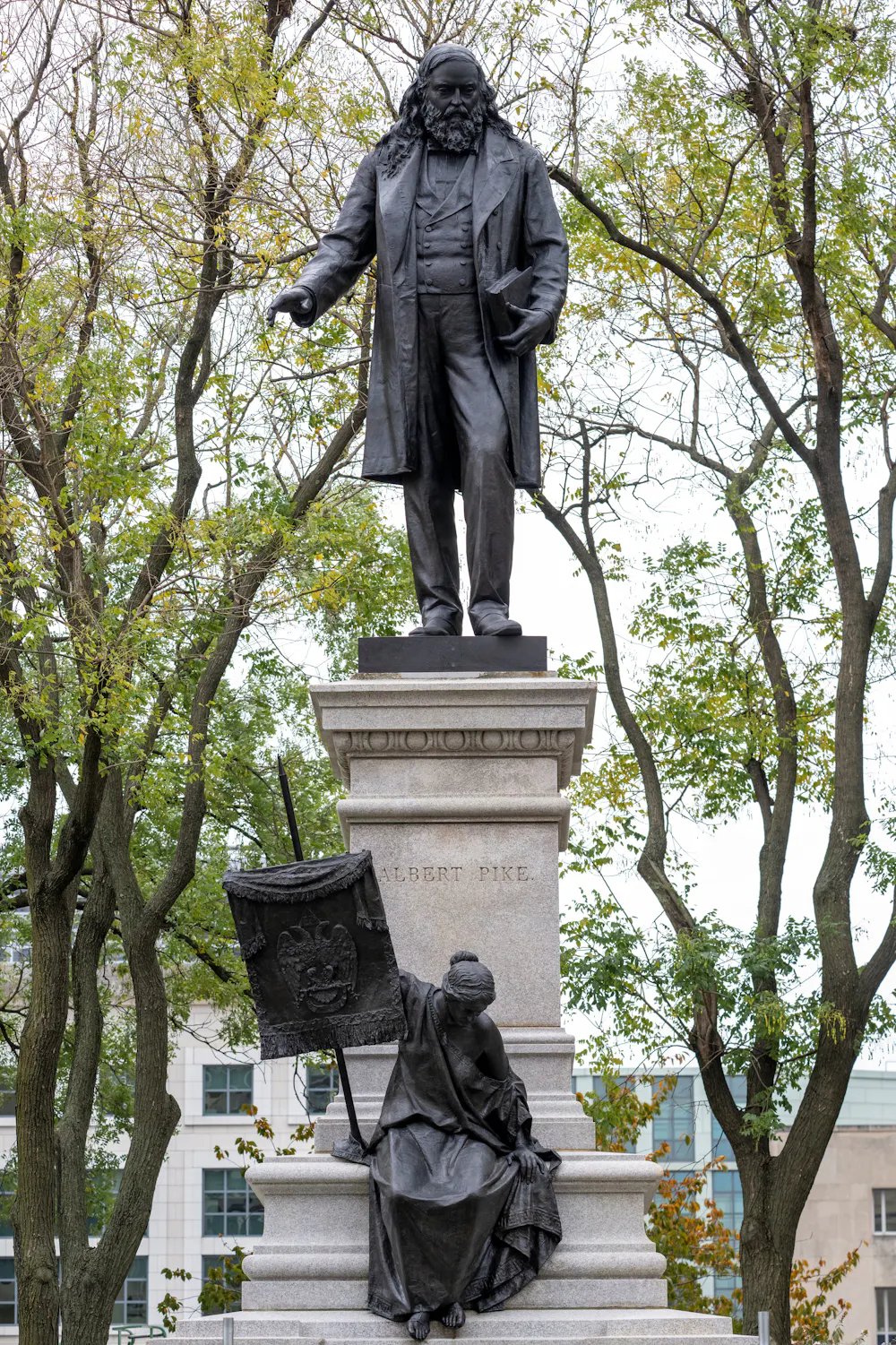
Pike was a disgraced figure, accused of misappropriating funds and allowing his troops to desecrate the bodies of Union soldiers. There are also alleged ties to an early version of the Ku Klux Klan.
Advocates for the statue’s retention note there is no mention of the Confederacy or depiction of a military uniform, only Pike’s contribution to the American Freemasons.
But when the statue was pulled down in 2020, Trump certainly took sides: “The DC police are not doing their job as they watched a statue be ripped down and burn. These people should be immediately arrested. A disgrace to our country.”
‘Woke lemmings’
Of course, history isn’t always simple, as memorialising the American Civil War shows.
Arlington National Cemetery in Virginia was established in 1864 as a national military cemetery, with a Confederate section dedicated in 1900 as part of the effort to promote reconciliation between the North and South.
Its Confederate Memorial (designed by a Confederate veteran) features a female figure representing the South holding symbols of peace. A bronze relief below depicts sanitised images of slavery: a woman caring for white children, and a man following his owner into battle as his servant.
A biblical quotation below preaches peace: “They have beat their swords into ploughshares and their spears into pruning hooks.”
But another quote in Latin – “Victrix causa diis placuit sed victa Caton” – references Julius Caesar’s victory in the Roman civil war and casts the South’s defeat as a noble lost cause.
The monument was erected in 1914, removed by Congress in 2023, and is scheduled to return in 2027. Secretary of War Pete Hegseth claimed on social media it “never should have been taken down by woke lemmings. Unlike the Left, we don’t believe in erasing American history – we honor it.”
Presidential hopeful Barack Obama addresses a rally before a statue of Caesar Rodney in Wilmington, Delaware, 2008.Emmanuel Dunand/AFP via Getty Images
Defiant choices
Similarly, an equestrian statue of Founding Father Caesar Rodney – installed in Wilmington, Delaware, in 1923 and removed in 2020 to prevent damage by protesters – highlights these contested readings of history.
Rodney is famous for riding all night from Delaware to Philadelphia, through a thunderstorm, to break a deadlock and cast the deciding vote in favour of American independence in 1776.
But as well as being a brigadier general and signatory to the Declaration of Independence, he owned 200 slaves on his family’s plantation.
The statue is now scheduled to reappear for six months, this time in Washington DC, to celebrate America’s 250th anniversary on July 4. It will be installed in Freedom Plaza, named in honour of Martin Luther King Junior.
Placing the contested statue of a famous slave owner in a space dedicated to a Black civil rights leader is a provocative, if not defiant, choice. And it shows again how powerful symbols and symbolic actions can be.
The argument that removing statues also erases history doesn’t hold up to scrutiny. It conflates public visibility and symbolic placement with actual knowledge of the past.
In that sense, reinstalling controversial memorials is, in itself, an attempt to rewrite history by erasing a more recent past and returning to an old, disputed status quo.
We usually have to wait until winter approaches before we see an increase in cases of influenza, or the flu. But we have already seen a lot of flu this year, with 25,000 cases reported from January to March – and that’s only a fraction of actual case numbers.
Most people with the flu recover without treatment. But it can cause serious complications in older people, young children, pregnant women and those with underlying chronic diseases such as asthma or heart disease. Influenza kills around 3,500 Australians a year and lands 18,000 in hospital.
Vaccination is the best way to protect against flu and is recommended for everyone over the age of six months.
Flu vaccines are free for certain risk groups. Others can access them (usually for a fee) at pharmacies, GP clinics and local council clinics in some states and territories. Some employers also offer vaccinations for staff.
Influenza has been unpredictable since the COVID pandemic, with off-season circulation. There are also concerns protection might lag at the end of winter. So when is the best time to get vaccinated?
What are the symptoms and how does it spread?
Flu symptoms include a cough, sore throat, fever, body aches and fatigue.
Flu spreads from person to person via small respiratory droplets when you talk, cough and sneeze. It may also spread by touching a surface or object where infected droplets have landed, but this is less common.
Flu spreads more in winter months due to increased contact between people and time spent indoors. Some studies also suggest influenza viruses transmit better in the cold.
What strains are around this year? And what is super-K?
Typically, human flu cases are caused by four virus strains, A(H3N2), A(H1N1), B/Victoria and B/Yamagata.
So far this year in Australia, almost 98% of cases have been influenza A(H3N2) and the remaining have been influenza B/Victoria.
In late 2025, a new variant of the H3N2 strain known as subclade K or “super-K” emerged in the northern hemisphere winter.
Super-K contributed to the unusual increase in flu numbers over summer in Australia. But there is no evidence to suggest it’s more severe than other H3N2 strains.
What does this year’s vaccine protect against?
Each year, the flu vaccine is designed to protect against a mix of different virus strains, depending on what strains are currently circulating.
This year’s flu vaccine contains two new strains for the influenza A(H1N1)pdm09 and A(H3N2) subtype virus components and an existing B strain:
an A/Missouri/11/2025 (H1N1)pdm09-like virus
an A/Singapore/GP20238/2024 (H3N2)-like virus
a B/Austria/1359417/2021 (B/Victoria lineage)-like virus.
The Singapore strain in the vaccine is closely related to the super-K strains that have been circulating, so should provide better protection than the vaccine used last year in the northern and southern hemispheres.
The composition of the southern hemisphere vaccine for use in Australia is different to the northern hemisphere composition for the 2025–26 winter.
How effective will this year’s vaccine be?
It’s too early to know how well the vaccine will work against preventing infection and severe disease.
Preliminary Australian data suggests people who received the flu vaccine in 2025 were 53% less likely to be hospitalised with influenza or visit a GP for flu symptoms compared with unvaccinated people.
In the UK, during the 2025–26 winter, influenza vaccines were 72–75% effective at protecting against flu cases needing medical attention in children and adolescents, including infections caused by super-K.
Herd immunity from influenza vaccines can also help prevent transmission to others who are unable to get vaccinated.
A three-year study in the United States, which ended in 2020 found influenza vaccines were 21% effective at preventing infection among others household members.
Another study in the UK and Ireland from 2010 to 2017 found vaccinating school-aged children reduced the amount of respiratory illnesses GPs saw across all age groups.
When does the flu season peak?
While we see flu cases throughout the year, the “flu season” in temperate Australia typically lasts from May to October, peaking in June to July.
Theoretically, the best time to get the flu vaccine is about two weeks before flu cases start to rise.
However, this is difficult to predict and the rise can start anywhere between April and July in temperate Australia, and even earlier in tropical northern Australia.
How long does the flu vaccine last?
There is some evidence the protection provided by influenza vaccines falls over six months. Immunity to flu is optimal for three to four months after you are vaccinated.
Pharmacies are encouraging customers get vaccinated now. But when is the best time for optimal protection?Meru Sheel
However, some studies suggest this may be an artifact of the methods by which vaccine effectiveness is measured.
Other factors may also be important. Waning protection may be more prominent in older people and may also depend on the degree to which mutations in circulating influenza strains accumulate during the season.
So when is the best time to get vaccinated?
When working out when is the best time to get your flu vaccine, you might be balancing a theoretical benefit by waiting, against a chance of actually getting the flu before you get vaccinated.
But if you’re travelling overseas, particularly for those travelling to the northern hemisphere in winter, aim to get your flu vaccine around two to four weeks before you leave.
If you’re pregnant, an ideal time to get the influenza vaccine is with RSV (respiratory syncytial virus) and pertussis vaccines from 28 weeks of pregnancy. This protects both mother and baby.
Finally, young children getting their first flu vaccines should have two doses four weeks apart. Getting their first dose in earlier in the season will leave plenty of time for the second dose before the influenza season starts.
Source: The Conversation (Au and NZ) – By Christine Keiner, Chair of the Department of Science, Technology, and Society, Rochester Institute of Technology
With the world struggling to get oil supplies moving from the Middle East, former House Speaker Newt Gingrich raised eyebrows with a social media post highlighting a radical idea: Use nuclear bombs to cut a new channel along a route that would avoid Iranian threats in the Strait of Hormuz.
The idea for a new canal to move oil from the Middle East had emerged two decades earlier, in the context of another Middle East conflict, the Suez crisis. In 1956, Egypt seized the Suez Canal from British and French control. The canal’s prolonged closure caused the price of oil, tea and other commodities to spike for European consumers, who depended on the shipping shortcut for goods from Asia.
But what if nuclear energy could be harnessed to cut an alternative canal through “friendly territory”? That was the question asked by Edward Teller, the principal architect of the hydrogen bomb, and his fellow physicists at the Lawrence Radiation Laboratory in Livermore, California.
President Dwight D. Eisenhower’s administration had already begun promoting atomic energy to generate electricity and to power submarines. After the Suez crisis, the U.S. government expanded plans to harness “atoms for peace.”
To kick-start the program, Teller wanted to create an instant harbor by burying, and then detonating, five thermonuclear bombs in an Indigenous village in coastal northwestern Alaska. The plan, known as Project Chariot, generated intense debate, as well as a pioneering environmental study of Arctic food webs.
Teller and the Livermore physicists also worked with the Army Corps of Engineers to study the possibility of using nuclear explosions to build another waterway in Panama. Fearing that the aging Panama Canal and its narrow locks would soon be rendered obsolete, U.S. officials had called for building a wider, deeper channel that wouldn’t require any locks to raise and lower the ships along its route.
A sea-level canal would not only fit bigger vessels; it would also be simpler to operate than the lock-based system, which required thousands of employees. Since the early 1900s, U.S. canal workers and their families had lived in the Canal Zone, a large strip of land surrounding the waterway. Panamanians increasingly resented having their country split in two by the racially segregated, colony-like zone.
Nuclear explosions appeared to make a new sea-level canal financially feasible. The greatest impetus for the so-called Panatomic Canal occurred in January 1964, when violent anti-U.S. protests erupted in Panama. President Lyndon B. Johnson responded to the crisis by agreeing to negotiate new political agreements with Panama.
Johnson appointed the Atlantic-Pacific Interoceanic Canal Study Commission to determine the best site to use nuclear explosions to blast a seaway between the two oceans. Funded by a $17.5 million congressional appropriation – the equivalent of around $185 million today – the five civilian commissioners focused on two routes: one in eastern Panama and the other in western Colombia.
The Panamanian route spanned forested river valleys of the Darién isthmus and reached 1,100 feet above sea level. To excavate this landscape, engineers proposed setting off 294 nuclear explosives along the route, in 14 separate detonations, using the explosive equivalent of 166.4 million tons of TNT.
This was a mind-blowing amount of energy: The most powerful nuclear weapon ever tested, the Soviet “Tsar Bomba” blast in 1961, released the energy equivalent to 50 million tons of TNT.
To avoid the radioactivity and ground shocks, planners estimated that approximately 30,000 people, half of them Indigenous, would have to be evacuated and resettled. The canal commission considered this a formidable but not impossible obstacle, writing in its final report, “The problems of public acceptance of nuclear canal excavation probably could be solved through diplomacy, public education, and compensating payments.”
[embedded content]
In 2020, the Russian government declassified this footage of the “Tsar Bomba” test blast from 1961.
A not-so-hot idea, in retrospect
As explored in my book, marine and evolutionary biologists of the late 1960s sought to study the project’s less obvious environmental effects. Among other potential catastrophes, scientists warned that a sea-level canal could unleash “mutual invasions of Atlantic and Pacific organisms” by joining the oceans on either side of the isthmus for the first time in 3 million years.
Plans for the nuclear waterway ended by the early 1970s, not over concerns about marine invasive species but rather due to other complex issues. These included the difficulties of testing nuclear explosions for peaceful purposes without violating the Limited Nuclear Test Ban Treaty of 1963 and the huge budget deficits caused by the Vietnam War.
Despite the geopolitical and financial constraints, the sea-level canal studies employed hundreds of researchers who increased knowledge of the isthmus and its human and nonhuman inhabitants. Ironically, the studies revealed that wet clay shale rocks along the Darién route meant nuclear explosives might not work well there.
But for Project Plowshare’s biggest proponents, atomic excavation remained a worthwhile goal. In 1970, in their final report, the canal commissioners predicted that “someday nuclear explosions will be used in a wide variety of massive earth-moving projects.” Teller shared their commitment, as he explained near the end of his life in the 2000 documentary “Nuclear Dynamite.”
Today, given widespread awareness of the severe environmental and health effects of radioactive fallout, it is hard to envision a time when using nuclear bombs to build canals seemed reasonable. Even before Gingrich’s post sparked ridicule, press accounts described Project Plowshare using words like “wacky,” “insane” and “crazy.”
However, as societies struggle with disruptive new technologies such as generative AI and cryptocurrency, it is worth remembering that many ideas that ended up discredited once seemed not only sensible but inevitable.
As historians of science and technology point out, technological and scientific developments cannot be separated from their cultural contexts. Moreover, the technologies that become part of people’s daily lives often do so not because they are inherently superior, but because powerful interests champion them.
It makes me wonder: Which of the high-tech trends being promoted by influencers today will amuse, shock and horrify our descendants?
Source: The Conversation (Au and NZ) – By Giuseppe Carabetta, Associate Professor of Workplace and Business Law, UTS Business School, University of Technology Sydney
Dogs are increasingly appearing in Australian workplaces. From “take your dog to work” days to permanent pet-friendly offices, the trend is often framed as an easy win for staff morale.
Evidence suggests having dogs at work can reduce stress and improve social connection. But only if some important risks are managed properly, such as allergies, phobias, hygiene concerns and general safety.
There’s another important distinction, reflected in the law: while pets are optional, assistance dogs are usually not.
So, how can employers design dog-friendly workplaces if they want to, and what does the law say about animals at work?
Barking up the right tree
There is strong evidence to suggest dogs benefit their owners’ physical health in general. Large studies have linked dog ownership to increased physical activity, reduced cardiovascular risk and lower all-cause mortality.
A major meta-analysis of more than 3.8 million people found dog owners had a 24% lower risk of early death from any cause and a 31% lower risk of dying from cardiovascular disease, likely driven by walking and stress reduction.
These findings were confirmed in follow-up analyses which accounted for other variables among dog owners, such as a younger age, better physical fitness and higher socioeconomic status.
Researchers still found a 17% reduction in dying early from any cause.
When it comes to mental health, outcomes are less clear. Reviewsshow mixed effects, depending on population, pet type and measurement.
A recent meta-analysis which draws the results of earlier studies found modest gains in physical activity, but small and inconsistent effects on depression and anxiety. That nuance matters at work.
Dogs in the workplace
Research suggests dogs can improve workplace wellbeing – but only under the right conditions. Studies report lower perceived stress, improved mood and stronger social connection.
Emerging, high-quality evidence suggests workplace pets can positively affect stress and social interaction. But it also identifies negative outcomes where risks are poorly managed.
What are those risks? An occupational health review by the US Centers for Disease Control and Prevention warned dogs can introduce new hazards, including:
allergies
phobias
hygiene issues
bites.
Dog-friendly policies for the office therefore raise safety and inclusion issues that need to be considered alongside any lifestyle perks.
Dogs may improve workplace wellbeing – but only under the right conditions.www.kaboompics.com/Pexels
What the law says
In Australia, ordinary pets have no automatic right to enter a workplace. Employers may allow pets as a matter of policy, provided they meet their obligations under work health and safety laws.
Government guidance recommends consulting staff, undertaking a risk assessment, establishing clear rules and ensuring a suitable premises.
However, while pets are optional, assistance dogs are usually not. The law reflects this balancing act.
Under Australia’s Disability Discrimination Act, it is unlawful to treat a person unfavourably because they use an assistance animal, subject to some narrow and clearly defined exceptions.
Assistance dogs are legally recognised as disability aids, not pets, and may support both physical and psychological disabilities.
Importantly, the law requires assistance animals to be trained to an appropriate standard, meaning:
trained to an appropriate standard to assist a person with a disability
trained to meet standards of hygiene and behaviour appropriate for an animal in a public place.
Employers may ask for evidence that a dog is an assistance animal and meets appropriate standards of hygiene and behaviour. But the law does not require a single national certificate or ID card.
Lead author, Giuseppe Carabetta, with his assistance dog Monty, on a visit to Parliament House.Author provided (no reuse)
An employer can only refuse to allow an assistance dog access in very narrow circumstances, such as where exclusion is reasonably necessary to protect health or safety and risks cannot be managed through reasonable adjustments.
What this looks like in Australian workplaces
Work health and safety laws in all states and territories now include a positive duty to manage psychosocial hazards at work – such as stress, poor support and harmful workplace design.
This means employers cannot rely on blanket bans justified by vague “safety concerns”. They must identify hazards, consult workers and implement proportionate controls – whether dogs are excluded or allowed.
Some employers have formalised dog-friendly design. Amazon’s Sydney office, for example, runs a “Dogs at Work” program with a dedicated onsite dog area to manage safety and hygiene risks.
Others are a little more cautious. Tasmanian company RACT expanded a “Furry Friday” trial only after introducing rosters, limits per floor and consulting with staff.
Co-working spaces such as CreativeCubes.Co publish detailed pet policies, while explicitly carving out assistance animals to reflect discrimination law.
The bottom line
The science suggests dogs can support wellbeing – but only when workplaces are designed for them. Australian law mirrors that evidence-based approach.
As employers rethink wellbeing in a post-pandemic workplace, the real question is no longer “should dogs be allowed?”. Rather, it’s whether policies are lawful, evidence-based and inclusive.
The sound of the Australian pedestrian crossing was initially conceived as a priority to assist visually impaired pedestrians. But is also benefits other people. It is now an instantly recognisable and unmistakable prompt of when to, and when not to, “walk”: the slow “tick” beat indicating a wait signal is replaced with the repetitive faster “dit-dit-dit-dit” of when to walk.
Many Australians will recognise the sound as uniquely Australian and part of our built urban soundscape. But how much sound around us is designed?
Designing for accessibility – and pop music
The PB/5 pedestrian crossing button audio is a successful example of audio-tactile signalling and an early example of universal design principles: products and environments that are inclusive for a diverse range of users, irrespective of age and ability.
Accessibility was not an afterthought. It was a foundational design requirement when first commissioned by then New South Wales Department of Main Roads in 1984. The resultant design was a successful collaboration led involving industrial design firm, Nielsen design associates, and acoustic engineers Challis & Associates.
Since it was introduced over 40 years ago, its robust form and distinctive sounds has also been recognised as an icon of Australian design by Good Design Australia and resides in museum collections.
The distinctive sounds of the PB/5 pedestrian button has also reached well beyond their purpose in the built environment. It now has been captured in popular culture – most notably by Billie Eilish, who used samples of the sound in her 2019 hit song Bad Guy.
People wanted quieter appliances, cars and machinery. Noise was a consequence of a product’s internal mechanism and function. Think of the pneumatic roar of a vacuum cleaner, the high-pitched whirl of a kitchen blender or the mechanical growl of a lawnmower.
But not all consequential product sounds may be perceived as noise. Product sounds can also be evocative of a particular moment of time or situation. The sound of a 1990s dial-up modem conjures thoughts of the early days of the internet; an espresso machine teases thoughts of fresh coffee with its airy hiss.
Sound plays a varied and increasingly sophisticated role in product design. In more recent times, sound has been designed into many products, added and crafted to enhance product functionality and user experience.
Electric vehicles illustrate this clearly. The comparatively silent motor and transmission in an electric vehicle offers an unfamiliar driving experience compared to the traditional internal combustion engine vehicles.
Kia counteracts this by using “active sound design”, where they modify the “in-car audio system to mimic engine sounds that drivers are familiar with”.
Conversely, Kia also employs active noise cancellation techniques to suppress unwanted road noise.
This emerging need to craft and enhance sounds beyond the inherent consequential sound of a product has led to new specialisations within product development and marketing. We now see people employed in acoustic design, sonic branding, psychoacoustics and product sound design.
Functional sound signalling
Despite the 40-year-old audio-tactile technology of the PB/5, it remains a relatively sophisticated and intuitive example of functional sound signalling. Especially when compared to the unrefined (but effective) screech of a household fire alarm, but comparable to slightly more refined car seatbelt warning ping and reverse parking beepers.
Functional sound signalling is pervasive in specialised industrial settings, factories, hospitals and aviation. Hospital medical devices and aircraft avionics incorporate various signalling alarms to indicate changes in operational status that require monitoring or intervention, without creating ambiguity or sensory overload.
Beyond the priorities of sonic notification and alarms, designers use sound to enhance user experience. Think of the soft click feedback of the well designed switch, or a car door closing “thunk” to signal precision engineering.
Such strategies are pervasive the digital realm. Chimes, pings and startup sounds not only represent feedback to the user but also represent how brand identity can be expressed through sound. The distinct sounds of an Apple Mac or a Windows machine starting up are unmistakable.
Even our food is not beyond reach of the sound design. Many processed foods and packaging offer distinctive brand cues to signal quality and perceived freshness. The crack of the chocolate on a Magnum ice cream, the loud crisp crunch of Pringles, the fizz upon opening a can of Guinness are just a few examples of how sound is designed into products today.
Few products and sounds last as long in circulation as the PB/5. Sounds of Australia is important as a accessible time capsule of a diverse range of ephemeral sounds that timestamp the shared lived experience of Australians, past and present.
So what Australian physical object sound would you nominate for next year’s Sounds of Australia? My product pick would present the curators with an interesting challenge: how do you represent a product not by the sound it makes, but by the sound it enables other to hear. My nomination is the Cochlear implant: a significant Australian medical innovation and assistive technology.
On February 28, the US and Israel launched a war against Iran following weeks of US military build-up in the region and threats from US President Donald Trump.
In the ensuing weeks, Iran has retaliated by striking US assets in the Persian Gulf states and targets across Israel. Israel has launched a ground invasion into southern Lebanon in response to attacks from Hezbollah.
Oil and gas shipments through the Strait of Hormuz have come to a virtual standstill, threatening a global energy crisis. And thousands have been killed, most in Iran and Lebanon.
The entire Middle East has been affected by this war – and the region will no doubt be very different once it’s resolved.
We asked five experts in international politics and Middle East studies to explain the most important changes they see happening following the war.
Farming is a vital industry, contributing an estimated A$100 billion to the Australian economy this year alone.
Nearly 60% of Australia is used for agriculture. The lion’s share of that land is used to graze livestock, such as cattle, sheep and, increasingly, goats.
However, our farming and environmental sectors have long been perceived to be at odds. This is because agriculture remains a major emitter of greenhouse gases. Another reason is it requires vast amounts of land to be cleared, often with devastating consequences for native wildlife and vegetation.
For many years now, governments and community organisations, such as local Landcare groups, have encouraged farmers to restore nature on their farms. This is one way to increase their “natural capital”, which refers to the sum of all natural resources that provide products and services of value to society. This includes the soil, air, water and all living organisms.
Some farmers have been keen to boost their natural capital. Others, however, see it as a waste of time or money.
But our world-first study shows maintaining and restoring nature on farms can actually increase farmers’ productivity and profits.
So how is this possible? And how can we encourage more farmers to invest in nature?
Why natural capital matters
Natural capital is more than a buzzword. For farmers, it’s a crucial part of running a productive and profitable business. And for the environment, natural capital serves as habitat for wildlife and a way to capture and store carbon.
Types of natural capital on farms include pastures used for grazing, remnant native vegetation and the soil beneath crops. These provide a range of ecosystem services. For example, planted shelterbelts, which are rows of trees and shrubs, help maintain soil moisture and protect livestock from wind.
It may seem intuitive that farms with more natural capital would be more productive and profitable than those with less. However, we don’t actually know if this is true. That’s because traditional accounting methods do not consider how natural capital may contribute to a farm’s productivity.
What we studied
In our world-first study, we investigated how the amount and quality of natural capital on a farm affects its economic performance.
Our study involved 114 livestock farms across the Australian states of New South Wales, Victoria, Tasmania and Western Australia. We tracked their economic performance in the five-year period between 2017 and 2022. This included both drought and high-rainfall years.
To do this, we looked at three main metrics:
production efficiency, which is how well a farm turns inputs such as fertiliser and diesel into products such as meat and wool
profitability, or how much a farmer earns after paying all their expenses
financial resilience, which refers to how stable a farm’s income is, particularly in times of drought.
We also assessed the amount and condition of natural capital on each farm. This involved collecting data about the:
amount of tree cover and how it is distributed across the farm
types of pasture grasses present
cover of low-growing plants, dead or alive, which help prevent soil erosion
overall ecological condition, which relates to how much existing ecosystems have been modified.
Overall, we found livestock farms with higher levels of natural capital were up to 3% more productive than farms with the lowest levels of natural capital. This is significant given Australia’s agricultural productivity has, on average, grown by just 0.2% each year over the past decade.
Better still, our research suggests farms with more natural capital are more financially resilient. This means there is less year-to-year variation in how much those farms earn, even when they experience periods of drought.
Why does this work?
There are several ways natural capital can improve a farm’s economic performance. Here are three.
1. Increase its production efficiency
Our research suggests farms with healthier pastures, and with trees and shelterbelts scattered throughout their paddocks, are generally more efficient. In the case of a sheep farm, this would mean fewer inputs are required to produce the same amount of meat or wool. Sheep on farms with more natural capital would also be healthier and more likely to survive extreme weather events due to having more shade and shelter.
2. Reduce its costs
The price of inputs, such as pesticides and fertilisers, can be both high and volatile. But by grazing on native grasses and conserving and planting native vegetation, farmers can reduce their need for these inputs. This is because native vegetation helps suppress weeds but also provides habitat for beneficial insects, bats and birds, all of which eat pest insects.
3. Make its income more stable
Our research shows farms with more natural capital are better protected from adverse weather events, such as drought or intense rains. For example, a sheep farmer who maintains patches of native vegetation is less likely to lose lambs in wet, windy conditions. So by protecting their livestock, pastures and crops, nature restoration projects can also give farmers a more secure income.
However, we don’t want to turn farms into national parks. There is a point at which too much natural capital starts to reduce farm productivity and food security. This occurs when further reducing the amount of land used for agriculture outweighs the benefits of having more natural capital. Instead, we need to find the sweet spot where restoring natural capital boosts, instead of limits, a farm’s production.
Overall, our research challenges the perception that profitable farming and biodiversity can’t go hand in hand. Our research shows investing in natural capital actually stacks up financially. And the more we embrace this view the better off our economy, and environment, will be.
Most of Australia’s existing homes are old, uncomfortable, and expensive to run. Too many are energy inefficient, and rising electricity and gas prices are making things worse.
Mainstream programs are supporting home energy upgrades. But the transition isn’t happening quickly enough and risks leaving behind the households that could benefit most.
Innovative finance models could help. My new research shows how local initiatives can make solar and electrification more accessible.
Darebin City Council’s Solar Saver program
My research investigated a local government program in Melbourne that helped people get rooftop solar.
Running from 2014-2025, Darebin City Council’s Solar Saver program helped almost 1,200 low-income and vulnerable homeowners in the area get A$4.8 million worth of home energy upgrades.
Council paid the upfront cost of installing solar and, in later iterations of the program, reverse cycle air conditioners and hot water heat pumps.
Factoring in state government rebates, these costs were added to the homeowner’s property taxes as a “special rates charge”. The homeowner could then repay this money over ten years – interest-free.
Suppliers were selected through council tender to make the process easier for homeowners, while ensuring quality products and services including component and performance warranties. This provided certainty for residents, one of whom told me:
the council’s not going to get involved with some shonky person who’s going to come in and tell you: “Terribly sorry, we’ve got to double the price because you’ve got a nail in the wrong place on your roof” or something.
The scheme reduced financial risks and burdens for low-income homeowners.
By using council rates to repay the money, the loan is attached to the property itself rather than the homeowner.
This means any remaining debt is recouped if and when the house is sold, avoiding a situation where someone is paying a debt for solar on a house they no longer live in.
[embedded content]
Homeowners were advised not to participate if debt repayments were more than they’d save in energy bills. Aged and disability pensioners were identified as a priority group because they were more likely to be at home during the day to reap the benefits.
Trust and relationships
Darebin Solar Saver shows how critical trust and relationships are for enabling household uptake.
Interviews with households and council officers highlighted the importance of council as an intermediary that could offer tailored and impartial advice, broker quality products and services, and channel finance without commercial terms.
[embedded content]
Other electrification programs have shown how effective council rates notices are for household engagement.
Colleagues and I are now developing tools and resources based on these lessons to support the sector to design and deliver home energy upgrade programs.
Expanding beyond Darebin
For this model to be expanded to other local government areas, funding is needed.
Darebin City Council made a significant cash investment that other councils have struggled to replicate, even though households repay most of the costs.
Federal government could address this barrier through a national fund, while others see opportunities for commercial loans through environmental upgrade agreements (which is where councils work with banks to provide loans to households, and the loan is repaid via the resident’s rates).
Very few private renters accessed Darebin Solar Saver, highlighting a need for targeted finance, engagement, and regulation to encourage landlords to upgrade investment properties.
The Darebin Solar Saver program concluded in 2025 for a range of reasons. Council staff told me human resources and time are essential, with one noting:
We have to go through a fair amount of information to explain how solar works. We have to explain how the Solar Saver program works. Many residents struggle to actually understand or accept that you don’t have to pay anything up front, at all. That takes often several times in a conversation and written material just to prove that that’s the case.
Darebin City Council is now offering electrification rebates for a wider range of products, which are also much simpler for council to administer.
Finding alternative finance models
While over 30% of Australian households have rooftop solar, Australia needs 11 times more households to disconnect from gas each year if it’s to achieve its 2050 emissions reduction targets.
For those with little to no available cash savings, partial subsidies and rebates are little help.
Discounted home energy upgrade loans still charge interest to be commercially viable. What’s more, many low-income homeowners may not have a high enough credit rating to get a loan from a bank. Buy Now Pay Later services typically pass on costs through the price of the solar system and late repayment fees. Interest-free loans for eligible households are no longer available from the Victorian government.
Inaccessibility is not just about cost. It’s also about a household’s ability and confidence to make decisions, especially as some solar and battery providers push bad deals.
All this means it is crucial we find more alternative finance models to help low-income households do energy upgrades.
As homes are increasingly exposed to worsening climate hazards like floods, bushfires, and cyclones, solving the finance problem will become more urgent.
Source: The Conversation (Au and NZ) – By Alyssa Milton, Associate Professor, Principal Research Fellow, Faculty of Medicine and Health, University of Sydney
When the bell rings at the end of each term, there is a happy buzz as kids leave school for the break. But for many parents, the start of the holidays brings a different feeling entirely: how are they going to keep their children engaged for two weeks and sometimes more?
One way is through school holiday programs, which take children for all or most of the work day. These can range from general programs on school sites – which might have sporting and craft activities for children as well as general play. It might also involve excursions to places such as zoos or adventure parks.
Other programs might be run by other operators, and focus on soccer, basketball, coding, art or drama.
How can you tell if your child’s program is good quality?
Access is tricky
First, we need to acknowledge that holiday program places fill quickly and costs add up. Some programs cost more than $100 a day, per child. While some are eligible for government subsidies, many are not.
Our analysis has highlighted how limited access can be for Australian families. Holiday programs where parents can claim the government’s Child Care Subsidy only have capacity for 18% of Australian primary school children. That’s around 413,000 places for more than 2.3 million primary school children (aged around 5–12).
Access is even more constrained outside major cities, with some regional communities having only one provider, or none at all.
Why holiday programs matter
School holidays provide an important break from routine for children.
But we also know many parents have to work during the holiday and kids can spend too much time being sedentary and on screens.
School holiday programs provide opportunities for children to spend time with peers and supportive adults, participate in engaging activities, and maintain routines during the break.
Our research, co-designed with young people, shows effective programs provide opportunities for children to explore interests, build friendships, develop confidence and participate in meaningful activities.
Research also suggests children benefit when programs include choice, allowing them to contribute ideas, try new activities and connect with peers.
What you should look for
While availability and cost often shape decisions for families, there are several indicators that can help parents assess quality. Here are some questions to ask.
Is it varied? If they offer a mix of creative, physical, social and exploratory activities, they are more likely to keep children interested and motivated.
Is there choice for kids? High-quality programs allow children some say in activities or how they participate, supporting confidence and enjoyment.
Does it encourage social connections? A good program will be able to talk about how it supports friendships and inclusion.
Is there movement and outdoor time? Some programs may specifically be for coding, crochet, art or other naturally sedentary activities.
Is there clear communication with families? This includes information about costs, schedules, staffing and supports.
If the holiday program is offered through an Outside School Hours Care, it is worthwhile looking for services assessed under the National Quality Standard. This is the system that rates other forms of childcare and will be able to tell you how the service is performing. These ratings consider factors such as programming, safety, staffing and relationships with children.
Possible warning signs
While every program differs, some features may signal lower quality. They include:
a focus on containing the children rather than engagement and relationships.
How can access improve?
Our research has called for improving access to affordable, high-quality holiday programs.
This could include increasing the number of government-supported places, expanding programs in regional and under-served communities and supporting providers to recruit and retain qualified staff. The federal government also needs to ensure the Child Care Subsidy reflects the real cost of delivering high-quality programs, so fees are not simply passed on to families.
Without these changes, many children will continue to miss out on the kinds of experiences that support wellbeing, confidence and connection during school holidays.
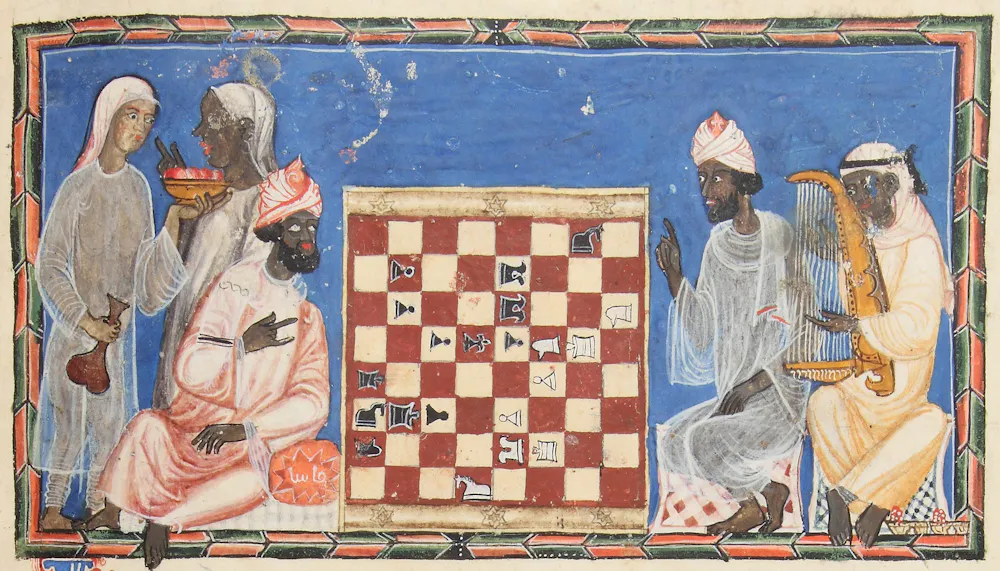

_(7364835218).jpg)