Truck data shows economy steady in March, but future demand softens

Source: Radio New Zealand

State Highway 16 full of slow moving morning traffic as the sun rises. RNZ / Cole Eastham-Farrelly

New data suggests the economy kept its head above water in March – but storm clouds may be gathering.

The latest ANZ Truckometer shows the heavy traffic index, a real‑time measure of economic activity, rose by 0.4 percent in March and it remains 2.3 percent higher than a year ago.

However, the light traffic index, which points to future activity and spending, fell by 2.4 percent in March – although it is still 3.6 percent higher than a year ago.

The light traffic index, which covers motorbikes, cars and vans, is regarded as a good indicator of the state of demand, as opposed to production, and typically provides up to a six-month lead on momentum in the economy.

ANZ chief economist Sharon Zollner said the fall in light traffic was not unusually large – coming off a strong lift in February – but may reflect people driving less as fuel prices rose in March.

“I think it’s reasonable to say that has been looking like a pretty good upward trend in the light traffic index has been challenged,” she said.

“It is possible this partly reflects people driving less in response to higher fuel prices, and it will be very interesting to see where it goes in the next month or two.”

Zollner said the weaker light traffic reading also aligned with slowdowns seen in both ANZ’s card spending data in March and its consumer confidence index.

“Although it’s not causal – the economy won’t be weaker simply because people are driving less – it could be that the correlation still holds, and that a decline in driving now points to pressure on the economy over the next six months or so,” she said.

However, Zollner also cautioned the March result could simply reflect a correction after February’s strong readings, and warned against reading too much into a single month’s data.

Sign up for Ngā Pitopito Kōrero, a daily newsletter curated by our editors and delivered straight to your inbox every weekday.

– Published by EveningReport.nz and AsiaPacificReport.nz, see: MIL OSI in partnership with Radio New Zealand

LiveNews: https://nz.mil-osi.com/2026/04/09/truck-data-shows-economy-steady-in-march-but-future-demand-softens/

NZ, Australia get tighter IKEA returns policy

Source: Radio New Zealand

IKEA’s first Auckland store opens on December 4 Marika Khabazi / RNZ

IKEA is tightening its returns policy for Australia and New Zealand.

The homeware retailer told customers on Thursday that its “test and try” policy, which allows for products to be assembled and then returned, would only apply for 60 days after the date of purchase. The original packaging would need to be maintained.

It would only allow returns for up to 365 days for products that were unopened, unused and that could be resold.

In comparison, the UK website still tells customers that they can return open products for up to 365 days, even if they had been assembled.

An IKEA spokesperson said the changes to the way returns, cancellations and exchanges worked had been introduced in Australia and New Zealand.

“The changes have been made to continue to provide peace of mind and flexibility for our customers.

“The new IKEA ‘Test & Try’ policy gives customers a fair time period of 60 days for a change of mind if the product does not suit their life at home, with the ability to return an opened and assembled product in acceptable condition. Customers still have 365-days to return their product if it is unopened, unused and resealable.

“The changes were implemented as part of a planned update across both markets are not related to the condition of goods being returned by customers.”

Sign up for Money with Susan Edmunds, a weekly newsletter covering all the things that affect how we make, spend and invest money

– Published by EveningReport.nz and AsiaPacificReport.nz, see: MIL OSI in partnership with Radio New Zealand

LiveNews: https://nz.mil-osi.com/2026/04/09/nz-australia-get-tighter-ikea-returns-policy/

Football Fern Grace Jale seeking consistency, calm

Source: Radio New Zealand

Football Fern Grace Jale contests the ball during Fifa Women’s World Cup qualifiers. Joshua Devenie / Phototek.nz

Football Fern Grace Jale has a new home off the field, but is still finding her place with the national team.

Jale is reaching new heights in her professional career this season, as Wellington Phoenix locked in an A-League semi-final spot for the first time.

The 27-year-old, who has played for the Phoenix, Canberra United and Perth Glory, before returning to the Phoenix last season, said it was “still kind of hard to believe” the Phoenix had finished second and she would be playing playoff football for the first time.

Chasing consistency on and off the field this season, Jale made some life changes, after reflecting on last season for club and country.

“I can have amazing games and I can just blend in other days.

“I think consistent, good performances is probably one of the hardest challenges, but something that really helped me.”

Grace Jale has had regular minutes for Wellington Phoenix this season. Marty Melville/ Photosport

Jale has made 19 starts for the Phoenix in their record-breaking season, but getting to the point of consistency has not been easy.

“It really is tricky and for me, unfortunately, I’m quite an emotional player. If I’m not in the right headspace, you can probably tell, whether it’s confidence or energy, that kind of stuff.”

A move to a house by the water in Wellington has provided Jale with the escape from football that she needs.

“I looked at the off-field things that I could control in terms of my environment. Just living with one person that I’m comfortable with in a small house, I can leave the [Phoenix] facility and go to basically a different world, which is beautiful.

“Having that nice environment that I’m surrounded by, which I can choose to go in any time, has been really great. I think just the off-field really helped being able to be fully present when I’m onfield.”

A tall presence on the field, Jale admits to “skipping over some of the one-percenters” earlier in her career and getting by on talent.

Taking that route is something she hopes Phoenix and Football Fern teammate 17-year-old Pia Vlok can avoid.

New Zealand’s Grace Jale celebrates with Pia Vlok after scoring a goal during Fifa Women’s World Cup qualifiers. Joshua Devenie / Phototek.nz

“She is super, super talented beyond her years and I feel like, if I can share some of that wisdom that I now know, which took me a while to get, then it can help her have a steadier transition into [the Football Ferns] and then just the professional life as well.

“I think, unfortunately, I missed that, unless maybe I wasn’t listening, but I’m happy to share the wisdom.”

Jale has 37 caps for the Football Ferns, but her time in the national team has not always been smooth.

She was in the squad for the last World Cup, took the field twice, but struggled to find where she fitted.

With a change of coach, a new World Cup cycle and strong club form, Jale still is “honestly not sure” how she feels in the Football Ferns.

“It’s been a bit of an up-and-down campaign for me personally.

“I haven’t been in all of the tours, probably less than half, and I’ve had to change my perspective on things, and not get too excited and hopeful too much to then have the feeling of being let down.

“I’m going to keep having that goal of trying to be consistent and I’m going to do my best. If I get minutes or not, it’s not my decision.”

Grace Jale has 37 caps for the Football Ferns and wants more. Photosport/Colombia Football

Jale is part of the Football Ferns squad for the World Cup qualifiers and will also celebrate her birthday while on international duty.

“Camps can be a lot and I’m not able to go home to my beautiful house in Welly, so it’s taking what I can and trying to control as much as I can to be as comfortable as I can.”

Earning more minutes for New Zealand would be a welcome gift for Jale and she has another motivation to take the field in the World Cup qualifying semi-final against Fiji in Hamilton on Sunday.

“I’m half Fijian, so I secretly root for them. I was hoping to face them in the final or something, but I’m proud of them and I’m wishing them luck.”

Sign up for Ngā Pitopito Kōrero, a daily newsletter curated by our editors and delivered straight to your inbox every weekday.

– Published by EveningReport.nz and AsiaPacificReport.nz, see: MIL OSI in partnership with Radio New Zealand

LiveNews: https://nz.mil-osi.com/2026/04/09/football-fern-grace-jale-seeking-consistency-calm/

Why the phrase “Super El Nino” makes Australian climate scientists roll their eyes

Source: The Conversation (Au and NZ) – By Kimberley Reid, Postdoctoral Research Fellow in Atmospheric Sciences, The University of Melbourne

Frightening headlines predicting a Super El Niño or even a Godzilla El Niño amp up anxiety levels for farmers and residents of bushfire-prone regions.

But these phrases are not particularly accurate. The phrase “Super El Niño” makes climate scientists like me roll our eyes.

Why? Let’s find out.

What is El Niño?

The El Niño–Southern Oscillation is a natural and reoccurring climate pattern in the Pacific Ocean which can influence the chance of different weather affecting Australia.

When sea surface temperatures near the Americas are warmer than usual and the trade winds blowing from east to west across the equator weaken, climatologists call this pattern an El Niño.

El Niño events typically ramp up in winter and spring, and decay towards the end of summer and start of autumn.

During El Niño, we tend to experience warmer than usual temperatures and reduced winter-spring rainfall in Australia’s east.

We pay attention to El Niño and its opposite, La Niña, because this climate pattern has the biggest influence on year-to-year rainfall and temperature differences in eastern Australia. Drought is a key concern for farmers and rural residents, and some of the largest droughts of the past 40 years took place during El Niño years.

But problems can arise if we expect El Niño to be the only factor dictating our weather.

Average spring temperature (L) and rainfall anomalies (R) during an El Niño. Ruby Lieber, CC BY

Why call an El Niño ‘super’?

One El Niño can be stronger or weaker than others. Scientists monitor El Niño using the Nino3.4 index, a measure of how much warmer (or cooler) than usual the ocean is in a region in the East Pacific. This region is the best at representing changes in the Pacific which can indicate El Niño.

When ocean temperatures are 0.8°C warmer than usual in that region, and the trade winds have sufficiently weakened, the Bureau of Meteorology can declare an El Niño has arrived. (The United States uses 0.5°C as the figure).

A “Super El Niño” is when the region’s ocean temperatures rise 2°C, roughly two standard deviations above normal (about a 2.5% chance of happening). While scientists first coined the term, the evocative phrase has become a favourite of media commentators.

But Australian forecasters don’t use these terms, as it doesn’t matter that much for our weather if the index goes over 2°C. What matters much more is whether an El Niño is present or not.

Why? When we measure the strength of the El Niño, we are really only referring to ocean temperatures in the eastern Pacific. But this figure is not very well correlated with less rain in eastern Australia. It also only captures ocean changes and doesn’t reflect the El Niño atmospheric changes which influence the weather systems that actually bring rain to Australia.

During the ‘strong’ 1997–98 El Niño (a), rainfall didn’t change much. But during the ‘weak’ 2002–03 El Niño (b), major rainfall deficits emerged. Bureau of Meteorology and Climate Extremes, CC BY

That’s not all. The Niño3.4 Index is just one of many indications of how Australia’s upcoming weather is likely to look. One index can’t tell the whole story. Relying on it is like looking at the BMI of a bodybuilder and declaring them obese.

Readers may wonder how scientists can define El Niño using an ocean temperature threshold when oceans are getting steadily warmer under climate change. Won’t we end up with constant El Niño?

This is a good question. It’s why the Bureau of Meteorology last year introduced a relative Niño index, to give scientists a way to account for warming due to climate change.

Should we believe winter and spring forecasts?

A Southern Hemisphere autumn in the Pacific Ocean is sort of like January in your average Australian office job. As you slowly ease into the work year, you set a bunch of optimistic goals which may or may not eventuate.

Over autumn, the Pacific Ocean is similarly noncommittal. It can indicate future outcomes that don’t always happen.

Meteorologists have a term for this. It’s called the Autumn Predictability Barrier. What it means is that El Niño forecasts are the least reliable during autumn.

So while forecasts of the Pacific Ocean might be pointing towards an El Niño, history warns us to take forecasts made in autumn for later in the year with a big lump of salt.

At present, the European, US and Australian model forecasts of Niño3.4 indicate a strong El Niño might develop. But this isn’t conclusive.

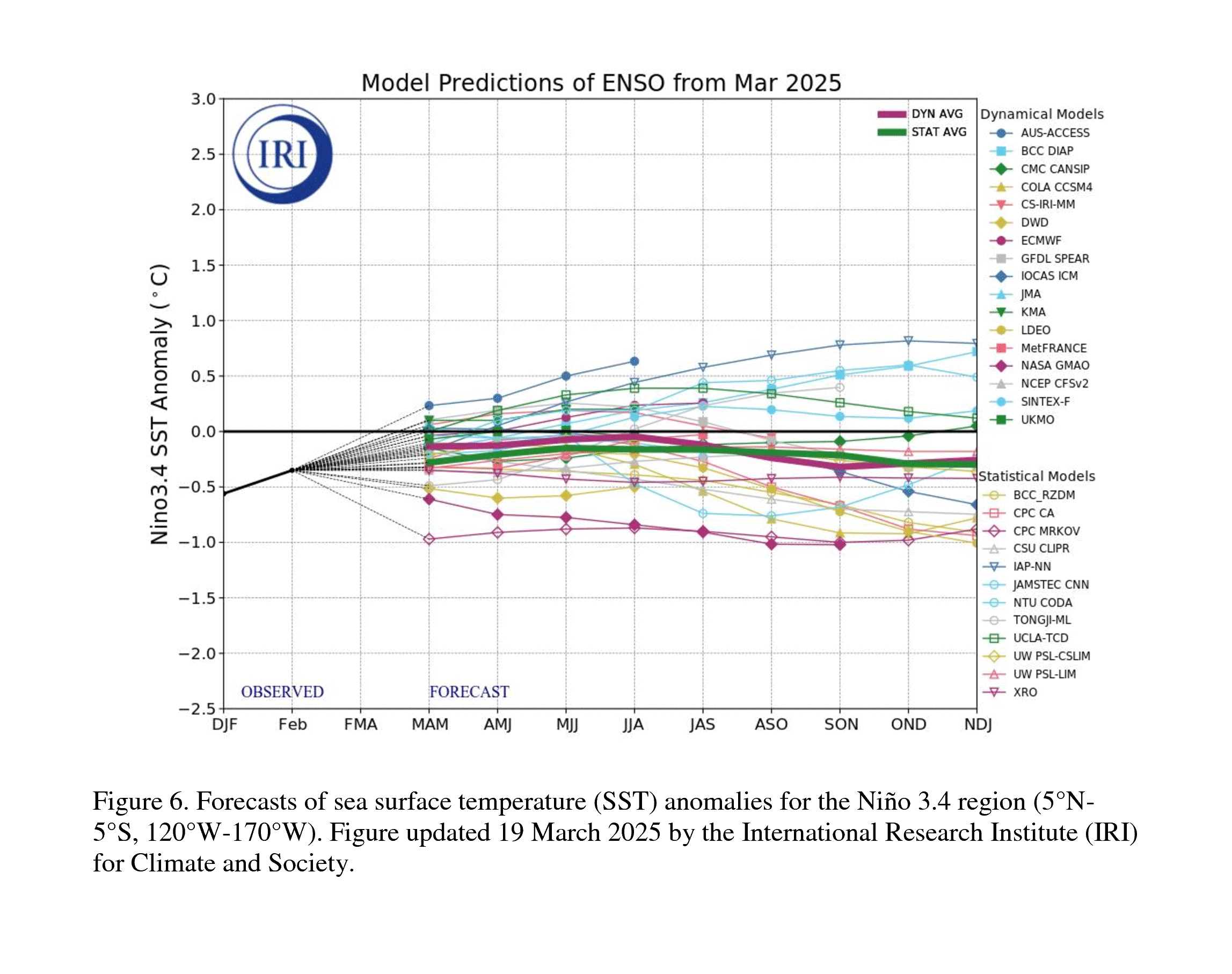
Forecast from March 2026 of the Niño3.4 Index. Red lines indicate different model forecasts. ECMWF, CC BY

The forecasts made in March 2017 are worth looking at. Here, models confidently predicted a moderate and long-lasting El Niño, similar to forecasts in March 2026. What happened instead was a short-lived, weak El Niño.

Forecast from March 2017 of the Niño3.4 Index. Red lines indicate different model forecasts and the dashed line indicates what actually happened. ECMWF

How should we think of El Niño forecasts?

As a scientist who has researched seasonal forecasts of Australian rainfall, my advice is to ignore autumn headlines warning of a potentially catastrophic “Super El Niño”.

These get more clicks than more accurate headlines pointing out long-term forecasts at this time of year are uncertain. It’s worth waiting until the end of autumn or early winter before taking El Niño forecasts too seriously.

The current gold standard for Australian seasonal forecasts are the Bureau of Meteorology’s long-range forecasts. But even here, these forecasts become quite uncertain more than a month in the future. It’s important to regularly check for updated forecasts.

Will we get an El Niño this year? The only scientifically accurate answer as of April 9 2026 is “maybe”. It’s way too early to say anything other than that an El Niño is more likely to form this year than a La Niña.

ref. Why the phrase “Super El Nino” makes Australian climate scientists roll their eyes – https://theconversation.com/why-the-phrase-super-el-nino-makes-australian-climate-scientists-roll-their-eyes-279758

Evening Report: https://eveningreport.nz/2026/04/09/why-the-phrase-super-el-nino-makes-australian-climate-scientists-roll-their-eyes-279758/

Northland shifts form recovery to readiness as Cyclone Vaianu approaches

Source: Radio New Zealand

Madleine CarrWhite, Massey Journalism Student

Aerial view of Whirinaki and State Highway 12 after the March storm. Supplied / FNDC

Northland communities are again bracing for the arrival of wild weather, only a couple of weeks after heavy rain and wind devastated parts of the region.

Cyclone Vaianu is set to touchdown in Northland this weekend, with authorities across the North Island preparing to withstand the potentially life-threatening storm.

Residents, businesses and growers across parts of Northland are now preparing for the Cyclone and what it might mean for their homes and livelihoods.

The organising efforts of Northland’s west coast

The Hokianga area – located on Northland’s west coast – was hit particularly hard by heavy rain and wind that struck the region in late March.

Whirinaki Trust chair Ruth Tautari has been organising the recovery effort for her community, told RNZ a number of evacuation centres were being stood up around Hokianga.

“We’ve just been going around Whirinaki, just giving everyone an update on the storm itself… just making sure that they are prepared, whether they have water in their tanks, making sure they’ve got the essentials they need to keep them going in the event that we get cut off for a couple of days with no power and no roading.” she said.

Tautari said many whānau were still dealing with the affects of recent flooding leaving them feeling “anxious”.

“We had six homes that were completely lost… the water went through and those whānau had to evacuate. We’ve got three whanau that are currently in temporary accommodation and the other three whānau are living with their whānau all outside of Whirinaki at the moment.” she said.

“The rest of the whānau in Whirinaki, they’ve just been going through re-establishing their access ways like roading, their sanitation, their septic tanks and removing all of the rubbish that got pushed down into their whare and just trying to get back to some sense of normal reality.”

As the cyclone bears down, a series of service hubs – called Rai ki te Rai – have been set up across the North. Tautari said welfare agencies and hauora organisations would be present.

“We’ve also got some of the teams from the Ministry of Housing and Urban Development to at their temporary accommodation services that they provide, but also a lot of mahi from the civil defence teams from Northland Regional Council and the whānau Far North District Council are coming up.”

“It’s quite heartbreaking to watch whānau go through it over again and just watch the stress come when the rain gets heavier, knowing that they could have to move from their whare but also that they could have to go through the whole situation again, removing silt, waters going through our marae and just the toll it takes, not just physically, but a lot of mental and emotional tolls.” she said.

‘It’s not an easy time’

A family shovelling silt off their Whirinaki property following the March storm. Supplied / FNDC

Former Ngāti Hine Forestry Trustchief executive and Green MP Hūhana Lyndon has been up North helping with the recovery effort. She told RNZ that the region now had to quickly switch it’s focus from recovery to readiness.

“The weather is comparable to Cyclone Gabrielle and touch down as early as lunchtime Saturday, whānau are now gearing up to brace and prepare for impact.” she said.

“We already have a stressed rohe or district from the last storm, it’s not an easy time”

Lyndon said she was in regular touch with local and central government, as well as marae and community members.

“There’s been a lot more response and pace by which people are moving now that we know that it’s coming, and the size and scale of what it could be.” she said.

“We’ve gone through Cyclone Gabriel, we’ve seen it, we’ve recovered from it. But it’s coming again, and it’s coming with significant impacts to Northland.”

Lyndon said marae were key parts of the region’s resilience infrastructure and should be resourced properly.

“We don’t have solar, we’ve got gaps in generators, we’ve got whānau who are cut off. They cannot get across to their home, and culverts are out. We need, sparkies, we need to be checking that are waterlocked… we are getting there, but unfortunately we’ve got a storm coming so it’s a bit of recovery as well as preparedness that’s going on right now.” Lyndon said.

March flooding in Northland’s Kerikeri RNZ/Tim Collins

Storms frieghtening for growers during prime harvest

The owner of a Wairoa business says everyone in the town is just hoping for the best.

Dianne Downey’s lime growing business was devastated after a nearby river burst it’s banks in 2024.

She is part of a class action lawsuit lodged against Hawke’s Bay Regional Council after many homes and businesses were flooded, with questions being asked about whether the river bar crest should have been lowered ahead of the weather event.

Downey said this latest storm was frightening for growers across the region.

“I’ve got pickers out there flat out picking at the moment because I just don’t want to lose all our fruit, we’re in prime harvest and all these growers around here are, so it’ll be the worst thing in the world if it all went pear shaped for us right now.”

Hawke’s Bay Regional Council said work was underway to maintain the lowered crest of the Wairoa bar to mitigate flooding.

Metservice has forecasted heavy rain and gale winds for Wairoa and surrounding rural areas on Sunday.

East Cape businesses getting geared up

Businesses in Hicks Bay say their community is resilient in the face of weather events.

RNZ spoke to businesses in Hicks Bay, where storms had badly hit the community at the start of the year.

One business told RNZ that there is no panic ahead of Cyclone Vaianu’s anticipated landfall this weekend.

A supermarket says people are getting extra supplies to prepare but aren’t getting more than what they need.

The store clerk says they want to stay open as long as it is safe so that they can be available to the community.

Retailers say the community is preparing to be self-sufficient, having learnt from the storms at the beginning of the year which caused roads to close and cut locals off from the rest of the motu.

A business owner says locals are getting used to living with severe weather events.

Cyclone Vaianu is expected to reach Northland late on Saturday night.

Sign up for Ngā Pitopito Kōrero, a daily newsletter curated by our editors and delivered straight to your inbox every weekday.

– Published by EveningReport.nz and AsiaPacificReport.nz, see: MIL OSI in partnership with Radio New Zealand

LiveNews: https://nz.mil-osi.com/2026/04/09/northland-shifts-form-recovery-to-readiness-as-cyclone-vaianu-approaches/
‘Tiny backpacks because they are tiny frogs’: Researchers track one of NZ’s smallest frogs

Source: Radio New Zealand

A Hochstetter’s frog with a transmitter. Tobia Dale

In a bid to learn more about one of New Zealand’s smallest frogs, researchers have come up with a novel way of tracking them.

The Hochstetter’s frog measure three-to-four-centimetres, and researchers developed tiny backpacks that are perfect for the native frogs.

Associate Professor Stephanie Godfrey supervised the study which took place in the Coromandel, and told Checkpoint the backpacks contained transmitters that weighed 0.5 of a gram, and were tricky to get on.

“It’s a matter of very gently trying to just wrap the little harness around their waists and then tighten it gently with a cotton thread.

“We use tiny backpacks because they are tiny frogs.”

The study shed some light on the movement of the endangered frogs, and was the first time such research had been carried out due to the challenge of finding transmitters that are small enough.

The frogs like living in creek banks. Tobia Dale

“It’s been really hard to get good insights into their movements because it’s hard to track a tiny frog.”

But even though the frogs are tiny, they are still susceptible to a common human problem.

“The main thing we noticed is that they did develop these little small abrasions just around their hip joints where the harnesses were resting… a little bit of chafe.” Godfrey said.

But overall, Godfrey said the frogs did “did pretty well with the backpacks”.

The transmitters had a “pretty short” battery life, but Godfrey said the longest they managed to track a frog was 16 days.

The frogs also like living under rocks. Tobia Dale

But they were able to record some interesting movements.

“We saw that their biggest movement during the period of our study was almost 17 metres, which is a long way for a three-to-four-centimetre frog.”

The researchers also found out more about their habitat and where they like to live.

“We found that they like living in banks of sort of creek banks. They like living under rocks and they tend to sort of stick around the same place for a while before getting up and moving elsewhere.”

The research will help with the protection of the frogs in the future.

“The main reason for collecting this data is to try and just understand a bit more about how much space they need when we’re protecting them. So when things like developments are happening or we want to translocate them.

The researchers used radio receivers to find the frogs with trackers. Katie Ryan

“It’s really important to know what habitat they’re using, how far they move, so that we can put in measures to protect them and ensure there’s sufficient habitat and of the right type.”

Godfrey said there are even smaller trackers, that weigh 0.17 of a gram, and would allow the frogs to wear the harness for longer, and was hopeful more research could be carried out on the frog’s movements.

“The goal of improving the way the backpacks sit on these frogs is to enable us to track them for longer. They tend to sit tight in the same place for a long time. If we only track them for a week or two weeks, we might not fully capture the entire area that they’re using.”

Sign up for Ngā Pitopito Kōrero, a daily newsletter curated by our editors and delivered straight to your inbox every weekday.

– Published by EveningReport.nz and AsiaPacificReport.nz, see: MIL OSI in partnership with Radio New Zealand

LiveNews: https://nz.mil-osi.com/2026/04/09/tiny-backpacks-because-they-are-tiny-frogs-researchers-track-one-of-nzs-smallest-frogs/

Will the conflict in Lebanon destroy the US-Iran ceasefire? Maybe, but it was already shaky

Source: The Conversation (Au and NZ) – By Jessica Genauer, Academic Director, Public Policy Institute, UNSW Sydney

Just hours after the leaders of the United States, Israel and Iran reached a temporary ceasefire, it was clear that each party had its own version of what had been agreed to.

Hundreds of people in Lebanon have been killed in Israeli airstrikes in the past 24 hours, immediately threatening to undermine the fragile agreement.

Iran had insisted hostilities in Lebanon cease as part of the deal, but Israel argued Lebanon was not included. The result is an ongoing proxy conflict alongside the main war, which has been paused for two weeks.

Given the US seems uninterested in addressing the intractable issues at the heart of tensions in the Middle East, this result was somewhat inevitable. It seems the most likely outcome now is the US will back out while claiming victory, leaving the region’s prewar status quo largely intact.

The importance of Lebanon

Lebanon has not been an official part of the war in the region, and is not a party to the ceasefire. So why is it so central to the conflict?

Since the Iranian revolution of 1979, the Iranian regime has funded and armed anti-Israel movements in the region including Hezbollah in Lebanon, Hamas in Gaza and the Houthis in Yemen.

Throughout its history as a nation, Israel has at times occupied and held security “buffer zones” around its territory.

After the fall of leader Bashar al-Assad in 2024, Israeli forces conducted a military operation in southern Syria, occupying a demilitarised buffer zone in the southwest of the country.

Israel has diplomatic agreements with Egypt and Jordan, leaving the focus on Iran and the proxies it supports. The proxies closest to Israel, and therefore of most concern from the government’s perspective, are Hamas in Gaza and Hezbollah in Lebanon.

Since the October 7 attacks, the Israeli government has taken an offensive military approach to dealing with both groups. From the perspective of Israel, Hamas and Hezbollah are just as severe security threats as Iran.

While both proxy groups have been severely degraded since 2023, they are still operating.

Since the onset of the conflict with Iran, the Israeli government has taken the opportunity to extend a security buffer zone in southern Lebanon. Under President Benjamin Netanyahu, Israel is very unlikely to give up this ambition.

For Trump’s part, it is unclear whether he could persuade Netanyahu to abandon it, or if he even wants to try.

Will the ceasefire survive?

Unless the US can bring Israel into line and convince Netanyahu to stop its action in Lebanon, the ceasefire will fall apart.

Iran has insisted fighting in Lebanon must end as part of the agreement. This is the regime’s way of protecting and supporting its much-diminished proxies. As negotiations get underway for a more lasting deal, the issue of Lebanon will become a key sticking point.

This is in part because resisting Israel and the US is not just politically expedient for Iran; it is at the core of the Iranian regime’s identity and existence.

While deeper antagonism that drives tensions in the region remains unaddressed, there’s little prospect of lasting peace.

Trump seems set on a US withdrawal from the war with Iran. The US leaves behind a security environment that upholds the existing tensions in the region. Iran and Israel will continue to engage in the tit-for-tat violence that led us here.

A flawed exit strategy

A key issue with Trump’s approach in the Middle East is he has no real interest in resolving the core issue of Israel’s place in the region. He’s shown little grasp of the deeper historical roots at play.

What seems to be front of mind for Trump is the unpopularity of the war within the US. With Trump’s approval ratings at a record low and the conflict already dragging on longer than many expected, the president is looking for a way out.

This might be why Iran’s ten-point plan, which was previously “not good enough”, is now a “workable basis on which to negotiate”.

The conflict in Iran is increasingly unpopular with people in the US. Ryan Murphy/AP

While there are competing versions of the ten points, they all include conditions the US could never reasonably accept, such as leaving control of the Strait of Hormuz in Iranian hands.

Iran also insists it wants to reserve the right to enrich uranium, something that would be contrary to the stated basis for this war in the first place: Iran’s ability to develop nuclear weapons.

By declaring the conditions suddenly right for a ceasefire, Trump is stating a reality he’d like to see, rather than describing tangible changes on the ground.

In practice, the US has already ceded ground to Iran, which has indicated it is not willing to compromise on anything. While Iran’s military capability to interfere in the region may be diminished for now, the will remains.

So with the ten points as a basis of negotiation, it is hard to see a path towards lasting peace in the next fortnight. Instead the US is likely to exit, leaving behind a lot of damage, but little materially changed.

ref. Will the conflict in Lebanon destroy the US-Iran ceasefire? Maybe, but it was already shaky – https://theconversation.com/will-the-conflict-in-lebanon-destroy-the-us-iran-ceasefire-maybe-but-it-was-already-shaky-280259

Evening Report: https://eveningreport.nz/2026/04/09/will-the-conflict-in-lebanon-destroy-the-us-iran-ceasefire-maybe-but-it-was-already-shaky-280259/

Chinese Mainland’s Largest Conference on Chest Pain Centres Goes Global in Hong Kong

Source: Media Outreach

HONG KONG SAR – Media OutReach Newswire – 9 April 2026 – Marking yet another milestone as the World’s Meeting Place, Hong Kong became the first city outside Chinese Mainland to host the nation’s largest conference on chest pain centres – the 15th China Chest Pain Centers Congress (CCPCC 2026), thanks to the effort of Hong Kong Convention Ambassador (HKCA) appointed by the Hong Kong Tourism Board (HKTB).

Together with two other high-profile and hugely successful medical congresses – the 41st Asia Pacific Academy of Ophthalmology Congress in February and the 17th Asian Congress of Oral & Maxillofacial Surgery in March, Hong Kong’s medical science events space was off to a strong start in 2026.

Ms Marilyn Tham, General Manager of Mega Events, MICE & Cruise of the HKTB said, “Hong Kong’s leading edge in medical sciences coupled with the city’s world-class venues and destination appeal have enabled notable success for internationally significant medical events. CCPCC 2026 is one of the large-scale medical conventions confirmed for 2026. Such robust lineup reflects event organisers’ confidence in Hong Kong as a premier hub for advancing global exchanges on medical sciences.”

Over 10 medical conventions have secured a spot in Hong Kong this year, spanning diverse disciplines, from cytology to oncology, antimicrobial resistance and more (see full list below). The breadth and depth of the events reflects Hong Kong’s growing appeal as the premier convention hub where global medical minds meet.

Globalising Chest Pain Leadership from Hong Kong

Held on 3-4 April 2026 at the Hong Kong Convention and Exhibition Centre with a concurrent venue in Shenzhen, CCPCC 2026 converged 3,000 healthcare leaders, physicians, nurses, researchers, policymakers and industry experts from Hong Kong, Chinese Mainland, the Belt and Road countries and beyond. The rich topics explored across two days encompassed cutting-edge healthcare innovations, AI-assisted clinical decision-making, intelligent emergency response systems and international accreditation standards.

Co-organised by Hospital Authority (HA) of Hong Kong, the National Clinical Research Center for Interventional Medicine, the Guangdong Chest Pain Centers Association, the Chinese Cardiovascular Association (CCA) and Oriental Huaxia Cardiovascular Health Research Institute (OHCHRI), Suzhou Industrial Park, CCPCC 2026 showcased conducive partnership.

Mr. Wenming Zeng, Secretary-General of OHCHRI, remarked, “The global influence of CCPCC has been growing over the years. Thanks to Hong Kong’s strategic location, leading medical standing and its unique role bridging Chinese Mainland and the world, this year’s congress has drawn even wider global participation, giving the event greater international significance. Hong Kong has helped showcase our event to the world, taking cardiovascular emergency intervention to a new height globally.”

A Launchpad for Mainland-spearheaded International Standards

Capitalising on Hong Kong’s strengths as a super-connector for fostering globalisation, CCPCC 2026 released for the first time the “International Standards on Chest Pain Center Construction and Accreditation”, marking Mainland’s global leadership in cutting-edge cardiovascular emergency intervention. Leveraging Hong Kong’s internationalisation, the efforts to foster global policy support and implementation of the standards will contribute to fair, accessible and timely intervention for cardiovascular emergencies around the world.

Another Significant Win for HKCA Programme on its 5th Anniversary

As a HKTB-appointed HKCA, Prof Lu Shi-Juan, who is a Member of Hainan Medical Association Cardiovascular Professional Committee, played an instrumental role in bringing CCPCC 2026 to Hong Kong. This marked the latest success story of the HKCA programme, as HKTB celebrated the programme’s milestone 5th anniversary with a HKCA Networking Cocktail Event on 31 March, 2026.

Prof Lu noted, “As a Hong Kong International Convention Ambassador, I have worked closely with the HKTB to bring CCPCC to Hong Kong, which is a gateway to the global stage. Hosting the conference here showcases how Hong Kong can elevate Mainland conferences internationally, foster cross‑border knowledge exchange and help shape the future development of the broader medical and professional community.”

The HKCA programme bands together over 170 local and mainland sector leaders of 13 industries and academics to champion Hong Kong as the World’s Meeting Place. Their initiative and connections have helped Hong Kong secure 50 convention wins that have brought in nearly 100,000 high-value overnight MICE visitors.

Strong Medical Events Lineup in 2026

Over 10 medical conventions will be held in 2026 across various disciplines, including ophthalmology, oncology, antimicrobial resistance and cytology.

Event

(*first-ever in Hong Kong)

Date / Venue Highlights
The 41st Asia-Pacific Academy of Ophthalmology Congress 2026 5-8 Feb,

HKCEC

The largest and most authoritative ophthalmology congress in APAC, returning to HK for the fifth time, with record-breakingattendance of 11,000+ participants from 111 countries and regions.
The 17th Asian Congress on Oral and Maxillofacial Surgery 2026 27-29 Mar,

HKCEC

Held in Hong Kong for the second time, bringing together internationally acclaimed speakers, globally renowned experts and young surgeons to foster academic exchange and professional development.
The 15th China Chest Pain Centers Congress 3-4 Apr,

HKCEC

Chinese Mainland’s largest conference on chest pain centres, hosted for the first time outside Chinese Mainland.
*Asian Federation of Cytology Societies Conference 2026 8-10 May,

Postgraduate Education Centre, Prince of Wales Hospital

First edition in Hong Kong, bringing together regional and international cytology experts for academic exchange and collaboration.
International Symposium on Antimicrobial Agents and Resistance 2026 12-14 Jun,

HKCEC

A key international platform for academic exchange on infectious diseases and antimicrobial resistance.
European Society of Medical Oncology Targeted Anticancer Therapies Asia 2026 12-14 Jun,

Kerry Hotel

A key Asia-Pacific platform for showcasing the latest advances in early-phase oncology drug development, targeted therapies and precision oncology.
Federation of Asian and Oceanian Biochemists and Molecular Biologists Conference 2026 10-13 Aug,

Cheung Kung Hai Conference Centre, The University of Hong Kong

A major regional scientific meeting in biochemistry and molecular biology, bringing together researchers, educators and professionals from across Asia and Oceania for academic exchange and collaboration.
* 2026 World Cancer Congress 24-26 Sep,

HKCEC

A leading global forum advancing cancer control and research.
2026 Asia-Pacific Longevity Medicine International Summit 1-4 Oct,

TBC

A leading international platform and regional collaborative hub dedicated to longevity medicine and innovation, attracting top longevity scientists, medical experts, cross-industry entrepreneurs and investors from over 50 countries.
10th Asia Cornea Society Scientific Meeting 2026 11-13 Dec,

TBC

A key regional forum for cornea specialists to exchange the latest clinical insights, diagnostics and treatments, and to strengthen collaboration across the Asia-Pacific ophthalmology community.
Association of Pacific Rim Universities (APRU) Global Health Conference 2026 7-9 Dec,

Henry Cheng International Conference Centre, CUHK

Third time in Hong Kong, convening leading academics, policymakers and practitioners to address critical global health challenges through interdisciplinary collaboration and innovation.

https://www.mehongkong.com/eng/home.html
https://www.linkedin.com/company/meetings-exhibitions-hong-kong/

Hashtag: #HongKongTourismBoard #MEHK #MeetingsandExhibitionsHongKong #HongKong #MICE #Medical #Convention #Conference #Event

The issuer is solely responsible for the content of this announcement.

– Published and distributed with permission of Media-Outreach.com.

LiveNews: https://livenews.co.nz/2026/04/09/chinese-mainlands-largest-conference-on-chest-pain-centres-goes-global-in-hong-kong/

Blonde Blues pay tribute to terminally ill teammate

Source: Radio New Zealand

Blues forward Suafua announced his retirement from rugby at just 27 years of age. Photosport / AAP / Darren England

The Blues will be sporting some new hair styles this weekend, as they pay tribute to a teammate forced out of the game.

Cam Suafua has been battling cancer since 2023, but recently got the tragic news that it was now terminal.

Suafua announced his retirement from rugby at just 27.

In an act of solidarity with Suafua, the Blues players have all either shaved their heads, or bleached their hair blonde.

Coach Vern Cotter said they have shared Suafua’s fight since the start.

“There’s a very strong awareness around and there’s a lot of empathy and I think the players are drawing strength from it as well. It was nice to have them here at training on Tuesday and the players will show in their own way. What they’re really focused on is making sure we go as far as we can in the season and take them with us for as long and far as we can,” he said.

Cotter joked he was unable to find a suitable hair dye, so opted for the shaving option.

“There’s a solidarity within the group, a strong sense of together.”

The Blues return to action this weekend in the capital against the Hurricanes in a top of the table clash.

The side is well aware of the threats the canes possess across the park.

The Hurricanes have been in blistering form of late, putting half centuries on the Highlanders and Reds in consecutive weeks.

“You don’t score 50 points by not being good. The key for us is to stay in for 80 minutes and make sure that we don’t give them too much space because a team like that, when they get it. they can become very difficult to play.”

Cotter said the squad was fizzing at the prospect of meeting the competition leaders, a match Cotter said will be a measure of where they truly are in 2026.

“They’re going to be up for this. One v Two. This is what the rugby’s about and this is why you play the game, is to measure yourself up against the best, whether it’s individually or collectively. It’s going to be an intense game of rugby. It’s really important we play 80 minutes. I don’t think we can get away with trying to put in a 60 minute effort.”

A threat the Blues won’t be sleeping on is that of All Black halfback Cam Roigard.

“You can’t ignore him. One player can’t cover all the spots. So we’ll be just keeping an eye on him. But once again, if they create those fast ball opportunities or line breaks, then he’s very good in the opposition 22.”

Midway through the campaign, Cotter said they are where they want to be.

“Your season is constantly evolving and at the moment, it’s evolving in the right direction. But you’re only as good as your last game, we get a chance to measure ourselves this weekend and then we’ll draw conclusions from that.”

Sign up for Ngā Pitopito Kōrero, a daily newsletter curated by our editors and delivered straight to your inbox every weekday.

– Published by EveningReport.nz and AsiaPacificReport.nz, see: MIL OSI in partnership with Radio New Zealand

LiveNews: https://nz.mil-osi.com/2026/04/09/blonde-blues-pay-tribute-to-terminally-ill-teammate/

DOC decides no action needed against McCallum Brothers sand mining in Pākiri

Source: Radio New Zealand

The company is seeking consent to mine up to eight million cubic metres of sand 4km offshore in Bream Bay. Supplied

The Department of Conservation has decided against taking action against a sand mining company over allegations it disturbed protected stony corals, citing insufficient evidence.

The complaint arose from dredging carried out by McCallum Brothers in the Pākiri temporary sand extraction area, north of Auckland, in 2025.

The company has since stopped sand mining at Pākiri but is applying for a fast-tracked resource consent to take sand from Northland’s Bream Bay instead.

DOC launched an investigation after Pākiri resident Damon Clapshaw contacted the department alleging McCallum Brothers had continued dredging after ecological consultants discovered stony corals in the area in March 2025.

Dredging ended when the protected coral was formally identified three months later.

Wildlife crime team lead Dylan Swain said DOC had investigated two alleged breaches of the Wildlife Act 1953.

He said the act made it an offence to “take or disturb absolutely protected marine wildlife without authority”.

It was also an offence to fail to report accidental or incidental death or injury of marine wildlife.

Swain said the investigation had now been completed.

“Although corals were identified in the area, there is insufficient evidence to prove stony corals were disturbed by the company. Therefore, we will not be pursuing enforcement action.”

Swain said DOC had notified the company and the person who brought the information to the department’s attention.

Earlier, Clapshaw told RNZ he believed DOC should have been notified of the discovery of stony corals straight away, and he was concerned coral may have been disturbed in the months between its discovery and the cessation of dredging.

McCallum Brothers chief operating officer Shayne Elstob said the company would not comment on DOC’s decision while its Bream Bay sand-mining application was being processed by the fast-track expert panel.

The company is seeking consent to mine up to eight million cubic metres of sand 4km offshore in Bream Bay – 150,000 cu m per year for the first three years, and up to 250,000 cu m per year for the next 32 years.

An estimated 700 people gathered on Northland’s Ruakākā Beach in March to protest a proposed sand mining operation. Supplied / Bream Bay Guardians

Meanwhile, it has been revealed that the expert panel’s decision on the sand-mining application is due on 1 October.

In a memo published to the fast-track website, associate panel convener Helen Atkins said she had appointed a three-person panel to consider the application, which had been received in full on 17 February.

The panel would be chaired by environmental lawyer Catherine Somerville‑Frost and would start work on 13 April.

Comments from invited parties would be accepted from 28 April, and the decision documents were due on 1 October.

The proposal has sparked protests in Bream Bay, including a gathering of about 700 people at Ruakākā Beach last month.

Sign up for Ngā Pitopito Kōrero, a daily newsletter curated by our editors and delivered straight to your inbox every weekday.

– Published by EveningReport.nz and AsiaPacificReport.nz, see: MIL OSI in partnership with Radio New Zealand

LiveNews: https://nz.mil-osi.com/2026/04/09/doc-decides-no-action-needed-against-mccallum-brothers-sand-mining-in-pakiri/

Thousands needing work in Kaikohe, but virtually nowhere to go

Source: Radio New Zealand

In the Far North town of Kaikohe, finding a job is a bare knuckle brawl.

Local employment adviser Megan Hepi, director of community advocacy organisation Nga Taonga o Kaikohe, says she’s snowed under with thousands needing a job and virtually nowhere for them to go.

Among those is Mikaere Mapiria, 37, who has been looking for a job for six years and is among the 6000 people on the Jobseeker benefit in the region.

Hepi estimates “a couple thousand” of those live in Kaikohe, which has a population of about 5000.

Fifteen jobs advertised in Kaikohe, with “a couple thousand” on Jobseeker benefit. Nick Monro

On the day Checkpoint visits Kaikohe, 15 jobs are advertised.

Mapiria spends a lot of time at the Mill Gym Kaikohe, where he trains and helps out – but it’s not paid work.

“My last job was during the lockdowns – Covid.

“I was doing security at the Countdown. It’s called Fresh Choice now.

“Maybe the last year or so, I’ve been trying to look for a job, and [there’s] just nothing that will let me train and work.

“It’s real hard, especially for our people up here, They do want to work, but there’s just nothing for them to go to.”

Hepi echoes Mapiria’s message, and says the lack of stable and decent employment opportunities for locals is “heartbreaking”.

“I meet so many beautiful people on the daily ‘looking for employment, wanting employment, wanting better, wanting something different’, but they just don’t know the pathway to get there.”

She scours the Jobseeker websites daily and says the fact that just “15 jobs” are advertised for “thousands” wanting work on the day she speaks to Checkpoint shows a huge disconnect in the region.

Her own teenage son can’t find a job, despite working at a used car parts company in Auckland for a year.

Mikaere Mapiria spends a lot of time at the Mill Gym. Nick Monro

“I cannot place my own son – my own son, who’s had a year’s experience. Good boy, full license, 19-years-old, got a bike, license, done everything right… I can’t get him placed.

“He is with a case manager at MSD, whose job is specifically to place him. [They] can’t place him.”

She also points to the lack of appropriate jobs in the area. Often, roles advertised are seasonal, such as fruit picking in Kerikeri.

These roles are for fixed-term shiftwork, and are physically demanding and often involve travelling long distances, wracking up petrol costs.

These types of conditions are difficult for a lot of people, including those with families, Hepi says.

Kylie Fifield is one person Hepi is supporting to find work. She’s a solo parent of five and has been on a benefit for 11 years.

Local employment adviser Megan Hepi is snowed under with people looking for jobs. Nick Monro

“I have worked part time, off-and-on as I can, doing things like childcare, creche, working in our local puna… just odd jobs like that, but finding a job that was suitable for me and being a solo mum is really hard.”

The lack of local opportunities has been difficult for her whole family, Fifield says.

“My oldest is now 23 – she’s moved to Australia – and my next son, he’s just turned 19 and doing a building apprenticeship in Auckland. My next son down is nearly 18 and he’s moved to Australia.

“Here [in Kaikohe}, there’s not the jobs for them.”

Back at the Mill Gym, Mapiria says he’s also thought about leaving. Several friends have moved to Australia to find work.

Mother of five Kylie Fifield has already seen two of her children move to Australia. Nick Monro

“Sometimes, they have to uplift their whole family, just so they can go somewhere where they can actually get paid their worth.”

He says it’s been a few days since he looked at what jobs were being advertised. None of them were suitable for him.

Mapiria also says the protracted job hunt has been disheartening.

“They don’t really give you specifics – it’s just like, ‘Yeah, keep looking. Maybe get a qualification’.

“Then there’s some people I know that get those qualifications and when they go back to the job, they’re like, ‘Oh, now you’re too overqualified’.”

Despite the ongoing challenges, Mapiria is determined to stay in Kaikohe. For him, it’s home and where he belongs.

“I am from up this way.

“If I had nothing here, I would have left ages ago, but I’ve got a lot here, so I can’t just up and leave.”

Sign up for Ngā Pitopito Kōrero, a daily newsletter curated by our editors and delivered straight to your inbox every weekday.

– Published by EveningReport.nz and AsiaPacificReport.nz, see: MIL OSI in partnership with Radio New Zealand

LiveNews: https://nz.mil-osi.com/2026/04/09/thousands-needing-work-in-kaikohe-but-virtually-nowhere-to-go/

Calls for strict monitoring of would-be child sex abuser after alleged breach

Source: Radio New Zealand

123RF

A justice advocacy group is calling for a would-be child sex abuser to be more closely monitored after he was charged with allegedly breaching his release conditions.

The Sensible Sentencing Trust has written to the Department of Corrections asking it to apply for an Extended Supervision Order (ESO) for John Tekuru. If granted an ESO allows sexual or violent offenders to be monitored for up to 10 years at a time after release.

Tekuru, who is in his 20s, served 12 months in jail for taking a three-year-old girl from a Rotorua day care centre with the intent of sexually abusing her.

He is now back in custody and due to appear in court in Auckland after allegedly breaching his release conditions.

One of his release conditions prevents him from loitering where children are likely to be, including in schools.

In a statement, Corrections said it has not made an application for either an Extended Supervision Order or Public Protection Order for John Tekuru.

It says an individual needs to be considered a high risk of further offending and must meet a number of very specfic criteria under the Parole Act -in order for an application to be pursued.

Corrections says only a very small number of people are likely to be subject to Public Protection Orders – which allow the detention of very high-risk individuals at a secure facility within prison precincts.

Sign up for Ngā Pitopito Kōrero, a daily newsletter curated by our editors and delivered straight to your inbox every weekday.

– Published by EveningReport.nz and AsiaPacificReport.nz, see: MIL OSI in partnership with Radio New Zealand

LiveNews: https://nz.mil-osi.com/2026/04/09/calls-for-strict-monitoring-of-would-be-child-sex-abuser-after-alleged-breach/

Former Silver Fern captain Katrina Rore gets shock call-up to Australian league

Source: Radio New Zealand

Katrina Rore last played for the Silver Ferns in 2019. SWpix.com

Silver Fern great Katrina Rore has come out of retirement to join the New South Wales Swifts as a temporary replacement player in Australia’s SSN competition.

Rore will provide cover for injured Diamonds defender Sarah Klau, who is rehabbing a quad injury.

Rore was a Suncorp Super Netball (SSN) champion with the Swifts in 2019, the same year she won an elusive World Cup with the Silver Ferns.

The 38-year-old officially announced her retirement from international netball in 2022, ending a decorated career with 137 caps. Her last appearance for the Silver Ferns was in 2019.

Rore planned to make her domestic comeback in 2022 with the Waikato Bay of Plenty Magic, but that did not eventuate when she discovered she was pregnant with her second child.

Rore, who now lives in Australia with her family, was called up to provide short-term injury cover in the 2023 ANZ Premiership for the Stars and Pulse.

The former New Zealand captain joins current Silver Fern shooter Grace Nweke at the Swifts, as well as her former New Zealand team-mate Gina Crampton.

Rore will become the 10th Kiwi to play in the this year’s SSN, after a number of players crossed the ditch thanks to Netball NZ loosening its eligibility rules last year.

Swifts head coach Briony Akle said she was delighted to welcome Rore back to the environment.

“Katrina did an amazing job for us in 2019 when Kate Eddy went down and her accomplishments in the game need no introduction.

“Like Sarah, Katrina is a world-class defender and a Premiership and World Cup champion. Recently she’s been playing a very high level of club netball in Brisbane, so I know she’s ready to step back into the elite level because her class is permanent.”

Akle said Rore has only been named as cover for this weekend’s game at this stage, with Klau expected to make a quick recovery.

“We’ll do an assessment next week to see if she’s ready to face the Firebirds in Round 6. It’s a massive year for Sarah, not just for the Swifts but also for the Australian Diamonds so we won’t get her on court her until she’s fully right.”

Meanwhile, former Silver Fern defender Jane Watson is expected to miss the next six to eight weeks of her debut Suncorp Super Netball season with the Giants.

Watson had to leave the court during the Giants’ round four game on the weekend with scans revealing a torn MCL on her left knee and medium-grade calf strain on her right calf.

Rore will be in the Swifts’ team for Saturday’s game against the Melbourne Vixens.

Sign up for Ngā Pitopito Kōrero, a daily newsletter curated by our editors and delivered straight to your inbox every weekday.

– Published by EveningReport.nz and AsiaPacificReport.nz, see: MIL OSI in partnership with Radio New Zealand

LiveNews: https://nz.mil-osi.com/2026/04/09/former-silver-fern-captain-katrina-rore-gets-shock-call-up-to-australian-league/

Business leaders urge government to prioritise food supply in fuel plan

Source: Radio New Zealand

Top chief executives took part in an hour-long call with ministers including Prime Minister Christopher Luxon and Finance Minister Nicola Willis over the fuel rationing framework. File picture. RNZ / Samuel Rillstone

BusinessNZ has made its case to ministers as to why the food and grocery sector should be put in the highest priority level of any fuel rationing framework.

Top chief executives – from the organisation’s Major Companies Group – took part in an hour-long call on Thursday morning, featuring Prime Minister Christopher Luxon, Finance Minister Nicola Willis and Associate Energy Minister Shane Jones.

BusinessNZ chief executive Katherine Rich told RNZ that attendees sought “greater clarity” from the government on how fuel rationing would be implemented if it activated the more extreme phases of its National Fuel Plan.

She said Willis encouraged business leaders to take part in the current consultation process and to keep sending through their on-the-ground insights.

Rich, who previously led the Food and Grocery Council for more than a decade, said she lobbied for the food industry to be given highest priority alongside other “life-supporting services” in Band A, like hospitals, courts and lifeline utilities.

“Feeding people is about supporting life and maintaining calm,” she said.

Under the draft framework published in March, food supply and distribution were categorised as “economically important services” and placed in the second highest priority level, Band B.

Rich said ministers did not signal where decisions might land, but business leaders felt their views were valued: “We do feel heard.”

The session brought together representatives from some of the country’s largest employers, spanning sectors including banking, infrastructure, tourism and logistics.

As well as the ministers, it included senior officials from Treasury, the Ministry of Business, Innovation and Employment, and the Ministry of Foreign Affairs and Trade.

Officials also invited ongoing input from industry, Rich said, particularly around red-tape or practical challenges businesses might face if fuel supplies tightened.

She said that level of engagement marked an improvement on the Covid-19 response, with businesses now being given more opportunity to contribute to decision-making.

“We’re facing a very fast-moving situation, and the information flow is very important,” Rich said.

“There’s a lot here that business can do on its own to try and work around some of the international disruption, but we need to make sure we keep the government informed.”

Rich said attendees found it “valuable” to ask questions and share their views, and they left the meeting with confidence that ministers and officials were doing everything they could to ensure New Zealand was in a strong position to deal with any disruption.

Speaking from Nelson on Thursday, Luxon told reporters the government was “working really closely” with industry players, including daily contact with the fuel companies.

“We have worked well in partnership, incredibly well. And we’ve also put New Zealand’s Commerce Commission on watch from day one to make sure that fuel companies are not gouging New Zealanders, and we haven’t seen evidence of that.”

Asked about the latest developments in the Middle East, Luxon said the potential for a ceasefire was promising but very fragile.

“We’ve got a long way to go. There’s a lot of trust that needs to be built back between the US and Iran, and we… encourage everybody to put best efforts forward to get to that long, lasting peace that we desperately need.”

Sign up for Ngā Pitopito Kōrero, a daily newsletter curated by our editors and delivered straight to your inbox every weekday.

– Published by EveningReport.nz and AsiaPacificReport.nz, see: MIL OSI in partnership with Radio New Zealand

LiveNews: https://nz.mil-osi.com/2026/04/09/business-leaders-urge-government-to-prioritise-food-supply-in-fuel-plan/

Northland settlement, Whirinaki bracing for wild weather again as Cyclone Vaianu approaches

Source: Radio New Zealand

Aerial view of Whirinaki and State Highway 12 after the March storm. Supplied / FNDC

The small Northland settlement of Whirinaki is again bracing for the arrival of wild weather, only a couple of weeks after heavy rain and wind devastated parts of the region.

Cyclone Vaianu is set to touchdown in Northland this weekend, with authorities across the North Island preparing to withstand the potentially life-threatening storm.

The Hokianga area – located on Northland’s west coast – was hit particularly hard by heavy rain and wind that struck the region in late March.

Whirinaki Trust chair Ruth Tautari has been organising the recovery effort for her community, told RNZ a number of evacuation centres were being stood up around Hokianga.

“We’ve just been going around Whirinaki, just giving everyone an update on the storm itself… just making sure that they are prepared, whether they have water in their tanks, making sure they’ve got the essentials they need to keep them going in the event that we get cut off for a couple of days with no power and no roading.” she said.

Tautari said many whānau were still dealing with the affects of recent flooding leaving them feeling “anxious”.

“We had six homes that were completely lost… the water went through and those whānau had to evacuate. We’ve got three whanau that are currently in temporary accommodation and the other three whānau are living with their whānau all outside of Whirinaki at the moment.” she said.

A family shovelling silt off their Whirinaki property following the March storm. Supplied / FNDC

“The rest of the whānau in Whirinaki, they’ve just been going through re-establishing their access ways like roading, their sanitation, their septic tanks and removing all of the rubbish that got pushed down into their whare and just trying to get back to some sense of normal reality.”

As the cyclone bears down, a series of service hubs – called Rai ki te Rai – have been set up across the North. Tautari said welfare agencies and hauora organisations would be present.

“We’ve also got some of the teams from the Ministry of Housing and Urban Development to at their temporary accommodation services that they provide, but also a lot of mahi from the civil defence teams from Northland Regional Council and the whānau Far North District Council are coming up.”

“It’s quite heartbreaking to watch whānau go through it over again and just watch the stress come when the rain gets heavier, knowing that they could have to move from their whare but also that they could have to go through the whole situation again, removing silt, waters going through our marae and just the toll it takes, not just physically, but a lot of mental and emotional tolls.” she said.

Former Ngāti Hine Forestry Trustchief executive and Green MP Hūhana Lyndon has been up North helping with the recovery effort. She told RNZ that the region now had to quickly switch it’s focus from recovery to readiness.

“The weather is comparable to Cyclone Gabrielle and touch down as early as lunchtime Saturday, whānau are now gearing up to brace and prepare for impact.” she said.

“We already have a stressed rohe or district from the last storm, it’s not an easy time”

Lyndon said she was in regular touch with local and central government, as well as marae and community members.

“There’s been a lot more response and pace by which people are moving now that we know that it’s coming, and the size and scale of what it could be.” she said.

“We’ve gone through Cyclone Gabriel, we’ve seen it, we’ve recovered from it. But it’s coming again, and it’s coming with significant impacts to Northland.”

Lyndon said marae were key parts of the region’s resilience infrastructure and should be resourced properly.

“We don’t have solar, we’ve got gaps in generators, we’ve got whānau who are cut off. They cannot get across to their home, and culverts are out. We need, sparkies, we need to be checking that are waterlocked… we are getting there, but unfortunately we’ve got a storm coming so it’s a bit of recovery as well as preparedness that’s going on right now.” Lyndon said.

Cyclone Vaianu is expected to reach Northland late on Saturday night.

Sign up for Ngā Pitopito Kōrero, a daily newsletter curated by our editors and delivered straight to your inbox every weekday.

– Published by EveningReport.nz and AsiaPacificReport.nz, see: MIL OSI in partnership with Radio New Zealand

LiveNews: https://nz.mil-osi.com/2026/04/09/northland-settlement-whirinaki-bracing-for-wild-weather-again-as-cyclone-vaianu-approaches/

Artemis II crew will endure 3,000°C on re-entry. A hypersonics expert explains how they will survive

Source: The Conversation (Au and NZ) – By Chris James, Senior Lecturer, Centre for Hypersonics, School of Mechanical and Mining Engineering, The University of Queensland

After successfully completing their mission to the Moon, the Artemis II crew are about to return to Earth.

The four astronauts set a new record for how far humans have travelled from Earth, reaching a maximum distance of 406,771 kilometres from our home planet.

Their journey back will culminate in a high-speed, hypersonic and extremely hot re-entry into Earth’s atmosphere before their spacecraft splashes down in the Pacific Ocean off the coast of California at roughly 8pm April 10 local time.

The re-entry will be the last challenge the crew will have to endure on their epic ten-day mission. It comes with many dangers – but their spacecraft is equipped with an array of technology to keep them safe.

A speedy re-entry

The Orion capsule carrying the Artemis II astronauts will be travelling at more than 11 km/s (40,000 km/h) when it reaches Earth’s atmosphere. This is 40 times faster than a passenger jet travels.

If we instead consider kinetic energy, which is the energy an object possesses due to its motion, upon re-entry the Orion capsule will have almost 2,000 times as much kinetic energy per kilogram of vehicle as a passenger jet.

Like any spacecraft returning home, it will have to slow down and reduce its kinetic energy to almost zero so parachutes can be deployed and it can land safely on Earth.

Spacecraft reduce their kinetic energy by performing a controlled re-entry through Earth’s upper atmosphere, where they use aerodynamic drag against the atmosphere as a brake to decelerate.

Unlike an aeroplane, which is generally designed to be aerodynamic and minimise drag forces to reduce fuel consumption, re-entering spacecraft do the opposite. They are designed to be as un-aerodynamic as possible to maximise drag and help them slow down.

This deceleration during re-entry can be extremely harsh.

Deceleration and acceleration are generally discussed in g-forces – or “g’s” for short. This is the deceleration or acceleration force divided by the standard acceleration we all feel from Earth’s gravity. A Formula One driver will experience over 5 g’s while cornering, which is close to the maximum g-forces a human can sustain without passing out.

Small, uncrewed re-entry capsules such as NASA’s OSIRIS-REx capsule which brought back samples from asteroid Bennu, just barrel into the atmosphere and rapidly decelerate. These entries occur very quickly, in less than a minute. But g-forces in that case can be upwards of 100 – fine for robotic vehicles, but not for humans.

Crewed vehicles such as NASA’s Orion capsule use lift forces to slow the entry down in time. This lowers the g-forces down to more manageable levels that humans can survive and makes re-entry last for several minutes.

The four Artemis II astronauts set a new record for how far humans have travelled from Earth, reaching a maximum distance of 406,771 kilometres from our home planet. NASA

A very hot re-entry

The Orion capsule will re-enter the atmosphere moving at more than 30 times the speed of sound.

A shock wave will envelop the spacecraft, creating air temperatures of 10,000°C or more – about twice the temperature of the surface of the Sun.

The extreme heat turns the air that crosses over the shock wave into an electrically charged plasma. This temporarily blocks radio signals, so the astronauts will be unable to communicate during the harshest parts of their descent.

Making sure it’s a safe re-entry

Spacecraft survive the extremely harsh re-entry environment through careful design of their trajectories to minimise heating as much as they can.

The craft also carries a thermal protection system. It’s effectively an insulating blanket which protects the spacecraft and its crew or cargo from the harsh hypersonic flow occurring outside.

The thermal protection system is tailored precisely for the vehicle and its mission. Materials that can take more heat are put on the surfaces where the environment is expected to be harshest, and thicknesses are precisely adjusted too.

These materials are designed to glow red hot and degrade during the entry – but they will survive. The red-hot glow also radiates heat back out to the atmosphere instead of allowing it to be absorbed by the spacecraft.

This precise design is how Artemis is to able to pass through air at 10,000°C while maintaining a maximum heat shield surface temperature of only around 3,000°C.

An image of the JAXA Hayabusa spacecraft reentering Earth’s atmosphere on June 13, 2010, with the spacecraft bus burning up behind it. NASA

Most spacecraft are protected by materials called ablatives. These are generally made out of carbon fibre and a type of glue known as phenolic resin.

These ablative heat shields absorb energy and inject a relatively cool gas into the flow along the surface of the vehicle, helping to cool everything down.

The ablative heat shield material used on the Orion capsule is called AVCOAT. It is a version of the material which protected the Apollo capsule when it returned from the Moon in the late 1960s and early 1970s.

While the Artemis I mission – an uncrewed test flight – was a great success, the heat shield ablation during re-entry was much larger than expected. Large chunks of material separated from the heat shield in some places.

The heat shield of NASA’s Orion spacecraft after the Artemis I mission. NASA

After lengthy inspections and analysis, engineers did decide to go ahead with the same type of heat shield on the Artemis II mission.

They believe Artemis I lost chunks of its heat shield due to a pressure buildup inside the material during the “skip” part of its entry, where the spacecraft exited the atmosphere to cool down before performing a second entry where it landed.

For Artemis II, the engineers have instead decided to modify the trajectory slightly to still use lift, but include a less defined “skip”.

It is amazing to see what NASA and the astronauts have achieved on this mission so far. But like many others, I’ll be more relieved when I see them welcomed safely home on Earth.

ref. Artemis II crew will endure 3,000°C on re-entry. A hypersonics expert explains how they will survive – https://theconversation.com/artemis-ii-crew-will-endure-3-000-c-on-re-entry-a-hypersonics-expert-explains-how-they-will-survive-280042

Evening Report: https://eveningreport.nz/2026/04/09/artemis-ii-crew-will-endure-3-000-c-on-re-entry-a-hypersonics-expert-explains-how-they-will-survive-280042/

A stage adaptation of Drive Your Plow Over the Bones of the Dead is truly singular, and genuinely memorable

Source: The Conversation (Au and NZ) – By Alexander Howard, Senior Lecturer, Discipline of English and Writing, University of Sydney

Like all true visionaries, the English poet William Blake was light-years ahead of his time: a fierce critic of industrial modernity and a thinker deeply suspicious of any mindset that might turn the world into something to be dominated. His work also treats non-human life as morally significant, with abuse of innocent animals registering as an augur of apocalypse.

We get an inkling of this in The Marriage of Heaven and Hell (1790–93), where, in an aphoristic turn, he insists:

All wholsom food is caught without a net or a trap.

I begin here because Blake’s vision of the natural world is a key to understanding Olga Tokarczuk’s 2009 novel Drive Your Plow Over the Bones of the Dead, which takes its title from a line in Blake’s book.

Now, Tokarczuk’s novel has been adapted for the stage by director Eamon Flack, who says the title:

talks about the way we plow the earth for our own means, but that we’re doing it over the bones of the dead and there are many kinds of dead. Part of what the book is about is the way that we live with a whole lot of creatures that are not human.

By the same token, Flack emphasises how the title “belies […] the very wonky, joyful, slightly madcap, gorgeous and eccentric nature of the story”.

Flack’s bravura production seizes on this doubleness. An anarchic energy runs through the show, full of remarkably striking imagery and theatrical invention, in keeping with the novel’s restless blending of modes and moods: the cosmological and the procedural, the comic and the horrific.

‘An ecofeminist fable’

Drive Your Plow is best described as anti-authoritarian ecofeminist fable moonlighting as an Agatha Christie-esque murder mystery.

Published in Polish in 2009 and translated into English by Antonia Lloyd-Jones in 2018, Tokarczuk’s genre-bending book is set in a rural Polish village near the Czech border, a liminal space where the social order feels simultaneously rigid and strangely permeable.

Tokarczuk’s narrator is Janina Duszejko, an opinionated and talkative older woman. A former teacher and keen amateur astrologer, she is at once an outsider and an obsessive interpreter of the world around her, given to discerning patterns where others see only sheer coincidence.

Janina Duszejko (Pamela Rabe) is at once an outsider and an obsessive interpreter of the world around her. Brett Boardman/Belvoir

Not long after the novel starts, Duszejko’s equally unconventional friend Oddball arrives at her door with the news that another neighbour, Bigfoot, has been found dead in his home.

It is the first of a series of unexplained deaths in the community, each circling back, in different ways, to questions of patriarchal authority, institutional violence and the human claim to mastery over the natural world.

Disgusted by the unthinking behaviour of the “neurotic egoists” that surround her, Duszejko becomes convinced that the region’s animals are rightfully “taking revenge on people”.

Capturing the novel’s emotions

Flack’s adaptation is faithful, but by no means deferential. Featuring a rotating cast of characters and making excellent use of Belvoir’s revolving stage, it embraces physical movement, metatheatrical gestures and variations in narrative pace. This renders the novel’s oscillating shifts in emotion and genre into something visually arresting and affectively charged.

At the heart of the production stands Pamela Rabe, a mesmeric Duszejko. On stage for pretty much the entire running time, she anchors the production with an exceptional display, by turns acerbic, droll and extremely moving.

Pamela Rabe is mesmerising, by turns acerbic, droll and extremely moving. Brett Boardman/Belvoir

It confirms Rabe is one of the finest actors working in Australia today.

But the production’s merits extend well beyond its central performance. One of its most impressive features is its unwavering commitment to the ensemble of 11 actors.

As Rabe told The Australian, Flack remains

committed to putting a large number of performers on stage, and a great diversity of performers, particularly diverse in terms of age. […] It might seem like financial folly, but he’s committed to making sure storytelling and live performance stay alive in this country.

Flack has an equal commitment to duration. He is a director who allows scenes, images and rhythms to unfold at their own pace. This is not a production in a hurry.

As with his 2023 adaptation of Mikhail Bulgakov’s The Master and Margarita, Drive Your Plow stretches towards the outer limits of what contemporary theatre audiences are typically asked to sit with, clocking in at something close to three and a half hours in length.

The play has an unwavering commitment to the collective ensemble. Brett Boardman/Belvoir

As The Conversation’s Arts and Culture Editor Jane Howard has recently argued, such run times can be risky:

Three and a half hours is the danger zone: the length of many an unabridged classic. The artists, too often, haven’t thought of the way time sits on our bodies and our minds. This is the play you’re most likely to feel restless in, like it has taken up too much of your day, like it has outstayed its welcome.

To be sure, Flack’s production occasionally brushes up against this threshold. And yet, its expansiveness also feels integral to its internal logic. It asks its audiences to dwell – to sit with its eccentricities and moments of drift – until something truly singular and genuinely memorable comes into view.

Drive Your Plow Over the Bones of the Dead is at Belvoir, Sydney, until May 10.

ref. A stage adaptation of Drive Your Plow Over the Bones of the Dead is truly singular, and genuinely memorable – https://theconversation.com/a-stage-adaptation-of-drive-your-plow-over-the-bones-of-the-dead-is-truly-singular-and-genuinely-memorable-278403

Evening Report: https://eveningreport.nz/2026/04/09/a-stage-adaptation-of-drive-your-plow-over-the-bones-of-the-dead-is-truly-singular-and-genuinely-memorable-278403/

Helen Clark surprises cast of play that hangs off her unique fashion style

Source: Radio New Zealand

Former prime minister Helen Clark has attended the opening night of a play which traces her rise to leadership through six pivotal outfits.

After the opening night of Helen Clark in Six Outfits,Clark took to the stage for an interview with Jesse Mulligan and the audience erupted in cheers and applause.

“I wouldn’t have missed it,” she said. “I love theatre, and so I said to people, I don’t expect it to be a hagiography, but I don’t expect it to be a hatchet job either.”

– Published by EveningReport.nz and AsiaPacificReport.nz, see: MIL OSI in partnership with Radio New Zealand

LiveNews: https://nz.mil-osi.com/2026/04/09/helen-clark-surprises-cast-of-play-that-hangs-off-her-unique-fashion-style/

Umaga softens All Blacks’ eligibility stance

Source: Radio New Zealand

New All Blacks defence coach Tana Umaga says the player eligibility conversation is one that needs to happen. Photosport

The elephant in the room at NZ Rugby has grown so large and loud, it simply can’t be ignored any longer.

International player eligibility.

Historically a strong stance has been taken by coaches and executives who point to the century old tradition which has brought the side so much success.

But with the game evolving and the All Blacks falling behind, that stance appears to be softening.

On day one of his new job, coach Dave Rennie was not shy about his desire to reassess the rule book.

Now incoming All Blacks defence coach Tana Umaga has echoed Rennie’s calls, noting the success of the Springboks model.

“My usual answer would be no, because I was a big believer that if you want to play for the All Blacks, you need to be based here and commit to New Zealand. But with so many young players leaving so early, you’re probably not getting the experience and players you need at test level.”

Umaga admitted it was a conversation that needed to happen.

“There’s still the status quo in me, but then I see where South Africa are. Everyone’s talking about it. I suppose I’m not as hard as I was before. You just think of what’s best.”

However, the jersey won’t be handed to anyone.

Umaga said Ardie Savea would be a perfect hybrid player. Marty Melville/Photosport

“There’s a few guys obviously coming back into the fold and going through the process around when they can be utilised. It’s about making sure everyone gets their chance to show what they’re worth. But if they want a crack at the All Blacks, they’ll have to get used to what this game’s about back here.”

Umaga insists that the demands of Super Rugby are very different to other competitions such as Japan League One.

“As we’re seeing this is really physical, so I think they’ve just got to settle in for a while. And then are they really prepared for it? I suppose that’s something that probably people higher up than me have to think about.”

Rennie has already hinted at a desire to bring Brodie Retallick back into the All Black environment, and while not prepared to throw out any names, Umaga is open to bringing overseas-based players back into the fold.

“Whoever wants to make themselves available, those are the guys that I suppose we’d love to work with, who can add value on the field and off the field. We’re picking who fits best into what we want to do and we think will take our team to the level we need it to be.”

Reflecting on the game’s rapid evolution, Umaga hinted at the possibility of seeing hybrid players in the national side.

Just last weekend, Leicester Faingaʻanuku showcased off his versatility for the Crusaders as he switched from centre to number eight during his side’s win over the Fijian Drua.

Umaga said Moana were already on the trend.

“Having some experience of backs playing forwards or vice versa, it just gives you so much more flexibility in your game and on your bench. In our first game, we ended up with Jonathan Taumateine at six and we’ve also had Solomon Alaimalo go to the loose forward spot.

“I think having that ability helps you, it’s another string to your bow if you can have a player that can do both. So it’s already happening really, it’s just no one’s really defined it. I think the players don’t mind going there, the backs that is, as long as they don’t have to train like a forward.”

One player he cited as a potential hybrid was superstar Ardie Savea.

“You’d have no qualms about putting him in the midfield. He’s just what kind of player you’re looking for who could do it. I’m sure if you put it to the forwards, all the front rowers would think they can play first five.”

Sign up for Ngā Pitopito Kōrero, a daily newsletter curated by our editors and delivered straight to your inbox every weekday.

– Published by EveningReport.nz and AsiaPacificReport.nz, see: MIL OSI in partnership with Radio New Zealand

LiveNews: https://nz.mil-osi.com/2026/04/09/umaga-softens-all-blacks-eligibility-stance/

Flight of the Conchords reunion gigs sell out in minutes

Source: Radio New Zealand

New Zealand’s self-described “fourth most popular guitar-based digi-bongo-acapella-rap-funk-comedy-folk duo” Flight of the Conchords sold out their first shows in eight years in minutes this week, sparking a frenzy among fans.

Bret McKenzie and Jemaine Clement formed the musical comedy act in 1998, soaring to worldwide fame off the back of their HBO comedy series of the same name with tunes including ‘Business Time’ and ‘Hiphopopotamus vs. Rhymenoceros’.

The duo announced on Tuesday four shows to be held at Wellington venue Meow Nui from next week – their first gig since 2018.

– Published by EveningReport.nz and AsiaPacificReport.nz, see: MIL OSI in partnership with Radio New Zealand

LiveNews: https://nz.mil-osi.com/2026/04/09/flight-of-the-conchords-reunion-gigs-sell-out-in-minutes/