Hope for struggling regional airlines during fuel crisis – Associate Transport Minister James Meager

Source: Radio New Zealand

James Meager is confident the airlines can survive the current hardship. RNZ / Nathan McKinnon

Associate Transport Minister James Meager hasn’t ruled out tweaking the current regional infrastructure package to help struggling airlines through the current fuel crisis.

Later this month, Air Chathams will reduce flights into Whakatāne by 45 percent, Whanganui by 22 percent and Kāpiti by 10 percent, as the price of jet fuel doubles, with chief excutive Duane Emeny telling RNZ’s Checkpoint that the aim was to cut costs without doing long-term damaged to the market.

“There’s no real point in operating the services, if we can’t even cover the direct cost,” he said.

The government is already working with regional airlines struggling to make ends meet, offering up to $30 million in loans, and Emeny claimed that assistance was needed more than ever.

Meager has heard the cries and seems prepared to explore how the funding criteria can be changed during crisis.

“I take Duane’s point about maybe modifying the fund,” he told Checkpoint. “It’s not something we’ve looked at yet, but given the ongoing fuel crisis, it’s certainly worth considering what flexibility there is under the existing fund conditions.

“We’ve got to be careful stewards of taxpayers’ money, but at the same time, our airlines are under significant pressure through no real fault of their own. There’s a set of circumstances outside of most people’s control, so I think officials will look at what flexibility we have under the current criteria.”

The government has already allocated funding to Golden Bay Air and Meager confirmed most of the other regional airlines had also lodged applications, which were being processed by a group of regional development ministers.

Meager anticipated the applications would drain the current funding pool.

“We’ve been pushing quite hard, given the ongoing fuel price volatility, to get some support out the door,” he said. “There are a handful of applications still to be decided on… I would be hoping within the next couple of weeks.”

So far, Air Chathams has not proposed cuts to its service to the Chatham Islands, where it is the sole provider.

“We know Air Chathams has a particularly unique set of circumstances,” Meager said. “They’re the only airline that serves the Chatham Islands and from I’ve seen in the information they’ve provided, they make a strong case for support.

“I take on board some of the issues they’re dealing with, which mean they have to make some decisions around routes, and I’ve made sure we’re looping in local MPs and local councils to make sure we’re providing any support we can.”

Meager conceded suspending interest on the loans was a consideration.

Air Chathams is the only airline serving Chatham Island. RNZ/Katie Doyle

“I know, under some of the loans distributed under other pots of the regional infrastructure fund, there have been periods where no interest has incurred or deferred payments,” he said. “That’s the kind of thing we can look at the flexibility in the existing concessionary loans.

“I’d have to leave that over to the officials and treasury to keep an eye on what’s good financial practice, but beyond that, there are other things we can look at. What are the other cost pressures they’re facing?

“Can we do something within our own regulatory systems to make it easier for them to operate and what are the other avenues of support we can provide?”

Air New Zealand has also had to reduce schedules during the fuel crisis, but Meager confirmed it was not eligible for the regional airline support.

He insisted none of the smaller airlines were currently at risk of going under, despite their hardships.

“I have been talking to them about how they are going and I am concerned that the longer this crisis goes on, the harder it is going to be,” he said.

“We will need to look at what other steps and interventions that we might take should it come to that point – I don’t think we’re at that point.

“Supply of jet fuel is pretty good, price is a concern, but we’ve seen some signals over the past couple of days that prices may start to ease.

“We’ve got to keep a close eye on it and respond accordingly, as situations change.”

Sign up for Ngā Pitopito Kōrero, a daily newsletter curated by our editors and delivered straight to your inbox every weekday.

– Published by EveningReport.nz and AsiaPacificReport.nz, see: MIL OSI in partnership with Radio New Zealand

LiveNews: https://nz.mil-osi.com/2026/04/09/hope-for-struggling-regional-airlines-during-fuel-crisis-associate-transport-minister-james-meager/

Oxfam: Peace talks only successful if ceasefire encompasses the region, as Israel launches deadliest strikes yet on Lebanon

Source: Oxfam Aotearoa

Reacting to news today of a two-week ceasefire between US/Israel and Iran, Oxfam International Executive Director Amitabh Behar said:
“We share in the widespread relief that the world has avoided the atrocities President Trump threatened yesterday and that the war between the US and Iran has paused while diplomatic talks commence. The ceasefire comes after weeks of escalating threats and unlawful attacks by the US and Israel on Iran, as well as retaliation from Iran, that have killed, injured, and displaced civilians across the region. However, until there is an end to all hostilities, across the entire region, no one will feel truly safe.
“This pause must become a stepping stone for wider peace. Israel’s ongoing invasion in Lebanon, its destructive occupation of Palestinian Territory, ground incursion and airstrikes in Syria, its continued attacks in Gaza, and violent attacks and territorial expansion in the West Bank are still continuing despite the provisional cessation of violence with Iran. This deadly toll across the Middle East is intolerable and must stop.
“Israel’s attacks on Lebanon continued with huge strikes today, reportedly killing at least 80 people. Another 1,500 people have been killed and 4,500 injured since last month. Israeli massive forced displacement orders cover more than 20 per cent of the population and humanitarian agencies cannot access critical projects to assist people in the most need.
“Any peace agreement must include the unconditional withdrawal of Israel’s forces in Lebanon and Syria, an end to its unlawful occupation of Gaza and the Syria Golan, and its annexation of the West Bank, including East Jerusalem.”

MIL OSI

LiveNews: https://livenews.co.nz/2026/04/09/oxfam-peace-talks-only-successful-if-ceasefire-encompasses-the-region-as-israel-launches-deadliest-strikes-yet-on-lebanon/

Fire and Emergency reminds public to be extra careful while strike action takes place

Source: Fire and Emergency New Zealand

Fire and Emergency New Zealand is warning the public that the New Zealand Professional Firefighters Union (NZPFU) will be undertaking a strike tomorrow, Friday 10 April, between midday and 1pm. 
The NZPFU has indicated its intention to continue twice-weekly strikes.
“I want to reassure the public that all 111 calls will be received and responded to during the strike periods,” Deputy National Commander Megan Stiffler says. 
“However, our response times will be delayed in impacted areas as volunteer crews will be responding from the next closest location. So, we are asking the public to remain extra careful.
“Our advice remains the same. If there is a fire, evacuate early, get out, stay out, then call 111.” 
During the one-hour strikes Fire and Emergency will prioritise emergencies and may not attend less serious incidents, such as private fire alarms where there is no sign of fire, small rubbish fires, traffic-management assistance, and animal rescues. 
In addition, Fire and Emergency has established a process with Hato Hone St John and Wellington Free Ambulance for responding to medical events in impacted areas. 
“We remain focused on achieving a fair and sustainable settlement with the NZPFU so we can continue working to keep our communities safe,” Megan Stiffler says.

MIL OSI

LiveNews: https://livenews.co.nz/2026/04/09/fire-and-emergency-reminds-public-to-be-extra-careful-while-strike-action-takes-place/

Son of The Chase host banned from driving

Source: Radio New Zealand

(L-R) Bradley Walsh and Barney Walsh attend the Virgin Media British Academy Television Awards ceremony at the Royal Festival Hall on 12 May, 2019 in London, England. WIKTOR SZYMANOWICZ

The son of The Chase host Bradley Walsh has been banned from driving after breaking a temporary 50mph speed limit on a motorway.

Barney Walsh, 28, was caught driving 58mph on the M4 near Bristol on 27 October.

Walsh, who presents Gladiators with his father Bradley, previously pleaded guilty to one count of exceeding a temporary 50mph speed restriction on a motorway.

Walsh’s lawyer Gwyn Lewis, told the BBC Walsh did not attend the hearing because of work commitments and said a disqualification was “inevitable” due to his client already having nine points on his licence.

“I’m not instructed to resist the disqualification and he has been told he is not to drive from last night,” Lewis added.

Alongside the ban, Walsh was also ordered to pay a fixed penalty notice of £72 (NZ$165), a surcharge of £28 (NZ$64) and prosecution costs of £85 (NZ$195).

In the UK, a minor speeding offence usually results in three penalty points. Motorists with 12 or more penalty points are typically banned from driving.

Sign up for Ngā Pitopito Kōrero, a daily newsletter curated by our editors and delivered straight to your inbox every weekday.

– Published by EveningReport.nz and AsiaPacificReport.nz, see: MIL OSI in partnership with Radio New Zealand

LiveNews: https://nz.mil-osi.com/2026/04/09/son-of-the-chase-host-banned-from-driving/

Engineering an Icon, Vinhomes Can Gio is Redefining The Master-Planned Revolution

Source: Media Outreach

HO CHI MINH CITY, VIETNAM – Media OutReach Newswire – 9 April 2026 – Within the context of a new global growth cycle, Vietnam is cementing its position as a strategic hub for global institutional capital. At the ‘Inbound Capital Flows’ forum, analysts underscored that Vinhomes is making a significant contribution to shaping the next generation of urban development and also addressing critical mass challenges in the Asian property sector. Through ‘urban marvels’ like Vinhomes Green Paradise, Vietnam is effectively repositioning itself as a leader in large-scale, infrastructure-led real estate on the world map.

Experts at the ‘Inbound Capital Flows’ forum discuss Vietnam’s growing resilience and its strategic role as a hub for global institutional capital, underpinned by political stability, legal reforms, and massive infrastructure investment.

Vietnam’s Macroeconomic Resilience Amid Global Volatility

Amid global volatility, geopolitical fragmentation, and monetary tightening cycles, Vietnam has distinguished itself as a rare convergence of macroeconomic stability and long-term growth potential. International analysts now recognize the country as a strategic hub for institutional capital.

Political consistency is the bedrock of Vietnam’s appeal. The country’s high-growth trajectory is underpinned by strong governance coherence, with a unified government that minimizes execution risk. Over the past five years, a series of legal reforms have strengthened land valuation transparency, financial discipline, and environmental compliance. These regulatory improvements systematically align Vietnam’s real estate market with international institutional standards.

Infrastructure investment serves as another structural catalyst. With public investment reaching approximately 7% of GDP, Vietnam is undertaking one of the region’s most aggressive infrastructure expansion programs. Flagship projects such as Long Thanh International Airport, Cai Mep deep-sea port, and metropolitan ring roads are not merely improving connectivity, they are fundamentally reshaping spatial economics and unlocking new real estate frontiers.

Urbanization further amplifies this trajectory. Unlike many regional peers that have reached saturation, Vietnam remains in an early-to-mid stage of urban transformation, creating a sustained demand pipeline for residential, commercial, and mixed-use developments. From a capital markets perspective, Vietnam demonstrates stronger growth across key indicators compared to neighboring countries, with robust FDI inflows and a favorable demographic profile positioning it as a top-tier emerging market in Asia’s real estate investment landscape.

Vinhomes Green Paradise (Can Gio): A New Urban Wonder of Asia

As global investor preferences shift from fragmented, single-asset developments toward integrated urban ecosystems, Vinhomes has emerged as a master developer capable of delivering internationally competitive megaprojects. At the center of this evolution is Vinhomes Green Paradise in Can Gio, a coastal development that international experts describe as unmatched in Asia.

Infrastructure plays a catalytic role in unlocking such projects. The transformation driven by Long Thanh Airport and Cai Mep Port significantly improves accessibility to Can Gio, redefining peripheral land into high-value development corridors. Vietnam’s coastal real estate, long overlooked, now offers a unique opportunity to develop globally competitive destinations, provided they are master-planned and executed at scale.

The defining factor is achieving critical mass. A large-scale integrated development that combines education, healthcare, entertainment, and residential zones within a single master plan is what truly differentiates a project. This philosophy is embedded from inception in Vinhomes’ development model. From an international vantage point, investors are increasingly looking for “urban wonders”, destinations that act as economic engines and catalysts for regional development. Vinhomes Green Paradise is regarded as truly a wonder, featuring world-class infrastructure and amenities.

Stephen Higgins, representing Cushman & Wakefield, emphasized the project’s unique positioning: “There is currently nowhere else in Asia delivering a project like Vinhomes Green Paradise in Can Gio, located adjacent to an existing major city.”

When benchmarked against global icons such as Marina Bay Sands and Palm Jumeirah, the project signals Vietnam’s emergence as a new frontier for landmark urban developments. In this paradigm, Vinhomes transcends the role of a conventional developer, positioning itself as a place-maker that engineers destination ecosystems, an increasingly critical concept in global real estate investment strategy.

Competitive Advantages of Scale, Pricing, and a Strategic Entry Point

A defining characteristic of Vietnam’s real estate market is the rare combination of high growth potential and relatively attractive pricing at scale. With a population of 100 million and a median age of 32, ideal within the region, Vietnam benefits from a demographic dividend that underpins long-term housing demand, absorption rates, and market liquidity.

Vietnam’s strategic geographic positioning near major economic hubs such as China, Singapore, and Hong Kong enhances its role within regional supply chains and capital flows. Importantly, the country can deliver world-class developments at a much more competitive price point. This pricing arbitrage creates significant upside potential as the market continues to mature and converge toward regional benchmarks.

Scale is another decisive factor. Mega-scale developments exceeding 1,000 hectares provide a rare opportunity to design entirely new urban environments. Globally, such large contiguous land parcels are increasingly scarce, making Vietnam one of the few markets capable of delivering next-generation master-planned cities. Within this landscape, Vingroup stands out as a dominant force, with Vinhomes at the forefront of executing these large-scale visions. By integrating residential, commercial, and smart-city infrastructure within a unified master plan, Vinhomes is not merely supplying real estate, it is institutionalizing a new asset class for global investors.

Highlighting the requirements for market competitiveness, Troy Griffiths from Savills stated: “Vietnam must compete through pricing, quality, and the value delivered within a master-planned estate. When these three pillars converge, real estate evolves from a transactional asset into a long-term value platform.

With global capital increasingly reallocating toward markets with structural growth and scalable opportunities, Vietnam is transitioning from an emerging destination to a strategic investment hub.

As a central figure in this transition, Vinhomes is playing a significant role in evolving Vietnam’s urban landscape and elevating the nation’s standing within the global real estate sector.

https://vinhomes.vn/en

Hashtag: #Vinhomes

The issuer is solely responsible for the content of this announcement.

– Published and distributed with permission of Media-Outreach.com.

LiveNews: https://livenews.co.nz/2026/04/09/engineering-an-icon-vinhomes-can-gio-is-redefining-the-master-planned-revolution/

Youth charity says inequitable access to drivers licences locks rangatahi out of jobs

Source: Radio New Zealand

RNZ / Mark Papalii

Tano Uilelea has been working towards his Restricted Licence with Youth Inspire for just over a year. He said he’s had amazing support from the Driving School and from his mum.

With their support the learners test “wasn’t really hard,” he said, and his confidence is building as he prepares for the practical test for his restricted licence.

“I reckon having a licence is really important for, yeah, especially finding jobs. Like, there’s a lot of jobs that need motors and yeah, just because we live in a world of illegal drivers, like kids our age just driving, just for the sakes of driving without a licence.”

Tano Uilelea. RNZ / Mark Papalii

Uilelea said that attitude is widespread among his friends.

“The boys think it’s cool to illegally drive. Not saying names, but yeah they think it’s just because we live in New Zealand that legally driving is just a free thing, but yeah, getting your licence is really important because you never know, one day you might just get pulled over randomly.”

Youth Inspire has been running a Driving School in the Hutt Valley for more than seven years, during which time over 1200 young people have come through its doors.

Māori and Pacific young people hold drivers licence’s at much lower rates than their Pākehā counterparts and the charity believes that’s locking them out of employment opportunities.

Zainab Ali. RNZ / Mark Papalii

Youth Inspire CEO Zainab Ali said rangatahi who aren’t driving on their correct licences are often referred to the program by local police.

“We are very blessed because we are funded to provide the service for free to rangatahi, they don’t pay anything including their testing fees. So I think the need for the service is, you know the largest it’s ever been.

“Our demand, our waiting lists are you know, really full and that’s a great sign because it means more and more rangatahi want to get their license, want to do it the right way,” she said.

Ali said the program is currently funded through Waka Kotahi’s Road Safety Fund.

“Unfortunately, we have heard that we have been denied further funding for the next three years. We just found out two weeks ago, so that’s a big blow to this community. So Youth Inspire and our governance members were working through how we can resolve that, how we can continue to provide this service to our community without that funding.”

The rising costs of fuel is also becoming a concern for Youth Inspire, but Ali said they invested in driving school vehicles in the past that are low cost in terms of fuel usage and one which is electric.

“Day-to-day when we fill our tanks up we can absolutely see the rise in cost and we are predicting that there will be a general rise in cost across all products and services, which means that even the price to power our electric car will rise, the cost of resources, you know, and all of the things that come with running a driving school is going to rise as well.”

Ali believes the importance of a driving licence to a young person is often underestimated, as it opens up a larger pool of job opportunities.

“The demand is higher than ever before and I worry that if a driving school that’s not free for the rangatahi in our community, if we didn’t exist it’s going to leave a huge gap and I can guarantee we will see a rise in road-related offences for young people in our community.”

‘They’re breaking the cycle’

Driving School Manager Kinder Khakh said there are currently 15 young people preparing for their learners test, with 20 more training for their restricted or full licences.

Many rangatahi have been driving illegally, so there is a need to help them get their licence sorted before they get into justice system, he said.

Driving School Manager Kinder Khakh. RNZ / Mark Papalii

“Some people just don’t actually have ability to go to VTNZ and get their license sorted, some people are just too anxious to go there seeing the big bright orange building and seeing the big bright yellow building at AA. It’s hard for them to go there on their own and some people they don’t even have any licence in the household. So I have encountered, I have seen people doing the learners and restricted through us and they’re first in the family. They’re breaking the cycle, they want to get a job, they don’t want to sit around.”

Khakh said with around 70 percent of jobs requiring a driver’s licence it’s a huge barrier, coupled with the second barrier of cost.

“When they come here the first thing they ask how much does it cost? When we tell them it’s free, then they say oh, what’s the catch? And they always kind of asking for that to start with because it’s a huge thing because the licence costs a lot, it’s $96 for learners license and some people getting their licence replaced.”

Khakh said the majority of jobs who ask for a licence are checking for reliability and more often then not they will go for someone who has a car and a licence rather than someone who relies on public transport to get to and from work.

It’s a privilege to help the young people achieve what they need to be and what they can because they have so much potential, he said.

“I think Youth Inspire is the only community driving school in the Hutt Valley and that caters to a lot of young people within the community here and for me why is this so [meaningful] to me is I’m the first person in my family to have a license and a car and we never had this kind of programs.”

Sign up for Ngā Pitopito Kōrero, a daily newsletter curated by our editors and delivered straight to your inbox every weekday.

– Published by EveningReport.nz and AsiaPacificReport.nz, see: MIL OSI in partnership with Radio New Zealand

LiveNews: https://nz.mil-osi.com/2026/04/09/youth-charity-says-inequitable-access-to-drivers-licences-locks-rangatahi-out-of-jobs/

How does Medicare’s new Mental Health Check In work? Is this low-intensity CBT likely to help?

Source: The Conversation (Au and NZ) – By Peter Baldwin, Senior Lecturer in Clinical Psychology, Swinburne University of Technology; UNSW Sydney

If you’ve been struggling with your mental health lately, a new free service could help. Medicare Mental Health Check In launched earlier this year to give more Australians access to mental health care.

The idea behind early-intervention programs such as this is simple: catch mental health problems early, before they get worse.

But do these kinds of programs actually help? And will it work for all Australians?

Bite-sized CBT online or over the phone

Medicare Mental Health Check In is a digital service offering what’s known as low-intensity cognitive behavioural therapy, or CBT. CBT is a widely studied form of talk therapy that helps people change unhelpful patterns of thinking and behaviour.

“Low-intensity” doesn’t mean treatment is watered down. It means sessions are shorter, delivered online or by phone, and guided by trained practitioners such as counsellors and not necessarily with psychologists.

‘Managing your worries’ is one of the low-intensity CBT modules in the program. Medicare Mental Health Check In

Mediare Mental Health Check In is free, available to any Australian aged 16 and over, and you don’t need a referral or a diagnosis.

First you call 1800 595 212 for an initial chat with a trained professional. They will help work out if the program is right for you.

From there, you’re offered a six-week treatment plan tailored to what you’re experiencing, whether that’s low mood, anxiety, or something else.

The program has modules to support six key struggles. Screenshot from Medicare Mental Health Check In

The treatment plans blend digital tools with a trained coach who checks in regularly via video or phone.

From May, self-guided versions will also be available for people who would rather work independently.

The service sits within the federal government’s broader Medicare mental health reforms designed to create a “stepped care” model. This aims to match people with the right level of support, from self-paced digital programs through to intensive face-to-face therapy.

What does the evidence say?

Low-intensity CBT can provide meaningful help to people with common mental health symptoms, such as anxiety and low mood.

Similar services overseas have worked well. In 2024–25, the United Kingdom’s National Health Service’s Talking Therapies program helped almost 100,000 people recover from mental ill-health.

However, not everyone who gets help gets better. The NHS CBT program has a recovery rate of around 42% and an improvement rate around 60%, meaning these people saw some benefits but still needed more support.

About 68% of Australians who previously used a similar program – Beyond Blue’s NewAccess – saw real improvements after around five CBT sessions.

If these figures hold for the Medicare program, for every 100,000 Australians who use Medicare Mental Health Check In, most will get some benefit.

But around 30,000–40,000 will still need further treatment to meaningfully improve their mental health. That’s a lot of Aussies going back on long waitlists.

What about the self-guided option?

Self-guided digital mental health tools are coming to the Medicare program in May, but their benefit might be limited.

When more than 22,000 people used self-guided tools such as apps and websites, they only experienced small reductions in anxiety and depression. Fewer than one in ten people got any real benefit.

Researchers behind one of the world’s largest studies of self-guided mental health tools recommend apps and websites only be used when no other option is available.

So, bear in mind that while some Australians will benefit from the self-guided programs, most people who use Medicare Mental Health Check In will need the support of a trained professional.

Will it be better than my AI chatbot?

Younger Australians may be wondering if this service is better than the help already in their pocket. Around one in eight adolescents and young adults in the United States use AI chatbots such as ChatGPT for mental health support, with the vast majority finding their AI therapists helpful.

The appeal is obvious: AI is free, available at 2am, and doesn’t judge you.

But chatbots aren’t therapists. They can’t reliably detect crises, they aren’t bound by regulations, and even the latest models can provide harmful advice.

Medicare Mental Health Check In doesn’t offer the instant back-and-forth of a chatbot. But it does offer something a chatbot can’t: an evidence-based program designed by experts and supported by a caring human.

You won’t get the same sort of interactivity with Medicare Mental Health Check In as you have with your AI chatbot, but it will be based on evidence. Medicare Mental Health Check In

Who will Mental Health Check In work best for?

This kind of program works best for people with mild to moderate symptoms.

If you have more complex needs, are experiencing severe depression, debilitating anxiety or complex trauma, or you’re in a full-blown crisis, you’ll likely need more intensive treatment with a psychologist or psychiatrist.

Digital services aren’t accessible to everyone. Older adults, people in remote areas, lower-income households and First Nations Australians are most likely to be digitally excluded. A phone-based option helps, but doesn’t eliminate the gap.

Australia needs more mental health services. With long waiting lists for psychologists and a hospital system under strain, a free, evidence-based early intervention service is welcome. It won’t provide the right therapy for everyone, but for Australians dealing with early signs of anxiety, stress or low mood, it could be a great first step towards mental wellbeing.

ref. How does Medicare’s new Mental Health Check In work? Is this low-intensity CBT likely to help? – https://theconversation.com/how-does-medicares-new-mental-health-check-in-work-is-this-low-intensity-cbt-likely-to-help-279741

Evening Report: https://eveningreport.nz/2026/04/09/how-does-medicares-new-mental-health-check-in-work-is-this-low-intensity-cbt-likely-to-help-279741/

Upwards of 200mm of rain could fall when Cyclone Vaianu hits North Island

Source: Radio New Zealand

A tracker showing the current path of Cyclone Vaianu and the different paths it could take over the North Island of New Zealand. cyclocane.com

Upwards of 200mm of rain could fall in 18-24 hours in some areas when Cyclone Vaianu makes its way over the North Island, according to Chris Brandolino of Earth Sciences.

Exactly where the centre of the storm will pass is yet to be determined, but Brandolino told RNZ it was likely to be somewhere in the zone “east of Auckland down toward the Eastern Bay of Plenty.”

Brandolino said he was focused on where the centre will pass because on the eastern side of the centre is where the biggest “wind-impacts” will be.

“Where that centre travels is quite critical because if it moves further west, i.e. over the mainland North Island, then those higher winds can cover more real estate. If the centre of the ex-tropical cyclone moves farther east, then everything too is shifted further east.”

Along with high winds, Brandolino said an intense amount of rain will fall.

“There will be a lot of rain in those areas, 100, 150 maybe upwards of 200 millimetres of rain that’s going to fall on very wet soils and it’s going to fall in a very short period of time. We’re talking within 18 to 24 hours, so that speaks to the rain intensity.”

But Brandolino cautioned the impacts will also be felt outside of that area.

“But I do think areas from the eastern part of the North Island, the upper North Island, they appear to be most likely to receive the highest impacts such as strong wind, damaging wind, very heavy rainfall, large ocean seas, and large swells.”

Brandolino also said high tides could cause damage during the storm, and to watch for coastal erosion and coastal inundation.

Another area of concern for Brandolino was heavy rain and wind on already wet soil.

“The wind coming from an unusual direction, likely to be the northeast to southeast in that sort of corridor, at least for a while or initially. Those high wind gusts coming from a somewhat unusual wind direction on top of wet soils, that does heighten the odds for impacts such as power cuts, tree damage, things like that.”

Brandolino said while there were some similarities with Cyclone Gabrielle, Vaianu has not interacted with another weather system, as Gabrielle did, and the system is moving much faster.

North Island authorities get ready for Cyclone Vaianu

Authorities across the North Island are preparing for a potentially life-threatening storm that could cause flooding, power cuts, slips and road closures leaving communities cut off.

Cyclone Vaianu is currently forecast to reach Northland late on Saturday night then spread across the rest of the island – but the fast moving storm should clear on Monday, MetService said.

MetService has put the entire North Island under a strong wind watch on Sunday, while heavy rain watches are in place for much of the top and middle of the North Island starting late on Saturday.

The agency was still working out which regions would bear the brunt of the weather, but it was “highly likely” that the current wind and rain watches would be upgraded to warnings, it said.

“The combination of damaging winds, heavy rain and coastal inundation makes this a multi-hazard, potentially life-threatening event.

“The locations of the most severe impacts associated with Cyclone Vaianu, such as power outages, falling trees, flooding, slips, road closures and isolated communities are highly dependent on the cyclone’s track.”

MetService urged people to keep an eye on the forecast.

Civil Defence, council officials, lifeline utilities and emergency services were closely monitoring the cyclone and preparing for its potential impact.

Gisborne Mayor Rehette Stoltz said people should make the most of having a couple of days’ warning to plan ahead.

She encouraged people to look out for whānau and neighbours, and stock up on supplies including enough food for a couple of days in case they were cut off.

There was “unease and worry” in the community, she said.

“I think we are all sleeping with one eye open the next 24 hours until we know which way this cyclone is going to come.”

Land in the region was already unstable, and State Highway 2 in the Waioweka Gorge south of Ōpōtiki was blocked off following a slip.

Further south, Wairoa Mayor Craig Little said the town was hoping for the best and preparing for the worst, which could including being “lone soldiers”, cut off from Gisborne to the north and the rest of Hawke’s Bay to the south.

Hawke’s Bay Regional Council opened the Tukituki river mouth, Nūhaka river mouth and Waihoratuna lagoon mouth as a precaution, and was monitoring other river mouths including maintaining the Wairoa bar.

Tauranga City Council said it had set up a response team to assess the situation and carry out routine checks.

A spokesperson said it had been a challenging start to the year with multiple bouts of extreme weather, and people may be feeling unsettled.

Whakatāne District Council said it was closely monitoring Cyclone Vaianu and emergency response planning had been activated.

Whakatāne District local controller Nicholas Woodley said while there was still uncertainty around the cyclone’s exact path, the message was clear: prepare now.

Council crews were already responding to the effects of 24 hours of heavy rain including downed trees and surface flooding, he said.

“We are dealing with two things at once,” Woodley said in a statement.

“There’s the immediate impact of the current wet weather, and the need to plan ahead for what Cyclone Vaianu could bring on top of that. That combination increases the likelihood of impacts escalating quickly.”

Prepare a ‘no power plan’, lines company says

Lines company Powerco was putting extra crews on standby, said its head of network operations Mark Dunn.

“It’s important to remember though, that in severe weather events it takes time to reconnect all customers affected by outages.

“This is because it’s dangerous for our crews to climb poles in high winds so, for their safety, they may not be able to fix faults until the weather calms.”

Road closures and downed trees could also make it difficult for crews to reach and assess damaged equipment, he said.

For that reason, people should come up with their “no power plan”, said Dunn.

That included charging devices, having spare batteries and torches, a supply of emergency water, and topping up gas for barbecues or camp stoves.

Sign up for Ngā Pitopito Kōrero, a daily newsletter curated by our editors and delivered straight to your inbox every weekday.

– Published by EveningReport.nz and AsiaPacificReport.nz, see: MIL OSI in partnership with Radio New Zealand

LiveNews: https://nz.mil-osi.com/2026/04/09/upwards-of-200mm-of-rain-could-fall-when-cyclone-vaianu-hits-north-island/

In mediating the US-Iran peace talks, Pakistan is flexing its geopolitical muscles

Source: The Conversation (Au and NZ) – By Samina Yasmeen, Director of Centre for Muslim States and Societies, The University of Western Australia

When news of the fragile ceasefire between the United States, Israel and Iran first broke, it came via a post on X by Pakistan’s Prime Minister, Shehbaz Sharif.

Securing such a big diplomatic win is highly significant for Pakistan, irrespective of how the agreement has since been tested.

Pakistan will remain central to ongoing peace negotiations, with talks between the parties being held in the country on April 10.

So how did Pakistan manage to bring the parties together? It harnessed long-running relationships, shared histories and security agreements to flex its diplomatic muscles.

Pakistan and Iran go back a long way

Pakistan and Iran have a long history as friends and allies. Sharing more than 900 kilometres of border, the countries have been involved in dispute mediation for one another since Pakistan’s creation in 1947.

CC BY-SA

During Iran’s monarchical period, which ended in 1979, Pakistan relied on Iran’s mediation in its disputes with Afghanistan, and active support in Pakistan’s wars with India in 1965 and 1971.

But the relationship has not been free of challenges. Pakistan’s Prime Minister Z A Bhutto, according to some sources on the ground, resented the Iranian Shah’s overbearing attitude.

The closeness has held since the Islamic regime took over. With nearly 20% of Pakistan’s population being comprised of Shia Muslims, the dominant form of Islam in Iran, there’s long been a close relationship between those Pakistani Muslims and the Iranian regime.

Iran has used these communities to spread their version of Islam and politics, but it has walked a fine line. The regime has ensured tensions do not exceed beyond certain point where the Pakistani government considers it to be a destabilising factor and a threat to Pakistan’s security.

Because of this shared history and the geographic proximity, the Iranian regime is at least willing to listen to Pakistan.

Eyeing regional and national security

This is particularly so because of Pakistan’s own security situation, especially in the event that a weakened or fragmented Iran would result in the emergence of multiple smaller states.

Pakistan’s geographically largest province, Balochistan, has been experiencing renewed militancy spearheaded by separatist group the Baloch Liberation Army. The militants have attacked multiple military targets, law enforcement agencies and public servants, especially those hailing from the Punjab province (the largest in terms of population and resources).


Read more: Who are the Baloch Liberation Army? Pakistan train hijacking was fuelled by decades of neglect and violence


There has been a growing sense in Pakistan that a weakened or fragmented Iran could further strengthen the appeal of Baloch Liberation Army ideology. The Pakistani government doesn’t want a situation where calls for a greater Balochistan encompass areas on both sides of its border with Iran.

Another consideration is that Pakistan has a nuclear program. The Pakistani government may fear its nuclear arsenal being next in line for targeting by foreign countries, and therefore seek to de-escalate tensions across the region.

[embedded content]

It’s also worth noting the potentially precarious position Pakistan finds itself in geographically. The spectre of being sandwiched between an Israeli-controlled Iran, and close Israel ally India, would be something to be avoided.

It’s likely the Iranian regime is aware of these concerns and appreciates that Pakistan’s mediation is grounded in the latter’s own security concerns. But from an Iranian perspective, that’s hardly a bad thing: it means exploring all possible scenarios to reach a ceasefire and a settlement.

Friends in MAGA places

Pakistan is highly credible with the Trump regime. This is primarily because of the dominant role the Pakistani military has played in shaping the country’s foreign policy. This influence has existed for almost 80 years, but has ramped up recently.

In 2022, General Asim Munir took over as the Chief of Army Staff. He was promoted to the rank of Field Marshal in the wake of Pakistan-Indian “mini-war” in May 2025.

Currently occupying the position of Chief of Defence Forces with a guaranteed command of the military for the next five years with the possibility of extension until 2035, he has emerged as the strongest army general to have ruled Pakistan in decades.

Munir has established a cordial relationship with US President Donald Trump. He visited the administration twice, including a meeting in the Oval Office. This was before Australian Prime Minister Anthony Albanese had secured even a telephone phone call with the president.

The Pakistani Prime Minister, Shehbaz Sharif, shakes hands with US Secretary of State, Marco Rubio, as Field Marshal Asim Munir watches on. Andrew Harnick/Getty

Munir has also guided Pakistan’s Gulf policy, particularly the signing of a Strategic Mutual Defence Agreement with Saudi Arabia in September 2025. The agreement builds on the decades of a defence relationship between Pakistan and Saudi Arabia. It includes the clear articulation that any attack on one is considered an attack on both.

Though Pakistan is careful to stress that it does not extend a nuclear umbrella to Saudi Arabia, the agreement signals regional deterrence and ability of the two states collaborating against opponents.

The agreement was followed by a Strategic Defense Agreement between Saudi Arabia and the US during the Crown Prince Mohammed bin Salman’s visit to Washington in November 2025.

Effectively, therefore, a tripartite quasi alliance has emerged between the US, Saudi Arabia and Pakistan.

And then there’s China

At the same time, Pakistan also maintains strong military, economic, and political relations with China. Beijing has been keen to de-escalate the situation in the Gulf due to China’s reliance on oil supplies from the region.

This interest was categorically expressed during the visit by Pakistan’s Foreign Minister, Ishaq Dar, to China on March 31.

Coming soon after Pakistan’s quadrilateral meetings with Saudi, Egyptian and Turkish foreign ministers, the negotiations established Pakistan’s credentials as a state that has the backing of significant Muslim majority states. Combined with the support of China, Pakistan was in prime position to explore solutions to the conflict, without Trump losing face.

ref. In mediating the US-Iran peace talks, Pakistan is flexing its geopolitical muscles – https://theconversation.com/in-mediating-the-us-iran-peace-talks-pakistan-is-flexing-its-geopolitical-muscles-280255

Evening Report: https://eveningreport.nz/2026/04/09/in-mediating-the-us-iran-peace-talks-pakistan-is-flexing-its-geopolitical-muscles-280255/

ISCA Academy Launches Hands-On AI Programme Across ASEAN to Close Finance Skills Gap

Source: Media Outreach

New initiative equips finance, audit and accounting professionals with immediately applicable AI skill from Excel automation to AI agents as demand for practical AI capability accelerates across the region

SINGAPORE – Media OutReach Newswire – 9 April 2026 – As artificial intelligence (AI) rapidly shifts from experimentation to everyday business use, the Institute of Singapore Chartered Accountants (ISCA) Academy has launched a hands-on AI training programme across ASEAN to address the region’s growing skills gap in finance and accounting.

Designed for immediate workplace application, the new programme equips finance, audit, and accounting professionals with practical AI capabilities, from automating Excel workflows and extracting data from documents to building dashboards, generating presentations, and deploying AI agents to support complex processes.

Developed in partnership with Singapore-based AI training specialist Skybots, the programme focuses on real-world tasks using widely accessible tools such as Microsoft Copilot, enabling participants to deliver tangible productivity gains from day one.

Leveraging ISCA’s network of overseas offices, the initiative will be rolled out across key ASEAN markets including Malaysia, Vietnam, Indonesia, Thailand and the Philippines, with an initial target to train 2,500 finance professionals in the first phase, positioning Singapore as a regional hub for applied AI capability in finance.

Ms Cyndi Pei, Chairperson of ISCA Academy, said the programme represents a strategic response to a rapidly evolving profession: “The window for treating AI as a theoretical topic is closing. Finance professionals across ASEAN are now expected to apply AI in their daily work — safely, effectively, and immediately. ISCA Academy is stepping up to lead this transformation regionally, ensuring professionals across Southeast Asia have access to practical training that delivers real outcomes, not just awareness.”

Immediate Impact in the Workplace

Unlike traditional AI programmes that focus on concepts, ISCA Academy’s approach is fully task-based. Participants work on real scenarios such as financial analysis, document review, reporting, and workflow automation, producing outputs they can directly replicate in their roles. Across pilot sessions, participants have reported completing tasks in minutes that previously took hours, a shift that compounds quickly across teams and reporting cycles.

A key differentiator is its emphasis on responsible AI use, embedding considerations of confidentiality, ethics, compliance, and governance into every module, which are critical for regulated professions.

Early pilot sessions have demonstrated measurable impact. Dr Jenny Tan, Head of Group Internal Audit at CapitaLand, noted: “What stood out about the Practical AI programme was how hands-on and relevant it was. Rather than focusing on theory, our staff came away with techniques they could use from day one and we have observed a real shift in how our team approaches their daily work.”

Built for Mainstream Professionals

The programme is designed for broad accessibility, requiring no coding knowledge or significant technology investment. Participants learn to leverage free and low-cost AI tools to enhance productivity and output quality.

Mr Daryl Aw, Founder and Director of Skybots, who brings a unique background as both a Chartered Accountant and three-time UiPath Most Valuable Professional (MVP), said the programme demystifies AI for finance professionals: “There is a common misconception that AI requires technical expertise or large budgets. In reality, the tools are already available. What professionals need is the confidence and practical know-how to apply them effectively and responsibly. This programme is built to deliver exactly that.”

Regional Rollout and Expansion

The first phase of the programme launches in mid-April, focusing on audit, accounting and finance professionals across the private sector, public sector and charities. A second phase in the third quarter will expand coverage to additional sectors including tax, corporate secretarial, human resources, banking and finance, and legal.

Through its regional network, ISCA Academy aims to train finance professionals across ASEAN and support broader efforts to accelerate digital upskilling and strengthen workforce competitiveness.

A Broader Shift Across Industries

The initiative reflects a wider transformation across ASEAN, where AI adoption is expanding beyond technology teams into core business functions. Finance, public sector, and corporate professionals are increasingly using AI for practical applications such as extracting insights from unstructured data, streamlining compliance workflows including KYC and AML checks, and automating reporting processes.

The message from ISCA Academy and Skybots is consistent: meaningful AI adoption does not require large budgets or deep technical expertise. With the right training, professionals across ASEAN can begin generating real value from AI from day one.

Hashtag: #ISCA #DifferenceMakers #Accounting #Accountancy #CharteredAccountants #ChooseAccountancy #AI #ArtificialIntelligence

The issuer is solely responsible for the content of this announcement.

– Published and distributed with permission of Media-Outreach.com.

LiveNews: https://livenews.co.nz/2026/04/09/isca-academy-launches-hands-on-ai-programme-across-asean-to-close-finance-skills-gap/

Truck data shows economy steady in March, but future demand softens

Source: Radio New Zealand

State Highway 16 full of slow moving morning traffic as the sun rises. RNZ / Cole Eastham-Farrelly

New data suggests the economy kept its head above water in March – but storm clouds may be gathering.

The latest ANZ Truckometer shows the heavy traffic index, a real‑time measure of economic activity, rose by 0.4 percent in March and it remains 2.3 percent higher than a year ago.

However, the light traffic index, which points to future activity and spending, fell by 2.4 percent in March – although it is still 3.6 percent higher than a year ago.

The light traffic index, which covers motorbikes, cars and vans, is regarded as a good indicator of the state of demand, as opposed to production, and typically provides up to a six-month lead on momentum in the economy.

ANZ chief economist Sharon Zollner said the fall in light traffic was not unusually large – coming off a strong lift in February – but may reflect people driving less as fuel prices rose in March.

“I think it’s reasonable to say that has been looking like a pretty good upward trend in the light traffic index has been challenged,” she said.

“It is possible this partly reflects people driving less in response to higher fuel prices, and it will be very interesting to see where it goes in the next month or two.”

Zollner said the weaker light traffic reading also aligned with slowdowns seen in both ANZ’s card spending data in March and its consumer confidence index.

“Although it’s not causal – the economy won’t be weaker simply because people are driving less – it could be that the correlation still holds, and that a decline in driving now points to pressure on the economy over the next six months or so,” she said.

However, Zollner also cautioned the March result could simply reflect a correction after February’s strong readings, and warned against reading too much into a single month’s data.

Sign up for Ngā Pitopito Kōrero, a daily newsletter curated by our editors and delivered straight to your inbox every weekday.

– Published by EveningReport.nz and AsiaPacificReport.nz, see: MIL OSI in partnership with Radio New Zealand

LiveNews: https://nz.mil-osi.com/2026/04/09/truck-data-shows-economy-steady-in-march-but-future-demand-softens/

NZ, Australia get tighter IKEA returns policy

Source: Radio New Zealand

IKEA’s first Auckland store opens on December 4 Marika Khabazi / RNZ

IKEA is tightening its returns policy for Australia and New Zealand.

The homeware retailer told customers on Thursday that its “test and try” policy, which allows for products to be assembled and then returned, would only apply for 60 days after the date of purchase. The original packaging would need to be maintained.

It would only allow returns for up to 365 days for products that were unopened, unused and that could be resold.

In comparison, the UK website still tells customers that they can return open products for up to 365 days, even if they had been assembled.

An IKEA spokesperson said the changes to the way returns, cancellations and exchanges worked had been introduced in Australia and New Zealand.

“The changes have been made to continue to provide peace of mind and flexibility for our customers.

“The new IKEA ‘Test & Try’ policy gives customers a fair time period of 60 days for a change of mind if the product does not suit their life at home, with the ability to return an opened and assembled product in acceptable condition. Customers still have 365-days to return their product if it is unopened, unused and resealable.

“The changes were implemented as part of a planned update across both markets are not related to the condition of goods being returned by customers.”

Sign up for Money with Susan Edmunds, a weekly newsletter covering all the things that affect how we make, spend and invest money

– Published by EveningReport.nz and AsiaPacificReport.nz, see: MIL OSI in partnership with Radio New Zealand

LiveNews: https://nz.mil-osi.com/2026/04/09/nz-australia-get-tighter-ikea-returns-policy/

Football Fern Grace Jale seeking consistency, calm

Source: Radio New Zealand

Football Fern Grace Jale contests the ball during Fifa Women’s World Cup qualifiers. Joshua Devenie / Phototek.nz

Football Fern Grace Jale has a new home off the field, but is still finding her place with the national team.

Jale is reaching new heights in her professional career this season, as Wellington Phoenix locked in an A-League semi-final spot for the first time.

The 27-year-old, who has played for the Phoenix, Canberra United and Perth Glory, before returning to the Phoenix last season, said it was “still kind of hard to believe” the Phoenix had finished second and she would be playing playoff football for the first time.

Chasing consistency on and off the field this season, Jale made some life changes, after reflecting on last season for club and country.

“I can have amazing games and I can just blend in other days.

“I think consistent, good performances is probably one of the hardest challenges, but something that really helped me.”

Grace Jale has had regular minutes for Wellington Phoenix this season. Marty Melville/ Photosport

Jale has made 19 starts for the Phoenix in their record-breaking season, but getting to the point of consistency has not been easy.

“It really is tricky and for me, unfortunately, I’m quite an emotional player. If I’m not in the right headspace, you can probably tell, whether it’s confidence or energy, that kind of stuff.”

A move to a house by the water in Wellington has provided Jale with the escape from football that she needs.

“I looked at the off-field things that I could control in terms of my environment. Just living with one person that I’m comfortable with in a small house, I can leave the [Phoenix] facility and go to basically a different world, which is beautiful.

“Having that nice environment that I’m surrounded by, which I can choose to go in any time, has been really great. I think just the off-field really helped being able to be fully present when I’m onfield.”

A tall presence on the field, Jale admits to “skipping over some of the one-percenters” earlier in her career and getting by on talent.

Taking that route is something she hopes Phoenix and Football Fern teammate 17-year-old Pia Vlok can avoid.

New Zealand’s Grace Jale celebrates with Pia Vlok after scoring a goal during Fifa Women’s World Cup qualifiers. Joshua Devenie / Phototek.nz

“She is super, super talented beyond her years and I feel like, if I can share some of that wisdom that I now know, which took me a while to get, then it can help her have a steadier transition into [the Football Ferns] and then just the professional life as well.

“I think, unfortunately, I missed that, unless maybe I wasn’t listening, but I’m happy to share the wisdom.”

Jale has 37 caps for the Football Ferns, but her time in the national team has not always been smooth.

She was in the squad for the last World Cup, took the field twice, but struggled to find where she fitted.

With a change of coach, a new World Cup cycle and strong club form, Jale still is “honestly not sure” how she feels in the Football Ferns.

“It’s been a bit of an up-and-down campaign for me personally.

“I haven’t been in all of the tours, probably less than half, and I’ve had to change my perspective on things, and not get too excited and hopeful too much to then have the feeling of being let down.

“I’m going to keep having that goal of trying to be consistent and I’m going to do my best. If I get minutes or not, it’s not my decision.”

Grace Jale has 37 caps for the Football Ferns and wants more. Photosport/Colombia Football

Jale is part of the Football Ferns squad for the World Cup qualifiers and will also celebrate her birthday while on international duty.

“Camps can be a lot and I’m not able to go home to my beautiful house in Welly, so it’s taking what I can and trying to control as much as I can to be as comfortable as I can.”

Earning more minutes for New Zealand would be a welcome gift for Jale and she has another motivation to take the field in the World Cup qualifying semi-final against Fiji in Hamilton on Sunday.

“I’m half Fijian, so I secretly root for them. I was hoping to face them in the final or something, but I’m proud of them and I’m wishing them luck.”

Sign up for Ngā Pitopito Kōrero, a daily newsletter curated by our editors and delivered straight to your inbox every weekday.

– Published by EveningReport.nz and AsiaPacificReport.nz, see: MIL OSI in partnership with Radio New Zealand

LiveNews: https://nz.mil-osi.com/2026/04/09/football-fern-grace-jale-seeking-consistency-calm/

Why the phrase “Super El Nino” makes Australian climate scientists roll their eyes

Source: The Conversation (Au and NZ) – By Kimberley Reid, Postdoctoral Research Fellow in Atmospheric Sciences, The University of Melbourne

Frightening headlines predicting a Super El Niño or even a Godzilla El Niño amp up anxiety levels for farmers and residents of bushfire-prone regions.

But these phrases are not particularly accurate. The phrase “Super El Niño” makes climate scientists like me roll our eyes.

Why? Let’s find out.

What is El Niño?

The El Niño–Southern Oscillation is a natural and reoccurring climate pattern in the Pacific Ocean which can influence the chance of different weather affecting Australia.

When sea surface temperatures near the Americas are warmer than usual and the trade winds blowing from east to west across the equator weaken, climatologists call this pattern an El Niño.

El Niño events typically ramp up in winter and spring, and decay towards the end of summer and start of autumn.

During El Niño, we tend to experience warmer than usual temperatures and reduced winter-spring rainfall in Australia’s east.

We pay attention to El Niño and its opposite, La Niña, because this climate pattern has the biggest influence on year-to-year rainfall and temperature differences in eastern Australia. Drought is a key concern for farmers and rural residents, and some of the largest droughts of the past 40 years took place during El Niño years.

But problems can arise if we expect El Niño to be the only factor dictating our weather.

Average spring temperature (L) and rainfall anomalies (R) during an El Niño. Ruby Lieber, CC BY

Why call an El Niño ‘super’?

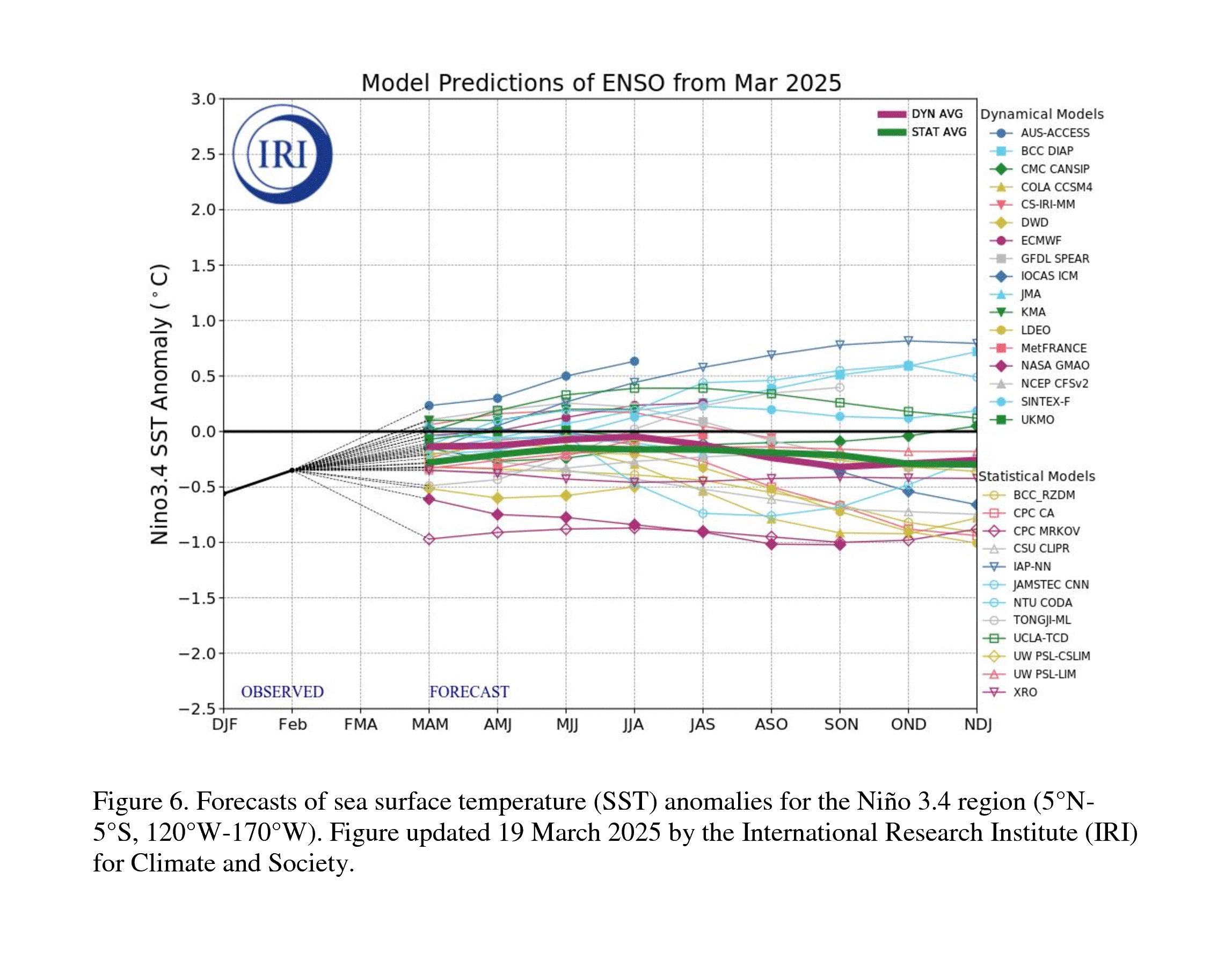
One El Niño can be stronger or weaker than others. Scientists monitor El Niño using the Nino3.4 index, a measure of how much warmer (or cooler) than usual the ocean is in a region in the East Pacific. This region is the best at representing changes in the Pacific which can indicate El Niño.

When ocean temperatures are 0.8°C warmer than usual in that region, and the trade winds have sufficiently weakened, the Bureau of Meteorology can declare an El Niño has arrived. (The United States uses 0.5°C as the figure).

A “Super El Niño” is when the region’s ocean temperatures rise 2°C, roughly two standard deviations above normal (about a 2.5% chance of happening). While scientists first coined the term, the evocative phrase has become a favourite of media commentators.

But Australian forecasters don’t use these terms, as it doesn’t matter that much for our weather if the index goes over 2°C. What matters much more is whether an El Niño is present or not.

Why? When we measure the strength of the El Niño, we are really only referring to ocean temperatures in the eastern Pacific. But this figure is not very well correlated with less rain in eastern Australia. It also only captures ocean changes and doesn’t reflect the El Niño atmospheric changes which influence the weather systems that actually bring rain to Australia.

During the ‘strong’ 1997–98 El Niño (a), rainfall didn’t change much. But during the ‘weak’ 2002–03 El Niño (b), major rainfall deficits emerged. Bureau of Meteorology and Climate Extremes, CC BY

That’s not all. The Niño3.4 Index is just one of many indications of how Australia’s upcoming weather is likely to look. One index can’t tell the whole story. Relying on it is like looking at the BMI of a bodybuilder and declaring them obese.

Readers may wonder how scientists can define El Niño using an ocean temperature threshold when oceans are getting steadily warmer under climate change. Won’t we end up with constant El Niño?

This is a good question. It’s why the Bureau of Meteorology last year introduced a relative Niño index, to give scientists a way to account for warming due to climate change.

Should we believe winter and spring forecasts?

A Southern Hemisphere autumn in the Pacific Ocean is sort of like January in your average Australian office job. As you slowly ease into the work year, you set a bunch of optimistic goals which may or may not eventuate.

Over autumn, the Pacific Ocean is similarly noncommittal. It can indicate future outcomes that don’t always happen.

Meteorologists have a term for this. It’s called the Autumn Predictability Barrier. What it means is that El Niño forecasts are the least reliable during autumn.

So while forecasts of the Pacific Ocean might be pointing towards an El Niño, history warns us to take forecasts made in autumn for later in the year with a big lump of salt.

At present, the European, US and Australian model forecasts of Niño3.4 indicate a strong El Niño might develop. But this isn’t conclusive.

Forecast from March 2026 of the Niño3.4 Index. Red lines indicate different model forecasts. ECMWF, CC BY

The forecasts made in March 2017 are worth looking at. Here, models confidently predicted a moderate and long-lasting El Niño, similar to forecasts in March 2026. What happened instead was a short-lived, weak El Niño.

Forecast from March 2017 of the Niño3.4 Index. Red lines indicate different model forecasts and the dashed line indicates what actually happened. ECMWF

How should we think of El Niño forecasts?

As a scientist who has researched seasonal forecasts of Australian rainfall, my advice is to ignore autumn headlines warning of a potentially catastrophic “Super El Niño”.

These get more clicks than more accurate headlines pointing out long-term forecasts at this time of year are uncertain. It’s worth waiting until the end of autumn or early winter before taking El Niño forecasts too seriously.

The current gold standard for Australian seasonal forecasts are the Bureau of Meteorology’s long-range forecasts. But even here, these forecasts become quite uncertain more than a month in the future. It’s important to regularly check for updated forecasts.

Will we get an El Niño this year? The only scientifically accurate answer as of April 9 2026 is “maybe”. It’s way too early to say anything other than that an El Niño is more likely to form this year than a La Niña.

ref. Why the phrase “Super El Nino” makes Australian climate scientists roll their eyes – https://theconversation.com/why-the-phrase-super-el-nino-makes-australian-climate-scientists-roll-their-eyes-279758

Evening Report: https://eveningreport.nz/2026/04/09/why-the-phrase-super-el-nino-makes-australian-climate-scientists-roll-their-eyes-279758/

Northland shifts form recovery to readiness as Cyclone Vaianu approaches

Source: Radio New Zealand

Madleine CarrWhite, Massey Journalism Student

Aerial view of Whirinaki and State Highway 12 after the March storm. Supplied / FNDC

Northland communities are again bracing for the arrival of wild weather, only a couple of weeks after heavy rain and wind devastated parts of the region.

Cyclone Vaianu is set to touchdown in Northland this weekend, with authorities across the North Island preparing to withstand the potentially life-threatening storm.

Residents, businesses and growers across parts of Northland are now preparing for the Cyclone and what it might mean for their homes and livelihoods.

The organising efforts of Northland’s west coast

The Hokianga area – located on Northland’s west coast – was hit particularly hard by heavy rain and wind that struck the region in late March.

Whirinaki Trust chair Ruth Tautari has been organising the recovery effort for her community, told RNZ a number of evacuation centres were being stood up around Hokianga.

“We’ve just been going around Whirinaki, just giving everyone an update on the storm itself… just making sure that they are prepared, whether they have water in their tanks, making sure they’ve got the essentials they need to keep them going in the event that we get cut off for a couple of days with no power and no roading.” she said.

Tautari said many whānau were still dealing with the affects of recent flooding leaving them feeling “anxious”.

“We had six homes that were completely lost… the water went through and those whānau had to evacuate. We’ve got three whanau that are currently in temporary accommodation and the other three whānau are living with their whānau all outside of Whirinaki at the moment.” she said.

“The rest of the whānau in Whirinaki, they’ve just been going through re-establishing their access ways like roading, their sanitation, their septic tanks and removing all of the rubbish that got pushed down into their whare and just trying to get back to some sense of normal reality.”

As the cyclone bears down, a series of service hubs – called Rai ki te Rai – have been set up across the North. Tautari said welfare agencies and hauora organisations would be present.

“We’ve also got some of the teams from the Ministry of Housing and Urban Development to at their temporary accommodation services that they provide, but also a lot of mahi from the civil defence teams from Northland Regional Council and the whānau Far North District Council are coming up.”

“It’s quite heartbreaking to watch whānau go through it over again and just watch the stress come when the rain gets heavier, knowing that they could have to move from their whare but also that they could have to go through the whole situation again, removing silt, waters going through our marae and just the toll it takes, not just physically, but a lot of mental and emotional tolls.” she said.

‘It’s not an easy time’

A family shovelling silt off their Whirinaki property following the March storm. Supplied / FNDC

Former Ngāti Hine Forestry Trustchief executive and Green MP Hūhana Lyndon has been up North helping with the recovery effort. She told RNZ that the region now had to quickly switch it’s focus from recovery to readiness.

“The weather is comparable to Cyclone Gabrielle and touch down as early as lunchtime Saturday, whānau are now gearing up to brace and prepare for impact.” she said.

“We already have a stressed rohe or district from the last storm, it’s not an easy time”

Lyndon said she was in regular touch with local and central government, as well as marae and community members.

“There’s been a lot more response and pace by which people are moving now that we know that it’s coming, and the size and scale of what it could be.” she said.

“We’ve gone through Cyclone Gabriel, we’ve seen it, we’ve recovered from it. But it’s coming again, and it’s coming with significant impacts to Northland.”

Lyndon said marae were key parts of the region’s resilience infrastructure and should be resourced properly.

“We don’t have solar, we’ve got gaps in generators, we’ve got whānau who are cut off. They cannot get across to their home, and culverts are out. We need, sparkies, we need to be checking that are waterlocked… we are getting there, but unfortunately we’ve got a storm coming so it’s a bit of recovery as well as preparedness that’s going on right now.” Lyndon said.

March flooding in Northland’s Kerikeri RNZ/Tim Collins

Storms frieghtening for growers during prime harvest

The owner of a Wairoa business says everyone in the town is just hoping for the best.

Dianne Downey’s lime growing business was devastated after a nearby river burst it’s banks in 2024.

She is part of a class action lawsuit lodged against Hawke’s Bay Regional Council after many homes and businesses were flooded, with questions being asked about whether the river bar crest should have been lowered ahead of the weather event.

Downey said this latest storm was frightening for growers across the region.

“I’ve got pickers out there flat out picking at the moment because I just don’t want to lose all our fruit, we’re in prime harvest and all these growers around here are, so it’ll be the worst thing in the world if it all went pear shaped for us right now.”

Hawke’s Bay Regional Council said work was underway to maintain the lowered crest of the Wairoa bar to mitigate flooding.

Metservice has forecasted heavy rain and gale winds for Wairoa and surrounding rural areas on Sunday.

East Cape businesses getting geared up

Businesses in Hicks Bay say their community is resilient in the face of weather events.

RNZ spoke to businesses in Hicks Bay, where storms had badly hit the community at the start of the year.

One business told RNZ that there is no panic ahead of Cyclone Vaianu’s anticipated landfall this weekend.

A supermarket says people are getting extra supplies to prepare but aren’t getting more than what they need.

The store clerk says they want to stay open as long as it is safe so that they can be available to the community.

Retailers say the community is preparing to be self-sufficient, having learnt from the storms at the beginning of the year which caused roads to close and cut locals off from the rest of the motu.

A business owner says locals are getting used to living with severe weather events.

Cyclone Vaianu is expected to reach Northland late on Saturday night.

Sign up for Ngā Pitopito Kōrero, a daily newsletter curated by our editors and delivered straight to your inbox every weekday.

– Published by EveningReport.nz and AsiaPacificReport.nz, see: MIL OSI in partnership with Radio New Zealand

LiveNews: https://nz.mil-osi.com/2026/04/09/northland-shifts-form-recovery-to-readiness-as-cyclone-vaianu-approaches/

‘Tiny backpacks because they are tiny frogs’: Researchers track one of NZ’s smallest frogs

Source: Radio New Zealand

A Hochstetter’s frog with a transmitter. Tobia Dale

In a bid to learn more about one of New Zealand’s smallest frogs, researchers have come up with a novel way of tracking them.

The Hochstetter’s frog measure three-to-four-centimetres, and researchers developed tiny backpacks that are perfect for the native frogs.

Associate Professor Stephanie Godfrey supervised the study which took place in the Coromandel, and told Checkpoint the backpacks contained transmitters that weighed 0.5 of a gram, and were tricky to get on.

“It’s a matter of very gently trying to just wrap the little harness around their waists and then tighten it gently with a cotton thread.

“We use tiny backpacks because they are tiny frogs.”

The study shed some light on the movement of the endangered frogs, and was the first time such research had been carried out due to the challenge of finding transmitters that are small enough.

The frogs like living in creek banks. Tobia Dale

“It’s been really hard to get good insights into their movements because it’s hard to track a tiny frog.”

But even though the frogs are tiny, they are still susceptible to a common human problem.

“The main thing we noticed is that they did develop these little small abrasions just around their hip joints where the harnesses were resting… a little bit of chafe.” Godfrey said.

But overall, Godfrey said the frogs did “did pretty well with the backpacks”.

The transmitters had a “pretty short” battery life, but Godfrey said the longest they managed to track a frog was 16 days.

The frogs also like living under rocks. Tobia Dale

But they were able to record some interesting movements.

“We saw that their biggest movement during the period of our study was almost 17 metres, which is a long way for a three-to-four-centimetre frog.”

The researchers also found out more about their habitat and where they like to live.

“We found that they like living in banks of sort of creek banks. They like living under rocks and they tend to sort of stick around the same place for a while before getting up and moving elsewhere.”

The research will help with the protection of the frogs in the future.

“The main reason for collecting this data is to try and just understand a bit more about how much space they need when we’re protecting them. So when things like developments are happening or we want to translocate them.

The researchers used radio receivers to find the frogs with trackers. Katie Ryan

“It’s really important to know what habitat they’re using, how far they move, so that we can put in measures to protect them and ensure there’s sufficient habitat and of the right type.”

Godfrey said there are even smaller trackers, that weigh 0.17 of a gram, and would allow the frogs to wear the harness for longer, and was hopeful more research could be carried out on the frog’s movements.

“The goal of improving the way the backpacks sit on these frogs is to enable us to track them for longer. They tend to sit tight in the same place for a long time. If we only track them for a week or two weeks, we might not fully capture the entire area that they’re using.”

Sign up for Ngā Pitopito Kōrero, a daily newsletter curated by our editors and delivered straight to your inbox every weekday.

– Published by EveningReport.nz and AsiaPacificReport.nz, see: MIL OSI in partnership with Radio New Zealand

LiveNews: https://nz.mil-osi.com/2026/04/09/tiny-backpacks-because-they-are-tiny-frogs-researchers-track-one-of-nzs-smallest-frogs/

Will the conflict in Lebanon destroy the US-Iran ceasefire? Maybe, but it was already shaky

Source: The Conversation (Au and NZ) – By Jessica Genauer, Academic Director, Public Policy Institute, UNSW Sydney

Just hours after the leaders of the United States, Israel and Iran reached a temporary ceasefire, it was clear that each party had its own version of what had been agreed to.

Hundreds of people in Lebanon have been killed in Israeli airstrikes in the past 24 hours, immediately threatening to undermine the fragile agreement.

Iran had insisted hostilities in Lebanon cease as part of the deal, but Israel argued Lebanon was not included. The result is an ongoing proxy conflict alongside the main war, which has been paused for two weeks.

Given the US seems uninterested in addressing the intractable issues at the heart of tensions in the Middle East, this result was somewhat inevitable. It seems the most likely outcome now is the US will back out while claiming victory, leaving the region’s prewar status quo largely intact.

The importance of Lebanon

Lebanon has not been an official part of the war in the region, and is not a party to the ceasefire. So why is it so central to the conflict?

Since the Iranian revolution of 1979, the Iranian regime has funded and armed anti-Israel movements in the region including Hezbollah in Lebanon, Hamas in Gaza and the Houthis in Yemen.

Throughout its history as a nation, Israel has at times occupied and held security “buffer zones” around its territory.

After the fall of leader Bashar al-Assad in 2024, Israeli forces conducted a military operation in southern Syria, occupying a demilitarised buffer zone in the southwest of the country.

Israel has diplomatic agreements with Egypt and Jordan, leaving the focus on Iran and the proxies it supports. The proxies closest to Israel, and therefore of most concern from the government’s perspective, are Hamas in Gaza and Hezbollah in Lebanon.

Since the October 7 attacks, the Israeli government has taken an offensive military approach to dealing with both groups. From the perspective of Israel, Hamas and Hezbollah are just as severe security threats as Iran.

While both proxy groups have been severely degraded since 2023, they are still operating.

Since the onset of the conflict with Iran, the Israeli government has taken the opportunity to extend a security buffer zone in southern Lebanon. Under President Benjamin Netanyahu, Israel is very unlikely to give up this ambition.

For Trump’s part, it is unclear whether he could persuade Netanyahu to abandon it, or if he even wants to try.

Will the ceasefire survive?

Unless the US can bring Israel into line and convince Netanyahu to stop its action in Lebanon, the ceasefire will fall apart.

Iran has insisted fighting in Lebanon must end as part of the agreement. This is the regime’s way of protecting and supporting its much-diminished proxies. As negotiations get underway for a more lasting deal, the issue of Lebanon will become a key sticking point.

This is in part because resisting Israel and the US is not just politically expedient for Iran; it is at the core of the Iranian regime’s identity and existence.

While deeper antagonism that drives tensions in the region remains unaddressed, there’s little prospect of lasting peace.

Trump seems set on a US withdrawal from the war with Iran. The US leaves behind a security environment that upholds the existing tensions in the region. Iran and Israel will continue to engage in the tit-for-tat violence that led us here.

A flawed exit strategy

A key issue with Trump’s approach in the Middle East is he has no real interest in resolving the core issue of Israel’s place in the region. He’s shown little grasp of the deeper historical roots at play.

What seems to be front of mind for Trump is the unpopularity of the war within the US. With Trump’s approval ratings at a record low and the conflict already dragging on longer than many expected, the president is looking for a way out.

This might be why Iran’s ten-point plan, which was previously “not good enough”, is now a “workable basis on which to negotiate”.

The conflict in Iran is increasingly unpopular with people in the US. Ryan Murphy/AP

While there are competing versions of the ten points, they all include conditions the US could never reasonably accept, such as leaving control of the Strait of Hormuz in Iranian hands.

Iran also insists it wants to reserve the right to enrich uranium, something that would be contrary to the stated basis for this war in the first place: Iran’s ability to develop nuclear weapons.

By declaring the conditions suddenly right for a ceasefire, Trump is stating a reality he’d like to see, rather than describing tangible changes on the ground.

In practice, the US has already ceded ground to Iran, which has indicated it is not willing to compromise on anything. While Iran’s military capability to interfere in the region may be diminished for now, the will remains.

So with the ten points as a basis of negotiation, it is hard to see a path towards lasting peace in the next fortnight. Instead the US is likely to exit, leaving behind a lot of damage, but little materially changed.

ref. Will the conflict in Lebanon destroy the US-Iran ceasefire? Maybe, but it was already shaky – https://theconversation.com/will-the-conflict-in-lebanon-destroy-the-us-iran-ceasefire-maybe-but-it-was-already-shaky-280259

Evening Report: https://eveningreport.nz/2026/04/09/will-the-conflict-in-lebanon-destroy-the-us-iran-ceasefire-maybe-but-it-was-already-shaky-280259/

Chinese Mainland’s Largest Conference on Chest Pain Centres Goes Global in Hong Kong

Source: Media Outreach

HONG KONG SAR – Media OutReach Newswire – 9 April 2026 – Marking yet another milestone as the World’s Meeting Place, Hong Kong became the first city outside Chinese Mainland to host the nation’s largest conference on chest pain centres – the 15th China Chest Pain Centers Congress (CCPCC 2026), thanks to the effort of Hong Kong Convention Ambassador (HKCA) appointed by the Hong Kong Tourism Board (HKTB).

Together with two other high-profile and hugely successful medical congresses – the 41st Asia Pacific Academy of Ophthalmology Congress in February and the 17th Asian Congress of Oral & Maxillofacial Surgery in March, Hong Kong’s medical science events space was off to a strong start in 2026.

Ms Marilyn Tham, General Manager of Mega Events, MICE & Cruise of the HKTB said, “Hong Kong’s leading edge in medical sciences coupled with the city’s world-class venues and destination appeal have enabled notable success for internationally significant medical events. CCPCC 2026 is one of the large-scale medical conventions confirmed for 2026. Such robust lineup reflects event organisers’ confidence in Hong Kong as a premier hub for advancing global exchanges on medical sciences.”

Over 10 medical conventions have secured a spot in Hong Kong this year, spanning diverse disciplines, from cytology to oncology, antimicrobial resistance and more (see full list below). The breadth and depth of the events reflects Hong Kong’s growing appeal as the premier convention hub where global medical minds meet.

Globalising Chest Pain Leadership from Hong Kong

Held on 3-4 April 2026 at the Hong Kong Convention and Exhibition Centre with a concurrent venue in Shenzhen, CCPCC 2026 converged 3,000 healthcare leaders, physicians, nurses, researchers, policymakers and industry experts from Hong Kong, Chinese Mainland, the Belt and Road countries and beyond. The rich topics explored across two days encompassed cutting-edge healthcare innovations, AI-assisted clinical decision-making, intelligent emergency response systems and international accreditation standards.

Co-organised by Hospital Authority (HA) of Hong Kong, the National Clinical Research Center for Interventional Medicine, the Guangdong Chest Pain Centers Association, the Chinese Cardiovascular Association (CCA) and Oriental Huaxia Cardiovascular Health Research Institute (OHCHRI), Suzhou Industrial Park, CCPCC 2026 showcased conducive partnership.

Mr. Wenming Zeng, Secretary-General of OHCHRI, remarked, “The global influence of CCPCC has been growing over the years. Thanks to Hong Kong’s strategic location, leading medical standing and its unique role bridging Chinese Mainland and the world, this year’s congress has drawn even wider global participation, giving the event greater international significance. Hong Kong has helped showcase our event to the world, taking cardiovascular emergency intervention to a new height globally.”

A Launchpad for Mainland-spearheaded International Standards

Capitalising on Hong Kong’s strengths as a super-connector for fostering globalisation, CCPCC 2026 released for the first time the “International Standards on Chest Pain Center Construction and Accreditation”, marking Mainland’s global leadership in cutting-edge cardiovascular emergency intervention. Leveraging Hong Kong’s internationalisation, the efforts to foster global policy support and implementation of the standards will contribute to fair, accessible and timely intervention for cardiovascular emergencies around the world.

Another Significant Win for HKCA Programme on its 5th Anniversary

As a HKTB-appointed HKCA, Prof Lu Shi-Juan, who is a Member of Hainan Medical Association Cardiovascular Professional Committee, played an instrumental role in bringing CCPCC 2026 to Hong Kong. This marked the latest success story of the HKCA programme, as HKTB celebrated the programme’s milestone 5th anniversary with a HKCA Networking Cocktail Event on 31 March, 2026.

Prof Lu noted, “As a Hong Kong International Convention Ambassador, I have worked closely with the HKTB to bring CCPCC to Hong Kong, which is a gateway to the global stage. Hosting the conference here showcases how Hong Kong can elevate Mainland conferences internationally, foster cross‑border knowledge exchange and help shape the future development of the broader medical and professional community.”

The HKCA programme bands together over 170 local and mainland sector leaders of 13 industries and academics to champion Hong Kong as the World’s Meeting Place. Their initiative and connections have helped Hong Kong secure 50 convention wins that have brought in nearly 100,000 high-value overnight MICE visitors.

Strong Medical Events Lineup in 2026

Over 10 medical conventions will be held in 2026 across various disciplines, including ophthalmology, oncology, antimicrobial resistance and cytology.

Event

(*first-ever in Hong Kong)

Date / Venue Highlights
The 41st Asia-Pacific Academy of Ophthalmology Congress 2026 5-8 Feb,

HKCEC

The largest and most authoritative ophthalmology congress in APAC, returning to HK for the fifth time, with record-breakingattendance of 11,000+ participants from 111 countries and regions.
The 17th Asian Congress on Oral and Maxillofacial Surgery 2026 27-29 Mar,

HKCEC

Held in Hong Kong for the second time, bringing together internationally acclaimed speakers, globally renowned experts and young surgeons to foster academic exchange and professional development.
The 15th China Chest Pain Centers Congress 3-4 Apr,

HKCEC

Chinese Mainland’s largest conference on chest pain centres, hosted for the first time outside Chinese Mainland.
*Asian Federation of Cytology Societies Conference 2026 8-10 May,

Postgraduate Education Centre, Prince of Wales Hospital

First edition in Hong Kong, bringing together regional and international cytology experts for academic exchange and collaboration.
International Symposium on Antimicrobial Agents and Resistance 2026 12-14 Jun,

HKCEC

A key international platform for academic exchange on infectious diseases and antimicrobial resistance.
European Society of Medical Oncology Targeted Anticancer Therapies Asia 2026 12-14 Jun,

Kerry Hotel

A key Asia-Pacific platform for showcasing the latest advances in early-phase oncology drug development, targeted therapies and precision oncology.
Federation of Asian and Oceanian Biochemists and Molecular Biologists Conference 2026 10-13 Aug,

Cheung Kung Hai Conference Centre, The University of Hong Kong

A major regional scientific meeting in biochemistry and molecular biology, bringing together researchers, educators and professionals from across Asia and Oceania for academic exchange and collaboration.
* 2026 World Cancer Congress 24-26 Sep,

HKCEC

A leading global forum advancing cancer control and research.
2026 Asia-Pacific Longevity Medicine International Summit 1-4 Oct,

TBC

A leading international platform and regional collaborative hub dedicated to longevity medicine and innovation, attracting top longevity scientists, medical experts, cross-industry entrepreneurs and investors from over 50 countries.
10th Asia Cornea Society Scientific Meeting 2026 11-13 Dec,

TBC

A key regional forum for cornea specialists to exchange the latest clinical insights, diagnostics and treatments, and to strengthen collaboration across the Asia-Pacific ophthalmology community.
Association of Pacific Rim Universities (APRU) Global Health Conference 2026 7-9 Dec,

Henry Cheng International Conference Centre, CUHK

Third time in Hong Kong, convening leading academics, policymakers and practitioners to address critical global health challenges through interdisciplinary collaboration and innovation.

https://www.mehongkong.com/eng/home.html
https://www.linkedin.com/company/meetings-exhibitions-hong-kong/

Hashtag: #HongKongTourismBoard #MEHK #MeetingsandExhibitionsHongKong #HongKong #MICE #Medical #Convention #Conference #Event

The issuer is solely responsible for the content of this announcement.

– Published and distributed with permission of Media-Outreach.com.

LiveNews: https://livenews.co.nz/2026/04/09/chinese-mainlands-largest-conference-on-chest-pain-centres-goes-global-in-hong-kong/

Blonde Blues pay tribute to terminally ill teammate

Source: Radio New Zealand

Blues forward Suafua announced his retirement from rugby at just 27 years of age. Photosport / AAP / Darren England

The Blues will be sporting some new hair styles this weekend, as they pay tribute to a teammate forced out of the game.

Cam Suafua has been battling cancer since 2023, but recently got the tragic news that it was now terminal.

Suafua announced his retirement from rugby at just 27.

In an act of solidarity with Suafua, the Blues players have all either shaved their heads, or bleached their hair blonde.

Coach Vern Cotter said they have shared Suafua’s fight since the start.

“There’s a very strong awareness around and there’s a lot of empathy and I think the players are drawing strength from it as well. It was nice to have them here at training on Tuesday and the players will show in their own way. What they’re really focused on is making sure we go as far as we can in the season and take them with us for as long and far as we can,” he said.

Cotter joked he was unable to find a suitable hair dye, so opted for the shaving option.

“There’s a solidarity within the group, a strong sense of together.”

The Blues return to action this weekend in the capital against the Hurricanes in a top of the table clash.

The side is well aware of the threats the canes possess across the park.

The Hurricanes have been in blistering form of late, putting half centuries on the Highlanders and Reds in consecutive weeks.

“You don’t score 50 points by not being good. The key for us is to stay in for 80 minutes and make sure that we don’t give them too much space because a team like that, when they get it. they can become very difficult to play.”

Cotter said the squad was fizzing at the prospect of meeting the competition leaders, a match Cotter said will be a measure of where they truly are in 2026.

“They’re going to be up for this. One v Two. This is what the rugby’s about and this is why you play the game, is to measure yourself up against the best, whether it’s individually or collectively. It’s going to be an intense game of rugby. It’s really important we play 80 minutes. I don’t think we can get away with trying to put in a 60 minute effort.”

A threat the Blues won’t be sleeping on is that of All Black halfback Cam Roigard.

“You can’t ignore him. One player can’t cover all the spots. So we’ll be just keeping an eye on him. But once again, if they create those fast ball opportunities or line breaks, then he’s very good in the opposition 22.”

Midway through the campaign, Cotter said they are where they want to be.

“Your season is constantly evolving and at the moment, it’s evolving in the right direction. But you’re only as good as your last game, we get a chance to measure ourselves this weekend and then we’ll draw conclusions from that.”

Sign up for Ngā Pitopito Kōrero, a daily newsletter curated by our editors and delivered straight to your inbox every weekday.

– Published by EveningReport.nz and AsiaPacificReport.nz, see: MIL OSI in partnership with Radio New Zealand

LiveNews: https://nz.mil-osi.com/2026/04/09/blonde-blues-pay-tribute-to-terminally-ill-teammate/

DOC decides no action needed against McCallum Brothers sand mining in Pākiri

Source: Radio New Zealand

The company is seeking consent to mine up to eight million cubic metres of sand 4km offshore in Bream Bay. Supplied

The Department of Conservation has decided against taking action against a sand mining company over allegations it disturbed protected stony corals, citing insufficient evidence.

The complaint arose from dredging carried out by McCallum Brothers in the Pākiri temporary sand extraction area, north of Auckland, in 2025.

The company has since stopped sand mining at Pākiri but is applying for a fast-tracked resource consent to take sand from Northland’s Bream Bay instead.

DOC launched an investigation after Pākiri resident Damon Clapshaw contacted the department alleging McCallum Brothers had continued dredging after ecological consultants discovered stony corals in the area in March 2025.

Dredging ended when the protected coral was formally identified three months later.

Wildlife crime team lead Dylan Swain said DOC had investigated two alleged breaches of the Wildlife Act 1953.

He said the act made it an offence to “take or disturb absolutely protected marine wildlife without authority”.

It was also an offence to fail to report accidental or incidental death or injury of marine wildlife.

Swain said the investigation had now been completed.

“Although corals were identified in the area, there is insufficient evidence to prove stony corals were disturbed by the company. Therefore, we will not be pursuing enforcement action.”

Swain said DOC had notified the company and the person who brought the information to the department’s attention.

Earlier, Clapshaw told RNZ he believed DOC should have been notified of the discovery of stony corals straight away, and he was concerned coral may have been disturbed in the months between its discovery and the cessation of dredging.

McCallum Brothers chief operating officer Shayne Elstob said the company would not comment on DOC’s decision while its Bream Bay sand-mining application was being processed by the fast-track expert panel.

The company is seeking consent to mine up to eight million cubic metres of sand 4km offshore in Bream Bay – 150,000 cu m per year for the first three years, and up to 250,000 cu m per year for the next 32 years.

An estimated 700 people gathered on Northland’s Ruakākā Beach in March to protest a proposed sand mining operation. Supplied / Bream Bay Guardians

Meanwhile, it has been revealed that the expert panel’s decision on the sand-mining application is due on 1 October.

In a memo published to the fast-track website, associate panel convener Helen Atkins said she had appointed a three-person panel to consider the application, which had been received in full on 17 February.

The panel would be chaired by environmental lawyer Catherine Somerville‑Frost and would start work on 13 April.

Comments from invited parties would be accepted from 28 April, and the decision documents were due on 1 October.

The proposal has sparked protests in Bream Bay, including a gathering of about 700 people at Ruakākā Beach last month.

Sign up for Ngā Pitopito Kōrero, a daily newsletter curated by our editors and delivered straight to your inbox every weekday.

– Published by EveningReport.nz and AsiaPacificReport.nz, see: MIL OSI in partnership with Radio New Zealand

LiveNews: https://nz.mil-osi.com/2026/04/09/doc-decides-no-action-needed-against-mccallum-brothers-sand-mining-in-pakiri/