The warrant targeted a Headhunters gang pad in West Auckland (file photo).RNZ / John Edens
Stolen vehicles, drugs, ammunition and a rifle have been confiscated from gang pads in West Auckland, police said on Friday.
A search warrant was carried out at the West Headhunters pad on View Road on Thursday morning, police said, where they found a .22 semiautomatic rifle, ammunition, a stolen Harley Davidson V Rod motorcycle and a stolen Cadillac Escalade.
In another vehicle at the address, police found a kilogram of dried cannabis.
Two were arrested without a struggle.
“The estimated street value of this quantity of cannabis is significant so it’s great to be able to remove it from our streets,” Detective Senior Sergeant Lautogo said.
A second warrant was executed at a property on Mountain Road, Henderson Valley, where police said they found a person “actively manufacturing firearms”.
A 42-year-old man was charged with unlawful possession of a firearm and unlawful possession of ammunition, a 69-year-old man charged with possession of cannabis for supply and a 35-year-old man charged with sell/manufacture firearms without dealer’s licence and unlawful possession of ammunition.
All were expected to appear in Waitākere District Court over the next two days.
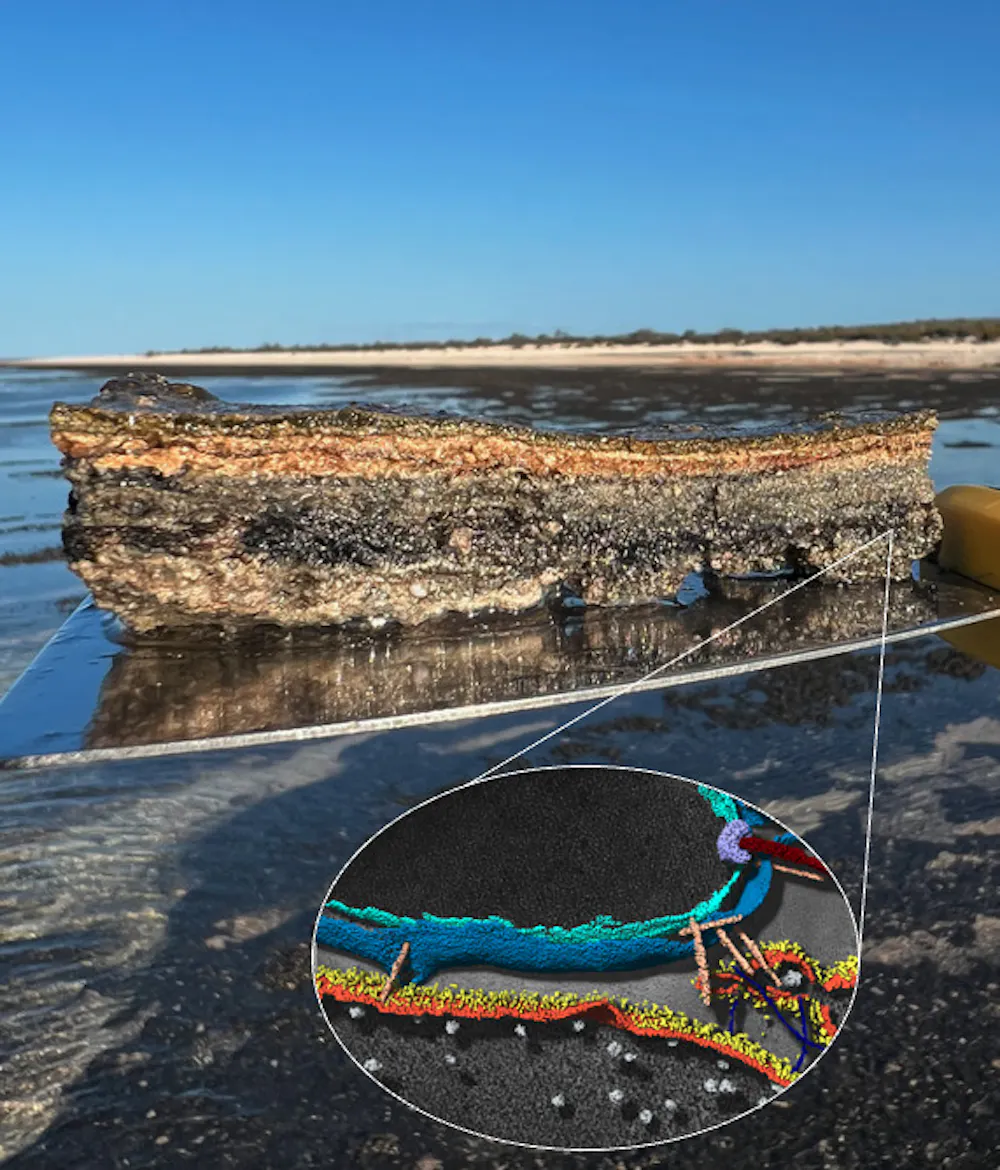
On the shores of the west coast of Australia lies a window to our past: the stromatolites and microbial mats of Gathaagudu (Shark Bay).
To the untrained eye they look like a collection of rocks and slime – but they are in fact teeming with microbial life. And these stromatolites are living “relics” of ancient ecosystems that thrived on Earth billions of years ago.
If you wade past, it feels like you’re walking back through time. In fact, the first bubbles of oxygen that filled the atmosphere on early Earth likely came from ancient stromatolites. You could say we owe our very existence to these piles of rocks.
So, what other secrets of our past could these ecosystems tell us? Through decades of research, we know how early life has woven its path through these “living rocks”. But most recently our team embarked on the greatest genealogy search of them all: searching for our great microbial ancestors, the Asgard archaea.
And in a new paper, published today in the journal Current Biology, we report how this search led to the discovery of a key clue that could help explain how complex life evolved on Earth.
A field of stromatolites in Shark Bay, Western Australia.Brendan Burns
The cells that comprise complex life
Asgard archaea were originally named after Norse gods. This fascinating group of microbes sits on the cusp of one of the most significant events in the evolution of life: the origin of the complex cells that make up plants and animals, known as eukaryotes.
Evidence suggests Asgard archaea are the closest relatives of eukaryotes. And that on an early Earth it was the “marriage” of an ancient Asgard archaeon and a bacterium that led to the first eukaryotes.
They formed an ancient partnership. They shared resources and physically interacted, leading to the first complex cells. Like a Romeo and Juliet tale of two distant families coming together, Asgard archaea and bacteria decided it was time to break from traditional family values.
But we have never seen a model of how this may have occurred. Until now.
Holding up a mirror to the ancient past
Our team used the mats of Shark Bay as a “seed” to establish cultures of these ancient microbes. We are one of only four groups worldwide to achieve this, through years of research with a dedicated team of graduate students nurturing the Asgards like offspring.
But the Asgards were not alone. We found them together with a sulphate-loving bacterium. Could this be a model of how complex life may have started on a primitive Earth?
We began by sequencing the Asgards’ DNA to decipher exactly how these microbes tick at the genetic level. We also used artificial intelligence to model how proteins could have behaved in a world before eukaryotes. Evidence suggested these two microbes were sharing nutrients. In other words, they were cooperating.
But we wanted to delve deeper. What do our great microbial ancestors look like? Here we turned to electron cryotomography, a high-resolution imaging approach that allowed us to observe cells and structures at a nanometre scale.
And here we showed – for the first time – an Asgard archaeon and a bacterium directly interacting. Tiny nanotubes were connecting the two organisms – perhaps reflecting what their great-ancestors did on an early Earth that ultimately led to the explosion of complex life as we know it.
Microbial mat from Gathaagudu (Shark Bay, Australia). Inset: Microscopic image showing Asgard archaeon and bacterium derived from these mats interacting as a model for evolution of complex cells.Iain Duggin/Bindusmita Paul/Debnath Ghosal/Matthew Johnson/Brendan Burns.
Weaving western science with Indigenous knowledge
This was a major discovery – one that originated in Gathaagudu, a World Heritage Site with significant environmental and cultural values.
Aboriginal people first inhabited Gathaagudu over 30,000 years ago. We wanted to recognise and celebrate the language of the Malgana people, one of the traditional language groups of Gathaagudu. We also wanted to connect western science with Indigenous Knowledge in a meaningful way.
To this end and working closely with the world’s foremost Malgana language expert, Kymberley Oakley, and Aboriginal elders, a name was granted for our novel Asgard archaeon from the language of the Malgana people: Nerearchaeum marumarumayae. The species name – marumarumayae – is derived from the Aboriginal language of the Malgana people, meaning “ancient home”, a reference to stromatolites being of ancient origin in Earth’s history.
Weaving Aboriginal language into the naming of our new microbe represents a fitting connection between unique Aboriginal culture in Australia and the ancient microbe discovered that calls the mats of Gathaagudu “home”.
Gathaagudu is under threat from global change, from increased heatwaves, cyclonic events and human activity. And among the values to preserve and conserve are the significant Aboriginal connections as well as the trails of life going back through evolutionary time.
With our study we have peered into our past. And maybe like the Montagues and Capulets of Shakespeare, we see distant families of microbes coming together to bridge the divide and ultimately form the early eukaryotes that eventually led to us: a fragile branch on the evolutionary tree of life.
The war in Iran has led to a global energy crisis. Shipping traffic through the Strait of Hormuz, a major energy chokepoint that handles roughly 20% of the world’s oil, has been largely blocked by Iran since hostilities broke out in late February. This has, at times, caused oil prices to rise above US$100 a barrel.
As the primary customers of Gulf energy, Asian economies are being hit particularly hard by this crisis. According to figures published by the International Energy Agency in 2025, around 80% of the oil and petroleum products and nearly 90% of the LNG that transited the Strait of Hormuz that year were destined for Asia.
Not all countries in Asia are equally vulnerable. Those most exposed to energy market disruption share a set of structural characteristics: heavy reliance on imported fossil fuels, limited fiscal space and constrained energy systems that make it difficult to switch to alternatives quickly.
Countries such as Bangladesh, Pakistan and Sri Lanka are all heavily dependent on imported oil and gas to meet domestic demand. However, they lack the foreign exchange reserves needed to secure energy supplies in volatile global markets. When prices spike or supplies tighten, these economies are forced into painful trade-offs between energy access, inflation and fiscal stability.
Wealthier Asian economies such as Japan, South Korea, Hong Kong and Singapore have greater financial resources, granting them superior purchasing power in volatile markets. But they, too, are structurally exposed to global energy crises. Their energy systems are also deeply dependent on fuel imported from the Gulf, which leaves them sensitive to supply disruptions.
These countries have the fiscal capacity to maintain strategic energy reserves, providing them with temporary relief from disruption. Japan and South Korea, for example, have both initiated record-breaking releases from their state oil reserves since the start of the Iran war.
But with the exception of China, which has huge stockpiles of oil and LNG as well as robust domestic energy supply, these reserves are not designed to offset prolonged disruptions. Japan and South Korea’s national stockpiles only hold enough oil for around 200 days.
Governments under pressure
Faced with tightening supplies and rising prices, many Asian governments have moved quickly to curb energy demand. One of the most immediate responses has been to limit mobility. The Philippines, Pakistan and Sri Lanka have all introduced four-day working weeks or have extended public holidays to cut commuting and fuel use.
Pakistan has also introduced hybrid working arrangements for public-sector employees, encouraging remote work to reduce transport demand. Education systems have been similarly affected. Bangladesh brought forward Ramadan holidays in universities, while Pakistan closed schools for two weeks from March 10 and shifted higher education online.
In some cases, governments have introduced more direct restrictions. Myanmar’s military leaders have imposed fuel rationing and have restricted private vehicle use to alternating days based on licence plate numbers.
Other interventions have focused on managing demand in less disruptive ways. Thailand, for example, has raised recommended air-conditioning temperatures to 27°C and is encouraging energy-efficient workplace practices such as replacing suits with short-sleeved shirts.
Some Asian governments have turned to subsidies to shield households and businesses from rising energy costs. Indonesia has allocated tens of billions of US dollars to maintain affordable fuel and electricity prices, while Thailand has capped cooking gas prices and promoted alternative fuels such as biodiesel.
However, subsidies are proving difficult to sustain. For lower-income countries in particular, fiscal constraints limit how long such support can be maintained. Pakistan initially introduced targeted subsidies for farmers and the transport sector, but has been forced to scale them back as the crisis has continued.
Perhaps the most consequential response has been in Asia’s power sector. As energy supplies have tightened and prices surged, several Asian countries have reverted to coal – a fuel many nations have been phasing out.
Thailand has restarted two decommissioned units at the Mae Moh coal-fired power plant, while South Korea and Japan have lifted restrictions on coal generation to allow older plants to operate at higher capacity.
The current energy market disruption has exposed structural vulnerabilities in Asia’s energy systems, including import dependence, limited diversification and fiscal constraints. Governments have relied on a mix of demand reduction, subsidies and fuel switching to limit the impact.
However, these are stopgap measures. If disruptions persist, these countries may be forced to rethink their energy strategies more fundamentally. This could accelerate investment in renewables and nuclear power, as well as efforts towards regional energy integration. But it also risks entrenching coal use and, in the process, hindering global climate goals.
Either way, the current crisis is a reminder that energy security and economic stability remain tightly intertwined and that disruptions in a single chokepoint can ripple across the global economy.
The human body is often described as a marvel of “perfect design”: elegant, efficient and finely tuned for its purpose. Yet, when we look closer, a rather different picture emerges.
Far from being a flawless machine, the body reads more like a patchwork of compromises shaped by millions of years of evolutionary tinkering. Evolution does not design structures from scratch. Rather, it modifies what already exists.
As a result, many aspects of human anatomy are just “good enough” solutions – functional, but far from perfect. Some of the most familiar medical problems and ailments arise directly from these inherited constraints.
The spine
The human spine tells this story best.
Our vertebral column has evolved little from our four-legged, quadrupedal tree-dwelling ancestors, where it functioned primarily as a flexible beam for smooth movement from branch to branch, while also protecting the spinal cord.
When humans adopted an upright bipedal gait, the spine retained these functions. But it was also repurposed for the additional need of supporting our body weight vertically and maintaining our centre of gravity, while still allowing the flexibility for us to move. These opposing demands creates strain.
The characteristic curves of the human spine helps distribute weight, but it also predisposes us to lower back pain, herniated discs and degenerative changes affecting its most important function – protection the spinal cord and surrounding nerves. These conditions are extraordinarily common, not because the spine is inherently poorly made, but because it’s doing a job it was never originally designed to do.
The neck
Another clear argument against divine design is the recurrent laryngeal nerve, which takes a course that simply makes no sense to invent.
This nerve, which is a branch of the vagus nerve, predominantly controls our organs’ “rest and digest” functions (such as slowing heart rate and breath). The laryngeal nerve also connects the brain and larynx, helping control speech and swallowing.
Logically, one might expect it to use the most direct route to connect brain and larynx. Instead, it descends from the brain into the chest, loops around a major artery, then travels back up to the voice box.
This detour is not a clever design, but a historical leftover from our fish-like ancestors when the nerve took a straightforward path around the gill arches. As necks lengthened over evolutionary time, the nerve was stretched rather than rerouted.
In humans and other vertebrates, the retina (the light-sensitive layer at the back of the eyeball) is wired “backwards.” This means light must pass through layers of nerve fibres before reaching the photoreceptors – specialised cells responsible for detecting light and converting that into a nerve impulse to send to the brain.
The optic nerve then exits through the back of the retina, creating a blind spot just below the horizontal level of the eye where no vision is possible. The brain fills in this gap seamlessly, so we rarely notice it.
So while we’ve developed incredible vision and light receptor cells, this has happened at the expense of having a gap in our visual field.
The teeth
Our teeth offer another reminder that evolution prioritises adequacy over durability.
Humans develop two sets of teeth: baby teeth and adult teeth – and that’s all. Once adult teeth are lost, they’re not replaced – unlike sharks, which continually regenerate teeth throughout life.
In mammals, tooth development is tightly regulated and linked to complex jaw growth and feeding strategies. This system worked well for our ancestors, but for modern humans it leaves us vulnerable to decay and tooth loss.
Wisdom teeth provide another example of evolutionary lag. Our ancestors had larger jaws, suited to tougher diets that required heavy chewing. Over time, human diets softened and jaw size decreased. However, the number of teeth did not change as quickly. Many people no longer have space for their third molars – leading to impaction, crowding and often requiring surgical removal.
Wisdom teeth aren’t useless in principle, but they no longer fit comfortably within modern skulls.
The pelvis
Childbirth presents one of the most profound evolutionary compromises. Like the spine, the human pelvis must balance two competing demands: efficient bipedal walking and birthing large-brained infants.
A narrow pelvis improves locomotion, but restricts the birth canal’s size. Meanwhile, human babies have unusually large heads relative to body size, resulting in a difficult and sometimes dangerous birth process – often requiring outside assistance.
This tension between mobility and brain size has shaped not only anatomy but also social behaviour, encouraging cooperative care and cultural adaptations around childbirth.
Evolutionary persistence
Evolution doesn’t necessarily eliminate structures unless they impose a strong disadvantage. So some anatomical features persist despite offering limited benefit.
The appendix, once considered a completely useless evolutionary left-over, is now thought to have minor immune functions. Yet it can become inflamed, causing appendicitis – a potentially life-threatening condition.
Similarly, the sinuses, have unclear functions. They may lighten the skull or influence voice resonance, and we can even use their size and variability for forensic identification. But the sinus’s drainage pathways go direct into the nose, making it prone to regular blockage and infection, a developmental byproduct rather than a purposeful adaptation.
Even tiny muscles around the ears hint at our evolutionary past. In many mammals, tiny ear muscles allow the outer ear (pinna) to swivel, improving directional hearing. Humans have these muscles, but most people cannot use them effectively.
Our bodies are not perfectly designed, but are a living archive of evolution. Anatomy reveals a historical record of adaptation, compromise and contingency. Evolution does not aim for perfection; it works with what is available, modifying structures step by step.
Understanding anatomy through this evolutionary lens can also help us reframe how we see common medical problems. Back pain, difficult childbirth, dental crowding and sinus infections are not random misfortunes. They are, in part, the consequences of our evolutionary history.
One study found that rates of psilocybin use increased 44% among adults ages 18-29 from 2019 to 2023, and 188% among those over age 30. This amounts to more than 5 million adults using psilocybin in 2023 alone. And those numbers are rising: A study published in early 2026 found that about 11 million adults in the United States used psilocybin in the previous year.
Now, we similarly aim to bridge the gap between public enthusiasm for psilocybin and the limited scientific evidence available about its potential benefits and risks. Currently, this type of real-world data on the effects of psilocybin mushrooms is almost nonexistent.
Psilocybin is a prodrug, which means that it has very low activity until the body converts it into psilocin. Psilocin is the compound primarily responsible for the psychoactive effects of psilocybin mushrooms.
Psilocin resembles the chemical messenger serotonin, which is involved in regulating a range of physiological and psychological functions, including mood, appetite, cognition and sensory perception. As a result, when psilocin binds to serotonin receptors, it alters how people think, feel and experience the world.
Psilocybin mushrooms contain numerous other compounds, together known as tryptamines, such as baeocystin, norbaeocystin and aeruginascin. Research on rodents shows that mushrooms containing these compounds may elicit stronger and longer-lasting effects than psilocybin alone.
But very little is known about how these other tryptamines affect humans. This is because federal regulations require researchers to use an isolated, synthetic version of psilocybin in clinical studies rather than the entire mushroom.
Thus, the many ongoing clinical trials testing psilocybin as a treatment for various mental health conditions use synthetic psilocybin that does not contain these other tryptamines.
In 2019, Denver, Colorado, became the first American city to decriminalize psilocybin mushrooms. This means that possession becomes the lowest law enforcement priority and criminal penalties are reduced or eliminated, but it does not fully legalize them.
Over the next two years, several other U.S. cities including Oakland and Santa Cruz, California; Seattle, Washington; and Detroit, Michigan, followed suit. In 2020, Oregon legalized psilocybin for supervised use in licensed settings, and Colorado did the same in 2022. These legal, supervised-use programs allow access to psilocybin mushrooms in regulated environments without a prescription.
Even for people living outside those states and cities, the barriers to accessing psilocybin mushrooms are low. With a quick Google search and around US$35, anyone can legally purchase kits containing the materials needed to grow psilocybin-containing mushrooms. These kits are legal to buy and sell because they contain only mushroom spores, which are tiny reproductive cells from which mushrooms grow. Once these spores begin growing into mushrooms, they can produce psilocybin, making the mushrooms a federal Schedule 1 substance.
Because psilocybin mushrooms exist in this legal gray area and are governed by different rules across states, psilocybin mushrooms are essentially unregulated across most of the U.S.
As a result, consumers lack reliable information about what their mushrooms contain, how much they should take and how to use them safely.
Psychedelic mushrooms have been decriminalized in only a handful of states, but many people already grow them at home.OllyPlu/iStock via Getty Images
For instance, psilocybin edibles are now available and increasingly popular.
In addition, selective cultivation practices are being used by individual and commercial growers to systematically increase the amount of psilocybin contained in their mushroom strains. For example, the Oakland Hyphae Cup, a community contest intended to identify the best mushroom strains, has shown wide variability in psilocybin content across samples.
Another serious potential side effect of psychedelic drugs is what’s known as hallucinogen persisting perception disorder. It involves ongoing perceptual distortions similar to those experienced while directly under the influence of psilocybin, which can persist for weeks, months or years, even once the psilocybin has left the body.
Harms are more likely when people take high doses.
As mushroom potency increases without market regulation, consumers may inadvertently ingest more psilocybin than intended, increasing the risk of harm. Without sufficient research on modern psilocybin products, consumers have little guidance on how to reduce potential harms.
Next steps in research and regulation
Studying psilocybin in the real world requires creative research approaches.
Our team hopes to work within federal restrictions to study people using their own psilocybin mushroom products at home, while providing real-time data to our research team using app-based surveys.
Independent laboratories using state-of-the-art measurement techniques can aid researchers like us by providing information about the potency of the mushroom products that people are using.
While ongoing clinical trials provide important data about the effects of psilocybin under tightly controlled conditions, real-world data is needed to understand how modern psilocybin mushrooms are used and experienced by consumers.
These insights matter not only for scientists and policymakers but for the growing number of people trying psilocybin mushrooms for relief, self-improvement or out of curiosity. In a largely unregulated market, and with few clear guidelines on safe use, consumers are left to simply figure it out on their own.
Source: The Conversation (Au and NZ) – By Jared Bahir Browsh, Assistant Teaching Professor of Critical Sports Studies, University of Colorado Boulder
“¡Ándale! ¡Ándale! ¡Arriba! ¡Arriba!”
Meaning “hurry up, let’s go,” the trademark slogan of Speedy Gonzales was, for generations of children, the first Spanish words they learned.
But by the 1980s, ABC had pulled his cartoons due to concerns that his dress, accent and characters like his cousin, Slowpoke Rodriguez, were insensitive toward Mexicans and Mexican Americans. The Cartoon Network followed suit in 1999.
I’ve studied and written about the history of animation, including how characters have been received around the world. Though rooted in a well-intentioned effort at cultural sensitivity, taking Speedy Gonzales off the air was a step too far for many viewers. He was one of the few cartoon characters rooted in Mexican identity, and he’d become a cultural icon across all of Latin America. The ensuing uproar in the wake of his cancellation prompted the Cartoon Network to reinstate the cartoon mouse in 2002.
With Warner Bros. greenlighting a new Speedy Gonzales movie in January 2026, the character’s redemption arc appears complete.
A speedy rise to stardom
“The fastest mouse in all of Mexico” first appeared in the 1953 animated short “Cat-Tails for Two.”
The short film features the general framework for future plots: Speedy helps members of his border community – a place inspired by Ciudad Juarez, just south of El Paso, Texas – evade the conniving Sylvester the Cat.
It opens with a town of starving mice looking longingly at the AJAX cheese factory through a fence establishing an “international border.” They try to determine who will try to outrun Sylvester, the factory’s guard. One of the mice says that his sister is friends with Speedy Gonzales. (Another pipes in that Speedy is friends with everybody’s sister, signaling Speedy as something of a Don Juan.) After they call on Speedy, he uses his speed and smarts to outrun and outwit Sylvester.
The basic premise also appears in a number of cartoons, from Tom and Jerry to Roadrunner and Wile E. Coyote: An antagonist is consistently thwarted by a clever protagonist who avoids increasingly complicated traps and attempts at capture.
In the 1940s, with the European and Asian markets cut off due to World War II, Disney had turned to the Latin American market. The studio produced “Saludos Amigos” in 1942 and “The Three Caballeros” in 1944 to abide by President Franklin D. Roosevelt’s Good Neighbor Policy, which aimed to leverage diplomacy, trade and cultural exchange to improve relations with Latin America.
Speedy ended up appearing in 45 theatrical shorts. In 1969, Warner Bros. shut down its animation studio, but the character lived on in Saturday morning cartoon anthologies like “The Bugs Bunny Show,” which repackaged older cartoons for younger audiences.
Animation’s racial reckoning
The Cartoon Network pulled Speedy Gonzales from the air at a time when networks and studios were starting to reassess animated characters from earlier eras.
Many early cartoon characters, including Mickey Mouse, had been modeled after blackface minstrel characters. Warner Bros.‘ first star, Bosko, was originally patented as “Negro Boy.”
Since racist tropes were ubiquitous in early-20th-century animation, films and shorts like Disney’s “Dumbo,” “Mickey’s Mellerdrammer” or Warner Bros.’ “All This and Rabbit Stew” were either pulled, edited or updated to feature a content warning.
[embedded content]
Speedy Gonzales’ cousin, Slowpoke Rodriguez, was one of the cartoon’s characters deemed culturally insensitive.
But after The Cartoon Network pulled Speedy Gonzales from the air in 1999, there was unexpected pushback from the Hispanic American community and the character’s Latin American fans. Groups like League of United Latin American Citizens, the oldest Hispanic civil rights organization in the United States, declared Speedy a cultural icon and requested that his cartoons return to the air.
Back when Speedy Gonzales was first introduced to audiences, Hollywood had been filming more movies in Mexico and at the U.S.-Mexico border. However, most of these films depicted Latinos as either incompetent or villains.
In this regard, Speedy represented something different. Though the character’s English speech and accent reflected stereotypes – and he was voiced by a white actor, Mel Blanc – the character was ultimately a clever, quick-witted and good-natured protagonist. And the Spanish dubbing of his cartoons in Latin America had removed the stereotypical accent altogether.
Let the people decide
The trajectory of Speedy Gonzales resembles that of another controversial cartoon character: Apu Nahasapeemapetilon from “The Simpsons.”
An Indian immigrant who earned his Ph.D. in computer science in his home country, Apu becomes the manager of a convenience store in the U.S.
Some critics viewed Apu’s depiction as problematic; voiced by a white actor, Hank Azaria, Apu’s exaggerated Indian-American accent and catchphrase – “Thank you, come again” – was routinely mimicked and mocked by viewers of the show. Others, however, saw Apu as the embodiment of the American Dream: He was intelligent, hardworking and morally grounded.
Cultural theorists like Jacques Derrida and Stuart Hall have written about the complexities of how audiences understand – and either resist or embrace – what they read and watch. They ultimately argue that viewers and readers often interpret media however they see fit, regardless of the creators’ intent. For example, many minority groups who are underrepresented or misrepresented in popular culture will nonetheless find their own meaning and inspiration in characters, even if those characters weren’t supposed to represent those groups in the first place.
This happened with “The Goofy Movie.” Some audiences went on to describe the 1995 film as Disney’s first “Black” animated feature, despite the fact that the characters’ race is never mentioned. There were hints, of course: Black R&B singer Tevin Campbell played the movie’s fictional pop star, Powerline, and the themes of fatherhood and generational tensions eerily echo those in the play “Fences,” written by Black playwright August Wilson.
Of course, in the case of a character like Speedy Gonzales, depictions can become more nuanced as cultural norms and sensitivities change. Jorge R. Gutiérrez is set to direct the animated feature. If his work on films like “The Book of Life” is any indication, he’ll be well-equipped to bring cultural awareness to the animated feature – even if Speedy continues to sport his big, floppy sombrero.
There’s no doubt that pets bring many Aucklanders a lot of joy. But if you and your family received a new pet recently, there are all kinds of new responsibilities. Whether a cat, a dog or something more exotic, follow this handy how-to guide on responsible pet ownership to help your furry, fluffy, feathered or scaly friends live their best lives.
Make sure your dog is registered before it turns three months old. Registration is a legal requirement for all dogs under the New Zealand Dog Control Act 1996, and if your dog is not registered you can be fined. Councils around New Zealand supply information about registered dogs to the National Dog Database and the registry helps dog control authorities reunite owners with their lost pups, as well as control dangerous or menacing dogs.
Luckily, Auckland Council makes it very easy to ensure your pooch has its paperwork in order – all you need to do is register your dog online. Fees vary depending on several factors, and you can even check if you qualify for a discount. After registering your dog, they will be sent a snazzy coloured Auckland Council disc or strap within 10 working days. You get to choose which type of tag you want, but straps are a good option for small dogs. You must renew your dog’s registration annually, and the colour of the disc or strap changes every year.
New puppies and dogs have to be microchipped by a vet within two months of their first registration, and it’s only done once in an animal’s lifetime. A microchip is a tiny implant about the size of a grain of rice, and has a unique 15-digit number which is added to the National Dog Database.
It’s not just dogs that can be microchipped – it’s recommended that cats, horses, turtles, rabbits, guinea pigs and exotic birds are also microchipped so they can be added to the Companion Animals Register. Microchipping helps lost animals be reunited with their owners, and it’s also particularly important to help identify feral stray cats which may be preying on native birds.
Desexing is a key way to improve animal welfare by preventing unwanted litters of puppies and kittens and reducing stray and feral cat populations. Mating behaviours are instinctive for cats and dogs, and desexing – also called spaying (females) and neutering (males) – will prevent animals from wandering away from home and may reduce some aggressive territorial behaviours. Stray cats and dogs suffer greatly so it’s best to avoid unwanted litters.
Dogs need regular exercise and taking your dog for a walk in an Auckland park is a great way to spend time with your furry friend. When out and about, it’s important to follow the rulesfor dogs in public places – dogs must be on-leash at all times in all Council-controlled public places with unrestricted access.
If you’re going to a special dog-walking park there may be designated areas in which your dog is allowed off-leash to play and socialise with other dogs. To find parks with off-leash areas, visit the parks search page on the Auckland Council website and select ‘Show only places with off-leash’. Remember to obey the signs and only take your dog off-leash in the designated areas.
Even when your dog is in an off-leash area it should stay under control. Always pick up your dog’s poop and dispose of it responsibly. Keep your dog away from any prohibited areas that are marked as ‘No dogs’.
Being a responsible pet owner means making sure your pet lives in a healthy home environment. This means access to food and water, freedom to move, a way to get exercise and lots of affection and mental stimulation. Remember your pet has instinctive behaviours such as chewing and hunting, and toys can help enrich your pet’s life without impacting native wildlife. Playing with toys will also keep your dog enriched and can also reduce barking.
Dogs must live in a fenced property, and small animals such as guinea pigs and rabbits should live in adequately sized hutch with a run. Turtles, fish and exotic birds should live in suitably sized enclosures. Remember never to release an animal into the wild as it’s not good for their wellbeing and they can pose a threat to native species – rehoming is the best option. Test your knowledge of exotic pets and how to care for them by taking the quiz here.
Aucklanders love their pet cats, but felines are hunters by instinct and do pose a threat to many native animals such as birds. Putting a bell on your cat and/or a brightly coloured scrunchy collar can help your cat be more noticeable to native birds as they are attracted to bright colours for food sources such as berries and will spot a scrunchy collar.
A cat enclosure or ‘catio’ will also make sure that your cat can access the outdoors without preying on wildlife. In wildlife areas such as Aotea / Great Barrier Island there are rules in place around responsible cat ownership, and cat owners in other parts of Auckland can benefit from many of these ideas.
Auckland Council recognises and rewards caring dog owners who have a Responsible DogOwner Licence (RDOL). Owners with the RDOL must fulfil some criteria and pass a written test, but once successful they are then eligible for a reduction in dog registration fees. Study the brochure before applying for the written test – you’d be barking mad not to!
State Highway 29/ Kaimai Range remains blocked following a truck breakdown earlier this morning.
Police were initially advised around 7:50am of a truck breaking down on the Matamata side of the summit.
Around 8:15am a second truck also broken down at the same site.
While there is one lane still available, the traffic has built up considerably and there will be extensive delays – it is expected to remain so for another couple of hours.
Te Whatu Ora’s attempt to cut costs by requiring health care assistants to carry out cohort patient watches is harming vulnerable patients and staff, NZNO says.
Patient watches involve trained and experienced health care assistants monitoring patients deemed a threat to themselves or others. They often have confusion, delirium or dementia.
Tōpūtanga Tapuhi Kaitiaki o Aotearoa NZNO delegate and Christchurch health care assistant Al Dietschin says cohort patient watches are occurring throughout the country.
“In Christchurch, health care assistants have written to local Te Whatu Ora leadership to raise our concerns that short-staffing and cohort patient watches are inherently unsafe and places both patients and staff at considerable risk.
“There have already been documented incidents of patient harm directly resulting from the use of these cohort watches. With winter approaching, the situation is now at a critical point. The letter warns: ‘the NZNO members are extremely concerned that without immediate and substantive change, further patient harm is not just possible, but inevitable’.
“The patients we watch are often highly agitated, have dementia or deliriums and can have mental health issues. They often have intravenous lines, drains, nasogastric tubes and catheters in which they can pull out, causing them further distress and trauma. They can hurt themselves in falls if they are not constantly watched.
“There has already been awarning from the Coronerabout the link between short staffing and falls. Despite 18 months of raising concerns with Te Whatu Ora in bargaining about understaffing, the situation is getting worse,” Al Dietschin says.
NZNO delegate and Auckland health care assistant Anamei Graham says understaffing means health care assistants are constantly forced to prioritise their tasks.
“It is very difficult to watch several such patients at once if they are put into a cohort, especially if they are in different rooms. It is not safe for them, and it is not safe for the kaiāwhina watching them,” she says.
“A lot of us are feeling unsafe.Whānau are asked to helpbut they are not trained to provide patient supervision and monitor changes in behaviour. Often it is a spouse caregiver who really needs some respite from 24/7 care themselves.
“We are pulled in all sorts of directions at once and we are stressed out and burnt out. There’s not enough HCAs on the wards and patients and whānau can feel it,” Anamei Graham says.
In response to the publication today of the Organization for Economic Cooperation and Development’s (OECD) preliminary data on Official Development Assistance (ODA) for 2025,Oxfam Aotearoa’s Advocacy and Policy Lead Nick Henry said:
“This report shows New Zealand aid fell by 12.8% in 2025. This is a huge problem for our Pacific neighbours who face an accelerating climate crisis.
Now more than ever, New Zealand should be standing with our Pacific neighbours with support for climate adaptation and sustainable development. But the New Zealand Government has not renewed our climate funding commitment for the Pacific and has not increased other aid enough to make up for the shortfall.
Unfortunately, this means New Zealand is now part of the problem.
Oxfam has previously praised the good work done through New Zealand’s support for climate action in the Pacific. We call on the New Zealand Government to restore and extend that support to our Pacific neighbours in this year’s budget.”
MeanwhileOxfam’s Development Finance Lead Didier Jacobs said:
“Wealthy governments are turning their backs on the lives of millions of women, men and children in the Global South with these severe aid cuts. They collectively slashed aid by 23% in 2025. Based on aid’s crucial role in combating diseases like HIV-AIDS and malaria, the Institute of Global Health of Barcelona estimated that global aid cuts of such magnitude would kill hundreds of thousands of people in 2025 alone. If this trend continues, aid cuts could kill over 9 million people by 2030.
At a time where aid cuts are already driving instability and fostering greater inequality, government donors are cutting life-saving aid budgets while financing conflict and militarization. Cuts from donors including Germany, France and the UK will be felt by the world’s poorest. The United States shut down USAID and recklessly cut aid by $37 billion in 2025, and the Trump administration has been preparing to ask Congress for tens of billions in additional funding for bombs, ammunition, and other military equipment relating to its unlawful war against Iran.
Governments must restore their aid budgets and shore up the global humanitarian system that faces its most serious crisis in decades. There are other ways to find tens of billions of dollars, such as by taxing the $2.84 trillions of dollars that the super-rich hide in tax havens.”
Notes
TheOECD preliminary datashows the DAC countries’ aid spending for 2025 was $174.3 billion, a cut of 23% from 2024.
The Institute of Global Health in Barcelona released astudy in Lancet Journal(February 2026) that evaluated the impact of ODA on mortality rates around the world. It estimates that aid cuts in 2025 alone, assuming a 21% aid cut, would be responsible for 695,238 excess deaths, and that, if the aid cut trend continued, it could kill 9,416,417 by 2030.
The US Administration isreportedlyplanning to seek a war appropriation of $80-$100 billion from Congress.
Oxfamestimates that the top 0.1% richest people worldwide hide $2.84 trillion in tax havens. Even a small tax on that wealth would yield much more than the amount of aid cuts.
Weather warnings ahead of Cyclone Vaianu.MetService
MetService has issued a raft of weather warnings for the North Island as Cyclone Vaianu approaches the country.
The cyclone is expected to move across the North Island on Sunday.
Orange heavy rain warnings have been issued for Gisborne north of Tolaga Bay, Auckland, Northland “about and south of Bay of Islands to Hokianga Harbour” and Bay of Plenty west of Whakatane, including Rotorua.
Orange heavy wind warnings have also been issued for Sunday for Taranaki, Whanganui, Waikato, Waitomo, Taupō and Taumarunui and until early Monday for Gisborne Hawke’s Bay and Taihape.
Aucklanders should expect between 70mm and 100mm of rain, and Coromandel/Bay of Plenty up to 180mm.
“Clear your drains and gutters to prepare for heavy rain. Avoid low-lying areas and drive cautiously,” Metservice warned.
A series of yellow wind and rain watches are also in place for Wairarapa, Manawatū, Kapiti Coast and Wellington.
A red strong wind warning was in place for Coromandel and Great Barrier Island, starting 5am Sunday.
“Severe gale easterlies changing to severe gale westerly Sunday afternoon, with damaging gusts of 140km/h,” MetService’s warning said, urging people to stay indoors and be ready for power and comms outages.
“Threat to life from flying items and falling trees. Destructive winds will cause widespread damage including powerlines and roofs, with dangerous driving conditions and significant disruption to transport and power supply.”
Earth Sciences New Zealand said the Auckland region could see over a month’s worth of rain in 12 hours. Principal scientist Chris Brandolino told Morning Report a tremendous amount of rain was forecast, and places in the Coromandel region could see about 200mm about the ranges.
Not even the South Island is spared, with a heavy rain watch in place for Marlborough Sounds, including northeastern areas north of Kaikoura.
RNZ is New Zealand’s statutory civil defence lifeline radio broadcaster. That means RNZ will provide vital information and updates as they come to hand on air and online during an emergency.
Find the radio frequency for your area here and get prepared here.
Iranian director Asghar Farhadi, Spain’s Pedro Almodovar and Russia’s Andrey Zvyagintsev will be among 21 directors vying for the coveted Palme d’Or prize at the Cannes Film Festival next month, organisers said.
Festival director Thierry Fremaux revealed a list of films in the main competition, including three from Japan and three from Spain, while major Hollywood studios are set to be notable in their absence on the French Riviera.
Other frontrunners for the top prize will include Japan’s Hirokazu Kore-eda, who won the 2018 competition with Shoplifters, and former winner Cristian Mungiu from Romania, whose new film Fjord is set in Norway and stars Renate Reinsve.
Out of competition, there will be a surprising amount of football at the high temple of French cinema, with documentaries about legendary forward Eric Cantona and the England-Argentina 1986 World Cup match featuring a notorious handball from Diego Maradona.
American A-listers will be thin on the ground at the 79th edition of Cannes, although Woody Harrelson and Kristen Stewart are set to star in the Paris-set Full Phil by French director Quentin Dupieux.
“The United States will be represented. The studios a bit less,” Fremaux told a press conference in Paris.
Organisers had already announced that plane-mad US movie legend John Travolta will present his directorial debut Propeller One-Way Night Coach out of competition about a young boy’s journey in the “golden age of aviation”.
Fremaux noted the high number of historical films at Cannes this year, as well as movies that provide some escapism from the grim realities of current affairs.
“We realised that the Western world needs gentleness, songs, nature, and that the countries of the Global South, as people say… need security, need prosperity and need to provide care for children and families,” he added.
Filmmaker Park Chan‑wook will be head of the jury that will award the Palme d’Or, the most prestigious prize in the film industry after the Oscar for best film.
The director of Oldboy and No Other Choice most recently is the first South Korean to hold the position and replaces French acting legend Juliette Binoche who held the role last year.
European film festivals have recently found themselves drawn into the conflicts raging in the Middle East and Israel’s bombardment of Gaza in particular.
– Published by EveningReport.nz and AsiaPacificReport.nz, see: MIL OSI in partnership with Radio New Zealand
Cyclone Vaianu will likely move across the Coromandel and the Bay of Plenty before hitting the rest of the North Island, according to MetService.
All of the North Island is under a heavy rain and wind watch due to the cyclone – and MetService says it will have potentially life-threatening impacts.
Spokesperson Heather Keats told RNZ Cyclone Vaianu is still spinning off to the North of New Zealand and will likely start moving through Coromandel and the Bay of Plenty on Sunday.
She says no-one in the North Island will be spared from the extreme weather, and MetService will issue red warnings for specific areas later on Friday.
Sign up for Ngā Pitopito Kōrero, a daily newsletter curated by our editors and delivered straight to your inbox every weekday.
– Published by EveningReport.nz and AsiaPacificReport.nz, see: MIL OSI in partnership with Radio New Zealand
10 April 2026 – New Zealand’s first comprehensive ranking of MP LinkedIn performance reveals a striking digital divide between the government and opposition benches.
A new report from Blackland PR and digital communications specialist Seamus Boyer has ranked every New Zealand MP on their LinkedIn performance, exposing wide gaps in how political parties are using the platform.
The MP LinkedIn Power List 2026 analysed the LinkedIn presence of all MPs with findable profiles across 2025, scoring each on profile quality, posting consistency, content impact, network size, content quality, and engagement behaviour. Content quality was weighted most heavily.
“LinkedIn has evolved well beyond a job-hunting or humble-brag platform. With an estimated 3.3 million New Zealand members and comment activity growing 24% in 2025, it has become a place where business leaders, public servants, industry stakeholders, and journalists spend significant time,” says Seamus Boyer.
“LinkedIn offers politicians a relatively high-trust environment to communicate directly with exactly the audiences that shape opinion and policy.”
ACT Deputy Leader Brooke van Velden and National’s Ryan Hamilton shared the top ranking, with ACT punching well above its weight relative to its parliamentary size. National dominated the overall leaderboard, with 18 of the top 25 places. Green MP Francisco Hernández was the standout from the opposition benches, coming in fifth.
In contrast Labour’s performance is strikingly weak. The party’s first representative on the list, Duncan Webb, ranked 24th. Leader Chris Hipkins came in at 68th equal, with his most recent post being from February 2019.
“We understand that Labour has different audiences, but it does want to build its credibility with business. Yet it’s almost completely absent from a key platform well suited to that goal. That’s a significant missed opportunity,” says Nick Gowland from Blackland PR.
And surprisingly, while National has the largest audience on LinkedIn, the party could be doing more.
“Too much content remains reactive rather than using LinkedIn to seed ideas or shape conversations early on. National MPs have the reach. Their opportunity is to be more deliberate about leading discussions and showing up as thought leaders,” says Seamus Boyer.
“The MPs doing this well aren’t just broadcasting announcements. They’re showing up with personality, adding context, engaging in debate, and treating LinkedIn as a genuine conversation platform rather than a noticeboard. The audience rewards that approach,”
The most-engaged post of 2025 was from ACT list MP Laura McClure, whose post about deepfake legislation drew nearly 6,500 engagements.
“The post had a compelling hook, image, and a subject with genuine public interest,” says Seamus Boyer.
“In contrast, the dominant pattern across all parties was “post and ghost,” with MPs posting content but failing to engage with replies or join the conversation in comments. Only 16 MPs engaged consistently and meaningfully.”
Key stats
91 MPs with a findable LinkedIn profile
27 MPs who didn’t post at all in 2025
35 Average posts per MP across the year
16 MPs engaging consistently in comments
The full report, including the complete ranking of all 91 MPs and party-by-party analysis, is available at blacklandpr.com and seamus.nz.
About Blackland PR
Blackland PR is a Wellington-based strategic communications consultancy specialising in persuasive communications with real New Zealanders. The firm works across public and private sector organisations on media strategy, stakeholder engagement, and public affairs.
About Seamus Boyer
Seamus Boyer is a digital communications consultant specialising in strategic storytelling and social media for the public sector, working with central and local government clients across New Zealand and Australia. He spent a decade in journalism before moving into communications.
A proposal to cut 26 roles at the Ministry of Justice would undermine the Ministry’s ability to deliver on its Te Tiriti obligations, in the latest example the Government’s extreme anti-Māori agenda.
The proposal, released to staff yesterday, includes a net loss of 21 policy roles, including the entire Inquiries team. It also includes a net loss of five roles in the Ātea a Rangi team, which provides strategic and policy advice and leads partnerships with iwi and Māori.
The Inquiries team supports the Crown’s participation in the Waitangi Tribunal’s Justice and Constitutional kaupapa inquiries. They have a mandate to ensure that the Crown participates in and responds to these inquiries in good faith.
“These job cuts are a continuation of the Government’s relentless attacks on Māori and is yet another example of how Māori and Te Tiriti capabilities in the public service are being hollowed out,” said Jack McDonald, Te Kaihautū Māori for the Public Service Association Te Pūkenga Here Tikanga Mahi.
“Disestablishing the Inquiries team will further harm the Māori-Crown relationship, breaking the trust of claimants that the Crown is genuine in participating in these inquiries.
“The disproportionate impact of this country’s criminal justice system on Māori is extremely well documented. Cutting these workers will undermine the Ministry’s ability to meet its Te Tiriti obligations and work alongside Māori communities to reduce inequities in the justice system.
“The Government must stop its insidious, ideological drive to cut costs at the expense of Māori. It is undermining the job security of dedicated workers, and it is harming the public service’s ability to deliver Te Tiriti-consistent services for all New Zealanders,” McDonald said.
Some examples of Government cuts to Māori capability
The Public Service Association Te Pūkenga Here Tikanga Mahiis Aotearoa New Zealand’s largest trade union, representing and supporting more than 95,000 workers across central government, state-owned enterprises, local councils, health boards and community groups.
Opposition MPs will present giant bank ‘cheques’ representing $20,644.45 in stolen pay equity wages to care and support workers at the Bridge of Remembrance this Sunday, 12 April.
The presentation will highlight what workers have lost, with the cancelled cheques representing the value of their pay equity claims cancelled last year.
Speakers at the event will include Public Service Association national secretary Fleur Fitzsimons, advocate Nancy McShane, Labour MPs Dr Tracey McLellan and Dan Rosewarne, and community supporters. Together, they will stand in solidarity with affected workers and call for renewed attention to pay equity issues.
“It is coming up a year on when the coalition betrayed New Zealand women by cancelling 33 pay equity claims and making future claims almost impossible,” Fitzsimons says.
“As the fuel crisis has come down hard on everyone, especially care and support workers who must use their cars to get to clients, their lack of pay equity has become starkly apparent.
“If these workers were valued properly in the first place, then they’d be better positioned to ride out this petrol crisis. Instead, we’re hearing workers are having to choose between putting petrol in their cars or food on the table.
“New Zealand women have not forgotten what was taken from them. Pay equity was won over decades by thousands of women organising together. We’re not giving up now.”
The cheques will be presented to mental health support worker Christie Frost and home support worker Theresa Parnell.
Frost says it’s “ridiculous” she and her colleagues are still having to fight for pay equity.
“The cancellation of the pay equity claims last year left us all feeling quite broken.
“The work we do is taxing, and carries a lot of risk and responsibility. I love my job – but I could go and work at Burger Fuel for the same money. Passion for my work doesn’t pay the bills.”
Members of the media and public are encouraged to attend, show their support, and make Kiwi workers voices heard. The event is open to all.
Attendees are advised to allow extra travel time due to Christchurch Marathon street closures earlier in the morning.
Event Details:
What:Pay Equity Cheque Presentation Event
When: Sunday, April 12 at 12:00pm
Where:Bridge of Remembrance, Christchurch.
The Public Service Association Te Pūkenga Here Tikanga Mahiis Aotearoa New Zealand’s largest trade union, representing and supporting more than 95,000 workers across central government, state-owned enterprises, local councils, health boards and community groups.
Momentum and progress will mark the success of today’s landmark city deal agreed between Auckland City and the Government, says the EMA (Employers and Manufacturers Association).
“This is the first of the city deals to be announced and it won’t just be Aucklanders watching its progress, but also the other cities and regions wanting to make similar deals with the Government,” says EMA’s Head of Advocacy, Alan McDonald.
“They have succeeded overseas and now we get to try one here. There are encouraging elements to the announced deal – with Auckland’s economy lagging, we need a shot in the arm to get things moving again.
“The announcement rightly notes just how important Auckland’s success is to the national economy and, as a national organisation founded in Auckland 140 years ago, we and our members really want to see the city grow and contribute more to the economy.
“Similar measures in the past, such as the Auckland Transport Alignment Plan (ATAP), brought some successes but this is a much broader agreement in scope. It’s an agreement that should prevent large-scale fantastical plans being foisted on the city, and lead to more pragmatic options that demonstrate real growth and progress.”
McDonald says key elements of the deal will all contribute to momentum and growth. These include the Council/Government partnership approach, the focus on developing precincts, a joint approach to a large-scale events programme, and gaining further efficiencies from existing infrastructure and transport networks
“The new Crown uplift funding tool should encourage Council to think more strategically about how it uses its existing assets, while recognising the important role the private sector can play in prioritising the Drury development and easing congestion at the critical airport hub. Auckland Airport is also one of the region’s largest roading authorities, controlling much of the road network around the airport.
“Getting the most out of the CRL (City Rail Link) by prioritising level crossing improvements just makes good sense, and there is recognition we should take a similar approach to maximising the flow of our roading and public transport networks, not just on the motorways.
“The intent behind the deal looks great. Now we need to see the results flow from the agreement – and quickly.”
Police in west Auckland have made several arrests in separate operations focusing on firearms offending, all in a morning’s work.
Yesterday morning the Waitematā Gang Disruption Unit, with assistance from the Organised Crime Unit, executed a search warrant at the West Headhunters pad on View Road.
Detective Senior Sergeant Josh Lautogo says the search was targeting suspects with links to the Headhunters Motorcycle Gang.
“During the search, Police located a .22 semiautomatic rifle inside a bag hanging from a coat hanger, and ammunition was found in the same room.
“A stolen Harley Davidson V Rod motorcycle, and a stolen Cadillac Escalade were located at the address and subsequently towed.”
Detective Senior Sergeant Lautogo says two people at the address were taken into custody without issue.
Police also searched a vehicle at the address, locating about one kilogram of dried cannabis.
“The estimated street value of this quantity of cannabis is significant so it’s great to be able to remove it from our streets.”
Another search warrant was executed at a property on Mountain Road, Henderson Valley in relation to the illegal manufacture and supply of firearms.
Detective Senior Sergeant Lautogo says upon entering the address, one person was taken into custody while allegedly actively manufacturing firearms.
“A number of items and .22 ammunition consistent with the manufacture of firearms was located during the search.
“It’s yet another result of work our offender prevention team is doing to put pressure on this illegal activity occurring.
“Our teams remain committed to disrupting this criminal activity and ensuring our community is safe.”
A 42-year-old man charged with unlawful possession of a firearm and unlawful possession of ammunition will appear in Waitākere District Court tomorrow.
A 69-year-old man also will appear in Waitākere District Court tomorrow man charged with possession of cannabis for supply.
A 35-year-old man will appear in Waitākere District Court today charged with sell/manufacture firearms without dealer’s licence and unlawful possession of ammunition.
“When they made their way, not without difficulty, through the intertangled forest, and passed beyond the line of the great trees, they found themselves confronted by still more serious difficulties. The soil became a complete swamp, and was covered with a multitude of low shrubs, lianas, and herbs of all descriptions, whose intertangled growth formed an impassable barrier.”
I read this passage aloud to my Camp Cove companions – an excerpt from Francois Raynal’s ‘Wrecked on the Reef’, an account from 1864 about the sailors from the wreck of the Grafton who spent nearly 20 months stranded on subantarctic Auckland Island. My teammates laugh, mostly out of a deep understanding of the scene being described, having just finished three days of field work installing a grid of cat-monitoring trail cameras across this landscape.
Kristen Clements immersed in thick subantarctic scrub, with Adams Island and Carnley Harbour in the background. : Blake Hornblow | DOC
One of our teams’ main objectives for being on Auckland Island is to understand more about feral cat behaviour around a novel predator bait, as well as their abundance in different habitats. We’re using 4 different flavoured, non-toxic meat sausages to do this. You can read more about this new bait in a recent media release on the DOC website. This research will feed into the Maukahuka Restoration programme, which entails eradicating feral pigs, mice, and feral cats from the main Auckland Island (46,000ha!) over 8 years. Once successful, the removal of pests from this wild environment would enable the return of thousands of nesting seabirds and the reinstatement of ground dwelling birds like Auckland Island teal and rail which cannot survive here currently with the ever-present pressure of predation by feral cats.
Photo of Auckland Island teal on Adams Island. :Mat Goodman| DOC
Not long before the wreck of the Grafton, Auckland Island was a safe breeding ground for 38 bird species, including nine found only here. It was also abundant with more than 280 invertebrate species. This diverse range of avian wildlife and small critters created a complementary 5-star smorgasbord for feral cats to establish and thrive. And thrive they did! Since feral cats were introduced by sealers on Auckland Island roughly 200 years ago, nesting seabirds have been all but wiped-out from the main island. And during the last two weeks here, I’ve seen the wreckage of this assault first-hand.
Examples of feral cat scavenged seabirds (left Carnley Harbour, right Western Cliffs) on Auckland Island. : Kristen Clements | DOC
During my time installing these trail cameras, I frequently came across ‘cat scavenge’ – the remnants of a feral cat’s all-you-can-eat buffet. Typically, these predators leave behind the least digestible or nutrient-rich pieces of birds, resulting in us rangers finding cast aside legs or wings of said victims. However, as confronting as it is to see the remains of a spritely storm petrel or squabbily sooty shearwater scattered along the coast, these messy eating habits happen to provide perfect clues for understanding feral cat behaviour.
Finding a feral cat among dense subalpine scrub and treacherous cliffs is like a morbidly satisfying treasure hunt. However, knowing what to look for in this vast ‘impassable barrier’ as Raynal called it, leads us one step closer to removing these predators from this ecosystem. Whether it’s an obvious sign such as a scavenged bird wing, muddy paw print, or not so subtly placed scat, or perhaps a craftier indicator of these predators’ existence like a game trail leading to a cliffy overhang, each clue brings us closer to our sharp-toothed prize.
The phrase ‘be the cat’ is often heard throughout our camp. And it’s true. To capture quality data investigating feral cat behaviour, you have to think like one. Thankfully, my teammates and I have become adept at crawling on our hands and knees through scrub to set up our trail cameras. And so, as we pull in our first round of camera data, we find numerous feral cats have been recorded interacting with these non-toxic sausage baits.
It’s a momentary pat on the back for the team, as we acknowledge the days of gruelling scrub bashing which went into capturing this footage. However, this respite quickly turns to determination, as I begin to imagine what it would be like to find the last few feral cats inhabiting this place – the reality of the latter stages of a feral cat eradication. I smile to myself, as I look forward to this muddy, scrubby, arduous hunt on the edge of the world.
Camp Cove team members make their way through the scrub to the tops with Musgrave Peninsula in the background. : Blake Hornblow | DOC
I ponder further, as a deeper appreciation for the reverberations of this project sink in. I imagine a time beyond writhing through a sea of scrub to catch feral cats. When the elusive Auckland Island snipe can return to nest here, and when tītī chicks can safely emerge from their warm burrows without even knowing of the existence of feral cats. When hoihō parents can lumber back to their nests knowing their fluffy grey chicks await their return without being a feral cat’s main course, and the air is full of the sound of white-capped mollymawks’ courtship rituals. A time when the mana of Auckland Island has been restored.
Tītī in Carnley Harbour : Mat Goodman
And so, from our crude base camp which we so fondly know as home, my team and I put out a call for action. Will you support the restoration of Auckland Island? To learn more or donate towards this world-first effort by DOC and Ngai Tāhu to remove feral pigs, mice, and feral cats from Auckland Island follow the link below. To hear more from my companions and I in the field, follow DOC’s Conservation Blog over the next four weeks.
Getting to know Maukahuka is the first step toward its recovery—you can be part of this ambitious endeavour by supporting the project through the NZ Nature Fund, you can help turn every trail camera checked and every mouse trap set into a future Auckland Island free of introduced pests and full of thriving native wildlife.
All White Francis de Vries adds to Auckland’s injury woes.www.photosport.nz
Auckland FC are on the brink of a rare double – but their biggest opponent right now might be their own injury list.
The club could claim both the A-League Premiers Plate and the OFC Pro League in its first seasons across the two competitions. Under normal circumstances, that would be cause for celebration.
Instead, it has become a balancing act.
But as the second-placed A-League side deal with an injury toll that has grown since the international window, coach Steve Corica has to decide whether to take players away from the OFC side to fill his team that has three games remaining to potentially win back-to-back Premiers Plates.
Auckland FC are in the unique position of being the only club with teams in both professional competitions as well as a reserve side in the New Zealand domestic competition.
Which in theory gives the top side a pool of players to call up should they need to. In practice it is a different juggle.
“They’re trying to win that [Pro League competition] as well as we’re trying to win ours and injuries just forces more problems on both teams or all the three teams that we’ve got,” Corica said.
“We’re starting to pick up a fair few injuries so that’s something that we really need to have a look at, obviously it’s not good at this time of year, it’s not good for the players trying to get into a World Cup squad as well, but first and foremost for us we need as many players fit as possible coming into the finals.”
The OFC side are in Fiji for four games in the fifth and final round robin of the inaugural competition. Auckland are top of the standings alongside South Melbourne FC.
Auckland FC’s Liam Gillion playing in the Pro League.Shane Wenzlick / Phototek.nz
Corica considered whether to bring in forwards Liam Gillion and Adama Coulibaly from the Pro League but ultimately let them go with the team they have played most with this season.
With injuries across the park, including the latest to goalkeeper Michael Woud with a groin issue, striker Guillermo May with concussion and midfielder Jake Brimmer with a calf injury as well as defender Francis de Vries who picked up an injury playing for the All Whites, Corica might have to get creative to fill positions against Melbourne Victory on Saturday.
“Hiroki [Sakai], Felipe Gallegos, Jake Girdwood-Reich, maybe I might come out of retirement to play there,” Corica quipped.
“We’ve got a few options. For me Jake did exactly what I expected him to do he stopped [Austin] Ayoubi from creating chances for Adelaide he only got beat once by him when he got the yellow card other than that he did a great job.
“I was always going to change after his yellow card and get fresh legs on I wanted to get Hiroki on to get him minutes as well but for me he did a great job Jake and so did Hiroki when he came on.”
Auckland FC are back at home this weekend, a place that was a fortress for the side last season but where the team have not won in their last two games.
“We’ve just got to take care of our own last three games of the season, we’ve got two at home and we need to improve our home form a little bit.
“There’s more pressure I think at home for us to go out and to make the play. Sometimes away games it’s the home team that is on the front foot, we’ve just got to play our own game we don’t need to do it that way even at home because we do create a lot of chances anyway.
“First and foremost we need to work hard, defend well, and we normally create chances from that.”
Sign up for Ngā Pitopito Kōrero, a daily newsletter curated by our editors and delivered straight to your inbox every weekday.
– Published by EveningReport.nz and AsiaPacificReport.nz, see: MIL OSI in partnership with Radio New Zealand