The planning and policy committee of New Zealand’s largest city today voted decisively to investigate sanctioning companies listed by the UN Human Right Council that are alleged to be complicit with the illegal Israeli occupation and settlements in Palestine Territory.
Auckland Council is the local body governing a “super city” with a population of more than 1.8 million people — almost a third of the country’s total population.
The council’s policy, planning and development committee voted 14 to 2 to call for a staff report by July about sanctioning UN listed companies over Israeli war crimes.
“Israel has been stealing Palestinian land and moving Israeli settlers onto the land in defiance of international law,” said Palestine Solidarity Network Aotearoa (PSNA) co-chair Maher Nazzal.
“The local Palestinian community and our supporters sincerely thank the Auckland councillors who today have voted for steps to refuse to procure goods or services from any of the companies involved in building and maintaining these settlements,” he said in a statement.
“Auckland ratepayers deserve to know their rates are not being used to support Israeli war crimes, as designated by the UN General Assembly, Security Council, international conventions and the International Court of Justice.
Councillor Julie Fairey moved the resolution and rejected the arguments of councillors who opposed it, arguing that the council should “stick to its knitting”. She said decisions should be made so that “the needles and the wool don’t have blood on them”.
Councillor Maurice Williamson voted against the resolution.
However, as a cabinet minister of the Key/English government at the time, he stated he had supported New Zealand co-sponsorship of UN Security Resolution 2334 in 2016, calling Israeli settlements “a flagrant breach of international law”.
Williamson then went on to attack the UN Human Rights Council, falsely claiming it was chaired by Iran, when in fact the president represents Indonesia.
“Already six different local bodies have taken this step — it’s good to see Auckland following along the same path,” Nazzal said.
Liberal candidate Raissa Butkowski has drawn top position on the ballot paper for the May 9 Farrer byelection, in a field of a dozen candidates.
While she will be at the top of the ballot paper Butkowski, a lawyer with a community legal service and an Albury councillor, has a massive struggle in the contest. The byelection is to replace as member former Liberal leader Sussan Ley, who quit parliament after being ousted from the leadership.
The frontrunners are Independent Michelle Milthorpe, who has an education background and won 20% of the vote at the last election, and One Nation’s David Farley, an agribusinessman. Milthorpe has drawn second on the ballot paper, while Farley is at eighth spot.
Preferences are expected to be crucial to the outcome.
A defeat for the Liberals would be a setback for Opposition Leader Angus Taylor.
The Nationals’ Brad Robertson, who has a military background, has drawn fourth place, while the Greens’ Richard Hendrie, a mental health and disability advocate, is at sixth place on the ballot.
Also contesting are candidates from the Shooters, Fishers and Farmers Party, Family First, Gerard Rennick People First, Legalise Cannabis, Affordable Housing Now – Sustainable Australia Party, and two other independents.
The Nationals are homing in strongly on the deep local concerns about health and hospital services in Albury, running a health forum with frontbenchers this week.
Nationals leader Matt Canavan said it was obvious the local hospital upgrades “are more about budget, rather than community needs”.
“It is clear we need adequate services and we need to invest in the community of Farrer,” he said.
Despite the mega-commentary about the Israel-Iran war, and especially the United States’ participation in that war, almost nothing is being debated about how the war is being funded.
Keith Rankin, trained as an economic historian, is a retired lecturer in Economics and Statistics. He lives in Auckland, New Zealand.
I’ll make some comments about Iran later. But we need to focus on the United States, which is by far the most profligate party to this war. And Israel is being funded, like a charismatic and entitled teenage brat, by its (American) sugar daddy.
Most of us should have noticed that, with the exception of new tariffs which are not a significant source of United States government revenue, there has been no move to raise taxes. (The President has clearly invoked the use of tariffs as means of leverage through extortion; though he doesn’t properly appreciate that these taxes are paid by American residents.) Nor has any explicit ‘war loan’ or ‘war bond’ been floated in Wall Street.
The United States is ‘printing money’ to fund the war. This expression is both pejorative and a misnomer. Because printing money is an unmentionable, it’s hardly ever mentioned! Though it should be, because it’s an important financial mechanism, and it is not as sinful as it’s made to sound.
‘Printing money’ is not a literal expression; actually printed (or photocopied) money, counterfeit money, is illegal. Printing money, a figurative moniker, is in fact the day-to-day business of banking, with billions of dollars printed every day (and a near-similar number of dollars unprinted). The technology of printing money is that of double-entry-bookkeeping. Money is a social technology, as is double-entry bookkeeping.
What matters most to us is the role of the central bank – the Reserve Bank – in creating new money. And in particular the relationship between the Reserve Bank and its privileged customers, most of which are governments’ Treasuries and commercial banks. Even more particularly, we are interested in the most highly privileged relationship of all, that between the United States Federal Treasury and the United States Federal Reserve Bank. This exceptional relationship arises because the United States Dollar is the world’s reserve currency.
Richard Gaisford: “It’s a significant contribution being made to the US economy by the defence industries. The last figures we have were for 2024, and that showed that it generated [?] something near one trillion dollars …”.
This comment reflects a wide belief that money is made by economic activity, and that the United States makes money by making, among other things, military hardware and software. The reality, of course, is that the money is made first, and is then used to purchase such hardware and software.
Interviewer: ‘Who has got the means to keep fighting at those levels the longest?’ Kenneth Katzman (a former senior analyst on Iran at the US Congressional Research Service): “The US Dollar is the main reserve currency of the globe, which means that the United States basically has the capability to manufacture money. Your viewers may not understand the mechanics of it, but basically the United States can print money.” (Actually, not only the United States.)
He goes on to address the military asymmetry between Iran and the United States: “The United States is a 28-trillion-dollar economy; Iran is a 400-billion-dollar economy”. Here he is talking about each country’s capacity to produce goods and services; not its capacity to manufacture money. Any amount of money can be made by any country’s banking-government nexus, and at trivial cost.
The interviewer (New Zealand’s Anna Burns Francis), and the other panellist did not respond to that seemingly provocative comment about printing money; there was no further discussion about how the war is being financed, only about how much it is costing. Discussion about the mechanics (and constraints) of printing money would go against the grain that most of us are fed. The public is not supposed to know – and generally does not know – that money is itself costless and can be manufactured, at will, in smaller or larger quantities.
Kenneth Katzman’s comments are not controversial; they are a statement of fact that no economist would disagree with. All countries’ banking systems (of which the central government is a component) have the capacity to print money; indeed, the New Zealand system (and other countries’ systems) necessarily did so in 2020.
The United States has fewer constraints on printing money than do other countries, but not zero constraints.
We note that money, like all financial and financialised assets, is not wealth; it is claims on wealth. So, the affordability of money – in practice – is measured by the ability of the economy to meet those claims, in the event that those claims are presented. (Indeed, the world can afford an octillion dollars’ worth of financial claims if it can be 100% certain that those claims will not be exercised; will not be spent on goods or services. The current world is awash with massive private holdings of financialised assets which, for the most part will not be spent on anything other than other financial assets. In technical language, such money has a very low ‘velocity’.)
We note also that newly printed United States’ dollars permeate into New Zealand through exports, including New Zealand made supplies to America’s war industry; to the United States’ military/industrial complex, which includes the space industry.
How does a country fund a war by printing money?
There are two key issues: rationing, and responsiveness.
The liberal critique against governments’ printing money is a general claim that governments are untrustworthy and spendthrift. In the eighteenth century when the liberal critique emerged, one principal concern was government adventurism in the form of warfare. This classical liberal critique presents one consequence of such government largesse as inflation (extra spending coming up against finite resources), and also presents any instance of general price increases as a consequence of government largesse. When governments consume relatively more resources, then – through the catalyst of inflation – private households and businesses consume relatively less.
The classical liberal critique emphasises this rationing issue, known as crowding out; in doing so, that critique presumes that private spending on goods and services is, per se, more efficient than public sector spending and redistributive transfers. There are two parts to this rationing argument: first, private parties are deemed to better assess (compared to bureaucrats and politicians) which items of spending translate to greater utility (ie happiness); second that relatively more private spending can be classified as ‘investing’, meaning spending for future rather than for present happiness. (Neither of these two propositions is generally true.)
The second issue, less emphasised by classical liberals, is responsiveness or ‘supply elasticity’. Classical liberals tend to assume that spending enabled by printed money does not elicit new production; ie does not bring-about a supply response. While this is true by definition for a hyper-taut economy, for the most part, economies are not hyper-taut and are indeed responsive to additional spending.
In the present case of the United States, the Israel-Iran War – on the pro-Israel side – is being funded substantially by new money printed for the United States government by the United States federal banking system; in the public accounts, this shows up directly as a huge increase in the United States’ fiscal deficit.
While prices are rising faster in the United States than before, this increase in general prices would appear to be substantially due to the supply-side cost-impact of the war itself, and not by increased aggregate demand inside the United States and the countries the United States imports goods and services from.
The United States domestic economy is not as supply-elastic as it might have been, given what ICE is doing to that country’s labour force. Nevertheless, the United States’ economy has been sufficiently depressed that it is now able to increase output without much difficulty. Hence, extra United States’s government spending has not in itself caused consumer prices in the United States to rise. The present chokehold on imports – a result of the war – is however causing CPI-inflation in the United States and the rest of the world. Prior domestic underemployment is one reason why money-printing may not be inflationary.
The second component of a country’s economic responsiveness to wads of newly printed money is that much production can be outsourced to the rest of the world. Thus, United States’ imports increase, the United States’ current account deficit increases, and the rest of the underemployed world gets to benefit from this as an economic stimulus. So, if the New Zealand banking-government nexus refuses to print money as a form of stimulus, the present Trump-printed money does create an alternative stimulus in New Zealand.
Certainly, New Zealand has very high visible and hidden unemployment, so (at present) is easily able to respond to the Trump stimulus. On that basis, New Zealand’s economic growth this year may not be as slow as is widely anticipated; though domestic confidence – in itself, a form of stimulus – may be countering the stimulus coming from the United States. In New Zealand too, any rise in CPI-inflation will be almost entirely due to the global supply chokeholds, and not to the American president’s money printing largesse.
Essentially, the United States is funding its war through its twin deficits: the United States fiscal deficit, and the United States current account deficit. The war is being funded through increased utilisation of underemployed resources throughout the world. In New Zealand’s case, we can see this easily and directly, by observing New Zealand’s increased exports to the United States.
How easily can other countries print money?
Technically, it’s as easy to print money in New Zealand as it is for the United States. However, the New Zealand dollar is not a global reserve currency, so a flood of new New Zealand dollars into the global economy is likely to generate financial risk; or at least perceptions of financial risk. ‘Investors’ – that is, financial traders – out there most likely would be more cautious about holding large quantities of New Zealand dollars (or $NZ assets) than they would be about holding large quantities of United States dollars. That caution generates an exchange rate risk; a risk that would be communicated to financial-asset-holders by the New York based rating agencies such as Standard and Poors.
When the exchange-rate risk is not widely seen as a matter of concern, New Zealand benefits mainly through its routinely-high current account deficit; that is, just the same way as the United States is able to benefit from printing money and enjoying the economic bounty of the world.
If the exchange rate risk becomes a concern however, the world would discount New Zealand dollar assets, and New Zealand would experience high levels of domestic inflation; that is, higher inflation than most other countries. The resulting low New Zealand dollar would confer a ‘competitive advantage’ on New Zealand; the current account deficit would close, exports increase, and reduced imports would create an increased demand for New Zealand- made goods and services.
The issue then becomes how responsive (ie supply elastic) the New Zealand economy is. If the domestic economy is able to respond to these new circumstances (which is the more common experience of other countries), then New Zealand would recover and soon prosper. The alternative is that New Zealand would go into an inflationary tailspin; that is, if its productive system is so hamstrung that it cannot respond to the stimulus of a low dollar exchange rate. One bad sign is over-dependence (as distinct from over-reliance) on imports. A dependent economy cannot switch away from imports. A country which relies on imports by choice, because imports are easily funded by exports, can usually pivot – if required to do so – towards more ‘tradable production’.
So, New Zealand can print money too, though printing in the proportion that the United States does certainly would be unadvisable. However, if a country overprints money, the normal situation is that the extra money just sits there in the banking system. (The brief real estate boom of 2021/22 has been widely attributed to excessive printed money stimulating a process of real estate speculation; though the unique circumstances of that few months – including labour and capital pandemic lockdowns – have not been properly researched. The government could easily have borrowed and then parked that money, but chose not to.)
Generally, the rest of the world is accommodating when some countries print more money (though not when all countries print too much money). The world has been very responsive to the United States for the entirety of post-WW2 history; it was American spending of new money that drove the economic growth of the capitalist world for 80 years.
The present US money printing to fund a globally-significant regional-war can be expected, sooner or later, to encounter an inflationary wall of its own making. The consequences of this war are to make the world economy much less responsive (ie are breaking the world’s economy) just as the American military-industrial complex – indeed the world’s expanding military-industrial complexes – are placing so many extra demands on the world’s economic environments.
War funding under pressure
Countries’ invaded or otherwise attacked on the perception that they are ‘easy meat’ tend to be much more capable of defending themselves than is widely understood. Their monetary systems are not integrated into the orthodox channels of the wider capitalist system; but their domestic monies work to keep domestic economies fully employed while on a war-footing. Yes, Iran will be printing money, and Iranians will be facing substantial visible and suppressed inflation. For Iran, that monetary process is a necessary part of its own defence. Money printing facilitates both necessary rationing in favour of the public sector, and also necessarily pushes the production system to its limits.
War times, historically, have shown that our economic systems are generally much more responsive than we presume them to be. Surprisingly often, the bullies neither win nor even achieve a limited range of objectives. Syria may be coming right today, despite rather than because of the nation which set off that 2010s’ war; a war which cruelly sandwiched the Syrian people between foreign bullies and a consequently more oppressive domestic tyranny.
We note that, when the United Kingdom was under threat during the first years of World War Two, it was able to import much on credit – especially from the United States, which was then a neutral country. China has played a large role in facilitating the United States’ more recent wars, through its current account surpluses. This time China will be helping to fund Iran’s war; as well as accommodating the United States through its ongoing – almost infamous – trade relationship with that country.
Indeed, when the Israel-US-Iran War is eventually over, it will be China’s version of the Marshall Plan which will revive the degraded world economy; part of that revival will be to write-off war debts, just as the United States – through plenty of printed money – eventually accommodated Germany’s reparations bill after World War One, and the West’s war debts after World War Two.
————-
Keith Rankin (keith at rankin dot nz), trained as an economic historian, is a retired lecturer in Economics and Statistics. He lives in Auckland, New Zealand.
As an Iranian living in New Zealand, I wake up every morning to the quiet green hills and the calm sea, but my mind is always thousands of kilometres away in Iran.
The news from home hits differently when you are far away. You feel helpless, but you sometimes also see things more clearly.
For years, I have watched the same old story from Washington and Tel Aviv: they want to change the regime in Iran. Not because they care about Iranian freedom, but because they want more power in the Middle East, control the oil routes, control the region, control everything.
They tried it openly in the 12-Day War last year. They bombed, they threatened, they hoped the whole system would collapse. It didn’t. And now they are trying again, waiting for the Iranian people to rise up and do their job for them.
But it is not happening, and it will not happen.
From my small house here in New Zealand, I talk to family back home almost every day. They are tired, yes. Life is hard with sanctions, constant threats and bombings.
But Iran isn’t run by stupid people. The authorities in Iran have planned for this for a long time. If top figures are targeted, there is a chain ready to continue. It is not a secret. They have built it step by step.
Americans, Israelis don’t understand The Americans and Israelis don’t seem to understand this because they do not know the religious and cultural soul of Iran. Without that knowledge any plan is blind. You cannot bomb a country and expect surrender when the children in every school learn about resistance from the first grade.
Take Imam Hussein, for example. Most people in New Zealand and other countries have probably never heard the name, so let me explain it simply. Imam Hussein was the grandson of the Prophet Muhammad.
In the year 680, in what is now Iraq, he and just 72 of his loyal companions including women and children stood in the desert of Karbala against an army of tens of thousands sent by a tyrannical ruler. They were cut off from water for days. They knew they would be killed.
Yet Imam Hussein refused to swear loyalty to a corrupt leader. He chose death with dignity over a life of submission. Every year during the month of Muharram, Iranians mourn this event not as a defeat but as the ultimate symbol of resistance.
We cry, we march, we tell the story to our children: standing for justice is worth any price.
That lesson is not ancient history. It is taught in schools today as a living example of how a small group can defy an empire. How do you expect a nation raised on that story to give up when missiles fall?
We have many such examples from the revolution to the war with Iraq to every pressure since. According to many political analysts, this is exactly why the West keeps making the same mistake.
The ornate copper dome of the memorial tomb for the 14th-century Persian poet Hafez located in the Musalla Gardens of Shiraz . . . Americans and Israelis “don’t see the culture that turns every attack into fuel for survival”. Image: David Robie/Asia Pacific Report
They don’t see the culture They look at Iran through their own eyes. They see maps and weapons and money. They do not see the culture that turns every attack into fuel for survival.
The diaspora is another story. When I first came to New Zealand years ago, the Iranians overseas were split into two main groups. One part supported the Islamic Republic, the other part, mostly louder in the West, wanted the return of the monarchy and backed the king in exile. They argued online, but at least the lines were clear.
Now everything is different. The attacks on Iran have created real splits and even anger among those who used to be against the regime. Some of them trusted Trump and Netanyahu. They said on social media and in interviews that the bombs would bring freedom.
Instead, the bombs are bringing destruction, dead civilians, ruined houses, fear in the streets.
Now you see fights breaking out in the comments, in the Persian TV channels, even in family online group chats. The ones who still wave the old flag blame the Islamic Republic for every death.
But many others who once hated the government are saying, “This isn’t freedom. This is an attack on our country.” They feel betrayed. They realise the “liberators” they cheered for only wanted a weaker Iran they could control.
And the war does not look like it will end soon. I speculate it will drag on in this strange way that gets tighter then loosens a bit, then tightens again. Iran will keep using its asymmetric tools: missiles that reach far, drones that are cheap, friends in the region who act when needed.
The system will not fall The economy will suffer, people will suffer more, but the system will not fall. The Iranian people have closed ranks around the idea of independence. Those in the diaspora who hoped for quick regime change will stay disappointed. The ones who begged for American and Israeli action are now watching their own relatives bury the dead and should be asking themselves what “freedom” really means when it comes with foreign bombs.
Living here in New Zealand, I sometimes feel guilty for the safety I have. I go to work without air-raid sirens. But every time I see the news, I remember why Iran will not break.
It isn’t because the government is perfect. Far from it. It is because the alternative they are being offered is not freedom. Instead, it is humiliation and loss of dignity.
The Americans and Israelis think they are playing chess. They do not realise they are fighting a nation that has turned resistance into a religion, a culture, a memory passed from mother to child for centuries.
I do not know how long this round will last. Maybe months, maybe years of shadow war. But one thing is clear from my quiet corner in New Zealand: regime change from outside will not come.
The Iranian people have decided, consciously or not, that they will decide their own future, even if it is painful. The planners in Washington and Tel Aviv should study Karbala again. They might understand then why their plans keep failing.
Kaveh is an Iranian who has been living in New Zealand for many years. Having travelled across many different countries, he takes great pride in contributing to various communities through his professional work and community activities in New Zealand. Republished with permission from Eugene Doyle’s Solidarity website.
Newspapers in Tehran . . . the press reflects a nation that has turned resistance into a religion, a culture, a memory passed from mother to child for centuries”. Image: David Robie/Asia Pacific Report
But public support for the NDIS is faltering. It’s one of the most expensive items in the federal budget, expected to cost taypaxers more than A$50 billion this year. And it’s a flawed system in urgent need of reform.
Reform is coming in May, with the federal government aiming to reduce the scheme’s annual growth from 10% to between 5% and 6% in the forthcoming budget.
So is that achievable? And what needs to change?
Ripe for reform
The NDIS was designed to replace an existing disability support system that was underfunded, fragmented and deeply inequitable.
In 2011, the Productivity Commission estimated the fully-developed scheme would cost $13.5 billion and would grow between 3% and 6% each year.
But this year its costs will grow to more than $50 billion. And growth is tracking at over 10% this year so far.
The government is now aiming to curb the annual growth of NDIS expenditure to 5% or 6%. This is not an unreasonable target. Both Medicare and aged care costs are projected to grow within this same range.
But if it’s not careful, the government risks hitting the target while missing the point. Rather than fixing the flaws in the NDIS, tightening at the margins alone may make the scheme worse for Australians with disability that need it most.
Where to start?
One of the clearest flaws is early childhood supports.
When the Productivity Commission first proposed the NDIS in 2011, it estimated how many adults and children would be supported by the scheme. Today, the number of adults on the NDIS is only slightly higher that original estimate. The number of children, however, is more than double.
There are 117% more children in the NDIS than predicted.
Children with autism or developmental delay make up almost half of all people on the NDIS. In 2025, about 170,000 of these children were receiving early intervention supports, such as speech pathology or occupational therapy.
These supports are delivered through individualised funding. This means each person on the scheme is given a budget with which to purchase their own supports. That’s instead of funding going directly to a service provider.
However, this individualised funding model has its downsides. It has led to a disproportionate focus on therapies delivered in clinical settings rather than supporting children and families in their everyday environments, such as at home or in childcare.
This NDIS has also contributed to an increase in diagnoses. Research suggests during the NDIS rollout, there was a 32% increase in reported diagnoses of child autism compared to rates before the NDIS was introduced.
The government made a major policy misjudgement in including early childhood intervention in the NDIS. It’s a major reason why the cost of the scheme is growing so rapidly.
Instead, we should deliver early childhood intervention supports as a commissioned program. This would involve directly funding service providers to offer evidence-based supports for children in places where they live, learn and play.
The government should expand its Thriving Kids initiative. This new nationwide program aims to support children with developmental delay and/or autism who have low to moderate support needs.
In its current form, Thriving Kids will target children aged eight years and below. But to help curb the growing costs of the NDIS, the government should make this program available to all school-age children. The NDIS should be reserved for children with permanent and significant disabilities.
What else needs to change?
To reach its 5% to 6% growth target, the government should prioritise reform in three other parts of the NDIS.
1. Improving planning
The current way the NDIS builds plans for participants is a major driver of the scheme’s unsustainable growth. The process involves a person requesting support items, and an NDIS planner then determining which ones are “reasonable and necessary” for them. This is a highly subjective, and often adversarial, process which leads to inconsistency between plans. It also contributes to year-on-year inflation, meaning individual plans cost more.
Plan budgets continue to rise each year, contributing to the NDIS’ unsustainable growth.
Importantly, the government’s “new framework planning” approach is a step in the right direction. It aims to make planning clearer and more transparent for NDIS participants. Standardised assessments, which look at a participant’s individual support needs and personal and environmental context, should ensure funding is more fairly distributed, according to need.
2. Rethinking psychosocial support
To date, the NDIS has failed to provide suitable support to many people with psychosocial disability. This refers to disability arising from significant mental health conditions, such as schizophrenia, major depression or post-traumatic stress disorder, that affects a person’s ability to function.
Current NDIS psychosocial spending is poorly targeted. More than 90% of all government spending in this area funds packages for 66,000 people on the NDIS. Meanwhile, more than 130,000 adults with the greatest support needs miss out entirely.
NDIS spending on psychosocial supports is roughly equal to one-third of the govenment’s total mental health expenditure.
Many of the supports currently funded by the NDIS don’t encourage personal recovery, which aims to give participants a sense of independence and purpose. Instead, about 80% of currently-funded supports focus on practical daily tasks, such as cleaning, cooking and transportation. These are important for people with psychosocial disability. However, there’s no evidence funding these supports long-term aids people’s recovery. Instead, the government should redirect a portion of these funds to a program outside the NDIS that prioritises evidence-based, recovery-oriented supports to reduce demand on the scheme.
3. Better supporting people with the highest needs
About one-third of NDIS payments go to just 5% of participants. These are people with disability who require the highest level of daily support.
Less than 10% of NDIS participants require intensive living support, but more than 25% of total payments go towards these supports.
Providing support to these Australians is one of the scheme’s most important responsibilities. However, it’s also where it currently delivers the least value for money.
A major reason is too many participants remain in group homes where they share supports with other disabled people. The Disability Royal Commission raised serious concerns about group homes, with residents frequently experiencing violence, abuse and neglect. They are also expensive, with individual plans including funding for group homes costing an average of $487,300 each year.
Thankfully, there are better options. Alternative models, such as living with host families or in home-share arrangements, allow people with disability to live independently in regular homes while still getting the support they need. They often improve participants’ quality of life by increasing their community involvement. And they can also reduce the cost of care by using different types of support, instead of relying solely on paid support workers.
The bottom line
The current NDIS system is financially unsustainable, so the government must act quickly to moderate its growth. But it must do so in a way that makes the scheme work better for the people who need it most. If not, we risk creating an NDIS that costs less, but delivers less too.
The landslide victory of Péter Magyar’s Tisza Party in Hungary’s parliamentary election represents much more than a routine change of government. It marks the fall of an “electoral autocracy”, a regime that used elections to shroud and legitimise a system designed to keep the ruling Fidesz party and its leader, Viktor Orbán, in power indefinitely.
The Orbán regime was founded on three pillars. The first was the concentration of power in Orbán’s hands and the destruction of constitutional restraints and oversight mechanisms.
Propelled to power in 2010 by a wave of revulsion at corruption scandals and economic crisis, Orbán quickly took over key state institutions like the judiciary, the taxation office, the prosecutor’s office and the election commission. Each were stacked with Fidesz loyalists, who transformed them into instruments of the regime.
The second pillar was corruption. The Orbán regime enriched Hungary’s elite by transferring vast resources to a group of loyal oligarchs and Orbán cronies.
It achieved this through skewered tendering processes to award massive state contracts to people like Lőrinc Mészáros, a former gas-fitter who had been one of Orbán’s close childhood friends. In 2010, Mészáros was a minor local businessman, but his wealth doubled every year of Orbán’s rule. By 2018, he was the richest man in Hungary.
The third pillar was the media, slowly subjugated by a pincer movement of government institutions and loyal oligarchs.
Legislation passed in 2011 created a Fidesz-controlled Media Council, which was empowered to impose fines for “unbalanced” reporting. This had a chilling effect on journalists.
At the same time, the regime distributed lavish subsidies and advertising contracts to pro-regime outlets. And loyal oligarchs acquired the last bastions of the Hungarian mainstream media. In 2016, one of Hungary’s most influential newspapers, Népszabadság, was purchased by a company linked to Mészáros and promptly shut down.
The culmination of this war of attrition was the creation of a massive media conglomerate, the Central European Press and Media Foundation. It came to control hundreds of media holdings donated by pro-regime businesses. The result was the consolidation of the regime’s control over an estimated 80% of Hungary’s media market.
Orbán justified this concentration of power by posing as a defender of Hungary’s sovereignty and traditional values against threats to the nation.
His rule was punctuated by a series of scare campaigns constructed around external threats – the philanthropist George Soros, the European Union, refugees and Ukraine. He used these threats to justify increasingly draconian controls over civil society and the domestic opposition.
Who is Péter Magyar?
What enabled opposition leader Péter Magyar to topple this system in Sunday’s election was the fact he was an insider.
As a moderate conservative and former Fidesz functionary, Magyar was not easy to stigmatise using the regime’s usual stereotypes. At the same time, he had deep knowledge of the inner workings of the system.
In early 2024, he broke with Fidesz during a massive scandal over a presidential pardon for a man convicted of covering up paedophilia in a children’s home. And he became an anti-corruption crusader.
On his Facebook page, Magyar reflected he had always believed in Fidesz’s vision of a “national, sovereign, civic Hungary”, but had slowly come to realise:
[…]this is really just a political product, a sugar coating that serves only two purposes: to conceal the operation of the power factory and to amass immense wealth.
A few weeks later, he magnified the impact of this bombshell by releasing audio recordings of a conversation in which his ex-wife, former Justice Minister Judit Varga, discussed how Orbán’s Cabinet chief had organised the removal of files in a corruption case.
Before the Orbán regime had time to react, Magyar had emerged as the leader of an obscure centre-right party, Tisza, in the elections to the European parliament. In a blow to Fidesz, it came from nowhere to win 30% of the vote. The result transformed Magyar into the undisputed leader of Hungary’s democratic movement.
Taking down an autocrat
Magyar undermined the Orbán regime in two ways.
The first was to neutralise Orbán’s populist, anti-elitist politics by focusing on corruption. Magyar repeatedly drew attention to the luxurious estate at Hatvanpuszta, a 19th century country estate and model farm that was massively redeveloped after 2018.
Although formally owned by Orbán’s father, Győző, it was widely believed to be a personal retreat of Viktor Orbán himself. Magyar called Hatvanpuszta “the heart of the system”, and likened it to one of Putin’s palaces.
The second was to reach out to Orbán’s rural heartland. In 2025, Magyar walked hundreds of kilometres in a series of political marches across the Hungarian countryside, visiting the small towns and villages that traditionally voted for Fidesz.
[embedded content]
Péter Magyar walks across border the Hungarian border to Romania.
His party, Tisza, soon overtook Fidesz in the pre-election polls, but a peaceful transition of power was far from inevitable.
During its final years, the Orbán regime had became increasingly repressive. It used the security services to conduct a covert operation to penetrate the Tisza party’s computer servers. It also laid espionage charges against the country’s famous investigative journalist, Szabolcs Panyi, for exposing how Orbán’s foreign minister was collaborating with the Kremlin.
And a disinformation campaign, apparently of Russian origin, prepared the ground for a government crackdown by raising the spectre of post-election violence and attempts to assassinate Orbán.
But what broke the regime was the tidal wave of popular support for Magyar’s campaign. In the lead-up to the election, fractures began to emerge within the regime. A combination of whistleblower testimony and leaks from the security forces shone a spotlight on its abuses of power.
When the scale of Magyar’s victory became clear on election night, there was no room to dispute the verdict of the people. Orbán was finished.
Being a single woman isn’t the social taboo it once was. Singlehood seems to be on the rise, with more single person households, and more women choosing to marry later in life, or not at all.
It could even be viewed as trendy, among growing online movements to boycott dating apps and go “boy sober”. So is the stigma attached to being a single woman well and truly gone? My latest research suggests not.
I studied two women’s experience of singlehood over the course of 17 years, from their late teens to their mid-30s. Both Gabriella and Suzy (pseudonyms) spent long periods of their adult lives unpartnered, and their experiences show how the identity of a “single woman” still carries a negative stigma that’s hard to shake.
‘I feel that others see me as a spinster’
The stigma of being a single woman dates back to the 17th century. It was around this time the term “spinster” – originally used to describe women who worked in textile spinning – was widely adapted to describe unmarried women.
Spinsters were seen as a problem in the patriarchal society of the time. Known as “feme sole” in English common law, they had many of the same legal rights as men, including the ability to own property, whereas married women did not. They also defied the idea that a woman’s worth lay only in her value as a wife.
Nonetheless, spinsters who weren’t from wealthy families were at an economic disadvantage and often restricted to lower income occupations. Even those who were financially secure were grantedlower social value than their married counterparts.
Although the term feels outdated, my participant Suzy described feeling this way in her early 20s:
I am worried about being alone, not having anyone to live [with] because I cannot live with my parents forever. Even though I know I am still young at 22, and I am not ready to settle down, I feel that others see me as a spinster and that I am already off the shelf. I thought things had changed nowadays.
Both Suzy and Gabriella worried about societal expectations of them, which they felt were characterised by a linear transition from school to work, to buying a house, to getting married and settling down.
Their own lives transgressed these expectations. For instance, when the women were in their early 30s, Suzy went back to studying while Gabriella moved back in with her parents.
Research shows traditional markers of adulthood are increasingly being postponed due to economic pressures, changing social attitudes, and people choosing to stay in education for longer.
Society rewards couples
The stigma of singlehood has mostly been researched among older women, with recent work demonstrating singlehood is more acceptable up until the age of 30.
This feeling was echoed by my participants. Gabriella described being able to resist the stigma in her 20s, before more of the people around her started to couple up:
I’m in this phase of my life in my mid-30s now, where I think it’s accumulated and now I feel really lonely […] I used to be ably to defy it, never really let it get to me, and I was always very positive and stuff, but now I’m just a bit more sensitive, a bit more conscious of it.
Historically, society has been ruled by the tenacity of the “couple norm”, which is the belief that living in a couple is a superior, more natural way to live.
Women have more options than ever before, and many choose to stay single. Yet the negative spinster stereotype prevails.Getty Images
This norm stems from the construction of a hetero-patriarchal society that has long been upheld by social and legal institutions that reward couples. The legacy of this norm is upheld daily through culture, including in the plethora of books, TV series and films centred on finding “the one”.
This culture helps to perpetuate economic inequalities for single people. For instance, Gabriella, who moved back in with her parents during COVID after a break-up, worried she wouldn’t be able to attain her dream home on a single income.
Everyone that I know is in a couple, and I think their success in building their house and their nest and all that stuff, has happened because they’ve been able to leverage each other.
Similarly, Suzy described getting financial help from her parents to freeze her eggs at age 34.
Both participants explained how singlehood also sustained an emotional burden, such as through them having to continually defend and justify their single status. As Suzy said:
[People ask], ‘Oh, why are you still single?’, I guess just implying, ‘what’s wrong with you?’. And I never really know how to answer that in a way that isn’t going to cause drama by me saying something really sassy back, or in a way that doesn’t make me feel or look real sad.
Although a growing number of women today are choosing to be defiantly single, the couple norm remains pervasive. And many single women – even if they are content in their singlehood – face a unique set of social pressures that are hard to shake off.
Hidden among the red sandstone escarpments of Mutawintji National Park in western New South Wales lives a rare lizard, long isolated in this arid landscape.
Known to Wiimpatja Aboriginal Owners as kungaka – “the hidden one” – we have now scientifically described it as a new species: Liopholis mutawintji.
For decades, this little lizard was thought to be an isolated population of a widespread skink. However, through a research collaboration between Wiimpatja and scientists we have confirmed it as a distinct species found nowhere else on Earth.
We have been monitoring them for 25 years. We believe there may be only be up to 20 individual kungaka remaining. It may be one of Australia’s rarest reptiles.
A kungaka peeks out from underneath a rock.Tom Parkin, CC BY-ND
How we identified this new species
The kungaka was previously thought to be a highly isolated population of White’s skink (Liopholis whitii), a widespread species that lives in rocky habitats across south-eastern Australia.
But through analysing its genetics, and variations in body shape, we confirmed this skink is actually three distinct species. Two of these, the southern White’s skink (Liopholis whitii) and northern White’s skink (Liopholis compressicauda) occur across large areas of south-east Australia. The third – the kungaka – is restricted to Mutawintji National Park, about 500km from its closest relatives.
The kungaka represents an ancient lineage that likely originated during earlier, wetter periods in Australia’s history. As the continent dried, this skink persisted in humid rocky refuges. Today, it survives in a tiny, isolated pocket of sheltered gorge in Mutawintji, surrounded by a hot and dry expanse of saltbush and stony plains.
Wiimpatja have worked alongside ecologists and the NSW National Parks and Wildlife Service to monitor the kungaka population since 2000, with surveys intensifying since 2019. Over that time, the outlook has become increasingly concerning. Fewer than 20 individuals have been counted since surveys in 2024, using pattern recognition methods from photographs. And there has been a decline in its range, the number of skinks observed and the habitat where it lives.
Goats, cats and foxes
One of the most significant threats to the kungaka is feral goats. These occur in large numbers in the region and damage the environment by overgrazing vegetation and trampling fragile rocky areas.
This damages the rocks kungaka rely on for shelter, and exposes them to predators and extreme temperatures. Goats are also a significant threat to Mutawintji’s endangered Wangarru, or yellow-footed rock-wallaby, as they compete for the same food and shelter. However, conservation work for Wangarru has been a major success story, with the population growing over the past decade.
Other threats are compounding the problem for the kungaka. Introduced predators such as cats and foxes may prey on them, while climate change is intensifying heat and drought across the region. The 2017–19 drought was the hottest and driest on record for far western NSW. For a species with such a small population, these pressures may be overwhelming.
A feral goat in Mutawintji National Park. They overgraze vegetation and trample fragile rocky areas.Tom Parkin, CC BY-ND
Kungaka as family
From Warlpa Thompson: For Wiimpatja, the kungaka is inseparable from people, country and culture. Every animal and every plant have people attached to them. There would have been people whose meat, their blood, their family is the kungaka. And these people are now gone. But the lizards aren’t.
In some places the animal is gone out of the landscape, but the people are still there. Like the bilby mob that live in Wilcannia, or the dingo mob from Mutawintji. With the kungaka, we’ve got the reverse. The people are gone but the lizards are still here.
Our old people had to fight for the right to get their country back. Now we’ve got it, we’re looking at how do we bring things back. How do we bring culture back? How do we bring our animals back?
The Wangurru, or yellow-footed rock wallaby, in Mutawintji National Park. Conservation work for Wangarru has been a success story, with the population growing over the past decade.Tom Parkin, CC BY-ND
The numbers of Wangurru have boomed in the last ten years. Hopefully we can do the same with the kungaka. A big part of that is making sure that our young people are involved so they know what it means to look after country, and the plants and animals from our country.
It’s important our kids don’t just get the cultural knowledge from us, but they get the scientific knowledge and understanding, so they know everything that it is to talk for that animal, not just balanced with one side or the other.
A group on the lookout for kungaka. Front: Keanu Garni Bates (left) and Ray Hunte-Mckeller. Back: Gerry Swan (left) and Lyndy Marshall.Tom Parkin, CC BY-ND
The future of the kungaka
There is a shared responsibility to protect and conserve the kungaka. We need to control goats, cats and foxes, search for additional populations and monitor them long-term. Given the kungaka’s extremely small population size, actions such as captive breeding may be required.
Scientific description of the kungaka is just the first step. If fewer than 20 individuals remain, it stands on the brink of extinction. The survival of this unique lizard will depend on sustained, long-term collaborative partnerships.
From Warlpa Thompson: Whatever we do needs to be done on Country, and led by Wiimpatja. That knowledge has to be driven by us but we need help to look after this lizard. It’s in such a bad position that we’re going to need everyone working together, in a culturally grounded way.
Acknowledgements: scientific description and conservation of the kungaka has been a truly collaborative effort, made possible through the dedication and knowledge of many individuals. We acknowledge the important work and contributions of Gerry Swan, Lyndy Marshall, Keanu Garni Bates, Ray Hunter-McKeller, Nhalpa Thompson and Dane Trembath, whose involvement have been integral to this research and its outcomes.
ER Report: Here is a summary of significant articles published on EveningReport.nz on April 14, 2026.
Pope Leo’s resolute response to Trump attack reveals a man of God, not politics Source: The Conversation (Au and NZ) – By Darius von Guttner Sporzynski, Professor of History, Australian Catholic University When Pope Leo XIV condemned threats to destroy Iranian civilisation as “truly unacceptable” in April 2026, the backlash was immediate. US President Donald Trump unleashed a tirade against the pope on social media, accusing him of being
Victoria has made public transport free – NSW hasn’t. Has there been any difference in uptake? Source: The Conversation (Au and NZ) – By Milad Haghani, Associate Professor and Principal Fellow in Urban Risk and Resilience, The University of Melbourne The recent military conflict in the Middle East triggered a sharp increase in petrol prices throughout March, with the federal government’s subsequent excise cut providing only partial relief. To address the
Why Trump’s naval blockade to ‘strangle’ Iran is a joke COMMENTARY: By Lim Tean This US naval blockade is meant to strangle the Iranian economy by preventing it from exporting oil — the economic lifeline of Iran. It will do nothing of the sort. Please study the infographics below. Before the war started, Iran was furiously loading tankers with oil at 3 times the normal
It’s right under your nose – why some people can’t find things in plain sight Source: The Conversation (Au and NZ) – By Michelle Spear, Professor of Anatomy, University of Bristol Many households will recognise this familiar exchange. One person insists an object simply isn’t there: impossible to find despite what they describe as a thorough and highly competent search. Another walks in, glances briefly at the same spot and
An extinct echidna the size of a small child once roamed Victoria, new fossil shows Source: The Conversation (Au and NZ) – By Tim Ziegler, Collection Manager, Vertebrate Palaeontology, Museums Victoria Research Institute Those who venture into Foul Air Cave, below Buchan township in eastern Victoria, quickly realise how it got its ominous name. In its deepest chambers, bacteria consume oxygen and excrete organic gases to produce a toxic stench.
Strait of Hormuz blockade: the complex regional realities the US ignores at its peril Source: The Conversation (Au and NZ) – By Leon Goldsmith, Honorary Senior Lecturer in Middle East and Comparative Politics, University of Otago After the breakdown of ceasefire talks between the United States and Iran, President Donald Trump has now ordered a blockade of the pivotal Strait of Hormuz in the Persian Gulf. It’s just the
Iran threatens retaliation over Gulf ‘piracy’ in Trump’s naval blockade Democracy Now! AMY GOODMAN: Ship traffic has halted again in the Strait of Hormuz after President Trump ordered the US military to begin a naval blockade of all Iranian ports and coastal areas starting on Monday. Iran denounced Trump’s move as an illegal act amounting to “piracy”. Iran has threatened to strike Gulf ports in
Google promotes ‘teacher approved’ apps for kids. Here’s what parents should know Source: The Conversation (Au and NZ) – By Chris Zomer, Research Fellow at the ARC Centre of Excellence for the Digital Child, Deakin University As school holidays continue around Australia, many parents are looking for educational ways to keep their children entertained. If you own an Android device and have young children, you may find
Is Shaddap You Face Australia’s best ever novelty song, or a poor ethnic stereotype? Source: The Conversation (Au and NZ) – By Jess Carniel, Associate Professor in Humanities, University of Southern Queensland American Australian performer Joe Dolce’s 1980 one-hit wonder Shaddap You Face was recently inducted into the National Film and Sound Archive’s Sounds of Australia collection, which also named it Australia’s best novelty song. For its fans, the
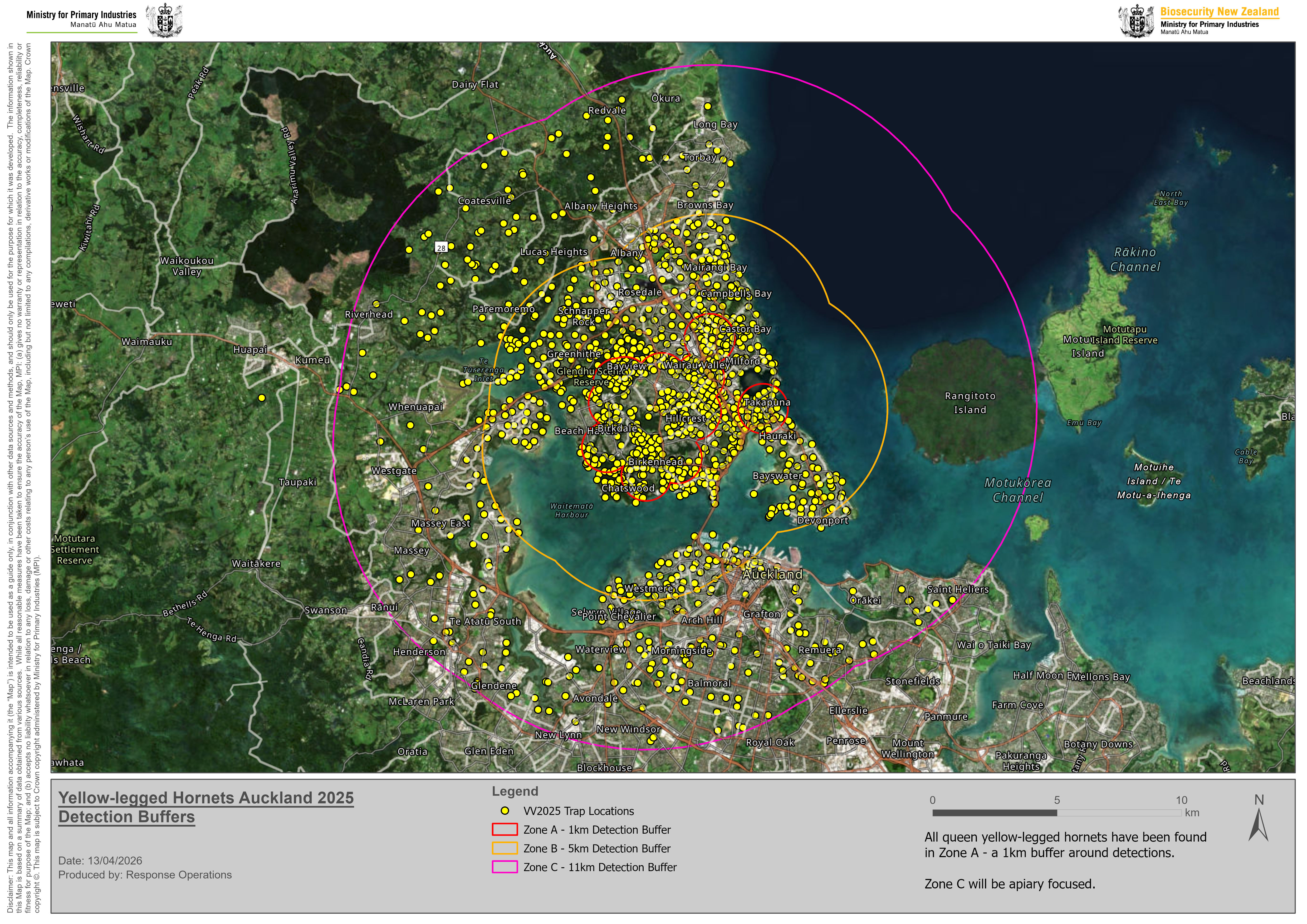
NZ may be winning the fight against the invasive yellow-legged hornet – but a crucial phase lies ahead Source: The Conversation (Au and NZ) – By Phil Lester, Professor of Ecology and Entomology, Te Herenga Waka — Victoria University of Wellington Six months on from the discovery of a yellow-legged hornet queen in Auckland there are encouraging signs New Zealand’s eradication effort is gaining ground. Teams that have been searching intensively for the
Global Sumud Flotilla heads from Barcelona to break Gaza blockade Asia Pacific Report A group of 39 boats known as the Global Sumud Flotilla has set sail from Barcelona to deliver humanitarian aid to Gaza, with organisers saying more vessels are expected to join along the route — making this their largest mission so far, reports Al Jazeera. Israeli security forces illegally intercepted and detained
Roblox is boosting safety features for young people. It’s a step in the right direction Source: The Conversation (Au and NZ) – By Lisa M. Given, Professor of Information Sciences & Director, Social Change Enabling Impact Platform, RMIT University Roblox has announced significant changes to its gaming platform to enhance safety for children under 16. The announcement comes just days after a man in the United Kingdom was jailed for
French Polynesia’s legislature shows new shape, more divisions By Patrick Decloitre, RNZ Pacific correspondent French Pacific desk The Territorial Assembly of French Polynesia has for the first time shown a new configuration during its first administrative sitting on Friday, following a mass resignation of a group of young elected members of the ruling Tavini Huiraatira. This follows the mass resignation of a group
Claude Mythos and Project Glasswing: why an AI superhacker has the tech world on alert Source: The Conversation (Au and NZ) – By Stan Karanasios, Professor in Information Systems, The University of Queensland New, more powerful artificial intelligence (AI) models are announced pretty regularly these days: the latest version of ChatGPT or Claude or Gemini always has new features and new capabilities that its makers are eager for customers to
What I would do if I was Mojtaba Khamenei – a Kenyan perspective COMMENTARY: By Bonface Chisutia On the night of February 28, the Israel-US airstrike killed his father, Supreme Leader Ayatollah Ali Khamenei, his wife, his brother-in-law and sister-in-law. According to a recent report from Reuters, Ayatollah Seyyed Mojtaba Khamenei suffered life threatening injuries and apparently lost his leg and has a disfigured face. The report said
Trump’s Strait of Hormuz blockade risks new costs for the global economy Source: The Conversation (Au and NZ) – By Sanjoy Paul, Associate Professor in Operations and Supply Chain Management, UTS Business School, University of Technology Sydney For weeks now, the world economy has been on tenterhooks, waiting for one outcome: reopening the Strait of Hormuz. In response to war with Israel and the United States, Iran
As Artemis II is celebrated, the world faces hard questions about US leadership in space Source: The Conversation (Au and NZ) – By Art Cotterell, Postdoctoral Fellow, Faculty of Law & Justice, UNSW Sydney The successful Artemis II trip around the Moon was a historic achievement – the first crewed lunar fly-by in more than 50 years, and the greatest distance yet travelled by humans from our “pale blue dot”.
What Viktor Orbán’s election loss means for Putin, Trump and the rise of right-wing populism Source: The Conversation (Au and NZ) – By Matthew Sussex, Associate Professor (Adj), Griffith Asia Institute; and Fellow, Strategic and Defence Studies Centre, Australian National University Hungary’s most consequential election in decades has just delivered an important victory for democracy and accountability. For Hungarians, opposition leader Péter Magyar’s emphatic defeat of Prime Minister Viktor Orbán
Do you taste words or hear colours? Here’s the neuroscience behind synaesthesia Source: The Conversation (Au and NZ) – By Sophie Smit, Postdoctoral Research Associate in Cognitive Neuroscience, University of Sydney Have you ever tasted a word, or seen colours while listening to music? If you have, you may be among the 1% to 4% of people who have a fascinating trait known as synaesthesia. Synaesthesia is
ABC’s Caper Crew delivers heists and heart – a bright spot in a struggling kids’ TV sector Source: The Conversation (Au and NZ) – By Alexa Scarlata, Lecturer, Digital Communication, RMIT University Australian kids’ TV shows are now few and far between. During the pandemic, the Australian government scrapped decades-old quotas for minimum hours of children’s content to try and bail out flailing commercial television networks. They were never reinstated. In 2023,
When Pope Leo XIV condemned threats to destroy Iranian civilisation as “truly unacceptable” in April 2026, the backlash was immediate. US President Donald Trump unleashed a tirade against the pope on social media, accusing him of being “weak on crime”, “terrible for foreign policy”, and acting like a politician rather than a religious leader.
But the exchange that followed matters more than the accusation. Confronted with criticism from Trump, Leo did not retreat. He made his position explicit: he was not afraid to speak, because his task was to proclaim the gospel.
Leo said he had “no fear of the Trump administration”, and “I don’t think that the message of the Gospel is meant to be abused in the way that some people are doing”.
That response clarifies the logic of his pontificate. Leo XIV is not trying to enter politics. He is defining the limits within which politics can operate.
Trump’s attack was heightened when he posted an AI-generated image of himself as Jesus, which caused an outcry even among his supporters. He has since deleted the post.
[embedded content]
God, not politics
Pope Leo’s opposition to the Iran war is not political in origin. It is moral and theological. It rests on a consistent claim: power must be judged, violence must be restrained, and invoking God to justify destruction is a distortion of both religion and public life.
From the beginning of his pontificate, Leo XIV has made this clear. Elected on May 8 2025, he used his first public address to call for dialogue, unity, and what he described as an “unarmed and disarming peace”. This was not positioning. It was a statement of purpose.
Since then, his interventions have followed a clear pattern. In 2025, as conflicts intensified in Ukraine, Gaza, and Sudan, he called repeatedly for ceasefires, humanitarian protection, and renewed diplomacy. He avoided strategic language. Instead, he focused on human dignity and the moral cost of war.
The pattern continued into 2026. On March 8, as the Iran conflict escalated, he called for an end to bombing and urged that “weapons may fall silent” to allow dialogue. On April 11, at a prayer vigil in St Peter’s Basilica, he sharpened his language. He warned of a “delusion of omnipotence” driving war and declared: “Enough of war”.
These are not policy prescriptions. They do not tell governments how to conduct war. They ask whether such wars can be justified at all.
This distinction lies at the centre of the current dispute. Political leaders operate within frameworks of interest, security, and power. Leo XIV operates within a framework of moral judgement. When those frameworks collide, his interventions are labelled political.
Yet his response to Trump shows he does not accept that framing. He has insisted his role is not to compete with political authority, but to speak from the gospel, even when that provokes criticism.
This is not new, but it is unusually explicit. Leo is drawing a line between two forms of authority: one grounded in power, the other in moral responsibility. He does not claim to direct political outcomes. He claims the right, and the duty, to judge them.
Beyond war
The same logic shapes his interventions beyond war. On migration, he has framed the issue in terms of human dignity, questioning whether harsh treatment of migrants can be reconciled with a consistent ethic of life. On social questions, he has resisted partisan categories, insisting moral coherence matters more than political alignment.
His engagement with artificial intelligence follows the same pattern. In December 2025, he warned that technological development must serve the common good, not concentrate power in the hands of a few. The question, again, was not technical but ethical: what does it mean to respect human dignity in a changing world?
Across these issues, the method is consistent. Leo XIV begins with principles, not interests. He does not align with factions. He applies moral reasoning to contemporary problems, even when doing so invites political backlash.
This approach reflects his formation. Born in Chicago in 1955 and shaped by decades of pastoral work in Peru, he encountered the realities of violence, inequality, and political instability firsthand. Those experiences did not draw him into politics. They reinforced a conviction that power must be accountable to moral limits.
His intellectual work supports this view. In his 1987 doctoral thesis, he argued authority is not domination but service, grounded in a moral order rather than human will. That understanding carries into his papacy. When Leo XIV speaks, he does not seek to exercise power. He seeks to define its boundaries.
[embedded content]
This is why his interventions provoke strong reactions. They do not remain abstract. They challenge real decisions, real policies, and real uses of force. They question the assumptions that underpin them.
In a political culture that often treats moral claims as secondary, this is disruptive. It exposes a tension that cannot easily be resolved: whether decisions about war, migration, or technology can be separated from questions of right and wrong.
Leo XIV’s answer is clear. They cannot.
His exchange with Trump brings that tension into focus. Trump’s criticism reflects a familiar expectation: that religious leaders should avoid direct engagement with political decisions. His response rejects that expectation. He does not present himself as a political actor. He presents himself as a moral voice that cannot be silent.
There is also a longer perspective at work. Political leaders operate within electoral cycles. Their decisions are shaped by immediate pressures. The papacy operates across generations. Its interventions are rarely decisive in the moment, but they shape how events are judged over time.
Leo XIV’s stance on the Iran war belongs to that longer horizon. It is not an attempt to determine outcomes. It is an attempt to set limits: on power, on violence, and on the use of religious language to justify either.
This US naval blockade is meant to strangle the Iranian economy by preventing it from exporting oil — the economic lifeline of Iran. It will do nothing of the sort.
Please study the infographics below. Before the war started, Iran was furiously loading tankers with oil at 3 times the normal rate and sending them off to the Far East, with the ultimate destination being China.
China buys 90 percent of Iranian oil, with many of its private refineries — known colloquially as “tea pot” refineries — depending on Iranian crude.
There are presently at least 158 million barrels of Iranian oil sitting in some 96 tankers anchored near the Malaysian state of Johor. There, ship-to-ship transfers take place, before the shipments go off to their final destinations in China.
So this naval blockade will cost the Americans billions of dollars to maintain, but the only thing it will achieve is to make countries dependent on oil from the Persian Gulf such as Australia, Britain, Europe, Japan, South Korea, India, Pakistan and Bangladesh cry.
American voters will get mad at Trump for the surging prices at the pump and give the Republicans a shellacking in the mid-terms.
Iran rolling in cash Iran will be rolling in cash from the sale of these 158 million barrels of oil already at sea and far away from any naval blockade, and the Iranians will be laughing at the stupidity of the Americans.
Isn’t this the classic illustration of the saying “closing the stable door after the horse has bolted”?
Let us see how long Trump can afford to keep up with this charade.
You would think that American intelligence would have the wherewithal to better advise their President what a harebrained idea his naval blockade is.
Lim Tean is a Singaporean lawyer, politician and commentator. He is the founder of the political party People’s Voice and a co-founder of the political alliance People’s Alliance for Reform.
Source: The Conversation (Au and NZ) – By Milad Haghani, Associate Professor and Principal Fellow in Urban Risk and Resilience, The University of Melbourne
The recent military conflict in the Middle East triggered a sharp increase in petrol prices throughout March, with the federal government’s subsequent excise cut providing only partial relief.
Queensland already had a 50-cent flat fare in place.
Other states and territories have not implemented similar measures.
But the moves by Victoria and Tasmania created a natural comparison: there are similar fuel price pressures but different public transport pricing across Australian states.
We examined how car use and travel patterns have changed since early April across three Australian states. Here’s what we found.
An unprecedented situation
The effectiveness of free public transport lies not only in increasing patronage, but in how much of that increase comes from reduced car use.
Evidence from Australia and other countries shows more people use public transport when it’s free. But much of this increase does not come from drivers switching modes. It often reflects more frequent use by existing public transport users, or shifts from walking and cycling.
What had not been tested is how people respond under a sudden fuel price increase. This created a rare situation where past evidence offered limited guidance.
We therefore examined this empirically. We surveyed nearly 2,000 Australians across Victoria, New South Wales and Queensland about a week after free public transport was introduced in Victoria. This allowed us to observe how travellers responded to rising fuel prices under different public transport pricing regimes.
How rising fuel prices changed travel
Our analysis shows car use has declined: across the three states, about 42% of respondents reported reducing their driving, with broadly similar patterns across states.
The shift to public transport, however, has not been uniform.
In Queensland, where fares were already heavily discounted, 21% reported shifting some commuting trips from car to public transport. This compares to about 24% in NSW and 26% in Victoria.
Free public transport in Victoria appears to have had some effect in shifting demand away from cars, but the difference compared to NSW – where fares remained unchanged – is modest rather than dramatic.
Non-work trips have been less responsive. On average, about 17% reported shifting some non-work trips to public transport, again with Victoria slightly higher at around 19%.
Other adjustments have also emerged. Around 16% reported working from home more often, while about 12% are now considering purchasing an electric vehicle.
The barriers beyond fare price
Given the high price of fuel and free public transport in Victoria, what has stopped people from embracing public transport more?
Access could be the key.
Across the sample, only about 49% reported they had good access to public transport, while the rest reported limited or none.
More than 30% reported public transport is not accessible to them within a reasonable walking distance (10-15 minutes). About 25% said it requires at least a short drive.
About 62% reported either they do not have a park-and-ride option (car parks at train stations) at the nearest station or stop, or that the parking is always full.
Another issue is the increase in travel time when using public transport, with about 70% saying their trip will be slower with public transport.
Access and travel time are only part of the story though. For many car users, familiarity with the public transport network also matters.
Planned disruptions – such as service replacements or altered routes – can make journeys more complex and less predictable.
For regular users, these may be manageable. But for those considering a mode shift, even small complications can act as a deterrent and negate the free fare policy. In that sense, disruptions are not conducive to encouraging new users at a time when incentives are in place.
Effective or just popular policy?
The patterns we observe suggest travellers are sensitive to cost.
Around four in ten people reported reducing their driving during the fuel price spike, indicating clear sensitivity to rising costs.
However, the relatively small difference between Victoria, where public transport was free, and NSW – where fares remained unchanged – suggests price is not the main constraint on mode shift. Access, travel time, service reliability and the ability to make specific trips appear to matter more.
This limits how effective fare-free policies can be in reducing car dependence. But effectiveness is only one dimension of policy. There is also public support.
Our results show free public transport is widely popular, with around 78% of respondents agreeing to varying degrees that it should be implemented during periods of high fuel prices – even if they are unlikely to use it themselves.
There is also recognition of shared responsibility: more than 70% agree reducing car use during such periods is a social responsibility, particularly to help ease demand for fuel.
But the broader reduction in car use appears to have been driven by fuel prices themselves, not fare policy. Victoria’s free public transport may have helped at the margins, but it did not produce a markedly different outcome from states that did not intervene.
This suggests that while fare relief is popular and can expand options, it is not, on its own, a decisive lever for reducing car dependence.
Many households will recognise this familiar exchange. One person insists an object simply isn’t there: impossible to find despite what they describe as a thorough and highly competent search. Another walks in, glances briefly at the same spot and points to it almost immediately.
“It’s right under your nose!”
This frustrating (for both sides) situation reflects something real about how the brain works. Finding objects in everyday environments relies on a process called visual search, and our brains are surprisingly imperfect at it. Even when something is directly in front of us, the brain can fail to register its presence. In other words, we are looking without seeing.
At first glance, searching for something seems simple. You scan a surface – a kitchen counter, a desk, the “everything” drawer – until the missing item appears.
But the brain cannot analyse every object in a scene simultaneously. Instead, it relies on attention, selecting certain features while filtering out the rest.
Psychologists often describe attention as a kind of spotlight sweeping across the visual field. Wherever that spotlight lands, information is processed in detail. Everything outside it receives far less scrutiny.
There is a practical anatomical reason the brain must constantly shift its gaze. The centre of the retina – the fovea – provides our sharpest vision. But it covers only a tiny part of the visual field, roughly the size of your thumbnail held at arm’s length. To inspect a scene properly, our eyes must repeatedly jump so that different parts of the environment fall onto this small, high-resolution patch.
Those jumps are called saccades, and they happen constantly. Even when you think you are staring steadily at something, your eyes are quietly darting from point to point.
Most of the time, this system works remarkably well. It allows us to navigate visually complex environments without becoming overwhelmed by information.
Looking without seeing
Seeing, it turns out, is not just about what reaches the eyes. It is also about what the brain expects to find. This phenomenon is known as inattentional blindness.
One of the most famous demonstrations of this involves a video in which participants watch a group of people passing a basketball and are asked to count the number of passes. While viewers concentrate on the task, a person in a gorilla suit strolls casually through the scene.
Roughly half the viewers never notice the gorilla at all.
The gorilla is not hidden. It walks directly across the centre of the screen. But the brain, focused on counting basketball passes, simply fails to register it.
[embedded content]
Did you spot the gorilla?
If you have ever searched a kitchen counter for your keys only to have someone else pick them up instantly, you have experienced the same phenomenon.
Once visual information reaches the brain, it is processed along different pathways. One of these – often called the dorsal stream – runs toward the parietal lobe of the brain, an area that plays a crucial role in spatial awareness and directing attention. This helps the brain determine where objects are in space. This system plays a crucial role in guiding attention during visual search.
Do men and women search differently?
In describing this familiar household moment, I avoided invoking a particular stereotype. The one where it is my husband who cannot find the object sitting directly in front of him.
Studies of visual search tasks have found small differences in how men and women scan complex scenes. On average, women tend to perform slightly better at locating objects in cluttered environments, while men often perform better on tasks involving large-scale spatial navigation or mentally rotating objects in three dimensions.
The reasons for this are still debated, but part of the answer may lie in how we move our eyes while searching.
Visual search relies on shifting our gaze from one point to another – the previously mentioned “saccades”. Eye-tracking studies show that some people tend to scan a scene methodically, moving their gaze in a more systematic pattern. Others make larger jumps across the visual field.
A systematic scan is more likely to cover every part of a cluttered surface, increasing the chances of spotting something small, such as a pair of keys or the elusive kitchen scissors. Larger jumps, by contrast, can skip over areas entirely, leaving an object sitting in plain sight but never quite falling under the brain’s attentional spotlight.
Some evolutionary psychologists have suggested these tendencies may have deep historical roots in hunter-gatherer societies. However, there is limited evidence for this. Experience, familiarity with an environment, and simple differences in attention probably matter far more than gender alone.
Ultimately, visual search is less like scanning a photograph and more like running a prediction algorithm. The brain constantly guesses where something is likely to be and directs attention accordingly.
Most of the time those predictions are correct. Occasionally, they are not, and an object sitting in plain sight fails to match the brain’s expectations.
Which means the next time someone insists they have looked everywhere, they may well be telling the truth. They just haven’t looked in quite the right way.
AMY GOODMAN: Ship traffic has halted again in the Strait of Hormuz after President Trump ordered the US military to begin a naval blockade of all Iranian ports and coastal areas starting on Monday.
Iran denounced Trump’s move as an illegal act amounting to “piracy”. Iran has threatened to strike Gulf ports in retaliation. Trump ordered the blockade after the US and Iran failed to reach a deal to end the war following 21 hours of talks in Islamabad, Pakistan.
The negotiations marked the highest-level talks between the two countries since the 1979 Islamic Revolution. US Vice-President JD Vance headed the U.S. delegation, which included US envoy Steve Witkoff and Trump’s son-in-law, Jared Kushner.
Iranian negotiators had flown to Pakistan on a plane they called “Minab 168” as a tribute to the 168 people killed in a US missile strike on an elementary school in the city of Minab on February 28. The plane carried images of the dead schoolchildren, along with blood-stained school bags recovered beneath the rubble.
Global oil prices jumped after Trump announced the blockade.
ERVAND ABRAHAMIAN: Well, I think both sides actually presented, basically, ultimate demands which the other side couldn’t accept, so it was a false start. But the implications of the failure is going to be actually quite drastic on the United States, because Trump’s main concern has been to actually put a limit, a lid, on the oil prices going up, and they’ve already jumped from $88 a barrel to over $100. They’re going to increase more with the present crisis, with the embargo on the Strait of Hormuz.
And as the crisis escalates, I think the US will start bombing Iranian oil installations. Iran will retaliate by bombing the Gulf’s oil installations, gas installations. The oil prices then could really zoom up.
Some people expect it to reach $200 a barrel. In that case, you know, it will have long-term implications for Wall Street and the whole American economy, not to mention the world economy. So, things that Trump has tried to avoid, he has got, actually, himself into the major crisis, economic crisis.
AMY GOODMAN: You have Robert Malley, who had previously been involved with talks with Iran, saying, “Twenty-one hours was 20 hours too many if the goal was to reiterate a demand Iran had already rejected. It was many hours too few if the goal was to negotiate.” Your response?
ERVAND ABRAHAMIAN: He’s exactly right. And I think, I mean, what Iran sees as the present crisis is an existential one, because although the talk has been regime change, the Israeli policy, clearly, in the last 10 years has been more than regime change. It’s basically been the destruction of the Iranian state, Iranian nation. So Iran sees this as an existential threat.
There was a speech that Trump made when he launched the attack on Iran a couple of weeks ago. It was actually quite an interesting speech. He talked about various ethnic minorities being oppressed in Iran, and they were dying to be liberated from Iranian control. And he listed obvious ethnic groups, but then there was one ethnic group that, really, I’d never heard of.
So I scratched my head. What is this group? And I did what most people do: You google. And lo and behold, this ethnic group actually exists in the other side of the Caucasus Mountains in Dagestan.
So you wonder what reason they had for putting this ethnic group that doesn’t exist in Iran as one of the ethnic groups, unless there’s some sinister idea the Israelis have of a civil war in Iran, where they will recruit, actually, mercenaries from the other side of the Caucasus to bring into Iran.
Of course, this sounds far-fetched, but this is what actually happened in Syria. You had a lot of Chechens actually brought in to fight against Assad. So, the Israelis may be thinking in those terms of actually a long civil war in Iran, where they would be bringing in mercenaries from outside. So, for this reason, I think Iran sees this as a real, serious, existential war. It’s not just a question of a minor sort of fine tuning of relations with the United States.
AMY GOODMAN: You’ve written about oil in Iran a great deal. Ghalibaf, the speaker of Iran’s parliament, tweeted on Sunday, “Enjoy the current pump figures. With the so-called ‘blockade’, soon you’ll be nostalgic for $4-$5 [per gallon] gas.”
ERVAND ABRAHAMIAN: Yeah, yeah. I mean, the price could go up to $200 a barrel, even more than that, if, basically, the Gulf oil — it’s not just Iranian oil, but the whole Gulf oil and gas — is actually cut off from the world market.
AMY GOODMAN: So, let’s talk about what Iran wants right now and what the US wants. Ten o’clock am — we’re broadcasting right before that — Eastern time is when the US Navy blockades, apparently, the Persian Gulf and the Strait of Hormuz.
What exactly does this mean? How will the Gulf nations be affected? How will Iran be affected? Because it both exports oil, but, of course, it needs oil and makes a great deal of its own oil.
ERVAND ABRAHAMIAN: Yeah, I mean, it won’t break Iran, because it has — Iran has other ways of actually exporting oil. It’ll obviously be a hardship, but it’ll be a much worse hardship on the Gulf states, if Iran actually dismantles their oil installations.
And that affects directly United States economy, because so much of Gulf oil money, gas money actually goes into high-tech United States. And much of the American, basically, modern technology is funded by subsidies from the various Gulf states. So it would have drastic repercussions on US economy.
AMY GOODMAN: What does Trump want? His latest, and what Vance said — right? Vance leaves the Hungarian prime minister, campaigning for him, Orbán, who was soundly defeated, and then goes to Islamabad to lead this negotiation. He says it’s all about nuclear weapons. Vance said, “The simple fact is that we need to see an affirmative commitment that they will not seek a nuclear weapon and they will not seek the tools that would enable them [to quickly] achieve a nuclear weapon.” Your response?
ERVAND ABRAHAMIAN: Exactly. I mean, that’s exactly what the Obama agreement was.
AMY GOODMAN: That Trump pulled out of.
ERVAND ABRAHAMIAN: Yes, which Trump pulled out of. But if you look at that agreement, basically, it said Iran had the right to enrich, but it had to be supervised to make sure it couldn’t enrich to the level of nuclear weapons.
So, Netanyahu cries it was vague agreement. In fact, it was very precise. Iran could enrich to 3.67 percent of uranium. That’s as precise as you can get. It was limited to 200 grams of enriched uranium. And also, it was — everything was supervised.
There were 140 international monitors, including American monitors. So, this was an incredibly tight procedure to make sure that Iran would actually fulfill its promise not to go into nuclear weapons.
When Trump pulled out of that, he basically unwound the whole system. And the best he can get is going back to that. So, demand that Iran should have no nuclear enrichment is a nonstarter. The best he could get is to go back, permit Iran to have enrichment, but with monitoring that it would not be weapon enrichment.
AMY GOODMAN: We just have a minute. In a call with the Russian President Putin, Iran’s President Masoud Pezeshkian said a deal is, “not out of reach.” So, if you can talk about whether — where you see this all headed?
ERVAND ABRAHAMIAN: Well, there are people in Iran in the — basically, in the National Security Council, including Pezeshkian, who think that they can make a deal with the United States. And they’ve been there a long time.
But there are also people now, I think, hardliners, who are stronger now than before the war, who are arguing that you can’t make a deal with Trump. Even if Trump makes a deal, he could, the following week, decide he’s going to pull out. So it’s a nonstarter, from their point of view, unless US can actually make full commitments. And I don’t see how they can do that, because Trump is basically untrustworthy.
So, from their point of view, I think the hardliners in Iran could argue, persuasively, the more the pressure they have, the more the prices are going to go up; the more it goes up, sooner or later, the patient will have a heart attack or a stroke. So they have an upper hand at the moment.
After the breakdown of ceasefire talks between the United States and Iran, President Donald Trump has now ordered a blockade of the pivotal Strait of Hormuz in the Persian Gulf.
It’s just the latest and most combustible phase of a broader regional conflict with global impacts and long, complex roots.
But while there has been copious analysis of this “coronary artery” of global oil and gas trade, much less attention has been paid to the history and sociopolitical fabric of the Hormuz region itself.
This is something of a blind spot, because understanding the deeper cultural dynamics of the strait and its surrounds can tell us something of what might now lie ahead.
Indeed, just as the 1956 Suez Crisis marked the eclipse of the old British Empire, the Hormuz crisis of 2026 may be remembered as a turning point for the US-led global order.
Origins of the oil monarchies
Great powers have long sought to control the Strait of Hormuz. Following the expulsion of the Portuguese in the early 17th century, imperial Britain evolved into the chief external power in the region over the next three-and-a-half centuries.
For much of this Pax Britannica commercial shipping through the strait – essential to links with Britain’s imperial territories in South Asia – faced attacks from local raiders in swift dhows that would emerge and quickly disappear into the complex and often foggy coastlines.
Not fully understanding the human and physical geography of the area, the British set out to closely map the coasts and populations. Based on this, Britain switched to co-opting certain tribes and sheikhs with financial incentives.
It also coordinated closely with the powerful sultan of Oman, who presided over an empire extending from the Persian Gulf to Zanzibar in east Africa, to tame the unruly populations of the Hormuz coastline.
This set the pattern of enriching local tribal rulers in the eastern Arabian peninsula that transformed into the contemporary oil monarchies in the 20th century.
The same tribes and clans that Britain privileged in the 19th century remain the ruling families of the United Arab Emirates (UAE), Qatar, Bahrain and Kuwait (Saudi Arabia evolved more independently). The result was long-term secure passage for commercial oil and gas shipping through Hormuz.
When the US inherited security responsibility for the Persian Gulf from the British after 1971, by which time eastern Arabian states were granted formal independence, it focused on these existing ruling families. Other facets of the region’s complex human geography were neglected.
Strait of Hormuz and surrounding countries, with Oman’s governorate of Musandam in the centre.Getty Images
In parallel, local rulers on both sides of the Gulf constructed narrow nationalisms based on Arab Sunni Islamic (apart from Oman, which is partly Ibadi) and Persian Shi’a Islamic identities. The combined effect was an illusion of political and cultural homogeneity.
Despite this, highly diverse communities continue to live along both coasts. The northern coast of the Gulf and Strait of Hormuz is home to significant ethnic Arab and Baluchi communities, both of which have long had testy relations with the Persian-dominant Iranian state (as well as with Pakistan).
Even less well known are the populations of the southern coastlines of Hormuz, including Oman’s governorate of Musandam at the tip of the Arabian Peninsula jutting into the Gulf, forming the Strait of Hormuz.
Only directly reachable from the Omani mainland by ferry, it contains a complex archipelago of islands and precipitous fiords and is surrounded by the UAE to the south and west.
Some of the indigenous population speak a unique language called Kumzari, with Arabic and Persian elements. The island communities have lived for centuries, virtually unknown, in a deeply symbiotic relationship with the sea.
For example, Kumzaris’ primary reference for direction is not north, south, east or west, but simply upward (bāla) and downward (zērin) – as a fisherman would perceive the depths of the sea relative to the mountains.
When I visited in 2019, I noted how many Musandam residents seemed relatively uncommitted to their Omani nationality. Many even wore the Emirati dish dasha – the traditional white robes that mark out the separate nationalities of the Gulf states.
This explains the special treatment Musandam residents receive, including social welfare assistance not available in other governorates, as a means of keeping the population loyal to Muscat, the capital of Oman.
Local forces, global tensions
All of this has potential implications for the current crisis.
On one hand, the ideological legitimacy of the Iranian state has increasingly been hollowed out in the face of internal unrest and external attacks by Israel and now the US.
Power in Tehran has been whittled down to a narrow clique within the Iranian Revolutionary Guard Corps. This weakening of state institutions opens the potential for sub-national identities, including those communities adjacent to the Strait of Hormuz, to crystallise and mobilise in the vacuum.
On the other hand, Oman is increasingly at odds with the UAE over Iran and the war. While the UAE is hawkish towards Tehran, Oman – long the Gulf’s most trusted neutral broker – has been implicated with Iran in a plan to establish a toll system for the Strait of Hormuz. Oman has denied this strenuously.
Ultimately, Oman’s control of the Musandam peninsula and its closeness to Iran create an uncomfortable tension with Abu Dhabi, the UAE capital.
The potential for the UAE to exploit local identity politics to try and bring the strategic Musandam peninsula under its own control is very real. Whether the US and other Gulf states would stand in the way is not clear.
Omani sensitivity to this possibility is extreme. At a university seminar I attended in Muscat in 2019, a map of the peninsula that failed to designate Musandam as part of Oman sparked a furious response from some in the audience.
More broadly, the fate of the Strait of Hormuz is emblematic of shifting world orders.
In 1956, Britain misread rising grassroots Arab nationalism and a changing world order as it sought to preserve its imperial lifelines through the Suez Canal. The risk for the US now is that it is making similar mistakes in the Strait of Hormuz, failing to adapt to local dynamics as the world changes again.
Those who venture into Foul Air Cave, below Buchan township in eastern Victoria, quickly realise how it got its ominous name. In its deepest chambers, bacteria consume oxygen and excrete organic gases to produce a toxic stench.
The cave is also a natural pitfall trap. Its water-worn entrance offers no escape to any creature unlucky enough to tumble in. The smell of death clings to your nostrils as you navigate vertiginous drops and calf-deep, sucking mud.
Tens to hundreds of thousands of years ago during the Pleistocene Epoch, Foul Air Cave accumulated remains of diverse, often-giant mammals known collectively as Australia’s megafauna.
One of these mammals was the giant echidna Megalibgwilia owenii, as we report in a new paper published today in Alcheringa: An Australasian Journal of Palaeontology. We recognised this extinct monotreme, twice the size of Australian echidnas today, from a newly identified fossil collected almost 120 years ago.
And the specimen is enough to verify for the first time that this species once roamed Ice Age Victoria, spanning a 1,000 kilometre gap in its previously known distribution.
Scores of ancient bones
The first scientific expeditions to Foul Air Cave were made in 1906–7 by Frank Palmer Spry who worked for what’s now called Museums Victoria, local caves curator Francis Moon, and geologist Thomas Sergeant Hall.
They were among the first to enter the cave. They encountered scores of fossil bones loosely buried in damp earth, including powerful, clawed mega-marsupial palorchestids and predatory marsupial “lions”.
They deposited their finds in the state collection, now housed at Melbourne Museum.
Over a century later, the fossils of Foul Air Cave have granted us a further insight into deep time.
Comparing fossil and modern echidna skulls. Left to right: Owen’s giant echidna (Megalibgwilia owenii); western long-beaked echidna (Zaglossus bruijnii); short-beaked echidna (Tachyglossus aculeatus).Museums Victoria, CC BY
A robust creature
Previously described fossils of Megalibgwilia owenii derive from a handful of sites in Western Australia, South Australia, Tasmania and New South Wales. They’re sparse, too: one well-preserved skeleton, four skulls of varying completeness, and a range of isolated bones.
Together, they illustrate a robust mammal a metre long and weighing in at 15 kilograms – roughly as big as a four-year-old child.
The meaning of its name is straightforward. Mega-libgwil-ia joins the ancient Greek prefix “mega-”, meaning large or mighty, with “libgwil”, the name for the echidna in the language of the Wemba Wemba people of northern Victoria and south-eastern NSW.
We can combine this with the species epithet owenii (acknowledging prolific 19th century anatomist Sir Richard Owen) to coin a common name: “Owen’s giant echidna”.
Using its fossil remains as a guide, Owen’s giant echidna most resembled the long-beaked echidna (Zaglossus), which today occupies the wet tropical cloud forests of New Guinea. Its broad limbs and shoulders bore prominent bony scars indicating it was more heavily muscled than other monotremes. It also had a wide, long and straight untoothed beak, with bony ridges across its palate.
This suite of differences implies Megalibgwilia was adapted to a different lifestyle than its modern relatives. One can imagine it tearing to pieces fallen logs or digging hard soils to seek out moth and beetle larvae, rather than feeding on termites or earthworms.
[embedded content]
A fossil awaits its finder
Our new fossil came to light during the systematic documentation and maintenance of thousands of fossil bones, teeth, and skeletons preserved by Museums Victoria.
But even this obscure seven centimetre fragment of skull was sufficient to identify the unique proportions of M. owenii – especially when we examined material in museum collections across Australia.
As well as identifying the fossil, we also researched its connection to Foul Air Cave by drawing on collection notes, hand-drawn maps, diaries and public newspaper archives.
These historical ephemera established Spry as the fossil’s collector. And they inspired a return to the cave in his footsteps.
A sketched cross-section of Foul Air Cave made in 1906–7, showing original locations of fossil deposits.Museums Victoria, Author provided (no reuse)
Ready for re-examination
Spry and Moon wore their everyday outfits of breeches, jacket and waistcoat for their fossicking. They lit their path with candles or kerosene lamps, and entrusted their life to stiff, heavy nautical rope. The trained geologist Hall never ventured into the cave himself. Under those conditions, who would judge him?
By comparison, modern caving is a technical affair. Brilliant headlamps illuminate entire caverns. Heavy-duty nylon oversuits protect from skin-shredding rocky surfaces. And the climbing ropes and devices are strong enough to suspend a small car.
The collaboration between Spry, Moon and Hall combined an informed perspective, fluent local knowledge, and technical know-how to succeed. Despite obvious advances in technology and disciplinary knowledge, our success is rooted in the same foundation as theirs – curiosity and community spirit.
During my own investigations at Buchan, families spanning generations have shared local history and acted as subterranean guides. Parks Victoria rangers have facilitated and overseen work on public reserves. Recreational cavers from the Victorian Speleological Association have been a wellspring of enthusiastic support.
Descending the near-vertical passages of Foul Air Cave.Stella Nikolaevsky/Museums Victoria
The long residence of this specimen in Victoria’s state collection epitomises how, thanks to past work, palaeontological discoveries arise from “collection-based” fieldwork as often as investigations outdoors.
And if one illuminating specimen can lie unnoticed across a century, why not others?
Sparse fossil bones of large, slender echidnas, seemingly distinct from Megalibgwilia owenii, have been noted from Victoria and South Australia. These warrant re-examination to test if Owen’s giant echidna adapted to different conditions over space or time, or if another unknown species co-occupied the landscape.
If true, then surely one of its ancestors awaits recognition – either among the landscape or preserved carefully among the nation’s public scientific assets.
American Australian performer Joe Dolce’s 1980 one-hit wonder Shaddap You Face was recently inducted into the National Film and Sound Archive’s Sounds of Australia collection, which also named it Australia’s best novelty song.
For its fans, the song presciently predated the rise of Australian “wog humour” in the late 1980s – comedy by and about the experiences of migrants and their families in Australia.
For its critics, it was an example of the ethnic buffoon: a racialised stereotype whose difference is a source of humour – to be laughed at rather than laughed with.
How can we best understand this song, nearly 50 years on?
[embedded content]
A migrant story
Shaddap You Face was first performed by Dolce at Fitzroy’s Marijuana House in 1979. The song tells the story of a young migrant dreaming of stardom and recalling how his mother would tell him off for his desultory attitude.
Recorded in Mike Brady’s Full Moon Records studio, Shaddap You Face would go on to surpass Brady’s own Up There Cazaly as Australia’s best-selling single ever, selling six million copies worldwide and recorded in 15 different languages, including the Indijibundji language.
Born in Ohio, Dolce migrated to Australia in 1978 following his then-wife Zadie Acton. While the marriage didn’t last, Dolce’s stay in Australia did. He soon met his wife and artistic collaborator of over 40 years, Australian artist and musician Lin Van Hek.
Prior to Shaddap You Face, Dolce wrote a protest song about the Australian government’s treatment of Vietnamese boat people. He also later revised Shaddap You Face with Vietnamese Australian comic Hung Le, protesting the rise of One Nation in the late 1990s.
Beyond Shaddap You Face, Dolce has cultivated a career as a respected songwriter, award-winning poet and prolific essayist.
In a 2024 interview with A Current Affair, Dolce described Shaddap You Face as
more of a phenomenon than a hit because it’s resonated through time […] this one for some reason is passing on from generation to generation.
Representing migrants in 1980s Australia
Prior to Shaddap, the best known representation of Italians in Australia was They’re A Weird Mob (1966). Directed by Michael Powell, the film was based on John O’Grady’s novel of the same name, published under the Italian-sounding pseudonym Nino Culotta.
[embedded content]
At the time of Shaddap’s success, the ABC was screening Home Sweet Home (1980–82). Created by British writer Vince Powell, the sitcom starred Polish Australian actor John Bluthal as Enzo Pacelli, an Italian taxi driver in Sydney.
The kind of accented comic performance provided by Bluthal’s Enzo – and by Dolce’s Shaddap Your Face – has been criticised as ethnic buffoonery.
For many early comedians of minority backgrounds, this form of self-caricature was the price of success as a performer. Blackface minstrelsy, performed by both Black and non-Black performers, is arguably the prototype of this.
In 1980s Australia, the ethnic buffoon was exemplified by Anglo-Australian comedian Mark Mitchell’s Con the Fruiterer on The Comedy Company (1988–90).
[embedded content]
To play the Greek Australian caricature, Mitchell darkened his skin and hair and adopted a thick accent.
Wog humour pioneer Nick Giannopoulos describes this kind of performance as “wog face”. In defence, Mitchell described Con as “an archetype of the new Australian who did well” and cites his popularity amongst Greek Australian viewers at the time.
At the same time as Con the Fruiterer, artists like Giannopoulos, Mary Coustas and Simon Palomares were crafting a new Australian comedy genre. Wog humour presented a counterpoint to such inauthentic representations, particularly for southern Europeans who saw themselves, their families and their accents represented.
But for some critics, wog comedies such as Wogs Out of Work (1987) and Acropolis Now (1989–92) were a “caricatured and stereotyped” continuation of the ethnic buffoon tradition.
[embedded content]
Where does this leave Shaddap You Face?
Despite its use of caricature, Shaddap Your Face was nevertheless a rare portrayal of Italians by an Italian in Australia. And considered in the broader context of Dolce’s career, Shaddap You Face is more than a novelty song.
The first verse describes how young Giuseppe’s family pressure him to do well at school and to behave himself because the rules of migrant success are different. It is not dissimilar from the Australian film Moving Out (1983).
[embedded content]
In the second verse, he dreams of becoming a performer but is determined to remain authentic to himself. In the final verse, he has become a success for singing this very song.
When he first arrived in Australia, Dolce was horrified to discover that being an Italian entertainer wasn’t as respected as it was in the land of Frank Sinatra. In his early live performances of the song, Dolce – in the persona of Giuseppe – would get his audiences to unpack their idea of “wogs”.
For many listeners, the novelty value of its chorus and Dolce’s comedic use of accented broken English obscures the story told in the song of a young migrant struggling to fit in.
But listen closely, and you’ll find the chorus is as much a criticism of the lack of respect for hard-working migrants as it is a gentle rebuff from an Italian mother to her recalcitrant son.
As Dolce has observed, “the general mass will always remember only the broadest strokes”. Although some might still cringe at its cheesy repetitiveness, we should look back on Shaddap You Face as a critical commentary on multicultural Australia and as a joke that we didn’t quite get.
As school holidays continue around Australia, many parents are looking for educational ways to keep their children entertained.
If you own an Android device and have young children, you may find yourself browsing Google Play for educational and age-appropriate apps. If you go to the children’s section, you will be led to a page with “Teacher Approved apps & games” featuring apps for children under 13 according to different age ranges and themes.
Popular “Teacher Approved” apps such as learning app Lingokids and the game Bluey: Let’s Play have been downloaded more than 50 million times. YouTube Kids, another “Teacher Approved” app, has been downloaded more than 500 million times.
Google says “teachers and specialists” rate the “Teacher Approved” apps. But in our research we argue it’s unclear who exactly those teachers and experts are. The educational value of Google Teacher Approved apps can also be unclear at times.
What is ‘Teacher Approved’?
Google launched the “Teacher Approved” program in 2020 to set a quality standard for apps for children aged under 13.
Google has an online course for developers who want to be included in the Teacher Approved section. We took this as part of our our research.
In the course, Google states “an app doesn’t have to be educational” as long as it is “enriching” and “support(s) a child’s healthy development”. At the same time, Google says teachers are assessing apps for “learning impact”. However, it is not clear how learning is assessed, especially for apps that are not educational.
Our research
In our study, we analysed how apps were presented in the children’s section on Google Play to make them seem educational.
We also interviewed five industry stakeholders (three founders/chief executives and two design specialists) from different companies developing apps for children.
We chose to involve industry rather than parents, as anecdotal evidence suggests parents have little understanding of the “Teacher Approved” program.
Confusing labels and categories
We found “Teacher Approved” apps are often categorised with vague or interchangeable labels such as “enriching apps”, “enriching games” and “games for kids”. This can make it difficult to understand the purpose of the apps, or to know whether they are educational or not.
We also found some apps with a “Teacher Approved” badge were labelled by the app developer as entertainment rather than “educational”. For example, Paw Patrol Rescue World was “Teacher Approved”, despite being labelled as “action-adventure” by the developer.
With the Teacher Approved badge Google creates the impression of educational value and trustworthiness for all sorts of apps. As one of the developers we interviewed explained:
how many people would look at a little graphical badge and go ‘oh, I trust this now, because they’ve got this badge’.
Who approves the apps?
The Teachers Approved badge implies teachers are used to evaluate the apps that appear in the children’s section on Google Play.
However, on the developer’s section of its website, Google notes it is not exclusively teachers who assess the apps. It says “teachers and children’s education and media specialists recommend high-quality [Teacher Approved] apps for kids on Google Play.”
In 2020, Google shared the names of two experts who were “lead advisers” at the time – a developmental psychologist and an education and media expert. But it is not clear who the “teachers” and “specialists” who currently rate the apps are and how many of them are actually teachers.
The Conversation asked Google where the teachers or specialists are located, whether they are paid, and what criteria non-teachers need to meet to be included in the program. The company did not respond before deadline.
What can parents do?
Our research suggests the current situation is confusing for parents. In the meantime, there are some things parents can do if they are not sure about apps their kids are using:
Teams that have been searching intensively for the highly invasive predators haven’t turned up a new nest since last month.
This result suggests the country’s $12 million response programme – which has seen dozens of nests found and destroyed, alongside a huge public reporting effort – may be starting to get on top of the incursion.
From my perspective, having closely followed the response, there is good reason to be cautiously optimistic this serious threat to New Zealand and its vulnerable ecosystems can be stamped out before it gains a foothold.
Still, this progress comes at a critical moment, when any remaining hornet nests will shift into a new phase and rapidly seed a new generation.
At this time of year, worker numbers peak and colonies would normally begin producing new queens, known as gynes. These queens mate, then disperse and overwinter in sheltered sites, ready to establish new nests in spring.
From a biosecurity perspective, the goal is straightforward: find and destroy every remaining nest before new queens are produced. The coming weeks may determine whether that goal is achieved.
Why this tiny invader remains such a threat
The yellow-legged hornet (Vespa velutina) is an invasive predator native to Asia that has spread rapidly through parts of Europe over the past two decades. It is now widely regarded as one of the most damaging threats to honeybees and other pollinators.
Yellow-legged hornets specialise in hunting live prey.
They are particularly effective at targeting honey bees, often hovering at the entrance of hives and killing returning workers mid-flight. A single colony can consume tens of thousands of honey bees and other insects over a season.
The impact on beekeeping can be severe. Entire hives can collapse under sustained predation pressure. Even when colonies survive, bees [may stop foraging altogether out of fear],(https://link.springer.com/article/10.1007/s10340-018-1063-0), reducing pollination of crops and native plants.
Hornets also pose a risk to people. While they are not typically aggressive away from their nests, they will defend them vigorously if disturbed. In Europe, stings have been linked to cases of anaphylaxis and, in some instances, death.
New Zealand’s incursion appears to be recent and geographically contained.
Since the first queens were detected in Auckland in October, all confirmed nests have been found within a relatively small area on the North Shore. Genetic analysis suggests they may have originated from a single introduction event, over the summer of 2024/25.
AI cameras and ‘Judas hornets’
Behind the 77 queens discovered to date – most of them linked to nests – lies a far larger response effort, measured in thousands of hours of fieldwork, thousands of public reports and a coordinated national push.
Each day, more than 50 people are on the ground hunting hornets. Beekeepers are also helping by monitoring more than 575 apiaries across the region. The wider public response has been impressive: the Ministry for Primary Industries has received more than 16,625 notifications so far.
Two experts visiting from the UK – where teams have been dealing with hornet incursions for years – have been advising on field tactics, tracking and nest detection.
Drawing on that experience, they say the New Zealand response stands out for its scale, coordination and smart use of technology. As Pete Davies, formerly of the UK’s Animal Plant and Health Agency, put it:
You’re throwing everything at it, using all the technology available and treating it with urgency. I remain optimistic that you’ll ultimately eradicate the hornet from New Zealand.
AI-enabled cameras are now being deployed at bait stations to distinguish yellow-legged hornets from wasps and other insects, allowing teams to monitor activity remotely and focus their efforts where it matters most.
Another key tool has been the clever use of so-called “Judas hornets”.
Captured workers are fitted with tiny radio transmitters and released, then tracked as they fly back to their nest – effectively leading search crews straight to hidden colonies that would otherwise be difficult to locate high in trees.
A toxic bait that attracts hornets and wasps, but not bees, has also been deployed. Other non-toxic bait stations have been set out across the search area and are being checked regularly.
For all of this momentum, however, the work is not yet over. Continued public support will be essential to locate any remaining hidden nests. Missing even one could undo this year’s progress and send the response back to square one next season.
If a suspect hornet is spotted, it should be photographed (from a safe distance) and reported. Where traps are in use, they should be checked regularly. Beekeepers are encouraged to monitor hive entrances closely for hornets “hawking” and killing bees.
A group of 39 boats known as the Global Sumud Flotilla has set sail from Barcelona to deliver humanitarian aid to Gaza, with organisers saying more vessels are expected to join along the route — making this their largest mission so far, reports Al Jazeera.
Israeli security forces illegally intercepted and detained crew from a similar flotilla last year, but organisers say rough sea conditions mean the journey will be slower this time.
The fleet is expected to reach international waters later this week.
Organisers accused Israel of repeatedly violating the ceasefire and expanding control in Gaza.
They said the flotilla aims to challenge what they describe as an illegal blockade.
About a total of 80 boats from around the world carrying about 1000 people are expected to join the flotilla.
Al Jazeera reporter Mohammad Saleh said from the dockside in Barcelona: “The aim is to break the Israeli blockade of Gaza and to deliver life-saving aid and relief to a besieged population.”
[embedded content] Global Sumud Flotilla heads from Barcelona to Gaza Video: Al Jazeera
Singer Rana Hamida . . . “Our strength is collective, and our will is unbreakable..” Image: Speak Up Dotcom screenshot APR
One of the New Zealanders taking part, Palestinian-Syrian Rana Hamida, said: “On the Global Sumud Flotilla, resistance songs have proved that encouraging comrades and showing our spirits can’t be crushed IS essential activism.
“Dissent comes from singing our truth, sailing toward freedom, and standing firm in solidarity.
“Every voice, every wave, every stance breaks through the siege. Our strength is collective, and our will is unbreakable.”