View from The Hill: David Littleproud quits as Nationals leader, declaring ‘I’m buggered’

Source: The Conversation (Au and NZ) – By Michelle Grattan, Professorial Fellow, University of Canberra

Nationals leader David Littleproud has unexpectedly quit his post, declaring he is “buggered” and “out on my feet”.

His announcement came as a shock to colleagues and follows a period of extreme turbulence for his party and the Coalition, which split twice during this term.

Littleproud has been a controversial and, in terms of Coalition relations, provocative, leader. Although the Nationals held their lower house seats at the election, since then two of their high profile MPs have defected. Jacinta Nampijinpa Price went to the Liberals immediately after the election, and former deputy prime minister Barnaby Joyce jumped to One Nation.

Littleproud had a bad relationship with former Liberal leader Sussan Ley and triggered both fractures between the two parties.

He has been much closer to the new Liberal leader, Angus Taylor, under whom relations between the parties have so far been smooth.

The Nationals will meet at 10am Wednesday to replace Littleproud. They need to do so quickly, as they have a candidate running in the May 9 byelection in Ley’s former seat of Farrer. On early indications, the Nationals have almost no chance of winning the seat, which former deputy prime minister Tim Fischer held for them before Ley.

Nationals senator Ross Cadell told Sky News the leadership contenders could be deputy leader Kevin Hogan, former leader Michael McCormack, who served as deputy prime minister, outspoken backbencher Matt Canavan and Senate leader Bridget McKenzie. Littleproud did not endorse a successor.

Sources confirmed McKenzie was likely to stand.

Canavan said he would run. “I believe I have the best chance to help win the battle for an Australia first plan that can deliver a better life for all Australians.”

Littleproud, who did not announce his plan at the Nationals’ regular party meeting on Tuesday, held a news conference after question time with his wife Amelia at his side.

He said he would stay on in his regional Queensland seat of Maranoa, including re-contesting it at the next election. He left open the possibility of serving on the shadow frontbench.

Despite internal and external criticism of his performance, Littleproud’s leadership position did not appear to be under any threat. One of his techniques for retaining support was to take every decision, however small, to the party room.

At his news conference, he defended his record saying, “I am proud of us recapturing our identity, for who we are and what we stand for. For that 30% of Australians who live outside a capital city.”

He said he had done this with the Voice (when the Nationals preempted the Liberals with their opposition) and on other policy areas, including net zero. “It’s not probably since John McEwen has the National Party leader had to stand up and show the courage of their character and […] stand for what their party room wants them to stand for. So I’m proud but I’m tired.”

“It is time for me to feel normal again, it has been a pretty rough road since the election.”

Littleproud was highly critical when asked about working with Ley. He said it was a mistake after the election to “wipe all our policies because all we did was leave a vacuum for someone to walk into.

“I stood and fought for those four policies that meant so much for our party room. […] I wasn’t going to let them go.

“And then [after the Nationals defied shadow cabinet solidarity] I was not going to stand by while my mates got punted for not doing anything wrong.

“Where I come from, if one of your mob gets knocked over and it is not for the right reason, you come swinging back. That is how we operate. The culture of National Party has always been like that. I am proud of that.”

Littleproud said to go on as leader “would be the wrong thing for me to do. I love the National Party. I grew up in it, I’ll bleed, to the day I die, green and gold, I love it, and it’d be wrong for me to say that I’m the right person to continue to lead. That’s tough for me to say, [that] I think someone better can do it, because I don’t have the energy. I’m out of my feet. I’m done.”

Barnaby Joyce, who said Littlepround’s ostracising of him was one reason for defecting, blasted Littleproud. He told The Australian: “Mr Littleproud has to accept responsibility for the existential crisis he left the National Party in.

“When I heard he said he was proud of what he achieved and compared himself to Black Jack [John] McEwen, I didn’t know whether that was pathos or AI interfering with my news.

“We had senior people leave such as David Gillespie, Keith Pitt, Jacinta Nampijinpa Price. We had a [Senate] seat that was lost, which was Perin Davey. Two people who basically walked out in myself and Andrew Gee, and Jacinta.”

Taylor described Littleproud as a “committed Coalitionist”.

Nationals federal president Andrew Fraser said: “I congratulate David on his personal strength and conviction that saw The Nationals lead the debate on the Voice and on the development and adoption of an energy and climate policy that will meet our future energy needs and allow Australian businesses to thrive.

“We are not a faction of the Liberal Party; we have a partnership, and David’s leadership never let them forget it.”

ref. View from The Hill: David Littleproud quits as Nationals leader, declaring ‘I’m buggered’ – https://theconversation.com/view-from-the-hill-david-littleproud-quits-as-nationals-leader-declaring-im-buggered-277970

Evening Report: https://eveningreport.nz/2026/03/10/view-from-the-hill-david-littleproud-quits-as-nationals-leader-declaring-im-buggered-277970/

Too valuable to burn? Chemical and plastic industries will rely on oil far longer than motorists

Source: The Conversation (Au and NZ) – By Mehdi Seyedmahmoudian, Professor of Electrical Engineering, School of Engineering, Swinburne University of Technology

Every year, the world uses roughly 37 billion barrels of oil. Most is burned to power cars, trucks, planes, ships and other types of transport. For more than a century, this energy-dense hydrocarbon has shaped the modern world, from geopolitics to electricity systems.

But this dependence on oil for transport comes with clear vulnerabilities. Combustion engines burning petrol, diesel or gas worsen climate change. Oil accounts for a third of all greenhouse gas emissions from fuel. Many countries rely on oil imports, which means oil has to be extracted and shipped long distances. Right now, oil prices are soaring after Iran closed the Strait of Hormuz, through which 20% of the world’s oil and gas is shipped. In response, governments may have to release strategic reserves, while stock markets have fallen and analysts are warning of sudden inflation.

As electric vehicles rise to 25% of new car sales globally, demand for oil as a fuel is expected to plateau and eventually decline. We can already see this in China’s very rapid shift to electric vehicles, trucks and bullet trains, which has slowed its oil demand growth.

This doesn’t mean an end to oil. We will likely need it as a raw material for useful products for decades yet. The International Energy Agency predicts petrochemicals will become the main driver of demand this year. Researchers have argued oil is likely to become increasingly important as a feedstock – and could become too valuable to burn.

Oil is far more than a fuel

Crude oil is an extremely versatile substance, able to be refined and separated into many different products. Two of these products – naptha and ethane – are the main feedstock for huge petrochemical industries manufacturing plastics such as polyethylene and polypropylene, synthetic fibres such as polyester, industrial solvents and cosmetics.

Oil is also essential for advanced materials such as carbon fibre, synthetic graphite and plastics embedded in electric vehicles, wind turbines, power electronics, insulation systems and grid infrastructure.

You might have seen this fact pointed out on social media to score points against environmentalists. But there are clear differences between burning oil for fuel – which can only be done once – and using it for materials that will stay in use for years or decades. Some of these materials can be recycled.

Oil used in this way is more like a mined product than a fuel. It is stored in products rather than immediately released as emissions.

[embedded content]
The main way we make plastics requires oil as a feedstock.

Electrification is changing demand for oil

Electric vehicles charge their batteries with electricity, which is typically produced domestically. Electricity production, too, is shifting to clean sources – renewables, grid-scale batteries and digital energy management. These two trends should reduce demand for oil as fuel.

This isn’t a given. It relies on networks of EV chargers and new charging hubs for electric trucks and buses. The power grid has to be expanded and strengthened. Microgrids and community energy systems can boost resilience and cut demand for diesel generators in remote areas.

Other sectors will remain dependent on oil as a fuel for longer. While pure electric planes and ships are emerging, range limitations mean hybrid electric-fuel models are more likely to succeed until technologies improve.

Petrochemicals still cost the environment

While manufacturing plastics from oil does less damage to the atmosphere than burning it for fuel, it still comes at an environmental cost. Refining oil to make plastics accounts for 3.4% of the world’s carbon emissions as of 2019, and this is likely to rise significantly.

If petrochemical industries such as plastics expand as dramatically as predicted, it will intensify existing problems with plastic pollution, marine plastic and microplastics. Strong recycling and waste management can counter this, but only to a degree.

Oil has become ubiquitous in modern life – not just as an energy dense fuel, but as a feedstock for thousands of petrochemical products. Tom Fisk/Pexels, CC BY-NC-ND

If oil shifts from fuel to feedstock, governments will have to amp up circular economy efforts to ensure products can be reused or recycled, boost recycling rates and avoid waste entering the environment.

In the longer term, we will need to look for alternatives to oil across its many uses. These could involve using pyrolysis to turn plastics back into oil so they can be used again, or looking to green chemistry approaches to convert biomass into feedstock.

What should we do?

Shifting away from using oil as fuel won’t happen overnight.

To soak up more renewables, power grid operators are adding energy storage and using digital tools and advanced control to maintain reliability and quality. This will be essential if transport is to go electric and petrol and diesel use is to fall.

The public EV charger network has to be widespread and reliable. Emerging very fast charge technologies could slash charging times. Allowing EVs to feed power back to the grid can help keep the grid stable and power prices reasonable – while rewarding owners.

Oil is not going to disappear any time soon. But over time, it’s likely to shift from a ubiquitous commodity sold at every service station to a more specialised role as a feedstock.

It will count as real progress on climate change if oil is no longer routinely burned as fuel. But if the oil industry simply shifts to petrochemicals, there will still be a significant environmental cost to pay.

ref. Too valuable to burn? Chemical and plastic industries will rely on oil far longer than motorists – https://theconversation.com/too-valuable-to-burn-chemical-and-plastic-industries-will-rely-on-oil-far-longer-than-motorists-276275

Evening Report: https://eveningreport.nz/2026/03/10/too-valuable-to-burn-chemical-and-plastic-industries-will-rely-on-oil-far-longer-than-motorists-276275/

Australia is sending an aircraft and personnel to the Middle East. Does this mean we are entering the war?

Source: The Conversation (Au and NZ) – By Peter Layton, Visiting Fellow, Strategic Studies, Griffith University

The Royal Australian Air Force (RAAF) is off to another Middle Eastern war, which is likely a surprise to many given how contentious the country’s involvement in the Iraq war was.

The Albanese government has decided to send a RAAF E-7A Wedgetail surveillance aircraft to the United Arab Emirates (UAE), along with 85 personnel and a supply of air-to-air missiles capable of shooting down drones.

Wedgetail aircraft have been sent on similar operations before, not just to the Middle East but most recently to Europe as part of the NATO mission to help Ukraine.

Australia recently agreed to an economic strategic partnership with the UAE, but this military deployment appears to be part of a defence cooperation agreement that dates back to 2007.

So, does this mean Australia is now entering the war by sending military assets, including personnel, to the region?

Defensive role

The deployment, while doubtless agreeable to the Trump administration, is not intended to be part of the Israeli–US air offensive against Iran.

Rather, the E-7A Wedgetail will help the UAE defend itself after some ground-based, long-range air surveillance radar systems were damaged in attacks from Iran. The gap in surveillance coverage will be partly filled by the RAAF aircraft.

The aircraft is fitted with a high-performance air surveillance radar system and will be able to provide early warning of approaching air attacks, most likely from Iran’s Shahed drones.

The aircraft will do this by providing digital tracking data of incoming hostile aircraft and drones to the UAE’s surface-to-air missile systems and fighter aircraft, so they can respond.

An RAAF E-7A Wedgetail aircraft in Sydney last year. Dan Himbrechts/AAP

The UAE has a very sophisticated air defence system that so far has intercepted over 1,000 Iranian ballistic missiles, cruise missiles and drones.

This extraordinarily large number of interceptions means its large stockpile of interceptor missiles is gradually being depleted. As a result, Australia is also transferring some of its AIM-120 advanced medium-range, air-to-air missiles (AMRAAM) to the UAE to help it intercept drones.

Australia placed a replenishment order to the United States for more of these missiles last year. The missiles now going to the UAE are probably older versions that have been in Australia’s stock for many years.

South Korea is rushing Cheongung-II interceptors to the UAE to help it defend against ballistic missiles, as well.

A history of air support in the region

The E-7A Wedgetail aircraft will presumably be deployed to the Al Minad airbase, some 40 kilometres south of Dubai. The Australian Defence Force has operated there since 2003. It maintains a small permanent presence at the base to support ADF operations across the Middle East.

Last week, the Albanese government announced it was deploying a C-17 large transport aircraft and a KC-30A air-to-air refuelling aircraft to the region. These planes are now assumed to be at Al Minad, too.

The RAAF previously deployed E-7A Wedgetail aircraft to the region from 2014–20 to support the US-led military operations against Islamic State in Iraq. The RAAF personnel going there now, therefore, will be quite experienced in operations in the region and the dangers involved.

The Al Minad airbase has already been hit by Iranian missiles and drones, but these had little effect.

Nevertheless, there is still a risk the E-7A Wedgetail could be damaged while parked at the air base.

Possible issues that could arise

This deployment does not mean Australia is entering a combat role in the war. It will instead have an enabling role – bolstering the UAE’s air defence.

Even though the E-7A Wedgetail has a clearly defensive purpose, the deployment could still be seen from the Iranian perspective as support for the US-Israeli air offensive.

In an indirect way, it could help the US. The RAAF deployment will reduce the need for the US to help defend the UAE, potentially freeing up US forces to strengthen its attacks on Iran. The Australian government’s messaging appears aimed at trying to avoid people drawing this conclusion.

More worryingly, Australia could potentially become enmeshed in other operations now that it has assets there.

For example, Iran has effectively shut down the Strait of Hormuz to shipping traffic, disrupting the flow of oil and gas to the world.

If the US Navy takes military action to forcibly open the strait, it is possible Australia could be called on to support this, initially using the E-7A Wedgetail already in place.

French President Emmanuel Macron has said his country and its European allies are preparing a “purely defensive” mission to escort ships through the strait once the “most intense phase” of the war ends.

Australia could be asked to join this effort, as well, putting its aircraft at risk of attack from Iran. Given Australia’s oil supplies and fuel costs are greatly impacted by the closure of the strait, the government would find it difficult to say no.

The deployment of the E-7A Wedgetail may then be an early warning that Australian military involvement in the Middle East is about to escalate as it did with the wars in Iraq and Afghanistan, and against Islamic State.

Like the Persian Gulf nations, Australia could become trapped and dependent on decisions that will be “mutually” taken by US President Donald Trump and Israeli Prime Minister Benjamin Netanyahu.

ref. Australia is sending an aircraft and personnel to the Middle East. Does this mean we are entering the war? – https://theconversation.com/australia-is-sending-an-aircraft-and-personnel-to-the-middle-east-does-this-mean-we-are-entering-the-war-277958

Evening Report: https://eveningreport.nz/2026/03/10/australia-is-sending-an-aircraft-and-personnel-to-the-middle-east-does-this-mean-we-are-entering-the-war-277958/

Politics with Michelle Grattan: Middle East war set to push inflation higher than forecast, warns RBA deputy governor

Source: The Conversation (Au and NZ) – By Michelle Grattan, Professorial Fellow, University of Canberra

The Reserve Bank’s Deputy Governor Andrew Hauser says inflation in Australia looks likely to be higher than projected before the war in the Middle East broke out.

The Reserve Bank’s board will meet to discuss interest rates next week. Reserve Bank Governor Michele Bullock has flagged the meeting will be “live” – meaning there could be a change in interest rates announced on Tuesday.

Global oil prices have seen a dramatic spike then fall this week, creating major uncertainty for the international and Australian economies.

Speaking on the Politics with Michelle Grattan podcast, Hauser concedes the bank’s projection for headline inflation for June – an annual rate of 4.2% – is likely to be exceeded because of surging oil prices and other fallout from the Middle East war. Inflation is already well outside the bank’s 2-3% target range.

Hauser won’t put a number on the likely mid-year level, but downplays the prospect of it reaching 5% by then, as NAB’s chief economist Sally Auld has suggested. Hauser says:

That 5% I think assumes that the oil price is in the sort of US$100 range, which we were well into yesterday, but not into today. We don’t have updated numbers on our forecast now. We don’t actually formally update our forecast until May, which is the [board] meeting after the one coming up.

[…] But it clearly is the case that it’s an upside risk to that projection in February. It’s still in flux […] I don’t want to give a number that might give a false sense of accuracy. But certainly directionally it’s higher than the projection we published in February.

The outlook for interest rates

Asked whether the fallout from the Middle East conflict makes an imminent rate rise more or less likely, Hauser says: “there’s going to be a lot for the board to discuss next week”.

I think there’ll be a very genuine debate. Inflation is too high. Higher prices don’t help that debate. But there are arguments from both sides, and I think if ever there was a time when board members will earn their meagre salary, it’ll be this month.

On what home owners and buyers can expect over the next year, Hauser says:

What I do hope we’ll be able to show is that we have brought inflation back down into, or close to, the target range; that employment has remained close to full employment; and growth has held up. I will be very happy indeed if we manage to get those macroeconomic outcomes.

[…] I’m afraid to say that what path of interest rates is required to get us to that outcome is less certain. It’s always less certain than the outcomes we’re targeting, and it’s probably a bit less certain still against the backdrop of the developments [in the Middle East]. And to be honest with you, I’d be lying if I told you otherwise. So what I hope we will be able to say [in a year] is that we have delivered on our macroeconomic mandate, and that interest rates are on a sensible path back to normality.

Reining in ‘toxic’ inflation

Hauser points out there are a number of “offsetting factors” as the board considers reining in inflation.

It’s worth us continuously reminding ourselves just how toxic inflation is. We’ve only just had an experience of that and we don’t want to go through that period again.

But he says “the Australian economy, in many ways, is in good shape”.

Growth has recovered quite materially over the past year. Unemployment is close to historic lows and compares very favourably internationally. And average levels of wealth and income in the economy are pretty good by international comparisons. But we have a problem with inflation. It’s too high.

The rise of AI in Australia

Hauser has just flown in from the United States, and says artificial intelligence (AI) remains the dominant topic of conversation in economic circles there.

Of the many conversations I had in the US when I was out there, fully 80% to 85% of them were dominated by discussions about AI. What was it going to do to employment in the US? How is it going to change the organisation of companies? How is it going to drive productivity growth? What was it going to do to social cohesion?

While Hauser says Australia is “not at the same level of advancement” or “maturity” in adopting AI as in the United States, he remains confident that Australia stands to benefit from AI overall.

Australia has time and again shown an incredible capacity to harness technologies and its natural raw material strengths and its national ingenuity and human capital to profit, frankly, or to benefit from challenges in the global economy. And, secretly, I am more optimistic than many people I speak to here that Australia might pull that off again.

ref. Politics with Michelle Grattan: Middle East war set to push inflation higher than forecast, warns RBA deputy governor – https://theconversation.com/politics-with-michelle-grattan-middle-east-war-set-to-push-inflation-higher-than-forecast-warns-rba-deputy-governor-277959

Evening Report: https://eveningreport.nz/2026/03/10/politics-with-michelle-grattan-middle-east-war-set-to-push-inflation-higher-than-forecast-warns-rba-deputy-governor-277959/

Academic’s warning over PNG settlement evictions – doomed to failure?

By Johnny Blades, RNZ Pacific journalist

A Papua New Guinean anthropologist has warned that a campaign by authorities to remove communities from informal settlements in Port Moresby will not solve growing social problems in PNG’s capital.

The government is determined to end the role of settlements as what Prime Minister James Marape describes as “breeding grounds for terror” as part of its law and order reforms, but recent evictions have run into problems.

Almost half of Port Moresby’s estimated population of around 500,000 live in settlements, often without legal title or access to basic services. Some of the settlements have become notorious as crime hotspots.

However, in late January, police moved into the settlement at 2-Mile, sparking clashes with residents that resulted in two deaths and numerous injuries.

Police then moved to evict another settlement at 4-Mile, but this met with a legal challenge which led to the National Court placing a stay order on the eviction.

While the campaign is essentially paused, Marape has said his government would soon announce a permanent plan to replace unplanned settlements with properly titled residential allotments.

He also apologised to residents affected by the evictions, in recognition that many law-abiding and hard working families have made settlements their home over the years.

Dr Fiona Hukula . . . settlements are long-established communities, stretching back decades. Image: Pacific Islands Forum Secretariat/RNZ

Urban drift
Previous attempts at evicting settlement communities did not exactly lay a template for the success of what authorities are trying to do in 2026.

In numerous cases, homes were destroyed or razed to the ground, people were left homeless and then simply moved to other areas of vacant land or ended up living with wantoks in other parts of Morebsy.

A PNG anthropologist who has done extensive work on settlements, Dr Fiona Hukula, noted that settlements are long-established communities, stretching back decades.

“Essentially, people came to work in the towns and the cities, like in Port Moresby, and so where there was low cost housing, or where people weren’t able to afford housing, they started living in settlements, and some of the settlements on the outskirts, there’s stories that they made some kind of connection and deals with the local landowners.”

Dr Hukula said over the decades, migration to the towns and cities had grown significantly, but the available housing had not kept pace.

Water services at a Port Moresby settlement. Image: RNZ

“People are just now coming into the city, really, to access better services, health and education. Some Papua New Guineans are coming to the city to escape various forms of conflict and violence.

“And this is now where we’ve seen just an influx of people coming into the city, and obviously there’s nowhere to live, and they live in settlements, and many of Moresby settlements are populated by families who have been there for several generations.”

‘Difficult thing I have to do’
Many of Moresby’s settlements are now populated by families who have been there for several generations. Removing people from these communities is a complex challenge.

“An eviction is not going to solve the problem, because people will just go and find somewhere else to stay (in Moresby), especially if they’re generational families who have lived in these settlements, who don’t necessarily have the ties back to their rural villages and their connections to their people in their village,” Dr Hukula said.

Adding to the complexities of the eviction drive are social connections forged in the National Capital District (NCD) over the years.

The head of the NCD Police Command Metropolitan Superintendent Warrick Simitab admitted that for him personally, leading the eviction exercises such as at 2-Mile had not been easy.

“It’s been difficult, because I grew up here. I grew up in NCD. For example in 2-Mile. Most of my classmates that I went to school together with, they live there. So for me personally, it’s a difficult thing that I have to do,” he told RNZ Pacific.

Papua New Guinea police .. . ran into problems at both 2-Mile and 4-Mile settlements. Image: RNZ/Johnny Blades

Simitab would not be drawn on when the evictions would start up again, saying things were paused while political leaders decide next steps.

Criminal hotspot
The local MP for Moresby South Justin Tkatchenko said the 2-Mile settlement had become a notorious criminal hotspot, and that the people of the city had had enough of it.

“Hold ups nearly every night and every day, women have been raped, attacked, citizens have been held up, cars stolen, injured, abused for nearly 20 years,” he said.

Things came to a head when police were shot at and those living in 2-Mile refused an ultimatum given by police to hand over the criminals, he explained.

Tkatchenko said the government was steadily working on resettling settlers with proper, legal allocations of land to live on.

“We have already allocated land and sub-divided that land for over 400 families in the 2-Mile Hill area and other areas. Some have already been resettled and moved, and others will follow suit,” the MP said.

Rainbow settlement in Port Moresby, Papua New Guinea, where West Papuan refugees have stayed for years. Photo: RNZI / Johnny Blades

Dr Hukula acknowledged that crime linked to some settlements was an issue that the general population keenly wanted addressed.

But she said persisting with displacing communities from other settlements would not address the underlying cause of the problem.

‘Ticking time bomb’
“It is a ticking time bomb. It’s going to be like this, where there’s evictions and then people move. And the thing is that the cycle of violence continues, and that’s what we’re trying to address here, the crime.”

The anthropologist stressed that “not everybody in settlements are criminals”, saying the people who lived in settlements were often working people, “people who are doing the menial jobs in the offices, the office cleaners, the people who are drivers, all of these kinds of people also live in settlements.

“And so when they’re being kicked out, there are people who can’t go to work, children who can’t go to school”.

Dr Hukula has researched and written about how settlement communities have developed informal systems of settling disputes or addressing law and order problems such as through local komiti groups or village courts.

These provided a way in which the communities could maintain order and general respect between their people. But “because the settlements have just exploded now it’s not like necessarily everybody comes from the same area or the same province” she said, making it harder to maintain a social balance.

In Dr Hukula’s view, “the village courts and the community leaders still play an extremely important role in being that bridge” between the authorities and the settlement community, and should be supported to play that role.

She said one of the other main things the government could do to help the situation was “to make sure that there’s affordable housing for all levels, all kinds of Papua New Guineans”.

This article is republished under a community partnership agreement with RNZ.

Article by AsiaPacificReport.nz

Evening Report: https://eveningreport.nz/2026/03/10/academics-warning-over-png-settlement-evictions-doomed-to-failure/

Major porn sites have blocked Australian users to protest new laws. Will kids be better off?

Source: The Conversation (Au and NZ) – By Giselle Woodley, Lecturer and Research Fellow in Communications and Sexologist, Edith Cowan University

Over the past couple of days, Australian users trying to access some of the most popular porn websites hit a dead end. Sites such as Pornhub have prohibited all Australians from accessing pornographic content.

The blocks came just days before the official start of new online safety codes from the eSafety commissioner, which require organisations to verify the ages of users.

[embedded content]

This new phase of online regulation aims to crack down on content, including what eSafety describes as “lawful but awful”. Platforms with content featuring pornography, violence and self-harm, suicide or disordered eating are to take meaningful steps to prevent under 18s from accessing material.

The United Kingdom, France and almost half the states in the United States have also been blocked.

The consequences of such a move are broad-reaching. It remains to be seen how effective these laws will be at preventing children from accessing graphic content.

What are the new rules?

Much quieter than the social media ban, the industry codes aim to regulate online services to protect children. The eSafety commissioner announced the new rules last September, to come into force on March 9.

The codes require age-assurance mechanisms and platforms to filter, de-prioritise, downrank and suppress content deemed age inappropriate. Tech companies will have more power (and responsibility) to remove content and suspend users.

Pornhub has restricted viewership to only those Australians who already had an account on the website. Author provided

Companies that don’t follow the codes risk fines of up to US$49.5 million (A$77 million).

In response, adult websites Pornhub, RedTube, YouPorn and Tune8 have restricted Australian users of all ages. The sites owned by the same parent company, Aylo, said in a statement:

Australia is following a similar approach to the UK, which all our evidence shows does not effectively protect minors, and instead creates harms relating to data privacy and exposure to illegal content on non-compliant platforms.

These websites are declining to participate, citing concerns over the security of their user data, which contains more sensitive data due to the intimate content being consumed.

Kids and porn

Our research involves talking to Australian teenagers about what they think of online porn and how to address unwanted impacts.

Their views are mixed. Some cite porn as a useful source of explicit information, offering visual representations of sex and bodies. Others feel it’s harmful and can lead to unrealistic expectations about sex.

Pornhub’s sexually explicit content has been removed, and only advertisements remain for viewers. Author provided

Broadly, our research participants show a high degree of online literacy.

Pornhub is the most well‐known porn website, under pressure to uphold better regulatory standards than its competitors, something teen participants in ECU research pointed out. Nicola told us:

Pornhub’s there now [operating at a higher standard] because that’s a main one, so they have more regulations […] but there’s others that I feel have less regulation to them.

Pornhub has avenues for people to request illegal or non-consensual content to be taken down. People may encounter darker, less regulated sites when searching for alternatives that may not offer such reporting options.

Teens in our research said industries and governments should do more to ban younger children, but shared that banning content makes them want to access it more.

Stigmatising sex

Consenting adults legally allowed to view porn are caught in the crossfire. These changes also affect the livelihoods of sex workers working in online spaces and people working in the adult entertainment industry.

Views on pornography are also shaped by personal beliefs, values and worldviews. Blanket banning of pornography websites raises ethical and philosophical debates about freedom of information and valid sexual expression.

While mostly used as a masturbatory aid to enhance sexual pleasure, media portrayals of pornography often disconnect it from this purpose. It’s instead positioned as dangerous. The strict regulation and banning of pornography reinforces this stigma.

There are many valid, well-documented concerns around harmful influences of pornography. These include reinforcing gender stereotypes, a lack of consent depicted on screen and potential impact on sexual scripts.

Less well circulated are the benefits to accessing pornography. For couples watching together, porn can ignite sexual desires. For individuals, it can be a source of stress relief or escapism.

Pornography has been identified as particularly beneficial for young LGBTQIA+ people who report it being the first place they could learn about their preferences and the practicalities of sex beyond the heteronormative.


Read more: Porn not ‘inherently harmful’, says first inquiry of its kind in Australia


The workarounds

People of all ages can still use VPNs (virtual private networks that make it look like they’re located elsewhere in the world) to overcome restrictions. VPN apps have already shot up in Australian downloads charts, just like they did in the UK when age verification was introduced.

These workarounds aren’t without their risks, since free VPNs can leave users vulnerable to hacking and targeted cyber attacks.


Read more: ‘Not available in your region’: what is a VPN and how can I use one safely?


While no age verification measure is completely effective, they still have value. Age verification can act as a first line of defence that can delay access, and will be useful in protecting young children from accidentally accessing unwanted content.

Differing personal views on porn aside, we’re entering a world of rising surveillance, reduced privacy and tighter control over what we’re permitted to view and engage with.

While protecting children is important, these shifts impact consenting adults too. Such moves deserve our collective concern and close attention.

ref. Major porn sites have blocked Australian users to protest new laws. Will kids be better off? – https://theconversation.com/major-porn-sites-have-blocked-australian-users-to-protest-new-laws-will-kids-be-better-off-277835

Evening Report: https://eveningreport.nz/2026/03/10/major-porn-sites-have-blocked-australian-users-to-protest-new-laws-will-kids-be-better-off-277835/

Iraq war’s aftermath was a disaster for the US – the Iran war is headed in the same direction

Source: The Conversation (Au and NZ) – By Farah N. Jan, Senior Lecturer in International Relations, University of Pennsylvania

The United States military achieved every objective it set when it went to war in Iraq in 2003. Decapitation: Saddam Hussein was captured, tried and hanged. Air dominance: total, within days. Regime collapse: The Iraqi government fell in 21 days.

Now, consider Iraq more than 20 years after the U.S.-Iraq war. Iraq is still an authoritarian state governed by political parties with deep institutional ties to Tehran. Iranian-backed militias operate openly on Iraqi soil – some holding official positions within the Iraqi state.

The country the U.S. spent US$2 trillion and 4,488 American lives to remake is, by any reasonable measure, within the sphere of Iran’s influence.

As an international security scholar specializing in nuclear security and alliance politics in the Middle East, I have tracked the pattern of U.S. military success across multiple cases.

But the military outcome and the political outcome are almost never the same thing, and the gap between them is where wars fail.

Two and a half millennia ago, Thucydides recorded the Athenian empire at its most confident in his “History of the Peloponnesian War”: “The strong do what they can and the weak suffer what they must.” Athens then destroyed Melos and launched the Sicily Expedition with overwhelming force and no coherent theory of governance for what came next.

The lesson, then and now, is not that empires cannot destroy. It’s that destruction and governance are entirely different enterprises. And confusing them is how empires exhaust themselves.

The U.S. military can destroy the Iranian regime. The question that the Iraq precedent answers – with brutal clarity – is what fills the power vacuum when it does?

The military and political ledger

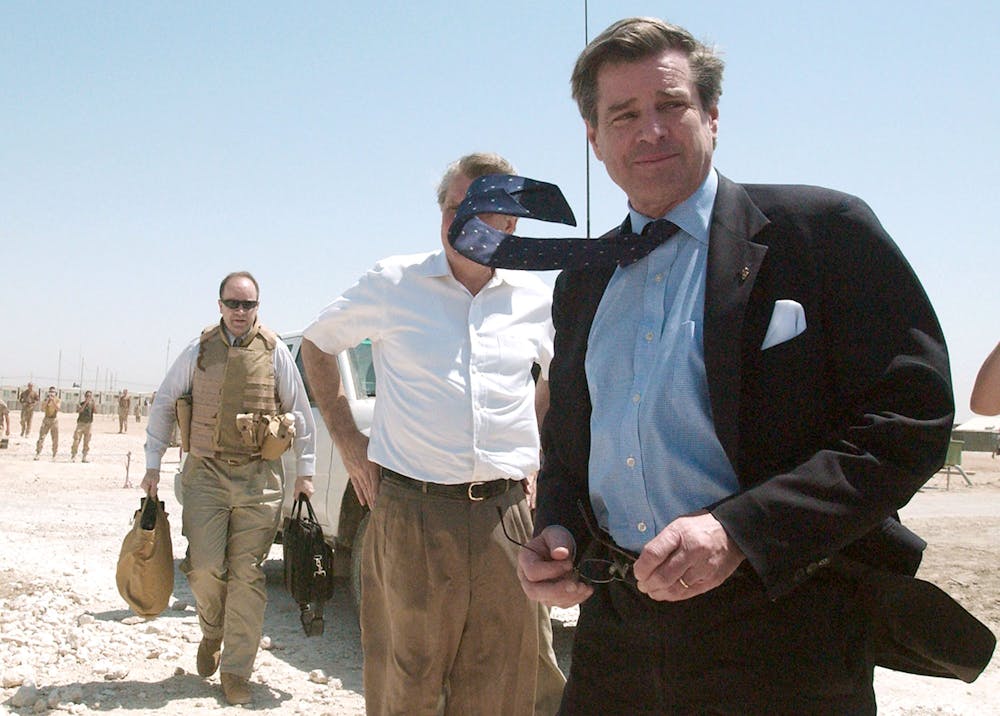
In April 2003, American L. Paul Bremer arrived in Baghdad as the head of the Coalition Provisional Authority, which served as a transitional government, and issued two orders that would define the next two decades.

Order 1 dissolved the ruling Baath Party and removed all senior party members from their government positions, purging the administrative class that ran its ministries, hospitals and schools. Order 2 disbanded the Iraqi army but did not disarm it. Approximately 400,000 soldiers went home with their weapons and without their paychecks.

Washington had just handed the insurgency – the Sunni-led armed resistance that would turn into a decade-long war – its recruiting pool. The logic behind Bremer’s de-Baathification was intuitive: You cannot build a new Iraq with the people who built the old one. The logic was also catastrophic

L. Paul Bremer prepares to board a helicopter in Hillah, Iraq, during a farewell tour of the country on June 17, 2004. AP Photo/Wathiq Khuzaie

Political scientists have long observed that countries are held together not by ideology but by organized coercion. That is, by the bureaucratic machinery, institutional memory and trained professionals who keep the lights on and the water running. Destroy that machinery, and you do not have a clean slate. You have a collapsed state, and collapsed states do not stay empty of leadership.

They fill, and they fill with whoever has the most organizational capacity on the ground. Iran had been building that capacity in Iraq since the 1980s, cultivating Shia political networks, exile parties and militia groups during and after the Iran-Iraq War and beyond with the explicit goal of ensuring a post-Saddam Iraq would never again threaten Iranian security.

Tehran did not need to build infrastructure in Iraq after the U.S. invasion, because it had spent the previous two decades building it. When the old order collapsed, Iran’s networks were ready.

The opposition the U.S. had cultivated in IraqAhmed Chalabi and the Iraqi National Congress – had Washington’s ear but no Iraqi constituency. They had not governed the country, or built networks inside it.

The lesson is that military success created the precise conditions for political catastrophe, and that chasm is where American strategy has gone to die – in Iraq and in Libya, where the Obama administration helped bring about regime change in 2011, but where political instability has endured since. And perhaps now in Iran.

The vacuum is not neutral

The fundamental misunderstanding at the heart of American regime-change strategy is the assumption that destroying the existing order creates space for something better.

It does not.

It creates space for whoever is best organized, best armed and most willing to fill it. In Iraq, that was Iran.

The question now is who fills it in Iran itself.

In Iran, the group that meets all three criteria – organized, armed and willing – is the Islamic Revolutionary Guard Corps. The Revolutionary Guard is not simply a military institution. It controls an estimated 30% to 40% of the Iranian economy and runs construction conglomerates, telecommunications companies and petrochemical firms. And it has cultivated a parallel state infrastructure for decades.

Since Ayatollah Ali Khamenei’s death at the start of the U.S.-Israeli bombing campaign, the Revolutionary Guard has taken effective control of decision-making. As one Iran expert told NBC News: “Even if they replace the supreme leader, what is left of the regime is the IRGC.”

The succession confirmed it: Mojtaba Khamenei, with deep ties to the Revolutionary Guard, was named supreme leader on March 8, 2026. It’s a Revolutionary Guard-backed dynastic succession that represents maximum continuity with the old regime, not regime change.

You cannot dismantle the Revolutionary Guard without collapsing the economy, and a collapsed economy does not produce a transition government; it produces a failed state. Washington has already run that experiment in Libya.

You cannot leave the Revolutionary Guard in place without leaving the regime’s coercive core intact. There is no clean surgical option of dropping bombs, killing certain people and declaring it a new day in Iran.

The Iranian opposition in exile, the Mujahedeen-e-Khalq; the monarchists who support the return of the late-shah’s son to lead the country; and the various democratic factions all present the same problem Chalabi did in 2003: Washington access, no domestic legitimacy.

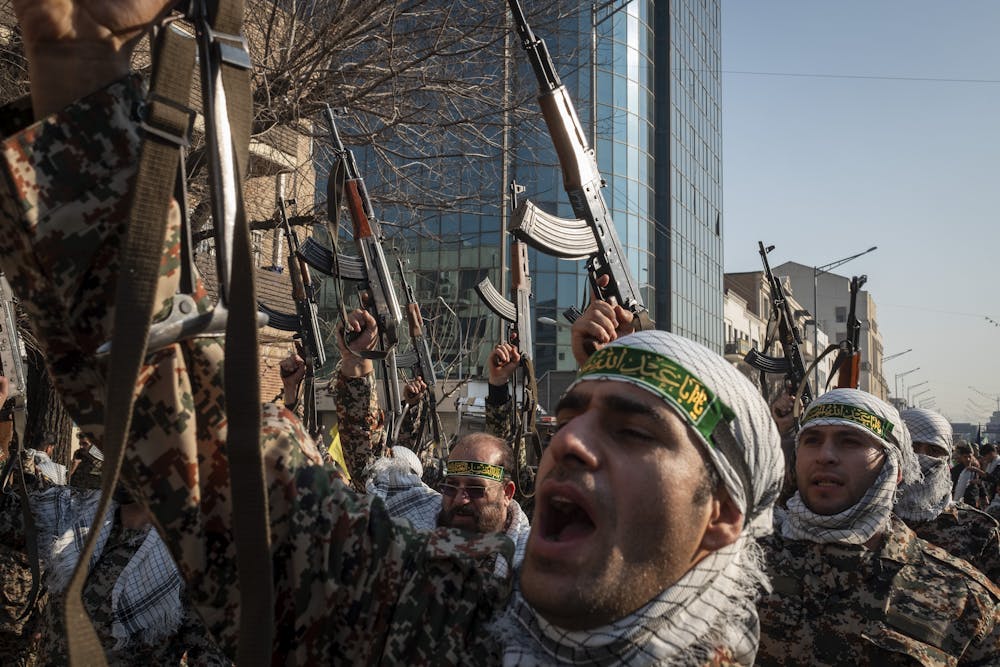
Revolutionary Guard troops march in a military rally in Tehran on Jan. 10, 2025. Morteza Nikoubazl/NurPhoto via Getty Images

The Mujahedeen-e-Khalq is listed as a terrorist organization by Iran and is widely despised inside the country. The monarchist movement has not governed Iran since 1979, and its corrupt, despotic leader was overthrown in the revolution. The democratic reform networks that had been building momentum inside Iran were not saved by the U.S. strikes. The regime had already crushed the movement in January, detaining and killing thousands.

Decades of research on rally-around-the-flag effects confirm what common sense suggests: External attack fuses regime and nation even when citizens despise their leaders. Iranians who were chanting against the supreme leader are now watching foreign bombs fall on their cities.

Iraq in 2003 had 25 million people, a military degraded by 12 years of sanctions, and no active nuclear program. Iran has 92 million people, proxy networks that would not disappear if Tehran fell – in fact, they would activate – and a stockpile of over 880 pounds of highly enriched uranium that the International Atomic Energy Agency has been unable to fully account for since the 2025 U.S. and Israeli strikes.

The question Washington hasn’t answered

Who governs 92 million Iranians?

President Donald Trump has said whoever governs Iran must receive Washington’s approval. But a veto is not a vision.

Approving or rejecting candidates from Washington requires a functioning political process, a legitimate transitional authority and a population willing to accept an American imprimatur on their leadership — none of which exists.

Washington has a preference; it does not have a plan. If the objective is eliminating the nuclear program, then why does Iran still hold an unverified stockpile of weapon-usable uranium eight months after the 2025 strikes? The strikes have not resolved the proliferation question. They have made it more dangerous and less tractable.

If the objective is regional stability, why has every round of strikes produced a wider regional war?

Washington has no answer to any of these questions – only a theory of destruction.

ref. Iraq war’s aftermath was a disaster for the US – the Iran war is headed in the same direction – https://theconversation.com/iraq-wars-aftermath-was-a-disaster-for-the-us-the-iran-war-is-headed-in-the-same-direction-277585

Evening Report: https://eveningreport.nz/2026/03/10/iraq-wars-aftermath-was-a-disaster-for-the-us-the-iran-war-is-headed-in-the-same-direction-277585/

To help save NZ’s native species, we must move past the extinction blame game

Source: The Conversation (Au and NZ) – By Nic Rawlence, Associate Professor in Ancient DNA, University of Otago

Each time another study about human-driven species extinction hits the news in Aotearoa New Zealand, a familiar pattern unfolds in online comment sections.

As researchers in this field, we have seen how quickly new findings about biodiversity loss are overshadowed by a debate over who is responsible.

We have repeatedly encountered blunt statements such as “why should Māori have a say?” linked to arguments that Māori caused species declines.

Given the long dominance of European colonial perspectives in natural history and archaeology, it is perhaps unsurprising that such claims provoke strong responses.

Some Māori counter with statements such as “we didn’t cause moa extinction, we were the first conservationists”.

We have seen arguments that treasured species such as kuri (Polynesian dogs) would not have been allowed to go feral, and that the extinction of the Waitaha penguin was due to competition for nesting sites with hoiho yellow-eyed penguin, despite evidence to the contrary.

Such responses reflect frustration with research – and at times media coverage – framed in ways that appear to assign blame without sufficient context.

One news article on the translocation of takahē onto Ngāi Tahu land, for example, linked the species’ “decline” to land confiscations, despite evidence of a more complex history.

This isn’t a phenomenon unique to New Zealand. The causes of ecosystem modificationn on Rapanui (Easter Island) and megafauna extinction in Australia have been hotly debated. In Australia, responsibility has been variously attributed to human activity, climate change, or some combination of the two.

[embedded content]

Ultimately, this blame game does little to advance understanding.

In Aotearoa, moving beyond it is essential if mātauranga (Māori knowledge systems) is to inform evidence-based kaitiakitanga (guardianship and stewardship) and the conservation of taonga (treasured) species.

Placing extinction in context

Throughout history, human expansion has often been followed by waves of extinction.

This is especially apparent in the Pacific, where island species – often slow-breeding and long-lived – have been especially vulnerable. Hunting for food, habitat clearance and the introduction of predators such as rats and dogs tipped ecosystems out of balance.

Eventually, a new balance was reached with humans as part of the ecosystem and the development of or modification of existing tikanga (customs).

Polynesians brought to Aotearoa kiore (Pacific rat), kuri and a suite of plants such as taro and kumara. With few available protein sources – there were no chickens or pigs – these earliest settlers relied heavily on hunting, particularly in southern Aotearoa where Polynesian horticulture was not viable.

Many species could not withstand even low levels of hunting, especially when combined with predation from introduced animals. People needed to eat, plain and simple.

Modelling suggests that for moa hunting to have been sustainable, more than half of the South Island would have needed to remain a “no-take” zone – and there is little reason to think the moa’s fate would have differed had Europeans arrived first.

Why language and inclusion matter

Effective science communication places findings in context and avoids language that overreaches the evidence or assigns unsupported blame.

A case in point was a recent study that described soot from human-induced forest fires in ice core samples retrieved in Antarctica and linked it to “Māori arrival in New Zealand”.

Some Māori saw the framing as suggesting responsibility for pollution in a region often perceived as pristine. There was considerable push back by New Zealand scientists, including Māori palaeoecologist Rewi Newnham, who showed the soot could have come from fires in Australia or South America around the same time.

It highlighted the problem of talking “about Māori without Māori” – and the importance of including Indigenous perspectives to ensure balanced interpretation of results.

We have seen similar tensions arise in discussions about rats. Pest eradication initiatives often treat all three rat species in Aotearoa as interchangeable, overlooking the distinct history of kiore.

While kiore undoubtedly contributed to ecological change, they were also a valued food source, seasonal indicator and taonga carried across the Pacific with intention and care.

Grouping kiore with Norway and ship rats oversimplifies that history and risks reinforcing the same binary thinking that underpins the extinction blame debate.

When nuance is stripped from species histories, our understanding of Māori relationships with animals are flattened. And opportunities are lost to learn from complex traditions of coexistence and management that could inform conservation today.

Moving forward with mātauranga

Society would do well to heed the whakataukī (traditional proverb) kia whakatōmuri te haere whakamua – to “walk backwards into the future with our eyes fixed on the past”.

Lessons from both Māori and Pākehā histories can help inform evidence-based kaitiakitanga, conservation management and sustainable mahinga kai (customary food gathering).

The knowledge gained from palaeontological and archaeological research should be viewed as an opportunity to give back knowledge to Māori lost due to colonialism, such as how Polynesians adapted to Aotearoa’s dynamic environment and evolved into Māori.

Within many Māori narratives of the natural world lie detailed ecological insights, shaped by generations of close relationship and observation.

These stories reflect deep understandings of population dynamics, seasonality and balance – knowledge grounded in lived experience and careful attention to place.

Reengaging with these ways of knowing alongside contemporary science offers more than historical understanding. It opens pathways toward more adaptive, relational and enduring forms of conservation in a rapidly changing world, such as is being done in the East Otago Taiapuri and between Manaaki Whenua Landcare Research and the Tūhoe Tuawhenua Trust.

Throwing blame about human impacts in the past is unproductive.

It is knowledge such as mātauranga, developed over centuries in Aotearoa and over millennia in other Indigenous cultures, alongside established conservation tools, that is needed to tackle Aotearoa’s ongoing biodiversity crisis.

ref. To help save NZ’s native species, we must move past the extinction blame game – https://theconversation.com/to-help-save-nzs-native-species-we-must-move-past-the-extinction-blame-game-276954

Evening Report: https://eveningreport.nz/2026/03/10/to-help-save-nzs-native-species-we-must-move-past-the-extinction-blame-game-276954/

Gamblers can now bet on the outcome of wars – and that’s a problem

Source: The Conversation (Au and NZ) – By Karoline Thomsen, Ph.D. Candidate, UNSW Sydney

The growing threat of conflict in the Middle East last week prompted a flood of activity in a little-known area of betting: prediction markets in which users can bet on a particular military action.

One user of the Polymarket betting platform won US$4,500 (A$6,350) by predicting the exact date of the United States striking Iran.

In total, Polymarket users bet more than US$4 million (A$5.65 million) on the US-Iran strikes occurring on February 28.

We are academics who have researched international criminal and humanitarian law and emerging trends in geopolitics on social media platforms.

So, what is Polymarket, how do these platforms work, and what are the potential risks?

What is Polymarket?

Polymarket is a cryptocurrency-based prediction market that offers an extremely wide range of foreign policy events for users to bet on.

Its main competitor, Kalshi, offers sports and policy bets, but not military bets.

The bets themselves are not gambling in a traditional sense, where the house sets the odds. Instead, it’s a contract where the price fluctuates much like shares traded on a stock exchange.

Users can suggest ideas for bets, but the bets are created by Polymarket.

The day-by-day US-Iran strike bet was accompanied by a series of other bets on the conflict, including:

  • the possibility of Iran closing the Strait of Hormuz
  • when US troops would enter Iran
  • what targets Iran might hit.

Bets related to the current war in Iran totalled US$529 million (A$726 million).

Users can also gamble on the Russia-Ukraine war, using real-time war maps synchronised to the Polymarket app to inform their bets – the same maps Ukrainians check for survival.

All payments are made in cryptocurrency.

Polymarket does not charge trading fees, except on its 15-minute crypto markets. These are comparable to day-trading stocks – users have to trade them swiftly for financial gain.

Instead, it has been reported the business model relies on the sale of the data generated on the platform.

While Polymarket hasn’t revealed whether it sells the data it collects, in other financial contexts, data is a valuable commodity. It is regularly sold to policymakers, advertisers and researchers.

The Conversation contacted Polymarket for comment but did not receive a reply before this article’s deadline.

Bans and grey areas

Polymarket was launched in the US in 2020 but it was banned for American users from 2022–25. The Commodity Futures Trading Commission found it to be non-compliant with gambling legislation.

More than 30 countries reached similar findings and banned the platform, with some such as Australia geoblocking the site.

Polymarket argued it is not a gambling company because the odds are set not by the house, but by user-determined probability contracts.

This argument was favourably received by the 2025 Trump administration, which overturned the ban.

Donald Trump Jr is a major investor in Polymarket, a strategic advisor to Kalshi, and the director of an upcoming expansion to the Truth Social universe: Truth Predict (another prediction market).

The bets on offer on these platforms raise a host of legal, political and moral questions.

Benefiting from misery

Users are betting millions of dollars on what they believe to be the probability of the US striking Iran or the likelihood of a particular city of Ukrainian civilians being captured by Russian forces.

These gamblers stand to benefit financially from the pain of innocent civilians.

Reducing complex military decisions to a yes/no gamble dehumanises the civilians trapped in the conflict and potentially paves the way for malicious activity.

What if an official in power was influenced by the bets they or their constituents had placed when deciding precisely when to bomb another country?

What if it was revealed after a military strike that a decision-maker personally profited from the choice to press the button on a specific date, or to use a specific weapon for the strike?

Concerns about inside information

This is not as far-fetched as it sounds. Several Israeli soldiers are currently under arrest and are facing an internal investigation for allegedly using classified information to inform their bets on Polymarket about strikes Israel would or would not pursue.

The case of a man winning US$400,000 (A$570,000) just hours after placing a correct bet on when the US would capture Venezuelan President Nicolas Maduro has led to speculation of misuse of insider information.

Polymarket is designed to minimise transparency regarding who places what bets and based on what information.

Polymarket claims to offer anonymity to users but corruption allegations against a few mysteriously lucky bettors indicates that in some cases, users may be identified.

The value of data

The value of the data generated depends on who is buying it and what value they place on it.

Data from bets on US military action in Iran might attract a higher price from states in the region than data on the expected likelihood of a hurricane in South Carolina.

Polymarket might, therefore, issue more bets on extreme events that attract attention.

This, combined with the anonymous design, makes it a potentially dangerous tool of information warfare: very little prevents hostile actors from placing bets and polluting the public discourse.

A foreign state could place bets on the odds of a war in their interest, for example. This can change the public discourse and additionally impact the values of the bets, with financial implications for the other gamblers.

Further, by monitoring what bets are available, a hostile state can assess what issues to sew disinformation into.

How Polymarket manages its data is unknown. It is unclear what data specifically Polymarket stores, to whom it is sold and in which configurations, and what the data is used for by the purchasers.

But selling data on the public’s expectations of war requires much more scrutiny.

ref. Gamblers can now bet on the outcome of wars – and that’s a problem – https://theconversation.com/gamblers-can-now-bet-on-the-outcome-of-wars-and-thats-a-problem-277374

Evening Report: https://eveningreport.nz/2026/03/10/gamblers-can-now-bet-on-the-outcome-of-wars-and-thats-a-problem-277374/

West Papua’s humanitarian crisis stalls Prabowo’s ‘global peacemaker’ credibility bid

ANALYSIS: By Ali Mirin

Indonesian President Prabowo Subianto has increasingly presented himself on the international stage as a mediator and promoter of peace.

Yet this global diplomatic posture raises a critical question: how credible is Indonesia’s claim to peace leadership while a prolonged humanitarian crisis continues in West Papua?

In late February 2026, Prabowo offered Indonesia’s services to mediate rising tensions involving the United States, Israel and Iran, even stating he was prepared to travel to Tehran if both parties agreed to dialogue.

The message was reinforced when former Indonesian vice-president Jusuf Kalla met Iran’s ambassador, Mohammad Boroujerdi, on 3 March 2026 to reiterate Indonesia’s readiness to facilitate diplomatic engagement.

In response, Iran publicly welcomed the gesture but tempered expectations.

Iranian officials insisted that any meaningful mediation must include condemnation of US and Israeli military actions, warning that diplomatic initiatives without political clarity may have limited effectiveness.

The exchange highlighted both Indonesia’s aspiration to play a larger diplomatic role and the complexities of international conflict mediation.

Peacebroker limitations
However, Indonesia’s attempt to position itself as a global peace broker has already faced significant limitations. In 2023, Prabowo proposed a peace plan for the war between Russia and Ukraine.

The proposal, which included controversial suggestions such as a demilitarised zone and a referendum in disputed territories, was quickly rejected by Ukrainian officials. The response exposed the limited influence of Indonesia’s mediation efforts in conflicts far beyond Southeast Asia.

While presenting himself internationally as a peacemaker, critics argue that Prabowo has largely paid lip service to human rights at home, particularly regarding the unresolved crisis in West Papua.

[embedded content]
Indonesian protesters denounce US link over Iran war         Video: Al Jazeera

While Indonesia promotes its diplomatic role in international conflicts, violence and instability continue to affect civilians in West Papua.

On 11 February 2026, only weeks before Prabowo’s international mediation initiative gained attention, a small civilian aircraft operated by Smart Air came under gunfire shortly after landing at Korowai Batu airstrip in Boven Digoel, West Papua.

A spokesperson linked to the military wing of Free Papua Movement (TPNPB- OPM) later claimed responsibility for the attack, stating that the aircraft had allegedly been used to transport Indonesian security forces.

The roots of the crisis stretch back to the early 1960s, when Indonesia invaded and took control of the territory following the withdrawal of Dutch colonial administration.

Act of Free Choice controversy
The subsequent 1969 referendum, known as the Act of Free Choice, remains one of the most controversial political processes in modern Southeast Asian and South Pacific history.

Rather than a universal vote, approximately 1025 selected representatives voted under significant political and military pressure.

Many Papuans and international observers argue that the process failed to meet internationally recognized standards for self-determination. As a result, the legitimacy of the referendum continues to be contested, and its legacy remains a central grievance fueling decades of political resistance and armed conflict.

For many analysts and human rights advocates, the Papua conflict cannot simply be framed as a domestic security problem. Instead, it represents a protracted humanitarian and political crisis that has yet to find a comprehensive and inclusive resolution.

In this sense, the issue has become what some observers describe as a long-standing wound within the Indonesian state.

Such incidents highlight the tragic reality faced by ordinary Papuans, who often find themselves caught between military operations and Papuan resistance attacks.

Civilians bear the brunt of a conflict that has persisted for decades without meaningful political dialogue capable of addressing its underlying causes.

Rising internal displacement in West Papua
According to reports by human rights organisations and humanitarian groups, displacement in West Papua has increased significantly in recent years.

The number of internally displaced persons (IDPs) has risen dramatically, from roughly 55,000 at the end of 2023 to more than 103,000 by October 2025. Many displaced communities face severe shortages of food, healthcare, education, and basic security.

These figures reflect a broader systemic failure to protect civilians and provide sustainable solutions for affected communities. Despite decades of development initiatives and official rhetoric emphasising stability and prosperity in Papua, the lived reality for many residents remains defined by insecurity and displacement.

Prabowo’s own military history also continues to shape international perceptions of Indonesia’s human rights record. During the Indonesian occupation of East Timor between 1975 and 1999, Prabowo served as an officer in Indonesia’s elite special forces, Kopassus.

Human rights organisations have linked him to operations accused of abuses against civilians during that period.

Following the 1999 referendum that ultimately led to East Timor’s independence, the United Nations supported investigations into violence carried out by Indonesian-backed militias and security forces.

Although Prabowo was never tried or convicted by an international court, activists and some Timorese leaders have long argued that senior Indonesian officers should have faced deeper scrutiny.

Shaping of credibility
In international diplomacy, credibility is often shaped not only by external initiatives but also by a state’s domestic human rights record. When internal conflicts remain unresolved, claims to global moral leadership can face heightened scrutiny.

Prabowo was also involved in military operations in Papua during the 1990s. One of the most widely discussed incidents was the 1996 Mapenduma hostage crisis in the highlands of what is now Nduga Regency.

Human rights organisations have documented allegations of abuses committed by Indonesian security forces during that period.

Additional controversies have surrounded claims that aircraft bearing the emblem of the International Committee of the Red Cross were misused during operations. Such allegations, whether proven or not, continue to raise questions about adherence to international humanitarian law and contribute to lingering distrust among Papuan communities.

Taken together, these historical and contemporary dynamics create a sharp contrast between Indonesia’s global diplomatic ambitions and the unresolved realities within its own borders.

In international diplomacy, credibility is closely tied to domestic consistency.
It is difficult to advocate peace abroad while unresolved grievances and allegations of human rights violations persist at home.

For Indonesia, genuine leadership in global peacemaking would require more than diplomatic offers on the world stage. It would involve confronting the deeper structural issues underlying the conflict in West Papua.

Ensuring accountability
This would include ensuring accountability for past abuses, protecting civil liberties, and opening inclusive political dialogue that allows Papuans to meaningfully participate in shaping their own future.

Without such reforms, Indonesia’s peace diplomacy risks being perceived less as principled international engagement and more as a form of strategic public relations. The gap between Jakarta’s diplomatic rhetoric and the lived experiences of Papuan civilians remains stark.

Ultimately, Indonesia’s credibility as a global peacemaker will depend not only on its willingness to mediate conflicts abroad but also on its ability to address the long-standing humanitarian and political crisis within West Papua.

Until that gap is bridged, Indonesia’s aspirations for global diplomatic leadership will continue to face serious questions about legitimacy and moral authority.

The continued instability in West Papua also has broader regional implications for the Pacific, where several governments and civil society groups have increasingly raised concerns about the humanitarian situation faced by indigenous West Papuans.

Ali Mirin is a West Papuan from the Kimyal tribe in the highlands bordering the Star Mountains region of Papua New Guinea. He holds a Master of Arts in international relations from Flinders University in Adelaide, South Australia.

Article by AsiaPacificReport.nz

Evening Report: https://eveningreport.nz/2026/03/10/west-papuas-humanitarian-crisis-stalls-prabowos-global-peacemaker-credibility-bid/

ER Report: A Roundup of Significant Articles on EveningReport.nz for March 10, 2026

ER Report: Here is a summary of significant articles published on EveningReport.nz on March 10, 2026.

Here’s why you might want to clean your headphones
Source: The Conversation (Au and NZ) – By Rina Wong (Fu), Research Fellow, Health Sciences, Curtin University Whether it’s enjoying a podcast, listening to music or chatting on the phone, many of us spend hours a day using our headphones. One 2017 study of 4,185 Australians showed they used headphones on average 47–88 hours a

As tonnes of illegal tobacco sneak in past our borders, we risk missing a threat that could cost us billions
Source: The Conversation (Au and NZ) – By Simon McKirdy, Professor of Biosecurity and Deputy Vice Chancellor of Global Engagement, Murdoch University Australia regularly makes global headlines for its strict biosecurity rules for international travellers. Failing to declare food, animal products and plant material – from an apple, to forgotten McMuffins or plant cuttings –

It’s tempting to offload your thinking to AI. Cognitive science shows why that’s a bad idea
Source: The Conversation (Au and NZ) – By Misia Temler, Research Affiliate, Psychology, University of Sydney With so many artificial intelligence (AI) products on offer now, it’s increasingly tempting to offload difficult thinking tasks to chatbots, agents and other tools. As we chart this new technological terrain, more and more we’re exposed to vast amounts

Australia has granted some Iranian soccer players asylum – but 2 questions remain
Source: The Conversation (Au and NZ) – By Catherine Ordway, Visiting Scholar, UNSW Sydney Last week, the Iranian soccer team refused to sing the national anthem before their Asian Women’s Cup opener on the Gold Coast. It was a silent protest in solidarity with thousands killed in deadly crackdowns in Iran. But some of these

Second COVID inquiry: why being politically prepared for the next pandemic is crucial
Source: The Conversation (Au and NZ) – By Grant Duncan, Research Associate, Public Policy Institute, University of Auckland, Waipapa Taumata Rau COVID-19 changed the course of New Zealand’s political history. Labour’s 50% of the vote in 2020 came from a huge electoral swing as a reward for the main coalition party’s effective evidence-based policies, and

5 members of Iranian women’s soccer team defect, Australia deploys RAAF plane and missiles to Gulf
Source: The Conversation (Au and NZ) – By Michelle Grattan, Professorial Fellow, University of Canberra The Albanese government has given humanitarian visas to five members of the Iranian women’s soccer team, including its captain, to enable them to remain in Australia, and is offering protection to any more of the women who want to defect.

’10 classrooms full of children’ – US-Israeli war kills hundreds of Iranian, Lebanese kids
Zahra Sultana has mocked US and Israeli pretensions, saying in a BBC interview on Sunday — International Women’s Day — that the girls in the Minab school were slaughtered “apparently to liberate women”. SPECIAL REPORT: By Brett Wilkins of Common Dreams US and Israeli airstrikes have killed nearly 300 Iranian and Lebanese children over the

COVID inquiry phase two: 4 main lessons to improve NZ’s future pandemic resilience
Source: The Conversation (Au and NZ) – By David Murdoch, Distinguished Professor, University of Otago A second Royal Commission of Inquiry into New Zealand’s experience and handling of the COVID pandemic released its substantial report today, running to several volumes and hundreds of pages. The coalition government commissioned the inquiry to specifically examine key decisions

I’ve studied MAGA rhetoric for a decade, and this is what I see in Hegseth’s boasts, action-movie one-liners and gloating over dominance
Source: The Conversation (Au and NZ) – By Casey Ryan Kelly, Professor of Communication Studies, University of Nebraska-Lincoln When Secretary of Defense James Mattis addressed the intensification of U.S. combat operations against the Islamic State group in 2017, he assured the American public of his commitment to “get the strategy right” while maintaining “the rules

AUKUS is binding Australia to a dangerous, unpredictable leader. We need a Plan B now
Source: The Conversation (Au and NZ) – By Hugh White, Emeritus Professor of Strategic Studies at the Strategic and Defence Studies Centre, Australian National University In a dangerous and uncertain world, what should US allies do? Draw closer to America, or pull away? When the United States under President Donald Trump is itself among the

5 top tips for the perfect compost – according to science
Source: The Conversation (Au and NZ) – By Gregory Moore, Senior Research Associate, School of Agriculture, Food and Ecosystem Sciences, The University of Melbourne As a young boy, I had to contend with my grandfather’s compost heap. It was a veritable Vesuvius of foul-smelling, putrescible plant waste, a metre high and hidden behind a privet

As global trade rules falter, how can Australia protect itself from economic coercion?
Source: The Conversation (Au and NZ) – By Peter Draper, Professor, and Executive Director: Institute for International Trade, and Director of the Jean Monnet Centre of Trade and Environment, Adelaide University The United States was once a champion of fair trade rules. Now, it has transformed into a rampaging Viking seeking extortionate tributes. This shift

The Oscars aren’t a meritocracy – there’s a complex formula for winning
Source: The Conversation (Au and NZ) – By William Simon, Casual Lecturer (Education and English Departments), University of Tasmania Every January, Hollywood is overtaken by a massive Oscar prediction game, with studios, critics and commentators all playing a role in shaping the debate. But choosing a winner is more complicated than acknowledging a film’s artistic

How ‘looksmaxxing’ self-improvement apps are marketing misogyny to young men
Source: The Conversation (Au and NZ) – By Marten Risius, Adjunct Senior Fellow, School of Psychology, The University of Queensland A theory about male “sexual market value” that began in online manosphere forums is now appearing in the TikTok feeds of Australian teenagers — repackaged as AI-powered “looksmaxxing” apps. The idea is closely tied to

Your child has pathological demand avoidance? Here’s what it means – and 9 tips for what to do
Source: The Conversation (Au and NZ) – By Nicole Rinehart, Nicole Rinehart, Professor, Clinical Psychology, Director of the Neurodevelopment Program, School of Psychological Sciences, Faculty of Medicine, Nursing and Health Sciences, Monash University For some children, everyday demands such “brush your teeth” or “time to get off of your computer game”, can trigger intense anxiety

US military opens environmental review for expanded Marianas training footprint
By Mark Rabago, RNZ Pacific Commonwealth of the Northern Marianas correspondent The United States military has begun the formal environmental review process for the continuation of large-scale training and testing activities in waters around the Northern Mariana Islands and on Farallon de Medinilla. The Department of the Navy, including the US Navy and Marine Corps,

ER Report: A Roundup of Significant Articles on EveningReport.nz for March 9, 2026
ER Report: Here is a summary of significant articles published on EveningReport.nz on March 9, 2026.

Evening Report: https://eveningreport.nz/2026/03/10/er-report-a-roundup-of-significant-articles-on-eveningreport-nz-for-march-10-2026/

Here’s why you might want to clean your headphones

Source: The Conversation (Au and NZ) – By Rina Wong (Fu), Research Fellow, Health Sciences, Curtin University

Whether it’s enjoying a podcast, listening to music or chatting on the phone, many of us spend hours a day using our headphones. One 2017 study of 4,185 Australians showed they used headphones on average 47–88 hours a month.

Health advice about headphones tends to focus on how loud sounds might affect our hearing. For example, to avoid hearing loss, the World Health Organization advises people to keep the volume at below 60% their device’s maximum and to use devices that monitor sound exposure and limit volume.

But apart from sound, what else is going in our ears? Using headphones – particularly in-ear versions such as earbuds – blocks the ear canal and puts the skin in contact with any dirt or bacteria they may be carrying.

Here’s what you need to know about keeping your ears clean and safe.

First, let’s take a look at your ear

Over-ear headphones cover the entire external ear – the elastic cartilage covered by skin that’s shaped to trap soundwaves. In-ear headphones (as well as hearing aids) are shaped to fit and cover the entrance to the external ear canal, which is called the concha.

Sound vibrations travel through the ear canal – which is S-shaped and a few centimetres long – to reach your ear drum.

Deeper parts of the ear canal produce earwax and oils. These help keep your skin healthy, hydrated and less vulnerable to infection.

Tiny hairs in the ear canal also help regulate temperature and keep foreign debris out. These hairs and earwax help trap and move small particles, shed skin and bacteria out of the ear canal.

Earwax is the ear’s self-cleaning method and we only tend to notice it when there’s too much.

Excessive buildup can block your hearing or even clog the mesh of your earpods. But don’t try to dig earwax out of your ears yourself. If you’re concerned, speak to a pharmacist or GP for advice.

We generally only notice earwax when there’s too much. Alexander_P/Shutterstock

How headphones can affect the ear’s bacteria

Healthy ear canals host a range of non-harmful microbes – mainly bacteria, but fungi and viruses too. They compete for space and nutrients, and this diversity makes it trickier for any potential pathogens (disease-causing microorganisms) to take hold.

But wearing headphones (and other in-ear devices such as hearing aids or ear plugs) may upset the balance between “good” and “bad” bacteria.

One 2024 study compared bacteria in the external ear canals of 50 people who used hearing aids and 80 who didn’t. The researchers found hearing-aid users – whose external ear canals are blocked for extended periods – had fewer types of bacteria than those who didn’t.

Another 2025 study looked at how using headphones (including over-ear, in-ear and on-ear) affected fungi and bacteria in the ear canal. It found using headphones was linked to a greater risk of ear infections, especially if people shared them.

This may because wearing headphones – especially in-ear devices – makes the external ear canal hotter and more humid. Trapped moisture is especially likely if you exercise and sweat while wearing headphones.

Higher humidity increases your risk of ear infection and discharge, including pus.

Wearing in-ear devices such as hearing aids or headphones for extended periods can also interfere with the ear’s natural “self-cleaning” function, aided by earwax.

So, what should I do?

Most of us need – or like – to wear headphones in our day-to-day routines. But for good ear health, it’s important to give your ears a break.

Allow your ear canals to “breathe” at different points throughout the day so they’re not constantly blocked and growing humid and hot.

You could also try bone conduction headphones. These don’t block the ear canal, because they transmit sound through your skull directly into the inner ear, without needing to block the ear canal. These can be expensive though. And while they allow our ears to breathe, high-intensity vibrations (high volume) can still damage hearing, so as with all headphones caution is required.

Other tips

Clean your devices regularly

Recommendations range from once a week to daily to after a physical workout.

For example, you can wipe them with a cloth or use a soft-bristled children’s toothbrush dampened with mildly soapy water. Blot dry with a paper towel and allow a few hours of drying before recharging or reuse.

But it’s best to follow your manufacturer’s guidelines. And don’t forget to clean the case and the body of your earbuds too.

Don’t use headphones when sick

If you have an ear infection, avoid using earphones as they may increase the temperature and humidity in your ear and slow recovery.

Watch for symptoms

If your ears become itchy, red or have discharge, stop using in-ear devices and seek medical advice.

ref. Here’s why you might want to clean your headphones – https://theconversation.com/heres-why-you-might-want-to-clean-your-headphones-255590

Evening Report: https://eveningreport.nz/2026/03/10/heres-why-you-might-want-to-clean-your-headphones-255590/

As tonnes of illegal tobacco sneak in past our borders, we risk missing a threat that could cost us billions

Source: The Conversation (Au and NZ) – By Simon McKirdy, Professor of Biosecurity and Deputy Vice Chancellor of Global Engagement, Murdoch University

Australia regularly makes global headlines for its strict biosecurity rules for international travellers.

Failing to declare food, animal products and plant material – from an apple, to forgotten McMuffins or plant cuttings – can result in fines of up to A$6,600, potential prosecution and cancellations of visitor visas.

There are good reasons for those rules: Australia has managed to keep its environment and agriculture free of many invasive pests and diseases. Yet the volume of goods coming into Australia makes it hard to catch everything, especially biosecurity threats coming in on ships.

And that’s a problem – because if tonnes of illegal tobacco keep getting past our border security, undetected, we risk increased exposure to invasive pests that could cost our farmers billions.

Why tobacco is a biosecurity risk

The social and economic problems caused by Australia’s illegal tobacco trade have been widely reported, including ongoing firebombings, shootings and intimidation targeting tobacco retailers across several states.

But while the scale of the booming illicit trade is well known, its biosecurity risks have received little public attention. This is a significant omission.

Around 575 tonnes of illegal tobacco products – cigarettes, loose leaf tobacco and vapes – were produced in Australia in 2024-25, according to official estimates.

But far more – an estimated 3,312 to 5,397 tonnes in the same year – was imported. It arrives mainly on ships coming in via China, Hong Kong, Singapore and the United Arab Emirates.

About 2,244 tonnes of that was seized in 2024-25. So thousands of tonnes more have been getting in undetected.

Illicit tobacco is a dried plant product and a biosecurity risk in its own right. The Australian government also lists tobacco as a potential carrier of many pests that pose significant threats to our agriculture and environment.

Khapra beetle: a high-impact hitchhiker

US Customs found these 13 live larvae in a package of jujubes fruit on a flight landing at Dallas International Airport. US Customs and Border Protection, via Wikimedia Commons

One such pest is the khapra beetle, a known hitchhiker on ships.

This tiny insect, just 1.6–3mm long, infests grain and other dry organic material, rendering it unfit for human or animal consumption. It’s the number one biosecurity threat to Australia’s $26 billion grain industry.

An incursion of khapra beetle would result in loss of access to key overseas markets, estimated at more than $15 billion over 20 years. Prevention is critical.

[embedded content]

Native to India, khapra beetles have spread around the world in a wide variety of products, from food (such as rice) and other products (such as a box of children’s nappy pants in Australia last year), to packaging and machinery.

The larvae are exceptionally resilient and can hibernate in sea containers for years.

Khapra beetle has been detected numerous times at our border, with a marked increase in 2020. Those extra detections came after the federal government introduced emergency measures to address the growing risk of khapra beetles arriving in sea containers.

This home in Western Australia had to be wrapped in plastic and fumigated in 2007, after a newly arrived couple from the UK discovered khapra beetles and larvae in their belongings. Rob Emery

One notable detection was in 2007, when a couple who had migrated from the United Kingdom found khapra beetles in belongings that had spent six weeks at sea.

The woman discovered beetles inside a mug and, worse, larvae in her wrapped wedding dress. It turned out many other belongings were infested. The entire two-storey house was shrink-wrapped in plastic and fumigated.

Importantly, it was a successful eradication, and the grain industry was protected.

How illegal tobacco raises the risks of invasive pests

Any trade that’s illegal is more likely to use sea containers that are not cleaned, fumigated or adequately documented.

Added to this, tobacco is often sourced from high-risk regions with fake declarations.

In addition to khapra beetles, other pests could be introduced from imported tobacco.

One example is insecticide-resistant tobacco beetles. These beetles are common in Australian grain storages as well as households. However, the introduction of resistant strains could make it more difficult to control in museums, galleries and libraries – where they can cause severe damage to preserved animal specimens or book-bindings – as well as in household pantries.

Citizen scientists have reported the presence of tobacco beetles more than 200 times using the free MyPestGuide Reporter photo app. This tool was developed by Dr Darryl Hardie and one of us (Rob Emery) to make it easier for the public to report pests they find in various household commodities, including in their tobacco.

Community vigilance, combined with strong border controls, remain essential for protecting Australia from the biosecurity consequences of illicit imports.

Why we need to boost detection at our ports

Public debate about curbing illegal tobacco sales has largely focused on state government enforcement efforts. However, the first, most effective line of defence is at the border.

The relatively low interception rate for a bulky and easily recognisable commodity such as tobacco raises broader questions about our ability to detect less visible threats – like tiny beetles – that may carry even greater biosecurity risks.

Investment in maintaining and strengthening Australia’s border biosecurity must remain a national priority. Detection of illicit tobacco arriving at our ports urgently needs to improve.

Failure to implement effective biosecurity controls across all Australian ports exposes our environment and our farmers to risks worth billions of dollars.


Thanks to Dr Darryl Hardie for his contribution to this article.

ref. As tonnes of illegal tobacco sneak in past our borders, we risk missing a threat that could cost us billions – https://theconversation.com/as-tonnes-of-illegal-tobacco-sneak-in-past-our-borders-we-risk-missing-a-threat-that-could-cost-us-billions-277614

Evening Report: https://eveningreport.nz/2026/03/10/as-tonnes-of-illegal-tobacco-sneak-in-past-our-borders-we-risk-missing-a-threat-that-could-cost-us-billions-277614/

Second COVID inquiry: why being politically prepared for the next pandemic is crucial

Source: The Conversation (Au and NZ) – By Grant Duncan, Research Associate, Public Policy Institute, University of Auckland, Waipapa Taumata Rau

COVID-19 changed the course of New Zealand’s political history.

Labour’s 50% of the vote in 2020 came from a huge electoral swing as a reward for the main coalition party’s effective evidence-based policies, and then prime minister Jacinda Ardern’s leadership.

It gave the party the first (and possibly last) single-party majority under the MMP proportional system.

But as the second report of the Royal Commission of Inquiry into COVID-19 says, “New Zealand’s exit from the elimination strategy was difficult, rather than prepared and staged.”

In late 2021, the report adds, “social licence and willingness to comply with restrictions diminished”.

Central decision-makers became risk-averse and didn’t keep up with shifts in public sentiment from late 2021. This contributed to a decline in public confidence and to Labour’s election defeat in 2023.

NZ First’s return to parliament with 6% of the vote in 2023 was aided by voters who had resisted vaccination. In its coalition agreement with National, NZ First negotiated to widen the COVID inquiry to focus on vaccine mandates, lockdowns and testing systems.

While politically contested, this phase two inquiry report is still valuable for what it reveals.

[embedded content]

Deep social divisions

Whether one supported the previous government’s pandemic responses or not, everyone has been affected by those policies which now form a big part of our life stories.

It was the largest fiscal outlay (NZ$70.4 billion) and the biggest national emergency in recent history. That calls for a thorough policy evaluation to help prepare for similar public-health emergencies in future, if not to heal some of the wounds that were opened.

The second report of the royal commission airs many (now familiar) grievances about the vaccine, the vaccine mandates, the lockdowns and their consequences.

Personal submissions to the inquiry reflect a deep social division – and the strength of feelings still associated with that – as well as much support for those policies.

If New Zealanders were to face a similar health emergency in the near future, these often unresolved differences of opinion would reemerge and affect public compliance. New measures would remind people of “last time”.

It doesn’t end the conversation simply to say “thousands of lives were saved”, maybe even 20,000 when compared with the mortality rate in the US. Saving or prolonging lives has consequences for those who live through and pay for the policy choices, especially on such a profound scale.

Unpredictable consequences

Any rational evaluation of the COVID response is inevitably clouded by politics, however, even after all the scientific evidence is weighed up. Using evidence to inform policy is essential, but even the best evidence doesn’t dictate what a whole country ought to do.

Decision-making is political and has consequences, some of which will be unpredictable. In May 2020, for instance, a vaccine strategy was drafted, but the report notes this “did not anticipate the extent to which concerns about vaccine safety would emerge”.

Similarly, no one was predicting the ostracisation of fellow citizens that would follow from vaccine mandates. Many of the personal impacts of that policy are now usefully recorded in the report.

It was already clear before the 2020 election, however, that most National and ACT supporters believed the economic costs of lockdown were too high and outweighed the public-health benefits.

More people, especially on the left, agreed with the Labour-led government’s line that it would damage the economy more in the long run if we had no strict lockdown.

Many people wanted to hang on to “elimination” as a permanent objective; others wanted the country to learn “to live with COVID” – as we now do.

Labour’s resounding 2020 victory may have convinced many that the debate over pandemic policy was won. But there was more to come: controversy over managed isolation and quarantine, and vaccine mandates.

In mid-2022, a spike in inflation induced by the massive fiscal response led to the cost-of-living crisis that became the leading issue in the 2023 election – and which looks set to become a leading issue in this year’s election as well.

Readiness for next time

The second COVID report will inevitably be politicised – in fact, the National Party began scoring points the moment the report’s embargo lifted.

But it’s important differing opinions are heard now, without judgement, to uphold democratic values.

To be serious about a public-health response means to take seriously the word “public” and take account of the effects of policies on people and communities.

That includes the experiences, needs and opinions of the ordinary people who were directly affected by the pandemic and by the government’s policies.

This also means hearing out those who don’t agree with expert advice. Some of the opinions shared with the Royal Commission are, in my opinion, misguided. But they should nonetheless be heard, given the magnitude of the experience and its effects on lives.

Those who support the actions taken by the Ardern government can validly agree that some things could have been done better, as current Labour leader Chris Hipkins has accepted.

Those who don’t support those policies and actions might also accept the Ardern government was making what it judged to be the best decisions with the information at hand, but in the face of deep uncertainty and rapid change.

There was no way through that emergency without some “unkind” measures, and doing nothing was not an option.

Will New Zealand be wiser and better prepared next time? It is to be hoped the Royal Commission’s work will help guide a future government, if and when that next time comes.

ref. Second COVID inquiry: why being politically prepared for the next pandemic is crucial – https://theconversation.com/second-covid-inquiry-why-being-politically-prepared-for-the-next-pandemic-is-crucial-277848

Evening Report: https://eveningreport.nz/2026/03/10/second-covid-inquiry-why-being-politically-prepared-for-the-next-pandemic-is-crucial-277848/

Australia has granted some Iranian soccer players asylum – but 2 questions remain

Source: The Conversation (Au and NZ) – By Catherine Ordway, Visiting Scholar, UNSW Sydney

Last week, the Iranian soccer team refused to sing the national anthem before their Asian Women’s Cup opener on the Gold Coast.

It was a silent protest in solidarity with thousands killed in deadly crackdowns in Iran.

But some of these athletes could be facing the death penalty should they return home, after being labelled “war traitors” on Iranian state television.

Late on Monday, news broke that five players have been granted asylum in Australia and are now safe with police.

So how did it get to this and what may happen next? And what about the rest of the team?

‘Wartime traitors’

Sport, and soccer in particular, carries enormous political weight in Iran.

Athletes are symbols of the nation’s endurance. Their victories are political capital while their silence is viewed as a threat.

It’s perhaps no surprise, then, the players’ refusal to sing the national anthem sparked fury with regime hardliners, days after US-Israel strikes on the country.

Radical conservative television presenter Mohammad Reza Shahbazi, who is considered a mouthpiece for the Iranian government, characterised the women’s team as “wartime traitors” for not singing the anthem, and called for reprisals.

The team subsequently sang and saluted the anthem at their next two matches, but the pressure on them did not abate.

If some members of the team return home, they may be charged for a crime that attracts the death penalty in wartime.

For those who stay in Australia, it’s likely their families’ safety will be threatened.

On Sunday, after Iran’s third and final match of the tournament, supporters protested around the team’s bus leaving the stadium, expressing their fear for the team’s safety.

Supporters surrounding the bus reported noticing at least one player making the hand gesture signalling for help (SOS) from the bus window.

Visas granted

As the situation escalated on Monday, US President Donald Trump implored Australia to give the athletes asylum.

He initially claimed the athletes were being forced to leave Australia, but later posted “he’s on it!” after discussing the issue with Prime Minister Anthony Albanese.

On Tuesday morning, Home Affairs Minister Tony Burke confirmed five Iranian athletes have been granted humanitarian visas to stay in Australia after escaping the squad’s security detail.

Burke said the the Australian government was keeping the door open for other athletes to claim asylum:

Last night, I was able to tell five members of the Iranian women’s soccer team that they are welcome to stay in Australia, that they are safe here, and they should feel at home here. Not everyone on the team will make a decision to take up the opportunity that Australia would offer them. What matters here is that they have the best agency they can over those decisions. So we’re making sure that the opportunity to seek assistance is there.

Two more questions

The dramatic events have sparked two serious questions.

First, what could the football organisations involved – the International Federation of Association Football (FIFA), the Asian Football Confederation (AFC), and Football Australia – have done to be more prepared?

All have policies that promote and protect human rights. A human rights assessment is also done as part of the host nation bid process.

FIFA has a human rights framework to which bidding host nations must adhere, focused on protecting players and their entourage from discrimination and other human rights abuses.

This framework is also reflected in the AFC statutes for its members, including Football Australia.

Football Australia, as Asian Cup host, states in its constitution that it:

strive(s) to promote the protection of human rights in accordance with FIFA’s human rights policies and commitments.

Beau Busch, Asia/Oceania president of world soccer’s professional players’ association, FIFPRO, said the refusal to sing the anthem had been anticipated.

Busch said he had written to FIFA, the AFC and the tournament organisers on February 11 to express concern for the players’ welfare and offering to work proactively to protect their human rights, but did not receive a reply.

This lack of preparedness meant the Iranian athletes were forced into a last-minute, life-or-death decision under immense pressure.

A second question revolves around the Iranian team’s security detail, which includes people linked to the Islamic Revolutionary Guard Corps (IRGC).

While in Australia, the players have been extremely restricted both inside their hotel and at press conferences by their minders – unable to speak with friends or move freely.

Australia officially listed the IRGC as a state sponsor of terrorism in November 2025.

The IRGC has a strong influence over the Iranian Football Federation, including through its president, Mehdi Taj, who is one of five vice-presidents of the AFC.

But how were these security personnel allowed into the country?

Julian Leeser, Shadow Minister for Education, said anyone associated with the IRGC should be detained.

Lessons for the future

So what lessons can be learned to reduce the chances of this gut-wrenching situation happening again?

A similar situation may emerge in June at the men’s FIFA Men’s World Cup in the United States, Canada and Mexico, for which Iran has qualified.

The president of Iran’s soccer federation has stated he “does not know” if the team will compete, as the US government has not confirmed who from the security team will receive visas to enter the country. The current visa rules in the US places a full restriction on Iranian nationals entry with exceptions subject to case-by-case waivers.

If they do play, FIFA and the World Cup’s local organising committees must be prepared for similar scenes.

Of course, sports organisations aren’t the United Nations. But if these powerful organisations are more proactive and prepared – with clear safeguards and secure access to support – it should help minimise the drama that has affected, not just the athletes and their coach, but their friends and families abroad.

ref. Australia has granted some Iranian soccer players asylum – but 2 questions remain – https://theconversation.com/australia-has-granted-some-iranian-soccer-players-asylum-but-2-questions-remain-277834

Evening Report: https://eveningreport.nz/2026/03/10/australia-has-granted-some-iranian-soccer-players-asylum-but-2-questions-remain-277834/

It’s tempting to offload your thinking to AI. Cognitive science shows why that’s a bad idea

Source: The Conversation (Au and NZ) – By Misia Temler, Research Affiliate, Psychology, University of Sydney

With so many artificial intelligence (AI) products on offer now, it’s increasingly tempting to offload difficult thinking tasks to chatbots, agents and other tools.

As we chart this new technological terrain, more and more we’re exposed to vast amounts of information and highly sophisticated software that offers to do the thinking for us. In just a few seconds, tools such as ChatGPT, Claude or Gemini can draft your emails, generate a caring birthday message for a friend, or even summarise the plot of that novel you haven’t gotten around to reading.

Such increased offloading has raised the fear that people will become overly reliant on AI. This could have unintended consequences, such as eroding our critical thinking skills and declining our overall cognitive ability.

This fear is not unfounded. Research from our lab suggests the online environment exploits our cognitive tendencies – individual differences in how we think, perceive, pay attention and remember. In turn, some people end up taking more mental shortcuts and only engaging with information superficially. Other studies have linked high AI use to increased laziness, anxiety, lower critical engagement and feelings of dependence.

Yet it may be how we use AI that’s the problem, rather than the fact we do it at all. Generally, relying on external sources is fine – we do this constantly. But it’s important to remain in control of what we choose to offload, and why.

How do we even know things?

We all constantly rely on each other’s knowledge to function as a society. Doctors provide medical information, engineers are in charge of construction, financial advisers give investment tips, and so on.

All this spread of expertise provides each of us with more knowledge than we can individually hold. In other words, we constantly balance offloading (letting someone else do the thinking) with scaffolding (relying on external knowledge sources to enrich our own thinking).

Scaffolding often happens when we learn. For example, a teacher doesn’t write an essay for their student – instead, they provide feedback so the student can connect, integrate, and grow their knowledge base.

Crucially, we also don’t offload all thinking tasks to one specific person. Instead, we carefully consider the person’s trust and expertise before accepting their advice, tools or support. We also check how the new information fits in with what we already know.

As our knowledge grows in a certain area, we rely less on outside support, just as a student relies on a teacher until they learn enough to stand on their own.

It’s not just our brains doing the work

Cognition (our thinking skills) is the central concept in all of this. Our minds engage in three fundamental tasks:

  • encoding information (taking it in so the brain can parse it)
  • storing information, and
  • retrieving information.

Cognition relies on how well these three mental tasks work together. When we’re overwhelmed with information, distributing tasks to outside sources lessens that mental effort.

Research shows when our attention is strained, our minds focus more on encoding information while sacrificing storage and retrieval, which are more taxing.

Intuitively, it’s easy to assume all our cognition just happens in the brain. But our cognitive processes are sometimes extended to things in the environment. These external sources can be people, physical objects and digital tools. A diary is an extension of your mind if you use it to retrieve memories you’ve written down.

However, flippantly offloading your knowledge acquisition and storage to external sources – such as asking ChatGPT any question that pops in your mind – can have an impact on your critical thinking skills. This is because acquired knowledge actively interacts with newly encoded information in our minds: we convert information we come across in a way that makes sense to us.

And the more knowledge we hold, the greater our capacity to encode and critically interpret new information. For example, knowledge of Hitler and Mussolini in the context of the second world war helps us to better understand the modern dangers of dictatorship.

Hard work can be rewarding

To restore balance, we need to perform the more difficult cognitive tasks ourselves, not just offload them whenever it’s convenient.

The faster and easier option isn’t always the best – just like choosing to walk to your friend’s place provides better exercise for your body and mind than driving there does.

Sometimes hard work can be rewarding. When faced with using AI tools, you can either choose to control them, or let them control you.

One way to balance your relationship with AI tools is to use reflective practices. Ask yourself: how do you feel after using AI? Do you feel proud and satisfied, or do you feel more anxious and more overwhelmed? Have you replaced or scaffolded your cognition today? What tasks can you do to expand your mental capabilities tomorrow?

For a successful relationship with AI, we need to exercise all our mental skills – otherwise we really do risk losing them.

This may not always be easy, but it remains in our control.

ref. It’s tempting to offload your thinking to AI. Cognitive science shows why that’s a bad idea – https://theconversation.com/its-tempting-to-offload-your-thinking-to-ai-cognitive-science-shows-why-thats-a-bad-idea-276766

Evening Report: https://eveningreport.nz/2026/03/10/its-tempting-to-offload-your-thinking-to-ai-cognitive-science-shows-why-thats-a-bad-idea-276766/

5 members of Iranian women’s soccer team defect, Australia deploys RAAF plane and missiles to Gulf

Source: The Conversation (Au and NZ) – By Michelle Grattan, Professorial Fellow, University of Canberra

The Albanese government has given humanitarian visas to five members of the Iranian women’s soccer team, including its captain, to enable them to remain in Australia, and is offering protection to any more of the women who want to defect.

The elaborate operation to give the women protection culminated late Monday night, with the Australian Federal Police moving the women, who were staying at a Gold Coast hotel, to a safe location.

Home Affairs minister Tony Burke, met with the women at the Gold Coast location. He told a Brisbane news conference early Monday that the women were happy to have their names and photographers released. “They want to be described as who they are.[…] they’re not activists, they’re athletes who want to be safe.”

The women, who were pictured with Burke, are Zahra Ghanbari, captain of the Iranian women’s national football team. Fatemeh Pasandideh, Zahra Sarbali, Atefeh Ramazanzadeh and Mona Hamoudi.

Burke stressed if remaining team members wanted to make a similar decision, “the same opportunity is there. Australia has taken the Iranian women’s soccer team into our hearts.

“These women are tremendously popular in Australia, but we realise they are in a terribly difficult situation with the decisions that they’re making. But the opportunity will continue to be there for them to talk to Australian officials if they wish to.”

Prime Minister Albanese briefed United States President Donald Trump in the early hours of Tuesday on the situation. The call lasted reportedly some 40 minutes and ranged beyond the women.

Trump on his social media platform Truth Social. Truth Social

“President Trump rang me this morning just before 2:00 AM. We had a very positive discussion. He was concerned about the Iranian women in the soccer team and their welfare and their safety if they returned home,” Albanese said at a Tuesday news conference.

The women made a gesture of defiance at their first match of the Asian Cup when they declined to sing their national anthem. They were denounced as traitors on Iranian state TV. At their next match they sang and saluted.

Burke described the scene after “everything had been signed off”.

“There were lots of photos, lots of celebrating, and then a spontaneous outcry of ‘Aussie, Aussie, Aussie, oi, oi, oi’. These women are great athletes, great people, and they’re going to feel very much at home in Australia.”

Deployment of RAAF plane to Gulf

News of the defections came as the government announced the deployment, in response to requests from the region, of an E-7A Wedgetail to the gulf “to help protect and defend Australians and other civilians”.

Albanese said this followed a “conversation that I had with the President Mohammed bin Zayed [of the United Arab Emirates] and other requests”.

The plane – which was recently deployed to Europe as part of assistance to Ukraine – goes with 85 Australian Defence Force personnel, for an initial four weeks. The government is also sending Advanced Medium Range Air-to-Air Missiles to the UAE.

A Royal Australian Air Force E-7A Wedgetail. Rob Griffith/AP

Albanese stressed that the deployment was purely for defensive purposes. “We’re not taking offensive action against Iran”, he said, and highlighted the large number of Australians in the region.

“The first priority of my government is and always will be to keep Australians safe. There are around 115,000 Australians in the Middle East, around 24,000 of those in the UAE.”

Bowen says don’t panic about fuel

As fuel prices rise sharply the Minister for Climate Change and Energy, Chris Bowen, told Australians “there is no need for panic buying.

“Now, I do have a great deal of concern and empathy for those farmers in particular who, because of the situation with the supply chain in regional Australia, are having difficulty getting diesel.

“But I do need to emphasise this is managing a huge spike in demand, not an impact on supply at this point.”

Minister for Foreign Affairs Penny Wong, Deputy Prime Minister Richard Marles, Prime Minister Anthony Albanese and Minister for Climate Change Chris Bowen arrive at a press conference at Parliament House in Canberra, Tuesday, March 10, 2026. Mick Tsikas/AAP

Bowen said the government was convening a round table of the National Farmers Federation, the oil companies, the peak groups and Trucking Australia, “to ensure that the flow of communication between those groups is as strong as it could be”.

He said the important thing to know was there was “no need to be concerned at this point about the supply of diesel or petrol […] because our stocks are as high as they were before this crisis began. But we do need to work to ensure that as much as possible is flowing to farmers”.

ref. 5 members of Iranian women’s soccer team defect, Australia deploys RAAF plane and missiles to Gulf – https://theconversation.com/5-members-of-iranian-womens-soccer-team-defect-australia-deploys-raaf-plane-and-missiles-to-gulf-277244

Evening Report: https://eveningreport.nz/2026/03/10/5-members-of-iranian-womens-soccer-team-defect-australia-deploys-raaf-plane-and-missiles-to-gulf-277244/

’10 classrooms full of children’ – US-Israeli war kills hundreds of Iranian, Lebanese kids

Zahra Sultana has mocked US and Israeli pretensions, saying in a BBC interview on Sunday — International Women’s Day — that the girls in the Minab school were slaughtered “apparently to liberate women”.

SPECIAL REPORT: By Brett Wilkins of Common Dreams

US and Israeli airstrikes have killed nearly 300 Iranian and Lebanese children over the past nine days as the attackers target apartment towers, single-family homes, schools, medical facilities, and other civilian infrastructure.

Iran’s Health Ministry said Sunday that 198 women and 190 minors have been killed by US and Israeli attacks since February 28, including six children under the age of 5. The youngest reported victim is an 8-month-old girl.

Children account for more than 30 percent of those killed, according to the ministry, which also said that 1044 women and 638 children have been injured.

Overall, Iran said that more than 1300 people have been killed by the airstrikes, which are reportedly targeting 30 of the country’s 31 provinces.

The Lebanese Health Ministry announced Sunday that 394 people, including 42 women and 83 children, have been killed by Israel Defence Forces (IDF) attacks after Iran-backed Hezbollah joined the war.

The US-based charity Save the Children noted yesterday that the number of slain Iranian and Lebanese minors is the equivalent of “10 classrooms full of children”.

“It is devastating that airstrikes in Lebanon have reportedly caused the deaths of 83 children… among nearly 300 children killed in the region,” said Save the Children Lebanon director Nora Ingdal.

‘Not just numbers’
“These are not just numbers — these are young lives cut short and children whose futures have been forever scarred by war.”

Israel claims it has killed around 200 Hezbollah fighters. However, the IDF’s routine attacks on apartment towers and other residential buildings have drawn widespread condemnation.

On Sunday, an IDF strike massacred 18 people sheltering in an apartment building in Sir El-Gharbiyeh in Nabatieh district. The building was housing some of the nearly 700,000 Lebanese forcibly displaced by Israeli attacks, including around 200,000 children.

Local officials said women and children were among the victims.

Another IDF aerial massacre in the southern Lebanese town of Tafahata killed eight people, including five members of the Ezzedine family, whose home was bombed.

“This time is much worse than the previous war,” Nabatieh Civil Defence chief Hussein Faqih told the National, referring to Israel’s 2023-25 attacks on Lebanon that killed more than 4000 people, including nearly 800 women and over 300 children, in retaliation for Hezbollah’s rocket strikes in solidarity with Palestine during the Gaza genocide.

Israeli attacks on Iran during last year’s 12-Day War also killed more than 1000 Iranians, including 436 civilians.

Worst reported bombing
In the worst reported bombing of the current war — and possibly the deadliest US massacre since more than 400 Iraqis were wiped out in a “precision strike” on a Baghdad bomb shelter during the 1991 Gulf War — around 175 Iranians, most of them young children, were killed in what first responders and victims’ relatives said was a so-called double-tap strike on an elementary school in Minab in southern Iran.

US military investigators reportedly believe the strike was carried out by US forces, but President Donald Trump has blamed Iran.

On Monday, a group of Democratic US senators lead by Jeanne Shaheen of New Hampshire said they were “horrified” by the school strike.

“The killing of school children is appalling and unacceptable under any circumstance,” the senators said in a statement. “This incident is particularly concerning in light of [Defence Secretary Pete] Hegseth’s openly cavalier approach to the use of force, including his statement that US strikes in Iran wouldn’t be bound by ‘stupid rules of engagement,’ in his words.”

Multiple members of the UK Parliament have condemned the killing of Iranian and Lebanese children.

Leftist Independent Jeremy Corbyn, a former Labour leader, said yesterday on Bluesky: “Classrooms of children in Iran. Hundreds of people in Lebanon. The ongoing genocide in Gaza. The message from our political and media class is clear: Their lives are less valuable than others.”

“Every human being matters, and every human being deserves a life of peace,” Corbyn added.

‘School girls slaughtered’
Zahra Sultana, who quit Labour and started the socialist Your Party with Corbyn last year, mocked US and Israeli pretensions, saying in a BBC interview on Sunday — International Women’s Day — that the girls in the Minab school were slaughtered “apparently to liberate women”.

Retaliatory attacks by Iran have killed at least 13 Israelis and wounded nearly 2000 others since February 28, according to Israel’s government. No Israeli child deaths have been reported. Seven US troops and at least 15 people in Gulf Arab nations have also been killed by Iranian counterattacks.

While the world’s focus is on Iran, Israeli occupation forces have continued killing and wounding people in Gaza and the West Bank of Palestine.

Drop Site News reported yesterday that eight Palestinians were killed in Gaza over the past 24 hours, including two women and at least as many children.

More than 250,000 Palestinians have been killed or wounded by Israeli forces since the Hamas-led attack of October 7, 2023. More than 20,000 children have been killed and over 44,000 others wounded.

More than 1 in 4 fatalities have been children in a war for which Israeli Prime Minister Benjamin Netanyahu is wanted by the International Criminal Court for alleged crimes against humanity and war crimes, and Israel is facing a genocide case currently before the International Court of Justice.

Since the 9/11 attacks, US-led wars have left nearly 1 million people dead in more than half a dozen countries in the Middle East, South Asia, and Africa—over 400,000 of them civilians, according to the Costs of War Project at Brown University’s Watson Institute for International and Public Affairs.

“Every war is a war on children, and once again we are seeing them pay the highest price for a conflict they neither started nor had a say in,” Ingdal said yesterday.

“Wars have laws, and children must be off limits in every conflict,” she added. “World leaders must act urgently to prevent further escalation. There must be an immediate cessation of hostilities, and all parties must uphold international humanitarian law and do everything in their power to protect civilians—especially children.”

Republished under Creative Commons.

Article by AsiaPacificReport.nz

Evening Report: https://eveningreport.nz/2026/03/10/10-classrooms-full-of-children-us-israeli-war-kills-hundreds-of-iranian-lebanese-kids/

COVID inquiry phase two: 4 main lessons to improve NZ’s future pandemic resilience

Source: The Conversation (Au and NZ) – By David Murdoch, Distinguished Professor, University of Otago

A second Royal Commission of Inquiry into New Zealand’s experience and handling of the COVID pandemic released its substantial report today, running to several volumes and hundreds of pages.

The coalition government commissioned the inquiry to specifically examine key decisions made between 2021 and 2022, with a focus on vaccine mandates, lockdowns and testing systems.

During this period, New Zealand moved from an elimination strategy, which required strict lockdowns, border closures and social distancing, to an approach of minimisation and protection, including the rollout of vaccines.

Overall, the commission found that:

While our health system and economy may have come through the pandemic better than expected, and New Zealand recorded lower case numbers and fewer deaths per capita than other comparable countries, our society is still counting the cost of the pandemic and the response.

The commission’s report is a reminder of just how many difficult decisions had to be made. It identifies four broad lessons for improving future pandemic resilience.

These lessons matter because pandemics place extraordinary pressure on decision-making systems, health infrastructure and public trust. Preparing those systems before the next crisis arrives is critical.

1. Systems for government decision making

The first lesson focuses on improving the quality and speed of decision making during a crisis.

Looking back at the pandemic, it is clear that many decisions needed to be made quickly with incomplete evidence. Epidemiological models were evolving, real-time data were limited and the wider impacts of interventions such as lockdowns were difficult to estimate.

The commission recommends strengthening strategic capability at the centre of government, including improved data systems, stronger modelling capacity and clearer frameworks for weighing public health benefits against social and economic costs.

This is fundamental. Pandemic responses rely on timely epidemiological information. Without strong surveillance systems and modelling capability, governments risk responding either too late or with measures that are broader and more disruptive than necessary.

Preparedness therefore requires institutional capacity to analyse risk and act quickly on evidence.

2. Clearer legal frameworks for pandemic powers

The second lesson focuses on legislation and democratic safeguards.

During the COVID pandemic, New Zealand relied partly on emergency legislation to implement public health measures such as lockdowns and vaccine mandates. While these powers enabled rapid action, they also raised questions about proportionality and limits on state authority.

The commission recommends establishing pandemic legislation that clearly defines what powers governments can use, under which conditions and safeguards. It says these powers should be transparent, subject to review and grounded in human rights protections.

Legal clarity is also about trust and compliance. Public health measures work best when people understand why they are necessary and believe they are being applied fairly.

3. More agile economic policy

The third lesson addresses the economic shock created by pandemics.

The COVID crisis required large-scale fiscal support for businesses and workers as well as significant monetary policy interventions. The inquiry recommends clearer frameworks for how economic agencies should respond to future pandemics and other crises.

Although economic policy may seem separate from health policy, the connection is strong. Public health measures inevitably affect employment, education and economic activity. Economic insecurity can also worsen health outcomes and widen existing inequities.

A pandemic response therefore needs to integrate public health, economic and social policy, rather than treating them as competing priorities.

4. Planning for social impacts and recovery

The final lesson focuses on the broader social consequences of pandemics.

COVID disrupted education, strained mental health services, affected employment and reshaped community life. It also exposed, and sometimes widened, existing inequities.

The commission highlights the need to plan for these impacts earlier, rather than treating recovery as an afterthought.

This reinforces a long-standing principle that pandemics are not purely biomedical events. They are social crises as well as health emergencies, requiring attention to mental health, social cohesion, community engagement and equity.

Being prepared for next time

While the four lessons describe system-wide challenges, several of the report’s specific recommendations focus directly on strengthening New Zealand’s preparedness.

These include improving the integration and timeliness of disease surveillance systems, expanding national epidemiological modelling capability, and developing structured decision-making frameworks that allow governments to assess the health, economic and social impacts of interventions during a crisis.

The inquiry also emphasises the importance of community engagement and public trust, recommending stronger partnerships with iwi, local organisations and communities that often play a central role in delivering public health responses.

Finally, the report calls for mechanisms to review and adapt pandemic strategies as evidence evolves. The experience of the COVID pandemic showed how quickly circumstances can change as new variants emerge.

Future preparedness therefore requires systems that allow policy to adjust rapidly as scientific knowledge and epidemiological conditions shift.

The commissioners note that the report reflects relatively narrow terms of reference, concentrated on specific policy decisions during 2021 and 2022. Consequently, some wider questions about the pandemic response and preparedness fall outside its scope.

New Zealand’s response to the COVID pandemic protected many lives, particularly in the early stages. This second inquiry makes clear success in one crisis does not guarantee readiness for the next.

Future pandemics will inevitably involve uncertainty and difficult trade-offs. Strengthening the systems that support decision making and public health response will help ensure New Zealand is better prepared for whatever comes next.

ref. COVID inquiry phase two: 4 main lessons to improve NZ’s future pandemic resilience – https://theconversation.com/covid-inquiry-phase-two-4-main-lessons-to-improve-nzs-future-pandemic-resilience-277847

Evening Report: https://eveningreport.nz/2026/03/10/covid-inquiry-phase-two-4-main-lessons-to-improve-nzs-future-pandemic-resilience-277847/

I’ve studied MAGA rhetoric for a decade, and this is what I see in Hegseth’s boasts, action-movie one-liners and gloating over dominance

Source: The Conversation (Au and NZ) – By Casey Ryan Kelly, Professor of Communication Studies, University of Nebraska-Lincoln

When Secretary of Defense James Mattis addressed the intensification of U.S. combat operations against the Islamic State group in 2017, he assured the American public of his commitment to “get the strategy right” while maintaining “the rules of engagement” to “protect the innocent.”

Mattis’ professional tone was a stark contrast to Secretary Pete Hegseth’s remarks following the first days of the joint U.S.-Israeli combat operations in Iran.

On March 2, 2026, after bragging about the awe-inspiring lethality of U.S. “B-2s, fighters, drones, missiles,” Hegseth casually brushed aside concerns about long-term geopolitical strategy, declaring “no stupid rules of engagement, no nation-building quagmire, no democracy building exercise, no politically correct wars. We fight to win.”

Admonishing the press for anything less than total assent, he commanded, “to the media outlets and political left screaming ‘endless wars:’ Stop. This is not Iraq.”

Two days later, Hegseth gloated about “dominance” and “control,” while asserting that the preoccupation of the “fake news media” with casualties was motivated by liberal media bias and hatred of President Trump.

“Tragic things happen; the press only wants to make the president look bad,” he said. He dismissed concerns about the rules of engagement, declaring that “this was never meant to be a fair fight. We are punching them while they are down, as it should be.”

[embedded content]
Pete Hegseth’s Pentagon press conference, at which he asserted the Iran war would have no ‘No stupid rules of engagement, no nation building quagmire, no democracy-building exercise.’

I’m a communication scholar who has studied MAGA rhetoric for a decade. I have observed how Hegseth and other officials in the second Trump administration refuse to abide by what recurring rhetorical situations – urgent public matters that compel speech to audiences capable of being influenced – typically demand of public officials.

The theme of this administration is that no one is going to tell it what to say or how to say it. It will be encumbered neither by norms nor the exigencies that compel speech in a democratic society.

The big man

When the U.S. goes to war, the public expects the president and the defense secretary to convince them of the appropriateness of the action. They do this by detailing the justification for military action, but also by addressing the public in a manner that conveys the seriousness and competence required for such a grave task as waging war.

But during the first week of the Iran war, Hegseth’s press briefings deviated from the measured tone expected from high-ranking military officials.

Hegseth flippantly employed villainous colloquialism – “they are toast and they know it,” “we play for keeps,” and “President Trump got the last laugh” – delivered with a combative tone that communicated masculine self-assurance.

Many observers were taken aback by his haughty tone, hypermasculine preoccupation with domination, giddiness about violence and casual attitude toward death.

During Trump’s first term, this penchant for rule-breaking was by and large isolated to the president, whose transgressions were part of his populist appeal.

Although Trump’s first cabinet members agreed on most political objectives, they attempted to rein in what they saw as the president’s more dangerous whims.

But with loyalty as the new bona fide qualification for administration officials, Trump’s second cabinet is populated with a large contingent of right and far-right media personalities like Hegseth, including Kash Patel, Sean Duffy and Mehmet Oz.

The anti-institutional ethos of far-right media explains why these officials refuse to conform to “elite” expectations and instead speak in a manner that is bombastic, outrageous and perverse.

Among them, there is little reverence for what they may perceive of as emasculating rules of tradition and politeness in a media marketplace where “owning,” “dominating,” and “triggering” your enemy is precious currency. Far-right media personalities are adept at commanding attention with showmanship and swagger.

Trump appears to have chosen Hegseth for precisely this reason: He performs the role of the big man to perfection.

[embedded content]
“They are toast and they know it,” Defense Secretary Pete Hegseth said of Iran on March 4, 2026.

‘Kill talk’

Hegseth’s language choices and petulant tone do not demonstrate an ignorance of what rhetorical situations demand of him; instead, they reflect a refusal to be emasculated by such cumbersome norms.

When making statements about the first week of the war, Hegseth grinned as he delivered action-movie one-liners, like “turns out the regime who chanted ‘Death to America’ and ‘Death to Israel’ was gifted death from America and death from Israel.”

Hegseth engaged in what is known as “kill talk,” a verbal strategy, typically directed at new military recruits, that denies the enemy’s humanity and disguises the terrible costs of violence. His repetition of words like “death,” “killing,” “destruction,” “control,” “warriors” and “dominance” framed violence in heroic terms that are detached from the realities of war.

In my view, Hegseth addressed the public as a squad leader addresses military recruits. Hegseth apparently delighted in dispensing death and elevating and glorifying war. He said virtually nothing of long-term strategy beyond “winning.”

In the MAGA media world, winning is really all that matters. If winning is the only goal, then war is, by profound inference, a game, a test of masculine fortitude.

This point was made clear when the White House posted a video that interspersed footage of airstrikes on Iran with “killstreak animation” from the popular video game Call of Duty: Modern Warfare. In the game, when a player kills multiple opponents without also dying, they are rewarded with the ability to conduct a missile strike to exterminate an opposing team. Again, this message gamifies violence and obscures the destructive toll of war.

Informed by the contemptuous hypermasculinity of far-right media culture, all this taboo behavior and glorified portrayals of death convey one fundamental message: When the public most needs explanation and justification for the actions of their government, the powerful owe the public neither explanation – nor comfort.

ref. I’ve studied MAGA rhetoric for a decade, and this is what I see in Hegseth’s boasts, action-movie one-liners and gloating over dominance – https://theconversation.com/ive-studied-maga-rhetoric-for-a-decade-and-this-is-what-i-see-in-hegseths-boasts-action-movie-one-liners-and-gloating-over-dominance-277731

Evening Report: https://eveningreport.nz/2026/03/10/ive-studied-maga-rhetoric-for-a-decade-and-this-is-what-i-see-in-hegseths-boasts-action-movie-one-liners-and-gloating-over-dominance-277731/