View from The Hill: Hanson nabs ex-Liberal for One Nation’s real time test in SA election

Source: The Conversation (Au and NZ) – By Michelle Grattan, Professorial Fellow, University of Canberra

One Nation Senator Pauline Hanson with former Senator Cory Bernardi One Nation Handout Image

As Sussan Ley and David Littleproud are at a standoff in their attempts to mend the federal Coalition, Pauline Hanson has set up a real-time test for One Nation at the March 21 South Australian election.

Ley, who met Littleproud on Monday night, set out conditions for reuniting with the Nationals, with the central one being that the three Nationals who broke shadow cabinet solidarity over the government’s anti-hate legislation spend six months off the front bench.

This was unacceptable to the Nationals, who were drafting a general response to Ley on Tuesday afternoon.

Other conditions in Ley’s proposal were that the Nationals accept shadow cabinet solidarity, and neither the Liberal Party room nor the Nationals Party room could overturn a shadow cabinet decision.

The joint parties room would remain supreme, which was made clear by Ley in response to questions when she briefed the Liberal Party meeting on Tuesday morning.

Also in Ley’s plan was for the Liberals to hold the portfolio of shadow assistant treasurer, in exchange for the Nationals taking the skills portfolio.

Littleproud said in a statement the Nationals would “take our time to consider the details” of the written offer that had been put to them.

“The Nationals are united in our endeavours to reset the Coalition, but we won’t be providing updates on any negotiations through the media.

“The negotiations are ongoing and we will always be constructive and act in good faith. It’s important we take the time to get the settings right.”

Meanwhile in Adelaide, Hanson announced former Liberal Cory Bernardi would lead the One Nation’s upper house ticket for the state election.

The party holds no SA state seats. Sarah Game, elected to the upper house in 2022 as the first One Nation candidate to win a seat in the SA parliament, defected last year to become an independent. Game cited problems with how the party’s brand was perceived.

The party will also contest all lower house seats.

Bernardi, a former senator, defected from the Liberals in 2017 to sit on the crossbench. His subsequent attempt to win support for a new conservative movement failed.

In the latest Redbridge poll in the Australian Financial Review, One Nation was on 26% nationally. Its spiking support, reflected in other polls, has discombobulated the Nationals, and added to pressure for a leadership change in the Liberals from the centrist Ley to a conservative.

While the SA Labor government is assured of victory against an opposition that has been beset by problems and leadership turnover, the election will test how One Nation’s voting surge translates to an actual election.

Former senator Nick Xenophon tried to transfer his personal popularity and the strong performance of his team nationally into trying to win seats at the 2018 South Australian election. The effort crashed dramatically.

The Coalition break was reflected for the first time in parliament on Tuesday as the Liberals and Nationals sat in their separate blocks.

Earlier, the leadership tensions were an undercurrent at the Liberal party meeting. “You could cut the air with a knife”, one source said.

Some sources believe Ley is not heavily invested in putting the Coalition back together because she wants to be able to hand out more posts to Liberals to lock in votes ahead of a leadership contest. She has said she will announce a permanent all-Liberal frontbench if there is not agreement to re-form the Coalition this week.

Also, some moderate Liberals (on whose support Ley depends) are not keen to have the Nationals back in the fold, believing the Liberals would have better appeal in the cities if they are not tied to the minor party.

Angus Taylor’s supporters are keeping open the option of a challenge to Ley next week. It will depend on whether Taylor – now the only conservative candidate after Andrew Hastie’s withdrawal – is confident he has the numbers, which are close. Ley is likely to take another polling hit at the weekend with the release of Newspoll on Sunday.

Michelle Grattan does not work for, consult, own shares in or receive funding from any company or organisation that would benefit from this article, and has disclosed no relevant affiliations beyond their academic appointment.

ref. View from The Hill: Hanson nabs ex-Liberal for One Nation’s real time test in SA election – https://theconversation.com/view-from-the-hill-hanson-nabs-ex-liberal-for-one-nations-real-time-test-in-sa-election-274832

Evening Report: https://eveningreport.nz/2026/02/03/view-from-the-hill-hanson-nabs-ex-liberal-for-one-nations-real-time-test-in-sa-election-274832/


These voices are the loudest in Australia’s ‘climate wars’

Source: The Conversation (Au and NZ) – By Christian Downie, Professor of Political Science, School of Regulation and Global Governance, Australian National University

The Conversation, CC BY-SA

There’s a reason political commentators refer to Australia’s “climate wars”. Every time a climate policy is put on the table, supporters and opponents come out in force and duke it out.

Last year, debates over Australia’s greenhouse gas emissions target led to a heated contest between various groups such as the Climate Council — arguing for strong action — and others such as the Business Council of Australia, which commissioned modelling to highlight the economic costs of a strong target.

This was not a one-off. Since at least the 1990s, emissions-intensive industries such as coal and gas and their lobby groups have had an outsized influence on climate policy. This includes groups such as the Minerals Council of Australia, which represents BHP, Rio Tinto and Whitehaven Coal, and Australian Energy Producers, which lobbies on behalf of BP, Shell and Woodside, among others.

Until now, we did not have a good understanding of who mobilises on climate policy in Australia, what side of the issue they fall on, and in which arenas they mobilise. In our new research, we found a core set of only 20 groups dominating climate policy debate in Australia, including gas corporations, industry lobby groups, environmental NGOs, and think tanks.

Who are these groups?

To find out which groups are most influential, we collected data on all organisations active on climate policy in Australia between 2017 and 2022. This included examining the number of groups as well as their volume of activity in the executive branch of government (responsible for implementing and enforcing laws, managing day-to-day administration and setting policy), the parliament and the media.

For example, we identified 700,000 mentions of groups in articles about climate change from 13 media outlets, including The Australian and the Sydney Morning Herald.

As well as media records, we also built a database of organisations who actively consulted with government departments and provided evidence to parliamentary inquiries.

We found 20 groups accounted for more than half (52%) of all activity.

They included a mix of mining and energy firms, such as AGL, BHP and Rio Tinto and their lobby groups, such as the Minerals Council of Australia. It also included high-profile NGOs, such as the Climate Council, and think tanks active on climate policy, including the Australia Institute and the Grattan Institute.

It’s important to note we didn’t look at the content of the messages in the media, the parliament or in departmental consultations, just the number of organisations and the frequency of their activity.

Where do these groups stand on climate action? tweaked

Among the 20 groups, some are strong supporters of climate action, such as the Climate Council. By contrast, the Minerals Council of Australia has a long history of opposing climate policies dating back to the Kyoto Protocol in the 2000s and the short-lived carbon price in the 2010s.

Interestingly, there are more pro-climate groups than anti-climate groups. Most NGOs in our study tended to support action on climate change, including the Australian Conservation Foundation, Greenpeace and WWF.

Many of the business groups do not. But it’s not as black and white as this might suggest. Firms and business advocacy groups are not unified. A growing number of renewable energy companies now mobilise in support of climate policy, often through advocacy groups such as the Smart Energy Council.

Interestingly, many industries active on climate policy don’t have a hardwired position. Rather, they sometimes support and sometimes oppose climate policy. This is often because their commercial interests are only indirectly impacted by climate policies, such as firms in the technology or finance industries.

These somewhat “neutral” groups actually account for the majority of groups active on climate policy in Australia.

Does this vary by arena?

We also explored whether some groups dominate the media more than the parliament, or the parliament more than the executive. For example, are environmental NGOs more active in the media than in Senate hearings? Are business groups more active in consultations with the government departments that make up the executive branch of government?

Interestingly, we found the media is the only arena where fossil fuel interests dominate. For example, groups typically opposed to climate action represent 43% of all media mentions, compared to 20% in support and 36% neutral.

This begs the question – why does the media appear to have a strong bias for reporting pro-fossil fuel messages?

One explanation consistent with overseas studies
is simply that messages from business coalitions and very large businesses are more likely to receive media coverage than other types of organisations, such as environmental NGOs.

These organisations are likely to have high standing in the media because they are viewed as key players in policy debates with inside knowledge. Certainly in Australia, the largest firms and lobby groups mobilised on climate change are tied to? fossil fuel industries.

Do these groups matter?

As we sweat through another of the hottest summers on record, the federal government will rightly remain under pressure to put in place further policies to cut carbon pollution. In fact, recent polling shows one in two Australians want action on climate change “even if this involves significant costs”.

Who mobilises to support or oppose climate policies will likely have a big influence on policy outcomes such as increasing renewable electricity in the grid, phasing out petrol and diesel vehicles or stopping new coal and gas projects

Our research shows a core set of groups, including firms in the coal and gas industries, that are likely to have an outsized voice in such policy debates.

While this does not always equate to influence, it is an important precondition. In the media in particular, it appears fossil fuel interests have the loudest voice.

This research was funded by the Climate Social Science Network.

ref. These voices are the loudest in Australia’s ‘climate wars’ – https://theconversation.com/these-voices-are-the-loudest-in-australias-climate-wars-272347

Evening Report: https://eveningreport.nz/2026/02/03/these-voices-are-the-loudest-in-australias-climate-wars-272347/

The Voice would have renewed Australian democracy. Its failure leaves us all worse off

Source: The Conversation (Au and NZ) – By Sana Nakata, Principal Research Fellow, James Cook University

There’s long been a fundamental issue underpinning Australia’s approach to Indigenous affairs. The state makes laws specifically about Aboriginal and Torres Strait Islander peoples without any protected mechanism giving them a say in the process.

The proposed Voice to Parliament sought to remedy this democratic deficit. Had the referendum succeeded, it would have established a formal representative connection between Indigenous peoples and the Commonwealth parliament.

The Voice proposal was a reform to democratic representation. Its failure was a missed opportunity to renew Australian democracy.

But it was also an explicit choice: to sustain the political subjugation of Indigenous people by denying them representative channels for making their voices heard on matters that affect them.

This enduring structural limitation leaves the parliament without any representative mechanism to consult with, or be accountable to, Aboriginal and Torres Strait Islander peoples.

What does Indigenous representation look like?

Even as we have seen increasing numbers of Aboriginal members in the federal parliament, they do not represent all Aboriginal and Torres Strait Islander people.

Nor are they empowered to. In the 125 years since federation, there has never been a Torres Strait Islander representative at the Commonwealth level.

A key aspect of political accountability is the ability of a constituency to remove their representative at the ballot box. If a majority feels their MPs have failed to advance their interests or otherwise represent them, they can vote them out.


This article is an edited extract from the new book The Failure of the Voice Referendum and the Future of Australian Democracy, edited by Professors Gabrielle Appleby and Megan Davis.


For minority populations, this mechanism fails because their votes will, by definition, always fall short of a majority. This has long been called “the tyranny of the majority”.

While this is a problem for all minorities, the political claims of Aboriginal and Torres Strait Islander people are distinct from other minority groups. This is because they’ve been politically subjugated through unlawful dispossession.

Voting rights alone cannot remedy this. We need to move beyond this narrow view of political representation.

More than politics

Being represented is not just about aggregating votes or delegating decision-making power to elected parliamentarians.

There are many types of democratic representation, far beyond formal political institutions. There are also unions, nongovernmental organisations, social movements, media organisations and community advocates.

These actors represent themselves and others through various channels, such as:

  • submissions to government inquiries

  • public protests and rallies

  • media campaigns

  • cultural productions

  • legal challenges

  • grassroots organising.

Through this lens, we can see Aboriginal and Torres Strait Islander people have long maintained and exercised their representative power, even when formal political institutions exclude or silence their voices.

Critics of the Voice proposal from both conservative and progressive perspectives focused on the power of direct decision making.

But it’s crucial to recognise representative power entails more than just making decisions in formal political institutions. Representative power can also set new agendas, shape political debates and transform public attitudes and values.

The proposed Voice offered what we might call “connective tissue” between First Nations peoples and communities, and the Australian state that continues to govern them.

The Voice proposed a new focal point for channelling the varied interests of diverse First Nations communities directly to government, as well as the broader Australian public. In similar ways to the Yoorrook Commission and First Peoples’ Assembly of Victoria (and now Gellung Warl), the Voice promised to highlight new priorities for action.


Read more:
Why the Voice referendum failed — and what the government hasn’t learned from it


In Victoria, this mobilised public attention on issues such as policing and self-determination.

This is why the proposal’s defeat represents more than just maintaining the status quo. It transforms the political subjugation of Aboriginal and Torres Strait Islander peoples from a historical legacy into the contemporary choice of the nation.

Despite decades of Aboriginal and Torres Strait Islander advocacy, careful institutional design and extensive consultation, the Australian public collectively decided to maintain political structures that exclude First Nations perspectives from decision-making processes that affect them.

Strengthening democracy for all

As we move forward, the implications of this decision extend beyond Aboriginal and Torres Strait Islander affairs. It raises questions about Australia’s capacity to renew its democracy.

The capacity of democracies to change themselves in response to shifting social conditions and emerging demands is a key part of what keeps them democratic.


Anthem Press

But this renewal involves much more than just holding elections. It requires political systems to transform their structures in response to injustices and problems of new generations. This includes long-term challenges, such as climate change.

When democratic systems don’t adapt, they risk ossifying into forms of rule that maintain historical inequities under the guise of democratic process.

This kind of political ossification threatens the democratic futures of all Australians. It also does nothing to improve the everyday lives of Aboriginal and Torres Strait Islander people.

The challenge now becomes how to maintain pressure for democratic renewal in the face of this setback. This requires Australians to continue to expose and challenge the democratic deficit the Voice sought to address.

We must also strengthen the many forms of First Nations political representation that persist in the face of institutional exclusion.

Sana Nakata receives funding from the Australian Research Council.

Daniel Bray has previously received funding from the Australian Research Council.

ref. The Voice would have renewed Australian democracy. Its failure leaves us all worse off – https://theconversation.com/the-voice-would-have-renewed-australian-democracy-its-failure-leaves-us-all-worse-off-271836

Evening Report: https://eveningreport.nz/2026/02/03/the-voice-would-have-renewed-australian-democracy-its-failure-leaves-us-all-worse-off-271836/

ER Report: A Roundup of Significant Articles on EveningReport.nz for February 3, 2026

ER Report: Here is a summary of significant articles published on EveningReport.nz on February 3, 2026.

Polls are snapshots, not predictions: how to read them critically this election year
Source: The Conversation (Au and NZ) – By Grant Duncan, Research associate, Public Policy Institute, University of Auckland, Waipapa Taumata Rau With nine months to go, how much can opinion polls tell us about the general election on November 7? Short answer: not much. Based solely on polls, no one could have predicted the past

We ate space mushrooms and survived to tell the tale
Source: The Conversation (Au and NZ) – By Sara Webb, Lecturer, Centre for Astrophysics and Supercomputing, Swinburne University of Technology Eating the space mushrooms for the first time. Author provided, CC BY-SA The mushrooms spread out on the chopping board seemed normal enough. They were rich and dense, and had a strong earthy aroma. In

Why regularly taking laxatives over the long term can be a bad idea
Source: The Conversation (Au and NZ) – By Vincent Ho, Associate Professor and Clinical Academic Gastroenterologist, Western Sydney University Photo by Anna Shvets/Pexels If you’ve ever been constipated you may have tried laxatives. They’re easy to get without a prescription and often help get things moving. Certainly a lot of people use laxatives and some

Academics call for divestment from NZ pensions fund implicated in Gaza
COMMENTARY: By Vincent Wijeysingha Will maximising investment returns override ethics? That is the question the tertiary sector posed to UniSaver, the academic equivalent of KiwiSaver, now revealed to invest in Israeli weapons and military intelligence. In 2024, some 400 university staff appealed to UniSaver to divest from such companies. The fund initially ignored the call.

Keith Rankin Analysis – A Black Sheep to Rule them All
Analysis by Keith Rankin. It’s great that there is a new season (Season 9) of William Ray’s podcast series Black Sheep, which looks at contributors to New Zealander history, many little known, who were of dubious or ambiguous character. Here I draw attention to a black sheep who I think trumps them all, Edward Arthur

Tiny radio transmitters reveal a hidden survival tactic in birds
Source: The Conversation (Au and NZ) – By Alice Barratt, PhD Candidate, Hawkesbury Institute for the Environment, Western Sydney University White-backed swallow in Sturt National Park. Alice Barratt, CC BY-NC In Sturt National Park, near Tibooburra in central Australia where temperatures can range from freezing to nearly 50°C, there lives a small bird with a

Our study shows younger siblings spend more time on screens than big sisters and brothers
Source: The Conversation (Au and NZ) – By Danusha Jayawardana, Research Fellow in Health Economics, Monash University Atlantic Ambience/ Pexels Where kids are born in a family can be important. But it is not just about who gets more grown-up privileges or parental pressure. Research tells us firstborn children, on average, tend to do better

Australia’s Pacific worker scheme is far from perfect – but we can make it better
Source: The Conversation (Au and NZ) – By Peter Mares, Adjunct Senior Research Fellow, School of Media, Film and Journalism, Monash University The Pacific Australia Labour Mobility scheme (PALM) is a crucial source of workers across regional Australia. About 32,000 people from nine Pacific nations and Timor-Leste work in Australia under PALM. Over seven months

From statement sleeves to the codpiece: 5 fashions which should come back from Tudor England
Source: The Conversation (Au and NZ) – By Grace Waye-Harris, Early Career Researcher in History, Adelaide University Portrait of Elizabeth I of England, 1588. Woburn Abbey/Wikimedia Commons There are few dynasties in history as well-known as the Tudors. From Henry VIII’s six wives to Elizabeth I’s defeat of the Spanish Armada, the Tudors continue to

As Australia’s online harm crackdown reshapes the debate, NZ must find its own path
Source: The Conversation (Au and NZ) – By Claire Henry, Associate Professor in Screen, Flinders University Getty Images Around the world, lawmakers are grappling with how to better protect young people from online harms such as cyberbullying, sexual exploitation and AI-generated “deepfake” images. Recent reforms overseas – notably Australia’s landmark move to restrict young people’s

What is Israel’s Herzog doing in Australia – who invited him, and why?
ANALYSIS: By Andrew Brown Israel’s President, Isaac Herzog, is due to arrive in Australia next Sunday. Why is a foreign Head of State asked to help heal an Australian community after an Australian tragedy? Australia is being asked to accept something extraordinary as if it were normal. Who invited Isaac Herzog in the first place,

View from The Hill: Littleproud and Ley turn on the music for another attempt at the two step
Source: The Conversation (Au and NZ) – By Michelle Grattan, Professorial Fellow, University of Canberra Nationals Leader David Littleproud easily saw off a token move to spill the party leadership on Monday. But he is now under immense pressure to reach a deal with Liberal leader Sussan Ley to put the Coalition together again. With

NSW is ditching good character references in sentencing. Will the rest of the country follow?
Source: The Conversation (Au and NZ) – By Vicki Lowik, Adjunct Research Fellow, School of Nursing, Midwifery and Social Sciences, CQUniversity Australia New South Wales is set to become the first jurisdiction in the country to end the use of good character references in the sentencing of convicted criminals. The government will introduce a bill

New data show where the parties got their money from in the lead-up to the 2025 election
Source: The Conversation (Au and NZ) – By Kate Griffiths, Democracy Deputy Program Director, Grattan Institute The Conversation, CC BY-SA Australia’s political parties set new records in funds raised and spent in the lead-up to the 2025 federal election. Now, nine months later, Australians finally get a look at who funded the parties’ election campaigns.

Does coffee raise your blood pressure? Here’s how much it’s OK to drink
Source: The Conversation (Au and NZ) – By Clare Collins, Laureate Professor in Nutrition and Dietetics, University of Newcastle Olga Pankova/Getty Images Coffee first entered human lives and veins over 600 years ago. Now we consume an average of almost two kilos per person each year – sometimes with very specific preferences about blends and

ASIC flags $40 million in refunds after review of risky financial products
Source: The Conversation (Au and NZ) – By Adrian Lee, Associate Professor in Property and Real Estate, Deakin University Australia’s corporate regulator has secured refunds of A$40 million to more than 38,000 investors in risky financial products, following a review of the industry. The Australian Securities and Investments Commission (ASIC) raised concerns that marketing of

Evening Report: https://eveningreport.nz/2026/02/03/er-report-a-roundup-of-significant-articles-on-eveningreport-nz-for-february-3-2026/

Polls are snapshots, not predictions: how to read them critically this election year

Source: The Conversation (Au and NZ) – By Grant Duncan, Research associate, Public Policy Institute, University of Auckland, Waipapa Taumata Rau

With nine months to go, how much can opinion polls tell us about the general election on November 7? Short answer: not much.

Based solely on polls, no one could have predicted the past three elections this early in the year they were held. Trends shifted over the subsequent months, and events (especially COVID in 2020) intervened to shake things up.

Each poll is a snapshot of past public opinion – and it’s out of focus, due to statistically inevitable sampling error. A sample of 1,000 people won’t exactly resemble the whole eligible population, and the percentage of “undecided” voters often goes unreported.

Researchers have an incentive to produce results that are as accurate as possible, but statistical variance happens. Each poll is an estimate. And a small variation between two polls by one or two percentage points is “noise”, not “signal”.

We get a picture of how party preferences have shifted by looking at trends across a number of polls. But past trends aren’t a sound guide to future trends.

What are recent polls telling us?

The Research Association New Zealand’s Political Polling Code requires that projections of the numbers of seats for each party “should state that polls do not predict – they measure a point in time”.

I’d add that no one can “measure” opinions in the precise ways we measure distances and times. An opinion isn’t an object in space.

So, what can we say recent polls indicate, rather than measure?

They seem to show that if an election had been held recently, National would have won fewer party votes than in the 2023 election. Labour may have done better than National, but been let down by potential coalition partners the Greens and Te Pāti Māori.

It’s unclear whether or not that hypothetical election could have led to a change of government. Polls held in the weeks immediately before elections are normally pretty close to the election results. But voter turnout can upset that.

A representative sample of eligible people in a survey may not demographically match the population that actually casts their votes.

Unexpectedly high turnout in 2020, for instance, meant polls in the month before the election underestimated Labour and overestimated National.

All the same, political observers can use polls as indicators of where things have been heading. As I write, none of the parties, except NZ First, would be pleased with their recent polling, on average.

NZ First has had results of 9% or more, improving on its previous election result of 6.1%. Labour’s gradual rise over 2025 appeared to be at the expense of the two smaller left-wing parties, however.

Do polls influence election results?

Opinion polls can have self-fulfilling or “bandwagon” effects on people’s voting behaviour. But there’s no A-causes-B theory that allows us to predict whether, or by how much, that will happen. The effects could go in different directions for different people.

If polls show one candidate is way ahead, it may motivate me to vote for that person (to join the bandwagon). Or I might vote for another candidate (to support the underdog). Or I might not vote at all (as it’s a forgone conclusion).

In a Mixed Member Proportional (MMP) election, a party that’s been polling below the 5% threshold and isn’t likely to win an electorate seat may get caught in a self-fulfilling prophecy.

Reluctant to “waste” their votes on that party, people may choose another – making it even harder for that party.

People also ask: who will work with whom in government? They may reason that a vote for one party means effectively voting to help put another party into government as well – which may or may not seem desirable.

Because of the potential for polls to lead public opinion rather than follow it, New Zealand bans the publication of polls on election day itself but not during the two-week advance-voting period.

But blackout periods are common in Europe and Latin America, and may be for as long as two weeks, as in Italy.

There’s also a risk that an unscrupulous actor could publish a false poll result in an effort to shift choices or suppress turnout, and that’s one reason why the research industry has a (self-regulated) code of conduct.

Past trends or future outcomes?

In a free society, however, the state shouldn’t prohibit research firms from doing surveys, or media from reporting the results.

Polls can be informative for voters, and a useful part of the democratic process. They also give the parties feedback about their performance (or perceived performance) between elections.

But they can be unhelpful when framed by media in sensationalist or biased ways.

People should be left to make up their minds about which candidate or party best represents them, rather than view an election as a contest narrated in terms of who’s up and who’s down.

In the end, we should read the polls and the media critically, and not take things on trust. It always pays to check, for example, who’s done the survey, who’s sponsored it and what the methodology was.

Above all, remember that opinion polls only indicate past trends; they don’t predict future outcomes.

Grant Duncan does not work for, consult, own shares in or receive funding from any company or organisation that would benefit from this article, and has disclosed no relevant affiliations beyond their academic appointment.

ref. Polls are snapshots, not predictions: how to read them critically this election year – https://theconversation.com/polls-are-snapshots-not-predictions-how-to-read-them-critically-this-election-year-274531

Evening Report: https://eveningreport.nz/2026/02/03/polls-are-snapshots-not-predictions-how-to-read-them-critically-this-election-year-274531/

We ate space mushrooms and survived to tell the tale

Source: The Conversation (Au and NZ) – By Sara Webb, Lecturer, Centre for Astrophysics and Supercomputing, Swinburne University of Technology

Eating the space mushrooms for the first time. Author provided, CC BY-SA

The mushrooms spread out on the chopping board seemed normal enough. They were rich and dense, and had a strong earthy aroma. In the saucepan, they melted – along with the cheese – to form a creamy pasta sauce.

A quick taste test proved they were delicious. The rich lion’s mane flavour immediately shone through.

This was the first meal we made with these unique mushrooms. They were gourmet, but not from any grocery store you can find on Earth.

These special fungi had travelled to space, lived aboard the International Space Station for more than a month, returned safely to Earth, and eventually came back to Australia in 2025.

Dr Sara Webb and Dr Rebecca Allen holding the newly grown lion’s mane mushroom.
Author provided, CC BY

Mushrooms launch into space

In August 2024, we launched a set of 36 small vials into space aboard a SpaceX Falcon 9 rocket. In these vials were three edible fungi species in the form of mycelium – small file filaments that act like the root network of mushrooms.

The species we tested were lion’s mane (Hericium erinaceus), turkey’s tail (Trametes versicolor) and cordyceps (Cordyceps militaris). These have shown benefits for brain function, gut health, and immune health – all important areas for long term space flight.

This experiment was our sixth payload to the International Space Station (ISS), thanks to the microgravity experimentation program we lead at Swinburne University of Technology.

It was designed and prototyped with the help of 12 high school students from Haileybury College in Melbourne. And it was made possible thanks to professional mushroom growers and suppliers who ensured the fungal strains were not only food grade but healthy enough to survive the extreme environment of space.

Our fungi may have stayed on the ISS with astronauts. But the mushrooms’ experience was very different to the astronauts’. Science experiments have special storage areas depending on what is being done and how much time astronauts have to be involved. Our mycelium was sealed up tight in special packaging to help keep them at a stable temperature and to ensure they weren’t damaged.

They stayed like that for close to a month, before they returned with the change of crew on the ISS.

We didn’t get much in the way of updates while our mushrooms were travelling – just some pictures and videos from NASA of the outside of the safely sealed experiment.

On their return, we waited with bated breath to see if they would survive once opened.

The mushrooms on board the International Space Station.
NASA, CC BY-SA

Mushrooms return to Earth

When our mycelium returned to Earth, and eventually Australia, they got a new home in rich, nutritious substrate. We then moved it into grow kits so we could watch and see whether any fruiting bodies (that is, mushrooms) would appear.

We created several grow boxes and placed them in different environments to see what conditions were best – from kitchen benches, to staff room tables, to laboratory fridges.

To our delight, within a few days we saw signs of the mushrooms emerging and within a week we had beautiful lion’s mane ready to be cooked up and enjoyed. Once they were ready, we harvested them and tried different recipes.

As well as eating these mushrooms, we’re also in the process of analysing them closely. But we can say now that the reduced gravity environment did not negatively impact our mycelium. In fact, they seem to be so happy that they continued to produce several rounds of mushrooms.

Mushrooms for long-term space missions

Artemis II – NASA’s crewed mission to the moon – is right around the corner. But there is still a lot that we need to understand to provide the best conditions for astronauts as they venture further into space than ever before.

For example, how will we continue to nutritionally support astronauts for weeks to months on long duration missions?

We know that a low gravity environment has a profound impact on human bodies, and one of the best ways to support astronauts in orbit is with nutritional foods.

Another outstanding question we need to answer is whether food produced in space environments be affected by radiation and other stresses, rendering it less valuable.

Our work – and these special mushrooms – are helping to provide crucial answers.

The authors do not work for, consult, own shares in or receive funding from any company or organisation that would benefit from this article, and have disclosed no relevant affiliations beyond their academic appointment.

ref. We ate space mushrooms and survived to tell the tale – https://theconversation.com/we-ate-space-mushrooms-and-survived-to-tell-the-tale-274112

Evening Report: https://eveningreport.nz/2026/02/03/we-ate-space-mushrooms-and-survived-to-tell-the-tale-274112/

Why regularly taking laxatives over the long term can be a bad idea

Source: The Conversation (Au and NZ) – By Vincent Ho, Associate Professor and Clinical Academic Gastroenterologist, Western Sydney University

Photo by Anna Shvets/Pexels

If you’ve ever been constipated you may have tried laxatives. They’re easy to get without a prescription and often help get things moving.

Certainly a lot of people use laxatives and some older people are very reliant on them to help with bowel function.

But you might have heard it’s not a good idea to take them over the long term. Even though serious complications from chronic laxative use are rare, they do happen. That’s why, whenever possible, long-term laxative use should be guided and monitored by a doctor.

Types of laxatives

There are five main types of laxatives (all are oral):

  1. bulk-forming laxatives (also known as fibre laxatives), which absorb water to form a soft, bulky stool and prompt normal contraction of bowel muscles. Common brands include Metamucil and Benefiber

  2. osmotic laxatives, which draw water into the colon to allow easier passage of stool. Common brands include Osmolax, Actilax and Movicol

  3. stool softeners such as docusate (brand name Coloxyl), which acts like a detergent and allows fat and water to mix in with hard stool – this makes it softer and easier to pass

  4. stimulant laxatives, which trigger rhythmic contractions of the bowel muscle. Common brands include Dulcolax, Bisalax and Senna

  5. lubricant laxatives, which coat the bowel and soften the stool. A common brand is Parachoc.

Starting a laxative

Before starting a laxative you should try dietary and lifestyle changes such as:

  • eating more foods with fibre in them, such as kiwifruit, corn, oats and brown rice
  • drinking more water
  • doing more exercise.

But if constipation persists, you might think about a laxative. Consider starting with gentler options, such as the bulk-forming laxatives or stool softeners, and implement those dietary and lifestyle changes listed above.

It’s a good idea to see your local doctor when starting a laxative; constipation may be a sign of something more concerning, especially if there are other symptoms such as rectal bleeding.

Your doctor can also advise whether laxatives might interact with any other medications you take.

Do laxatives cause a ‘lazy colon’?

Probably not. So where does this idea come from?

A case report published in the 1960s described bowel changes in a patient who had been taking stimulant laxatives for more than 40 years.

When the colon was examined, doctors noticed a reduced number of key cells in the colon. This sparked concern about whether long-term use of stimulant laxatives could result in damage to the gut, culminating in a “lazy colon” (also known as a cathartic colon). This is when the colon becomes an inert tube with no real muscle function to push along stool.

However, a later review of more than 70 publications describing 240 cases of stimulant laxative abuse found no cases of cathartic colon reported. Researchers concluded the prior cathartic colon cases might have been linked to a laxative called podophyllin that is now no longer recommended.

A review of 43 publications on the safety of stimulant laxatives discovered many of the studies were of poor quality, with small sample size. Confounding factors, such as medications and age, were often not being taken into account.

It found no good evidence chronic use of stimulant laxatives damages the gut.

That said, there are other good reasons not to take laxatives regularly and over the long term unless advised by a doctor who is monitoring your progress.

Gut symptoms and electrolytes

Laxative abuse is when someone takes laxatives to lose weight through frequent and repeated use of laxatives.

The most common symptom of laxative abuse is diarrhoea, which can mean abdominal cramps, nausea, vomiting and weight loss.

But laxative abuse can also disrupt the body’s electrolytes.

The main electrolyte in poo is potassium. As the body loses more and more potassium through diarrhoea, you can end up with lower blood potassium levels.

This can lead to:

  • generalised muscle weakness
  • heart complications
  • changes in heart rhythm
  • in extreme cases, stopping your heart beat, which can lead to death.

A 2020 systematic review of case reports found that laxative abuse can cause mild to severe cases of cardiac complications.

Laxative abuse can also lower other electrolytes, such as calcium and magnesium, leading to painful muscle contractions. Occasionally the kidney can be severely affected by chronic laxative abuse.

If you take just the recommended dose of laxatives, though, the risk of serious electrolyte complications is extremely low.

Depression, dementia and mental health

Two UK studies that examined a data set of approximately half a million participants found regular laxative use was associated with a higher risk of developing depression and dementia.

One theory is chronic laxative abuse could alter what’s known as the microbiome-gut-brain-axis (the way microbiota and the brain communicate) and lead to a higher risk of conditions such as depression and dementia.

Laxative abuse is commonly associated with eating disorders, so it’s important anyone found to be abusing laxatives also undergo a comprehensive mental health assessment. A plan might be needed to address the broader problem.

Safe when taken properly

Laxatives are obtained easily without a prescription and are very widely used in the community. They are certainly helpful for treating chronic constipation.

However, they can cause side effects such as diarrhoea and electrolyte imbalances. Long-term use and overuse can lead to problems.

It’s always a good idea to consult your doctor before starting laxatives, especially if you have other medical issues or are taking other medications.

Vincent Ho does not work for, consult, own shares in or receive funding from any company or organisation that would benefit from this article, and has disclosed no relevant affiliations beyond their academic appointment.

ref. Why regularly taking laxatives over the long term can be a bad idea – https://theconversation.com/why-regularly-taking-laxatives-over-the-long-term-can-be-a-bad-idea-269404

Evening Report: https://eveningreport.nz/2026/02/03/why-regularly-taking-laxatives-over-the-long-term-can-be-a-bad-idea-269404/

Academics call for divestment from NZ pensions fund implicated in Gaza

COMMENTARY: By Vincent Wijeysingha

Will maximising investment returns override ethics? That is the question the tertiary sector posed to UniSaver, the academic equivalent of KiwiSaver, now revealed to invest in Israeli weapons and military intelligence.

In 2024, some 400 university staff appealed to UniSaver to divest from such companies.

The fund initially ignored the call.

The fund issued a statement in September 2025 emphasising its fiduciary duty to ensure best performance, arguing divestment was unnecessary because the New Zealand government had not imposed sanctions against Israel, and noting its Israel-linked exposure is only 0.11 percent of total assets.

After a November open letter signed by 715 staff, nearly double the earlier number, UniSaver agreed to meet representatives of the group.

What should the tenor of those discussions be?

And why should any of this matter to the average New Zealander returning from the summer lull, facing a new year that looks uncomfortably like the last, with no sign from the Prime Minister’s State of the Nation last weekend that domestic pressures will ease?

The core question
This is the core question: with so many local concerns, why should the Israel–Palestine conflict matter?

Or, more pointedly, why should 0.11 percent of a pension fund belonging to a relatively privileged cohort matter to those worried about jobs, the cost of living, and healthcare?

Global issues are closer than we think. The suffering of Gazans and the anxieties of New Zealanders share a root: public policy framed as instrumental and amoral, where the wellbeing of persons is sacrificed to detached abstractions of markets and efficiencies while morality and integrity are treated as incidental.

These attitudes yield the same harvest everywhere: dehumanisation, insecurity, and the corrosion of civic trust.

Our only defence is a moral standpoint that declares “thus far shall you come, and no farther”.

When a society publicly avows that certain principles, human dignity and the integrity of persons, are non negotiable, it restores those ideals to the centre of the public square.

This is what a rules-based order is for: to foreground the human person before power and profit. Where such an order is honoured, flourishing follows; where it is neglected, flourishing is the first casualty.

Small acts of moral probity — even a mere 0.11 percent — may appear inconsequential.

Beacons for human progress
Yet as articulations of what we hold valuable, they resound deeply in the moral universe. They are the lit matches that, gathered, become the beacon that lights human progress.

Recent years have seen our public life dominated by the contrary impulse: to measure every policy by an economic yardstick calibrated to austerity.

As we enter an election year, two paths lie before us: one paved by slavish adherence to instrumental rationality, the other by a politics that puts people in a place of honour and treats wellbeing, security, and human flourishing as the purpose, not by product, of policy.

We have precedents. In the 1930s, as the world entered a moment not unlike our own, New Zealand, small, distant, still reeling from the Depression, adopted what became known as a moral foreign policy.

After that most devastating conflict, we added our voice to a chorus that helped shape a rules-based international order privileging human rights, cooperation, and diplomacy over war.

From the gradual undermining of that settlement, particularly after the crisis-ridden 1970s, one can trace many of today’s global and national disorders.

So what has all this to do with UniSaver?

Instability gathering pace
From our relatively safe redoubt at the bottom of the world, we watch instability elsewhere gather pace. Shall we respond in the same polarising, amoral terms or recover the loftier stance that once gave us outsized moral influence?

The UniSaver Board now faces a profound opportunity. In opposing the 715 who call for ethical investment, it has chosen expediency over ethics.

But morality often begins with small, unfashionable acts that grow, over time, into the juggernaut of social change.

Consider how a small student-led divestment campaign in the 1950s catalysed what became the global movement that helped topple South African apartheid.

Such actions shift the parameters of the values debate. Even if it concerns only 0.11 percent, UniSaver can redraw the moral horizon.

If its decision signals that we value a fair go for all — yes, even for far off Palestinians — it will achieve far more than a simple reassignment of assets.

It will have reminded us who we are.

And it will return UniSaver to being an institution to be proud of, one that affirms that people matter at least as much as the return on investment.

Dr Vincent Wijeysingha is senior lecturer in social work and social policy at Massey University. He is a member of Uni Workers 4 Palestine but writes here in a personal capacity.

Article by AsiaPacificReport.nz

Evening Report: https://eveningreport.nz/2026/02/03/academics-call-for-divestment-from-nz-pensions-fund-implicated-in-gaza/

Keith Rankin Analysis – A Black Sheep to Rule them All

Analysis by Keith Rankin.

Keith Rankin, trained as an economic historian, is a retired lecturer in Economics and Statistics. He lives in Auckland, New Zealand.

It’s great that there is a new season (Season 9) of William Ray’s podcast series Black Sheep, which looks at contributors to New Zealander history, many little known, who were of dubious or ambiguous character.

Here I draw attention to a black sheep who I think trumps them all, Edward Arthur Wilson; though he doesn’t really qualify for William Ray’s series, because his black sheepishness only happened after he left New Zealand.

Edward Arthur Wilson, born in Birmingham England in 1878, arrived in New Zealand in 1901. He married Margery Clark in 1902; she was a recent immigrant from Queensland, though her mother had been born in Wellington in 1852. Both the Wilson and Clark families were members of the somewhat messianic Catholic Apostolic Church (not to be confused with the Roman Catholic church), founded originally by Edward Irving in the 1820s.

Wilson’s employment in England (1901 census) had been as a telephone inspector. In Wellington in 1902, he’s listed as a ‘stenographer’. Edward and Margery had two children, in 1904 and 1906.

In 1911 the family sailed to Canada. Margery and the two children were on the Mārama, arriving in May 1911; presumably Edward was already there. In the 1911 census of Canada, Edward is living with his family in Sunnyside, Calgary, Alberta; listed again as a stenographer. His story gets murky after that.

Apparently, he abandoned his family in 1912. He never returned to New Zealand, though his family did. I understand that he has living descendants in New Zealand. Margery identified herself as a ‘widow’ in the 1920s (in Auckland), and was listed as ‘next of kin’ to her co-resident brother during World War One.

Wilson appears to have worked as a shipping clerk for the ‘merchant navy’ for around ten years from 1912; work that seems to have involved lots of travel, much of it no doubt in dangerous waters. He apparently had a major prophetic vision while in France, in the early 1920s. (His apostolic upbringing will have primed him for this.)

Nostradamus meets Rasputin meets Charles Manson meets Bert Potter

Edward Arthur Wilson restyled himself as Brother XII. He created the Aquarian Foundation in 1927, in the context of radical theosophy. In that time in the early-mid-1920s, he wrote many prognostations about the fate of the world. At that time – in the problematic remission phase of the 1914-1945 Great World War, albeit before modern social media – there was a substantial audience for alternative narratives, given the perilous reality of the then world order.

The story of Wilson’s aquarian cult – based at Cedar-by-the-Sea, just out of Nanaimo, British Columbia, Canada – is well summarised in Fear, Distrust, and Black Magic, written in 2024 by Kristin D’Agostino for A-B Tech (Asheville-Buncombe Technical Community College) in North Carolina, United States. (Follow the link to part one first: How a 1920’s Socialite Fell Under a False Prophet’s Spell; the focus here is on Mary Connally, Brother XII’s principal patron.) While Mary Connally was an heiress, most of her fellow aquarians were also from prosperous families, and many not young – contrast most of the 1960s’ aquarians) searching for some missing insights as to where the seemingly bankrupt world went wrong.

The Aquarian Foundation community existed in two phases, from 1927 to 1928, and 1928 to 1933. In 1928 there was an important court case in which the prosecutors, judge, chief witness and court gallery appear to have been mesmerised by Wilson. The case collapsed when chief witness Mary Connally gave Wilson a glowing testimony instead of the damning evidence anticipated.

In the second phase of the community, Mary Connally became a slave to Wilson and his new paramour and enforcer, Madame Z, aka Mabel Scottowe; aka Edith Mabel Rowbotham, a former schoolteacher. And the cult became increasingly obsessed with hoarding money.

It’s not for me to say much more – others have done that – other than to note that Wilson’s ‘death’ in Switzerland in 1934 was possibly faked, signed-off by a member of the Aquarian Foundation. (Though it would have been hard for a narcissist sociopath like him, if still alive, to have rendered himself completely invisible.) Madame Z later married a man called Edric John Douglas Agate in 1943. In the United States’ 1950 census they were living together in – Eugene, Oregon – as Murray D and Edith M Agate.

Other Material about Brother XII

De Courcy Island farm of notorious cult leader up for sale, 7 May 2021, Times and Colonist.

For Sale: The Former Home of B.C.’s Notorious Apocalypse Cult, 8 June 2021, Montecristo Magazine.

#177 Edward Arthur Wilson, 9 March 2026, BC Booklook.

XII Brother, ABC Bookworld.

5 things you probably didn’t know about the Gulf Islands, 11 Jan 2026, Vancouver is Awesome.

entry in Dictionary of Canadian Biography

The Aquarian Foundation (about 1990), by James A. Santucci, professor of Comparative Religion at California State University; and The Aquarian Foundation, 18 February 2024.

Secrets of Brother XII, episode of Expedition Unknown (S.4, Ep.10) Josh Gates, 28 Feb 2018

The Dream of Brother XII, CBC podcast by Moss, Jennifer, 22 March 2016

ENCORE: Searching for Brother XII—the story of Nanaimo’s infamous cult leader, CBC podcast by Moss, Jennifer, 29 August 2016

The collapsing birth rate becomes front-page news, and a long-foretold financial crash? The Hub predicts 2026, Howard Anglin, a doctoral student at Oxford University

Works by John Oliphant, including Brother XII: The Strange Odyssey of a 20th-century Prophet and His Quest for a New World, 2006, Twelfth House Press

*******

Keith Rankin (keith at rankin dot nz), trained as an economic historian, is a retired lecturer in Economics and Statistics. He lives in Auckland, New Zealand.

Evening Report: https://eveningreport.nz/2026/02/03/keith-rankin-analysis-a-black-sheep-to-rule-them-all/

From statement sleeves to the codpiece: 5 fashions which should come back from Tudor England

Source: The Conversation (Au and NZ) – By Grace Waye-Harris, Early Career Researcher in History, Adelaide University

Portrait of Elizabeth I of England, 1588. Woburn Abbey/Wikimedia Commons

There are few dynasties in history as well-known as the Tudors. From Henry VIII’s six wives to Elizabeth I’s defeat of the Spanish Armada, the Tudors continue to capture imaginations.

While sex, power and public execution provide endless entertainment, if you ask me, the enduring popularity of the Tudors is down to one factor – their magnificent fashion.

Dress was serious business in Tudor England. Clothing was its own language with each textile, colour and style carrying a different meaning. This allowed people to display their identity, status, and even send political messages.

From the Elizabethan Ruff to Henry VIII’s codpiece, here are five Tudor fashions which should make a comeback.

1. The linen shift

Sounds like a boring place to start, but the linen shift was a staple in every Tudor wardrobe.

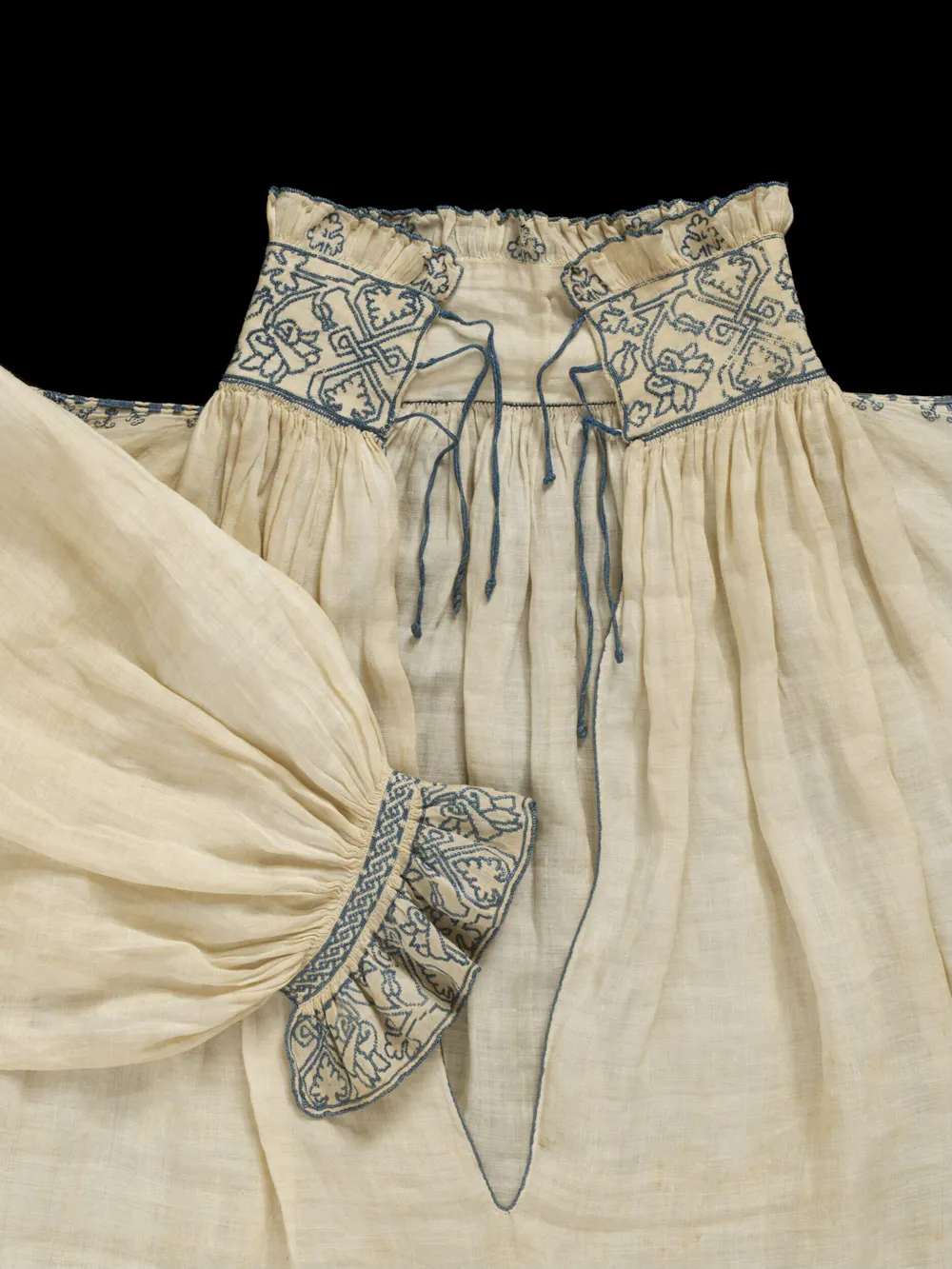
Linen was inexpensive, breathable and could be laundered daily. Contrary to popular belief, the Tudors were obsessed with cleanliness and hygiene. Linen absorbs sweat, bodily fluids and was believed to protect the skin from diseases such as the plague. Wearing and changing your linen shift daily was the best way to stay clean and protected from infection.

The collar on this linen shift, from around 1540, was larger so it could be seen under the outer garments.
©Victoria and Albert Museum, London, CC BY-NC

A fashionable trend of the Tudor period saw the collar on the linen shift become larger so it could be seen under the outer garments. A clean collar demonstrated that you could afford to change your shift and therefore had good hygiene.

You know what they say, cleanliness is close to godliness.

2. The ruff

If there is a single item of clothing that is most redolent of the Tudors, it’s the ruff.

The ruff was a pleated collar made from linen or lace and given its iconic stiff shape with starch. During the reign of Elizabeth I, large lace ruffs became an elaborate status symbol because they were difficult to set and impractical to wear which meant you had to have a lot of servants helping you.

Large, impractical ruffs – like the one in this 1615 portrait of a woman, possibly Elizabeth Pope – were a status symbol in Tudor England.
Yale Center for British Art

For Elizabeth I, the ruff was a significant source of power. The queen’s opulent ruffs commanded deference and situated her as the ultimate object in any room. In Elizabeth’s court, people came to her, not the other way around.

Dior gave the ruff a modern twist in their 2025 Fall–Winter collection, so it looks like they are already making a comeback.

3. Statement sleeves

In the Tudor period, sleeves were a separate garment that were attached while getting dressed in the morning. This allowed the wearer to pair them with different outfits and play around with fabrics, colours and styles.

The most popular style was the trumpet sleeve. This sleeve was narrow at the top of the arm and dramatically expanded in a cone shape over the elbow. A second sleeve would then appear underneath at the forearm.

This painting of Elizabeth I before her accession is dated between 1546 and 1547. The sleeves give the outfit a dramatic and voluminous appearance.
Royal Collection/Wikimedia Commons

This gave any outfit a dramatic and voluminous appearance with layers of luxurious textiles. See how this beautiful design looked on a young Elizabeth I.

A modern take on statement sleeves would be a great way to spice up any outfit.

4. Decorative techniques

Tudor tailors used a range of decorative techniques when making clothes. Paning, pinking and cutwork were just some of the more elaborate modes of garment construction but the most common was slashing.

Slashing involved cutting small slits into outer garments of velvet to reveal an inner layer of white silk. The layering and contrast of different colours not only created a striking and vibrant image but showed off your ownership of expensive textiles.

In this portrait of Henry VIII from between 1540–1547, you can see slashing on his doublet and sleeves.
Walker Art Gallery/Wikimedia Commons

You can see slashing on Henry VIII’s doublet (jacket) and sleeves in his famous portrait.

In 1991, this technique inspired Vivienne Westwood to produce the collection Cut and Slash, so it definitely has a place in the modern era.

5. The codpiece

Ok, this one is a bit of fun… but for Henry VIII the codpiece was no laughing matter. Starting out as a small triangular piece of material, by the early 16th century the codpiece had evolved into a padded, stiff and bejewelled item symbolic of virility and fertility.

Toxic masculinity was all the rage during the Tudor period, and Henry VIII was under immense pressure to maintain absolute control through his superior machismo.

As the king aged, his vigour waned and his failure to produce a male heir sent him into a crisis of masculinity. The display and exaggeration of his manhood through the codpiece was Henry’s only means of reasserting his masculine identity and fecundity.

Henry’s 1540 tournament armour gives a clear indication of just how exaggerated the codpiece became.

One thing is for sure, fashion in Tudor England was not a flippant pursuit. If the ever-enduring legacy of the Tudors can teach us anything, it’s that we should always dress to impress.

Grace Waye-Harris does not work for, consult, own shares in or receive funding from any company or organisation that would benefit from this article, and has disclosed no relevant affiliations beyond their academic appointment.

ref. From statement sleeves to the codpiece: 5 fashions which should come back from Tudor England – https://theconversation.com/from-statement-sleeves-to-the-codpiece-5-fashions-which-should-come-back-from-tudor-england-271507

Evening Report: https://eveningreport.nz/2026/02/03/from-statement-sleeves-to-the-codpiece-5-fashions-which-should-come-back-from-tudor-england-271507/

Australia’s Pacific worker scheme is far from perfect – but we can make it better

Source: The Conversation (Au and NZ) – By Peter Mares, Adjunct Senior Research Fellow, School of Media, Film and Journalism, Monash University

The Pacific Australia Labour Mobility scheme (PALM) is a crucial source of workers across regional Australia. About 32,000 people from nine Pacific nations and Timor-Leste work in Australia under PALM.

Over seven months of researching the scheme – interviewing workers, employers, country liaison officers, trade union organisers, community volunteers and academics, as well as digging into the data on it – I didn’t encounter anyone who thought it was a bad idea.

But there were many calls for change to make it work better for everyone. My , published today, suggests where we could start.

Who benefits from PALM now?

PALM has short- and long-term streams. Under the short-term stream, operating since 2012, workers can stay for nine months to do seasonal jobs such as fruit picking.

The long-term stream, introduced in 2018, allows for a four-year stay. Most long-term workers are employed in meat processing.

PALM is widely credited with delivering a triple win.

The first win is for Pacific participants and their communities.

In 2024-25 PALM workers remitted A$450 million to their home countries, an average of $1,500 each per person per month. The money bought food, paid school fees, upgraded housing and financed small enterprises.

Benefits flow beyond immediate families. After working in an Australian abattoir, Devid John Suma returned to Vanuatu and invested $30,000 to supply clean drinking water to his remote village.

The second win is for Australia’s economy. PALM workers make a significant contribution to regional businesses that struggle to attract local workers, from farms to abattoirs.

The third win is that PALM advances Australia’s strategic interests, not least by providing a counter to China’s wooing of Pacific nations.

Pacific leaders might wish for more aid from Canberra and be frustrated by the government’s tepid action on climate change. But well-paid work is something Australia offers that China does not.

Persistent problems

Yet the wins of the PALM scheme have countervailing costs in the pain of separated families, loneliness and broken marriages.

PALM is dogged by reports of workers being abused, underpaid or housed in substandard, overpriced or overcrowded accommodation.

Thousands of PALM workers have quit their approved jobs, “disengaging” from the scheme. This breaches their visa conditions and leaves them vulnerable to exploitation.

Drifting from its original mission

PALM has profoundly changed migration between the Pacific and Australia.

It brings workers to Australia from countries that have seen minimal migration to Australia since Federation, despite their geographic proximity — particularly the Melanesian countries Papua New Guinea, Solomon Islands and Vanuatu that were sources of labour in the late 19th century, when indentured South Sea Islanders built Queensland’s plantation economy.

But the future of PALM is not guaranteed.

Some Pacific countries, including Papua New Guinea, would like more of their nationals engaged under the scheme, while others worry it creates workforce shortages and disrupts community life.

Participation peaked at 34,830 workers in September 2023 and was at 32,365 in November 2025. Numbers in the long-term stream are steady, but fewer short-term workers are being recruited as employers revert to using backpackers — a cheaper, less regulated workforce — for seasonal jobs.

So, PALM has drifted from its original mission of filling seasonal gaps in the rural economy through annual circular migration, to become a labour program for sectors like meat processing and aged care with a constant demand for workers.

In April 2022, three-quarters of all PALM workers were in the short-term stream and a quarter were long-term. Now, more than half of all PALM workers hold long-term visas.

How to make the scheme work better

The PALM scheme changes lives and communities in the Pacific and Australia, often for the better. But its problems must be addressed to realise its potential.

Australian employers will turn away from a scheme that is too bureaucratic, expensive or cumbersome. PALM’s future won’t be secured by burying it under layers of rules and reporting.

has ten recommendations to improve PALM. These include:

  • making it easier for PALM workers to change jobs, rather than tying them to a single employer
  • simplifying PALM scheme rules for employers
  • regulating labour hire at the national level
  • giving workers access to Medicare while they’re in Australia to stop them missing out on medical attention
  • and reforming working holiday programs by phasing out the second and third visas offered to backpackers who do work like fruit picking in regional areas.

Australia’s interest in fostering Pacific development and rivalry with China are added reasons to limiting working holidays and expanding the PALM scheme instead.

PALM is a work in progress and will never be perfect. The scheme is shaped by the power differential between Australia and its Pacific partners. And there are tensions between three priorities: being a development program enhancing Pacific wellbeing, being a labour market program benefiting Australia’s economy, and serving a strategic purpose in Australia’s rivalry with China.

Yet when it operates well, PALM is far more than transactional.

Beyond wages earned, jobs filled and diplomatic points scored, it also fosters cultural exchange and personal engagement, binding the peoples of Australia and the region more fully into a “Pacific family”.

Peter Mares received funding from The Scanlon Foundation Research Institute to research and write “Improving PALM: Pacific Australia Labour Mobility”, but the views in this article are the views of the author alone and do not represent the position of the Scanlon Foundation. Peter Mares is a fellow at the Centre for Policy Development and a sessional moderator with Cranlana Centre for Ethical Leadership. He is a regular contributor to Inside Story magazine. He has also received past Australian Research Council funding.

ref. Australia’s Pacific worker scheme is far from perfect – but we can make it better – https://theconversation.com/australias-pacific-worker-scheme-is-far-from-perfect-but-we-can-make-it-better-274618

Evening Report: https://eveningreport.nz/2026/02/03/australias-pacific-worker-scheme-is-far-from-perfect-but-we-can-make-it-better-274618/

Our study shows younger siblings spend more time on screens than big sisters and brothers

Source: The Conversation (Au and NZ) – By Danusha Jayawardana, Research Fellow in Health Economics, Monash University

Atlantic Ambience/ Pexels

Where kids are born in a family can be important. But it is not just about who gets more grown-up privileges or parental pressure.

Research tells us firstborn children, on average, tend to do better on a range of outcomes. This includes doing better at school and being more likely to be top managers when compared to those born later.

In our new study, we looked at what impact birth order might have on how children spend their time. Both on their own and with their parents.

This revealed differences in terms of screen use and time spent enriching their intellectual development.

Our research

In our study, we used survey data from around 5,500 Australian children aged two to 15. The data comes from the Longitudinal Study of Australian Children, a nationally representative survey.

This included detailed 24-hour diaries, which recorded how children spent their time from waking up to going to sleep. They specified if activities were done with parents or independently.

We grouped activities into “sleep”, “school time”, “enrichment activities”, “screen time” and “physical activities”.

Enrichment activities are outside of school activities that help intellectual development. For example, reading, homework, playing board games or learning a musical instrument.

We then compared the diaries of firstborn children to later-born children from different families born in the same year, living in the same neighbourhoods, with similar socioeconomic backgrounds. All families had two or three children.

There is no similar data (such as time use records over years) available on siblings within the same family to capture and compare what siblings were doing at the same age.

Other studies looking at different outcomes (such as academic achievement) have shown birth order comparisons within a family are extremely similar to birth order comparisons across different families, once you adjust for family size, as we have done in our study.

So, it is likely our results would be similar to actual sibling comparisons within a family.

Younger kids get more screens

When compared to firstborn children, second- and thirdborn children spend an extra nine and 14 minutes, respectively, per day having screen time.

While this may sound modest, it represents a 7–10% increase compared to the average daily screen time of firstborns. Over the course of a week it is between about one and 1.5 hours.

This extra screen time also comes at the cost of other activities. In particular, later-born children spent 11 to 18 minutes less per day on enrichment activities, an 11–20% reduction compared to older siblings in the study.

We found no consistent differences between older and younger siblings when it came to time spent on other activities, such as school, physical activity or sleep.

Looking across age groups, the effects are generally greater for 10–14-year-old children. This suggests early adolescence is a period where particular attention is needed.

To check whether these patterns extend beyond Australia, we repeated the analysis using time-use diaries from a sample of children in the United States. The results were similar.

Why is this happening?

One common explanation for differences between first and subsequent children is parental time. As families grow, parents have less time and attention to foster subsequent children’s development.

However, this may not be the whole story. Our study showed later-born children did spend less time on enrichment activities with their parents. But about half of the difference comes from later-born children spending less time on enrichment activities on their own.

Screen time shows a similar pattern. The increase among later-born children is largely explained by activities they do alone, rather than with parents or siblings.

So this also reflects differences in children’s own choices or opportunities, not just direct parental involvement. For example, a younger sibling may have more freedom to choose to play video games rather than do their homework.

Of course parenting may still play an important role here. Our study shows later-born children face fewer rules around screen use, such as limits on programs or time, and are less likely to feel their parents expect them to follow rules. This may in part reflect parents’ desire for fairness in allowing similar use of screens for siblings at any given time, rather than at specific ages.

What does this mean?

The differences we find may seem small on any given day.

But they can add up over time. As our 2024 study showed, spending more time on screens and less time on reading, homework or other learning activities can lead to gaps in academic skill development over childhood, as measured by lower NAPLAN test scores.

The increase in solo screen time for later-born children is particularly concerning, because it may expose children to inappropriate content online.

What can we do?

First, recognising later-born children on average spend more time on screens and less time on enrichment activities than firstborns can be helpful for informing parenting strategies.

Second, it shows spending quality time with later-born children, actively encouraging enrichment activities, and keeping consistent rules around screen time all matter.

Finally, this suggests broader policies, such as the social media limits for under 16s, could help equalise opportunities for later-born children to learn and grow.

Gawain Heckley receives funding from the Swedish Research Council for Health, Working Life and Welfare (dnr 2023-01128).

Nicole Black receives funding from the Australian Research Council.

Danusha Jayawardana does not work for, consult, own shares in or receive funding from any company or organisation that would benefit from this article, and has disclosed no relevant affiliations beyond their academic appointment.

ref. Our study shows younger siblings spend more time on screens than big sisters and brothers – https://theconversation.com/our-study-shows-younger-siblings-spend-more-time-on-screens-than-big-sisters-and-brothers-273904

Evening Report: https://eveningreport.nz/2026/02/03/our-study-shows-younger-siblings-spend-more-time-on-screens-than-big-sisters-and-brothers-273904/

Tiny radio transmitters reveal a hidden survival tactic in birds

Source: The Conversation (Au and NZ) – By Alice Barratt, PhD Candidate, Hawkesbury Institute for the Environment, Western Sydney University

White-backed swallow in Sturt National Park. Alice Barratt, CC BY-NC

In Sturt National Park, near Tibooburra in central Australia where temperatures can range from freezing to nearly 50°C, there lives a small bird with a white back, forked tail and – as we’ve just discovered – a very clever strategy to survive its extreme environment.

The white-backed swallow (Cheramoeca leucosterna) is a type of passerine – the largest group of birds, comprising 60% of all bird species.

Scientists have long thought these birds incapable of deep torpor – a controlled state of reduced body temperature that saves energy and has been found in many animals in the northern hemisphere, where winters are more severe.

But our new paper, published today in the journal Current Biology, shows otherwise.

A white-backed swallow equipped with a temperature sensing radio-transmitter.
Chris Turbill, CC BY-NC

Understanding how animals cope with extreme conditions

Animal physiologists have long seen the value of studying animals in extreme conditions to understand their survival strategies.

In the past, however, field instruments were cumbersome or delicate and studies were mostly limited to artificial conditions in the laboratory.

This was a problem for several reasons.

First, in captivity wild animals are often stressed and don’t tend to exhibit their full capabilities. Exposing captive wild animals to extreme conditions is also logistically difficult and an animal welfare concern.

But more recently, technological advances allow us to measure the physiological responses of animals when they are exposed to extreme conditions in the wild.

Tracking birds to their burrows

Biologging involves attaching electronic devices to animals that can record key traits such as movement, body temperature and energy expenditure. It is providing a fascinating window into the natural lives of animals.

Technological advances have meant these devices have become miniature in recent years. This has greatly expanded the species scientists can study in the wild and provides an exciting opportunity to challenge long held assumptions based on lab-based studies – including about torpor.

Night-time radio-tracking of white-backed swallows.
Chris Turbill, CC BY-NC

Our team set out to investigate the white-backed swallow, which has been the subject of some intriguing reports over the years.

For example, during cold and wet winter periods, observations as old as 1936 have reported finding the birds in their sandy burrows during the daytime that appeared in a torpor-like state: “inert, nestling into each other as if to escape from the bleak winter’s day”.

Over the winters of 2023 and 2024, we used miniature (400 milligrams) temperature sensing radio transmitters to study the thermal physiology of these swallows in Sturt National Park – the traditional lands of the Wongkumara, Wadigali, and Malyangapa peoples.

We tracked tagged birds to their burrows at night and set up autonomous data logging units nearby to record their body temperature data.

Following a tenuous radio signal on foot across the desert was spectacular on a clear starry night. But sometimes it was also tiring and intimidating.

After that, we trusted our data logging units to collect the steady radio pulses emanating from the resting birds. From these we obtained their body temperature, and therefore their potential use of torpor.

We had two major inland rain events in winter 2024, leading to local flooding. This meant we were unable to access our field site. So we waited it out in the local campground, hoping our trusty loggers were still recording data while enduring the unusually chilly nights.

Downloading the body temeprature data from the receiver and data logging units deployed near white-backed swallow burrows.
Chris Turbill, CC BY-NC

An extraordinary discovery

As the land dried out, we returned to find something extraordinary.

During and after these extreme rain events, the birds remained in their burrows even during the daytime. And they entered deep and long bouts of torpor – far exceeding what passerine birds were thought capable of.

Such torpor is presumably crucial for these in-flight foragers to survive when wet and cold conditions suppress the activity of flying insects.

More generally, our discovery of torpor use by a passerine bird suggests that this strategy is not limited to hummingbirds, nightjars and their relatives.

Instead, it could be a more widespread adaptation for survival across the diversity of birds.

Flooding of a typically dry creek during heavy rainfall.
Alice Barratt, CC BY-NC

A new wave of discoveries

Our finding adds to a growing number of recent discoveries revealed by biologging about the thermal adaptations of birds and mammals when faced with extreme conditions.

In 2024, for example, we found that even the largest of bats, the flying foxes (Pteropus species), are capable of using torpor during cold winter conditions that pose a risk of starvation.

In contrast, during summer, when flying foxes can be exposed to extreme heat events, our biologging data has shown they employ controlled increases in body temperature. This adaptation reduces the costs of shedding heat and helps to avoid lethal dehydration.

These data are essential for us to understand how animals survive extreme weather events, which are becoming increasingly common and severe with a warming climate.


The authors would like to acknowledge Justin Welbergen, Ben Moore and Anthony Hunt for their contribution to the research.

Alice Barratt receives funding from Western Sydney University, Hawkesbury Institute for the Environment and the Australian Bird Study Association.

Christopher Turbill receives funding from the Australian Research Council, and the Australian Commonwealth and New South Wales government.

ref. Tiny radio transmitters reveal a hidden survival tactic in birds – https://theconversation.com/tiny-radio-transmitters-reveal-a-hidden-survival-tactic-in-birds-274517

Evening Report: https://eveningreport.nz/2026/02/03/tiny-radio-transmitters-reveal-a-hidden-survival-tactic-in-birds-274517/

As Australia’s online harm crackdown reshapes the debate, NZ must find its own path

Source: The Conversation (Au and NZ) – By Claire Henry, Associate Professor in Screen, Flinders University

Getty Images

Around the world, lawmakers are grappling with how to better protect young people from online harms such as cyberbullying, sexual exploitation and AI-generated “deepfake” images.

Recent reforms overseas – notably Australia’s landmark move to restrict young people’s access to social media – have sharpened debate about how far governments should go.

Despite past and current efforts – including a government inquiry shortly due to report its final findings – New Zealand arguably lags other developed countries in tackling a problem that is growing more serious and complex by the year.

In 2026, the question facing the government is whether to cautiously follow overseas models, or to use this moment to develop a response better suited to its own legal, social and cultural context.

What is online harm?

Online harm can take many forms, including exposure to illegal material, AI-driven racial bias, and the non-consensual sharing of intimate images. As Netsafe highlights, online abuse and harassment can unfold across social media, messaging apps, email and text, and often involves repeated or sustained behaviour.

New Zealand’s legislative response has developed gradually over the past decade. A major step was the Harmful Digital Communications Act 2015, which introduced civil and criminal penalties for serious online abuse and established Netsafe as the approved agency for complaints and dispute resolution.

Since then, governments have attempted broader reform. In 2018, the Department of Internal Affairs launched a wide-ranging regulatory review, followed in 2021 by the Safer Online Services and Media Platforms review, which aimed to modernise online safety protections and oversight.

However, that process stalled and in May 2024 the review was terminated by Internal Affairs Minister Brooke van Velden. A year later, the government launched a new inquiry into “the harm young New Zealanders encounter online”.

In the meantime, New Zealand’s fragmented and increasingly outdated regulatory framework is struggling to keep pace with fast-evolving digital risks.

What can NZ learn from other countries?

Many submissions to the government’s latest inquiry urged New Zealand to learn from overseas experience, while others noted that not all of those solutions would work at home.

InternetNZ argued that as a small and relatively late mover, New Zealand can “piggyback” on reforms in larger markets, so long as it ensured they reflect the country’s “unique local context, both socially and practically”. The Inclusive Aotearoa Collective – Tāhono similarly stressed the need to protect sovereignty.

Others argued New Zealand should draw on its reputation for innovation and develop its own culturally appropriate approaches.

Amokura Panoho of Pou Tangata Online Safety, for instance, called for updating the Harmful Digital Communications Act to address emerging AI harms such as deepfakes, and creating new Māori-led reporting pathways tailored for young Māori to seek help. Advocates argue this could allow New Zealand to anticipate future risks rather than chase them.

Australia’s move to ban social media for under-16s has loomed large over the inquiry. While France and the United Kingdom are considering similar bans, there are concerns blanket age restrictions can be blunt instruments and that young people often find ways around age-verification systems.

This international focus was reinforced in the inquiry’s interim report, which drew heavily on models from Australia, the UK, Ireland and the European Union. But submitters also pointed to other lessons, including the UK’s Internet Watch Foundation, South Korea’s online safety framework and California’s youth privacy laws.

A further complication is that many international reforms remain largely untested. Australia’s Online Safety Act is still being rolled out in phases, while the EU’s Digital Services Act only entered full force in early 2024. As a result, evidence about their effectiveness remains limited.

The case for a national regulator

One of the clearest options emerging from the inquiry is the creation of a national online safety regulator: a model already adopted in several comparable countries, including Australia, the UK and Ireland.

In the UK, communications regulator Ofcom oversees the Online Safety Act 2023, while Australia’s eSafety Commissioner was granted expanded powers under the Online Safety Act 2021.

A 2021 Department of Internal Affairs report concluded that a central regulator in New Zealand could streamline oversight, provide a single point of contact and improve enforcement. The inquiry’s interim report reached a similar conclusion, pointing to the benefits of coordinated regulation and proactive “safety by design” rules.

But reform has been slowed by political caution, particularly around concerns about freedom of expression. The government’s preference for light-touch regulation has left gaps – notably in addressing emerging harms such as sexualised deepfakes – prompting ACT MP Laura McClure’s member’s bill aimed at closing some of those loopholes.

The inquiry’s final report, and the government’s response to it, offer a rare opportunity to reset direction. The challenge will be to move beyond piecemeal reform and design a system capable of keeping pace with rapid technological change, while placing the voices of young people and Māori at its centre.

Claire Henry receives funding from the Australian Research Council as a DECRA Fellow. She previously received a research grant from InternetNZ (2018) for an unrelated project on “Preventing child sexual offending online through effective digital media.”

Michael S. Daubs was commissioned by the Department of Internal Affairs to co-author the 2021 report with Peter Thompson.

ref. As Australia’s online harm crackdown reshapes the debate, NZ must find its own path – https://theconversation.com/as-australias-online-harm-crackdown-reshapes-the-debate-nz-must-find-its-own-path-274723

Evening Report: https://eveningreport.nz/2026/02/03/as-australias-online-harm-crackdown-reshapes-the-debate-nz-must-find-its-own-path-274723/

What is Israel’s Herzog doing in Australia – who invited him, and why?

ANALYSIS: By Andrew Brown

Israel’s President, Isaac Herzog, is due to arrive in Australia next Sunday. Why is a foreign Head of State asked to help heal an Australian community after an Australian tragedy?

Australia is being asked to accept something extraordinary as if it were normal.

Who invited Isaac Herzog in the first place, and why did Australian Prime Minister Anthony Albanese say yes? Presented to us not as diplomacy, not as geopolitics, not as a strategic signal, but as “healing”.

Before we swallow that story, one question needs to be put on the table and left there until someone answers it.

Where does this community’s allegiance align? Australia or Israel?

The visit is being sold as reassurance for Jewish Australians after the Bondi attack last December 14. And yet the reassurance on offer does not come from Australia at all.

It does not come from Australian civic leaders. It does not come from Australian law or Australian institutions. It does not come from Jewish Australian faith figures, nor even from Israeli rabbinical leaders rooted in this country and this community.

It comes instead from a foreign head of state, and that single choice does more than any speech. It quietly rewrites the relationship between citizenship, faith, and state power in Australia.

So ask the obvious questions. Who requested this visit? Who lobbied for it? Who thought it was wise to import a foreign political figure into the emotional aftermath of Bondi? And why did the Prime Minister say yes?

Why did Albanese say yes?
If the purpose is truly pastoral, then the choice makes no sense. The visitor is not a rabbi. Not a spiritual leader. Not an interfaith presence. Not a community counsellor.

He is an Israeli president. A political figure. The constitutional face of a foreign state. Politics, not pastoral care. Power, not solace.

That is the first truth we are being asked not to notice, but the second truth is even more uncomfortable.

For years, Australians have been hammered with a single instruction, delivered with the confidence of a moral rule. Judaism is a religion. Israel is a state. Zionism is a political ideology. Keep them separate. Do not conflate.

If you blur those lines, you will be accused of prejudice, sometimes fairly, sometimes strategically, but always loudly.

That instruction has been enforced through the culture. In media commentary. In parliamentary speeches. In complaints processes. In campaigns to delegitimise critics who would not repeat the approved formula with sufficient reverence.

Fine. If separation is the principle, then separation must hold when it matters most. Especially when grief is raw, and symbols do their sharpest work.

Separation is abandoned
But at the precise moment symbolism matters most, the separation is abandoned. Not by critics. Not by social media hotheads. By the state itself.

At a moment of Australian grief, it is not faith that is summoned. It is the Israeli state.

Its president is elevated as the symbolic consoler. Its presence is framed as essential to the healing of Jewish Australians.

This visit does not merely blur the line between Judaism and Israel. It erases it. Publicly. Institutionally. With government endorsement of inviting a man who, according to Labor Friends of Palestine, doesn’t pass the character test for a visa application:

  1. “A person does not pass the character test if … the Minister reasonably suspects that the person has been or is involved in conduct constituting . . .  the crime of genocide, a crime against humanity, a war crime, a crime involving torture or slavery or a crime that is otherwise of serious international concern; whether or not the person, or another person, has been convicted of an offence constituted by the conduct . . . ”
  2. “A person does not pass the character test if . . .  in the event the person were allowed to enter or to remain in Australia, there is a risk that the person would . . . incite discord in the Australian community or in a segment of that community . . . ’ 

— Migration Act 1958, Section 501

Judaism vs Israel
You cannot spend decades demanding that Australians keep Judaism and Israel separate, then place an Israeli head of state at the centre of an Australian tragedy and expect the public to maintain the fiction.

You cannot demand absolute separation when critics speak, then collapse that separation when power needs a stage.

That is not an oversight. It is a choice, and it leads to the real debate Australia has been pushed to avoid.

If Jewish Australians are Australians of Jewish faith, then their safety, grief, and belonging are matters for Australia to address. Australian law. Australian civic leadership. Australian institutions.

Or, if faith is the organising principle, rabbis and religious leaders who actually carry pastoral authority. They are not matters for a foreign head of state. Not for an overseas government inserting itself into an Australian tragedy.

The moment a foreign political leader is presented as necessary to healing, the issue stops being faith and becomes allegiance.

And allegiance is not some abstract thing in Australia. It is demanded constantly. Migrant communities are told, again and again, that Australia comes first. That loyalty must be singular. That old countries are left behind. That this nation, its laws, its institutions, and its flag are the sole point of civic attachment.

Except here, the rules bend. Here, the separation we are warned never to breach is breached from above. Here, the state quietly endorses the idea that

Jewish identity in Australia is incomplete without Israeli political authority standing behind it.

Divisive double standard
That is why this visit is divisive. Not because Australians lack compassion. Not because antisemitism is not real. It is real, and it should be crushed without hesitation.

The division comes from the double standard. The division comes from importing a foreign political symbol into Australian grief, then scolding Australians for noticing what that symbol implies.

And once Israel is positioned as the emotional guarantor of Jewish life in Australia, the logic runs further, whether anyone likes it or not.

Why does responsibility stop at speeches? Why does it end in symbolism?

Why is the Australian taxpayer funding security, policing, protective infrastructure, and now a full diplomatic visit, while the implication being advanced is that Jewish safety here is inseparable from the Israeli state?

If Israel is to be treated as the natural guardian, then why is Australia carrying the entire material cost?

The Prime Minister has not merely allowed a diplomatic courtesy. He has endorsed a narrative. One that collapses the very separation it claims to defend.

One that institutionalises the question of allegiance while pretending the question is offensive to ask.

It is not offensive. It is civic. It is democratic. It is necessary. So ask it clearly, without malice and without fear.

Who asked for this visit? Why did the government agree? And what exactly are Australians being told, in symbols rather than words, about where allegiance is supposed to lie?

Because if the answer is Australia, this visit makes no sense.

And if the answer is Israel, Australians deserve honesty about what has just been done in their name.

Andrew Brown is a Sydney businessman in the health products sector, former Deputy Mayor of Mosman and Palestine peace activist. This article was first published by Michael West Media and is republished with permission.

Article by AsiaPacificReport.nz

Evening Report: https://eveningreport.nz/2026/02/02/what-is-israels-herzog-doing-in-australia-who-invited-him-and-why/

View from The Hill: Littleproud and Ley turn on the music for another attempt at the two step

Source: The Conversation (Au and NZ) – By Michelle Grattan, Professorial Fellow, University of Canberra

Nationals Leader David Littleproud easily saw off a token move to spill the party leadership on Monday. But he is now under immense pressure to reach a deal with Liberal leader Sussan Ley to put the Coalition together again.

With talks scheduled for Monday night, Liberal frontbencher Dan Tehan flagged reunification as a top priority, proposing codifying the arrangements for future behaviour, with a mechanism to resolve disputes.

Littleproud split the Coalition after Ley sacked three Nationals frontbenchers who crossed the floor on the hate legislation, breaking shadow cabinet solidarity. Nationals sources said reinstating the three was a condition of a deal.

Ley’s numbers man, frontbencher Alex Hawke, delivered a strong call for Littleproud to return his party into a coalition with the Liberals.

Hawke told Sky: “We are urging him not to break the Coalition, because it will be the biggest own goal. It will be bigger, or as big, as the DLP split in the Labor Party [in the 1950s].

“If there’s any chance or prospect of turning away from this [divided] course, David Littleproud needs to turn away from scoring the biggest own goal of all time in the centre-right of Australian politics.”

The unsuccessful spill motion at the Nationals meeting came from backbencher Colin Boyce, a strong critic of how Littleproud handled events leading to the Coalition’s split that happened less than a fortnight ago. Boyce knew his motion would not succeed but wanted to make a point.

The meeting carried a motion moved by Victorian MP Darren Chester, to authorise the Nationals leadership team “to negotiate in good faith” and urgently with the Liberals’ leadership to re-establish “a Coalition for the duration of the 48th Federal Parliament”.

Chester said later, “After a very constructive discussion my motion was overwhelmingly supported because it’s in the best interests of the nation for the Coalition to reform and hold this government to account. I hope the negotiations are successful.”

A deal would strengthen Ley’s position in the short term against defence spokesman Angus Taylor, undermining any argument he might mount that only a change of leadership could reunite the Coalition.

Littleproud initially said his shadow ministers – who all quit after the three were sacked – could not serve in a Ley shadow ministry.

Hawke dismissed this as “a moment of anger. I haven’t heard him repeat that claim.”

Not all Liberals are anxious for a quick rapprochement, believing the party can better appeal to inner city voters if not tied to the Nationals.

The pressure on Littleproud to re-form the Coalition has been increased by a Redbridge poll in the Australian Financial Review showing One Nation polling 26%, well ahead of the Liberals and Nationals combined on 19%.

One Nation’s Barnaby Joyce on Monday flagged the party would announce on Tuesday a high profile recruit defecting from another party.

If the Coalition re-forms this would be the second time since the election. The post-election split was also brief.

Michelle Grattan does not work for, consult, own shares in or receive funding from any company or organisation that would benefit from this article, and has disclosed no relevant affiliations beyond their academic appointment.

ref. View from The Hill: Littleproud and Ley turn on the music for another attempt at the two step – https://theconversation.com/view-from-the-hill-littleproud-and-ley-turn-on-the-music-for-another-attempt-at-the-two-step-274835

Evening Report: https://eveningreport.nz/2026/02/02/view-from-the-hill-littleproud-and-ley-turn-on-the-music-for-another-attempt-at-the-two-step-274835/

New data show where the parties got their money from in the lead-up to the 2025 election

Source: The Conversation (Au and NZ) – By Kate Griffiths, Democracy Deputy Program Director, Grattan Institute

The Conversation, CC BY-SA

Australia’s political parties set new records in funds raised and spent in the lead-up to the 2025 federal election. Now, nine months later, Australians finally get a look at who funded the parties’ election campaigns.

Data released today reveal that big money matters in Australian elections, and political donations remain highly concentrated among a small number of powerful individuals and interest groups.

The big spenders

Money matters in Australian elections because it helps spread political messages far and wide. The Coalition substantially outspent Labor in the year leading up to the 2025 election, declaring $212 million in expenditure compared with Labor’s $160 million. In fact, the two major parties together spent three quarters of a total $489 million in 2024–25. These figures include electoral communication, as well as party operating expenses and salaries, but there is no breakdown.

Clive Palmer’s Trumpet of Patriots party came in third, declaring $53 million in expenditure, well below the $123 million and $89 million his United Australia Party spent in the 2022 and 2019 election campaigns, respectively. The Greens declared $40 million and One Nation just $3 million in expenditure in 2024–25.

Australia’s political parties collectively exceeded their 2022 election budgets in 2025, raising $490 million, compared with $402 million in the lead-up to the 2022 election, and coming very close to the half-a-billion mark for the first time.

The Coalition has long led the fundraising “arms race” between the major parties, with Labor taking a substantive lead only once on record – in the lead-up to the 2007 election that saw Kevin Rudd’s Labor Party defeat John Howard’s Coalition government.

The big donors

So who’s stumping up these whopping sums? A few big donors dominate the picture.

Clive Palmer’s Mineralogy – which donated almost exclusively to the Trumpet of Patriots – was by far the largest donor in the 2024–25 financial year. While Palmer’s $54.3 million in donations this electoral cycle is lower than his record-breaking intervention in 2022, it still shows the substantial sway a single donor can have in an election year.

Climate 200 was the second-largest donor over the period, with the organisation making $6.6 million in donations to a range of independent candidates and campaign groups. Donors to Climate 200 – including Scott Farquhar, William Taylor Nominees, and Mike Cannon-Brookes – were among those stumping up the largest individual donations.

One new player this cycle was Coal Australia, a lobby group founded in 2024 to represent coal mining interests. The group made more than $4 million in donations to electoral campaign groups such as Australians for Prosperity, and Jobs for Mining Communities.

The single biggest donation to the Coalition came from philanthropist Pam Wall, who gave $5.2 million to the Liberal Party of South Australia in 2024–25, in memory of her late husband, Ian Wall. Other major donors to the Coalition included the Cormack Foundation (an investment arm for the Liberal Party), Oryxium Investments (linked to the Lowy family), and DoorDash Australia.

Labor’s single biggest donor was Labor Holdings (an investment arm of the party), which donated $4 million, followed by the Mining and Energy Union ($3.3 million). SA Progressive Business, a fundraising arm of the Labor Party, donated $1.4 million.

Anthony Pratt’s paper and packaging company Pratt Holdings made big donations to both Labor and the Coalition, as it has done in previous years, with Labor benefiting to the tune of $2 million, and the Coalition $1 million.

What about the rest of the money?

There’s a lot of hidden money in Australian politics. Declared donations made up only a quarter of political parties’ total income in 2024–25. Public funding made up another quarter, and “other receipts” a further 20%. That leaves about 30% ($144 million) in undisclosed private funds.

The Coalition’s funding is a little more murky: 36% of Coalition income in 2024–25 was undisclosed, compared with 23% for Labor. Only donations bigger than $16,900 need to be declared under the current rules, so substantial donations remain hidden.

Reform is coming, but there’s still more to do

Fortunately, the rules are changing soon to provide much more transparency. From July 1 this year, the donations disclosure threshold will be lowered to $5,000, and donations data will be released much more quickly. Donations will be required to be disclosed within seven days during an election period, and at other times, within 21 days following the month the gift was received.

That means Australians will finally know who’s donating while policy issues – and elections – are still “live”.

The new rules also introduce caps on donations and electoral expenditure, helping to reduce the influence of money in politics. But the new rules unfairly advantage major parties over independents and new entrants.

The new total cap of $90 million for electoral expenditure by a political party is too high, keeping too much money in politics. And the per-seat spending cap of $800,000 is too low, advantaging incumbents over new entrants. There is also a loophole in the design of the donations cap that advantages major parties by allowing the cap to apply separately to each branch of a party.

The new legislation should be reviewed and amended to close the loopholes before the next federal election.

The Grattan Institute began with contributions to its endowment of $15 million from each of the Federal and Victorian Governments, $4 million from BHP Billiton, and $1 million from NAB. In order to safeguard its independence, Grattan Institute’s board controls this endowment. The funds are invested and contribute to funding Grattan Institute’s activities. Grattan Institute also receives funding from corporates, foundations, and individuals to support its general activities as disclosed on its website.

Matthew Bowes does not work for, consult, own shares in or receive funding from any company or organisation that would benefit from this article, and has disclosed no relevant affiliations beyond their academic appointment.

ref. New data show where the parties got their money from in the lead-up to the 2025 election – https://theconversation.com/new-data-show-where-the-parties-got-their-money-from-in-the-lead-up-to-the-2025-election-274739

Evening Report: https://eveningreport.nz/2026/02/02/new-data-show-where-the-parties-got-their-money-from-in-the-lead-up-to-the-2025-election-274739/

NSW is ditching good character references in sentencing. Will the rest of the country follow?

Source: The Conversation (Au and NZ) – By Vicki Lowik, Adjunct Research Fellow, School of Nursing, Midwifery and Social Sciences, CQUniversity Australia

New South Wales is set to become the first jurisdiction in the country to end the use of good character references in the sentencing of convicted criminals.

The government will introduce a bill this week to amend the state’s sentencing laws. The amendment will stop people submitting references of their “good character” to lobby for more lenient sentences.

References attesting to the convicted criminal’s prospects for rehabilitation and their likelihood of reoffending will still be permitted.

The move acknowledges the potential re-traumatisation faced by victims when unsubstantiated character references from family and friends are submitted for consideration during sentencing hearings. Victims have stated the process can make them think the courts don’t care about or take seriously the harm they have experienced.

It’s a decision that aligns with expert evidence, so might other states follow suit?

What is a good character reference, exactly?

Good character references are letters presented to a court during the process of sentencing someone convicted of a crime. They are often provided by friends and family members, though references may be sought from employers, priests and other respected community members.

The references usually describe how the person is a valuable family or community member, has a good work record and no criminal history.

Character evidence can help a judge more fully understand the person they are sentencing and decide if they can be rehabilitated. Demonstrated prior good character enables the judge to ensure the appropriateness and fairness of the sentence.

But contemplating the subjective opinions of non-professionals regarding the possibility of rehabilitation can be problematic.

Such references have promoted people being sentenced for sexual assault and rape as having “high moral values”, being a “kind-hearted, loving father” or having a “good work ethic”.

Since 2009, NSW hasn’t allowed good character references for child sexual offenders who used their position of influence to gain access to victims.

But two sexual abuse victims, Harrison James and Jarad Grice, have led a campaign for more substantial change. Called Your Reference Ain’t Relevant, the campaign protested against convicted child sex offenders being able to produce glowing character references to reduce their sentence.


Read more:
Character references tell a court you’re a good person. Why are convicted rapists allowed to use them?


What does the evidence say?

The Australian Law Reform Commission has been reviewing justice responses to sexual violence. In its 2025 final report, the commission said it received submissions describing the provision of good character references for convicted sexual violence offenders as a “problematic” practice.

The commission noted the NSW Sentencing Council was reviewing the use of character evidence. It said the outcome of the NSW process would inform any suggestions for future reforms at a national level.

The New South Wales Sentencing Council’s report was released on February 1. It recommended legislation to prevent the court from using evidence that goes solely to a finding of good character. This legislation, however, may permit the court to consider other relevant evidence in sentencing.

The report states “there is no settled definition of what good character is, or what it reflects”. The council said the concept “has been criticised as being vague and incoherent […] lacking a settled definition”.

The council’s recommendations go beyond child sexual offences. They apply to all convicted offenders.

And for NSW at least, they would overrule a 2001 High Court decision allowing character to be considered in providing “some leniency” in sentencing.

Will other states do the same?

A report by the Queensland Sentencing Advisory Commission into the sentencing of sexual assault and rape recommended that some types of good character evidence be limited. It said good character evidence should only be used to assist the court in deciding on the rehabilitation or the potential recidivism of the convicted criminal.

The report recommended that courts have the option, depending on the nature or seriousness of an offence, to disregard character references when determining sentencing.

In September 2025, Queensland parliament passed legislation addressing the recommendations. The references can now only be considered to inform a judge’s assessment of the likelihood of rehabilitation or recidivism.

But as some frontline sexual assault services submitted in consultations this left open ways to circumvent the rule. Friends and family could provide references mentioning the prospects of rehabilitation.

So while there’s some movement on the issue in Queensland, if the NSW recommendations are to lead the way in nationwide reform, the task will not be easy.

Significant differences exist between the states. This is because apart from Commonwealth offences, criminal law remains primarily a state matter. This has produced divergent offence labels, maximum penalties and sentencing regimes.

Even on the specific issue of character evidence in child sexual offence proceedings, there are substantial differences in laws and contexts across the country.

These contrasts in approach to legislating the use of good character references in sentencing will, as observed by the Law Council of Australia, likely result in similar cases attracting different outcomes in different states.

But sometimes it just takes one bold attempt at reform to inspire action in others. As advocates have succeeded in NSW, it’s likely others will attempt similar change. State and territory governments have been put on notice.

The authors do not work for, consult, own shares in or receive funding from any company or organisation that would benefit from this article, and have disclosed no relevant affiliations beyond their academic appointment.

ref. NSW is ditching good character references in sentencing. Will the rest of the country follow? – https://theconversation.com/nsw-is-ditching-good-character-references-in-sentencing-will-the-rest-of-the-country-follow-274842

Evening Report: https://eveningreport.nz/2026/02/02/nsw-is-ditching-good-character-references-in-sentencing-will-the-rest-of-the-country-follow-274842/

Does coffee raise your blood pressure? Here’s how much it’s OK to drink

Source: The Conversation (Au and NZ) – By Clare Collins, Laureate Professor in Nutrition and Dietetics, University of Newcastle

Olga Pankova/Getty Images

Coffee first entered human lives and veins over 600 years ago.

Now we consume an average of almost two kilos per person each year – sometimes with very specific preferences about blends and preparation methods. How much you drink is influenced by genes acting on your brain’s reward system and caffeine metabolism.

Coffee can raise your blood pressure in the short term, especially if you don’t usually drink it or if you already have high blood pressure.

But this doesn’t mean you need to cut out coffee if you have high blood pressure or are concerned about your heart health. Moderation is key.

So how does coffee affect your blood pressure? And if yours is high, how much is OK to drink?


Read more:
Health Check: four reasons to have another cup of coffee


What is high blood pressure?

Blood pressure is the force blood exerts on artery walls when your heart pumps. It’s measured by two numbers:

  • the first and biggest number is systolic blood pressure, which is the force generated when your heart contracts and pushes blood out around your body

  • the lower number, diastolic blood pressure, is the force when your heart relaxes and fills back up with blood.

Normal blood pressure is defined as systolic blood pressure of less than 120 millimeters of mercury (mm Hg) and diastolic blood pressure of less than 80 mm Hg.

Once your numbers consistently reach 140/90 or more, blood pressure is considered high. This is also called hypertension.

Knowing your blood pressure numbers is important because hypertension doesn’t have any symptoms. When it goes untreated, or isn’t well-controlled, your risk of heart attacks and strokes increases, and existing kidney and heart disease worsens.

About 31% of adults have hypertension with half unaware they have it. Of those taking medication for hypertension, about 47% don’t have it well-controlled.


Read more:
Do you take your own blood pressure at home? Here’s how to choose the device that fits your arm best


How does coffee affect blood pressure?

Caffeine in coffee is a muscle stimulant that increases the heart rate in some people. This can potentially contribute to an irregular heartbeat, known as arrhythmia.

Caffeine also stimulates adrenal glands to release adrenaline. This makes your heart beat faster and your blood vessels to constrict, which increases blood pressure.

Blood caffeine levels peak between 30 minutes and two hours after a cup of coffee. Caffeine’s half-life is 3–6 hours, meaning blood levels will reduce by about half during this time.

The range is due to age (kids have smaller, less mature livers so can’t metabolise it as fast), genetics (people can be fast or slow metabolisers) and whether you usually drink it (regular consumers clear it faster).

The impact of caffeine on blood pressure from coffee (and cola, energy drinks and chocolate) varies. Research reviews report increases in systolic blood pressure of 3–15 and a diastolic blood pressure increase of 4–13 after consumption.

The effect of caffeine also depends on a person’s usual blood pressure. An increase in blood pressure may be more risky if you have hypertension and existing heart or liver disease, so it’s best to discuss your coffee consumption with your doctor.

What else is in coffee?

Coffee contains hundreds of phytochemicals: compounds that contribute flavour, aroma, or influence health and disease.

Phytochemicals that directly affect blood pressure include melanoidins, which regulate the body’s fluid volume and activity of enzymes that help control blood pressure.

Quinic acid is another phytochemical shown to lower systolic and diastolic blood pressure by improving the lining of blood vessels, allowing them to better accommodate blood pressure rises.

Can coffee cause hypertension?

In a review of 13 studies that included 315,000 people, researchers examined associations between coffee intake and the risk of hypertension.

During study follow-up periods, 64,650 people developed hypertension, with the researchers concluding coffee drinking was not associated with an increased risk of developing the condition.

Even when they examined data by gender, amount of coffee, decaffeinated versus caffeinated, smoking or years of follow-up, coffee was still not associated with an increased risk of developing hypertension.

The only exceptions suggesting lower risk were for five studies from the United States and seven low-quality studies, meaning those results should be interpreted with caution.

A separate Japanese study followed more than 18,000 adults aged 40–79 years for 18.9 years. This included about 1,800 people who had very high blood pressure (grade 2-3 hypertension), with systolic blood pressure of 160 or above or diastolic blood pressure of 100 or above.

Here, risk of dying from cardiovascular disease, including heart attack or stroke, was double among those drinking two or more cups of coffee a day compared to non-drinkers.

There were no associations with death from cardiovascular disease for those who had either normal blood pressure or mild (grade 1) hypertension (systolic blood pressure 140–159 or diastolic blood pressure 90–99).

The bottom line

There is no need to give up coffee. Here’s what to do instead:

  1. know your blood pressure, health history and which food and drinks contain caffeine

  2. consider all factors that influence your blood pressure and health – family history, diet, salt and physical activity – so you can make informed decisions about what you consume and how much you move

  3. be aware of how caffeine affects you and avoid it before having your blood pressure measured

  4. avoid caffeine in the afternoon so it doesn’t affect your sleep

  5. aim to moderate your coffee intake by drinking four cups or less a day or switching to decaf

  6. if you have systolic blood pressure of 160 or above or diastolic blood pressure of 100 or above, consider limiting to one cup a day, and talk to you doctor.


Read more:
Seven things to eat or avoid to lower your blood pressure


Clare Collins AO is a Laureate Professor in Nutrition and Dietetics at the University of Newcastle, NSW and a Hunter Medical Research Institute (HMRI) affiliated researcher. She is a National Health and Medical Research Council (NHMRC) Leadership Fellow and has received research grants from NHMRC, ARC, MRFF, HMRI, Diabetes Australia, Heart Foundation, Bill and Melinda Gates Foundation, nib foundation, Rijk Zwaan Australia, WA Dept. Health, Meat and Livestock Australia, and Greater Charitable Foundation. She has consulted to SHINE Australia, Novo Nordisk, Quality Bakers, the Sax Institute, Dietitians Australia and the ABC. She was a team member conducting systematic reviews to inform the Heart Foundation evidence reviews on meat and dietary patterns and was Co-Chair of the Guidelines Development Advisory Committee for Clinical Practice Guidelines for Treatment of Obesity 2025.

ref. Does coffee raise your blood pressure? Here’s how much it’s OK to drink – https://theconversation.com/does-coffee-raise-your-blood-pressure-heres-how-much-its-ok-to-drink-270955

Evening Report: https://eveningreport.nz/2026/02/02/does-coffee-raise-your-blood-pressure-heres-how-much-its-ok-to-drink-270955/

ASIC flags $40 million in refunds after review of risky financial products

Source: The Conversation (Au and NZ) – By Adrian Lee, Associate Professor in Property and Real Estate, Deakin University

Australia’s corporate regulator has secured refunds of A$40 million to more than 38,000 investors in risky financial products, following a review of the industry.

The Australian Securities and Investments Commission (ASIC) raised concerns that marketing of high-risk products known as “contracts for difference” or CFDs, failed to clearly explain the risks involved.

This is just ASIC’s latest intervention in more than 15 years of ongoing concern with the potential harm of CFDs to retail investors.

Fine-tuning the marketing of these complex financial products to a suitable audience remains an unfinished task for the regulator.

What are CFDs?

In its report, ASIC said thousands of Australians lose money trading CFDs every year. In 2023-34, over 133,000 people, or 68% of retail clients, lost more than $458 million.

Contracts for difference are a type of financial instrument known as derivatives because they follow the price of an underlying asset, such as stocks, the Australian dollar, and other financial products.

They are traded “over-the-counter” (meaning not on a public exchange) on platforms run by CFD providers.

Investors can profit from both upward or downward movements in financial assets with CFDs. Unlike buying shares, investors need only pay a fraction of the price (the margin) up front to enter into a CFD to track a financial product, with the hope of making a profit.

CFDs are leveraged products, which means an investor is borrowing money to speculate on the price of an asset. A small price change in the underlying stock or commodity can have an amplified effect by increasing the gain – or the loss – on the CFD.

For example, this can be as little as paying $1 upfront to gain the same trading power as $100.

Let’s say you buy a CFD on one Apple share. As you only need to pay a fifth of the Apple stock for the CFD, you can buy five Apple CFDs for the price of one Apple share. So if the price of Apple rises by $1, you could make $5. But if it falls by $1, you could lose $5 dollars.

CFDs are therefore popular with investors as they can trade many financial instruments (betting on rises or falls) and magnify their trading power.

The downside is that trading on margin also amplifies losses if the market goes against the bet that a price will rise or fall. This has led to financial distress and cases of attempted self-harm.

ASIC has been particularly concerned about issuers offering “margin discounts” to clients on particular trades, to reduce the amount or “margin” that the investor pays up front.

This contravenes ASIC’s 2021 product intervention order. ASIC published a further warning to CFD issuers in 2024 to stop this practice.

The complexity and risk of CFDs has meant they are effectively banned in the United States. In Singapore, prospective traders need to pass a customer knowledge assessment before they are allowed to trade CFDs.

Who are the products being marketed to?

CFDs are not for the faint of heart and would only suit investors who are very knowledgeable and have a large appetite for risk. Despite this, retail investors (regular people) are the dominant market targeted by CFDs issuers in their marketing and advertising.

In ASIC’s recent report, the regulator found that CFD issuer websites misled consumers.

Some examples were promoting the underlying instruments, such as shares or commodities, rather than actual CFDs, and overstating the benefits of trading CFDs and understating the risks.

ASIC has forced 46 issuers to rewrite their websites by removing misleading content and making them clearly state that they are offering CFDs, among other changes. One issuer amended 1,000 web pages.

ASIC chair Joe Longo last week floated the idea of banning advertising for high-risk financial products, which would also include CFDs.

The underlying concern is that unsophisticated investors are being attracted to complex financial products that carry great risk of financial loss.

Indeed, ASIC’s report found that only 32% of retail clients made money from CFDs after fees. Of those that traded the most per month (over 50 trades), only 19% were profitable after fees.

Fears vulnerable investors still slipping through the cracks

The key difference is between retail and wholesale clients.

Wholesale clients are generally institutions or sophisticated investors, highly experienced and more likely to trade complex derivatives and make a profit.
Wholesale clients are defined in law based on certain tests.

Wholesale clients also lose some of the consumer protections that apply to retail investors, such as receiving product disclosure statements and having access to dispute resolution.

Yet, ASIC found that even wholesale clients lost money, with only 30% making profits.

This raises concerns for ASIC of whether some retail clients were misclassified as wholesale clients by the CFD issuers.

So, it is not the laws that need changing, which clearly define sophisticated investors. What is needed is more scrutiny of how issuers misclassify potentially vulnerable investors.

The statistics are concerning as this means the large majority of investors are losing money trading CFDs, driven largely by paying fees. On the flip side, this means CFD issuers are profiting from some of these losses as they earn the fees.

This raises questions of whether CFD issuers are attracting suitable clientele through advertising, as the losses by investors seem excessive. This suggests that advertising should carry warning labels, similar to advertising for other risky activities, such as sports betting.

Walking a fine line

CFDs have existed for over two decades, with a market that is predominantly comprised of retail investors.

ASIC has managed the fine balance of permitting their access, while regulating issuers on their marketing and operations without banning them outright. Potential investors would be wise to do their own homework to carefully assess the costs and risks of CFDs before wading into the market.

Adrian Lee receives funding from the Australian Research Council. The author is working on a separate ASIC project related to crypto trading.

ref. ASIC flags $40 million in refunds after review of risky financial products – https://theconversation.com/asic-flags-40-million-in-refunds-after-review-of-risky-financial-products-274426

Evening Report: https://eveningreport.nz/2026/02/02/asic-flags-40-million-in-refunds-after-review-of-risky-financial-products-274426/