Sweeping cuts by one of most iconic investigative newspapers in the United States, The Washington Post, now owned by Amazon billionaire Jeff Bezos, apply to about one-third of the newsroom, with sport and international coverage largely gutted. Another major blow to media freedom in the US that came after the following CPJ editorial was published. EDITORIAL:By the Committee to Protect Journalists Board
Over the past year, those liberties have come under threat in ways not seen in generations.
The events of recent weeks — including the arrest of two journalists for covering protests in Minnesota, and the raid on the home of a Washington Post reporter — represent a dangerous escalation.
These are not isolated incidents. They are the latest in a sustained pattern of actions that are systematically undermining press freedom and the public’s right to know.
Such actions are unacceptable and intolerable.
The board of directors at the Committee to Protect Journalists (CPJ) stands unequivocally in defence of a free and independent press — one that can report the facts and hold power to account without intimidation or interference.
For more than 40 years, CPJ has been consistent in its defence of journalists. As a nonpartisan, nonprofit organisation, we stand with journalists whenever they are threatened or placed in peril, anywhere in the world — including in the United States.
We hold all political leaders to the same standard. We will not be silenced by pressure, harassment, or efforts to punish journalists and those who support them.
A free press and the factual information journalists provide are essential to democracy, public safety, and social stability. Without them, the public is at greater risk.
This role is explicitly recognised and protected by the First Amendment to the US Constitution. Journalists have the right to report the news. Efforts to obstruct, punish, or deter them from doing so violate not only their rights, but the rights of all Americans.
CPJ stands with Don Lemon, Georgia Fort, Hannah Natanson, and all journalists targeted for doing their jobs in the United States.
Today we call on leaders across political, civic, and business life—especially those who lead media organisations — to speak out clearly and publicly in defense of press freedom.
Nine days after it happened, police have declared an alleged attempted bombing at an Invasion Day rally in Perth an act of terrorism.
A 31-year-old man is accused of throwing a homemade fragment bomb, filled with ball bearings and screws, into a crowd protesting on Australia Day. The bomb failed to detonate.
He has been charged with engaging in a terrorist act: the first time such charges, which carry a maximum sentence of life in prison, have been laid in Western Australia. This is in addition to previously laid harm and explosives charges.
Law enforcement and the media have been criticised for not calling the incident a terrorist attack sooner. But terrorism isn’t always cut and dry, and it’s crucial authorities get the necessary proof to have the best chance of successful prosecution.
What do we know about the attack?
WA Police, ASIO and the Australian Federal Police have been working together on the investigation, under the Joint Counter Terrorism Team arrangements.
They allege the man, who can’t be named for legal reasons, engaged in an “attack on Aboriginal people and other peaceful protesters”. They allege it was “motivated by hateful, racist ideology”.
He is accused of disguising the bomb in a child’s sock. It was allegedly intended to detonate on impact.
Authorities say they have evidence the man was accessing “pro-white male, pro-white material online”.
Why did it take 9 days?
When intelligence and law enforcement authorities investigate incidents like these, they must pursue every relevant line of inquiry.
In the immediate aftermath, it wasn’t clear whether the man police had taken into custody had any ideological motivation: a key distinguishing factor for terrorism as opposed to other (equally serious) offences, such as hate crimes.
Under the Australian Criminal Code, terrorism is violence and conduct done for the purpose of advancing a “political, religious or ideological cause”.
In an event such as the Bondi terror attack, the ideological motivations were relatively clear. Authorities found two Islamic State flags in the car that belonged to the accused gunmen.
In Perth, however, police had no such immediate evidence. They would have had to investigate every other conceivable possibility.
The man could have been having a severe psychotic episode, as in the tragic Bondi Junction stabbings. He could have been acting out of hate for Indigenous people that didn’t have an organising ideological framework behind it.
Police are clearly confident they’ve found enough evidence to meet the criteria for a terrorist act. While nine days may seem a long time, given the likely breadth of the investigation, the time frame is quite efficient.
Was he acting alone?
Part of what authorities would have had to establish was whether the alleged attacker was linked to other people or terrorist groups.
WA Police Commissioner Col Blanch said “we understand he’s accessing and participating in the ideology, but not having conversations about what was going to happen on January 26”. He said the man was engaging with ideology on Facebook.
So while he wasn’t formally linked to a specific terrorist group, police allege he was on the periphery.
Academic evidence shows this is quite common. Terrorism, especially in Western nations, is generally less centrally organised and far more fragmented.
On the far-right, they call this approach “leaderless resistance”. For Islamic extremists, it’s often referred to as “lone Jihad”.
Terrorists actively encourage this sort of decentralised structure because it helps them avoid detection by intelligence organisations. If a person is planning an attack, no leader need know about it. Both in Jihadist and extreme right-wing contexts, encouraging lone actor methodology is, in part, to maintain operational security.
We also know people on the edges of an ideology are more likely to act than key leaders and organisers. Often, lone-wolf actors see themselves as avoiding getting bogged down in a movement’s politics and bureaucracy. In their eyes, they’re the ones getting the job done.
These movements, however different in their politics, are less formal groups and more social movements. People believe in the cause, the aesthetic and the social scene, but there’s no formalised membership structure, at least for those operating in Western nations.
This makes it harder for counter terrorism operations to track key people and prevent incidents. It can also make investigations after an event longer and more complicated.
But conversely, while not always the case, it also can mean a perpetrator’s capacity for harm is smaller. Someone who has been radicalised online and is acting with whatever they can get their hands on is often less likely to pull off a mass-casualty event than an organised, trained fighting force.
The path ahead
It should be noted, however, that even if this hadn’t been designated as terrorism, it wouldn’t have lessened its severity. This could have been a mass casualty event, as was highlighted by WA Police. People rightly feel unsafe and emotional, and want to see the threat taken seriously.
Indeed, it was taken very seriously. The Joint Counter Terrorism Team was involved almost immediately.
But the job of law enforcement is to find the evidence to successfully prosecute. Nobody would want to see someone escape harsh punishment because of a flimsy police case, nor would they want to citizens detained on terrorism charges without a thorough investigation.
There’s still a lot we don’t know about this terror attack, the man allegedly behind it, and what his precise beliefs are. As the matter is proceeding through the courts, a lot of these details will come to light in the weeks and months ahead.
Levi West is employed under a National Intelligence and Security Discovery Grant, administered by the Office of National Intelligence.
It quickly became apparent the newly discovered object was a member of a group called the Kreutz sungrazing comets. These include many of the brightest and most spectacular comets ever seen.
Comet MAPS is moving on an extreme, highly elongated orbit around the Sun, and is diving towards a fiery date with our star. In early April the comet will pass within just 120,000km of the Sun’s surface.
If the comet survives, it could become a spectacular sight in the evening sky in early April. It may even become visible in broad daylight as it swings closest to the Sun – unless it falls apart before then.
So what makes these sungrazers so exciting, and what can we expect?
Fragments of a mega-comet
Over the past 2,000 years, a series of spectacular comets have graced our skies. Without fanfare, they appear seemingly from nowhere, shining remarkably close to the Sun in the sky. Some even become bright enough to be visible in broad daylight.
Historically, the brightest comets often become known as “Great Comets”. The Great Comet of 1965 – C/1965 S1 (Ikeya-Seki) – was the brightest comet of the 20th century. Discovered just one month before its closest approach to the Sun, it got as bright as the full Moon, and was easily visible with the naked eye during the day.
The Great Comet of 1882, C/1882 R1, was even more impressive. At its brightest, it was a hundred times brighter than the full Moon, dazzling in the sky for several months.
We now know that all these bright comets from the last two millennia – the Kreutz sungrazing family – share a common origin. At some point in the past (potentially in the 3rd or 4th century BCE), a giant cometary nucleus, more than 100km in diameter, came perilously close to the Sun’s surface. Some time after that close approach, far from the Sun, that comet split into two major fragments and shed lots of smaller pieces.
In the eleventh century, the two largest remaining pieces of the ancient mega-comet swung by again, becoming the Great Comets of 1106 and 1138. Once again, the pieces fragmented – and the products of those fragmentations have been seen as a series of comets through the past two centuries.
Today, the Kreutz sungrazing family contains a vast number of smaller comets which fall apart en-route towards the Sun, as well as larger pieces that can put on a fantastic show.
NASA’s Solar and Heliospheric Observatory, SOHO, has spotted thousands of Kreutz fragments over the years – tiny icebergs just metres or tens of metres across. Larger fragments swing by more rarely.
Comet Lovejoy seen from the International Space Station, December 22 2011. NASA
That comet would be a sibling to the Great Comets of 1965 and 1882, and a fragment of the Great Comet seen by Chinese observers in 1138.
Enter comet MAPS
Which all brings us to the newly discovered comet C/2026 A1 (MAPS). It’s moving on an orbit typical of Kreutz sungrazing comets, and already holds one record. At the time of its discovery, comet MAPS was farther from the Sun than any previous newly discovered sungrazer.
That suggests it might be a larger-than-usual fragment – perhaps.
The previous holder of this record was comet Ikeya-Seki in 1965, which proved to be the brightest of the 20th century. However, technology has moved on significantly in the past 70 years, and it seems very unlikely the nucleus of comet MAPS is as large as that of Ikeya-Seki. In turn, that makes it unlikely comet MAPS will be as bright.
Nevertheless, the fact we’ve caught it so early means it’s either a reasonably large Kreutz fragment, or it’s currently in outburst – already falling apart. Fortunately, recent observations have shown it steadily brightening, which points to the former theory.
What can we expect from the new comet?
Overall, it’s too soon to tell. If – and that’s a big if – the comet survives its closest approach to the Sun (known as perihelion), it could put on a great show in early to mid-April.
If it holds together, it might get bright enough to be visible in broad daylight. Even if that doesn’t happen, the SOHO spacecraft will provide great images of the comet.
In the days following perihelion, the comet will move into the evening sky. Thanks to its orbit, like all Kreutz comets it will be far easier to see from the southern hemisphere.
If the comet survives until perihelion, then fragments as it passes the Sun, it could brighten suddenly and unexpectedly. A late break-up might therefore be the best-case scenario for a dazzling show.
For now, we watch and wait.
Jonti Horner does not work for, consult, own shares in or receive funding from any company or organisation that would benefit from this article, and has disclosed no relevant affiliations beyond their academic appointment.
A new Pacific Media research publication and outlet for academics and community advocates has now been added to the Informit database for researchers.
Two editions of the new journal, published by the Aotearoa-based independent Asia Pacific Media Network (APMN) and following the traditions of Pacific Journalism Review, have been included in the database’s archives for institutional access.
Most university and polytech journalism schools in Australia, New Zealand and the Pacific subscribe to Informit which delivers expert-curated and extensive information from sectors such as health, engineering, business, humanities, science and law — and also journalism and media.
Informit also offers an Indigenous Collection with a broad scope of scholarship related to Indigenous culture, health, human geography in Australia, New Zealand and the Pacific.
Pacific Media offers journalists, journalism academics and community activists and researchers an outlet for quality research and analysis and more opportunities for community collaborative publishing in either a journal or monograph format.
While associated with Pacific Journalism Review, the new publication series provides a broader platform for longer form research than has generally been available in the PJR, featured here at ANU’s Development Policy Centre. The full 30-year archive of PJR is on the Informit database.
Earlier editions of Pacific Journalism Monographs have included a diverse range of journalism research from media freedom and human rights in the Asia-Pacific to Asia-Pacific research methodologies, climate change in Kiribati, vernacular Pasifika media research in New Zealand, and post-coup self-censorship in Fiji.
Managing editor Dr David Robie, who founded both the PJR and PM, welcomed the Informit initiative and also praised the Tuwhera DOJ platform at AUT University.
“There is a real need for Pacific media research that is independent of vested interests and we are delighted that our APMN partnership developed with Informit is continuing with our new Pacific Media journal,” he said
The first edition, themed on “Pacific media challenges and futures”, was partnered with the The University of the South Pacific and edited by Associate Professor Shailendra Singh and Dr Amit Sarwal and published last year.
The second edition, themed on “Media construct, constructive media”, was partnered with the Asian Congress for Media and Communication (ACMC) and edited by Khairiah A Rahman and Dr Rachel E Khan, and was also recently published.
Bad Bunny is on a roll. Among the three wins at the 68th Grammy Awards, DeBÍ TiRAR MáS FOToS (I should have taken more pictures) became the first Spanish-language record to win Album of the Year. On Sunday, Bad Bunny will be the first Latino and Spanish speaking artist to perform as solo headliner at the Super Bowl halftime show.
Born Benito Antonio Martínez Ocasio, and raised in Borinquen (the Taíno-language name for Puerto Rico), Bad Bunny’s life and music has been marked by political, social and economic crises affecting the archipelago: government corruption, failing infrastructure and debt.
Bad Bunny has used his voice to protest in both his music and public statements against national crises and the ongoing effects of colonialism, while celebrating Latinx and Puerto Rican identities.
Bad Bunny started posting songs on SoundCloud in 2016. In 2018, he released his first album, X 100PRE. Sung in Spanish, the album reached number 11 on the Billboard charts.
His third album, 2020’s El último tour del mundo (The Last World Tour), became the first Spanish-language album to reach number one in the Billboard charts. His fourth record, 2022’s Un Verano Sin Ti (A Summer Without You) also topped this chart, this time for 13 weeks.
DeBÍ TiRAR MáS FOToS stands out against Bad Bunny’s previous albums for its focus on Puerto Rican identity and ongoing fight against colonisation. This is reflected in the album through national symbols, genres and, of course, language. Bad Bunny addresses these themes through companion videos explaining central aspects to the collective memory of Puerto Rico.
In the current climate in the United States of interventionism and mass deportations, DeBÍ TiRAR MáS FOToS has made the domestic Puerto Rican experience resonate among global audiences.
Language and genre
Puerto Rico is an unincorporated territory that belongs to the US, and Puerto Ricans are US citizens, but the territory is not counted as one of the country’s states. The US exerts control over the military, politics and economy of the archipelago.
Spanish plays a complex role in Puerto Rico, as a colonial language that was imposed in the archipelago. More recently, Spanish has been embraced as a resistance to English dominance.
Bad Bunny speaks Puerto Rican Spanish, which combines influences from indigenous Taíno language, African languages, Spanish and English. Studies have found Spanish speakers may consider this variety as incorrect because its characteristics are seen as distant from the Castilian Spanish norm: perceptions anchored in colonial ideologies that privilege Castilian Spanish.
Among other genres, Bad Bunny sings reggaeton, a Caribbean genre that draws on Jamaican dancehall, American hip-hop and Dominican Republic dembow.
Reggaeton is popular music with underground roots and explicit lyrics. In the 1990s, Puerto Rican reggaeton was subject to government prosecution (including confiscation, fines and negative media campaigns) due to its alleged obscenity. That did not stop its increasing popularity among young audiences in the Caribbean, and beyond.
The international popularity of reggeaton artists such as Don Omar, Daddy Yankee, Young Miko, Ozuna and Bad Bunny has changed the perception of Puerto Rican Spanish from a history of deficit views to more social prestige. In the past, the distance from the Castilian Spanish norm was considered something negative, but there is now a strong interest among students of Spanish to learn this variety.
Fluid use of language
Bad Bunny’s language does not reflect a purist vision of language with rigid boundaries. Instead, he embraces a creative use of language with fluid boundaries.
The Puerto Rican slang Bad Bunny uses on DeBÍ TiRAR MáS FOToS features numerous Anglicisms, or words borrowed from English – a feature of Puerto Rican Spanish.
He uses unadapted borrowings – such as the words shot, pitcher, flashback, follow, blondie, glossy, brother, bestie, eyelash, underwater and movie. And he also uses hybrid realisations, compound words that combine English and Spanish components such as janguear (adapted from the English “hang out”), girla (girl), ghosteó (ghosted), stalkeándote (stalking) and kloufrens (close friends).
Bad Bunny embraces his Puerto Rican identity in the pronunciation of lyrics and in public commentary. For example, he pronounces the letter “r” as the letter “l” in songs like NUEVAYoL (New York) and VeLDÁ (Truth).
The letter “l” becomes a strong identity feature of NUEVAYoL when compared to other iconic renditions to the city, such as from Frank Sinatra.
By using his voice to celebrate characteristics of Puerto Rican Spanish previously not perceived as prestigious, Bad Bunny is contributing to the values of linguistic diversity and fighting language ideologies inherited from colonialism.
Music as defiance
The way Bad Bunny uses language has been described as an act of defiance and survival. Bad Bunny does not break down language and make it easier for listeners. Rather, listeners have to make the effort of decoding it.
Notably, the lexicographer Maia Sherwood Droz created a Spanish dictionary for DeBÍ TiRAR MáS FOToS, including definitions of words, phrases and cultural references to decode the meanings in the album.
In an album loaded with references to the ongoing fight to preserve Puerto Rican identity, he evokes community symbols of “pitorro de coco” (homemade clandestine rum) to “la bandera azul clarito” (the light blue flag, referring to a 1895 Puerto Rican emblem.
When accepting an award at the Grammys, Bad Bunny said:
We’re not savage. We’re not animals. We’re not aliens. We are humans, and we are Americans.
Bad Bunny’s acceptance speech is explicitly rejecting dehumanisation in a ceremony where, finally, music in language other than English and, importantly, in Puerto Rican Spanish, was honoured and celebrated as the best album of the year.
Beatriz Carbajal-Carrera does not work for, consult, own shares in or receive funding from any company or organisation that would benefit from this article, and has disclosed no relevant affiliations beyond their academic appointment.
When the World Wide Web went live in the early 1990s, its founders hoped it would be a space for anyone to share information and collaborate. But today, the free and open web is shrinking.
The Internet Archive has been recording the history of the internet and making it available to the public through its Wayback Machine since 1996. Now, some of the world’s biggest news outlets are blocking the archive’s access to their pages.
Major publishers – including The Guardian, The New York Times, the Financial Times, and USA Today – have confirmed they’re ending the Internet Archive’s access to their content.
While publishers say they support the archive’s preservation mission, they argue unrestricted access creates unintended consequences, exposing journalism to AI crawlers and members of the public trying to skirt their paywalls.
Yet, publishers don’t simply want to lock out AI crawlers. Rather, they want to sell their content to data-hungry tech companies. Their back catalogues of news, books and other media have become a hot commodity as data to train AI systems.
Robot readers
Generative AI systems such as ChatGPT, Copilot and Gemini require access to large archives of content (such as media content, books, art and academic research) for training and to answer user prompts.
In response, some tech companies have struckdeals to pay for access to publishers’ content. NewsCorp’s contract with OpenAI is reportedly worth more than US$250 million over five years.
Similar deals have been struck between academic publishers and tech companies. Publishing houses such as Taylor & Francis and Elsevier have come under scrutiny in the past for locking publicly funded research behind commercial paywalls.
Now, Taylor & Francis has signed a US$10 million nonexclusive deal with Microsoft granting the company access to over 3,000 journals.
Publishers are also using technology to stop unwanted AI bots accessing their content, including the crawlers used by the Internet Archive to record internet history. News publishers have referred to the Internet Archive as a “back door” to their catalogues, allowing unscrupulous tech companies to continue scraping their content.
The Wayback Machine has also been used by members of the public to avoid newspaper paywalls. Understandably, media outlets want readers to pay for news.
News is a business, and its advertising revenue model has come under increasing pressure from the same tech companies using news content for AI training and retrieval. But this comes at the expense of public access to credible information.
When newspapers first started moving their content online and making it free to the public in the late 1990s, they contributed to the ethos of sharing and collaboration on the early web.
In hindsight, however, one commentator called free access the “original sin” of online news. The public became accustomed to getting their digital editions for free, and as online business models shifted, many mid- and small-sized news companies struggled to fund their operations.
The opposite approach – placing all commercial news behind paywalls – has its own problems. As news publishers move to subscription-only models, people have to juggle multiple expensive subscriptions or limit their news appetite. Otherwise, they’re left with whatever news remains online for free or is served up by social media algorithms. The result is a more closed, commercial internet.
This isn’t the first time that the Internet Archive has been in the crosshairs of publishers, as the organisation was previously sued and found to be in breach of copyright through its Open Library project.
The past and future of the internet
The Wayback Machine has served as a public record of the web for more than three decades, used by researchers, educators, journalists and amateur internet historians.
Blocking its access to international newspapers of note will leave significant holes in the public record of the internet.
Today, you can use the Wayback Machine to see The New York Times’ front page from June 1997: the first time the Internet Archive crawled the newspaper’s website. In another 30 years, internet researchers and curious members of the public won’t have access to today’s front page, even if the Internet Archive is still around.
Today’s websites become tomorrow’s historical records. Without the preservation efforts of not-for-profit organisations like The Internet Archive, we risk losing vital records.
Despite the actions of commercial publishers and emerging challenges of AI, not-for-profit organisations such as the Internet Archive and Wikipedia aim to keep the dream of an open, collaborative and transparent internet alive.
Tai Neilson does not work for, consult, own shares in or receive funding from any company or organisation that would benefit from this article, and has disclosed no relevant affiliations beyond their academic appointment.
The Victorian government has announced it will train 150 GPs to diagnose and start treatment for attention deficit hyperactivity disorder (ADHD) in adults and children.
This decision could shorten wait times and lower costs for people yet to be diagnosed. It will also bring Victoria in line with most other Australian states.
But how will it all work?
How do we currently diagnose ADHD?
Diagnosing ADHD requires a comprehensive assessment. This allows the doctor to understand a person’s medical history and the impact of their symptoms on how they function in different settings, for example at school or in social situations.
Then the patient has to learn to manage their ADHD, with the support of professionals such as psychologists and occupational therapists. This might mean modifying aspects of their lifestyle such as sleep, nutrition or exercise.
They may also be given strategies to help them cope at school, home or work, such as scheduling regular rest breaks.
Stimulant medication is often prescribed to help the patient focus better and to reduce impulsive behaviours.
About 6% of boys and 2% of girls under 12 in Australia are prescribed ADHD medications. This figure rises to 9% of boys and 5% girls aged 12–17 years, and 2–3% in adults.
Currently in Victoria, GPs can continue prescribing ADHD medication to a patient if a specialist (such as a paediatrician or psychiatrist) has already made a diagnosis.
At the moment Victorian GPs need a government permit to continue prescribing and the patient must be reviewed by a specialist every two years.
A costly condition
In many parts of Australia, parents wait months or even years to get an appointment with a paediatrician to be assessed for ADHD and related conditions. This is the case in both the public and private health-care systems.
These long wait times can lead to delayed diagnoses in children, which means delays in starting treatment. This can result in ongoing problems such as inattention, impulsivity and hyperactivity, which can have a major impact on learning, relationships and social functioning.
There is also the financial burden on families on getting assessments and diagnoses for ADHD from a specialist.
Similarly, Victorian adults who wish to be assessed for ADHD must see a psychiatrist. This need for specialist appointments makes the diagnosis process more costly than your average GP visit.
One benefit of involving GPs in ADHD care is that this should free up appointments with paediatricians and psychiatrists for people with ADHD or other conditions.
So, how will this training work?
Following the Victorian government’s decision, GPs can undertake additional training to diagnose and treat ADHD in patients aged six years and above. This includes prescribing medication alongside other non-medication care options such as behavioural therapy.
This accredited training program will be overseen by the Royal Australian College of General Practitioners (RACGP).
So far, the Victorian government has committed A$750,000 towards training an initial 150 GPs by September 2026.
Across Australia, ADHD-specific training for GPs varies between states. However, the RACGP is also involved in delivering training to GPs in Western Australia, South Australia and New South Wales.
What’s happening in other states?
Queensland has been the frontrunner in GP-managed ADHD care. Since 2017, Queensland GPs have been able to both diagnose ADHD and prescribe stimulant medication for children. As of December 2025, they can also treat adults with ADHD.
In June 2025, the WA government committed A$1.3 million to train GPs to diagnose and treat ADHD in patients aged ten and older. The first group of 65 local GPs is expected to be trained by the end of 2026.
Since September 2025, GPs in NSW have been able to prescribe stimulant medications to patients with an existing ADHD diagnosis, aged six years and older. However, they must first apply to become a “continuation prescriber” and meet certain criteria.
As of 2026, South Australian GPs can access additional training to diagnose ADHD and prescribe medication to both children and adults, without the need for specialist appointments.
Governments in Tasmania and the Australian Capital Territory have also committed to revise their policies around ADHD care.
The Northern Territory remains the only Australian jurisdiction that has not announced ADHD-related reforms.
ADHD assessment must consider a range of factors. Most patients with ADHD have one or more other conditions. Common ones in children include learning difficulties, anxiety and autism spectrum disorder.
And in some people, ADHD symptoms might actually be caused by something else, such as sleep deprivation, depression, learning disorders or trauma.
Medication can be extremely helpful to manage symptoms. But patients taking medication need to be regularly reviewed to ensure the medication is having the desired impact. GPs must also monitor any side effects to make sure they are not too severe.
On the whole, this policy change has the potential to improve access to medical care for Victorians with ADHD. However, we must give careful consideration to the details of the training, implementation and supports available.
Daryl Efron has received research grants from the Medical Research Future Fund, National Health and Medical Research Council, Victorian Medical Research Acceleration Fund (Department of Jobs, Precincts and Regions), and the Victorian government Department of Families, Fairness and Housing
Nadia Coscini is currently the paediatrician on the Royal Children’s Hospital/Murdoch Children’s Institute/ North Western Melbourne Primary Health Network ADHD shared care feasibility study which is funded by the North Western Melbourne Primary Health Network. Nadia also receives funding for a postgraduate PhD scholarship through the NHMRC (No. 2031478).
Source: The Conversation (Au and NZ) – By Tim Lindsey, Malcolm Smith Professor of Asian Law and Director of the Centre for Indonesian Law, Islam and Society, The University of Melbourne
Indonesian President Prabowo Subianto waited decades for his chance to lead the country. The controversial former general finally won the office on his third attempt in a 2024 landslide election.
Since then, Prabowo has wasted little time moving against Indonesia’s fragile democracy, accelerating a process that began under his predecessor, Joko “Jokowi” Widodo.
As Australia and Indonesia grow closer, this matters. The two neighbours agreed on an important bilateral security treaty in November, and it is expected to be formally signed in the coming days during Prime Minister Anthony Albanese’s trip to Indonesia.
Yet, the countries seem to be moving further apart when it comes to freedom of speech and respect for civil society. This could complicate matters for Albanese, particularly as Prabowo ramps up his crackdown on critics of his administration.
Distaste for democracy
Indonesia’s vulnerable democratic system has been under repeated attack from government for most of the last decade. Under the administrations of Widodo and now Prabowo, a laundry list of actions have been taken to chip away at it. To name just a few:
the independence of the once-feared anti-corruption commission (KPK) has been profoundly compromised
Many predicted these events. Prabowo has never made secret his distaste for democracy and enthusiasm for the authoritarian New Order regime of Soeharto, his former father-in-law.
In fact, Gerindra, Prabowo’s political party, still has as its No. 1 objective reinstating the old constitution under which Soeharto ruled. This would mean dumping most of the key democratic reforms of the past 30 years.
But recent developments suggest the dismantling of democratic freedoms is speeding up. Prabowo seems to be using the Soeharto playbook to move against those who oppose what he is doing – mainly pro-democracy activists.
It’s not hard to understand why. Prabowo’s grand ruling coalition now includes almost every party in the legislature – all of them right or centre-right – and political discourse rarely involves detailed policy debates.
This means civil society – in particular, Indonesia’s tiny but vibrant activist community – has become the only real source of opposition.
Now, Prabowo’s administration has identified them as the enemy.
In August, huge protests broke out after politicians voted to give themselves extravagant allowances. A brutal police response then triggered wild violence against authorities across the archipelago. These riots shook the ruling elite to the core.
In response, the government came down heavily on civil society activists. It blamed them for the riots, even though they were mostly a spontaneous popular response to abusive actions by the authorites. Prabowo, however, said activists were engaging in “treason and terrorism”.
Thousands were arrested and, detainees claim, some were tortured. Hundreds now face trial for subversion and incitement. This has tied up the small activist groups working frantically to defend their colleagues.
Prabowo has also used the Soeharto-era approach of associating his critics with shadowy foreign enemies. He has railed against “foreign intervention” he says is intended to “divide the country”. He claims there are “foreign lackeys” backed by foreign powers “that do not want to see Indonesia prosper”.
Last year, Prabowo even accused the highly-respected news outlet Tempo of being a foreign stooge because it won a grant from the Media Development Investment Fund, a not-for-profit linked to George Soros.
This week, he claimed to have unspecified proof that foreign forces were behind the August riots.
A draconian new law against ‘foreign propaganda’
“Let the dogs bark,” Prabowo told a press conference last March in response to his critics. “We will keep moving forward. We are on the right path”.
But, in reality, Prabowo is determined to stop the barking. His government has now proposed a law against disinformation and foreign propaganda that could revive Soeharto-era media controls and censorship.
A so-called “academic draft” putting forth the rationale for the law says Indonesia needs “a comprehensive and integrated legal instrument to prevent, detect, and counter disinformation and foreign propaganda”. It alleges that disinformation and foreign propaganda is being “powered by social media, artificial intelligence and transnational networks” of malicious actors.
If this law is passed in the form the draft suggests, it could be used to ramp up the government’s crackdown on civil society groups. Activists and journalists could potentially be charged with offences of spreading “foreign propaganda”.
The draft also proposes restricting “foreign capital” to stop the threat posed by so-called foreign agents.
Many civil society groups in Indonesia are affiliated with international NGOs, such as Amnesty and Transparency. Many others receive funding from overseas aid organisations, including Australia’s, or private philanthropists. Most depend on these streams of income to pay wages and day-to-day expenses. They would collapse without this funding.
It’s not clear what exactly “foreign capital restrictions” means. But it could cast a wide net over all activist groups, as well as foreign organisations working in Indonesia that have an online presence.
Indonesians targeted in Australia
But the net may reach even further than this. The draft suggests the law would apply across borders. This could effectively target government critics based overseas, including in Australia.
Despite the dramatic decline in Indonesian studies in our schools and universities, Australia is still a major global centre for research on Indonesia. Indonesian critics of different regimes in Jakarta have sought sanctuary in Australia over the decades, and many thousands of Indonesians have studied here.
Australia is also home to a small but active Indonesian diaspora community. In August, they held their own demonstrations in cities across Australia in support of the protests in Indonesia.
As Prabowo’s administration moves Indonesia closer to becoming a “new New Order”, where opposition is routinely met with repression and censorship prevails, Australia’s role as a hub for open dialogue, free speech, analysis and criticism of Indonesia will become even more important.
We can be sure this will be no more welcome in Prabowo’s Indonesia than it was under Soeharto. Then, Australian academics and journalists were often denied entry and critical articles sometimes led to a freeze in diplomatic relations.
Today, however, the Indonesian government has coercive digital capabilities, which it can deploy against its critics in the diaspora. To make matters worse, Australia and Indonesia have an active extradition agreement. Theoretically, it might be deployed against Indonesians in Australia who have fallen afoul of the proposed disinformation and foreign propaganda law.
Indonesia is the dominant economic and political force in Southeast Asia, and an emerging global player. It is crucial to Australia’s defence strategies and an important partner on immigration, trade and education.
This means Canberra must have a good working relationship with Jakarta. Agreements about trade and defence are part of that, as is the constant flow of ministerial visits between the two countries.
But all that will become way more difficult to manage if this xenophobic new law is passed and used to stifle free speech and target legitimate criticism of the government.
Tim Lindsey receives funding from the Australian Research Council.
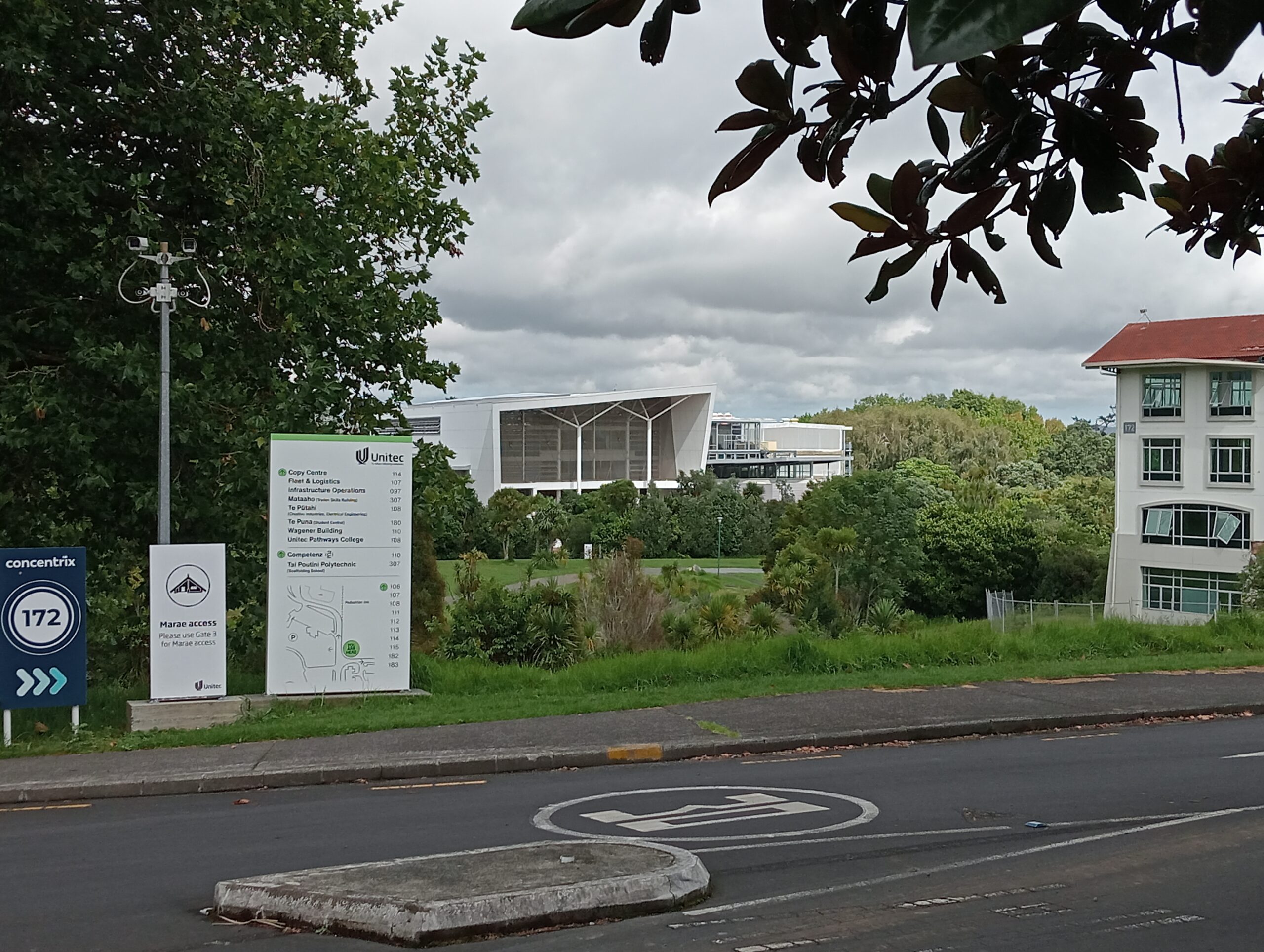
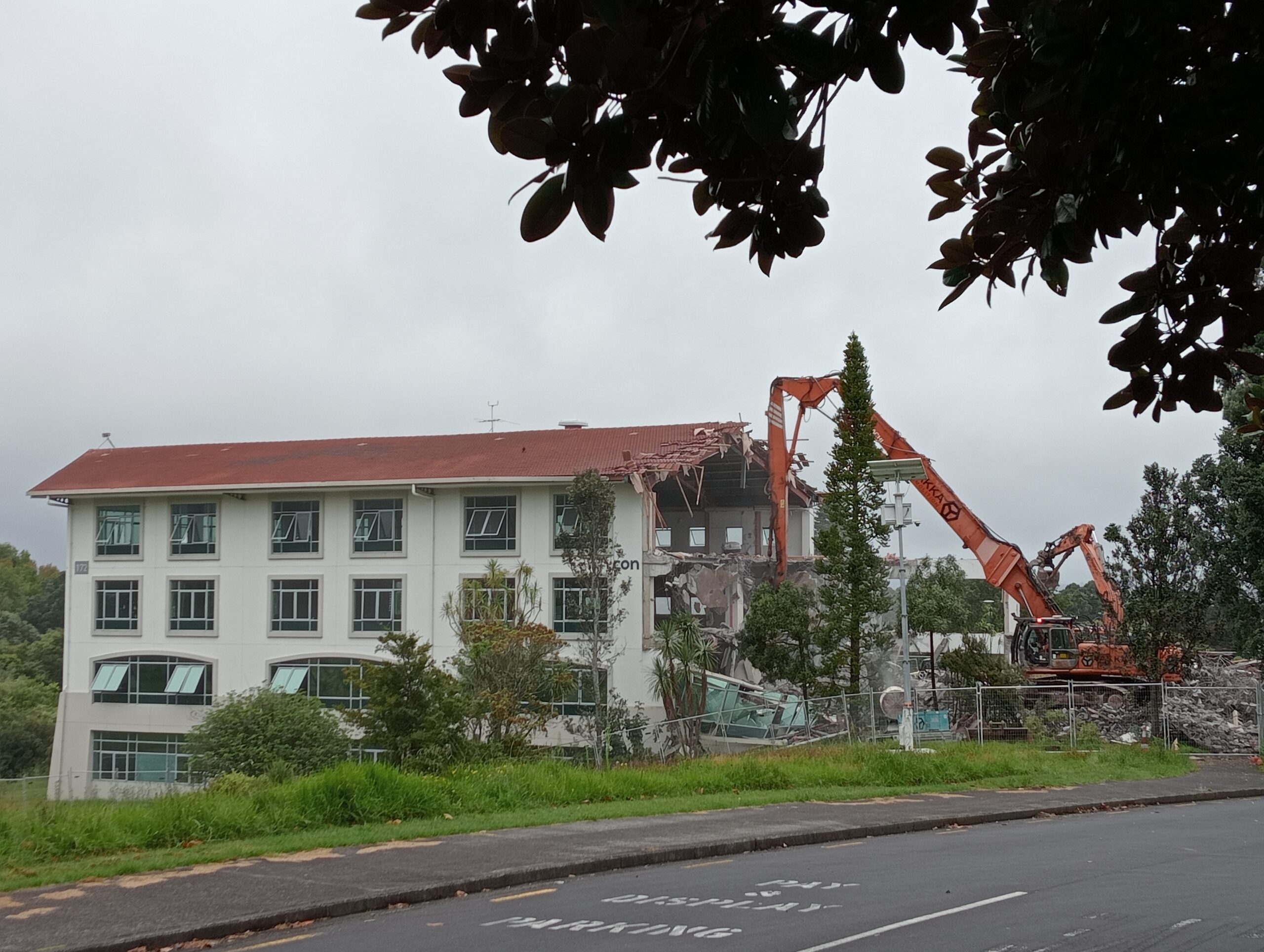
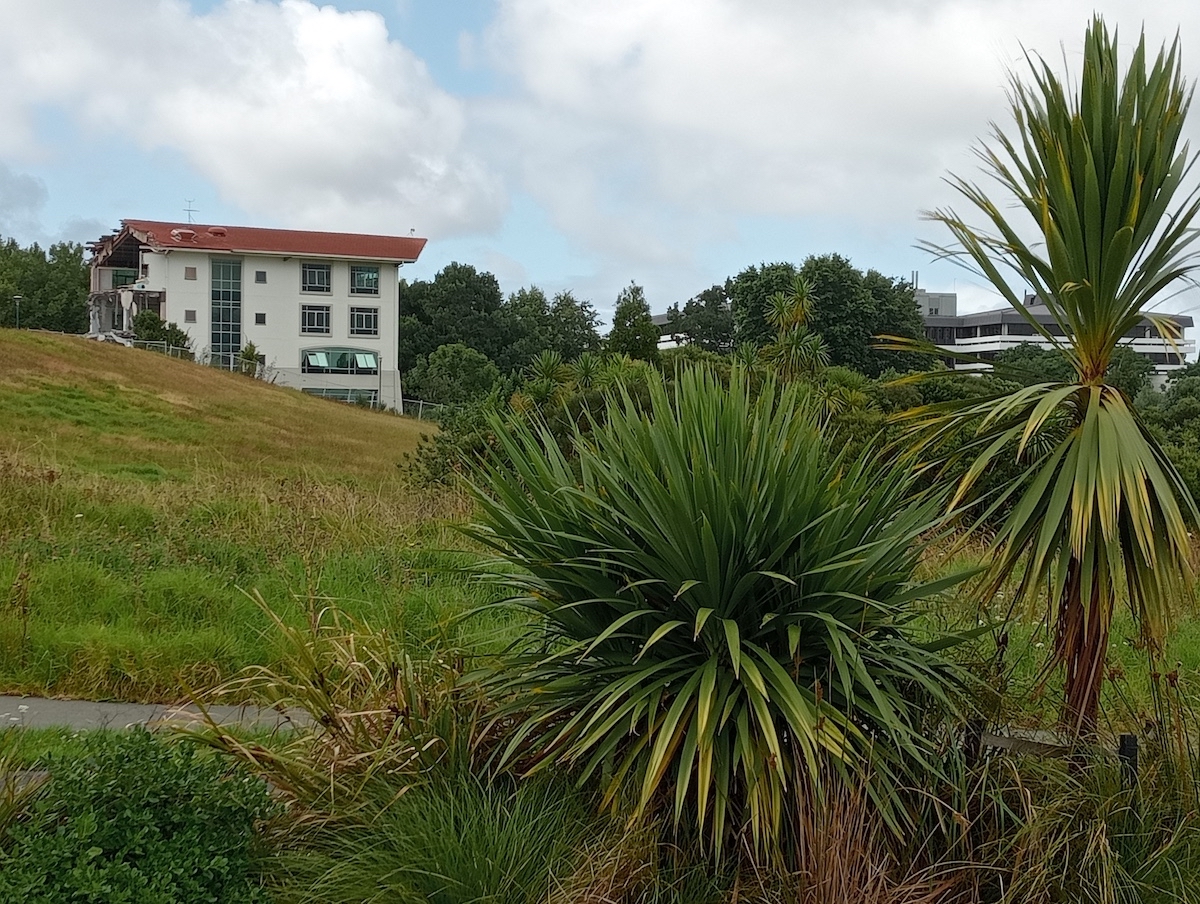
A great academic campus? But note the roof of the Concentrix building.
Photo by Keith Rankin.
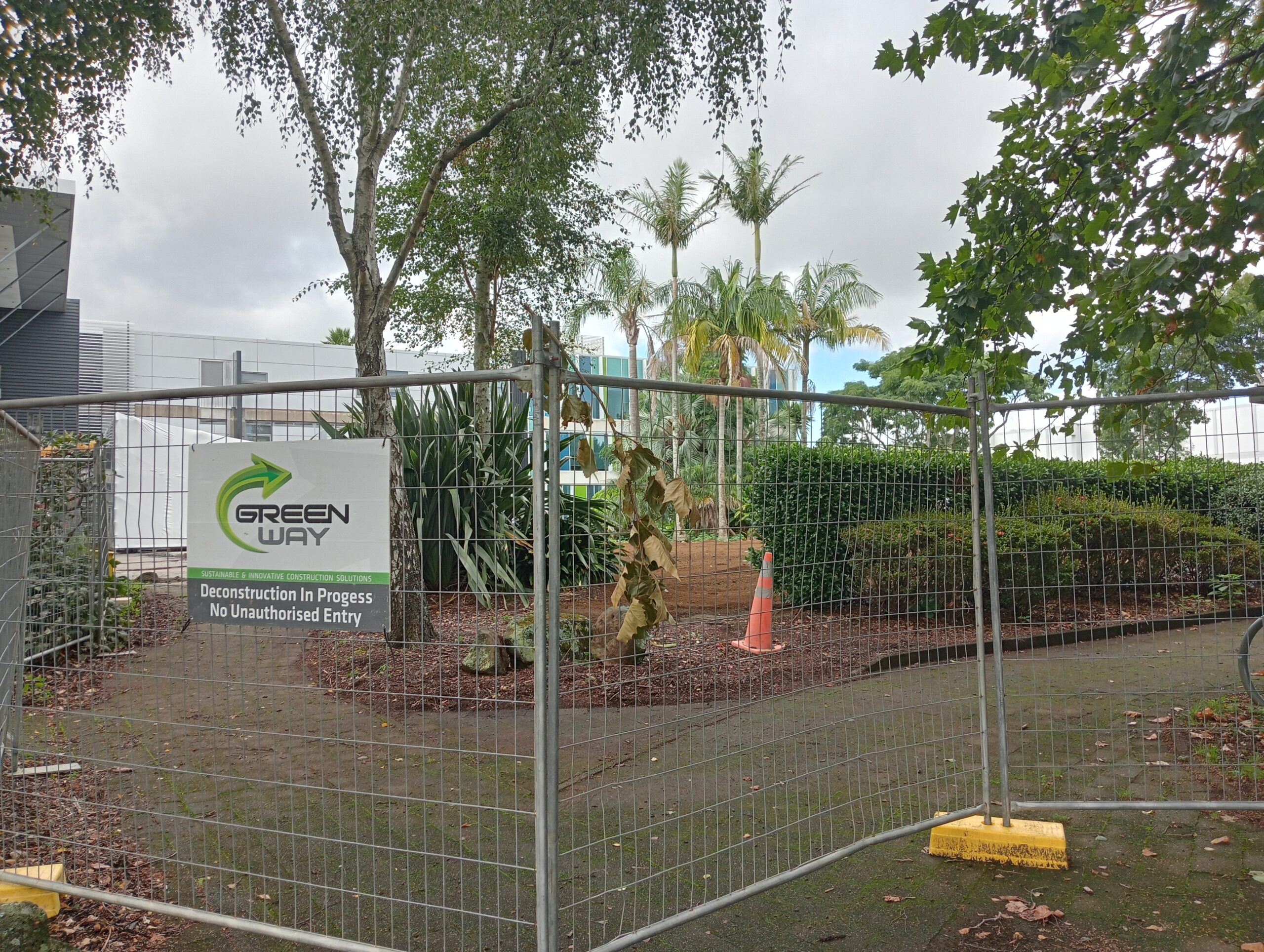
A Green Way?
Photo by Keith Rankin.
Or was it the 1990s’-built Languages Building?
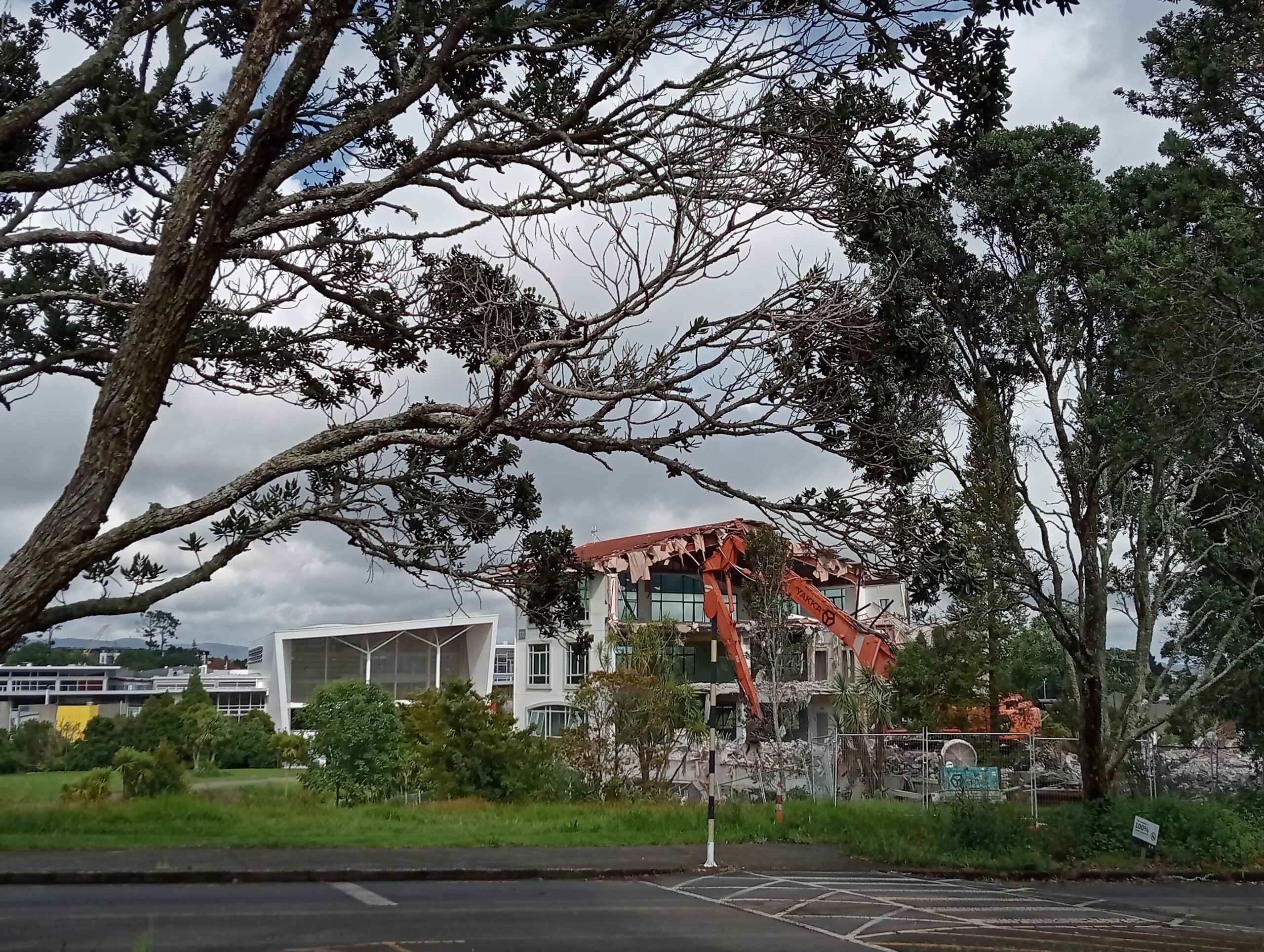
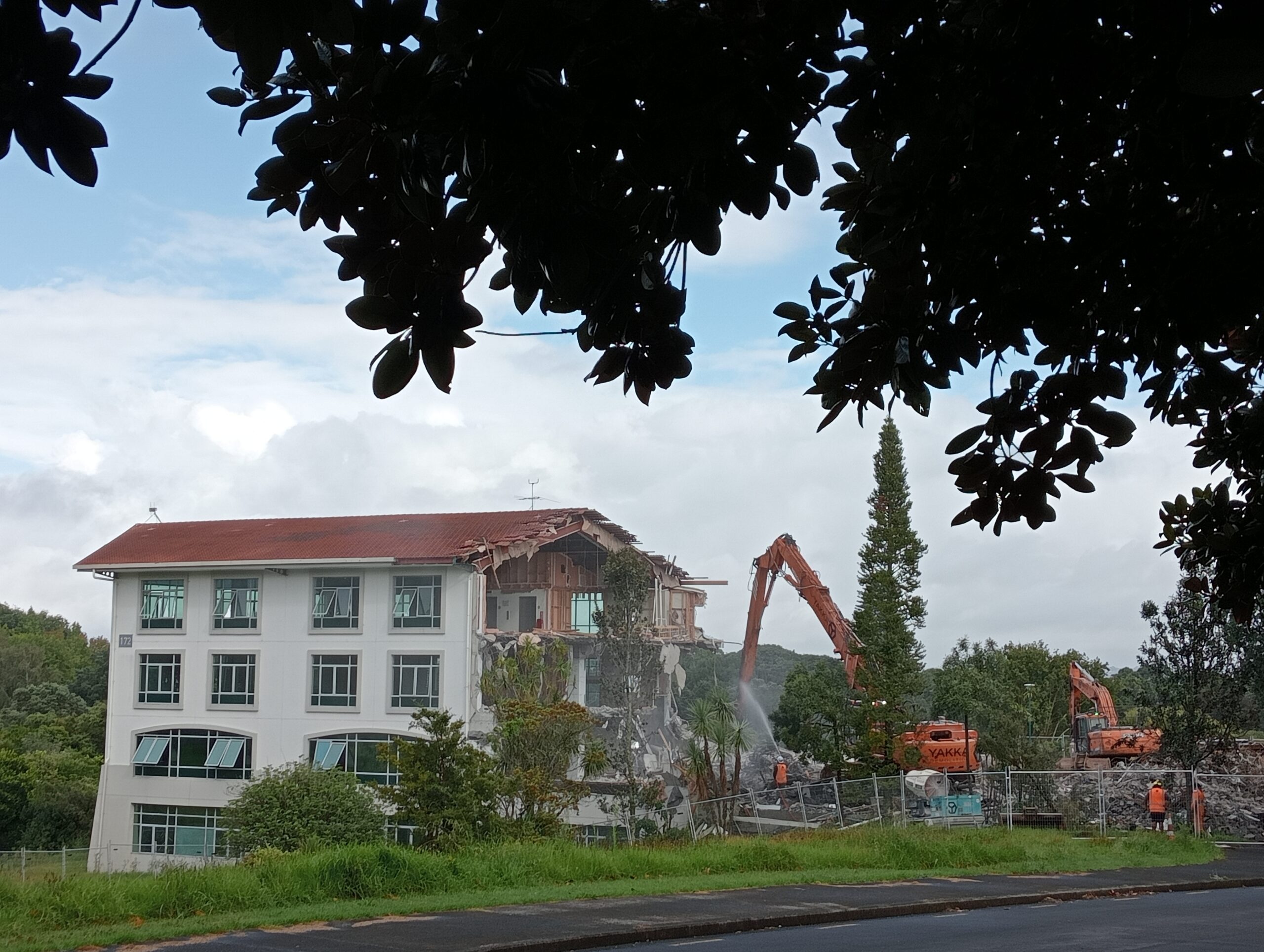
Whoops, there goes Concentrix!
Photo by Keith Rankin.
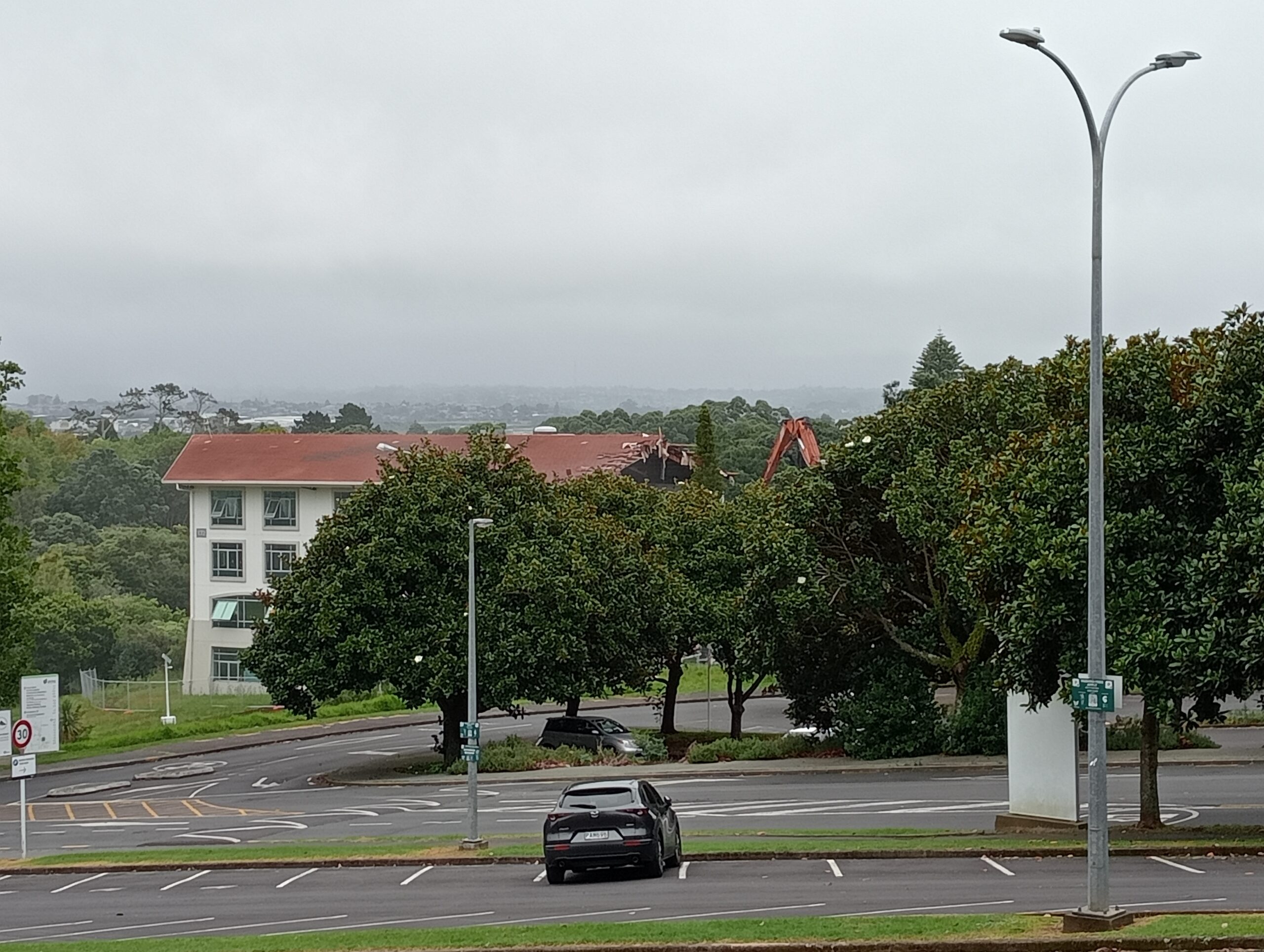
Hard Yakka. Auckland’s answer to the Christchurch Cathedral
Photo by Keith Rankin.Photo by Keith Rankin.
Two days before present
The Martians have landed:
Photo by Keith Rankin.Photo by Keith Rankin.
One Day before present: going, going, …
Photo by Keith Rankin.Photo by Keith Rankin.
Unitec Stadium and Gymnasium (and there were state-of-the-art Squash Courts with a café popular with business staff and students). Once the home of Auckland basketball and netball. And the Auckland Blues – and business staff – trained at the gym, not so long ago.
Photo by Keith Rankin.
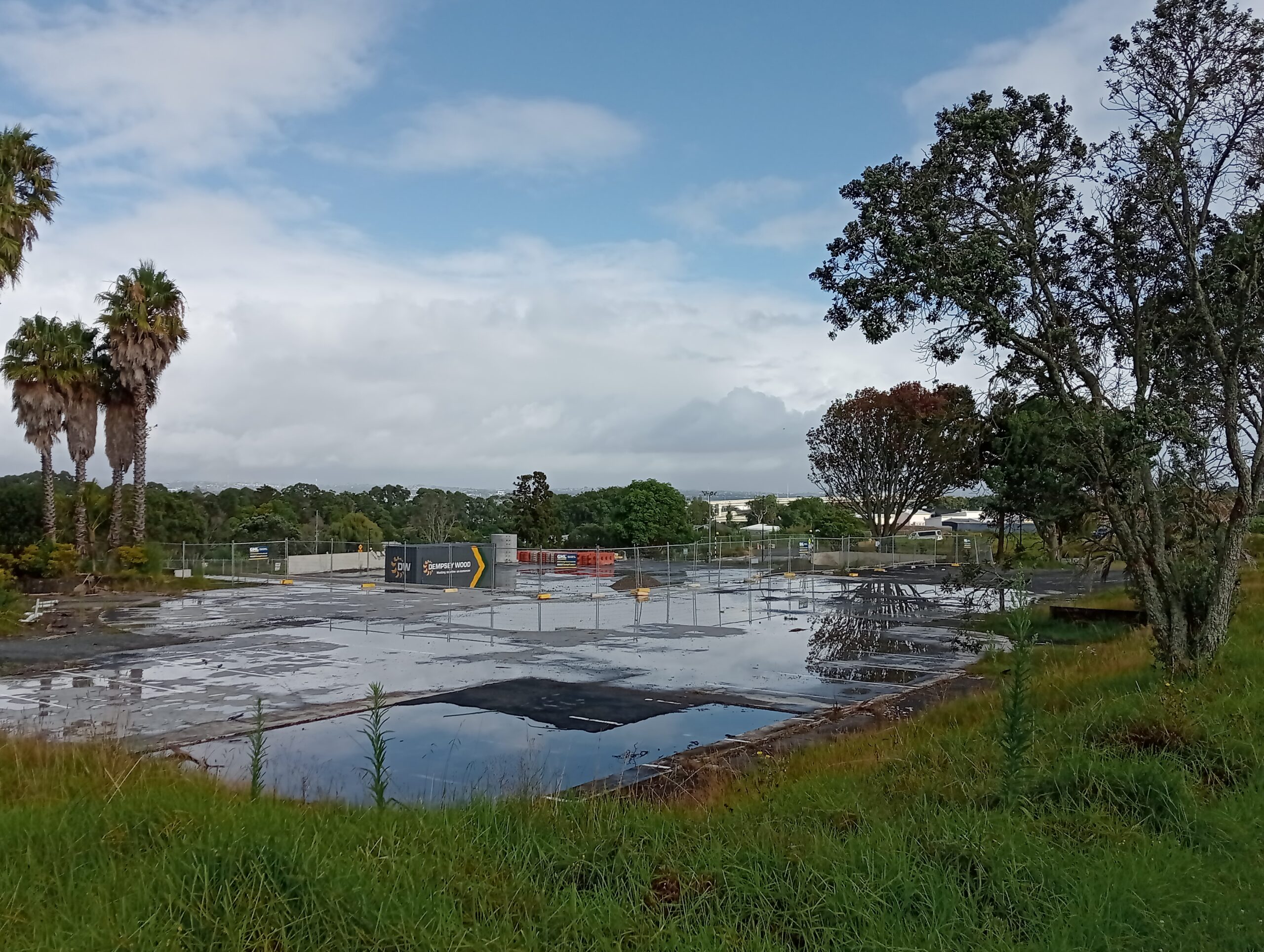
Back to today:
Photo by Keith Rankin.
Ouch, from late 2006 to early 2014 that was my modern state-of-the art workplace and teaching place!
Literally the home of the Schools of Communications and Business. Over those years, I had three offices in that building, and many great memories; and sad memories, too, losing two colleagues.
Photo by Keith Rankin.
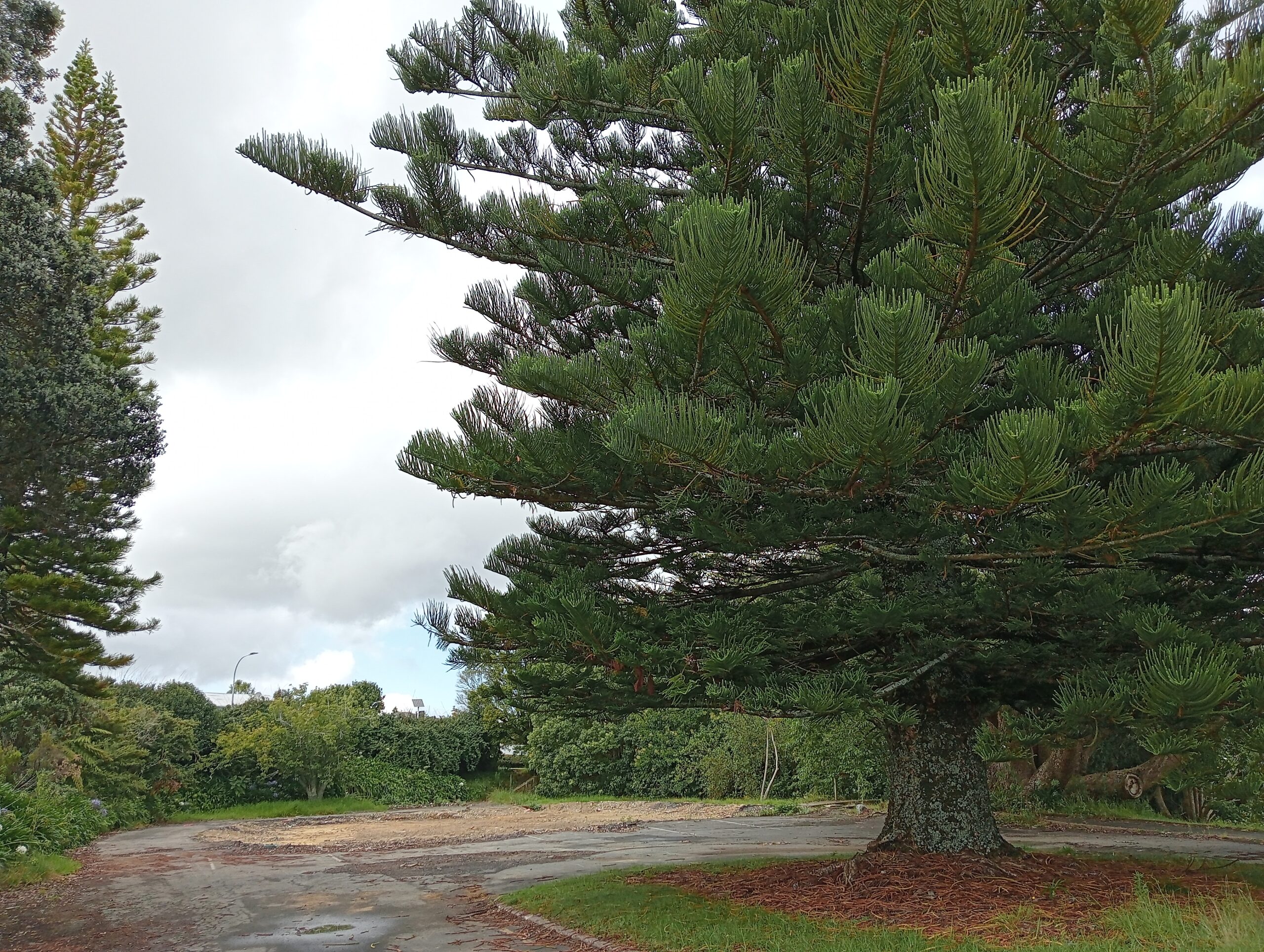
Near the Carrington Campus main entrance on Carrington Road South; erasing 1900s’ as well as 1990s’ history.
(Who today knows where ‘norfolk pines’ originated? Hint, it’s a place not far away which been erased from our travel maps, despite being a Unesco World Heritage site. I was lucky enough to fly there from Auckland in 2024, when it was still possible. One of these trees is the signature tree at the Waitangi Treaty Grounds.)
See this and other easily googled material about Robyn Hyde’s 1930s’ sanctuary. Fortunately, local MP Helen White was able to save a few heritage mementos from the house, just in the nick of time.
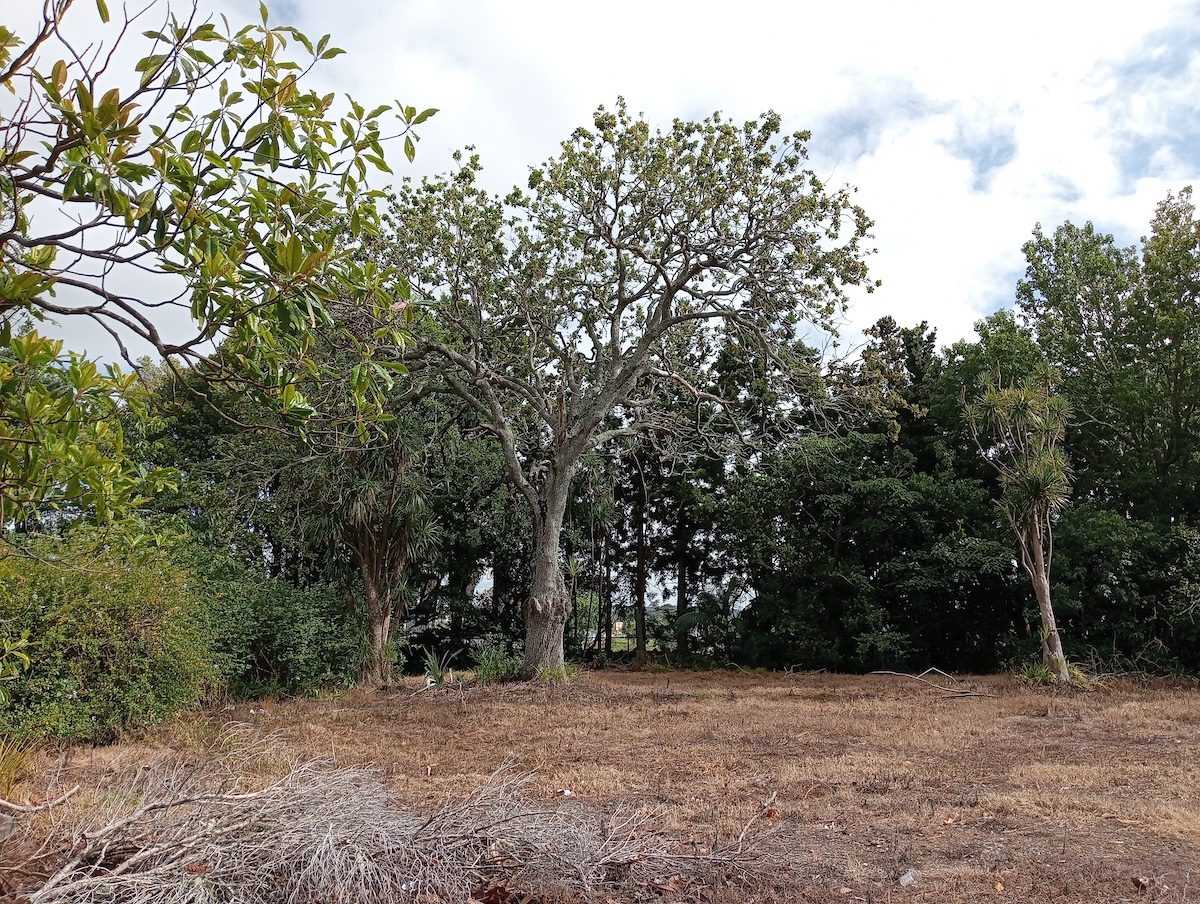
Is that an oak tree? Sadly the Unitec Arboretum and Sanctuary Gardens have also gone. At least there are still oaks and norfolks in the Carrington precinct.
Oakridge House became the main sanctuary (especially 2017 to 2019) for the School of Business in the years after Unitec’s flagship business building was tenanted to IBM (in 2012, in an opaque high-level deal) and soon after was abandoned by IBM and became the Concentrix Call Centre. (I understand that the aim of the 2012 eviction was for Unitec to make money through renting out some of its key assets to lucrative high-tech tenants; the template was the University of Ballarat in Australia, with QUT Kelvin Grove being the template for a high level tertiary campus without being ‘saddled with’ heritage and green spaces which government accounts would construe as a ‘lazy asset’.)
There are very few photos of Oakridge House in the public domain; Unitec itself has been remiss in this aspect of the documentation of its past. Here is one poignant photo that I found, in an advertisement labelled “chimney demolition”.
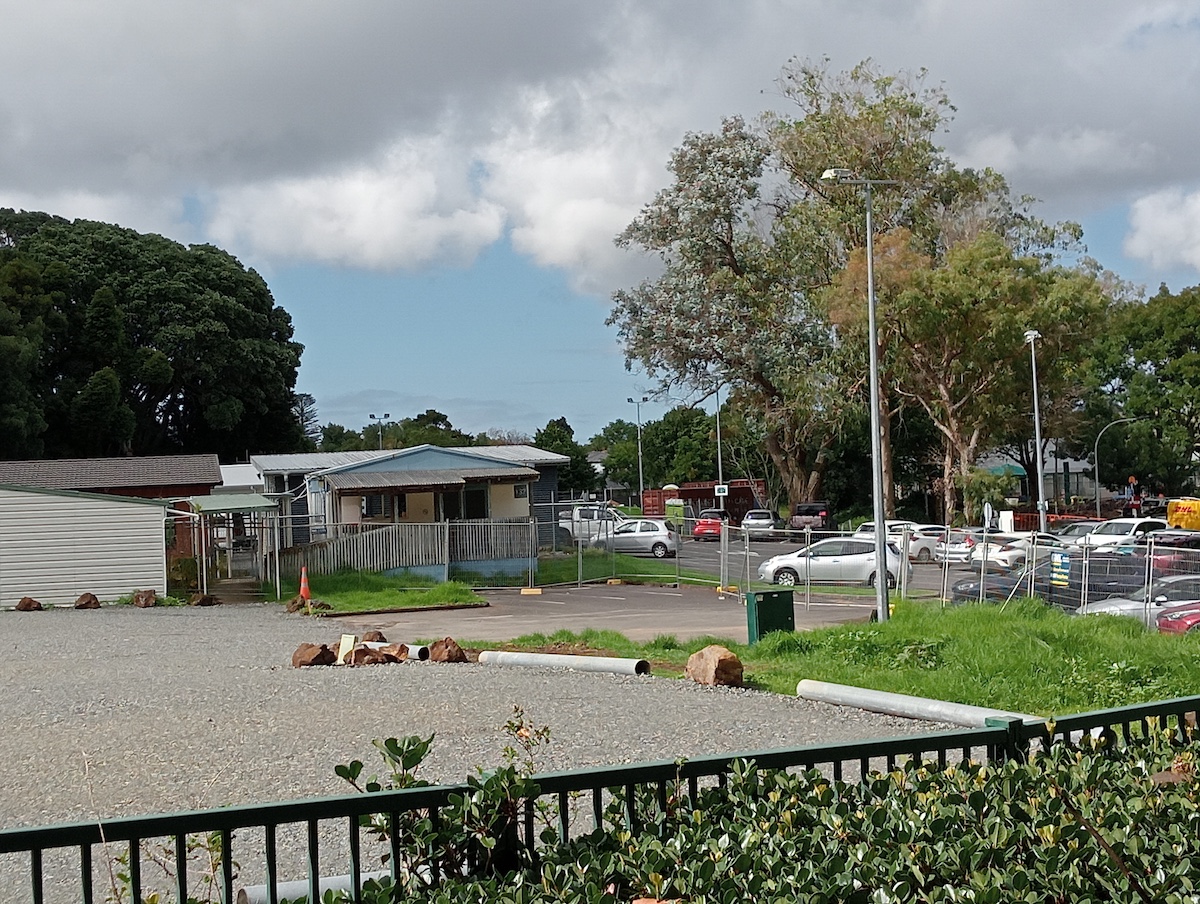
Finally, below, is the former Childcare Centre and another former workplace. (My son attended the demolished childcare centre in the foreground. He was proud to have been a ‘Unitec student’. My 2016 office was in the former building in the distant background.)
Photo by Keith Rankin.
Unitec has now formally merged with Manukau Institute of Technology. It is reputedly going to become a site for city edge tenement housing; some of it, but not all, ‘social housing’. The precinct will need schools, given that nearby schools Gladstone Primary and Mount Albert Grammar are amongst the most oversubscribed schools in the country. It takes little imagination to see that the remnants of Unitec at Mt Albert eventually will become a school (or schools), and that the ongoing Unitec presence of the new Tamaki Institute of Technology (it will probably be called something else) will be at the Henderson ‘campus’, a highrise sandwiched between the Waitakere District Court and the Henderson Library.
Q How do you acquire a small Polytech? A. Establish a large Polytech, then wait.
Keith Rankin (keith at rankin dot nz), trained as an economic historian, is a retired lecturer in Economics and Statistics. He lives in Auckland, New Zealand.
ER Report: Here is a summary of significant articles published on EveningReport.nz on February 5, 2026.
Milan Cortina Winter Olympics: history, new events and Australian medal chances Source: The Conversation (Au and NZ) – By Vaughan Cruickshank, Senior Lecturer in Health and Physical Education, University of Tasmania This year’s Winter Olympics will be held in northern Italy, starting on Friday. They will be the most spread out in history: the two main competition sites – Milan and the winter resort of Cortina
Big tech companies are still failing to tackle child abuse material online Source: The Conversation (Au and NZ) – By Joel Scanlan, Adjunct Associate Professor, School of Law; Academic Co-Lead, CSAM Deterrence Centre, University of Tasmania In the 2024–25 financial year alone, the Australian Centre to Counter Child Exploitation received nearly 83,000 reports of online child sexual abuse material (CSAM), primarily on mainstream platforms. This was a
This central Auckland cottage tells a remarkable tale of the city’s bicultural history Source: The Conversation (Au and NZ) – By Ahmed Uzair Aziz, PhD Candidate in Māori Studies, University of Auckland, Waipapa Taumata Rau Rose Davis, CC BY-NC-ND This story begins with a 160-year-old cottage, sited in a vortex of overlapping histories, and becomes the tale of a city itself. The green and cream weatherboard house at
French shrug off cocaine case costs with new smugglers ‘strategy’ SPECIAL REPORT: By Jason Brown Fast-paced electronic music pumps in the background as a rapid montage of moving images flash across the screen. In a 20 second video, French sailors hunker down in an inflatable speeding over swells. Another sailor, in bright red shorts, is lowered from a helicopter onto the vessel’s back deck. Captured
Indigenous and Pacific leaders unite at Waitangi with shared messages on ocean conservation By Coco Lance, RNZ Pacific digital journalist As Waitangi Day commemorations continue drawing people from across Aotearoa and around the world to the Bay of Islands, Te Tii Marae has become a gathering point for Indigenous ocean leadership from across the Pacific. Taiātea: Gathering of the Oceans held its public forum yesterday, uniting more than
One family’s ocean paddle almost ended in tragedy. It reminds us coastal weather is notoriously changeable Source: The Conversation (Au and NZ) – By Samuel Cornell, PhD Candidate in Public Health, School of Population Health, UNSW Sydney Fernando Garcia/Unsplash The extraordinary rescue this week in Geographe Bay, Western Australia has been described as heroic. A 13-year-old boy swam four hours to shore in rough seas after his family was swept far
In the Australian outback, we’re listening for nuclear tests – and what we hear matters more than ever Source: The Conversation (Au and NZ) – By Hrvoje Tkalčić, Professor, Head of Geophysics, Director of Warramunga Array, Australian National University ANU Media Tyres stick to hot asphalt as I drive the Stuart Highway from Alice Springs northward, leaving the MacDonnell Ranges behind. My destination is the Warramunga facility, about 500 kilometres north – a
Digital ghosts: are AI replicas of the dead an innovative medical tool or an ethical nightmare? Source: The Conversation (Au and NZ) – By Jon Cornwall, Senior Lecturer and Education Adviser, University of Otago Elise Racine, CC BY-NC-ND For centuries, work with donated bodies has shaped anatomical knowledge and medical training. Now, digital technologies and artificial intelligence (AI) are reshaping education and we can imagine a future where AI-generated representations of
Can One Nation turn its polling hype into seats in parliament? History shows it will struggle Source: The Conversation (Au and NZ) – By Kurt Sengul, Research fellow, Far-Right Communication, Macquarie University One Nation is no stranger to the headlines, but it’s been a long time since the party has been talked about as a serious political force. Operating on the fringes of Australian political life for years, suddenly Pauline Hanson
The ‘hot flush gold rush’: how women feel about being flooded with menopause marketing Source: The Conversation (Au and NZ) – By Samantha Thomas, Professor of Public Health, Deakin University Every person with functioning ovaries will eventually experience menopause. While the biology is relatively universal, the experience varies dramatically between individuals and in the same person over time. Menopause has long been shrouded in stigma and shame but recently
School breaks make up more than an hour of the day. Should they be considered part of learning? Source: The Conversation (Au and NZ) – By Brendon Hyndman, Associate Professor of Education and Associate Dean (Academic), Faculty of Arts and Education, Charles Sturt University Johnny Greig/ Getty Images Most public debate about schooling focuses on what happens inside the classroom – on lessons, tests and academic results. But students also spend significant time
City skylines need an upgrade in the face of climate stress Source: The Conversation (Au and NZ) – By Mohamed Shaheen, Lecturer in Structural Engineering, Loughborough University The downtown district of Hong Kong city. Lee Yiu Tung/Shutterstock When structural engineers design a building, they aren’t just stacking floors; they are calculating how to win a complex battle against nature. Every building is built to withstand a
What will a rebuilt Gaza look like? The competing visions for the Strip’s future Source: The Conversation (Au and NZ) – By Timothy J. Dixon, Emeritus Professor in the School of the Built Environment, University of Reading; University of Oxford A girl walks along a street in Gaza to get food during the war between Hamas and Israel. Jaber Jehad Badwan / Wikimedia Commons, FAL Following a visit to
Why cheaper power alone isn’t enough to end energy poverty in summer Source: The Conversation (Au and NZ) – By Duygu Yengin, Associate Professor of Economics, Adelaide University Declan Young/Unsplash Australia is an energy superpower. We have abundant natural resources, high average incomes and one of the highest per-capita rates of rooftop solar uptake in the world. Yet every summer, many households across the country skimp on
AC/DC in surgery and lo-fi beats in the office: what the science says about working to music Source: The Conversation (Au and NZ) – By Emery Schubert, Professor, Empirical Musicology Laboratory, School of the Arts and Media, UNSW Sydney Vitaly Gariev/Unsplash Phil is in prep for surgery. As the anaesthetic is about to be administered, the anaesthetist says: “Oh, and by the way, during the procedure the surgical team will be listening
West Papua Solidarity Forum, mini film festival aim to educate Asia Pacific Report A two-day West Papua Solidarity Forum and mini film festival is being held in Auckland Tāmaki Makaurau next month featuring West Papuan and local academics, advocates and journalists. Hosted by West Papua Action Tamaki and West Papua Action Aotearoa, keynote speeches, panels and discussion on the opening day, March 7, will focus
Politics with Michelle Grattan: Barnaby Joyce on getting on with Pauline Hanson and One Nation’s rise Source: The Conversation (Au and NZ) – By Michelle Grattan, Professorial Fellow, University of Canberra Barnaby Joyce’s political career has hit the highest of highs and the lowest of lows. He’s been Nationals leader and deputy prime minister twice. As a senator, he was a maverick, often crossing the floor. As party leader, he had
New Zealand holds out hope for halted PNG electrification aid project By Johnny Blades, RNZ Pacific bulletin editor The New Zealand government says it hopes an electrification aid project that was halted in Papua New Guinea can still be completed if security improves. Work on the Enga Electrification Project in PNG’s Enga province has stopped due to ongoing violence around the project area in Tsak Valley.
Victoria’s mountain ash forests naturally thin their trees. So why do it with machines? Source: The Conversation (Au and NZ) – By Elle Bowd, Research Fellow, Fenner School of Environment and Society, Australian National University David Clode/Unsplash, CC BY-ND There has been much global discussion about the best ways to manage Earth’s forests in an era of climate change and more frequent bushfires. Some foresters and forest managers support
‘Journalism is not a crime’ – US journalists arrested for covering anti-ICE protest in church Report by Dr David Robie – Café Pacific. – AMY GOODMAN: We begin today’s show looking at the arrests of two American journalists for covering a protest at the Cities Church [in the Minnesota Twin City of] St Paul, where a top ICE official serves as pastor. Former CNN anchor Don Lemon and independent journalist
This year’s Winter Olympics will be held in northern Italy, starting on Friday.
They will be the most spread out in history: the two main competition sites – Milan and the winter resort of Cortina d’Ampezzo – are more than 400 kilometres apart.
Events are organised into broad categories, including ice sports (such as figure skating and curling), skiing and snowboarding (including moguls and halfpipe), Nordic events (such as cross-country and ski jumping) and sliding events (including skeleton and luge).
For the Milan Cortina games, the program has added eight new events designed to increase variety and genderparity.
The most significant addition is the sport of ski mountaineering, often referred to as “skimo”.
The sport requires competitors to ski uphill, transition to walking up steep climbs and then descend on skis.
The program will be the most gender-balanced winter games to date, with 47% women participation mainly thanks to the introduction of women’s double luge and a women’s large hill event in ski jumping.
Following the success of these events, and support from the father of the modern Olympics Baron Pierre de Coubertin, the International Olympic Committee (IOC) decided to hold a separate winter competition in 1924.
Since then, Australia has competed in every Winter Olympics and its team has grown from one athlete in 1936 to more than50 in recent games.
Speed skater Colin Coates has represented Australia at the most winter games: six times between 1968 and 1988.
It took 58 years for Australia to claim its first Winter Olympic medal in 1994. Steven Bradbury, Richard Nizielski, Andrew Murtha and Kieran Hansen won bronze in the 5,000m short track speed skating relay.
Bradbury also famously won Australia’s first Winter Olympic gold medal in the 1,000m speed skating in 2002.
Australia has won 19 Winter Olympic medals, including six gold.
It has achieved most success in freestyle skiing events such as aerials and mogul, led by multiple medal winners Alisa Camplin and Lydia Lassila.
Australia’s medal chances in 2026
Australia heads into these games with realistic medal chances in a small number of sports where it has consistently punched above its weight. This may seem surprising for a country better known for beaches than snow but targeted investment and athlete pathways have paid off.
Australia’s strongest gold medal hope is in freestyle skiing moguls, a fast downhill event where athletes ski over steep bumps while performing two jumps.
Jakara Anthony, who won gold in Beijing in 2022, has dominated international competitions since then, regularly winning World Cup events – the highest level of competition outside the Olympics.
Aerial skiing has also emerged as a genuine medal opportunity for Australia.
Laura Peel has continued her strong international form with recent World Cup gold, while Danielle Scott has also topped the podium this season.
With two athletes consistently winning at the highest level outside the Olympics, Australia is a genuine podium contender in this discipline.
Snowboarding also offers strong chances.
In snowboard halfpipe, riders launch out of a giant ice channel and perform aerial tricks while being judged on height, difficulty and style. Scotty James has been among the world’s best for almost a decade and has won multiple World Championship medals.
Australia is also building serious depth through younger athletes such as Valentino Guseli, who has already claimed World Cup gold and is emerging as a genuine podium contender.
In women’s monobob, Bree Walker’s recent World Cup gold shows Australia is now a genuine contender in one of the games’ newer disciplines.
In skeleton, where athletes race head-first down an icy track at speeds exceeding 120 kilometres per hour, Jaclyn Narracott won silver in 2022 – Australia’s first sliding sport medal. Another podium finish is possible for her.
Beyond these core medal prospects, sports such as short track speed skating could also feature in Australia’s medal mix if athletes peak at the right time, with potential for 2026 to rival Australia’s most successful Winter Olympics to date.
The authors do not work for, consult, own shares in or receive funding from any company or organisation that would benefit from this article, and have disclosed no relevant affiliations beyond their academic appointment.
The street was named after Colonel Robert Henry Wynyard, the commanding officer of British armed forces in the 1850s and acting Governor of New Zealand for a year.
Wynyard lived among other colonial officers in Officials Bay, which was visible from Wynyard Street back then. The Māori name for the bay is Te Hororoa, the “slipping away”.
It was a short stroll from Wynyard Street to Te Hororoa before extensive land reclamation between the 1870s and 1920s. Now, the shoreline is covered in asphalt and named Beach Road.
Despite the massive changes in the area over the past 160 years, stories have surfaced from the earth beside the cottage on Wynyard Street.
Lost history and reclaimed land
Around 2007, when buildings to the south of the cottage were demolished to make way for the university’s business school, an archaeological team found a midden containing traces of earlier Māori life: obsidian flakes, chert and greywacke tools, and a bird-bone awl that may have been used to make dog-skin cloaks.
The archaeologists noted that Te Reuroa pā once stood at the top of Constitution Hill, near where the Auckland High Court now stands.
In nearby Albert Park, there was also a significant settlement, the Ngāti Whātua kāinga (village) of Rangipuke, and a fortified pā called Te Horotiu.
Māori are believed to have valued the hilltop because the elevated site was good for growing crops and easy to defend, while two freshwater streams ran into the bays below.
In the 1840s, British military barracks were built at what became Albert Park. Albert Barracks grew to a nine-hectare military compound, which the early British used to secure their position against Māori.
Part of the basalt wall that once circled Albert Barracks still snakes through the university grounds.
Before European histories begin, the whenua (land) beside the cottage might have been used by Māori for preparing flax and food, and making garments.
The earth under our feet is full of fragments. But it’s difficult to reclaim the past in this part of Auckland because reclaiming land for a new shoreline involved digging up hills where Māori once lived and worked.
Parts of Tāmaki Makaurau were flattened beyond recognition, then concreted over in the process of becoming Auckland city.
The Wynyard Street cottage has also changed over the years. It was restructured in the 1920s by Malcolm Draffin, one of the architects of the Auckland War Memorial Museum in the nearby Domain.
The cottage in 1965 during its brief era as the Vivien Leigh Theatre. Anton Estie/University of Auckland, CC BY-NC-ND
The house later glimpsed the limelight during a brief season when it became a theatre. British movie star Vivien Leigh (who played Scarlett O’Hara in Gone with the Wind) visited in 1962 and the venue was named in her honour.
But the owner and manager of the Vivien Leigh Theatre was jailed for his homosexuality and the theatre doors slammed shut before a single show was staged.
Later in the 1960s, the university bought the building. Education and anthropology departments took over the space until it became a Māori research centre in 1993.
The official opening of the James Henare Research Centre in 1994. University of Auckland, CC BY-NC-ND
A door to the past and future
By a curious coincidence, the James Henare Research Centre is named after Sir James Henare, the great-grandson of Colonel Robert Henry Wynyard.
But hold on for a plot twist.
Sir James was the son of Taurekareka Henare, whose father Henare Wynyard was the son Robert Wynyard had fathered out of wedlock with a Maōri woman.
Taurekareka changed the family name from Wynyard to his father’s Christian name, Henare, as a means of aligning with his whakapapa (genealogy), which led back to the great warriors Kāwiti and Hone Heke.
In 1845, Taurekareka’s grandfather Robert Wynyard had fought in the British army that attacked Ruapekapeka pā in Northland. The Māori defending the pā included Kāwiti and Hone Heke.
That left Taurekareka looking back at a history in which his ancestors did battle. He chose the Māori side when he dropped the surname Wynyard and became a Henare.
Taurekareka’s son James (later Sir James) was a Ngāti Hine rangatira (chief) born in the Bay of Islands. He served as commanding officer in the Māori Battalion in World War II and later became a champion of Māori education and the kōhanga reo movement.
Sir James Henare with Queen Eizabeth II in February 1963 during the 123rd anniversary celebration of the signing of te Tiriti o Waitangi. Henare Whānau Archive, CC BY-NC-ND
A man of great mana, he helped Ngāti Whātua Orākei during their Waitangi Tribunal claim in the 1980s. After he died in 1989, Ngāti Whātua leaders asked if his name might be given to the new centre.
Thus the name Henare returned to claim ground on Wynyard Street. Sir James’ son, Bernard Henare, is now chair of the centre.
In the 1990s, Ngāti Porou master carver Pakaariki Harrison created two pou and a lintel for the entrance to the centre.
The whakairo (carving) physically and symbolically transformed the house into a whare for its official opening in 1994. Several years ago, the pou were removed for restoration by Pakaariki’s son, Fred Harrison. The carvings will be returned to cloak the whare early in 2026.
Number 18 Wynyard Street is shrouded in layers of the past that build to the future. Maybe one day its doors will open onto Henare Street instead.
Ahmed Uzair Aziz has worked as a researcher and administrator at the James Henare Research Centre. He is a recipient of the University of Auckland Doctoral Scholarship.
Source: The Conversation (Au and NZ) – By Joel Scanlan, Adjunct Associate Professor, School of Law; Academic Co-Lead, CSAM Deterrence Centre, University of Tasmania
In the 2024–25 financial year alone, the Australian Centre to Counter Child Exploitation received nearly 83,000 reports of online child sexual abuse material (CSAM), primarily on mainstream platforms. This was a 41% increase from the year before.
It is in this context of child abuse occurring in plain sight, on mainstream platforms, that the eSafety Commissioner, Julie Inman Grant, requires transparency notices every six months from Google, Apple, Microsoft, Meta and other big tech firms.
The latest report, published today, shows some progress in detecting known abuse material – including material that is generated by artificial intelligence (AI), live-streamed abuse, online grooming, and sexual extortion of children and adults – and reducing moderation times.
However, the report also reveals ongoing and serious safety gaps that still put users, especially children, at risk. It makes clear that transparency is not enough. Consistent with existing calls for a legally mandated Digital Duty of Care, we need to move from merely recording harms to preventing them through better design.
But the new eSafety “snapshot” shows an ongoing gap between what technology can do and what companies are actually doing to tackle online harms.
One of the positive findings is that Snap, which owns SnapChat, has reduced its child sexual exploitation and abuse moderation response time from 90 minutes to 11 minutes.
Microsoft has also expanded its detection of known abuse material within Outlook.
However, Meta and Google continue to leave video calling services such as Messenger and Google Meet unmonitored for live-streamed abuse. This is despite them using detection tools on their other platforms.
The eSafety report highlights that Apple and Discord are failing to implement proactive detection, with Apple relying almost entirely on user reports rather than automated safety technology.
Apple, Discord, Google’s Chat, Meet and Messages, Microsoft Teams, and Snap are not currently using available software to detect the sexual extortion of children.
The biggest areas of concern identified by the commissioner are live video and encrypted environments. There is still insufficient investment in tools to detect live online child sexual exploitation and abuse. Despite Skype (owned by Microsoft) historically implementing such protections before its closure, Microsoft Teams and other providers still fail to do so.
Alongside the report, eSafety launched a new dashboard that tracks the progress of technology companies.
The dashboard highlights key metrics. These include the technologies and data sources used to detect harmful content, the amount of content that is user reported (which indicates automated systems did not catch it), and the size of the trust and safety workforce within the companies.
The new dashboard provides an interactive summary of the transparency notices. This table shows which technology platforms are using tools to detect child abuse and exploitation within live streams. eSafety Commissioner
How can we improve safety?
The ongoing gaps identified by the eSafety Commissioner show that current reporting requirements are insufficient to make platforms safe.
The industry should put safety before profit. But this rarely happens unless laws require it.
This would make tech companies legally responsible for showing their systems are safe by design before launch. Instead of waiting for reports to reveal long-standing safety gaps, a duty of care would require platforms to identify risks early and implement already available solutions, such as language analysis software and deterrence messaging.
Beyond detection: the need for safety
To stop people from sharing or accessing harmful and illegal material, we also need to focus on deterrence and encourage them to seek help.
This is a key focus of the CSAM Deterrence Centre, a collaboration between Jesuit Social Services and the University of Tasmania.
Working with major tech platforms, we have found proactive safety measures can reduce harmful behaviours.
Such messages can be triggered when new or previously known abuse material is shared, or a conversation is detected as sexual extortion or grooming. In addition to blocking the behaviour, platforms can guide users to seek help.
This includes directing people to support services such as Australia’s Stop It Now! helpline. This is a child sexual abuse prevention service for adults who have concerns about their own (or someone else’s) sexual thoughts or behaviours towards children.
Safety by design should not be a choice
The eSafety Commissioner continues to urge companies to take a more comprehensive approach to addressing child sexual exploitation and abuse on their platforms. The technology is already available. But companies often lack the will to use it if it might slow user growth and affect profits.
Transparency reports show us the real state of the industry.
Right now, they reveal a sector that knows how to solve its problems but is moving too slowly.
We need to go beyond reports and strengthen legislation that makes safety the standard, not just an extra feature.
The author acknowledges the contribution of Matt Tyler and Georgia Naldrett from Jesuit Social Services, which operates the Stop It Now! Helpline in Australia, and partners with the University of Tasmania in the CSAM Deterrence Centre.
Joel Scanlan is the academic co-lead of the CSAM Deterrence Centre, which is a partnership between the University of Tasmania and Jesuit Social Services, who operate Stop It Now (Australia), a therapeutic service providing support to people who are concerned with their own, or someone else’s, feelings towards children. He has received funding from the Australian Research Council, Australian Institute of Criminology, the eSafety Commissioner, Lucy Faithfull Foundation and the Internet Watch Foundation.
Fast-paced electronic music pumps in the background as a rapid montage of moving images flash across the screen.
In a 20 second video, French sailors hunker down in an inflatable speeding over swells.
Another sailor, in bright red shorts, is lowered from a helicopter onto the vessel’s back deck. Captured crew with faces blurred are held in a galley, as bags full of drugs are pulled from below deck and loaded onto pallets for lift-off.
“Throwback to the latest drug seizure at sea by the French Navy, as if you were part of it,” reads the social media caption from French armed forces, documenting last month’s drug seizure by the frigate Prairial.
What the video does not show French sailors dropping 4.87 tonnes of cocaine into the ocean near the Tuamotu group, north-east of Tahiti. Tossing drugs overboard may be a time-honoured tactic for drug smugglers at sea — but a new one for authorities.
“This record seizure is a successful outcome of the new territorial plan to combat narcotics developed by the High Commissioner of the Republic in French Polynesia,” reads a statement on their website.
Record seizure — worth at least US$150 million — and record disposal, in record time.
One raising questions worldwide.
Why? “Why won’t France open an investigation after the seizure of these 5 tons of cocaine?” reads the January 20 headline in the French edition of Huffington Post.
Prosecutors in Tahiti emphasised the costs faced by French Polynesia if it were to prosecute all drug traffickers.
Record seizure — worth at least US$150 million — and record disposal, in record time. Image: French Navy screenshot APR
“Our primary mission is to prevent drugs from entering the country and to combat trafficking in Polynesia,” said Public Prosecutor Solène Belaouar. As “more and more traffickers transit through our waters we must address the issue of managing this new flow.”
Belaouar told French media that prosecuting drug cases locally costs 12,000 French Pacific Francs a day, or about US$120 per person.
This new concern about costs came as the French territory winds up another drug trafficking case. Under those estimates, the conviction of 14 Ecuador sailors caught smuggling in December 2024 would represent around US$600,000.
Last Thursday, they had their appeal against trafficking 524 kilos on the MV Raymi dismissed, meaning their jail sentences of six to eight years are confirmed. Costs of this case compare with the US$93 million spent between 2013 and 2017 constructing a new prison, Tatutu de Papeari, with a capacity of 410 inmates in Tahiti.
A question sent via social media about the drug dump went unanswered by ALPACI, Amiral commandant la zone maritime de l’océan Pacifique.
Overall, drug seizures by French forces worldwide have increased dramatically.
A total of 87.6 tons of drugs were seized in 2025 in cooperation with state services, including local police, customs and the French Anti-Drug and Smuggling Office (OFAST), nearing twice the previous record of 48.3 tons set the year before, in 2024.
Those statistics seem unlikely to quieten concerns about the new cost-cutting strategy.
Sunny day Boarded on a sunny day on January 16, the MV Raider carried a crew of 10 Honduran citizens, with one from Ecuador. All faced lengthy jail terms if convicted.
Part of the drug haul on palettes . . . before dumping at sea near the Tuamotu group.Image: French Navy screenshot APR
Instead, French authorities let all 11 go, allowing the crew to resume their journey on the offshore supply ship. That decision contrasts with the high-profile approach sometimes taken when it comes to illegal fishing boats, with many captured and resold or set on fire and sunk at sea.
Dozens of public social media comments in French Polynesia and the Cook Islands questioned the disposal of the drugs at sea, with some calling for the ship’s seizure. Tahiti news media were the first to question the decision to catch and release.
At first, French authorities claimed the seizure took place in international waters or the “high seas”.
Lead prosecutor Belaouar told TNTV that “Article 17 of the Vienna Convention stipulates that the navy can intercept a vessel on the high seas, check its flag of origin, ask the Public Prosecutor, and the High Commissioner is involved in the decision, if they agree that the procedure should not be pursued through the courts, and that it should therefore be handled solely administratively.”
However, TNTV also quoted legal sources as stating the drug seizure of 96 bales took place within the “maritime zone” of French Polynesia.
Ten days after first reports of the seizure, Belaouar was no longer talking about the “high seas”, instead claiming the need for a new strategy to handle drug flows.
The MV Raider carried a crew of 10 Honduran citizens, with one from Ecuador . . . All faced lengthy jail terms if convicted. Image: JB
Drug ‘superhighway’ “The Pacific has become a superhighway for drugs”, Belaouar asserted, adding that “70 percent of cocaine trafficking passes through this route.”
Those differing claims raised questions in Tahiti, and 1100 km to the south-west, when the briefly seized vessel, the MV Raider, turned up off Rarotonga broadcasting a distress signal.
Customs officials told daily Cook Islands News the vessel was reporting engine trouble, and confirmed MV Raider was the same vessel that had been intercepted by French naval forces with the drugs on board.
Live maritime records also show the tug supply boat as “anchored” at Rarotonga.
Aptly named, the Raider caught official attention before passing through the Panama Canal, with a listed destination of Sydney Australia.
Anonymous company Sending a small coastal boat some 14,000 km across the world’s largest ocean drew attention on a route more usually plied by container ships up to nine times longer.
Also raising questions — the identity of the ship owners.
A signed certificate uploaded online by an unofficial source appears to show that the last known ownership traces to an anonymous Panama company named Newton Tecnologia SA.
That name also appears in a customer ranking report from the Panama Canal Authority, with Newton Tecnologia appearing at 541 of 550 listed companies.
Under Panama law, Sociedad Anonomi — anonymous “societies” or companies — do not need to reveal shareholders, and can be 100 percent foreign owned.
A review of various databroker services show one of the company directors as Jacinto Gonzalez Rodriguez.
A person of the same name is listed on OpenCorporates in a variety of leadership roles with 22 other companies in Panama, including engineering, marketing, a “bike messenger” venture, and as treasurer and director for an entity called “Mistic La Madam Gift Shop.”
However, Newton Tecnologia SA does does not show up in the same database, or searches of the country’s official business registry.
A similarly named company is registered in Brazil but is focused on educational equipment, not shipping, with one director showing up in search results at community art events.
‘Dark fleet’ Registered with the International Marine Organisation under call sign 5VJL2, the MV Raider is described as a “Multi Purpose Offshore Vessel” with IMO number: 9032824.
The Togo registration certificate for the MV Raider. Image: JB
Online records indicate that the ship was built in 1991 in the United States, with a “Provisional Certificate of Registry” from the Togo Maritime Authority dated only two months ago, on 19 November 2025. With a declared destination of Sydney, Australia, the Raider and its Togo certificate are valid until 18 May 2026.
According to maritime experts, provisional certification is a red flag that allows what industry sources term the “dark fleet” to exploit open registries. This “allows entry on a temporary basis (typically three to six months) with minimal due diligence pending submission of all documentation,” according to a 2025 review from Windward, a marine risk consultancy.
“Vessels then ‘hop’ to another flag before the provisional period expires.”
Where there’s smoke Windward listed Togo as being among ship registries that flagged ships with little to no oversight, along with Antigua and Barbuda, Azerbaijan, Barbados, Belize, Cameroon, Comoros, Djibouti, Gabon, Guinea-Bissau, Honduras, Hong Kong, Liberia, Mongolia, Oman, Panama, San Marino, São Tomé and Príncipe, St. Kitts and Nevis, Sierra Leone, Tanzania, and Vietnam.
In the Pacific, other registries noted by Windward as failing basic enforcement include Cook Islands, Marshall Islands, Palau, Tuvalu and Vanuatu.
Previously registered in Honduras, the July 2023 edition of the Worldwide Tug and OSV News reports that GIS Marine LLC, a Louisiana company, sold the Raider in 2021 to an “undisclosed” interest in Honduras.
Other records indicate GIS Marine acted as managers but the actual owner was a company called International Marine in Valetta, Malta. The only company with a similar name at that address, International Marine Contractors Ltd, is shown as inactive since 2021.
For now, though, the Raider is among tens of thousands of ships operating worldwide with “provisional certification” — allowing ships to potentially skip regulations requiring expensive maintenance and repair.
That may have been the case for the Raider, with Rarotonga residents filming what one described as “smoke” rising from the ship a day after issuing a distress call.
Where there’s drug smoke, there’s usually a bonfire of questions afterwards.
Including from José Sousa-Santos, associate professor of practice and head of the University of Canterbury’s Pacific Regional Security Hub, who told Cook Islands News that since the vessel was intercepted in French Polynesian waters “it falls under French legal jurisdiction”.
Jason Brown is founder of Journalism Agenda 2025 and writes about Pacific and world journalism and ethically globalised Fourth Estate issues. He is a former co-editor of Cook Islands Press.
As Waitangi Day commemorations continue drawing people from across Aotearoa and around the world to the Bay of Islands, Te Tii Marae has become a gathering point for Indigenous ocean leadership from across the Pacific.
Taiātea: Gathering of the Oceans held its public forum yesterday, uniting more than 20 Indigenous leaders, marine scientists and researchers from Australia, Canada, Cook Islands, Hawai’i, Niue, Rapa Nui and Aotearoa.
The forum forms part of a wider 10-day wānanga taking place across Te Ika a Māui (North Island).
With a focus on the protection and restoration of Te Moana Nui a Kiwa, the Pacific Ocean, kōrero throughout the day centred on the exchange of knowledge, marine protection, ocean resilience and the accelerating impacts of climate change.
A key message remained prevalent throughout the day – the moana is not separate from the people, but a living ancestor, and a responsibility carried across generations.
Taiātea Symposium at Waitangi 2026 . . . a key message remained prevalent throughout the day – the moana is not separate from the people, but a living ancestor. Image: WAI 262 – Kia Whakapūmau/wai262.nz / projects@wai262.nz/RNZ Pacific
‘Continue that path of conservation, preservation’ Hawaiʻi’s Solomon Pili Kaho’ohalahala, co-founder of One Oceania, a former politician, and a respected elder, framed his kōrero around the belief that there is no separation between human and nature — “we are all one”.
For Kaho’ohalahala, being present at Waitangi has been a powerful reminder of the links between past, present, and future.
“Waitangi is a very historical place for the Māori people,” he said. “It is where important decisions were made by your elders.
“So to be here in this place, for me, is significant.”
Solomon Pili Kaho’ohalahala, known as Uncle Sol, on board the Greenpeace ship Arctic Sunrise en route to Kingston, Jamaica, for a summit of the ISA in 2023 . . . “We need to negotiate and navigate the challenges we face in the present.” Image: Martin Katz/Greenpeace/RNZ Pacific
“We are talking about historical events that have happened to our people across Oceania, preserved by the elders who had visions to create treaties . . . decisions that were going to be impactful to the generations to follow,” Kaho’ohalahala said.
“It brings the relevancy of these conversations. They are what we need to negotiate and navigate the challenges we face in the present. The purpose for this is, ultimately, no different to the kupuna (Hawai’ian elder), that this was intended for the generations yet unborn,” he added.
Kaho’ohalahala also reflected on the enduring connections between indigenous communities across oceans.
“To be a part of this conversation from across the ocean that separates us, our connection by our culture and canoes is to help us understand that we are still all connected as the people of Oceania.
“But we need to be able to reiterate that, and understand why we need to emerge from that past to bring it to our relevancy to these times and issues, to continue that path of conservation, preservation, for those unborn.”
‘Our ocean … a living organism,’ advocate says Cook Islands environmental advocate and Ocean Ancestors founder Louisa Castledine reiterated the responsibility of Indigenous peoples to protect the ocean and pass knowledge to future generations.
She said Waitangi was the perfect backdrop to encourage these discussions. While different cultures face individual challenges, there is a collective sense of unity.
“One of our key pillars is nurturing our future tamariki, and the ways of our peu tupuna, and nurturing stewardship and guardianship with them as our future leaders,” Castledine said.
“It’s about reclaiming how we perceive our ocean as being an ancestor, as a living organism, as whānau to us. We’re here at Waitangi to stand in solidarity of our shared ancestor and the responsibility we all have for its protection,” Castledine said.
She said people must be forward-thinking in how they collectively navigate environmental wellbeing.
“We all have a desire and a love for our moana, our indigenous knowledge systems of our oceans are critical to curating futures for our tamariki and mokopuna,” she said.
“We want to ensure that generations that come after us will continue to be able to feed generations beyond all of us. It’s about safeguarding their inheritance.”
Wuikinuxv Nation Chief Councillor Danielle Shaw with the Coastal First Nations Great Bear Initiative . . . “This is [an] opportunity to learn about common challenges we may have.” Image: CFN Great Bear Initiative/RNZ Pacific
Learning about shared challenges Canadian representative Chief Anuk Danielle Shaw, elected chief councillor of the Wuikinuxv Nation, said the challenges and goals facing Indigenous peoples were often shared, despite the distances between them.
“This is [an] opportunity to learn about common challenges we may have, and how other nations and indigenous leaders are facing those challenges, and what successes they’ve been having,” she said.
“It just makes sense that we have a relationship, and that we build that relationship.”
She noted the central role of the marine environment for her people.
“It’s not lost on me that my people are ocean-going people as well. We rely on the marine environment.
“Our salmon is the foundation and the backbone of our livelihood and the livelihood of all other beings in which we live amongst. I’m a world away, and yet I’m still sitting within the Pacific Ocean.
“So the work I do at home and how we take care of our marine environment impacts the people of Aotearoa as well, and vice versa. And so it just makes sense that we have a relationship, and that we build that relationship, because traditionally we did,” she added.
Following the public forum, indigenous leaders will visit haukāinga in the Tūwharetoa and Whanganui regions for further knowledge exchanges and to discuss specific case studies.
This article is republished under a community partnership agreement with RNZ.
A sunrise sets over Te Tii beach as Waitangi commemorations commence. Image: Layla Bailey-McDowell/RNZ
The extraordinary rescue this week in Geographe Bay, Western Australia has been described as heroic. A 13-year-old boy swam four hours to shore in rough seas after his family was swept far from the beach. This boy’s bravery in raising the alarm is to be commended.
For the public, it’s useful to consider how the family found itself in this predicament. The boy’s mother told the ABC the weather conditions had rapidly changed. This is similar to other recent marine rescues.
According to the boy’s mother, conditions were calm when she and her three children set out on inflatable paddle boards and a kayak. But in a short time, strong winds and waves pushed them steadily out to sea, leaving them clinging to a board about 14 kilometres from shore.
How does weather change so quickly at sea – and why does it catch even careful people by surprise?
In southern WA, afternoon sea breezes are a key factor, such as the Fremantle Doctor. On warm days, air rises over land and draws cooler air in from the ocean. These sea breezes can strengthen rapidly in the late afternoon or early evening, sometimes increasing by around 10 knots or more over a few hours.
In Geographe Bay, about 220 kilometres south of Perth, a strengthening afternoon south-westerly sea breeze could plausibly drive a light inflatable craft away from shore. Owing to the orientation of the Quindalup–Dunsborough coastline, prevailing summer sea breezes strike the coast obliquely, creating cross-shore drift that can steadily increase the distance from land once paddlers lose their ability to make headway.
Sudden wind shifts can also occur when cold fronts approach. Even if a front is hours away, pressure changes ahead of it can cause winds to freshen unexpectedly, particularly later in the day.
Paddleboarding has become extremely popular as ocean craft become more affordable. Oxk/Unsplash, CC BY-ND
Winds, waves and currents
Wind alone is dangerous enough, but when combined with waves and currents it can dramatically reduce a person’s ability to return to shore, even with a craft.
Strong winds striking the coast obliquely create surface drift, pushing lightweight vessels – such as inflatable paddleboards and kayaks – steadily offshore. At the same time, wind-driven waves increase drag, making paddling or swimming far more exhausting.
Ocean currents compound the problem. Even modest currents of 1–2 knots can exceed a swimmer’s sustainable speed over long distances. Against waves and wind, fatigue sets in quickly, increasing the risk of panic, hypothermia and drowning.
Research consistently shows people overestimate their ability to swim or paddle against environmental forces. Once offshore drift begins, the distance to shore can increase much faster than people realise.
Inflatables – a boon and a potential bane
Inflatable craft, such as stand-up paddle boards, are increasingly popular as they’re often cheap, portable and easy to use.
But they’re also particularly vulnerable to wind, even light breezes.
Because inflatables sit high on the water and have little mass, they act like sails. Even moderate winds can overpower a paddler’s strength, especially when conditions deteriorate. Marine safety agencies repeatedly warn inflatables should only be used close to shore, in light winds, and with constant attention to changing conditions.
In coastal Australia, large-scale wind changes often unfold over hours, but conditions on the water can feel dramatically worse within minutes once waves build and fatigue sets in. The weather can shift from benign to hazardous within minutes, particularly in the afternoon and early evening.
This is why marine forecasts often emphasise timing, not just wind strength.
A forecast of “10–15 knots increasing to 20 knots in the afternoon” may sound manageable. But for paddlers and swimmers, that increase can mark the difference between control and crisis.
Clouds developing, rising wind, whitecap waves forming further offshore and a sudden drop in temperature are all warning signs that conditions are changing, and a cold front is approaching.
What to do if caught out
First, stay calm. Staying with the craft, such as the inflatable paddle board, is imperative. It provides flotation and – crucially for rescue – visibility. If you have a life jacket, you should keep it on.
If you don’t have a flotation device, you should float on your back. Remember, Float to Survive. Floating on your back, keeping limbs relaxed, and pacing your effort can extend survival time significantly.
If you must swim, swimming diagonally across waves or with the waves, rather than directly against them, may help reduce exhaustion. Crucially, raise the alarm as soon as possible. Early notification gives rescue crews a far greater chance of success.
Before heading out, check marine forecasts – not just general weather apps – and pay close attention to wind strength, direction and timing. Avoid inflatables when winds are forecast to increase later in the day.
Stay close to shore, set clear limits on how far you’ll go, and be prepared to turn back early. Always let other people know you’re heading out to sea, even if you plan on staying very close to shore.
The Geographe Bay rescue had a remarkable outcome, thanks to the extraordinary courage and determination of the young boy. But it also highlights a sobering reality: the ocean doesn’t need to be stormy to become dangerous. Sometimes, it just needs the weather to change – and it often does, faster than we expect.
Samuel Cornell does not work for, consult, own shares in or receive funding from any company or organisation that would benefit from this article, and has disclosed no relevant affiliations beyond their academic appointment.
One Nation is no stranger to the headlines, but it’s been a long time since the party has been talked about as a serious political force. Operating on the fringes of Australian political life for years, suddenly Pauline Hanson is in the news every day.
A significant part of this is the party’s well-documented meteoric rise in the polls. It’s promptedspeculation about One Nation becoming Australia’s official opposition party, leaving the Liberals and Nationals in the dust.
But while politics is a fast-moving beast, you only need to look back a couple of years to be reminded of the long history of dysfunction that’s plagued the party.
So will this ascendancy amount to a lasting realignment of conservative politics in Australia? Can One Nation overcome its scandal-ridden past to emerge as the dominant force in Australian right-wing politics?
A tale of peaks and troughs
The 1998 Queensland state election remains One Nation’s electoral high point. It was the only time the party polled above 20%. The election saw the party pick up 11 of 89 seats, propelling it to the third largest party in the state parliament.
But One Nation’s stunning rise was over almost as soon as it started. The party was beset with internal disunity, political scandals and poor management. Most of the party’s Queensland parliamentarians abandoned it after demands to democratise the party organisation were ignored.
Hanson lost her seat in parliament soon after, narrowly failing to win the newly-formed Queensland seat of Blair at the 1998 federal election.
One Nation managed to gain the upper house balance of power in the 2001 Western Australian state election. However, Hanson’s resignation from the party in 2002 and conviction for electoral fraud in 2003 (later overturned) helped plunge the party into political irrelevance.
Returning to the party in 2014, and the leadership in 2015, Hanson led One Nation to its second breakthrough on the national stage at the 2016 double dissolution election. Four One Nation senators, including Hanson, were elected from just 4.29% of the first preference vote.
But the party was again wracked by defections and scandal. Rodney Culleton, Fraser Anning, and Brian Burston – all elected on the One Nation ticket – abandoned the party after falling out with Hanson.
One Nation was reduced to two Senate seats until the 2025 federal election, where it picked up a seat in New South Wales and WA, bringing the party back to four senators.
What’s driving this polling surge?
It’s useful to think of One Nation’s rising support as a combination of short-term factors and longer-term trends.
In the short term, dysfunction within the (former) Coalition parties and conservative voters’ dissatisfaction with moderate Liberal leader Sussan Ley have been a boon for One Nation.
As she did after the 2014 Lindt cafe siege, Hanson has connected the 2025 Bondi terror attack to immigration and multiculturalism, criticising the government for allowing “the wrong people” to migrate to Australia.
Long-term, the party has been buoyed by the mainstreaming of far-right politics globally, profound shifts in media and communication landscapes, and the decline in support of the major political parties in Australia.
Succeeding in spite of itself
One Nation’s polling surge appears to defy conventional wisdom about the viability of a far-right party in Australia.
Parties like One Nation perform relatively poorly compared with their European counterparts. It’s typically assumed this reflects a lack of supply of effective leadership and strong party organisation, rather than a shortage of demand for a far-right party.
Of course the test for One Nation is translating their current polling boost into electoral success. If they succeed, it will challenge long-held ideas that features of our electoral system, such as compulsory voting, provide a bulwark against more extreme forms of politics.
One of the greatest barriers One Nation has faced to electoral success has been itself. Research has shown the party has a history of serious organisational dysfunction.
Issues of candidate quality have been exacerbated by the lack of on-the-ground support and campaign co-ordination. Recent claims about booming One Nation membership should be viewed sceptically, unless accompanied by actual membership numbers. But most parties, including Labor and the Liberals, rarely publish such figures.
Likewise, claims the party has branches in all 151 federal electorates require qualification. Though a significant milestone for the party, the existence of a branch doesn’t automatically mean there is an active grassroots body able to knock on doors and hand out how-to-vote cards. One Nation has historically struggled with these things, outside of a handful of seats.
On top of this, while the defections of former Nationals leader Barnaby Joyce and former Liberal Senator Cory Bernardi have kept One Nation in the spotlight, Hanson’s history of falling out bitterly with elected representatives (think Mark Latham) raises questions about whether such partnerships can last.
Crucially, this kind of polling – with One Nation well ahead of the Coalition –should bring greater scrutiny from media and voters alike. The problem One Nation faces as it tries to reposition itself from a party of protest to a potential party of government is that people will rightly expect policy detail and costings.
One Nation’s strength is the politics of identity and grievance, not policy substance.
Proceeding with caution
There are many reasons to treat One Nation’s surge with caution. We should be circumspect about prematurely declaring the death of the Coalition parties or a realignment of Australian conservative politics. Infighting and dysfunction have been constant features of One Nation since its inception. There is little evidence to expect this will change.
Yet the scale of One Nation’s support in the polls and the collapse of the Coalition’s primary vote is uncharted territory. Despite its many challenges, the next federal election may for the first time see a well-funded One Nation pose a serious threat to the Coalition’s dominance of the Australian right. If their polling remains above 20%, it’s entirely possible there will be serious pressure to include Hanson in televised leaders’ debates.
Essential questions remain about One Nation’s electoral viability on polling day. The party’s success will rely on its ability to run a disciplined campaign, endorse quality candidates, and manage intra-party conflicts – all of which the party has previously struggled with.
The first test of whether One Nation can translate polling support into electoral success will come at the upcoming South Australian election, where the party plans to field candidates in every seat.
Kurt Sengul receives funding from The Australian Research Council, NSW Government and the NSW RNA Research & Training Network
Jordan McSwiney receives funding from the Australian Research Council, NSW Government, and NSW RNA Research & Training Network.
For centuries, work with donated bodies has shaped anatomical knowledge and medical training.
Now, digital technologies and artificial intelligence (AI) are reshaping education and we can imagine a future where AI-generated representations of dead people – chatbots specifically developed as “thanabots” – are used to support students’ learning.
The term thanabot is derived from thanatology, the study of death. Such AI replicas are already used to assist people during bereavement and could be integrated into medical education.
Thanabots based on information and data from a body donor could interact with students during dissections, providing personalised guidance drawn from medical records, linking clinical history to anatomical findings and improving factual learning.
They might even support the learner’s humanistic development through an intensive first encounter with a dead body who comes “alive” through AI.
At this point, thanabots remain hypothetical in educational settings, but the technology exists to make them a reality. At first glance, this looks like an educational breakthrough – a “first patient” brought to virtual life to enhance both anatomical factual learning and the acquisition of skills such as empathy and professionalism in students.
But as we show in our new research, there are many unknown risks associated with the development of such applications that might raise the question of what it actually means to be dead or even “not quite dead”.
The evolution of thanabots
Thanabots, also called deadbots or griefbots, already exist. They are, at present, mostly being used as tools to help comfort the bereaved, though thanabots of famous people are also available.
Technologies such as Project December, which simulates text-based conversations with the dead, and Deep Nostalgia, which animates old photos, show how digital afterlives are increasingly represented and even normalised.
Extending these tools to anatomy education seems a logical step. An educational version of a thanabot could answer student questions, guide dissection and provide contextual clinical narratives. These interactions would likely improve clinical reasoning and potentially help students navigate emotionally challenging encounters with the dead.
Yet significant risks accompany such innovation. AI-generated content is prone to error, and incorrectly interpreted medical records or hallucinations about data could mislead students. Also, emotional engagement with a digitally “resurrected” donor could overwhelm learners, or engender unhealthy parasocial attachments.
The illusion of a human presence risks trivialising the body donor’s physical reality and could compromise the leaners’ authentic encounter with mortality and respect for the deceased.
Cultural norms and individual grief may be disrupted, especially for students already sensitive to exposure to the dead or from backgrounds with strong constraints around postmortem representation.
This includes instances where death and the dead are considered sacred and further engagement with their likeness is considered taboo. In many cultures, the dead should be respectfully left to rest, not “brought back to life”.
Risks of using thanabots in anatomy education
The ethical and legal frameworks covering thanabot use are underdeveloped because specific legislation and guidelines are scant or non-existent. This leaves many ethical and legal questions unanswered.
In a scenario where a thanabot were generated for use in anatomy education, who would own a digital donor? How would consent for AI use be obtained from families or estates, medical records ethically managed or privacy and dignity safeguarded?
Any implementation of thanabots would need to address these questions to ensure that potential educational gains don’t come at the cost of psychological well-being, ethical integrity or societal unease.
Beyond these practical concerns lies a deeper philosophical issue. What does it mean to be dead in an age of AI “resurrection”?
Anatomy education has long been shaped by societal understanding of mortality and the human body. Use of thanabots might alter these boundaries, blurring the line between life and death, providing representations of something “different” that is neither one nor the other.
Thus, even with the best intentions, students could experience emotional dissonance, confusion about mortality or a distorted understanding of what it means to be human if that understanding is tied to an AI proxy rather than a real person.
We are not suggesting that AI cannot play a role in anatomy education. Carefully designed tools that respect donor dignity, support reflection and augment (not replace) human interaction can enrich learning.
But the allure of technological novelty should not override caution.
Before bringing digital “ghosts” into anatomy laboratories, educators must ensure ethical governance and critically examine what these tools truly teach students about life, death and human dignity.
The authors do not work for, consult, own shares in or receive funding from any company or organisation that would benefit from this article, and have disclosed no relevant affiliations beyond their academic appointment.
Source: The Conversation (Au and NZ) – By Hrvoje Tkalčić, Professor, Head of Geophysics, Director of Warramunga Array, Australian National University
ANU Media
Tyres stick to hot asphalt as I drive the Stuart Highway from Alice Springs northward, leaving the MacDonnell Ranges behind. My destination is the Warramunga facility, about 500 kilometres north – a remote monitoring station I’ve directed for the Australian National University for nearly 19 years, and one of the most sensitive nuclear detection facilities on Earth.
When I started exploring Earth’s inner core in 1997, I had no idea my calling would lead me here, or that I’d spend years driving this highway through the red expanse of the Australian outback.
And today, as the New START treaty curbing the US and Russian nuclear weapons programs expires, the work we do in the red centre has become more important than ever before.
A giant telescope pointed at Earth’s centre
Located 37km southeast of Tennant Creek – or Jurnkkurakurr, as it’s known in the local Warumungu language – Warramunga consists of what might generously be called a demountable building, surrounded by sensors lined up across 20km of savannah, covered by red soil and long, white spinifex grass.
The facility operates two sophisticated arrays. One consists of 24 seismometers detecting vibrations through Earth, the other eight infrasound sensors picking up ultra-low-frequency sound waves inaudible to human ears.
When North Korea detonated its largest nuclear device in September 2017 – about 7,000km away – our instruments captured it clearly. Warramunga detected all six of North Korea’s declared nuclear tests, and our data was among the first to reach the International Data Centre in Vienna.
The Warramunga station is near Tennant Creek in the Northern Territory. Nearmap, CC BY
The geological stability and remoteness mean we detect events that might be masked elsewhere. When a wild brumby gallops past our sensors, we pick it up. When a nuclear bomb is tested on the other side of the world, we definitely know about it. We can distinguish it from an earthquake because of the different kinds of vibrations it produces.
Warramunga detects more seismic events than any other station in the global network. With multiple instruments in a carefully designed configuration, far from the coast and human activity, you have something like a giant telescope pointed at the centre of Earth.
The CTBTO, headquartered in Vienna, operates a global network of more than 300 facilities designed to detect any nuclear explosion anywhere on Earth. Australia hosts 21 of these facilities – the third-largest number globally.
But Warramunga is unique. It’s operated by a university on behalf of both the CTBTO and the Australian government, located on Warumungu Country. The location of sensors was determined in consultation with Traditional Owners to ensure the instruments would not interfere with sacred sites.
The Research School of Earth Sciences at the Australian National University in Canberra has managed Warramunga for more than 50 years, and we still do.
Life at the station
The station requires constant attention. Two dedicated technicians drive from Tennant Creek to the array each morning. By the time they arrive, the Sun is already high above the red land across which the array’s elements and termite mounds are spread.
They keep a careful watch on the world’s earthquakes and explosions, enduring extreme heat, dust, flies, fires, floods, thunderstorms and the occasional visit from wildlife. They ensure data flows continuously via satellite to Vienna.
After one infrastructure reconstruction, we found two large goannas wrapped around a seismometer, having decided to spend their nights in the firm embrace of our equipment. You don’t learn about this kind of challenge in Vienna’s United Nations offices.
From Canberra, I coordinate between the on-site team, the Australian government, and our partners at the CTBTO. At least once a year, I make the drive up the Stuart Highway to Warramunga, checking equipment and discussing challenges with the technicians.
I also meet regularly with colleagues at the United Nations in Vienna. Managing this facility means bridging two worlds: the practical realities of maintaining sensitive equipment in a harsh environment and the international diplomacy of nuclear verification.
Why it matters now
For more than 30 years, the world has observed a de facto moratorium on nuclear explosive testing. The last US test was in 1992. Russia’s was in 1990.
This norm has been crucial in limiting nuclear weapons development. Verification systems such as Warramunga make this possible, because would-be violators know any significant nuclear explosion will be detected.
But this system faces its greatest challenge in decades. In October 2025, President Donald Trump announced the United States would begin testing nuclear weapons “on an equal basis” with Russia and China.
Days later, President Vladimir Putin directed Russian officials to prepare for possible nuclear tests. If this moratorium collapses, it opens the door to a new era of nuclear arms racing.
This is when verification becomes most crucial. The CTBTO’s network doesn’t just detect violations – its existence deters them. If the world knows a country has carried out a nuclear test and tried (but failed) to hide it, the testing country will face political consequences.
A hidden contribution
Warramunga’s data also helps researchers understand earthquakes, study Earth’s deep interior, such as the solid inner core, and track phenomena from meteorite impacts to Morning Glory clouds – extraordinary atmospheric waves travelling 1,400km from Cape York, first scientifically documented with Warramunga’s infrasonic array in the 1970s.
What strikes me after nearly two decades is how this unique partnership represents a remarkable example of academic institutions contributing directly to global security.
Few people realise that a university research school operates one of the world’s most crucial nuclear verification facilities. It’s an arrangement that brings together fundamental scientific research with practical obligations under international treaties – a model for how researchers can engage with pressing global challenges.
As nuclear rhetoric intensifies globally, the quiet technical work in the Australian outback gains new significance. Nuclear test monitoring is essential to deter would-be nuclear nations – and that’s a mission worth maintaining, even from the remote red centre of Australia.
Hrvoje Tkalčić receives funding from the Australian Research Council. The Australian National University operates and maintains the Warramunga Seismic and Infrasound Facility with funding from the CTBTO at the United Nations in Vienna.
Phil is in prep for surgery. As the anaesthetic is about to be administered, the anaesthetist says: “Oh, and by the way, during the procedure the surgical team will be listening to the hard rock classic, You Shook Me All Night Long.”
Does Phil say, “STOP! I’m getting out of here”?
Perhaps he shouldn’t. According to one study, by listening to AC/DC during surgery, doctors can improve their performance. Use of music in operating theatres has had mixed results but the study – which looked at young surgeons working on laparoscopic procedures at a hospital in Dresden while listening to various different kinds of background music – found background music reduced surgeons’ anxiety. And who wants an anxious surgery team, right?
Particularly for boring, repetitive jobs, music can help. Locking into the beat (psychologists call this “rhythmic entrainment” means your actions sync with the beat of the music, which can make routine tasks feel smoother and faster.
Put melody and beat together and, after a bit of practice, you too might be working like this postal officer – who even supplies his own melody.
When else does music help you at work?
Background music often doesn’t help with memory and language tasks, such as reading comprehension and reading speed, especially when the music contains lyrics. When you’re processing words, extra words supplied by the song are competing for attention.
Difficult, complex tasks are also hindered by music.
But what about that surgery team? Aren’t they performing among the highest-stakes tasks of all? The key is expertise. An experienced medical professional typically carries a lower “cognitive load” for familiar procedures, leaving mental bandwidth to spare. In those circumstances, a bit of music might steady the nerves without crowding out attention.
But personality matters: people on the shy or introverted side are more likely to find background music distracting than extroverts who thrive on stimulation.
The music genre matters, too. Jazz standards might help one person focus, and drive another around the bend, while the latest K-pop hits might do no more than help you procrastinate from that already overdue task.
And volume matters. Not too soft, and the music can cover up or “mask” unwanted, unpredictable, distracting noise like office chatter, café clatter, library whispers, or (heaven help you), shopping centre din. The goal isn’t loudness; it’s control over your soundscape.
Why is music such a popular work companion?
Music occupies your ears. That leaves your eyes – and your hands – free to get on with the job.
Music can sometimes support tactile and kinaesthetic work, such as our postal worker cancelling stamps with a beat and a ditty. He was able to watch what he was doing, while singing and stomping away.
Intriguingly, even though music is a sound signal, the ear can deal with the auditory airwaves containing other sounds more gracefully than the eye can with visuals. Trying to work while listening to music is very different than trying to work while watching television. This holds true even when you need to be listening to something as part of your work.
Our brains are surprisingly good at separating simultaneous sound sources. This ability is called “auditory scene analysis”: the brain’s way of separating mixed sounds into distinct sources – like picking out one voice in a noisy room.
So audio tasks – such as listening to instructions or taking dictation – can still be performed with background music, though performance may be somewhat reduced compared with silence. But the ear can juggle streams in a way the eye often can’t.
Music also provides us with joy. Music can spark powerful experiences – belonging, awe, tenderness, thrills – states that can boost mood and motivation. That’s why some people can’t help plugging in.
If music ever starts to get in the way of focused work, another strategy is to take a “music break”: get a quick hit of your favourite tracks to elevate mood, then return to the task refreshed.
Putting it into practice
If you want to experiment, try this quick checklist:
match the music to the task: embrace rhythm for repetitive or motor tasks; favour instrumentals for reading, writing or anything word heavy
mind the lyrics: words in your music compete with words in your head
keep it moderate: play music at a volume enough to mask distractions, not enough to dominate attention
know thyself: if you’re easily overstimulated, keep sessions short or choose calmer genres such as lo fi, ambient or soft classical
use breaks strategically: if music distracts while you work, save it for short “fuel up” breaks to restore mood and focus.
But there is no hard and fast rule. Recall our hard rock–loving surgeons? No lo-fi for them. But for the record, the surgery went just fine with the gentler Beatles classic, aptly titled Let It Be. And music’s not for everyone. For some, the surest way to stay tuned in to work is to not tune in at all.
Emery Schubert does not work for, consult, own shares in or receive funding from any company or organisation that would benefit from this article, and has disclosed no relevant affiliations beyond their academic appointment.
_boven_Rotterdam_-_11028-A-B_-_Museum_Rotterdam.jpg)