Strongest evidence yet that vaping likely causes cancer

Source: The Conversation (Au and NZ) – By Bernard Stewart, Professor, Paediatrics and Child Health, UNSW Sydney

As early as the 1880s, there was evidence that smoking tobacco damaged your lungs. But it took almost 100 years to definitively show that smoking causes lung cancer.

So, what about vapes?

Until now, most research that has looked at the cancer risk for people using vapes, also known as electronic or e-cigarettes, has mainly focused on their role as a gateway to smoking tobacco. This is because we know people who vape are more likely than non-smokers to take up smoking.

But whether they cause cancer by themselves has been unclear. There are still no long-term studies. But now a comprehensive review of the evidence I conducted with colleagues, published today, has found vaping likely causes oral and lung cancers.

What we looked at and what we found

Given there is no long-term research on whether vaping directly causes cancer, we had to look for effects on the body that we know are linked to cancer.

We identified all peer-reviewed research published between 2017 and mid-2025 that looked at health impacts of vapes considered indicative of potential cancer causation.

The aerosol that vapers inhale contains a complex range of chemicals, including nicotine and its byproducts, and vapourised metals. This aerosol demonstrates almost all of the ten “key characteristics of carcinogens” identified by the World Health Organization.

Blood and urine analyses from vapers confirmed they had absorbed chemicals from e-cigarette chemicals that we know are linked to cancer. These studies revealed nicotine and its breakdown products present in their bodies, including carcinogenic (cancer-causing) metals from the heating element and organic compounds from vapourising e-liquids.

There is no doubt vaping alters tissues in the mouth and lungs. We found evidence of mutations in DNA from the mouth and lungs in those who vaped, which is further evidence of carcinogen exposure.

There was also evidence of changes to cancer biomarkers in the lung and mouth tissue of vapers. Cancer biomarkers are changes in cell or molecular structure that precede a tumour developing. Some of these can be observed under a microscope, such as inflammation, while others such as oxidative stress are detected by molecular analysis.

We also examined experiments on mice which found the aerosols in vapes caused lung cancer, as well as cases reported by dentists who thought that oral cancers in certain individual patients (who didn’t smoke) were caused by them vaping.

Our review did also examine studies that had addressed the possibility vaping may cause cancer. However none of these covered the wide range of evidence we had assessed.

What this means

The evidence shows nicotine-based vapes are likely to cause oral and lung cancer. We just don’t yet know how many cases it will cause.

But in the evidence we looked at, there was rising concern, and a significant shift in the conclusions that had been drawn.

Between 2017 and 2019, researchers tended to say there wasn’t enough evidence to conclude that vapes cause cancer. This included papers that typically looked at cancer biomarkers and carcinogenic mechanisms.

By 2024 and 2025, almost without exception, authors were expressing concern. They noted that the idea vaping has a lower cancer risk than smoking could no longer be supported, given the evidence we now have.

Our study, which looks at cancer caused by vapes in their own right, marks a new approach to what we know about the link between cancer and vaping.

What we still don’t know

We still don’t have direct evidence that there are more cancer cases than expected among people who vape.

The fact it took 100 years to demonstrate that smoking causes cancer indicates it will take decades to make a similar case for vaping. And it will be challenging, because definitive proof will depend on a population of people who only vape, not people who smoke and vape.

So we need large and carefully planned studies, which will then allow us to monitor and detect cancer early, and precisely determine if it is caused by – or worsened by – vaping. Lives can be saved by these means, but only if this research is funded and started now.

ref. Strongest evidence yet that vaping likely causes cancer – https://theconversation.com/strongest-evidence-yet-that-vaping-likely-causes-cancer-279550

Evening Report: https://eveningreport.nz/2026/03/31/strongest-evidence-yet-that-vaping-likely-causes-cancer-279550/

Focusing on how and why you eat – not just what – may be the key to healthy eating

Source: The Conversation (Au and NZ) – By Nina Van Dyke, Associate Professor and Associate Director, Mitchell Institute, Victoria University

When most people think about “healthy eating”, they usually focus on what they eat. That might mean trying to eat more fruit and vegetables or less fast food, or counting calories.

But there’s a lot more to healthy eating than just dietary intake. Behaviours and attitudes around food are also important.

Take, for example, orthorexia nervosa, which is an obsessive preoccupation with consuming only “healthy” foods. If healthy eating only means ingesting healthy foods, then people with orthorexia are super healthy.

But people who live with this eating disorder often struggle with relationships and report poor quality of life, among other issues.

Research suggests that shifting the focus from food itself to our experience of eating can have a range of health benefits. Let’s take a look.

Why are we so obsessed with diet?

Equating “healthy eating” with “healthy diet” may have taken off in the early 1980s with panic over the “obesity epidemic” in Western countries – defined as a rapid rise in the prevalence of people in the population with a body mass index (BMI) of 30 or greater.

But causes of obesity are complex and poorly understood, with numerous possible explanations beyond simply what a person eats. And admonishing overweight people to eat “healthier” has done nothing to reduce population rates of obesity.

There is some evidence that this fixation on weight has resulted in increased rates of disordered eating and eating disorders – both of which involve problematic eating behaviours and distorted attitudes towards food, weight, shape and appearance.

Clearly, something needs to change in how we think about healthy eating.

Listening to your body

A growing body of research on intuitive eating has found this approach has an array of health benefits.

Intuitive eating means trusting internal body cues that tell us when, what and how much to eat. For example, tuning into your stomach growling telling you it’s time to eat, or noticing feeling full or satisfied, or that you may crave certain foods because your body wants specific nutrients (such as protein after exercising).

Studies have shown this approach can lead to better physical and mental health as well as better diet quality, and is associated with lower BMIs.

Research also shows eating at regular intervals and eating with other people also lead to better overall health and diet.

But if you find it hard, you’re not alone

Most of us are surrounded by food environments that make healthy eating difficult.

Unhealthy food environments promote overeating and encourage us to override our innate signals of hunger and fullness.

When we’re surrounded by cheap and accessible sugary snacks, fast foods and large portions – and lots of marketing – it can be hard to develop a positive relationship with food.

The issue is particularly acute for people in more disadvantaged communities.

For example, in our research with rural Australians about food and eating, most told us they wanted to eat more healthily, but found it difficult for many reasons, These included busy schedules and the cost of healthier food.

Habits and emotional eating can also make healthy eating difficult.

So, what works?

For most people, healthy behaviours and attitudes to eating mean a balanced, flexible and non-judgmental approach, without fear of “bad” foods. It means paying attention to hunger and fullness cues.

But it also means recognising that food is a source of social and cultural connection. A healthy attitude to food doesn’t ignore nutritional information – it incorporates this knowledge into a broader and more joyous approach to eating.

Here are three suggestions to get you started.

1. Recognising signs of hunger and fullness

These may differ from person to person. Can you hear your stomach start to growl or your energy begin to dip? Is it a while since you ate? And while eating, is there a point where the hunger has gone away and you no longer feel a strong desire to continue eating? Some people find using hunger and fullness scales useful.

2. Reframing “bad” foods

Is there a food you really like but don’t eat because you consider it “bad” or “forbidden”? Try incorporating a small amount into your next meal or snack. You may find that doing so brings greater joy to your eating while simultaneously taking away its power.

3. Eating with people

If you normally eat by yourself or “grab and go”, see if there’s a way to plan more time for meals and include other people – whether this is more family meals or group lunches with coworkers.

But some people have to follow a specific diet

People with medical conditions that require a particular type of diet – such as those with diabetes or coeliac disease – need to follow that advice. But they may still be able to have healthy behaviours and attitudes towards food even within these constraints.

For example, one 2020 study of people with type 2 diabetes found that more intuitive eaters had better control of their blood sugar levels.

The bottom line

So – if you don’t have a medical condition that prevents it – go ahead and have some of that birthday cake. And then listen to your body when it tells you you’ve had enough.

If you feel that you have an unhealthy relationship with food that is interfering with your life, please contact your GP to discuss your options. You may also want to contact the Butterfly Foundation for support.

ref. Focusing on how and why you eat – not just what – may be the key to healthy eating – https://theconversation.com/focusing-on-how-and-why-you-eat-not-just-what-may-be-the-key-to-healthy-eating-273019

Evening Report: https://eveningreport.nz/2026/03/31/focusing-on-how-and-why-you-eat-not-just-what-may-be-the-key-to-healthy-eating-273019/

How do fugitives like Dezi Freeman evade police for so long?

Source: The Conversation (Au and NZ) – By Vincent Hurley, Lecturer in Criminology (police & policing). School of International Studies, Macquarie University

Police killer Dezi Freeman evaded authorities for more than 200 days before he was reportedly shot and killed by police on Monday morning.

Freeman shot and killed two police officers on August 26 last year before escaping and hiding in rugged bushland in north-east Victoria.

His evasion of police captured public attention primarily because it is so rare for fugitives to avoid capture for so long. The hunt for him was the largest tactical police operation in Australian history.

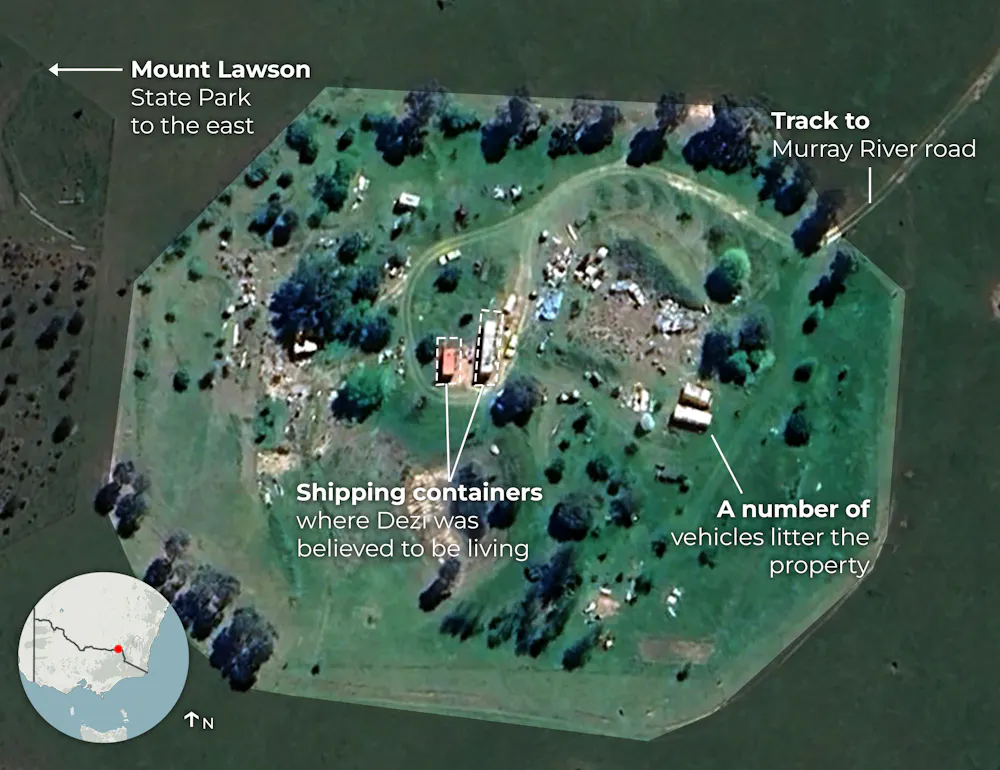
The rural property where Freeman was shot and killed, near Walwa on the Victoria-NSW border. Google Maps, The Conversation

So, how do people like Freeman stay hidden for so long, considering the technology and resources available to police?

Long-term evasion is rare

During the hunt for Freeman, New Zealand police were similarly trying to locate a man called Tom Phillips, who evaded police for almost four years.

He disappeared with his three children just before Christmas 2021 and hid in dense bush in the North Island’s western Waikato region before being shot and killed by police in late 2025.

Both he and Freeman were skilled bushmen with deep local knowledge. And they likely received support from others.

“It would be very difficult for him to get where he was […] without assistance,” Victoria Police chief commissioner Mike Bush said of Freeman. “We will be speaking to anyone we suspect has assisted him to avoid detection and arrest.”


Read more: After 216 days on the run, how was Dezi Freeman caught and what happens now?


In Australia, there have only been four other significant, long-term fugitives in the past 40 years:

  • John Bobak, who police believe was responsible for a double murder on the Gold Coast in 1991, is still on the run

  • Brenden Abbott, nicknamed the “postcard bandit”, escaped from Fremantle Prison in 1989. He evaded police for six years

  • Malcolm Naden hid and lived in rugged bushland around Gloucester and Scone for seven years after murdering two girls in 2005. NSW Police eventually found and arrested him in 2012.

  • New South Wales prison escapee Darko Desic evaded police for 30 years, living in sand dunes in Sydney’s Northern Beaches until he voluntarily handed himself into police in 2022.

How do these fugitives stay hidden?

A person going off the grid is one of the greatest challenges police face in trying to find someone, because technology serves as a person’s electronic footprint.

It ties a person to a time and place. When someone in a city or regional area with mobile coverage uses a phone, it logs their location, who they are talking to and how long they were on the phone call.

If they use their phone to pay for something, it ties that person to a place and time.

If they drive a car, they may be seen on CCTV on roadways that check for real time traffic conditions.

If they access money from an ATM, there may be facial recognition that captures their image. Not using technology blinds police.

The geography of an area also gives someone who goes off the grid a natural advantage because of the difficulty of physically trying to locate them in bushland. The bigger the area, the more rugged the terrain, the easier it is for anyone with bush skills to hide.

That was certainly the case for Freeman in north-east Victoria.

For police, bushcraft skill would not be as well honed as it would have been 20 years ago.

Technology has totally reoriented the way in which police carry out investigations. The use of drones, aerial surveillance, satellite imagery, number plate recognition, or residential home surveillance systems are rendered pointless for someone living off the grid.

For both police and the offender, these types of searches are a game of patience.

Freeman had time on his side, he knew the area and was a skilled bushman. It seems he was able to blend into the environment and become a shadow in the landscape, outwitting the police for months – until he was eventually tracked down.

How he was eventually discovered is yet to be revealed, but police, those impacted by Freeman’s actions, and the taxpayers footing the search bill, will no doubt be relieved the search is over.

ref. How do fugitives like Dezi Freeman evade police for so long? – https://theconversation.com/how-do-fugitives-like-dezi-freeman-evade-police-for-so-long-279554

Evening Report: https://eveningreport.nz/2026/03/30/how-do-fugitives-like-dezi-freeman-evade-police-for-so-long-279554/

Halving the fuel excise is smart politics, but flawed policy

Source: The Conversation (Au and NZ) – By Locky Xianglong Liu, Research fellow, Centre of Policy Studies, Victoria University

With fuel prices staying high, the federal government has announced a halving of the fuel excise for three months. This will cost the federal budget A$2.55 billion, according to Treasurer Jim Chalmers.

This will cut the cost of fuel by 26.3 cents a litre. At the same time, the government said it will temporarily cut the 32.4-cent-a-litre heavy vehicle road user charge to zero.

Cutting fuel excise is politically deft. It is highly visible, easy to implement and provides quick relief to motorists.

But that does not make it the right response to the kind of crisis Australia now faces.

Australians are not experiencing a conventional cost-of-living squeeze. Global energy supply has tightened, and oil prices have surged. This is a direct hit to national income.

Rather than lifting supply, a temporary cut in fuel excise seeks to cushion the price hit for fuel users, by shifting part of the national burden to the federal budget. From there, the burden will be shifted to other groups via cuts in spending or higher taxes – or shifted to the future if the excise cut is funded through government debt.

A poor answer for the problem

From a political perspective, the excise cut is skilful. Subsidising fuel for everyone might seem like a simple way to lower prices at the petrol bowser, and is easy to understand.

But it misses the mark on several counts when it comes to the fiscal response Australia really needs. The fuel excise cut is costly at a time when state and federal budgets across the country are already strained, it is narrowly focused on fuel, it heads off fuel-saving strategies and it is poorly targeted in who it helps.

Rising fuel costs have prompted the federal government’s latest measures to ease prices. Lukas Coch/AAP

First, it is fiscally costly and unsustainable. Our research suggests that the effect of a cut to temporarily soften a hit comes at significant cost to the budget. If debt-financed, such relief comes with higher public debt. Depending on the scale, this may create a debt overhang, where higher interest bills become a drag on growth long after the crisis has ended.

The Morrison government’s fuel excise cut in 2022 to address cost-of-living pressures cost about $1 billion a month, a cost that is hard to sustain in long-term crises.

Second, it is too narrow in what it covers. A fuel excise cut only lowers the cost of fuel, even though the shock is hitting Australian households and businesses more broadly with higher prices for other goods that are reliant on energy, transport, and hydrocarbon-dependent products.

Third, it is too broad in who it helps. Relief is spread across all fuel users, not those who need it most. This is poorly targeted and makes the excise cut a blunt tool that benefits wealthy households, as well as low-income ones.

When fuel is scarce, higher prices serve an important role. They signal that economic adjustment is needed, encouraging businesses and households who can cut back to do so. This helps ensure that limited supply goes to essential uses – farming, food transport and other industries, and households under the greatest pressure from rising fuel costs.

A fuel excise cut works against this price signal. When higher prices can’t do the rationing, we tend to fall back on queues, spending limits or formal rationing, increasing the administrative cost.

Additionally, a broad fuel tax cut creates a wider macroeconomic tension. If it is not offset elsewhere in the budget, it can leave overall spending higher than is helpful when inflation is still a concern and the Reserve Bank is working to dampen demand.

That does not make a fuel excise cut inherently inflationary, but it does sit uncomfortably alongside the RBA’s efforts to slow growth.

Economists have voiced similar warnings about the inflation risk of broad fuel tax relief.

What better-designed relief could look like

If governments want to help households through an oil shock, support should be targeted and fiscally sustainable. The aim should be to direct help to the people under the greatest pressure, rather than simply subsidising all fuel users.

In the near term, that points to more targeted responses, such as direct payments to vulnerable, low-income households and support for essential fuel-using activities.

To fund that relief, a temporary tax on the windfall profits earned by the largely foreign-owned gas exporters from the energy shock is worth considering. Alongside these policies, the excise cut would reconcile public demands for action within a sound and broader economic policy package.

Over the longer term, policymakers could also focus on reducing Australia’s exposure to future energy supply shocks. That means strengthening energy security and exploring policies that support the transition to lower fuel dependence.


Read more: Amid a surge in energy prices, a windfall tax on gas profits could be the best way to protect households


ref. Halving the fuel excise is smart politics, but flawed policy – https://theconversation.com/halving-the-fuel-excise-is-smart-politics-but-flawed-policy-279535

Evening Report: https://eveningreport.nz/2026/03/30/halving-the-fuel-excise-is-smart-politics-but-flawed-policy-279535/

Regime change: What Americans can learn from other nonviolent civil activism movements

ANALYSIS: Introduced by Robert Reich

From time to time, I post transcripts I’ve come across of particularly insightful conversations. Here’s one that’s particularly relevant to the US “No Kings” Day protests at the weekend.

Recently, The Conversation hosted a webinar in which executive editor and general manager Beth Daley interviewed John Shattuck, professor of practice at The Fletcher School of Law and Diplomacy at Tufts University, and Oliver Kaplan, associate professor at Josef Korbel School of Global and Public Affairs at the University of Denver and a visiting scholar at Stanford University.

Shattuck is the former president of Central European University in Hungary, where he defended academic freedom against a rising authoritarian government. Kaplan is the author of Resisting War: How Communities Protect Themselves. This interview has been condensed and edited for print.

BETH DALEY: What is an authoritarian regime, and what are their characteristics?

JOHN SHATTUCK: The authoritarian, often referred to as a “king,” is the ideal role from the point of view of the king, but certainly not from the point of view of the people. Authoritarian characteristics include centralised unlimited power, the opposite of democracy; no accountability and no rule of law; no independent courts; no checks and balances on how the king operates; rule by fear and coercion, and when necessary, in order to carry out the king’s orders, rule by by force.

There are no individual rights or civil liberties except those the king decides to allow those who are loyal to him to have, at least until he decides to take them away.

That’s a nutshell informal description of an authoritarian regime. A special threat today is that an authoritarian can emerge from a democratic election, and, indeed, a democratic election can be used to turn a weak democracy into an authoritarian regime.

But when this happens, it opens the door to challenge the authoritarian in a subsequent election if civic activism can defend the electoral process by which the authoritarian was elected.

BD: What are we seeing and not seeing in the US that other countries have gone through in terms of authoritarian government?

OLIVER KAPLAN: I think we are heading toward an autocracy, if not there already. In their 2026 report, the Varieties of Democracy Project writes that the US is no longer a liberal democracy and is moving into “competitive authoritarianism,” marked by executive overreach and erosion of judicial and legislative checks. The report notes that US democracy is being dismantled at a speed that is “unprecedented in modern history”.

We are seeing shifts in terms of concentration of power to the executive branch and a disregard of the rule of law, things like ignoring court orders and difficulty with holding the executive branch accountable. We are also seeing the militariSation of law enforcement, monitoring of US citizens, and what some refer to as the dual state — that the state is working for some people while causing more challenges for or oppressing other people.

One of the things we’re not seeing at full force yet is a complete shutdown of civic space. We’re able to hold this kind of conversation, and people are still able to dialogue and go out on the street.

There are some efforts at curtailing free speech, and I think there’s some self-censorship possibly happening. But there’s still this open space and a powerful mass movement growing in this country.

BD: John, you were on the front lines, particularly in Hungary as the head of Central European University. What did you see there that has parallels today to the US?

JOHN SHATTUCK: There’s certainly a parallel between Hungary and the US, even though the countries are very different in size, history and background. What I saw in Hungary when I became president of Central European University in 2009 was a weak, new democracy that was only established in 1990 after 70 years of fascism and communism.

I was in Hungary from 2009 to 2016 and, despite the differences, I could begin to see some parallels. Many people had grievances in Hungary about how their economy was operating, particularly after the global financial crisis that affected Hungary more than any other Eastern European country.

Then there was an urban-rural divide, the urban elite versus the rural majority in the country.

Along came a cynical populist-nationalist politician, Viktor Orbán. Orbán started manipulating these grievances, and did so to significantly divide Hungarian society. He attacked many of the institutions of democracy, which were increasingly unpopular because of people’s grievances.

He went after elites, and foreigners, and migrants, and the media. And he blamed all of them for the country’s problems. He then was able to ride these grievances into office.

Once in office, Orbán amended the constitution and laws relating to the Parliament. He undermined the independence of the media and the judiciary so as to centralise power. All of this happened while I was running an international university in Budapest, which remained independent because it received no funding from the Hungarian government.

We were able to resist the increasingly authoritarian regime over issues of academic freedom. The government tried to shut down our programmes of migration studies and gender studies, and tried to censor aspects of our history department.

These authoritarian attacks are similar to what we’ve seen happening in the US, and in fact, Viktor Orbán was greatly admired by Donald Trump, and a lot of the playbook that Orban has followed was mirrored in Project 2025 in the US under Trump.

BD: How do communities respond in different ways to authoritarian regimes?

OLIVER KAPLAN: Pro-democracy movements and protection types of movements at the local level often co-occur. For example, in Colombia there have been various leftist movements and political parties that have pushed for greater democratic opening while communities mobilise to keep people safe and help them cope with repressive conditions.

In places like Chile, El Salvador and Guatemala, communities built trust and support networks to provide aid, such as for people who needed food assistance. This provides space to independently operate and preserve the community.

The US has parallels, such as innovating early warning networks to get advance notice of risks and threats, by communicating using the Signal app. In the Democratic Republic of Congo, villages set up radio networks, and in Ukraine they have sophisticated early warning networks to get word of airstrikes and drone attacks.

Fact-finding and countering stigma are important, and in the US we’re seeing that in the form of the video recording and publicising of harmful actions. This has played out similarly in Syria with fact-finding to protect nongovernment organisations.

There’s also accompaniment where outside actors come in to provide support to communities. Around the world, church organisations play important accompaniment roles. We’re seeing clergy in the US step up and visit places that are at risk.

And then, there are protests, the most visible kind of action. In Minnesota, we’ve seen communities actually setting up community barricades, which has also happened in Mexico, Colombia and Northern Ireland. Communicating the nonviolent nature of these movements is important to avoid any pretext for additional crackdowns.

I think Americans have been taking similar actions to other places around the world in part because there are some similar background conditions: repression and strong social capital networks. Those two things come together to produce these strategies.

BD: Could you speak more about the need to build a clear narrative and a positive one?

JOHN SHATTUCK: There are two basic rules for how to resist authoritarianism that I’ve learned from experience: Build a diverse coalition and develop a unifying theme. You need a diverse coalition in order to appeal to a broad range of the public, and in order to do that, you need agreement on the goal and values of what you’re trying to accomplish.

You need a clear and unifying narrative. The narrative often involves economic issues and issues of corruption, since there’s often a great deal of corruption in authoritarian regimes.

Hungary will have its next parliamentary election in April in which Orbán will seek his fifth term as prime minister. The opposition has developed a broad coalition and a unifying theme, while Orbán is using the centralised instruments of government and media that he controls to try to manipulate public opinion.

The opposition coalition is headed by Peter Magyar, who was once a major supporter of Orbán’s government. Magyar’s name can be magical in Hungary — sort of like a “Joe America” in the US.

With Magyar as its head, the opposition is aiming to peel off supporters of the regime. It’s campaigning on economic grounds, with a positive message and on moderate terms. And most importantly, it includes parties from the left, right and center.

Poland has succeeded in doing what the Hungarian opposition is attempting. It managed to vote out an authoritarian government by putting together a broad coalition to defend the independence of the Polish judiciary. That became a coalition to elect parliamentarians in 2023, and that succeeded in changing the government.

BD: How important is the preexisting social fabric of a community to the success of a protest movement?

JOHN SHATTUCK: It’s important, but complicated. Hungary had a very weak civil society after 70 years of totalitarian fascism and communism. When I was there, the very word to “volunteer,” which we think of as the essence of community action and service, was seen to be a bad word in Hungarian because it was closely associated with collaborating with the regime.

In the US, we’re the opposite in a sense, although the US is now slipping on this. We have a long history of volunteerism, we have all these civil society organisations, we have a tradition of barn raising, people getting together with their neighbours and doing things in their communities. This is very much a part of the American spirit and a core value.

But today, I would say a combination of consumerism and economic individualism coming out of decades of economic deregulation has caused our civil society to fray. But the authoritarian challenge that we face now, and the way in which we are beginning to respond to it, is in fact bringing communities back together again.

I think what happened in Minneapolis is an example of that. And this may reflect a growing capacity to resist an authoritarian regime.

Republished from Robert Reich’s Substack, originally published by The Conversation. Republished under Creative Commons

Article by AsiaPacificReport.nz

Evening Report: https://eveningreport.nz/2026/03/30/regime-change-what-americans-can-learn-from-other-nonviolent-civil-activism-movements/
Rapists’ lawyers are using their victim-survivors’ counselling notes in court. This needs to stop

Source: The Conversation (Au and NZ) – By Rachael Burgin, Senior Lecturer in Criminology and Criminal Justice, Swinburne University of Technology

Sexual violence causes profound trauma and many victims seek counselling and support in its wake. Access to counselling is crucial to promote recovery for victim-survivors.

Like anyone seeking health care, victim-survivors have a reasonable expectation that what they say to a counsellor – which might include a psychologist, a rape crisis worker or social worker – will remain private.

Yet, counselling records including notes, transcripts and even audio and video files are ending up in the hands of the alleged perpetrators’ legal teams. These records, including calls to 1800 RESPECT, might even relate to counselling the victim-survivor received before the rape.

Journalist Nina Funnell has launched a campaign calling for law reform to protect victim-survivors’ counselling records from subpoena in rape trials. The campaign has garnered thousands of signatures and widespread community support.

So why are victim-survivors’ counselling notes being given to defendants’ lawyers? And what can be done about it?

The legal landscape

Each state and territory in Australia has laws that are meant to protect counselling records from being used in court. These protections are often referred to as a sexual assault communications privilege. The privilege operates differently across Australia.

But police, prosecution or defence legal teams may subpoena notes about the content of counselling sessions to be used as evidence in a case. A subpoena is a court order that legally requires someone to give documents to the court.

For example, police might subpoena counselling files to go into the brief of evidence. During this process, copies are made for the defence team, meaning that suspected perpetrators also have access to the counselling information.

Why do accused rapists want to access victims’ counselling records?

A key tactic for the defence in criminal rape trials is to attack the character of the victim. This practice is so well-established that victim-survivors commonly refer to sexual assault trials as a “second rape”.

In seeking access to counselling records, defence teams are hoping to attack a victim’s credibility. A victim-survivor who shares feelings of self-blame in counselling, for example, might be constructed as having made a false accusation. Yet, it is well established that self-blame is common in post-traumatic stress disorder.

Legal teams might argue the counselling records are relevant information regarding a person’s emotional state or account of events.

But such evidence is weak. Academics have long argued that records of counselling sessions have no place in a court room.

Legal (ir)relevance

Counselling sessions are not forensic interviews. They are not concerned with fact-finding. Counselling is a conversation, focused on feelings and impact, that takes place on the victim’s terms and in their words. There is no obligation to share every detail. But they should also be a space where any detail can be safely shared.

In that context, victim-survivors might focus on aspects of the assault that are unrelated to the legal process. This might include how it impacted their relationships, or on other aspects of their trauma.

Access to the records offers defence lawyers an avenue to cross-examine victims on matters unrelated to the rape, including their use of drugs or alcohol, prior experiences of sexual violence or even consensual sex, or the impact of the rape. These arguments draw on myths and stereotypes about rape that shift blame onto victim-survivors and away from perpetrators.

For these reasons, there is no evidentiary value in a counselling record.

Impact on victims and therapists

Accessing a victim’s counselling records without their consent can have a profoundly harmful impact on victims and their recovery.

Victim-survivors have expressed that this intrusion can stall the recovery process and can compound the sense of powerlessness, loss of control and violation inherent in sexual violence.

The effectiveness of counselling is dependent on a relationship of trust between the victim-survivor and their counsellor. That trust is often rooted in privacy and confidentiality.

Accessing counselling records can fundamentally undermine the work of mental health services. It can also discourage victims from seeking help when they need it the most.

Victim-survivors should not have to choose between seeking counselling and seeking justice. But, this is the reality for survivors, given how common it is for counselling records to be sought in the criminal justice process.

What needs to change

Counselling services can resist subpoenas in some circumstances. And most specialist sexual assault services do, as policy. Others, such as 1800 RESPECT, fail to fight subpoenas.

For victim-survivors, though, the intrusion begins at the request. For the general public, the intrusion might be the ability for courts to subpoena them at all.

We urgently need stronger law reform across Australia to protect victim-survivors’ counselling records from being subpoenaed. As the Australian Law Reform Commission recently stated, an absolute protection:

prioritises the public interest in ensuring that people who have experienced sexual violence seek therapeutic treatment and are not deterred from reporting.

What can victims do to protect themselves?

If you are calling a sexual assault crisis hotline, you can request that your call not be recorded. Or, you can call a service that does not record calls, such as 1800 FULL STOP.

You can be anonymous. You do not have to give any identifying details, including your name. You can use a fake name if you prefer. You can turn caller-ID off, too.

If police ask you to sign over consent to having your records accessed, you can say no. Before you agree, you should seek your own independent legal advice, including through legal aid, women’s legal services or a sexual assault service in your area.

Victim-survivors deserve to access confidential counselling and support in the aftermath of sexual violence. Governments owe survivors – and the community – a safe therapeutic service system.

ref. Rapists’ lawyers are using their victim-survivors’ counselling notes in court. This needs to stop – https://theconversation.com/rapists-lawyers-are-using-their-victim-survivors-counselling-notes-in-court-this-needs-to-stop-279314

Evening Report: https://eveningreport.nz/2026/03/30/rapists-lawyers-are-using-their-victim-survivors-counselling-notes-in-court-this-needs-to-stop-279314/

AVFA PODCAST: A Deep-Dive into the US-Israel War in the Middle East

Podcast: A View from Afar with Paul G. Buchanan and Selwyn Manning

In this episode of A View from Afar, political scientist and former Pentagon Analyst Paul Buchanan and journalist Selwyn Manning deep-dive into the US-Israel war in the Middle East.
In This Episode, they discuss:
  • Why did Netanyahu and Trump attack Iran and start this war?
  • Why did the US decide to attack without a clear reason to do so and without strategic planning nor a legal argument for it?
  • What impact will this war in the Middle East have on US Midterm Elections?
  • And what of independent operators in this conflict, such as European states, why do they risk being drawn into this US-Israel Middle East War?
Your Interaction:
A View from Afar podcast is recorded live before an internet audience.
Paul and Selwyn welcome and invite interaction.
You Tube is the best platform for supporting this live interaction, so we invite you to subscribe, follow and like this podcast on this channel.
That way you will be notified in advance of the next episode of A View from Afar.
We look forward to your company and your questions and comments.
You can follow this podcast via the following podcast platforms:
 

Evening Report: https://eveningreport.nz/2026/03/30/avfa-podcast-a-deep-dive-into-the-us-israel-war-in-the-middle-east/

Government slashes fuel excise, heavy vehicles charge for 3 months at cost of $2.55 billion

Source: The Conversation (Au and NZ) – By Michelle Grattan, Professorial Fellow, University of Canberra

The Albanese government will halve the excise on petrol and diesel and reduce the heavy vehicle road user charge to zero, both for three months, at a budget cost of $2.55 billion.

Halving the fuel excise will cut the cost of fuel for motorists by 26.3 cents a litre. That will reduce the cost of a 65 litre tank of fuel by nearly $19.

The heavy vehicle charge is currently 32.4 cents a litre. The relief will help the trucking industry.

The cuts will start on Wednesday.

The government will also defer the next increase in the road user charge for six months. This will be a loss to revenue of $53 million.

The changes are estimated to reduce inflation by half a percentage point through the year to June.

Prime Minister Anthony Albanese announced the measures at a news conference on Monday morning with Treasurer Jim Chalmers and Energy Minister Chris Bowen. They were earlier approved by federal cabinet.

The government said in a statement: “The spike in fuel prices as a result of the war in the Middle East is hurting Australians and causing financial stress. This will help to provide some relief”.

The announcement followed a meeting of national cabinet, which agreed to a national fuel security plan to coordinate responses to the fuel crisis across federal, state and territory governments.

The plan has four stages: plan and prepare; keeping Australia moving; taking targeted action; and protecting critical services for all Australians. The plan has no specific mention of rationing. Level three includes “practical measures” to help reduce use of fuel; stage four refers to “stronger” measures to curb demand.

Albanese said we were currently at stage two.

You can find the plan here.

The federal opposition has been calling for the excise to be halved. Some government sources were discounting the prospect of it last week but by Friday Albanese had it on the table. Chalmers argued it must be responsible and temporary.

A number of economists have criticised the idea of an excise cut.

Chalmers would not give any indication of offsets to pay for the cuts.

Asked on Monday morning, before the announcement, to categorically rule out cuts to the fuel excise, Chalmers told Channel 9: “Well what we’ve said about that […] is we’ve had a focus more on supply, more on distribution, more on the rip offs, more on cost-of-living relief in other ways. But obviously we always have contingencies and fallbacks that we work through, and we keep under more or less under constant review.”

At the news conference, Albanese said: “People should enjoy their Easter, and it’s important as well that we keep the economy going. This is an important time for tourism destinations, for jobs. They rely upon that.”

ref. Government slashes fuel excise, heavy vehicles charge for 3 months at cost of $2.55 billion – https://theconversation.com/government-slashes-fuel-excise-heavy-vehicles-charge-for-3-months-at-cost-of-2-55-billion-279207

Evening Report: https://eveningreport.nz/2026/03/30/government-slashes-fuel-excise-heavy-vehicles-charge-for-3-months-at-cost-of-2-55-billion-279207/

Australia’s rooftop solar boom left apartment residents behind. Here’s how to fix it

Source: The Conversation (Au and NZ) – By Saman Gorji, Associate Professor, Renewable Energy and Electrical Engineering, Deakin University

Most Australians now understand the basic promise of rooftop solar: lower power bills, cleaner electricity and, for some households, the option to charge an electric vehicle at home for far less than the cost of petrol.

But that promise was built around a particular kind of housing – the detached house with a privately controlled roof, a private meter board and a driveway or garage where the owner can install whatever equipment they need.

If you live in an apartment, unit or townhouse, the story is often very different.

That’s becoming a national problem.

Rebates alone aren’t enough

Apartments made up 16% of Australian dwellings in the 2021 Census, and rooftop solar supplied 14.2% of Australia’s electricity in the second half of 2025, according to the latest Clean Energy Council report.

Yet apartment-specific solar programs are only now starting to appear. In New South Wales, the government says fewer than 2% of apartment buildings currently have solar.

Victoria and NSW have both started to respond. Victoria’s current Solar for Apartments round offers rebates of up to A$2,800 per apartment.

NSW’s Solar for Apartment Residents program offers grants of up to A$150,000 for eligible shared systems.

That is overdue progress. It suggests apartment residents are finally being treated as part of the mainstream energy transition, not an afterthought.

But rebates alone will not solve the problem.

The barrier is the building, not the panels

Australian research on apartment solar and strata solar and battery projects shows the main barriers are usually not the panels themselves.

They are the complications that come with shared buildings, including:

  • roof access
  • strata approvals
  • common-property rules
  • metering arrangements
  • switchboard upgrades
  • network constraints and
  • how benefits are shared across residents.

Newer research on power-sharing between tenants points in the same direction.

In a detached house, one household can make one decision. In a multi-owner building, the same decision can require committee approval, engineering advice, retailer coordination and agreement on who pays and who benefits.

Smart meters (which can send data on electricity use to your retailer, so you don’t need manual checks) will help, and governments are right to speed up their rollout. National rules now aim to deliver smart meters across the National Electricity Market by 2030.

But a smart meter on its own does not solve all the problems.

EV charging raises the stakes

This is no longer only about electricity bills. It’s also about transport.

Federal guidance says most EV charging happens at home.

NSW says an estimated 80–90% of EV owners will charge where they live, including in apartment buildings.

That matters because home charging is usually the cheapest and most convenient way to run an EV, especially when households can use off-peak power or rooftop solar.

For people in detached houses, the long-term pathway is fairly clear: solar, a home charger and perhaps a household battery.

For people in apartments with no EV-ready infrastructure, that pathway may not exist at all.

Governments are starting to notice. NSW has funded EV-ready retrofits for residential strata buildings, and Queensland has issued guidance for bodies corporate dealing with EV charging.

But if apartment buildings cannot support electrified living, a growing share of Australians will miss out.

Carrot, stick or both?

The answer is both – but applied differently.

For existing apartment stock, governments need carrots. That means:

  • co-funding for common-property electrical upgrades
  • support for feasibility studies
  • simpler approvals and
  • trusted one-stop advice for owners corporations, body corporates and strata committees.

In many buildings, the real upfront cost is not the solar panel. It is the enabling infrastructure around it.

For new apartment developments, governments also need a stick. It makes little sense to keep approving buildings that are not solar-ready, EV-ready or set up for modern metering and shared energy services. Retrofitting later is usually slower, more expensive and more contentious.

And whatever model is used, consumer protection matters.

If apartment residents are asked to rely more on shared systems, they also need clearer rights, fairer disclosure and real recourse when something goes wrong.

An equity issue

Australia should not let rooftop solar, batteries and home EV charging become advantages available mainly to people who own detached houses.

This is partly a climate issue and partly an engineering issue. But it is also a cost-of-living issue and, increasingly, a housing equity issue.

NSW’s apartment solar program explicitly says renters should be able to benefit, not just owner-occupiers.

The Social Housing Energy Performance Initiative in NSW and Victoria’s Energy Efficiency in Social Housing Program show governments are also starting to treat energy access as a fairness question, not just a technology question.

The next phase of Australia’s energy transition is not about proving rooftop solar works. We already know it does.

It is about deciding whether people in shared buildings can participate on fair terms.

If governments get this right, apartment buildings can become more than passive consumers of electricity. They can host shared solar, smarter demand management, batteries and EV charging.

If governments get it wrong, many Australians will keep watching the energy transition from the sidelines.

ref. Australia’s rooftop solar boom left apartment residents behind. Here’s how to fix it – https://theconversation.com/australias-rooftop-solar-boom-left-apartment-residents-behind-heres-how-to-fix-it-279082

Evening Report: https://eveningreport.nz/2026/03/30/australias-rooftop-solar-boom-left-apartment-residents-behind-heres-how-to-fix-it-279082/

ER Report: A Roundup of Significant Articles on EveningReport.nz for March 30, 2026

ER Report: Here is a summary of significant articles published on EveningReport.nz on March 30, 2026.

My baby loves children’s music, but I don’t – what can we listen to together?
Source: The Conversation (Au and NZ) – By Emily Dollman, Head, Music Education and Pedagogy, Adelaide University Music is a wonderful addition to your baby’s life from the earliest days. Hearing is one of the first senses to develop in the womb, and by birth a baby’s hearing is fully functioning. This means hearing our

After 216 days on the run, how was Dezi Freeman caught and what happens now?
Source: The Conversation (Au and NZ) – By Terry Goldsworthy, Associate Professor in Criminal Justice and Criminology, Bond University For more than 200 days, police killer Dezi Freeman was on the run in the harsh bush terrain of north-east Victoria after shooting and killing two police officers in August 2025. Freeman was reportedly shot dead

After more than 200 days on the run, how was Dezi Freeman caught and what happens now?
Source: The Conversation (Au and NZ) – By Terry Goldsworthy, Associate Professor in Criminal Justice and Criminology, Bond University For more than 200 days, police killer Dezi Freeman was on the run in the harsh bush terrain of north-east Victoria after shooting and killing two police officers in August 2025. Freeman was reportedly shot dead

Yes, China has made inroads in the Pacific, but Australia still does far more
Source: The Conversation (Au and NZ) – By Joanne Wallis, Professor of International Security, Adelaide University Last year, Australia was reminded of China’s willingness to exercise its growing naval power in the region. In February, a Chinese flotilla circumnavigated the country and conducted live-fire drills in the Tasman Sea. And in November, a powerful Chinese

Tropical geckos in Australia are more adaptable than we thought
Source: The Conversation (Au and NZ) – By Keith Christian, Professor of Zoology, Charles Darwin University Earth is teeming with life: creatures big and small have spread and adapted to vastly different environments. Many animals can also change their physiology – how their bodies function – in response to local fluctuations. Just think of hibernating

A war without accountability: why the Middle East crisis is also a legal quagmire
Source: The Conversation (Au and NZ) – By Anna Marie Brennan, Senior Lecturer in Law, University of Waikato What began with surprise US and Israeli strikes on Iran one month ago has hardened into a grinding stand-off, with no clear way out. The conflict’s opening blows on February 28 killed senior leaders in Tehran, including

USP academic calls for better press freedom protections in face of Fiji’s declining media trust
By Cheerieann Wilson in Suva Public trust in Fiji’s mainstream media has significantly declined, a journalism academic has told the Truth and Reconciliation Commission, citing decades of political upheaval, censorship and institutional pressure. At its third expert hearing in Suva, the commission heard from University of the South Pacific’s associate professor of journalism Shailendra Singh,

Trump’s unpopularity shields Labor in Newspoll and other polls despite fuel crisis
Source: The Conversation (Au and NZ) – By Adrian Beaumont, Election Analyst (Psephologist) at The Conversation; and Honorary Associate, School of Mathematics and Statistics, The University of Melbourne Although Anthony Albanese’s ratings are down in three new federal polls, Labor has maintained a comfortable lead, with the combined vote for the Coalition and One Nation

Fiji’s former President Ratu Epeli Nailatikau dies at 84
RNZ Pacific Former Fijian President Ratu Epeli Nailatikau died on Thursday, aged 84. Ratu Epeli, a chief and former Fiji military commander, served as president from 2009 to 2015. He also served as Speaker of Parliament from 2019 to 2022. Local media reported Ratu Epeli died at the Suva Private Hospital after being admitted earlier

We surveyed more than 8,000 principals – they face violence, threats and stress in their schools
Source: The Conversation (Au and NZ) – By Paul Kidson, Associate Professor in Educational Leadership, Australian Catholic University Almost half of surveyed Australia’s school principals face physical violence in their jobs. Almost 90% say they encounter offensive behaviour from students, parents and even colleagues, according to new survey results. The latest instalment in an annual

Sex Pistols at 50: how punk’s most notorious band became part of the mainstream
Source: The Conversation (Au and NZ) – By Adam Behr, Reader in Music, Politics and Society, Newcastle University “Ever get the feeling you’ve been cheated?” John Lydon’s closing words before stalking off stage at San Francisco’s Winterland Ballroom in January 1978, concluding the Sex Pistols’ US tour, have echoed ever since. They’re a bitter bookend

Can NZ’s new T20 cricket franchise attract the dollars, players and fans it will need?
Source: The Conversation (Au and NZ) – By Chris McMillan, Professional Teaching Fellow in Sociology, University of Auckland, Waipapa Taumata Rau New Zealand Cricket’s decision to support “in principle” the development of a T20 franchise competition represents a major shift in governance and funding for the summer game. But it’s not clear whether the tensions

Women in the Pacific are increasingly subject to digital abuse: new research
Source: The Conversation (Au and NZ) – By Emma Quilty, Postdoctoral Research Fellow, Centre for Excellence for The Elimination of Violence Against Women, Monash University Gender-based violence is a global issue, but studies consistently show the Pacific has among the highest rates in the world. Up to 79% of women in the region experience some

Can I drive when taking medicinal cannabis? Is it safe?
Source: The Conversation (Au and NZ) – By Tom Arkell, NHMRC Emerging Leadership Fellow, School of Health Sciences, Swinburne University of Technology Your doctor has just prescribed medicinal cannabis. You think it’s helping. But you rely on your car to get to work and pick up the kids. Are you allowed to drive? And more

Why do men sexually harass women at work? Science offers two explanations – but only one of them holds up
Source: The Conversation (Au and NZ) – By Cordelia Fine, Professor, History & Philosophy of Science program, School of Historical & Philosophical Studies, The University of Melbourne What causes workplace sexual harassment? How can we continue to better understand it? And what can be done to prevent it? Successful answers to questions like these need

War could add an extra 5% to prices in Australia – but there’s one sector that shields the economy
Source: The Conversation (Au and NZ) – By George Verikios, Adjunct Professor of Economics, Griffith University A drawn-out war in the Middle East could add an extra 5% to existing inflation in Australia, our new modelling shows. We looked at the likely impacts of two different scenarios: a moderate disruption with the war ending in

How the US, Israel and Iran are controlling their media narratives
In the ongoing United States and Israel war on Iran, it appears that all the countries agree on “controlling” the media. Despite differences in their political systems, all three governments follow an approach that prioritises “national morale” and “operational security” over press freedom and the flow of information. This approach redefines the concept of fake

View from The Hill: Andrew Hastie calls out Trump’s war strategy
Source: The Conversation (Au and NZ) – By Michelle Grattan, Professorial Fellow, University of Canberra Andrew Hastie hung out his leadership shingle in a weekend interview that may have a few Liberals wondering if the right’s factional heavyweights made the best judgement in choosing Angus Taylor for the top job. Hastie wanted to run for

New Caledonia’s domestic airline AirCal files for bankruptcy
By Patrick Decloitre, RNZ Pacific correspondent French Pacific Desk New Caledonia’s domestic airline Air Calédonie filed for bankruptcy on Friday, following almost a month of blockades by customers in the French Pacific territory’s outer islands. The protest movement had been initiated by groups of angry outer islands customers who intended to oppose the company’s decision

War on Iran: The French senator who said what everybody was thinking
COMMENTARY: Pacific Media Watch A French senator walked into the Luxembourg Palace, opened his mouth, and basically set the whole room on fire. Politely. In a suit. Claude Malhuret didn’t yell nor wave his arms. He just listed things… calmly, methodically, like a doctor reading a very long and very depressing diagnosis. And by the

Evening Report: https://eveningreport.nz/2026/03/30/er-report-a-roundup-of-significant-articles-on-eveningreport-nz-for-march-30-2026/

My baby loves children’s music, but I don’t – what can we listen to together?

Source: The Conversation (Au and NZ) – By Emily Dollman, Head, Music Education and Pedagogy, Adelaide University

Music is a wonderful addition to your baby’s life from the earliest days.

Hearing is one of the first senses to develop in the womb, and by birth a baby’s hearing is fully functioning. This means hearing our voices is key to strengthening connection with newborn babies.

A key area of music research is how our brains process speech and music at this early age, and we have discovered the brain actually treats speech like music, with newborns focusing on features of pitch, rhythm and speed.

There is a huge variety of musical material you can engage with together so there will definitely be songs to suit everyone. Yes – even if the last time you listened to kids’ music was several decades ago. And even if you listen to it now and think “I don’t think I can sit through this for the next couple of years!”.

Here’s what to think about when creating a playlist for baby – and for you.

Lullabies

There’s a universal human instinct to soothe our babies through the safety of the repetitive rhythms, calming melodies and steady pulse of lullabies. Singing lullabies to my babies certainly saved my sanity at many 3am witching hours!

Lullabies are musically very beautiful and are also very singable thanks to their simple melodies, so as well as listening to the music this is the perfect opportunity to croon a quiet song to our babies ourselves.

With such a wealth of lullabies to choose from, you could sing a new song each evening, although there is something very special about having a “signature” lullaby rooted in family tradition.

Play songs and nursery rhymes

The main features to look for in play songs are a faster tempo, physical actions to match with the music and often an element of fun or jokes, which will prompt many cute giggle fits from your little one.

As well as providing amusement for your babies during play time, these higher energy songs are also helping to spark cognitive development, language development and gross and fine motor control.

Attending a parents and baby music class is great for music exposure, and social connections. Jelleke Vanooteghem/Unsplash

Attending a parent and baby music class is great for both the musical input and the social connections, and will be much more fun if you join in as well. It’s very cute to watch the toddlers getting better each week at the actions for Heads, Shoulders, Knees and Toes while their sleep-deprived carers struggle locating their eyes, ears, mouth and nose.

An early start in listening to music and singing is at the core of each music education methodology – you might have heard the saying music education should ideally start nine months before the birth of the mother.

Enjoying music together from birth is setting your little one up well for all future musical activities. This is important for parents who are aware of the research showing music tuition through childhood has a range of transferable benefits, in addition to the development of musical talent.

Thinking outside the box

Parents often ask where to find music to listen to with their baby. ABC Kids Listen is a great place to start, or the superstar groups of the kids’ music world like the Wiggles or Hi-5. However, if you really don’t like the mainstream hits for kids, you can definitely think outside the box.

For calming music, you could explore recordings from Australia’s Hush Foundation, stream playlists of lullabies from around the world, or even try Max Richter’s eight-hour lullaby, Sleep.

To replicate the qualities of play songs, look for songs with catchy lyrics and a strong beat you can clap to, or make up actions for – yes, permission to “shake it off” with your toddler instead of waking up Jeff.

[embedded content]

Listen to what you enjoy

Introducing your kids early to a wide variety of music you love shows music is there to be enjoyed for life.

With our little ones, kid classics like Big Red Car, Let it Go and Twinkle Twinkle were frequent replays. But they also loved listening to Kurt Elling’s Uncertainty of the Poet, scatting with Ella Fitzgerald, twirling to Swan Lake and marching to Grieg’s Hall of the Mountain King.

The main thing is to find the music that works for you and your little ones through both the active and quieter times of your day, that you will both enjoy listening to and moving to together.

From dancing in the lounge room to singing Hush Little Baby at 3am, the memories and the benefits will both be long lasting. I promise, one day, you will actually miss the days of listening to the Frozen soundtrack in the car.

ref. My baby loves children’s music, but I don’t – what can we listen to together? – https://theconversation.com/my-baby-loves-childrens-music-but-i-dont-what-can-we-listen-to-together-274525

Evening Report: https://eveningreport.nz/2026/03/30/my-baby-loves-childrens-music-but-i-dont-what-can-we-listen-to-together-274525/

After 216 days on the run, how was Dezi Freeman caught and what happens now?

Source: The Conversation (Au and NZ) – By Terry Goldsworthy, Associate Professor in Criminal Justice and Criminology, Bond University

For more than 200 days, police killer Dezi Freeman was on the run in the harsh bush terrain of north-east Victoria after shooting and killing two police officers in August 2025.

Freeman was reportedly shot dead by police on Monday morning.

In a press conference on Monday, Victoria Police Chief Commissioner Mike Bush didn’t confirm the identity of the person killed, nor the exact location of the incident.

But a spokesperson earlier said: “A man has been fatally shot by police at a property in north-east Victoria this morning as part of the operation to locate Desmond Freeman”.

Bush said police would seek to formally identify the body as soon as possible.

So how was he caught, what happens now in terms of the criminal investigations and what implications may there be for policing after this incident?

How was Freeman caught?

Freeman’s disappearance sparked one of the most extraordinary manhunts in Australian history.

At its peak the hunt for Freeman involved hundreds of police and other experts, drones, helicopters and specialist police dogs.


Read more: Treacherous terrain: the search for alleged police killer Dezi Freeman


In February police declared they “strongly believed” Freeman was dead.

Despite this, police continued to search for Freeman or his remains.

The fact police actively continued to search for Freeman despite stating he was likely dead suggests the statement may well have been a tactic to lure him out.

Using a ploy such as this can entice a fugitive into thinking police may be reducing the intensity of the search.

Bush said there was “a lot to suggest Freeman had taken his own life” with police following every possible lead.

On Monday, it was reported police received a tip-off last week, with Freeman hiding in a caravan or shipping container-style structure on a property.

Bush said police appealed for the person to come out of where he was hiding, which resulted in a three-hour standoff. He was given an opportunity to surrender peacefully but he was shot and killed following the standoff with police.

No officers were hurt.

Freeman would have been regarded as a high level threat risk – police would have approached him with the utmost caution and preparedness.

The homicide investigation

While police searched for Freeman, a parallel criminal investigation has been in full swing. The murder investigation of the two police officers has involved units from the homicide, armed crime and fugitive squads as well as local detectives.

For major crimes such as this, criminal investigations move through a number of stages.

In this case, the investigation would have focused primarily on the crime scene where the officers were shot.

Any additional crime scenes would need to be identified such as clothing or weapons discarded by Freeman. This will now include the site of the shooting of Freeman.

All crime scenes need to be protected until they can be processed: restricting public access and protecting it from the elements.

Dezi Freeman shot two police officers as they tried to issue a warrant at 80 Raynar Track, outside Porepunkah on August 26 2025. Google Earth, CC BY-SA

During the investigation, detectives would have identified possible witnesses and evaluated the physical evidence available.

During the search for Freeman more than 100 properties were searched.

Investigators also focused on other people who may have aided Freeman prior to or after the shootings. Given the amount of time Freeman was on the run, it is highly likely he had assistance. Bush intimated police had several suspects.

As part of the investigation, police offered a A$1 million dollar reward for information to locate him.

Ultimately the final stage of any investigation is the arrest stage. It was at this stage that police shot dead a man likely to be Freeman.

Police actions to be investigated

Victoria Police’s Professional Standards Command will conduct and oversee an investigation into the shootings – both the initial fatal shooting of the police officers and the fatal shooting of Freeman.

This is standard procedure where there is a critical incident that results in a death or serious injury resulting from contact between police and the public.

Investigations look to assess if the incident was preventable or whether changes need to made to police policies and procedures to prevent similar incidents from occurring.

The death of the two officers and Freeman are reportable deaths under the Victorian Coroners Act and will be investigated by the coroner.

In this case the coroner will hold an inquest, as an inquest is mandatory in matters involving homicide where no one is charged, and for deaths in custody. An inquest goes beyond an investigation by holding public hearings and looking at the circumstances around the deaths.

This happened when four Victorian police officers were killed during a traffic stop in 2020.

Victoria Police would have been preparing a report for the coroner since the initial shootings – this report will now also contain information in relation to the shooting of Freeman.

ref. After 216 days on the run, how was Dezi Freeman caught and what happens now? – https://theconversation.com/after-216-days-on-the-run-how-was-dezi-freeman-caught-and-what-happens-now-264196

Evening Report: https://eveningreport.nz/2026/03/30/after-216-days-on-the-run-how-was-dezi-freeman-caught-and-what-happens-now-264196/

After more than 200 days on the run, how was Dezi Freeman caught and what happens now?

Source: The Conversation (Au and NZ) – By Terry Goldsworthy, Associate Professor in Criminal Justice and Criminology, Bond University

For more than 200 days, police killer Dezi Freeman was on the run in the harsh bush terrain of north-east Victoria after shooting and killing two police officers in August 2025.

Freeman was reportedly shot dead by police on Monday morning.

In a press conference on Monday, Victoria Police Chief Commissioner Mike Bush didn’t confirm the identity of the person killed, nor the exact location of the incident.

But a spokesperson earlier said: “A man has been fatally shot by police at a property in north-east Victoria this morning as part of the operation to locate Desmond Freeman”.

Bush said police would seek to formally identify the body as soon as possible.

So how was he caught, what happens now in terms of the criminal investigations and what implications may there be for policing after this incident?

How was Freeman caught?

Freeman’s disappearance sparked one of the most extraordinary manhunts in Australian history.

At its peak the hunt for Freeman involved hundreds of police and other experts, drones, helicopters and specialist police dogs.


Read more: Treacherous terrain: the search for alleged police killer Dezi Freeman


In February police declared they “strongly believed” Freeman was dead.

Despite this, police continued to search for Freeman or his remains.

The fact police actively continued to search for Freeman despite stating he was likely dead suggests the statement may well have been a tactic to lure him out.

Using a ploy such as this can entice a fugitive into thinking police may be reducing the intensity of the search.

Bush said there was “a lot to suggest Freeman had taken his own life” with police following every possible lead.

On Monday, it was reported police received a tip-off last week, with Freeman hiding in a caravan or shipping container-style structure on a property.

Bush said police appealed for the person to come out of where he was hiding, which resulted in a three-hour standoff. He was given an opportunity to surrender peacefully but he was shot and killed following the standoff with police.

No officers were hurt.

Freeman would have been regarded as a high level threat risk – police would have approached him with the utmost caution and preparedness.

The homicide investigation

While police searched for Freeman, a parallel criminal investigation has been in full swing. The murder investigation of the two police officers has involved units from the homicide, armed crime and fugitive squads as well as local detectives.

For major crimes such as this, criminal investigations move through a number of stages.

In this case, the investigation would have focused primarily on the crime scene where the officers were shot.

Any additional crime scenes would need to be identified such as clothing or weapons discarded by Freeman. This will now include the site of the shooting of Freeman.

All crime scenes need to be protected until they can be processed: restricting public access and protecting it from the elements.

Dezi Freeman shot two police officers as they tried to issue a warrant at 80 Raynar Track, outside Porepunkah on August 26 2025. Google Earth, CC BY-SA

During the investigation, detectives would have identified possible witnesses and evaluated the physical evidence available.

During the search for Freeman more than 100 properties were searched.

Investigators also focused on other people who may have aided Freeman prior to or after the shootings. Given the amount of time Freeman was on the run, it is highly likely he had assistance. Bush intimated police had several suspects.

As part of the investigation, police offered a A$1 million dollar reward for information to locate him.

Ultimately the final stage of any investigation is the arrest stage. It was at this stage that police shot dead a man likely to be Freeman.

Police actions to be investigated

Victoria Police’s Professional Standards Command will conduct and oversee an investigation into the shootings – both the initial fatal shooting of the police officers and the fatal shooting of Freeman.

This is standard procedure where there is a critical incident that results in a death or serious injury resulting from contact between police and the public.

Investigations look to assess if the incident was preventable or whether changes need to made to police policies and procedures to prevent similar incidents from occurring.

The death of the two officers and Freeman are reportable deaths under the Victorian Coroners Act and will be investigated by the coroner.

In this case the coroner will hold an inquest, as an inquest is mandatory in matters involving homicide where no one is charged, and for deaths in custody. An inquest goes beyond an investigation by holding public hearings and looking at the circumstances around the deaths.

This happened when four Victorian police officers were killed during a traffic stop in 2020.

Victoria Police would have been preparing a report for the coroner since the initial shootings – this report will now also contain information in relation to the shooting of Freeman.

ref. After more than 200 days on the run, how was Dezi Freeman caught and what happens now? – https://theconversation.com/after-more-than-200-days-on-the-run-how-was-dezi-freeman-caught-and-what-happens-now-264196

Evening Report: https://eveningreport.nz/2026/03/30/after-more-than-200-days-on-the-run-how-was-dezi-freeman-caught-and-what-happens-now-264196/

Yes, China has made inroads in the Pacific, but Australia still does far more

Source: The Conversation (Au and NZ) – By Joanne Wallis, Professor of International Security, Adelaide University

Last year, Australia was reminded of China’s willingness to exercise its growing naval power in the region. In February, a Chinese flotilla circumnavigated the country and conducted live-fire drills in the Tasman Sea.

And in November, a powerful Chinese task group came within a few kilometres of Australia’s maritime territory.

These events also highlighted the continued importance of Australia’s relationship with its Pacific neighbours and their maritime security. In fact, several Pacific Island countries worked with Australia to monitor the Chinese task group as it passed their territories.

Australia has been accused of “neglect” and “stupor” when it comes to the Pacific. Some even claim Australia has “lost” the Pacific to China.

But these observations overlook the sophisticated ways the Pacific countries decide who they will partner with.

While there is always room for improvement, Australia does a lot more than China in the Pacific. This is demonstrated by five maps from a project we are conducting to examine Pacific maritime security cooperation.

Australian assistance in fisheries and security

As our mapping illustrates, both Australia and New Zealand are members of all major Pacific institutions. This includes the region’s preeminent political and security institution, the Pacific Islands Forum. China is not.


However, as the largest financial contributor to these institutions, as well as a major aid donor, Australia has been criticised for seeking to exert undue influence on them. And, though Australia has supported important initiatives such as the South Pacific Nuclear Free Zone, it has been accused of stymieing collective commitments to address climate change.

Australia should be mindful to use its seat at the table carefully.

For most Pacific Island countries, fisheries are an important source of revenue. And our mapping illustrates the significant role Australia plays in this industry. For example, many Australians work within the Pacific Islands Forum Fisheries Agency, the peak regional body that manages Pacific fisheries. China does not have personnel working there.

In addition, the Pacific Maritime Security Program is providing 24 new patrol boats, three landing craft, and a small loan fleet of other boats to 15 Pacific countries. This helps them counter illegal fishing, transnational crime and other threats.

Australia is also helping to upgrade wharf infrastructure in 13 countries.


This support is bolstered by Australia’s longstanding Defence Cooperation Program, which has been providing assistance to bolster Pacific defence capabilities since the 1960s.

And, as our mapping shows, Australia has helped to redevelop the Blackrock Peacekeeping and Humanitarian Assistance and Disaster Relief Camp in Fiji, the Lombrum Naval Base in PNG, and the Cook Barracks and Tiroas Barracks in Vanuatu, among other projects.

Transnational crime is a growing concern in the Pacific, particularly the drugs trade and online scam operations. Both Chinese and Australian criminal networks are guilty of fuelling it.

However, as our mapping demonstrates, Australia is a member of several major regional response agencies. Again, China is not.

Chinese infrastructure projects and security deals

China has funded some port infrastructure in the Pacific, including the Luganville wharf in Vanuatu. That development generated anxiety in Australia. Some claimed it could be converted into a Chinese naval base.

But these claims are seldom tested.

Any Chinese military base in the region would be extremely vulnerable. If a conflict were to break out, this would be the first thing that Australia – and its American allies – would target.

A military base would also likely be unpopular with locals and difficult and expensive to maintain from a supply and logistics perspective.

The strategic value of a Chinese military base would be questionable, too. China could make Australia feel vulnerable in other ways, such as periodically sending its warships into Australian waters.

In 2022, China signed a security agreement with Solomon Islands, generating much anxiety in Australia. But as our mapping illustrates, Australia has a number of similar treaties and arrangements with Pacific countries.

Although we have argued it would be preferable for Australia to prioritise regional security approaches over bilateral agreements, there is no denying Canberra has achieved remarkable success in this area.

The US and France also have territories and bases across the Pacific. So, there aren’t many places for China to establish a military foothold – if it even wanted one.

Humanitarian assistance and disaster relief

In addition, Australia has long been the main provider of humanitarian and disaster relief in the region, and is a member of several disaster response initiatives.

It is also the largest donor to the Pacific Resilience Facility, which will fund climate change and disaster resilience projects across the region.

In 2024, Pacific defence ministers endorsed Australia’s proposal for a Pacific Response Group, which will facilitate joint military deployments to respond to disasters. While there were questions about whether the group has adequate regional buy-in and would meet the needs of Pacific countries, this kind of assistance is often welcomed.

China has no similar seat at important regional tables. It has founded alternative Pacific disaster response and risk reduction groups, but they are based in China.

All is not lost

Given China’s recent demonstrations of its naval muscle, it’s understandable why the Albanese government is cautious about its rising influence. Foreign Minister Penny Wong has called it a “permanent state of contest” with China over the Pacific.

But our mapping is a reminder of the dangers of viewing China’s inroads in absolute terms, not relative to what Australia and other partners can offer.

Beyond New Zealand, no other country is as embedded as Australia in the national and regional institutions of Pacific Islands countries. And the shifting global order only reinforces the importance of Australia maintaining these strong relationships with its neighbours.

ref. Yes, China has made inroads in the Pacific, but Australia still does far more – https://theconversation.com/yes-china-has-made-inroads-in-the-pacific-but-australia-still-does-far-more-276877

Evening Report: https://eveningreport.nz/2026/03/30/yes-china-has-made-inroads-in-the-pacific-but-australia-still-does-far-more-276877/

Tropical geckos in Australia are more adaptable than we thought

Source: The Conversation (Au and NZ) – By Keith Christian, Professor of Zoology, Charles Darwin University

Earth is teeming with life: creatures big and small have spread and adapted to vastly different environments. Many animals can also change their physiology – how their bodies function – in response to local fluctuations. Just think of hibernating bears in winter, for example.

But some places experience less fluctuation. When you imagine the tropics, you’re likely picturing something akin to a travel brochure – lush and always warm.

Indeed, temperatures in the tropics are relatively stable, so some biologists have suggested tropical animals can’t adjust their physiology in response to a changing environment.

For animals in tropical rainforests that’s somewhat true. However, a bigger portion of the tropics consists of savannas with strongly seasonal rainfall. For the animals that live here, water is as important as temperature when it comes to shaping their physiology.

My colleagues and I studied geckos from Australia’s seasonal tropics to see if they can adjust to the seasons. Our new study, published in The Journal of Experimental Biology, challenges conventional views on what we know about reptiles and their ability to adjust to the seasons.

How geckos avoid drying out

With their scaly skin and ability to survive in deserts, reptiles are often viewed as being impervious to seasonal rainfall fluctuations.

Geckos, a type of nocturnal lizard, are particularly abundant in the tropics around the world. We measured water loss during the wet and dry seasons in closely related species of geckos in the genus Gehyra. They are impressive climbers that typically live in trees or on rocks.

In lizards, about 70% of the water loss happens across the skin, with some water also lost from the eyes and the air they exhale. Depending on habitat and how closely related they were, we expected to find differences among gecko species in the rate of water lost.

Instead, the striking result was their ability to change water loss seasonally. Compared to the wet season, the dry season water loss was reduced by up to 76%.

The plain tree dtella (Gehyra gemina) lives in Western Australia. Geoff Byrne/iNaturalist, CC BY-NC

It’s clear geckos need to conserve water in the dry season, but why not have low rates of water loss throughout the year?

We suspect there could be a cost to holding in the water in the dry season – possibly related to an increase in molecules that prevent the indiscriminate leaking of water across the skin of all land-based animals. When water is abundant in the wet season, they relax their hold, and water loss increases.

The geckos likely preserve water in direct response to how humid the air is. However, seasonal rainfall brings other important changes to tropical savannas.

Insect prey are less abundant in the dry season, and having less food available means animals in the seasonal tropics must adapt in other ways too. Previous studies of amphibians and reptiles in this region show the animals conserve energy by reducing activity, lowering body temperatures, and slowing their metabolisms in what’s known as “metabolic depression”.

Now we can add changes to the permeability of their skin to the list of seasonal adaptations that allow geckos to survive the harsh conditions of a long dry season.

Getting ready ahead of time

Interestingly, animals start deploying these adaptations very early in the dry season, which lasts from May to October in the region where they live. In the geckos, the shift to lower water loss happened in May, despite there being rain early in the month.

This tells us the geckos adjust in anticipation of physiological stress, rather than in response to it.

There’s also evidence the animals aren’t just responding to general cues for that time of year, such as sun angle or day length.

For example, monitor lizards living in the savanna change their behaviour early in the dry season, but individuals of the same species living near the floodplain of the South Alligator River delay the seasonal adjustments until the plain dries late in the season. And other monitors that live near permanent water, forgo the seasonal changes altogether.

Although we don’t know how proximity to water affects water loss in geckos, what we know about other animals suggests the cues they respond to are early changes in humidity, or possibly something to do with food availability.

Gehyra australis, also known as the Australian house gecko. Max Tibby/iNaturalist

Adapting in a harsh world

Far from being inflexible, many animals in the seasonal tropics have evolved a range of adaptations in response to the harsh conditions they experience every dry season.

Some of these adaptations are unique, such as underwater nesting by the northern long-necked turtle. Some, such as metabolic depression, are variations of strategies animals use elsewhere.

And some, such as the geckos’ changes to water loss, may just be more obvious because the animals are above ground and observable, unlike ones hibernating in the winter somewhere inaccessible.

Global climate change involves more than increased temperatures. Other consequences may include changes in rainfall patterns and insect population declines.

Decreased food availability would have devastating consequences to future animals in the seasonal tropics.

However, over evolutionary time, the fact they live in variable seasonal conditions means they’ve adapted to survive at least some, less devastating environmental changes.

ref. Tropical geckos in Australia are more adaptable than we thought – https://theconversation.com/tropical-geckos-in-australia-are-more-adaptable-than-we-thought-266777

Evening Report: https://eveningreport.nz/2026/03/30/tropical-geckos-in-australia-are-more-adaptable-than-we-thought-266777/

A war without accountability: why the Middle East crisis is also a legal quagmire

Source: The Conversation (Au and NZ) – By Anna Marie Brennan, Senior Lecturer in Law, University of Waikato

What began with surprise US and Israeli strikes on Iran one month ago has hardened into a grinding stand-off, with no clear way out.

The conflict’s opening blows on February 28 killed senior leaders in Tehran, including Supreme Leader Ali Khamenei – prompting retaliatory missile and drone attacks on Israel, US bases and Gulf infrastructure.

Years of tension over Iran’s nuclear programme and its regional influence have now boiled over into open warfare, with diplomacy faltering as both sides entrench their positions.

On the ground in Iran, the violence is worsening what was already a strained human rights situation. News reporting from within the country carries daily images of damaged neighbourhoods, overwhelmed hospitals and families fleeing tit-for-tat strikes.

One incident in particular – the US airstrike on a school in Minab in southern Iran that left dozens of girls dead – highlights the scale of the devastation, as well as the war’s murky legal context.

Future war crimes investigators will need to ask some obvious questions. Was the school a civilian site, was it used for military purposes, what precautions were taken and was the civilian harm excessive relative to any military advantage?

Only then will responsibility be able to be determined – but such clarity is likely to be a long way off.

When the law is clear, but accountability is not

Many observers have already criticised the shaky legal basis for the conflict.

Some have described the US position – as set out in a letter to the United Nations invoking self-defence and the protection of Israel against an alleged imminent threat from Iran and its allied groups – as thin.

Others have argued that strikes supporting the stated goal of regime change were unlawful, citing the UN Charter’s prohibition on the use of force against the political independence of a state and the principle of non-intervention.

At this point, it is safe to assume that accountability for alleged international crimes by all sides to this ongoing conflict will remain elusive.

The International Criminal Court has no automatic jurisdiction because the United States, Israel and Iran are not parties to the Rome Statute, the treaty that established the court and defines its powers.

A UN Security Council referral of the situation to the court for investigation and possible prosecution is also unlikely, given the high potential for any such move to be blocked by veto-wielding permanent members.

Is any accountability likely to come through internal investigations by the states involved? This too is uncertain, as such investigations are often classified or narrowly framed by military and legal authorities.

This means independent investigators are often left to piece together their cases from satellite imagery, authenticated videos, mass graves, weapon remnants and medical and mortuary records.

While this can establish what happened and where, linking harm to identifiable decision-makers and proving intent is far harder while the conflict continues and key military records remain sealed.

This is not to say the laws of war themselves are ambiguous. They require forces to distinguish between civilians and fighters, avoid excessive civilian harm and take practical precautions.

International criminal cases turn on attribution and intent, meaning investigators must show who authorised an attack and what they knew. But without insider witnesses or key evidence, that is difficult, and proper accountability for war crimes often fall short.

A pattern of impunity?

We have seen this pattern before, where efforts to secure accountability are blocked or weakened by international deadlocks.

In 2014, the UN Security Council attempted to refer alleged war crimes and crimes against humanity against civilians in Syria’s civil war to the ICC. The effort failed after Russia and China vetoed it, citing concerns about sovereignty and the impact on a political settlement.

In 2021, the UN Human Rights Council ended the mandate of the Group of Eminent Experts on Yemen – an independent body tasked with investigating and reporting on violations by all parties – after some member states voted against renewing it. This removed one of the international community’s few mechanisms for documenting human rights abuses.

The ongoing crisis in Gaza has also proved a defining test of whether international law can be enforced.

The ICC has opened an investigation into Palestine and issued arrest warrants for senior Israeli and Hamas officials over alleged war crimes and crimes against humanity.

But such warrants depend on states to enforce them, and cooperation has been limited. A parallel UN inquiry has found Israel has committed genocide, yet the path to legal accountability remains contested.

In Iran, a similar outcome – or lack of one – now appears sadly likely.

ref. A war without accountability: why the Middle East crisis is also a legal quagmire – https://theconversation.com/a-war-without-accountability-why-the-middle-east-crisis-is-also-a-legal-quagmire-279199

Evening Report: https://eveningreport.nz/2026/03/30/a-war-without-accountability-why-the-middle-east-crisis-is-also-a-legal-quagmire-279199/

USP academic calls for better press freedom protections in face of Fiji’s declining media trust

By Cheerieann Wilson in Suva

Public trust in Fiji’s mainstream media has significantly declined, a journalism academic has told the Truth and Reconciliation Commission, citing decades of political upheaval, censorship and institutional pressure.

At its third expert hearing in Suva, the commission heard from University of the South Pacific’s associate professor of journalism Shailendra Singh, who detailed how censorship, intimidation and political pressure had weakened the media landscape over decades.

Dr Singh, who is contributing to the commission’s media chapter, told the TRC that repeated disruptions — including the 1987, 2000 and 2006 coups — had lasting consequences on press freedom and public discourse.

Drawing on more than 30 years of experience, he outlined how newsrooms faced closures, financial strain and the loss of skilled journalists, contributing to declining editorial independence and professional standards.

He said journalists were often forced into difficult ethical positions, navigating threats and highly polarised environments, which led to self-censorship, and, at times, uncritical reporting aligned with dominant political narratives.

He described the 2000 and 2006 coups as defining moments for the industry.

The 2006 period, he noted, brought the most stringent controls, including the introduction of the Media Industry Development Act 2010, which entrenched censorship and self-censorship in newsrooms.

Steady decline in public confidence
The long-term impact, he said, had been a steady decline in public confidence.

Dr Singh told the commission that perceptions of bias and compliance had contributed to the erosion of trust, with some members of the public even supporting tighter media control.

At the same time, restrictions on traditional media created space for alternative platforms such as blogs, social media and diaspora outlets — opening new avenues for expression but also raising concerns around misinformation and accountability.

Despite the repeal of the MIDA legislation in 2023, Dr Singh said the sector continued to grapple with its legacy, including financial instability, skills shortages and the risk of renewed political interference.

He recommended stronger legal protections for press freedom, improved training to lift professional standards, greater media literacy and independent regulatory mechanisms.

Republished from The Fiji Times with permission.

Article by AsiaPacificReport.nz

Evening Report: https://eveningreport.nz/2026/03/30/usp-academic-calls-for-better-press-freedom-protections-in-face-of-fijis-declining-media-trust/

Fiji’s former President Ratu Epeli Nailatikau dies at 84

RNZ Pacific

Former Fijian President Ratu Epeli Nailatikau died on Thursday, aged 84.

Ratu Epeli, a chief and former Fiji military commander, served as president from 2009 to 2015.

He also served as Speaker of Parliament from 2019 to 2022.

Local media reported Ratu Epeli died at the Suva Private Hospital after being admitted earlier on Thursday evening.

In Saturday’s frontpage story titled “Nailatikau is no longer with us”, The Fiji Times described the late president as “widely respected for his leadership and dedication to the people of Fiji”.

The Fiji Sun described him as a “respected chief, soldier, diplomat and statesman”.

A former opposition leader and high chief, Ro Teimumu Kepa, said Ratu Epeli’s death had left many people in shock.

“The flowing tributes on social media shows how his personality touched many lives that he came in contact with,” she wrote in a social media post.

The ‘people’s president’
Fiji’s former Attorney-General Aiyaz Sayed-Khaiyum described Ratu Epeli as “the people’s president”.

“Ratu Epeli Nailatikau lived his life among his people, not above them. We see that in the countless stories coming in from across the country about his personal interactions with everyday people,” Sayed-Khaiyun said.

“He put his belief of the dignity of every Fijian into practice every day, including the day he promulgated our Fijian Constitution in 2013 which granted every citizen an equal voice in our democracy while concomitantly protecting everyone’s specific rights including the marginalised and the vulnerable.

“And as if God hadn’t given the man enough rare qualities — he had both a wonderful singing voice and the wits to know when to close out a long night in song and send us all home on a high note.”

The Fiji Labour Party said that as the great-great-grandson of Ratu Seru Cakobau — one of Fiji’s most significant figures — and the grandson of King George Tupou II of Tonga, “Ratu Epeli was undoubtedly a scion of royal lineage”.

This article is republished under a community partnership agreement with RNZ.

Article by AsiaPacificReport.nz

Evening Report: https://eveningreport.nz/2026/03/30/fijis-former-president-ratu-epeli-nailatikau-dies-at-84/

Trump’s unpopularity shields Labor in Newspoll and other polls despite fuel crisis

Source: The Conversation (Au and NZ) – By Adrian Beaumont, Election Analyst (Psephologist) at The Conversation; and Honorary Associate, School of Mathematics and Statistics, The University of Melbourne

Although Anthony Albanese’s ratings are down in three new federal polls, Labor has maintained a comfortable lead, with the combined vote for the Coalition and One Nation at 46–47% (steady in Newspoll, down one in Redbridge and down three in Fox & Hedgehog).

A Newspoll question finds the US action against Iran is very unpopular, while both the Redbridge and Fox & Hedgehog polls show the petrol crisis is overwhelmingly blamed on Donald Trump or the Iran war. Redbridge has Trump at -55 net favourable in Australia. Trump is currently shielding Labor from a backlash over the fuel crisis.

A national Newspoll, conducted March 23–26 from a sample of 1,232, gave Labor 31% of the primary vote (down one since the late February Newspoll), One Nation 26% (down one), the Coalition 21% (up one), the Greens 12% (up one) and all Others 10% (steady).

With One Nation well ahead of the Coalition in second, no two-party estimate was provided. An estimate using 2025 election preference flows gives Labor a lead under 54–46.

Albanese’s net approval fell three points to -18, with 57% dissatisfied and 39% satisfied. Angus Taylor’s net approval was down four points to -7 (42% dissatisfied, 35% satisfied). Albanese led Taylor by 44–36 as better PM (45–37 previously).

By 72–23, respondents disapproved of the United States military action against Iran. By 63–30, they opposed Australia sending naval vessels to the Strait of Hormuz. Opposition to the US action is far stronger than in the previous week’s Essential poll (42–26).

Here is the graph of Albanese’s net approval in Newspoll, with a trend line. His net approval has slumped eight points in the last two Newspolls, and is only just above his low of -21 in February 2025. But Labor is in a far better position now than it was then.

Albanese Newspoll ratings.

Redbridge poll: Coalition at just 17%

A national Redbridge and Accent Research poll for The Financial Review, conducted March 23–27 from a sample of 1,003, gave Labor 32% of the primary vote (steady since the late February Redbridge poll), One Nation 29% (up one), the Coalition 17% (down two), the Greens 13% (up one) and all Others 9% (steady).

By respondent preferences, Labor led both the Coalition and One Nation by 53–47 (steady against the Coalition and a one-point gain for One Nation).

Albanese’s net favourability was down four points to -17 (46% unfavourable, 29% favourable). Taylor’s net favourability was down two points to -3, Pauline Hanson’s was down one to -3 and Donald Trump’s was down four points since January to -55. New Nationals leader Matt Canavan debuted at -3.

In a three-way preferred PM question, Albanese had 33% (down one), Hanson 23% (steady) and Taylor 14% (up four).

By 61–14, respondents thought Trump rather than Albanese was most responsible for rising petrol prices.

Cost of living remained the most important issue. Combining the Coalition and One Nation against the combined Labor and Greens, the right led the left by 38–31 on cost of living and also led on four other important issues. The left’s only lead was on healthcare (by 37–32).

Fox & Hedgehog poll

A national Fox & Hedgehog poll for the News Corp papers, conducted March 24–25 from a sample of 1,810, gave Labor 30% of the primary vote (steady since the mid-February F&H poll), the Coalition 23% (down one), One Nation 23% (down two), the Greens 13% (up one) and all Others 11% (up two).

By respondent preferences, Labor led the Coalition by an unchanged 51–49. They led One Nation by 56–44, a three-point gain for Labor. In a three-party preferred question, Labor had 46% (up two), the Coalition 27% (steady) and One Nation 27% (down two). By 2025 election flows, Labor would lead the Coalition by above 53–47.

Albanese’s net approval was down four points to -19 (49% disapprove, 30% approve). Taylor’s net approval was down three to net zero. Albanese led Taylor as preferred PM by 39–35 (40–35 previously). Hanson’s net approval was down four to +5 and Treasurer Jim Chalmers’ net approval was -12.

On what was most responsible for rising fuel prices, 55% blamed the Iran war, 24% the federal government and 15% petrol stations and suppliers. But by 57–18, respondents rated the government’s handling of the fuel crisis poor rather than good. By 76–8, they thought fuel shortages would become widespread across Australia in the coming weeks.

SA election late counting

With 88% of enrolled voters counted in the lower house for the March 21 South Australian election, the ABC has called 34 of the 47 seats for Labor, five for the Liberals, two for One Nation and four for independents, with two still uncalled.

The two uncalled seats are both One Nation vs Liberal contests. In Narungga, One Nation leads the Liberals after preferences by just 25 votes. One Nation is further ahead in MacKillop, but no non-ordinary votes have been counted yet.

Statewide vote shares are 37.6% Labor, 22.8% One Nation, 18.9% Liberals, 10.4% Greens and 10.3% for all Others. Despite beating the Liberals into second by 3.9% on statewide primary votes, the Liberals will win at least one more seat than One Nation, retaining opposition status.

The Liberals’ votes were better distributed than One Nation, and preferences also played a role. The two seats One Nation has clearly won (Hammond and Ngadjuri) were in contests with Labor where Liberal preferences helped One Nation. But in One Nation vs Liberal contests, Labor, Greens and Other preferences have helped the Liberals.

Trump’s US ratings fall to record low

I last covered the Iran war’s effect on Trump’s US ratings two weeks ago. His net approval then was -13.8 in analyst Nate Silver’s aggregate of US national polls, and it has now fallen to -16.6, with 56.7% disapproving and 40.1% approving. Trump is below his previous worst net approval of -15.0.

In the last two trading days, the benchmark US S&P 500 stock market index has lost 3.4%. Since a peak on February 25 in the week before the Iran war started, it has lost 8.3%.

While the S&P is near a “correction” (a 10% drop), it’s still well above a “bear market” (a 20% drop). High petrol prices probably explain Trump’s ratings drop more than the stock market.

Silver also has an aggregate of US support for the Iran war. Net support has fallen 5.1 points in the last two weeks to -14.5, with 53.8% opposed to the Iran war while 39.3% support it.

ref. Trump’s unpopularity shields Labor in Newspoll and other polls despite fuel crisis – https://theconversation.com/trumps-unpopularity-shields-labor-in-newspoll-and-other-polls-despite-fuel-crisis-279522

Evening Report: https://eveningreport.nz/2026/03/30/trumps-unpopularity-shields-labor-in-newspoll-and-other-polls-despite-fuel-crisis-279522/

Women in the Pacific are increasingly subject to digital abuse: new research

Source: The Conversation (Au and NZ) – By Emma Quilty, Postdoctoral Research Fellow, Centre for Excellence for The Elimination of Violence Against Women, Monash University

Gender-based violence is a global issue, but studies consistently show the Pacific has among the highest rates in the world. Up to 79% of women in the region experience some form of abuse over the course of their lives.

An emerging concern is violence through technology. This is where digital technologies are used to abuse, harass, coerce and exploit another person.

Most often, these harms are disproportionately experienced by women and girls.

Yet there is limited research on gender-based violence in the Pacific. And even fewer academic studies looking at the role of technology.

Our recent study aims to fill that gap. We surveyed victim-survivor support practitioners from nine Pacific Island nations. We found smartphones, Facebook and AI-generated sexualised deepfakes are being used to control and harm women and girls.

Coercive controlling behaviours

In our study, recently published in the journal Violence Against Women, we surveyed 19 and interviewed five practitioners across Fiji, Kiribati, Micronesia, Tonga, Samoa, Vanuatu, Tuvalu, Papua New Guinea and the Solomon Islands who work with victim-survivors.

We asked about the ways technologies are being used to abuse. We also asked about any challenges in supporting victim-survivors who experience tech-based violence.

We found common types of abuse included:

  • controlling access to devices

  • sharing or threatening to share intimate images without permission (often with the person’s family and religious or faith-based networks)

  • monitoring another person’s location using trackers or publicly available online information

  • and creating or threatening to create AI-generated sexualised deepfake videos or images to extort money.

Practitioners reported they were supporting increasing numbers of victim-survivors with experiences of technology-facilitated violence.

The abuse was also happening in the context of other forms of intimate partner violence. This included financial, physical and psychological harm, further compounding the abuse.

[embedded content]

One device per household

One finding particular to the Pacific is the shared-device problem.

Practitioners reported that many families share a single phone. This meant the somewhat standard digital safety advice, “change your password” or “use a different device”, does not apply.

Practitioner Mere said partners sharing access to one digital device can facilitate controlling and abusive behaviours. She explained:

married couples having the same Facebook account, then the other partner sees messages coming in directly to the wife […] and monitoring where the other partner is going.

Sexualised image-based abuse

Another common form of abuse reported was coerced sexual acts and image-based sexual abuse. Victim-survivors are commonly forced into sexual activities via digital means, according to 36% of participants.

Other forms of image-based sexual abuse practitioners reported as very common included:

  • the taking of sexual images or videos without permission

  • the sharing of sexual images without permission

  • the threat to share sexual images without permission.

Practitioner Kiana said victim-survivors report image-based sexual abuse happening in both relationship breakdowns and as a way to force them to stay in an abusive relationship:

the partner would threaten or even send nude photos of their partners […] to group chats [or] threaten to send the photos to his partner’s family members.

An emerging issue in the Pacific, and one that is being experienced globally, is sexualised deepfake abuse. This is where sexualised imagery is created with Artificial Intelligence (AI) or other digital technologies, such as Photoshop. Of the participants in our study, 26% reported this as occurring “often”.

With the rapid development of AI technologies that easily create sexualised deepfake abuse content, these trends are likely to increase.


Read more: What to do if you, or someone you know, is targeted with deepfake porn or AI nudes


Challenges in supporting victim-survivors

The study found a range of challenges and barriers for practitioners in supporting victim-survivors in the Pacific.

One of the prominent barriers was cultural practices and norms. Practitioners said these norms are shaped by traditional communal values, family honour, kinship systems, faith, ideals of modesty and respect for hierarchy.

Sexual and cultural taboos in Pacific Island nations can discourage women experiencing domestic violence from seeking help. Pita Simpson/Getty

Sexual and cultural taboos, strongly ingrained within traditional Pacific value systems, were also seen to discourage women from seeking help.

Participants said the controlling of phones by perpetrators and the shared device problem was also restricting women’s opportunities to connect with support networks, to identify their situation as abusive and to seek help.

Another major barrier identified by 37% of practitioners was the poor handling of cases by police. Cases are simply not taken seriously by authorities, according to 32% of participants. In this context, practitioners observed perpetrators were rarely held accountable, leaving victim-survivors without justice or protection.

Where to next?

While the findings in our study are similar to those in other countries, they highlight the importance of social and cultural contexts in addressing these issues. These contexts should inform how technology-facilitated violence in the Pacific is prevented, and how victim-survivors are supported.

There are a range of things governments, technology providers, police and the legal sector can do to address the problem. One would be to fund and prioritise practitioner and police training to better understand and respond to technology-facilitated violence.

Another is to develop culturally-sensitive community education initiatives that stop victim-survivors from being silenced.

And finally, religious and faith-based organisations should be brought on board to help prevent and respond to technology-facilitated violence.


The authors would like to thank Siân Human from the Australian Research Council Centre of Excellence for the Elimination of Violence Against Women for her insights and support during the process of writing this piece.

ref. Women in the Pacific are increasingly subject to digital abuse: new research – https://theconversation.com/women-in-the-pacific-are-increasingly-subject-to-digital-abuse-new-research-278990

Evening Report: https://eveningreport.nz/2026/03/30/women-in-the-pacific-are-increasingly-subject-to-digital-abuse-new-research-278990/