Wairoa mayor Craig Little stands firm on not declaring ‘woke’ state of emergency in cyclone

Source: Radio New Zealand

Wairoa District mayor Craig Little. Nick Monro

Declaring a state of emergency should be the last tool used in the toolbox – not the first.

Those are the words of Wairoa District mayor Craig Little after he chose not to join Hawke’s Bay Regional Council, Napier, Hastings, and Central Hawke’s Bay councils in declaring a local state of emergency during Cyclone Vaianu.

Little later told local Democracy Reporting: “We’re becoming woke as a country when it comes to states of emergency.”

Prime Minister Christopher Luxon hit back at Little’s comment – saying he is happy to be labelled woke if it means New Zealanders are not losing their lives.

Speaking to Morning Report, Little said Wairoa has been through disasters before and suffered greatly in the wake of Cyclone Gabrielle.

For this event, calling a state of emergency before it even hit simply wasn’t necessary, he said.

Little said his district was well prepared for the weather event and forecasts were being watched closely.

The cyclone was downgraded as it approached New Zealand and was considered a “low rain event”.

From the intel he had, “we didn’t require it”.

Little said calling a state of emergency causes panic amongst people – “there’s no doubt about it”.

But he said he was confident Wairoa would be safe – and if it was necessary, he would have called a state of emergency when it was needed.

The decision not to declare was made by not just himself, but agreed upon by elected members of the council.

Little said residents were well aware of what was going on and a number of media releases and social media posts were shared.

Hindsight was a wonderful thing, Little said, and a state of emergency had not been needed.

“I believe it’s the last tool in the toolbox to use – not the first.”

Sign up for Ngā Pitopito Kōrero, a daily newsletter curated by our editors and delivered straight to your inbox every weekday.

– Published by EveningReport.nz and AsiaPacificReport.nz, see: MIL OSI in partnership with Radio New Zealand

LiveNews: https://nz.mil-osi.com/2026/04/14/wairoa-mayor-craig-little-stands-firm-on-not-declaring-woke-state-of-emergency-in-cyclone/

Delays of up to an hour possible after Wellington crash

Source: Radio New Zealand

The crash closed a southbound lane south of Newlands on State Highway 1 at the Ngauranga Gorge. Supplied / NZTA

Motorists are facing delays after significant congestion built up following a crash on a arterial route into Wellington city.

The smash just before 7am on Tuesday closed a southbound lane south of Newlands on State Highway 1 at the Ngauranga Gorge.

The New Zealand Transport Agency said at its peak, delays of up to an hour were possible.

The vehicle has now been removed and the lane is clear but drivers should still expect the journey to take longer than usual while the congestion cleared.

The transport agency’s traffic dashboard currently estimates about 30 minute delays.

Sign up for Ngā Pitopito Kōrero, a daily newsletter curated by our editors and delivered straight to your inbox every weekday.

– Published by EveningReport.nz and AsiaPacificReport.nz, see: MIL OSI in partnership with Radio New Zealand

LiveNews: https://nz.mil-osi.com/2026/04/14/delays-of-up-to-an-hour-possible-after-wellington-crash/

Wealthy buyers eyeing up New Zealand since Iran war started

Source: Radio New Zealand

RNZ / Nate McKinnon

The conflict in the Middle East has prompted increased interest in multi-million-dollar New Zealand properties, the head of a luxury real estate company says.

Changes to the so-called Golden Visa came into effect a year ago, and Immigration Minister Erica Stanford recently updated the investment that had been made so far.

Changes to the Overseas Investment Act came into effect on 6 March.

Investors from Germany and the United States have reportedly already made purchases.

Sotheby’s International Realty managing director Mark Harris told Nine to Noon there had been increased interest from foreign buyers since the rule changes were announced, even before they came into force.

“We’ve also had more recently a pick up out of Asia again, out of Hong Kong.

“It’s interesting looking at our web traffic, has really picked up in the last month from the UAE so you’ve got to think that the AIP is encouraging these guys but we’ve obviously got a geopolitical situation that’s unfolding in the Middle East and that’s generating a lot of web traffic and interest as well I think in New Zealand.”

He said there was now interest from across all the United States, where previously those looking to buy here were predominately from the West Coast.

“Noticeable pick up particularly from the US, and countries like Germany and Switzerland lately.”

While the immigration changes allowed foreigners to buy home worth more than $5 million , there was more interest in the $10-20m category, Harris said.

“The ones that we’ve got are generating quite a bit of interest in that sort of ultra high end so I’m sure there’ll be contracts coming forward.”

The southern lakes region – Queenstown and Wānaka – were the most popular areas, though there was still interest in Auckland’s harbourside suburbs, he said.

And he thinks the interest in New Zealand is sustainable.

“I think the interest in New Zealand is not going to go away.”

* Mark Harris will be live on RNZ National around 9.30am. You can listen live in the player at the top of this web page, your RNZ app or your local frequency.

Sign up for Ngā Pitopito Kōrero, a daily newsletter curated by our editors and delivered straight to your inbox every weekday.

– Published by EveningReport.nz and AsiaPacificReport.nz, see: MIL OSI in partnership with Radio New Zealand

LiveNews: https://nz.mil-osi.com/2026/04/14/wealthy-buyers-eyeing-up-new-zealand-since-iran-war-started/

‘Natural next step’: NZ alcoholic spirits see rapid growth in export markets

Source: Radio New Zealand

File image. AFP

New Zealand’s niche alcoholic spirits are seeing rapid growth in key export markets, with plenty of potential for more of the same.

Trade and Enterprise estimated the annual value of New Zealand’s exports of premium spirits at $61 million, which barely scratched the surface of a growing global market valued at more than $100 billion (US$60b).

NZTE general manager of international Clare Wilson said there was demand for New Zealand’s premium spirits, as consumers increasingly prioritised quality rather than quantity when it came to alcohol consumption.

“Certainly the brand New Zealand story is incredibly strong. And in those markets, we’ve done very well with wine in the past,” she said.

“So, you know, it’s kind of a natural next step. The products look great. I think the packaging, the storytelling around it is impressive.

“And also people are looking for more than just the taste. They’re actually looking for authenticity and social alignment.”

Wilson said the botanicals being locally sourced was attractive, and the global market was made for a product like Strange Nature gin.

Strange Nature a by-product of no-alcohol wine

Strange Nature, which was a sauvignon-blanc-based gin, was born from a recent boom in the production of no-alcohol wine and other premium beverages.

Strange Nature partnered with its Marlborough neighbour and award-winning winemaker Giesen Wines in October 2021, which supplied Strange Nature with its key ingredient – a by-product of its popular range of no-alcohol wine.

Strange Nature founder and general manager Rhys Julian said Giesen’s grape-alcohol was the hero of the gin’s unique taste, which was helped along by ageing the gin in Giesen’s used wine barrels.

“Marlborough sauvignon blanc has been an absolute rock star. So it sort of made sense to market to those consumers … if you like New Zealand wine … our gin could be a really good option as well.”

He said the company was currently producing 75,000 bottles for export to 12 countries, but was weighing up whether to make a big step-change to produce half a million bottles, rather than stick with a three-year goal to produce 150,000 bottles.

“We’re growing really nicely year on year, but imagine if we really fired this thing up. You know, we’ve got really good momentum,” he said.

Julian said Strange Nature’s key markets of Australia, United States and Japan were big enough to absorb an increase in the product, but expansion would require investment, as well as the long-term certainty of supply.

“We really believe in the brand and we’re confident that we could raise the money that we need to give the brand an injection, but (we are) just sussing it out and working out the best way to do that,” he said.

“We’ve never needed to rely on investment. So it’s new territory for us.”

Wilson said NZTE was working with 18 spirit exporters, but sees the number continuing to grow.

“What’s great to see is that we now have 170 distilleries in New Zealand, up from 27 in 2019,” she said.

“So as companies get to a certain scale, then they look to export.

“So I think we can safely say we’re going to see more New Zealand distilleries start to export in the next couple of years.”

Sign up for Ngā Pitopito Kōrero, a daily newsletter curated by our editors and delivered straight to your inbox every weekday.

– Published by EveningReport.nz and AsiaPacificReport.nz, see: MIL OSI in partnership with Radio New Zealand

LiveNews: https://nz.mil-osi.com/2026/04/14/natural-next-step-nz-alcoholic-spirits-see-rapid-growth-in-export-markets/

Nelson Hospital ED expansion complete

Source: New Zealand Government

A major expansion of Nelson Hospital’s emergency department has been completed, boosting capacity and strengthening care for patients across the region, Health Minister Simeon Brown says. 

“With the final stage now complete, patients will move through a modern, fit-for-purpose emergency department designed to support more efficient care,” Mr Brown says.

The $10.6 million upgrade, delivered in four stages over 18 months, has increased treatment spaces from 23 to 29 and modernised key clinical areas to better meet growing demand.

“The expanded department includes additional clinical spaces, improved triage areas, dedicated mental health rooms, and new fast-track assessment zones, giving staff the tools they need to assess and treat patients more quickly and safely.

“Three new fast-track areas will also help ensure patients with less complex needs are seen sooner, freeing up capacity for those requiring more urgent care.”

The final stage of the project has delivered a refurbished reception and triage area, improving visibility, privacy, and the patient experience from the moment people arrive.

“With all stages now complete, the emergency department is better set up to support more efficient patient flow and deliver more responsive care for the community.”

The upgraded emergency department is already seeing improved performance against the Government’s shorter stays in ED target, with more patients being seen, treated, and admitted or discharged within six hours compared with the same period last year.

“Alongside the infrastructure upgrades, workforce capacity at Nelson Hospital has been strengthened following Health New Zealand’s review, with 28 permanent full-time roles now filled in the emergency department. This includes senior doctors, nurses, allied health professionals, and support staff, ensuring the expanded facilities are supported to deliver safe and timely care.”

The emergency department expansion is part of the wider redevelopment of Nelson Hospital, with work underway on a new 28-bed rapid-build inpatient ward to support further upgrades, including a new 128-bed inpatient unit.

“From the expanded emergency department to new inpatient capacity and ongoing redevelopment, we are committed to delivering the Nelson community modern, fit-for-purpose facilities that put patients at the centre of care, now and into the future,” Mr Brown says. 

MIL OSI

LiveNews: https://livenews.co.nz/2026/04/14/nelson-hospital-ed-expansion-complete/

‘Probably a mistake’: Transport Minister on building concessions into national ticketing system

Source: Radio New Zealand

The first stage of the $1.4 billion National Ticketing has been launched in Christchurch. (File photo) RNZ / Nate McKinnon

It was “probably a mistake” to try and build every public transport concession into the $1.4 billion National Ticketing System project, the Transport Minister says.

Chris Bishop told Morning Report, the system which would allow people to pay for public transport with their phone or card anywhere across the country, would likely be up and running by the end of 2027.

The system was first signed off by the New Zealand Transport Agency (NZTA), in 2009.

Bishop said the idea for the system was created as many of the systems used by each region were coming to the end of their lives.

He said the government at the time could have either funded the individual upgrades or built a national system that had one backend for all public transport systems.

“The mistake was trying to build every concession into the system as well,” Bishop said.

He said this was “probably a mistake”.

“That is the short reason why is it has taken so long as it is different for every single council.”

Bishop said the system would likely be up and running for the entire country by the end of 2027.

It was already running in Christchurch.

Public transport usage had seen a notable spike in the last month as commuters reacted to the cost of filling up their vehicles.

US transport-defence contractor Cubic had been delivering the project under a near-$500m contract, but it had previously had capacity problems and missed deadlines.

Sign up for Ngā Pitopito Kōrero, a daily newsletter curated by our editors and delivered straight to your inbox every weekday.

– Published by EveningReport.nz and AsiaPacificReport.nz, see: MIL OSI in partnership with Radio New Zealand

LiveNews: https://livenews.co.nz/2026/04/14/probably-a-mistake-transport-minister-on-building-concessions-into-national-ticketing-system/

No ‘peace of mind’ until managed retreat from vulnerable areas – iwi leader

Source: Radio New Zealand

A slip blocks State Highway 2 in January. Supplied/NZTA

The deputy prime minister says it is up to local communities, not necessarily the government, to decide whether they need to relocate as climate change worsens.

And a local iwi leader agrees, saying it will take a “whole of community approach” to make the hard calls required to create “peace of mind”.

Parts of the North Island have been repeatedly hit by extreme weather events in recent years, particularly the Bay of Plenty, Tai Rāwhiti and Hawke’s Bay.

The latest – Cyclone Vaianu – was not as destructive as feared, but still took out roads and flooded communities at the weekend.

Prime Minister Christopher Luxon told Morning Report on Monday that iwi in the eastern part of the North Island were having conversations about relocating from areas vulnerable to wild weather and the effects of climate change.

“They’re having those conversations with the elders who have been very connected to those areas, and that’s been a really positive thing.”

As for the 14 percent – around 675,000 – New Zealanders who currently live in areas prone to flooding, Luxon said it was time to “confront the brutal facts of the reality that actually they are going to be areas of New Zealand that we’re going to have to rethink over time how we manage that”.

Asked whether we should be “pushing fast forward on those discussions” by First Up host Nathan Rarere on Tuesday morning, Deputy Prime Minister and ACT leader David Seymour said it depended on who “we” are.

“It’s more important to break down who has each role. The government has a role in this, and that is producing the national flood maps. producing the National Adaptation Framework, which sets out what the information is in each location and potentially what the options are in any location.

“It’s then up to the communities you mentioned to figure out what’s most important to them and what choices they’d like to make.”

Important roads around the Gisborne region – such as State Highways 2 and 35 – are frequently closed due to flooding and slips when big storms strike. Mayor Rehette Stoltz on Monday said she was not aware of discussions between Luxon and iwi in regards to relocation, but some marae had already been moved and the council had bought dozens of ‘category 3’ homes people could no longer live in.

She said there had been a lack of investment in the national roading network, which is handled by the New Zealand Transport Agency, not local councils.

Willie Te Aho. RNZ

‘This is going to happen again’

Willie Te Aho, chief executive of Te Aitanga a Mahaki Trust on the East Coast, confirmed iwi had been making moves towards managed retreat since March 2023, in the aftermath of Cyclone Gabrielle.

“That’s led to the relocation of two of our marae, or a commitment to relocate two of our marae on either side of Te Karaka – Rangatira Marae and Takipu Marae,” he told Morning Report.

“It wasn’t the overall result that I personally wanted, because I put the question to my people what they wanted, and they said ‘peace of mind’, and I said, ‘You will not have peace of mind staying in this area.’

“And so we’ve had to look at other alternatives, including the raising of roads, the moving of flood protection, the raising of houses, to basically compensate for an alternative decision, which was to stay in the same place. But we have our two of our marae, our people have made the decision to relocate two of our marae to higher, safer ground.”

He said they were ill-prepared when Gabrielle hit, but had learned a lot since then – including the importance of some form of managed retreat.

“We’re never, ever going to have full peace of mind unless we look at managed retreat ourselves, how we work that through with local government, insurers and central government.”

Te Aho agreed with Seymour’s assessment that central government would not lead any managed retreat.

“I don’t think the government, any government has the funding to do that on a wholesale approach. And accordingly, we’ve got to look at how we do that long-term through our own individual ownership, through our hapu and iwi, through local government, through central government, and through insurance companies…

“And so, we need to have a whole of industry, a whole of community approach to looking at a better future because this is going to happen again. The issue is not if it’s going to happen, it’s going to be when it’s going to happen.

“I have nannies from the 1948 Waipauwa flood just beside us. I had people, the same people in Cyclone Bola in ’88, the same people in Cyclone Gabrielle in ’23. They’re saying that the timeframe between these severe weather events is shorter and they’re more severe.

“And so as our world temperature [rises], the reality is that this is going to happen more, in a timely manner, within the next 20 years. So, we’ve got to make the hard decisions about [sustainability] and resilience, and we’ve got to consider managed retreat in these areas that are vulnerable, like… Te Karaka.”

RNZ / Samuel Rillstone

Seymour said there had been a lack of investment in infrastructure for up to 60 years.

“It’s always easier to defer some maintenance, balance the Budget this year and put physical problems into the future. And we see that in hospitals. school buildings and so on.

“I’d like to think this government is actually doing a bit to improve the accounting and capital asset maintenance.”

He played down the importance of reducing emissions.

“We’ve invested an awful lot of resource in trying to reduce emissions, when in reality that won’t change the picture for New Zealand because the rest of the world will drive emissions whether we do or not.

“What we can change and have in our own power so far as climate change and New Zealanders is the ability to ensure we do adaptation. Now, I sympathise with the mayors… I also point out that since Gabrielle in early 2023, the investment in the highway in Hawke’s Bay has been done precisely to future-proof it against those challenges.

“That doesn’t mean it’s been done everywhere. But yes, there is a couple of historic problems in our policy approach. This government, I believe, is rectifying those. But it’s also true that some work has been done. So there are problems, but not everywhere.”

Sign up for Ngā Pitopito Kōrero, a daily newsletter curated by our editors and delivered straight to your inbox every weekday.

– Published by EveningReport.nz and AsiaPacificReport.nz, see: MIL OSI in partnership with Radio New Zealand

LiveNews: https://livenews.co.nz/2026/04/14/no-peace-of-mind-until-managed-retreat-from-vulnerable-areas-iwi-leader/

Crash blocks SH1 near Christchurch, trapped people freed from vehicles

Source: Radio New Zealand

File photo. Police asked motorists to avoid the intersection of Telegraph Road south of Burnham. RNZ / Cole Eastham-Farrelly

State Highway 1 is blocked near Christchurch following a two-vehicle crash.

Emergency services were called after the two vehicles collided south of Burnham at the intersection of Telegraph Road about 7.30am on Tuesday.

Fire and Emergency confirmed one person was trapped in each of the vehicles following the crash, and had since been extricated and were with St John.

St John sent two ambulances, a first response unit, a critical care paramedic, an operations manager and a helicopter.

A spokesperson said it was too early to provide details on the condition of the patients.

Police asked motorists to avoid the area.

“The Serious Crash Unit have been notified,” police said.

“Traffic control will be in place from Selwyn Lake Road to Telegraph Road.”

Sign up for Ngā Pitopito Kōrero, a daily newsletter curated by our editors and delivered straight to your inbox every weekday.

– Published by EveningReport.nz and AsiaPacificReport.nz, see: MIL OSI in partnership with Radio New Zealand

LiveNews: https://livenews.co.nz/2026/04/14/crash-blocks-sh1-near-christchurch-trapped-people-freed-from-vehicles/

New bridge underway for Tongariro River Trail

Source: NZ Department of Conservation

Date:  14 April 2026

The new bridge, built by the Department of Conservation in partnership with Ngāti Tūrangitukua, Tūwharetoa Māori Trust Board, and Te Kotahitanga o Ngāti Tūwharetoa, will replace the 70-year-old Major Jones bridge, which is no longer fit-for-purpose. Major Jones Bridge is one of the prominent structures on the Tongariro River Trail, located short distance from the Koura Street entrance in Tūrangi.

DOC Taupō Operations Manager Dave Conley says the new bridge will honour the look of the existing bridge, with steel cable supports and a timber deck.

“The new bridge will be about 15cm wider than its predecessor, allowing easier use for cyclists, anglers, walkers, and other recreational users alike.”

Construction is set to occur between 20 April and 30 September 2026, with progress depending on weather conditions.

Ngāti Tūrangitukua Charitable Trust Chair Lauren Fletcher says the Tongariro River is an important taonga to all of Ngāti Tūwharetoa.

“As it flows through our hapū we take our roles as tangata tiaki seriously, and we are looking forward to the construction of the bridge to ensure the safety of all manuhiri who are in our rohe.”

Dave says the existing bridge and Tongariro River Trail will generally remain open for the public during the construction period.

“We’ll be doing our best to minimise disruption, but there will be some noise, and temporary windows of closure to ensure visitor safety. Follow instructions from the crew on site to keep yourself and others safe.”

Construction will require some vegetation clearance, tree removal, and earthworks. The site will be rehabilitated in the 2027 planting season with weed control already underway to give new plantings the best chance of survival. No in-stream work is required.

Hugely popular and loved by both locals and visitors, the Tongariro River Trail offers naturing adventures including walking, biking, and access to world-class fly-fishing pools. With the trail hosting around 50,000 visitors a year, the new suspension bridge will enhance safety, visitor experience, resilience, and ensure ongoing access for another 50 years.

Contact

For media enquiries contact:

Email: media@doc.govt.nz

MIL OSI

LiveNews: https://livenews.co.nz/2026/04/14/new-bridge-underway-for-tongariro-river-trail/

Google promotes ‘teacher approved’ apps for kids. Here’s what parents should know

Source: The Conversation (Au and NZ) – By Chris Zomer, Research Fellow at the ARC Centre of Excellence for the Digital Child, Deakin University

As school holidays continue around Australia, many parents are looking for educational ways to keep their children entertained.

If you own an Android device and have young children, you may find yourself browsing Google Play for educational and age-appropriate apps. If you go to the children’s section, you will be led to a page with “Teacher Approved apps & games” featuring apps for children under 13 according to different age ranges and themes.

Popular “Teacher Approved” apps such as learning app Lingokids and the game Bluey: Let’s Play have been downloaded more than 50 million times. YouTube Kids, another “Teacher Approved” app, has been downloaded more than 500 million times.

Google says “teachers and specialists” rate the “Teacher Approved” apps. But in our research we argue it’s unclear who exactly those teachers and experts are. The educational value of Google Teacher Approved apps can also be unclear at times.

What is ‘Teacher Approved’?

Google launched the “Teacher Approved” program in 2020 to set a quality standard for apps for children aged under 13.

To be included in the “Teacher Approved” section, an app needs to adhere to Google’s family policies, which includes having an easy-to-understand interface and content that is appropriate for children. Any ads, in-app purchases or cross-promotion “must be appropriate” too.

Google has an online course for developers who want to be included in the Teacher Approved section. We took this as part of our our research.

In the course, Google states “an app doesn’t have to be educational” as long as it is “enriching” and “support(s) a child’s healthy development”. At the same time, Google says teachers are assessing apps for “learning impact”. However, it is not clear how learning is assessed, especially for apps that are not educational.

Our research

In our study, we analysed how apps were presented in the children’s section on Google Play to make them seem educational.

We also interviewed five industry stakeholders (three founders/chief executives and two design specialists) from different companies developing apps for children.

We chose to involve industry rather than parents, as anecdotal evidence suggests parents have little understanding of the “Teacher Approved” program.

Confusing labels and categories

We found “Teacher Approved” apps are often categorised with vague or interchangeable labels such as “enriching apps”, “enriching games” and “games for kids”. This can make it difficult to understand the purpose of the apps, or to know whether they are educational or not.

We also found some apps with a “Teacher Approved” badge were labelled by the app developer as entertainment rather than “educational”. For example, Paw Patrol Rescue World was “Teacher Approved”, despite being labelled as “action-adventure” by the developer.

With the Teacher Approved badge Google creates the impression of educational value and trustworthiness for all sorts of apps. As one of the developers we interviewed explained:

how many people would look at a little graphical badge and go ‘oh, I trust this now, because they’ve got this badge’.

Who approves the apps?

The Teachers Approved badge implies teachers are used to evaluate the apps that appear in the children’s section on Google Play.

However, on the developer’s section of its website, Google notes it is not exclusively teachers who assess the apps. It says “teachers and children’s education and media specialists recommend high-quality [Teacher Approved] apps for kids on Google Play.”

In 2020, Google shared the names of two experts who were “lead advisers” at the time – a developmental psychologist and an education and media expert. But it is not clear who the “teachers” and “specialists” who currently rate the apps are and how many of them are actually teachers.

The Conversation asked Google where the teachers or specialists are located, whether they are paid, and what criteria non-teachers need to meet to be included in the program. The company did not respond before deadline.

What can parents do?

Our research suggests the current situation is confusing for parents. In the meantime, there are some things parents can do if they are not sure about apps their kids are using:

  • use independent sites such as Children and Media Australia that evaluate the educational content of apps

  • don’t rely on the content description on Google Play, but test the apps yourself

  • don’t use apps with advertising, as this will interrupt the learning experience.

ref. Google promotes ‘teacher approved’ apps for kids. Here’s what parents should know – https://theconversation.com/google-promotes-teacher-approved-apps-for-kids-heres-what-parents-should-know-278663

Evening Report: https://eveningreport.nz/2026/04/14/google-promotes-teacher-approved-apps-for-kids-heres-what-parents-should-know-278663/

Is Shaddap You Face Australia’s best ever novelty song, or a poor ethnic stereotype?

Source: The Conversation (Au and NZ) – By Jess Carniel, Associate Professor in Humanities, University of Southern Queensland

American Australian performer Joe Dolce’s 1980 one-hit wonder Shaddap You Face was recently inducted into the National Film and Sound Archive’s Sounds of Australia collection, which also named it Australia’s best novelty song.

For its fans, the song presciently predated the rise of Australian “wog humour” in the late 1980s – comedy by and about the experiences of migrants and their families in Australia.

For its critics, it was an example of the ethnic buffoon: a racialised stereotype whose difference is a source of humour – to be laughed at rather than laughed with.

How can we best understand this song, nearly 50 years on?

[embedded content]

A migrant story

Shaddap You Face was first performed by Dolce at Fitzroy’s Marijuana House in 1979. The song tells the story of a young migrant dreaming of stardom and recalling how his mother would tell him off for his desultory attitude.

Recorded in Mike Brady’s Full Moon Records studio, Shaddap You Face would go on to surpass Brady’s own Up There Cazaly as Australia’s best-selling single ever, selling six million copies worldwide and recorded in 15 different languages, including the Indijibundji language.

Born in Ohio, Dolce migrated to Australia in 1978 following his then-wife Zadie Acton. While the marriage didn’t last, Dolce’s stay in Australia did. He soon met his wife and artistic collaborator of over 40 years, Australian artist and musician Lin Van Hek.

Prior to Shaddap You Face, Dolce wrote a protest song about the Australian government’s treatment of Vietnamese boat people. He also later revised Shaddap You Face with Vietnamese Australian comic Hung Le, protesting the rise of One Nation in the late 1990s.

Beyond Shaddap You Face, Dolce has cultivated a career as a respected songwriter, award-winning poet and prolific essayist.

In a 2024 interview with A Current Affair, Dolce described Shaddap You Face as

more of a phenomenon than a hit because it’s resonated through time […] this one for some reason is passing on from generation to generation.

Representing migrants in 1980s Australia

Prior to Shaddap, the best known representation of Italians in Australia was They’re A Weird Mob (1966). Directed by Michael Powell, the film was based on John O’Grady’s novel of the same name, published under the Italian-sounding pseudonym Nino Culotta.

[embedded content]

At the time of Shaddap’s success, the ABC was screening Home Sweet Home (1980–82). Created by British writer Vince Powell, the sitcom starred Polish Australian actor John Bluthal as Enzo Pacelli, an Italian taxi driver in Sydney.

The kind of accented comic performance provided by Bluthal’s Enzo – and by Dolce’s Shaddap Your Face – has been criticised as ethnic buffoonery.

For many early comedians of minority backgrounds, this form of self-caricature was the price of success as a performer. Blackface minstrelsy, performed by both Black and non-Black performers, is arguably the prototype of this.

In 1980s Australia, the ethnic buffoon was exemplified by Anglo-Australian comedian Mark Mitchell’s Con the Fruiterer on The Comedy Company (1988–90).

[embedded content]

To play the Greek Australian caricature, Mitchell darkened his skin and hair and adopted a thick accent.

Wog humour pioneer Nick Giannopoulos describes this kind of performance as “wog face”. In defence, Mitchell described Con as “an archetype of the new Australian who did well” and cites his popularity amongst Greek Australian viewers at the time.

At the same time as Con the Fruiterer, artists like Giannopoulos, Mary Coustas and Simon Palomares were crafting a new Australian comedy genre. Wog humour presented a counterpoint to such inauthentic representations, particularly for southern Europeans who saw themselves, their families and their accents represented.

But for some critics, wog comedies such as Wogs Out of Work (1987) and Acropolis Now (1989–92) were a “caricatured and stereotyped” continuation of the ethnic buffoon tradition.

[embedded content]

Where does this leave Shaddap You Face?

Despite its use of caricature, Shaddap Your Face was nevertheless a rare portrayal of Italians by an Italian in Australia. And considered in the broader context of Dolce’s career, Shaddap You Face is more than a novelty song.

The first verse describes how young Giuseppe’s family pressure him to do well at school and to behave himself because the rules of migrant success are different. It is not dissimilar from the Australian film Moving Out (1983).

[embedded content]

In the second verse, he dreams of becoming a performer but is determined to remain authentic to himself. In the final verse, he has become a success for singing this very song.

When he first arrived in Australia, Dolce was horrified to discover that being an Italian entertainer wasn’t as respected as it was in the land of Frank Sinatra. In his early live performances of the song, Dolce – in the persona of Giuseppe – would get his audiences to unpack their idea of “wogs”.

“It was kind of like group therapy,” Dolce said.

For many listeners, the novelty value of its chorus and Dolce’s comedic use of accented broken English obscures the story told in the song of a young migrant struggling to fit in.

But listen closely, and you’ll find the chorus is as much a criticism of the lack of respect for hard-working migrants as it is a gentle rebuff from an Italian mother to her recalcitrant son.

As Dolce has observed, “the general mass will always remember only the broadest strokes”. Although some might still cringe at its cheesy repetitiveness, we should look back on Shaddap You Face as a critical commentary on multicultural Australia and as a joke that we didn’t quite get.

ref. Is Shaddap You Face Australia’s best ever novelty song, or a poor ethnic stereotype? – https://theconversation.com/is-shaddap-you-face-australias-best-ever-novelty-song-or-a-poor-ethnic-stereotype-280352

Evening Report: https://eveningreport.nz/2026/04/14/is-shaddap-you-face-australias-best-ever-novelty-song-or-a-poor-ethnic-stereotype-280352/

NZ may be winning the fight against the invasive yellow-legged hornet – but a crucial phase lies ahead

Source: The Conversation (Au and NZ) – By Phil Lester, Professor of Ecology and Entomology, Te Herenga Waka — Victoria University of Wellington

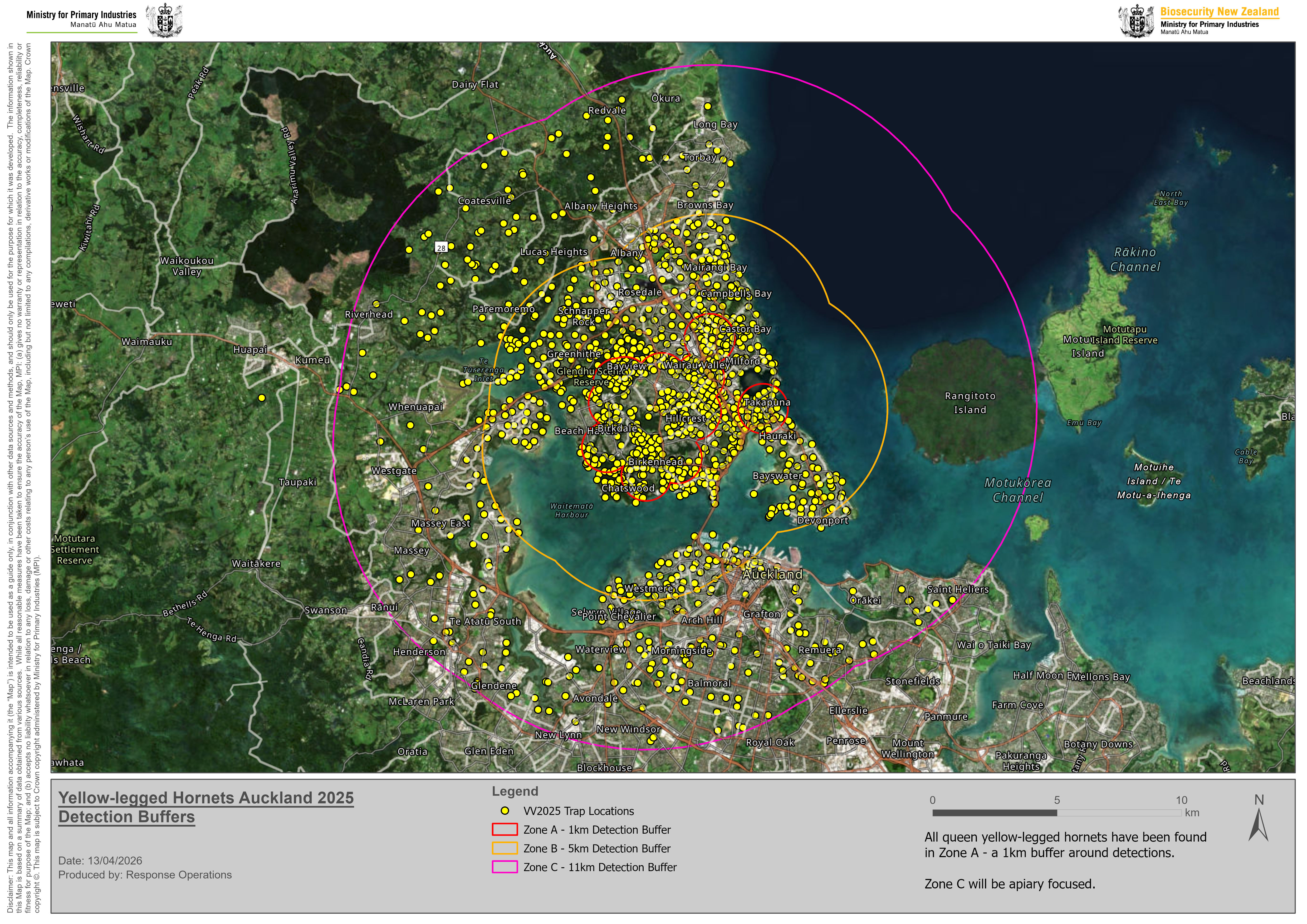
Six months on from the discovery of a yellow-legged hornet queen in Auckland there are encouraging signs New Zealand’s eradication effort is gaining ground.

Teams that have been searching intensively for the highly invasive predators haven’t turned up a new nest since last month.

This result suggests the country’s $12 million response programme – which has seen dozens of nests found and destroyed, alongside a huge public reporting effort – may be starting to get on top of the incursion.

From my perspective, having closely followed the response, there is good reason to be cautiously optimistic this serious threat to New Zealand and its vulnerable ecosystems can be stamped out before it gains a foothold.

Still, this progress comes at a critical moment, when any remaining hornet nests will shift into a new phase and rapidly seed a new generation.

At this time of year, worker numbers peak and colonies would normally begin producing new queens, known as gynes. These queens mate, then disperse and overwinter in sheltered sites, ready to establish new nests in spring.

From a biosecurity perspective, the goal is straightforward: find and destroy every remaining nest before new queens are produced. The coming weeks may determine whether that goal is achieved.

Why this tiny invader remains such a threat

The yellow-legged hornet (Vespa velutina) is an invasive predator native to Asia that has spread rapidly through parts of Europe over the past two decades. It is now widely regarded as one of the most damaging threats to honeybees and other pollinators.

Yellow-legged hornets specialise in hunting live prey.

They are particularly effective at targeting honey bees, often hovering at the entrance of hives and killing returning workers mid-flight. A single colony can consume tens of thousands of honey bees and other insects over a season.

The impact on beekeeping can be severe. Entire hives can collapse under sustained predation pressure. Even when colonies survive, bees [may stop foraging altogether out of fear],(https://link.springer.com/article/10.1007/s10340-018-1063-0), reducing pollination of crops and native plants.

Left unchecked, yellow-legged hornets can multiply fast. Jean-Pierre Muller/AFP via Getty Images

Hornets also pose a risk to people. While they are not typically aggressive away from their nests, they will defend them vigorously if disturbed. In Europe, stings have been linked to cases of anaphylaxis and, in some instances, death.

New Zealand’s incursion appears to be recent and geographically contained.

Since the first queens were detected in Auckland in October, all confirmed nests have been found within a relatively small area on the North Shore. Genetic analysis suggests they may have originated from a single introduction event, over the summer of 2024/25.

AI cameras and ‘Judas hornets’

Behind the 77 queens discovered to date – most of them linked to nests – lies a far larger response effort, measured in thousands of hours of fieldwork, thousands of public reports and a coordinated national push.

Each day, more than 50 people are on the ground hunting hornets. Beekeepers are also helping by monitoring more than 575 apiaries across the region. The wider public response has been impressive: the Ministry for Primary Industries has received more than 16,625 notifications so far.

Two experts visiting from the UK – where teams have been dealing with hornet incursions for years – have been advising on field tactics, tracking and nest detection.

Drawing on that experience, they say the New Zealand response stands out for its scale, coordination and smart use of technology. As Pete Davies, formerly of the UK’s Animal Plant and Health Agency, put it:

You’re throwing everything at it, using all the technology available and treating it with urgency. I remain optimistic that you’ll ultimately eradicate the hornet from New Zealand.

AI-enabled cameras are now being deployed at bait stations to distinguish yellow-legged hornets from wasps and other insects, allowing teams to monitor activity remotely and focus their efforts where it matters most.

Another key tool has been the clever use of so-called “Judas hornets”.

Captured workers are fitted with tiny radio transmitters and released, then tracked as they fly back to their nest – effectively leading search crews straight to hidden colonies that would otherwise be difficult to locate high in trees.

A toxic bait that attracts hornets and wasps, but not bees, has also been deployed. Other non-toxic bait stations have been set out across the search area and are being checked regularly.

For all of this momentum, however, the work is not yet over. Continued public support will be essential to locate any remaining hidden nests. Missing even one could undo this year’s progress and send the response back to square one next season.

If a suspect hornet is spotted, it should be photographed (from a safe distance) and reported. Where traps are in use, they should be checked regularly. Beekeepers are encouraged to monitor hive entrances closely for hornets “hawking” and killing bees.

Clear guidance on identifying yellow-legged hornets, making traps and submitting sightings is available through the Ministry for Primary Industries.

ref. NZ may be winning the fight against the invasive yellow-legged hornet – but a crucial phase lies ahead – https://theconversation.com/nz-may-be-winning-the-fight-against-the-invasive-yellow-legged-hornet-but-a-crucial-phase-lies-ahead-280452

Evening Report: https://eveningreport.nz/2026/04/14/nz-may-be-winning-the-fight-against-the-invasive-yellow-legged-hornet-but-a-crucial-phase-lies-ahead-280452/

Football: Auckland FC boss gets one-match ban for abuse

Source: Radio New Zealand

Auckland FC head coach Steve Corica. Andrew Cornaga/www.photosport.nz

Auckland FC coach Steve Corica will miss his side’s game against Central Coast Mariners this weekend after receiving a one-game ban.

Corica was shown a red card by the referee late in Auckland’s 2-2 draw with Melbourne Victory last weekend for abuse of the match officials.

The match review panel decided he used “offensive, insulting or abusive language and/or gestures”.

The minimum ban for the offence was one game.

Corica will be replaced in the dugout this weekend by assistant coach Danny Hay.

Auckland are second in the A-League standings, three points behind leaders Newcastle.

They play Central Coast in Auckland on Sunday and then are away to Sydney FC in the last two regular season games.

Sign up for Ngā Pitopito Kōrero, a daily newsletter curated by our editors and delivered straight to your inbox every weekday.

– Published by EveningReport.nz and AsiaPacificReport.nz, see: MIL OSI in partnership with Radio New Zealand

LiveNews: https://livenews.co.nz/2026/04/14/football-auckland-fc-boss-gets-one-match-ban-for-abuse/

Road blocked, Main South Road, Selwyn

Source: New Zealand Police

Main South Road in the Selwyn District is blocked following a two-vehicle crash.

The crash was reported to emergency services just before 7.30am.

The Serious Crash Unit have been notified.

Traffic control will be in place from Selwyn Lake Road to Telegraph Road.

Motorists are advised to avoid the area as emergency services work at the scene.

ENDS

Issued by Police Media Centre

LiveNews: https://nz.mil-osi.com/2026/04/14/road-blocked-main-south-road-selwyn/

Fonterra farmer-shareholders ‘bank the good times’ with Mainland sale payments

Source: Radio New Zealand

Cows at a dairy farm in Waikato. RNZ / Sally Round

It is pay day for dairy giant Fonterra’s 8000 or so shareholding farmer-suppliers from the sale of the co-operative’s Mainland Group consumer business.

The proceeds from the dairy co-op’s multibillion-dollar sale of its Mainland consumer brands business were landing in most shareholders’ bank accounts this week.

The average payout would be about $400,000 from the $4.2 billion sale of the business behind well-known brands including Anchor butter, Kāpiti ice creams and Mainland cheese.

Tuesday marked the official payment date, after the sale was first proposed in August last year.

Gary Reymer has been a dairy farmer for nearly 50 years and farms near Cambridge. RNZ / Andrew McRae

Reducing debt a priority

Waikato farmer Gary Reymer, who had supplied milk to the co-op for nearly 50 years, ran around 500 cows on two farms near Cambridge.

He started with the co-op as a sharemilker in the late 1970s, originally to the New Zealand Dairy Group, before the merger with Kiwi Co-operative Dairies formed Fonterra.

Reymer said it would differ how farmers used their payment, as some were more comfortable into the long-term than others.

“Some will have drinks on them, some will take a bit of travel, some will go for debt reduction, and some will go for capital improvement,” he said.

“For ourselves, it’ll just be consolidating our position, nothing extravagant… debt reduction.”

Reymer was among the 98 percent of shareholders who supported the divestment of Mainland Group, and said it was smart to sell it because the brands were no longer adding value.

“Turning off the brands business was probably the final conclusion over many, many years, decades on the back of discussion,” he said.

“Everybody’s just come to the understanding that it was a really difficult nut to crack, and this is probably the best strategy.”

Reymer said not all was lost, as the deal enabled the co-op to continue supplying the ingredients for the new owner, Lactalis.

“I see it as very much a win-win and I think that’s where the majority of shareholders have got to.

“We’ve lived through farming long enough or farmed for long enough and there’s plenty of cycles, and you’ve got to make sure you bank the good times so you can move to the bad times.”

Fonterra’s Anchor brand butter, showing the label claiming it is ‘100 percent New Zealand grass-fed’. Supplied/ Greenpeace

Debt, farm equipment and family holiday

Meanwhile, for Waikato’s Wallis farming family, the mega-payment was going towards reducing debt, buying new farm equipment and a long-awaited family holiday.

Sixth-generation farmer Ross Wallis ran around 285 cows on 108 hectares with his wife and four kids near Raglan. Wallis joined the co-op in the year 2000 and said the consumer brands business had even been a “bone of contention” since back then.

“I think with consumer goods, it was kind of – you were pulled too many ways, and it was just evident that we’re really not a consumer business. We’re not good at it, for whatever reason that might be.

“But ingredients and business-to-business foodservice, I mean we’re exceptional at and we do really well. We’re probably world leaders in that space.”

In support of the deal, he said his payments were already accounted for.

“There’ll be a good chunk of it going into debt reduction, which is greatly needed. But also we’ve just purchased a tow and fert.”

He said the $34,000 investment into the 1000-litre piece of equipment would help reduce his fertiliser bill.

“With fertiliser prices skyrocketing, we just need to be more efficient at what we’re putting on, and so tow and fert allows you to put on less with more bang for your buck.”

Now only using locally sourced fertilisers, Wallis said the new equipment would allow for a more efficient use of spraying lime, small seeds and the seaweed-based fertilisers he used to improve soil biology.

“We’re [also] going to put a little bit towards an overseas holiday later in the year.”

Wallis said many farmers would likely invest in technology to drive on-farm efficiencies, as he had.

“I think we’ve got some exciting times ahead.”

Deferred maintenance, effluent system and succession

Jonn Dawson, a Morrinsville-based farm management consultant of almost 30 years, said many of his clients will be using the payout to pay down debt as their number one priority.

Dawson said others were also planning on reinvesting the money into their farm operations, with the cowshed especially the basis of all dairy farm operations.

“It’s never hard to spend money on a dairy farm,” Dawson said. “There are often deferred maintenance issues that need to be attacked, things like fencing and milking plant maintenance.”

He said compliance and projects like new buildings or machinery updates were other options.

“There are compliance issues, which you can throw a lot of money at, perhaps upgrades to effluent systems and environmental initiatives,” he said.

“The other thing is that there’s the opportunity for expanding the business, you know, more cows, upgrades to cow sheds.”

Dawson said the payout also represented a chance to consider succession planning, which a few of his clients were looking at.

He said the cash injection will be good for communities which supported dairy farmers, especially in regions like Waikato and Taranaki.

ASB chief economist Nick Tuffley did not expect any consumer spending binge, but obvious moves to pay down debt and do some maintenance and capital spending.

“This is a big one-off payment,” he said.

“It will take time for some of the spending impacts to flow through, but that is going to benefit rural communities. And also, we think it’ll put the dairy farming sector in a more resilient position.”

He said a theme coming through was that older farmers were looking to their departure from the industry.

“It will also set up some dairy farmers for their future as well, particularly if they’re looking at diversifying and putting that money to use in other ways that will help them at that time of life if they move off the farm.”

Meanwhile, the co-op’s president of global ingredients Richard Allen was announced on Monday as the new incoming chief executive, following the resignation of Miles Hurrell, announced last month.

Sign up for Ngā Pitopito Kōrero, a daily newsletter curated by our editors and delivered straight to your inbox every weekday.

– Published by EveningReport.nz and AsiaPacificReport.nz, see: MIL OSI in partnership with Radio New Zealand

LiveNews: https://livenews.co.nz/2026/04/14/fonterra-farmer-shareholders-bank-the-good-times-with-mainland-sale-payments/
Retail NZ wants ‘rigorous crackdown’ by government on illicit tobacco

Source: Radio New Zealand

RNZ’s investigation found black market tobacco was sometimes being sold for less than half the price of the regulated product. 123RF

Retail NZ wants an urgent government taskforce created to crack down on illicit tobacco before the problem reaches crisis levels like in Australia.

An RNZ investigation last month found black market cigarettes were being openly being sold in Auckland shops with huge discounts.

In a report released today, Retail NZ, which represents shop owners, called on a “immediate and rigourous crackdown on illicit tobacco.”

Chief executive Carolyn Young said in Australia the horse has bolted, with organised crime groups terrorising shop owners who did not cooperate.

“In Victoria there has been something like 200 fire bombs in the last year. What happens is that if you say you are not going to sell the illicit tobacco, they’ll firebomb your business, they’ll make threats to your family,” she said.

New Zealand needed to act before the black market trade took off here, she said.

There should be a multi-agency taskforce created, including the police, Customs and health, she said

Currently, the police, Customs and the Ministry of Health worked separately to combat the problem and there were low-level penalties, she said.

“We are urging the Government to immediately establish a multi-agency Illicit Tobacco Task Force, increase penalties and have an independent roundtable consider a range of other measures, to ensure the illicit tobacco market is stamped out before it’s too late,” she said.

The illegal cigarettes were also able to skirt many of the measure aimed at decreasing tobacco use in New Zealand, such has packets with warning labels.

There was no way of knowing how much nicotine was in them, she said.

The illicit market was growing very quickly in New Zealand and that was why action was needed now, Ms Young said.

RNZ’s investigation found black market tobacco was sometimes being sold for less than half the price of the regulated product.

One retailer called it an “open secret.”

People caught selling illicit cigarettes, could face a six-month prison sentence, a $20,000 fine or both.

Importing cigarettes without paying the excise duty was illegal under Customs law.

Sign up for Ngā Pitopito Kōrero, a daily newsletter curated by our editors and delivered straight to your inbox every weekday.

– Published by EveningReport.nz and AsiaPacificReport.nz, see: MIL OSI in partnership with Radio New Zealand

LiveNews: https://nz.mil-osi.com/2026/04/14/retail-nz-wants-rigorous-crackdown-by-government-on-illicit-tobacco/

Managed retreat for communities to decide, not government – David Seymour

Source: Radio New Zealand

A slip blocks State Highway 2 in January. Supplied/NZTA

The deputy prime minister says it is up to local communities, not necessarily the government, to decide whether they need to relocate as climate change worsens.

Parts of the North Island have been repeatedly hit by extreme weather events in recent years, particularly the Bay of Plenty, Tai Rawhiti and Hawke’s Bay.

The latest – Cyclone Vaianu – was not as destructive as feared, but still took out roads and flooded communities at the weekend.

Prime Minister Christopher Luxon told Morning Report on Monday that iwi in the eastern part of the North Island were having conversations about relocating from areas vulnerable to wild weather and the effects of climate change.

“They’re having those conversations with the elders who have been very connected to those areas, and that’s been a really positive thing.”

As for the 14 percent – around 675,000 – New Zealanders who currently live in areas prone to flooding, Luxon said it was time to “confront the brutal facts of the reality that actually they are going to be areas of New Zealand that we’re going to have to rethink over time how we manage that”.

Asked whether we should be “pushing fast forward on those discussions” by First Up host Nathan Rarere on Tuesday morning, Deputy Prime Minister and ACT leader David Seymour said it depended on who “we” are.

“It’s more important to break down who has each role. The government has a role in this, and that is producing the national flood maps. producing the National Adaptation Framework, which sets out what the information is in each location and potentially what the options are in any location.

“It’s then up to the communities you mentioned to figure out what’s most important to them and what choices they’d like to make.”

Important roads around the Gisborne region – such as State Highways 2 and 35 – are frequently closed due to flooding and slips when big storms strike. Mayor Rehette Stoltz on Monday said she was not aware of discussions between Luxon and iwi in regards to relocation, but some marae had already been moved and the council had bought dozens of ‘category 3’ homes people could no longer live in.

She said there had been a lack of investment in the national roading network, which is handled by the New Zealand Transport Agency, not local councils.

David Seymour. RNZ/Mark Papalii

Seymour agreed there had been a lack of investment for up to 60 years.

“It’s always easier to defer some maintenance, balance the Budget this year and put physical problems into the future. And we see that in hospitals. school buildings and so on.

“I’d like to think this government is actually doing a bit to improve the accounting and capital asset maintenance.”

He played down the importance of reducing emissions.

“We’ve invested an awful lot of resource in trying to reduce emissions, when in reality that won’t change the picture for New Zealand because the rest of the world will drive emissions whether we do or not.

“What we can change and have in our own power so far as climate change and New Zealanders is the ability to ensure we do adaptation. Now, I sympathise with the mayors… I also point out that since Gabrielle in early 2023, the investment in the highway in Hawke’s Bay has been done precisely to future-proof it against those challenges.

“That doesn’t mean it’s been done everywhere. But yes, there is a couple of historic problems in our policy approach. This government, I believe, is rectifying those. But it’s also true that some work has been done. So there are problems, but not everywhere.”

Sign up for Ngā Pitopito Kōrero, a daily newsletter curated by our editors and delivered straight to your inbox every weekday.

– Published by EveningReport.nz and AsiaPacificReport.nz, see: MIL OSI in partnership with Radio New Zealand

LiveNews: https://nz.mil-osi.com/2026/04/14/managed-retreat-for-communities-to-decide-not-government-david-seymour/

Liam Lawson still concerned about the speed of Racing Bulls car

Source: Radio New Zealand

Liam Lawson of Visa Cash App RB F1 Team VCARB03. Eric Alonso / PHOTOSPORT

Liam Lawson remains concerned about the speed of his Racing Bulls car.

Lawson sits tenth in the Formula 1 drivers’ standings after three rounds afterpicking up points in both China and Japan.

The 24-year-old grabbed valuable points as some other teams struggled with the new hybrid set-up for the cars in 2026.

Lawson also had his issues with the new power unit which now relies on 50 percent electrical power, finishing 13th in the season-opener in Australia when he failed to launch successfully off the start line and slipped from 8th on the grid to finish 13th.

Since then he finished seventh in both the sprint and GP in China and ninth in Japan.

However he remains concerned.

“I think, to be honest, we haven’t actually been that fast, but still managed to come away with three points finishes,” he said following Japan.

“So I think it’s when we get a really quick car, we’ll obviously be in a much better place. And if we keep making the decisions we’re making, I think it’s quite exciting.”

Lawson and the rest of the F1 grid are currently on a break following the cancellation of the Bahrain and Saudi Arabian Grands Prix because of the conflict in Iran.

Lawson has spent some of his off-time playing golf in New Zealand.

The five week break before the Miami Grand Prix does allow teams time to continue to develop their cars.

Liam Lawson and Max Verstappen in 2024. Getty Images / Red Bull Content Pool / PHOTOSPORT

Suggestion Lawson could be promoted back to Red Bull a bad idea

Former F1 driver turned commentator Jolyon Palmer doesn’t believe Lawson would be the right fit for a return to the Red Bull team if Max Verstappen was to leave.

Verstappen has raised doubts about his future as he struggles for results in 2026, while members of his set-up are leaving the once dominant team.

The NZ Herald reported that team principal Laurent Mekies was under pressure to make sure the Red Bull stable of drivers would be used if the Dutch four-time world champion was to leave.

However Palmer believes promoting Lawson or Arvid Lindblad to join Isack Hadjar would not be wise.

“I think, to partner Hadjar with Lawson or Lindblad leaves them too inexperienced. I think they have to import some experience to help bolster Hadjar, if nothing else.”

The Miami Grand Prix is on 3 May.

– Published by EveningReport.nz and AsiaPacificReport.nz, see: MIL OSI in partnership with Radio New Zealand

LiveNews: https://nz.mil-osi.com/2026/04/14/liam-lawson-still-concerned-about-the-speed-of-racing-bulls-car/

Reports of property investment dying may be overstated

Source: Radio New Zealand

Unsplash / Tom Rumble

Investors aren’t giving up on the property market yet – despite reports of large numbers planning to sell.

Cotality’s latest data shows that investors with mortgages were responsible for 24 percent of sales in the first quarter of the year, returning to a level that was in line with their long-term average.

In Auckland they were 26 percent, Hamilton 28 percent and Christchurch 25 percent.

Cotality said it was smaller players driving the increase, such as those who owned their own home plus one investment property.

Chief property economist Kelvin Davidson said lower house prices and mortgage rates helped, as did the return of full interest deductibility.

“Our calculations suggest a ‘typical’ new investor may have had to find an extra $400 to $450 per week when house prices were higher and mortgage rates were 7 percent or more – and interest deductions were being phased out.

“Now that’s perhaps $150 to $200 instead – even though buildings insurance and council rates have risen steadily. It remains a sizeable chunk of cash, but still a lot more feasible for more people.”

A recent survey by independent economist Tony Alexander said a record number of mum and dad landlords were planning to sell their properties.

But Davidson said buying still seemed a popular option, although the approach was not as frenzied as it might have been at points in the past.

“People are definitely looking at property investment right now… it’s probably a measured return. It hasn’t been the big surge in investment purchasing like we saw just after Covid.

“There are some supports for investors but I think people are starting to question it a bit.”

Concerns about the potential for a capital gains tax or for investors’ ability to offset interest costs against their income, to again be reduced if Labour were to return to government might be keeping some people on the sidelines, he said.

“When I talk to people at the moment there is more of an undertone of ‘it has delivered strong capital gains in the past but I’m not so sure about the future’.

“That’s easy to say when house prices are flat and everyone sees prices are flat and they go ‘oh well they’ll always be flat’. But I’m conscious if and when house prices start rising again, everyone changes their tune… I’m always conscious of saying this time is different.”

But he said there were factors that meant gains were likely to be lower in future.

Interest rates had trended lower over the long term, most households were now double-income and the government was pushing forward with plans to increase land supply.

Davidson said some level of investment activity would always be needed to provide rental properties.

“We still need investors but… you have to either accept a lower return because capital gains are lower or you get the same return but you do it a bit differently and get some income or yield off it. You can’t just rely on the capital gain. It has to turn cash flow positive a bit sooner.”

Squirrel chief executive David Cunningham said some investors might decide they did not want to continue topping up their investment properties if there was no chance of capital gains in the short term.

“There was a 20 or 30 year period where you could buy anything and it would go up. I think the savvy investors are sort of the more long-term ones that are habitual investors rather than jumping on the bandwagon because everyone’s been on the bandwagon and it’s been successful.

“I think selective property investment still is really wise and lets you leverage, but it’s all about buying well and not having to top up with cash… which has been the norm.”

Part of the market cycle

Property investment coach Steve Goodey said investor activity dropping and then returning was part of the market cycle.

“All the conversation at the moment that property investment is over and you should sell your apartment in Auckland, you should get rid of this and get rid of that… it’s coming from vested interests… I don’t think investors are actually having these conversations.”

He said banks were willing to lend but some people might be waiting to see what happened with the election.

The data also shows first-home buyers’ share of the market held up at more than 27 percent, well above the long-term average.

In Auckland, their share was higher at about 30 percent, while Hamilton was 33 percent and Wellington 37 percent.

“There remain multiple supports for first-home buyers,” Davidson said.

“Obviously, lower house prices and reduced mortgage rates help, as does access to KiwiSaver for at least part of their deposit. But not even needing to save a 20 percent deposit in the first place is proving beneficial too, as part of the LVR rules, the latest Reserve Bank figures show that more than half of FHB loans over January and February were done at less than 20 percent equity.”

Sign up for Money with Susan Edmunds, a weekly newsletter covering all the things that affect how we make, spend and invest money.

– Published by EveningReport.nz and AsiaPacificReport.nz, see: MIL OSI in partnership with Radio New Zealand

LiveNews: https://nz.mil-osi.com/2026/04/14/reports-of-property-investment-dying-may-be-overstated/

Don’t boycott RUCs over diesel price, vehicle owners told

Source: Radio New Zealand

Diesel was selling for an average $3.89 a litre on Monday, according to Gaspy, while 91 was $3.48. RNZ / Quin Tauetau

Anyone planning to boycott their road user charges (RUCs) as the cost of diesel rises may find their protest backfires.

A number of online groups have raised the prospect of refusing to pay for RUCs as the cost of diesel surpasses that of other fuel types. One group, Stand Up to RUCs, has 1400 members.

Its admin said the government could suspend or reduce RUCs temporarily to take the pressure of food and freight sectors.

Diesel was selling for an average $3.89 a litre on Monday, according to Gaspy, while 91 was $3.48.

While petrol vehicles pay excise tax within their pump price, diesel vehicles pay RUCs on top of what it costs them to fill up. That is because a number of diesel-powered vehicles, such as farm machinery, are not used on roads.

RUCs are charged on distance travelled and according to vehicle weight. Most passenger vehicles will pay $76 per 1000km.

People who do not pay them face a $200 police fine plus a 10 percent penalty on fees not paid within two months. Another 10 percent is added if not paid after three months.

AA fuel spokesperson Terry Collins said even though the price of diesel was high, the idea that it was unfair to pay RUCs on top was unfounded.

“You’re paying a levy to update the roads you’re using. Hybrid vehicles have to do it, diesel have to do it, and ultimately in the future, petrol will have to do it when they move to move all the vehicle fleet over to road user charges.

“Is it unfair? No it’s very fair. Has it come at a time when the diesel prices are high and it’s putting cost pressures on? Yes, but it doesn’t take away from what the road user charges are in place for and what they do.

“The problem is the price of diesel, not the road user charges. They weren’t complaining about the road user charges before this diesel went up, when the diesel was cheap, that was fine to pay.”

David Birkett, Federated Farmers arable chair, said frustration over the price of diesel, as well as other fuels, was understandable,

“There is genuine concern that delivery of diesel to some smaller rural areas is behind schedule. Diesel demand on farm is relatively inelastic and so unavoidable – the crops still have to be brought in, feed taken out to animals, and produce taken to processors.

“However, suspending road user charge payments as some form of protest doesn’t make a lot of sense. Most diesel used by farmers is on the farm, not on public roads, and so does not incur RUC. The financial relief for farmers is therefore minimal.

“Any immediate relief of cost savings from suspending RUCs means there is less money for the Government to spend on road and bridge maintenance and renewal longer term. Many rural roads and bridges are already in dire need of investment.

“Federated Farmers believes the best course is for farmers – and other diesel users – to do what they can to reduce /be more efficient with their use of the fuel. The fix for this situation is a clear return to normalcy in the supply and price of fuels upon which farming and so many other businesses depend.”

The government has expanded the distance-based RUC system to also include light electric vehicles.

EVs had been exempt from the scheme since 2009, but multiple governments had proposed bringing in the charges for EVs once they accounted for 2 percent of vehicles on the roads.

[ https://rnz.us6.list-manage.com/subscribe?u=211a938dcf3e634ba2427dde9&id=b4c9a30ed6 Sign up for Money with Susan Edmunds], a weekly newsletter covering all the things that affect how we make, spend and invest money.

– Published by EveningReport.nz and AsiaPacificReport.nz, see: MIL OSI in partnership with Radio New Zealand

LiveNews: https://nz.mil-osi.com/2026/04/14/dont-boycott-rucs-over-diesel-price-vehicle-owners-told/