Minister to attend AI Impact Summit in India

Source: New Zealand Government

Science, Innovation and Technology and Universities Minister Dr Shane Reti will visit India this week to attend the flagship artificial intelligence (AI) Impact Summit, strengthening international AI partnerships and unlocking opportunities for New Zealand. The theme for the summit is ‘AI for People, Planet and Progress’.

“Attendance at this summit ensures New Zealand has a seat at the table, along with senior international Ministers and officials, to help shape global AI standards, while providing opportunities to strengthen international partnerships and drive economic growth,” Dr Reti says.

“As highlighted in the New Zealand AI Strategy, AI has enormous potential to lift productivity and grow our economy, with some estimates predicting that generative AI alone could add $76 billion, around 15 per cent of GDP, by 2038.

“Our government is focused on unlocking economic opportunity through AI adoption, while ensuring appropriate guardrails. That’s why we are investing up to $70 million over seven years to support innovative AI research and applications, develop world-class expertise, and sharpen New Zealand’s competitive edge.

“This visit is also a chance to strengthen our science, innovation and technology relationships and promote New Zealand as an outstanding destination for international education.

“India is a growing powerhouse in science and technology. While New Zealand already has strong links between universities and research organisations, there is significant potential for greater research collaboration between our two countries. 

“International education partnerships bring students and export earnings into New Zealand, while AI adoption will lift productivity, support higher incomes, and help drive economic growth.”

While in India, Dr Reti will attend the AI Impact summit, meet with science and education counterparts, engage with leading technology firms and undertake a range of education focused engagements. Dr Reti departs New Zealand on 14 February and returns on 21 February.

MIL OSI

LiveNews: https://livenews.co.nz/2026/02/16/minister-to-attend-ai-impact-summit-in-india/

Name release: Waiohiki fatal crash

Source: New Zealand Police

Police can release the name of the man who sadly died following a crash on Korokipo Road, Fernhill, on Friday 9 January.

He was Patutai Patterson Kire, 60, from Flaxmere.

Police extend condolences to Patutai’s loved ones.

Enquiries into the circumstances of the crash are ongoing.

ENDS

Issued by Police Media Centre

LiveNews: https://nz.mil-osi.com/2026/02/16/name-release-waiohiki-fatal-crash/

Wellington Water chair’s resignation ‘right thing to do’ – Mayor Andrew Little

Source: Radio New Zealand

Wellington mayor Andrew Little. RNZ / Mark Papalii

Wellington’s mayor says he has confidence in Wellington Water’s current leadership, after its chair resigned in the wake of the Moa Point crisis.

Nick Leggett stepped down on Sunday, saying the failure at the Moa Point treatment plant was deeply serious and had affected the environment, public health and the community.

Last week the plant failed – sending millions of litres of raw sewage into Cook Strait per day.

Mayor Andrew Little said Leggett’s resignation was the right thing to do, and he believed the remaining directors could lead work on restoring the plant.

“Particularly the deputy chair person who is going to be stepping up – Bill Bayfield – I have confidence they [the directors] will continue to lead the organisation to respond effectively, they have to do that in conjunction with Wellington City Council.”

Little said Leggett made the decision to resign, and that it was “the right thing to do”.

“Wellington Water has I think been struggling with some public confidence issues for some time, this further incident doesn’t help. And it’s not a question of blame, it’s about indicating the organisation accepts the seriousness of it.”

File photo. Nick Leggett. RNZ / Angus Dreaver

Little said he spoke with Leggett last week, who raised with him that he was considering resigning.

He said the priority now was for the organisation to set about fixing the plant.

“The focus now though has to be on Wellington Water being supported to get the recovery done, and an assessment of the damage and a plan for reinstating it, and that’s got to be top priority and that’s my expectation as what they’ll be focusing on.”

Sign up for Ngā Pitopito Kōrero, a daily newsletter curated by our editors and delivered straight to your inbox every weekday.

– Published by EveningReport.nz and AsiaPacificReport.nz, see: MIL OSI in partnership with Radio New Zealand

LiveNews: https://nz.mil-osi.com/2026/02/16/wellington-water-chairs-resignation-right-thing-to-do-mayor-andrew-little/

Six-monthly company reporting season hoped to start to reflect turnaround in economy

Source: Radio New Zealand

Investment firm Forsyth Barr said 2025 looked to have ended on a strong note and it would be looking for revenue and profit margin growth. RNZ

The six-monthly company reporting season is about to start, with high hopes that earnings will start to reflect the turnaround in the economy.

Investment firm Forsyth Barr said 2025 looked to have ended on a strong note and it would be looking for revenue and profit margin growth.

“Many NZ corporates have had three-plus years to right size their businesses, therefore how they speak to operational improvements, cost control, and operating leverage will be key,” Forsyth Barr analysts said.

“This season will be the first litmus test.”

Sharesies head of data and analytics Jordan Cunningham said its customer base would be looking closely at the dividend payout of the big four power companies – Meridian, Contact, Mercury and Genesis.

“Expectations going into this earning seasons are quite subdued, but we think that our investors will be looking to New Zealand stocks in particular for dividends, if they’re looking for that growth potential for New Zealand.”

Power companies were also regarded as defensive stocks, often able to avoid or withstand market volatility.

Cunningham said only about 15 percent of the funds invested on the platform were in NZX-listed companies, with strong support from Air New Zealand, Auckland Airport and Spark.

“Despite that strong US focus, there really is still growing trading in New Zealand, and a really strong buy-to-sell ratio… In recent months for every dollar sold $1.50 was bought.”

The good, the bad, the ordinary

Forsyth Barr expected about 40 percent of reporting companies to have a positive outlook, including speciality milk company A2 Milk, healthcare and pet food firm EBOS, Port of Tauranga and casino operator SkyCity, despite its torrid time in recent years.

A similar proportion was likely to have a neutral outlook, with a handful of companies with potential to disappoint the market.

Among them was the national carrier Air New Zealand, which was expected to deliver a first-half loss, but with hopes of a more positive second-half outlook.

Forsyth Barr senior analyst Matt Montgomerie said companies most exposed to the economic cycle and which were hard hit by the recession such as building product firms, retailers, and service businesses might surprise on the upside.

He said many of the firms had aggressively cut costs, but might not be in a hurry to start spending again.

“This reluctance to re-expand costs creates strong operating leverage … As a result, net earnings growth during upswings can surprise to the upside, often materially outpacing consensus expectations.”

Window on recovery

Amova Asset Management head of equities Michael Sherrock said company reports should provide a steer on the economic turn around, with companies such as transport firm Freightways something of a bellwether.

“For the likes of Freightways, what is customer volume growth looking like? Six months ago, they started to see some pickup in that customer volume growth. How that’s tracking since they last updated the market.”

“The likes of SkyCity as well, somewhat cyclically exposed, but also some regulatory type of issues as well.”

Sherrock, the casino and hotel operator, has been required to implement carded play on pokie machines, and has just taken over the International Convention Centre, which would be pointers for the company’s future earnings.

Others to watch included Fletcher Building, pharmaceutical supplier and pet retailing chain EBOS and Sky Television.

“The market will be very, very focused on (EBOS) given that stock (price) has fallen … on the back of a disappointing result last year. They’ve got a new CEO. What are they telling the market ? And hopefully it’s a positive story, and there’s no disappointments.”

He said Sky TV would be watched to see if it delivered on plans to pay a dividend this year.

Sign up for Ngā Pitopito Kōrero, a daily newsletter curated by our editors and delivered straight to your inbox every weekday.

– Published by EveningReport.nz and AsiaPacificReport.nz, see: MIL OSI in partnership with Radio New Zealand

LiveNews: https://nz.mil-osi.com/2026/02/16/six-monthly-company-reporting-season-hoped-to-start-to-reflect-turnaround-in-economy/

Wellington Water chair’s resignation ‘right thing to do’ – Mayor Anderw Little

Source: Radio New Zealand

Wellington mayor Andrew Little. RNZ / Mark Papalii

Wellington’s mayor says he has confidence in Wellington Water’s current leadership, after its chair resigned in the wake of the Moa Point crisis.

Nick Leggett [ttps://www.rnz.co.nz/news/national/586892/wellington-water-chair-nick-leggett-resigns-over-moa-point-sewage-disaster stepped down] on Sunday, saying the failure at the Moa Point treatment plant was deeply serious and had affected the environment, public health and the community.

Last week the plant failed – sending millions of litres of raw sewage into Cook Strait per day.

Mayor Andrew Little said Leggett’s resignation was the right thing to do, and he believed the remaining directors could lead work on restoring the plant.

“Particularly the deputy chair person who is going to be stepping up – Bill Bayfield – I have confidence they [the directors] will continue to lead the organisation to respond effectively, they have to do that in conjunction with Wellington City Council.”

Little said Leggett made the decision to resign, and that it was “the right thing to do”.

“Wellington Water has I think been struggling with some public confidence issues for some time, this further incident doesn’t help. And it’s not a question of blame, it’s about indicating the organisation accepts the seriousness of it.”

File photo. Nick Leggett. RNZ / Angus Dreaver

Little said he spoke with Leggett last week, who raised with him that he was considering resigning.

He said the priority now was for the organisation to set about fixing the plant.

“The focus now though has to be on Wellington Water being supported to get the recovery done, and an assessment of the damage and a plan for reinstating it, and that’s got to be top priority and that’s my expectation as what they’ll be focusing on.”

Sign up for Ngā Pitopito Kōrero, a daily newsletter curated by our editors and delivered straight to your inbox every weekday.

– Published by EveningReport.nz and AsiaPacificReport.nz, see: MIL OSI in partnership with Radio New Zealand

LiveNews: https://livenews.co.nz/2026/02/16/wellington-water-chairs-resignation-right-thing-to-do-mayor-anderw-little/

Onehunga shooting: Police seize firearm in ongoing investigation

Source: New Zealand Police

Police are continuing to make progress in investigating a shooting in Onehunga last month.

The Auckland City Organised Crime Unit has been investigating the incident on Arthur Street on 16 January 2026.

Detective Senior Sergeant Matt Bunce says the investigation team executed a search warrant at a Māngere property on Friday.

“Our detectives were supported by the Armed Offenders Squad, in which we have recovered a shotgun and ammunition,” he says.

“At this stage we are unable to confirm this firearm was involved in the original offending.”

Police have charged a 43-year-old man with unlawful possession of a firearm as well as unlawful possession of ammunition.

He appeared in the Auckland District Court over the weekend.

“We have no tolerance for blatant violence involving firearms in our community,” Detective Senior Sergeant Bunce says.

“The public will appreciate we can’t share the details of the work ongoing, however we have a dedicated investigative team that is working to hold those involved to account for what happened that day.”

Detective Senior Sergeant Bunce continues to call for any information to assist the ongoing investigation.

If you can assist, update Police online now or call 105 using the reference number 260116/9278.

Information can also be provided anonymously via Crime Stoppers on 0800 555 111.

ENDS. 

Jarred Williamson/NZ Police

MIL OSI

LiveNews: https://livenews.co.nz/2026/02/16/onehunga-shooting-police-seize-firearm-in-ongoing-investigation/

Why your brain has to work harder in an open-plan office than private offices: study

Source: The Conversation (Au and NZ) – By Libby (Elizabeth) Sander, MBA Director & Associate Professor of Organisational Behaviour, Bond Business School, Bond University

Since the pandemic, offices around the world have quietly shrunk. Many organisations don’t need as much floor space or as many desks, given many staff now do a mix of hybrid work from home and the office.

But on days when more staff are required to be in, office spaces can feel noticeably busier and noisier. Despite so much focus on getting workers back into offices, there has been far less focus on the impacts of returning to open-plan workspaces.

Now, more research confirms what many suspected: our brains have to work harder in open-plan spaces than in private offices.

What the latest study tested

In a recently published study, researchers at a Spanish university fitted 26 people, aged in their mid-20s to mid-60s, with wireless electroencephalogram (EEG) headsets. EEG testing can measure how hard the brain is working by tracking electrical activity through sensors on the scalp.

Participants completed simulated office tasks, such as monitoring notifications, reading and responding to emails, and memorising and recalling lists of words.

Each participant was monitored while completing the tasks in two different settings: an open-plan workspace with colleagues nearby, and a small enclosed work “pod” with clear glazed panels on one side.

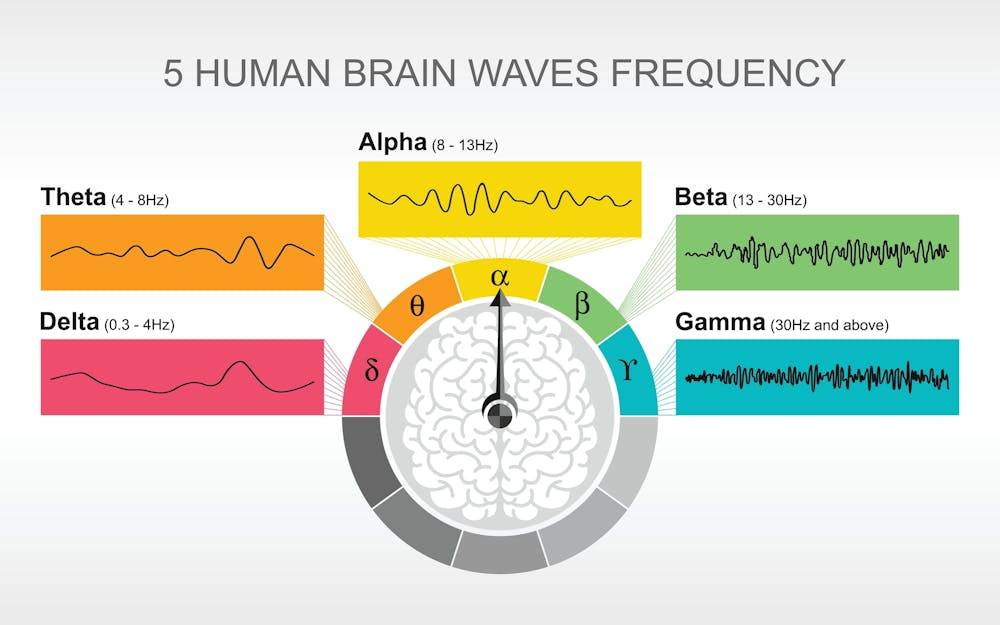
The researchers focused on the frontal regions of the brain, responsible for attention, concentration, and filtering out distractions. They measured different types of brain waves.

Brainwaves are grouped into five different wavelength categories. Shutterstock

As neuroscientist Susan Hillier explains in more detail, different brain waves reveal distinct mental states:

  • “gamma” is linked with states or tasks that require more focused concentration
  • “beta” is linked with higher anxiety and more active states, with attention often directed externally
  • “alpha” is linked with being very relaxed, and passive attention (such as listening quietly but not engaging)
  • “theta” is linked with deep relaxation and inward focus
  • and “delta” is linked with deep sleep.

The Spanish study found that the same tasks done inside the enclosed pod vs the open-plan workspace produced completely opposite patterns.

It takes effort to filter out distractions

In the work pod, the study found beta waves – associated with active mental processing – dropped significantly over the experiment, as did alpha waves linked to passive attention and overall activity in the frontal brain regions.

This meant people’s brains needed progressively less effort to sustain the same work.

The open-plan office testing showed the reverse.

Gamma waves, linked to complex mental processing, climbed steadily. Theta waves, which track both working memory and mental fatigue, increased. Two key measures also rose significantly: arousal (how alert and activated the brain is) and engagement (how much mental effort is being applied).

In other words, in the open-plan office participants’ brains had to work harder to maintain performance.

Even when we try to ignore distractions, our brain has to expend mental effort to filter them out.

In contrast, the pod eliminated most background noise and visual disruptions, allowing participant’s brains to work more efficiently.

Researchers also found much wider variability in the open office. Some people’s brain activity increased dramatically, while others showed modest changes. This suggests individual differences in how distracting we find open-plan spaces.

With only 26 participants, this was a relatively small study. But its findings echo a significant body of research from the past decade.

What past research has shown

In our 2021 study, my colleagues and I found a significant causal relationship between open-plan office noise and physiological stress. Studying 43 participants in controlled conditions – using heart rate, skin conductivity and AI facial emotion recognition – we found negative mood in open plan offices increased by 25% and physiological stress by 34%.

Another study showed background conversations and noisy environments can degrade cognitive task performance and increase distraction for workers.

And a 2013 analysis of more than 42,000 office workers in the United States, Finland, Canada and Australia found those in open-plan offices were less satisfied with their work environment than those in private offices. This was largely due to increased, uncontrollable noise and lack of privacy.

Just as we now recognise poorly designed chairs cause physical strain, years of research has shown how workspace design can result in cognitive strain.

What to do about it

The ability to focus and concentrate without interruption and distraction is a fundamental requirement for modern knowledge work.

Yet the value of uninterrupted work continues to be undervalued in workplace design.

Creating zones where workers can match their workplace environment to the task is essential.

Responding to having more staff doing hybrid work post-pandemic, LinkedIn redesigned its flagship San Francisco office. LinkedIn halved the number of workstations in open plan areas, instead experimenting with 75 types of work settings, including work areas for quiet focus.

[embedded content]

For organisations looking to look after their workers’ brains, there are practical measures to consider. These include setting up different work zones, acoustic treatments and sound-masking technologies, and thoughtfully placed partitions to reduce visual and auditory distractions.

While adding those extra features in may cost more upfront than an open plan office, they can be worth it. Research has shown the significant hidden toll of poor office design on productivity, health and employee retention.

Providing workers with more choice in how much they’re exposed to noise and other interruptions is not a luxury. To get more done, with less strain on our brains, better design at work should be seen as a necessity.

ref. Why your brain has to work harder in an open-plan office than private offices: study – https://theconversation.com/why-your-brain-has-to-work-harder-in-an-open-plan-office-than-private-offices-study-274946

Evening Report: https://eveningreport.nz/2026/02/16/why-your-brain-has-to-work-harder-in-an-open-plan-office-than-private-offices-study-274946/

Ōtorohanga flooding: The silver lining amongst devastation, damage and disarray

Source: Radio New Zealand

An Ōtorohanga man in his 80s is devastated by the damage and disarray at his flooded home after the weekend weather event – save the silver lining of a saved pet goat and an heirloom teddy bear that survived the waters.

Kio Kio Station Road resident Colin Payne had to be rescued by a boat, after floodwaters came through his property in the early hours of Saturday, when the region received between 150 to 300 millimetres of rain.

He said he had a feeling on Friday night that things could get bad when the water came up to his gate, which prompted him to move his campervan to a friend’s house in the town centre before returning home.

Payne slept at about 9.30pm, not expecting that floodwaters would gush through his property, and also not knowing about the state of emergency declared in Ōtorohanga around 1am.

He woke up about 4.30am to find his bed surrounded by water.

A family heirloom teddy bear from Colin Payne’s great great grandfather. RNZ / Marika Khabazi

The only thing Payne managed to pull out of the water before his rescue boat came – besides his medication and clothes – was an heirloom teddy bear and its chair, which was inherited from his great-great-grandparents.

Returning to check on his house for the first time on Sunday, Payne struggled to come to terms with the rooms with knocked over fridges, a fallen TV, and sentimental items strewn over the muddy floors, in rooms where they would have floated for hours.

“Coming in and seeing the mess here is a bit devastating, 85 years of collections … personal stuff and family stuff and heirlooms,” said Payne.

“How do you describe it… I mean daunting, devastated, everything, just suddenly your life’s expired in a sort of roundabout way, if you understand what I mean, from an asset … the biggest trick is you gotta be very careful walking around in the silt because it’s very slippery.”

Colin Payne said he’s devastated to see 85 years worth of collections and family heirlooms drenched by floodwaters. RNZ / Marika Khabazi

A silver lining amidst the chaos of his flood-damaged home and having to write off his drowned vehicle – Payne was relieved to find out that his pet goat Sophie survived, thanks to the help of neighbours.

“At least my good friend Sophie’s been rescued, that’s my favourite friend, my goat.”

Colin Payne and his partner Frances Rawlings. RNZ / Marika Khabazi

Payne’s partner, Frances Rawling – who was not at the house that night – said it was hard to know where to begin when faced with the mammoth task of cleaning up.

“Once the mould sets in… it’s hard to imagine being here again,” she said.

The couple said they have a house in Te Kuiti where they can stay in the meantime.

RNZ / Marika Khabazi

On Sunday morning the rain resumed, and a community member with a quadbike came to help take Payne’s two steers to a safer place.

Craig Janett, who had been helping out, said he felt for the Kio Kio Station Road residents.

“A lot have been lost, one bloke down here lost all his lifestyle block… lost all their stock, washed away, just devastation, the river, the rubbish in the river, the drums, just everything rubbish.”

Payne was moved by the kindness of the community.

A washed over bridge off Kio Kio Station Road. RNZ / Marika Khabazi

“Kio Kio Station Road, K-K-S-R stands for kind, caring, supportive residents, and believe me, that applies to everyone in this street.

“Here’s two people coming this morning and taking my stock away… I know damn well that they’ll be well looked after and they’d take them away and put them onto safer ground, and that’s the kind of community we have in K-K-S-R.”

Sign up for Ngā Pitopito Kōrero, a daily newsletter curated by our editors and delivered straight to your inbox every weekday.

– Published by EveningReport.nz and AsiaPacificReport.nz, see: MIL OSI in partnership with Radio New Zealand

LiveNews: https://nz.mil-osi.com/2026/02/16/otorohanga-flooding-the-silver-lining-amongst-devastation-damage-and-disarray/

Households and the Reserve Bank’s official cash rate decision

Source: Radio New Zealand

How soon is the official cash rate (OCR) likely to start to increase? And will any hint of it send what banks charge higher?

For many homeowners and households, that will be the main thing on their minds when the Reserve Bank issues its next update this week.

It cut the OCR to 2.25 percent in November, but what captured the most attention was the indication that it did not necessarily think it would cut rates much further.

Market attention turned to when the rate might start to lift, and wholesale rates increased, taking banks’ home loan rates with them.

  • Reserve Bank governor sends message markets gone too far
  • Reserve Bank Governor Anna Breman took the unusual step of warning that it might have been an overreaction.

    In recent days though, all the main banks have again shifted their longer-term rates higher, as inflation worries continue to simmer.

    ANZ senior economist Miles Workman said any insight the bank gave into the future path of interest rates would be key for most households.

    “Swap rates have lifted meaningfully since the November MPS (monetary policy statement) as markets have reassessed the outlook for monetary policy following the inflationary vibe across recent data releases.

    “And that’s put upward pressure on fixed mortgage rates. The February MPS is an opportunity for the Reserve Bank to signal whether it thinks that move is justified by recent data and its updated economic outlook. Households may also be listening closely to what the bank says about the inflation and labour market outlooks, given cost of living pressures remain and the labour market is still soft.”

    Mike Jones, chief economist at BNZ, said the Reserve Bank would need to walk a fine line between signalling the OCR would not stay as low for as long as previously thought, and not sending financial markets higher on the expectation of future increases.

    “There will probably be a hat tip from the bank to the fact the economic recovery is growing in momentum, but equally confirmation that a period of low interest rates is still part of the plan to ensure it gets going proper and current spare capacity is soaked up.

    “There does appear to be some concern out there about whether recent lifts in wholesale and retail interest rates might lean against the fledgling economic recovery. The bank will also be wary of this, but it’s also important to note most mortgage borrowers soon to experience a mortgage rate reset will be rolling on to a rate more favourable than previously. So, there’s still some of the lagged impacts of previous rate cuts to come through.”

    He said households would probably also want to see confirmation that the bank still thinks inflation will return to about 2 percent later this year.

    Westpac chief economist Kelly Eckhold said it would also be interesting to watch Breman‘s first press conference.

    “It will be the first opportunity we get to understand what sort of things she thinks are important, how she chooses to express the trade-offs that she inevitably has to deal with when deciding what to do with policy. Ultimately, is she dovish? Is she hawkish? What sort of factors and variables is she going to make more prominent when explaining to people what she’s doing?”

  • New Reserve Bank Governor Anna Breman talks to Corin Dann
  • He said the market had already priced in a lot of cash rate rises this year.

    “It’s not to say that it’s impossible that they could price in more, but it feels like the hurdle, the bar is set quite high to really have those rates have to go up much further.

    “Perhaps, if she was to say that a September rate hike might be something that’s a realistic possibility, that could be the sort of thing that would leave the market to obviously fully price that in, and maybe even start speculating about an earlier move than that. But it strikes me as relatively unlikely, and that instead she might talk about the possibility of a rate rise at the end of the year. And, you know, possibility could have a capital P or a small p, depending on the nature of the discussion that’s around it.”

    He said households might also be interested in what the Reserve Bank expects of house prices.

    “We’re not really forecasting a house-price led recovery. We’ve got 4 percent [increase in house prices] this year, which is close to where the Reserve Bank was forecasting them at the end of last year.

    “What does she think about that? Does she think that the fortunes of the housing market are tightly tied to the fortunes of the broader economy, or not?”

    Westpac last week changed its forecast. It still expects a first increase in November, but then increases at each meeting between February and September 2027.

    “We’ve basically upgraded the growth forecasts, so that means excess capacity will get used up a bit more quickly based on our revised view,” Eckhold said.

    “We think once they get going they’ll move a bit more quickly, because by the end of the year, if the growth outlook that we are depicting has panned out then it won’t really be appropriate to have interest rates in the 2 percents.”

    Sign up for Money with Susan Edmunds, a weekly newsletter covering all the things that affect how we make, spend and invest money.

    Sign up for Ngā Pitopito Kōrero, a daily newsletter curated by our editors and delivered straight to your inbox every weekday.

    – Published by EveningReport.nz and AsiaPacificReport.nz, see: MIL OSI in partnership with Radio New Zealand

    LiveNews: https://nz.mil-osi.com/2026/02/16/households-and-the-reserve-banks-official-cash-rate-decision/

    Auckland’s Eden Park to host State of Origin match in 2027

    Source: Radio New Zealand

    Watch above: Prime Minister Christopher Luxon, Auckland Mayor Wayne Brown and Tourism Minister Louise Upston announce the deal.

    A State of Origin match will be played in Eden Park in Auckland in 2027 following three years of high-level talks with the NRL and the Australian Rugby League Commission.

    It is expected that 50,000 fans will pack the stadium for the Queensland versus New South Wales match.

    Auckland Mayor Wayne Brown said securing State of Origin reflected the city’s strength as a major sporting centre.

    “From the outset, Auckland made it clear we wanted to bring State of Origin to our city, and we’ve worked hard to secure it,” he said in a statement.

    “We know how to host major events, and we know the value they bring. This match will mean full hotels, busy restaurants and bars, and thousands of visitors experiencing everything our region has to offer.”

    Hamiso Tabuai-Fidow of the Maroons celebrates after scoring a try during the State of Origin game two match between the Queensland Maroons and the NSW Blues. AAP / Photosport

    Hosting State of Origin is expected to attract more than 10,000 international visitors from Australia, generate nore than 50,000 international visitor nights, and inject an estimated $17.4 million into the Auckland economy.

    Australian Rugby League Commission chairman Peter V’landys AM said the historic clash would give New Zealanders the opportunity to experience the intensity of the game’s greatest rivalry.

    “Rugby league is the number one sport in Australia and the Pacific, and the growth we have seen in New Zealand over recent years has been nothing short of extraordinary,” V’landys said.

    Sir Graham Lowe, the only New Zealander to coach a State of Origin team as a former Queensland coach, said the occasion would be one to remember.

    “Kiwis are excited about State of Origin, but there are only a few of them that have had the opportunity to actually watch it live. This will be a fantastic occasion for Auckland,” he said in a statement.

    The 2027 fixture is being co-funded in partnership by Auckland Council Events and the New Zealand Government via the Major Events Fund.

    Sign up for Ngā Pitopito Kōrero, a daily newsletter curated by our editors and delivered straight to your inbox every weekday.

    – Published by EveningReport.nz and AsiaPacificReport.nz, see: MIL OSI in partnership with Radio New Zealand

    LiveNews: https://livenews.co.nz/2026/02/16/aucklands-eden-park-to-host-state-of-origin-match-in-2027/

    More gigs, more goals, more growth: Eden Park planning restrictions eased

    Source: New Zealand Government

    The Government is building Eden Park’s future as a major events venue, making significant changes to local planning rules that have been holding Eden Park back from its full potential, RMA Reform Minister Chris Bishop says.

    “Late last year the Government launched an investigation into whether outdated planning rules were unnecessarily limiting Eden Park’s ability to host major events and deliver jobs and economic growth for Auckland and the rest of the country,” Mr Bishop says.

    “That investigation, which included public consultation in November, found the rules were overly restrictive, out of step with modern stadium use, and were directly constraining economic activity. We have now accepted all of the recommendations in full, with some technical amendments to reflect feedback from Auckland Council.

    “The changes will allow Eden Park, New Zealand’s largest stadium with a capacity of around 50,000, to host more major events that bring significant benefits to the local and national economy.

    “Under the new settings, Eden Park will be able to host up to 12 large concerts and 20 medium-sized concerts per year as permitted activities, without needing resource consent. That’s up from its current limit of 12 concerts, which were not permitted to be from more than six different artists or acts.

    “The changes also enable a wider range of events, including exhibitions, displays, markets, fairs, trade fairs, and cultural and community events.”

    Chris Bishop says the changes are expected to be in place in April 2026.

    “Concerts will be able to take place on any day, must finish by 11pm, and can run for up to eight hours. This is a significant increase on the current maximum of five hours on a weekday and six hours on a Saturday.

    “Night-time sports games will be permitted on any day, including Sundays, provided noise standards are met. Existing caps on the number of night games per year and per 35-day period, as well as the restriction on day-night cricket matches, will be removed.”

    Minister for Tourism and Hospitality Louise Upston says it’s a huge step forward for major events.

    “We know big events deliver. For example, over three years, 14 Auckland shows (including Coldplay and Pearl Jam) generated $33.7m for the local economy with 490,000 attendees,” Ms Upston says.

    “These changes sit alongside the Government’s $70 million events and tourism investment package announced in September, which is about helping New Zealand compete internationally, attract world-class events, and give both visitors and locals more reasons to get out and enjoy them.”

    Auckland Minister Simeon Brown says Eden Park is our national stadium and a critical piece of infrastructure for Auckland and New Zealand, and these changes secures its future as a premier events venue.

    “This is a significant win for Auckland and for New Zealand. Strengthening Eden Park’s ability to host major events supports our broader work to grow the economy and ensure Auckland remains a world-class destination.

    “It means more jobs, more activity for local businesses, and more opportunities for people – whether they live here or are visiting – to enjoy more events at our largest stadium,” Mr Brown says.

    “These common-sense changes will enable Eden Park to operate like a modern, world-class stadium and deliver more jobs and economic benefits for Auckland and the rest of New Zealand,” Mr Bishop says. 

    Note to editors: 

    Please see attached fact sheet which compares the key changes to Eden Park’s existing restrictions with the status quo.

    Regulation-making power background:

    The investigation was conducted under the new regulation-making power in the Resource Management Act, recently passed into law through the Resource Management (Consenting and Other System Changes) Amendment Act 2025. 

    The regulation-making power enables the Minister Responsible for RMA Reform to remove or modify provisions in RMA plans where they negatively impact economic growth, development capacity or employment.

    The Minister must investigate the impacts of the provisions and whether specified statutory criteria are met and produce an investigation report which must be made publicly available.

    The Minister must then report to Cabinet with the findings, for a final decision on any changes to the RMA plan. 

    The changes will be delivered via regulations, which will require Auckland Council to amend its plan without using the regular plan-making process.

    MIL OSI

    LiveNews: https://livenews.co.nz/2026/02/16/more-gigs-more-goals-more-growth-eden-park-planning-restrictions-eased/

    State of Origin heads to New Zealand

    Source: New Zealand Government

    In an historic moment, New Zealand will host its first-ever State of Origin match next year at Eden Park, a major event expected to draw thousands of international visitors and deliver a significant economic boost for Auckland.

    The New Zealand Government and Auckland Council have worked in tandem, alongside the Australian Rugby League Commission, to bring the sporting spectacular to Auckland. 

    Tourism and Hospitality Minister Louise Upston says securing one of Australasia’s biggest sporting events represents a major win for fans, tourism and New Zealand sport.

    “I couldn’t be more excited to welcome the Blues and Maroons across the ditch for the very first time,” Louise Upston says.

    “This is a milestone moment for rugby league in New Zealand, but it is so much more than a game. 

    “Hosting State of Origin is expected to attract over 10,000 of our Aussie neighbours, generate more than 50,000 international visitor nights, and inject an estimated $17.4 million into the economy. 

    “With a significant Australian audience, our biggest tourism market, this match will showcase Auckland on an international stage, and put New Zealand on the map as a world-class destination for major events.”

    The State of Origin series is one of the fiercest rivalries in global sport, pitting Queensland and New South Wales against each other in a high‑intensity three‑match contest. Next year, for the first time ever, one of the series matches will be played on New Zealand soil.

    Hosting events has been made even easier because of changes to planning restrictions at Eden Park announced by the Government today, which will unlock the opportunity for more major events to be hosted at the stadium.

    The 2027 fixture is proudly supported by the Government’s Major Events Fund and Auckland Council Events.

    Dates and ticket details for the State of Origin fixture will be confirmed by the NRL later in the year.

    Attached:

    NRL State of Origin fact sheet

    MIL OSI

    LiveNews: https://livenews.co.nz/2026/02/16/state-of-origin-heads-to-new-zealand/

    Amelia Kerr confirmed as White Ferns captain

    Source: Radio New Zealand

    Wellington Blaze captain Amelia Kerr. Kerry Marshall / www.photosport.nz

    Amelia Kerr has officially been confirmed as White Ferns captain.

    Kerr takes over in all formats from fellow Wellingtonian Sophie Devine who stepped down as captain following the ICC Women’s Cricket World Cup in October.

    The 25-year-old, who has represented the White Ferns in 172 internationals, will take on the permanent leadership mantle of both the ODI and T20I sides, having previously led the side in two ODIs and two T20Is.

    Her first official outing in the position will be in the T20 and ODI series against Zimbabwe later this month.

    “Growing up it was my childhood dream to represent New Zealand and to now have the opportunity to captain my country is a massive privilege,” Kerr said.

    “I am following an exceptional group of leaders who have captained the White Ferns before me, so I don’t take the responsibility lightly.

    “The captaincy doesn’t change who I am, I am still the same person and will give everything I can to lead this group and hopefully bring our country success.”

    Since making her international debut in 2016 at the age of just 16, Kerr has gone on to score 3757 runs and take 201 wickets across both formats and is already the White Ferns’ third all-time leading wicket-taker and fifth all-time leading run-scorer.

    Kerr said her leadership philosophy was centred around putting people first.

    “One of my favourite quotes is: ‘He aha te mea nui o te ao? He Tāngata, He Tāngata, He Tāngata.

    “We are people first. As a group we look out for each other, we celebrate each other’s success and we represent our people.

    “Encouraging others and building belief around us so we can all be the best we can be both as people and as cricketers.”

    Amelia Kerr at a glance

    WHITE FERN #188

    • Youngest player to ever debut for the White Ferns (16 years and 27 days)
    • Highest ever individual ODI score for the White Ferns (232* v Ireland 2018)
    • Only New Zealand player ever to win the ICC World Player of the Year (Rachael Heyhoe-Flint Trophy)
    • 2022 Commonwealth Games Bronze medal winner
    • 2024 ICC Women’s T20 World Cup winner
    • 2024 ICC Women’s T20 World Cup Player of the Tournament
    • 3x winner of the NZC Debbie Hockley Medal
    • White Ferns third all-time leading wicket-taker (201 wickets)
    • White Ferns fifth all-time leading run scorer (3757 runs)

    Sign up for Ngā Pitopito Kōrero, a daily newsletter curated by our editors and delivered straight to your inbox every weekday.

    – Published by EveningReport.nz and AsiaPacificReport.nz, see: MIL OSI in partnership with Radio New Zealand

    LiveNews: https://nz.mil-osi.com/2026/02/16/amelia-kerr-confirmed-as-white-ferns-captain/

    ‘Every tonne matters’: The climate scientist who wants to give you hope

    Source: Radio New Zealand

    for Monday AM

    University of Bremen glacier scientist Ben Marzeion RNZ / Kate Newton

    The ice sheets are unstable, the glaciers are melting, sea levels are rising, and one of the world’s largest carbon polluters has just abandoned its global and domestic efforts to curb emissions.

    Every new climate change headline seems to bring another reason to be despondent about the existential challenge the world faces.

    “Sometimes I just want to bury my face in the remaining snow and ice,” British Antarctic Survey director of science Petra Heil told a Wellington audience last week.

    Enter Ben Marzeion.

    The University of Bremen glacier scientist, in New Zealand for the international Climate in the Cryosphere conference last week, has every reason to be gloomy.

    The warming that the world has already locked in – roughly 1.2° Celsius above the pre-industrial average and still rising – means the world is projected to lose 40 percent of all glacier ice over the coming centuries, half of that within the lifetimes of children born today.

    But Marzeion’s presentation at the conference was not about that.

    Instead, together with colleagues, he has been quantifying the impact that saving one tonne – or even one kilogram – of carbon emissions can have.

    “People often really feel powerless when they’re thinking about climate change,” he told RNZ.

    “They think, ok, if I change something, I do a little bit, it’s going to be meaningless if no one else is changing anything.”

    He and fellow researchers always believed that way of thinking was “really wrong” – so they set about finding the numbers to prove otherwise.

    “The main message is that small changes in emissions lead to changes in the climate system, in the Earth’s system, that are surprisingly big, actually.”

    The average person on the planet contributes between five and 10 tonnes of greenhouse gas emissions each year, he says.

    Reducing that by even 10 percent makes a difference.

    “One tonne of CO2 reduction keeps, for example, nine tonnes of glacier ice in the mountains that would melt otherwise.”

    The same reduction prevents 12 cubic metres of sea level rise.

    It keeps 250 grams more fish in that sea, through averted increases in ocean temperatures.

    By similar mechanisms, it protects growing conditions enough to create six more kilograms of rice, or a kilogram of meat.

    “All those things, and many more, are happening at the same time – it’s not that you have to pick one,” Marzeion says.

    An artwork by Olafur Eliasson, The Glacier Melt, highlights glacier loss over 20 years. David St George

    The research looked at the effect of even tinier emissions decreases.

    “If I take my bike for around three kilometres instead of driving a car, I save one kilogram of glacier ice.”

    The numbers sound small, but they are real, and they compound, he says.

    “The idea behind this, really, is to show there is no lower limit to meaningful climate mitigation. Anything you can do is helpful, there is nothing that is too small to be relevant.”

    He does not want to see the numbers misused to place the burden of responsibility entirely on individuals, though, emphasising that global and national political action is still vital.

    “It’s often used as an excuse not just for individual people but for companies or countries not to do anything – saying we are a small country, if we lower our emissions but the US or China is not doing anything, it doesn’t make a difference.

    “And that’s simply wrong – it does make a big difference.”

    Sign up for Ngā Pitopito Kōrero, a daily newsletter curated by our editors and delivered straight to your inbox every weekday.

    – Published by EveningReport.nz and AsiaPacificReport.nz, see: MIL OSI in partnership with Radio New Zealand

    LiveNews: https://livenews.co.nz/2026/02/16/every-tonne-matters-the-climate-scientist-who-wants-to-give-you-hope/

    Live weather: Evacuations, power cuts, roads closed as severe gales, rain batter lower North Island

    Source: Radio New Zealand

    Follow the latest in RNZ’s live blog above

    People have been evacuated in Manawatū and on the coast of the Tararua District due to rising river levels.

    The entire Manawatū-Whanganui region is in a state of emergency with heavy rain, flooding as severe weather lashes the lower North Island.

    Thousands of properties have had power cut off.

    Fire and Emergency have had 185 call outs across the lower North Island – with roofs lifting, power lines down, and trees and windows being blown in.

    Five districts – Manawatū, Rangitīkei, Tararua, Waipā and Ōtorohanga District – are in states of emergency.

    On Sunday afternoon, all remaining flights in and out of Wellington for the day were cancelled, as were Cook Strait ferry crossings.

    Follow RNZ’s live coverage above for the most up-to-date information.

    – Published by EveningReport.nz and AsiaPacificReport.nz, see: MIL OSI in partnership with Radio New Zealand

    LiveNews: https://nz.mil-osi.com/2026/02/16/live-weather-evacuations-power-cuts-roads-closed-as-severe-gales-rain-batter-lower-north-island/

    New dietary guidelines from the US stir the pot

    Source: Radio New Zealand

    U.S. Secretary of Health and Human Services Robert F. Kennedy Jr. unveils the department’s new dietary guidelines food chart during a policy announcement event. ANNA MONEYMAKER/ Getty Images via AFP

    New dietary guidelines from the US have upended the traditional food pyramid, moving protein into the spotlight – but some of the maths doesn’t add up

    When the new Dietary Guidelines for Americans were released in January, it was the graphic on the front – a food pyramid that’s been turned upside down – that grabbed attention.

    But the health sector has turned its focus to the finer details; not just what’s actually in the guidelines, but who’s behind it.

    “The process for the dietary guidelines in America is pretty rigourous and it actually takes years and years,” says long-time food and health journalist Niki Bezzant.

    She says the Dietary Guidelines Advisory Committee puts together a report with recommendations for the guidelines – this takes years.

    But this time, about half of those recommendations were rejected, and a new committee was formed to write new recommendations.

    “That was written by some hand-picked people who were all, as it turns out, aligned with beef, dairy, protein supplement industry interests, and it’s unclear exactly how they got to where they got to with the guidelines.

    “They claim to focus on gold-standard science, but actually their justifications are lacking, at least according to nutrition experts and certainly nutrition bodies around the world.”

    Bezzant points to articles from the Center for Science in the Public Interest, The Journal of the American Medical Association, and Physicians Committee for Responsible Medicine.

    In today’s episode of The Detail, Bezzant and dietician Caryn Zinn look at what’s changed, and the process behind those changes, as well as how this trickles down to New Zealand, and whether we can trust science coming out of the White House.

    “That’s the biggest problem – people are going to look at these guidelines and go ‘oh gosh it’s part of that group which is all nutters so it’s meaningless,’ and that’s problematic,” says Zinn.

    These guidelines put protein, dairy, healthy fats, vegetables and fruits at the top of the pyramid – which is now the wide part of the triangle. Whole grains are at the bottom. Sugars have disappeared altogether. The visual itself takes a few minutes to unpick.

    “I don’t think they’ve done themself a service by flipping it … [my colleagues and my] philosophy was we need to flip the food pyramid in our philosophical thinking about what’s at the bottom and what’s at the top … they’ve actually visually flipped it which has added a little bit of the confusion.”

    But Zinn believes the changes themselves are largely positive.

    Among the positives for her: an emphasis on whole, real food over ultra-processed foods; a strong message that no amount of added sugar is considered nutritious; the prioritisation of protein, including a boost in the recommended daily intake and focus on animal proteins as opposed to plant-based; and a reduction in the recommended daily servings of grains.

    Fat is also in – the guide talks about butter, olive oil and beef tallow, and recommends full-fat dairy and animal proteins without removing fat.

    Zinn says this has brought controversy, because of the relationship between saturated fat and heart disease (which she says is a hotly debated topic).

    The guidelines suggest keeping saturated fats under 10 percent of total calories – but Zinn says it’s “highly unlikely” that someone could eat fatty meats, oils and butter as suggested and still keep their saturated fat intake at that level.

    But how much do these guidelines matter in America, let alone here?

    In the US, they’re used to guide policy and food programmes in places like schools and rest homes. But here, they may still trickle through to the way people think about food – for better or worse.

    “It might certainly affect people’s attitudes and eating behaviours, because we are all consuming the same content. This stuff is out there everywhere on social media,” says Bezzant.

    “The irony is that most people, and this probably is true around the world, don’t follow official guidelines anyway, and certainly in America they do not.

    “It’s true in New Zealand as well – we know that less than 10 percent of us eat the recommended servings of vegetables a day, five to six servings.”

    “I think the danger is probably that people take the simple messages away, right, and the simple message out of this American guideline is that image [of the inverted pyramid], and it’s just ‘hey eat more steak, and butter, woohoo’.

    “And if people go away and do that and they keep on eating their refined grains and their high fat diet and their high sugar and their high salt, no one’s getting healthier from that.”

    Check out how to listen to and follow The Detail here.

    You can also stay up-to-date by liking us on Facebook or following us on Twitter.

    – Published by EveningReport.nz and AsiaPacificReport.nz, see: MIL OSI in partnership with Radio New Zealand

    LiveNews: https://nz.mil-osi.com/2026/02/16/new-dietary-guidelines-from-the-us-stir-the-pot/

    Do you need an admin party to get your life back in order?

    Source: Radio New Zealand

    “We’re always behind on something. We’re always juggling too many things. We’re always trying to deal with some company that we need to remember the password for their portal, or we need to dispute an insurance claim … or we need to wait on hold for a thousand hours for something and then get disconnected and start all over again.”

    American journalist Chris Colin had struck a nerve. So when he suggested gathering friends to party and do life admin, they found it funny but weren’t surprised. He has a reputation for quirky ideas.

    Seven years later, there’s now a waitlist and, after writing about it for The Atlantic and The Wall Street Journal last year, the concept has gone viral.

    Having a few minutes break in between for socialising is important too, Chris Coin says. It has to be fun.

    Supplied / Chris Colin

    LiveNews: https://nz.mil-osi.com/2026/02/16/do-you-need-an-admin-party-to-get-your-life-back-in-order/

    SailGP reviews split-fleet experiment, after high-speed crash between NZ, France

    Source: Radio New Zealand

    Sir Russell Coutts admits the smaller fleet drew mixed reviews from sailors. Alan Lee/Photosport

    SailGP boss Sir Russell Coutts has confirmed this weekend’s split-fleet experiment will become the norm next year, when the professional fleet grows to 14 teams, but reaction from teams is divided.

    New Zealand SailGP off Auckland’s Wynyard Point was marred by a crash that put the Black Foils and France out of the event – and probably more to come – and raised questions about the safety of having 13 boats charging off a start line together at high speed.

    Sailors from both teams were hospitalised, with Kiwi grinder Louis Sinclair suffering compound fractures on both legs and French strategist Manon Audinet being assessed for abdominal bruising, after being thrown forward on impact and breaking the boat’s steering wheel.

    In response, organisers decided to divide the fleet in two for Sunday’s racing to reduce the risk of more mayhem.

    “We’ve been trialling that format for a while now, because we are going to that format next year for all racing,” Sir Russell said.

    “It doesn’t really affect that situation that happened yesterday, because they were sailing in a straight line and it could happen with two boats in a match race.

    “What it does remove is the congestion at the bottom mark gate and sometimes at the top mark gate. It just means less boats on the racecourse, particularly when they’re going in opposite directions, and particularly when it’s gusty and the course of the boats is varying a lot.

    “In reality, it probably wouldn’t make much difference on the first leg of the course.”

    Black Foils and France come together during racing off Wynyard Point. Felix Diemer for SailGP

    Drivers provided varying reviews of the smaller fields, with some insisting they preferred the bigger fleet, while others relished the ability to sail without their heads on a constant swivel, checking for impending danger.

    One of those not convinced was NZ-born Italy driver Phil Robertson, who actually predicted the reduction before it happened.

    “I think it was what the sailors wanted and it was the reasonable thing to do, but the spectacle was compromised a bit,” he said. “It will probably get a heavy review and we’ll definitely have some suggestions on how to make the racing a little safer with all the boats on the course, because I think it’s good to have everyone out there.”

    Sir Russell acknowledged the feedback was mixed.

    “Some of them like the bigger fleet and there’s competitive elements to that too,” he said. “Some think they start better in the bigger fleet, some think they’re better in a small fleet.

    “It’s competitive sport and you have to balance the politics with the real desire to make it a safer situation. That’s the role of the league to step in and say we think it’s going to provide safe racing by splitting the fleet in certain conditions, so we did it today.

    “Once we grow to seven-and-seven, then eight-and-eight, split fleet will be absolutely fine. We weren’t planning on doing it this weekend, but clearly, with the conditions, it was the prudent thing to do.

    “Ultimately, if it’s a question of safety over visual experience, clearly safety has to govern that decision.”

    Coutts’ ultimate vision is for a 20-team championship, with split fleets of 10 boats.

    Because the French were not at fault, their boat will be repaired first and, ironically, that may entail using the salvageable parts of the New Zealand boat to replace damage to the French boat.

    The Black Foils were docked eight event points for causing the impact and presumably driver Peter Burling will incur more demerit points on his new licence, on top of the three he earned in a collision with Switzerland at Perth last month.

    “There is a new boat under construction in Southampton, but I checked last night and that’s not due to be completed until June,” Sir Russell said. “Eventually, the league will have two spare boats, so if you had a situation like that, they would race the next day in a different boat.

    “We’re not at that level yet. We’re still a relatively new sports property and we’ve got to get to that point.

    The French boat will be repaired before the Kiwis, because they weren’t at fault for the incident. James Gourley for SailGP

    “I think the reality is they’re out of the season standings now. Realistically, they’re not going to score any points for the first three events at least and they’re going to get some penalty points.

    “They’re obviously one of the top teams in the league and it’s a tragedy that it’s happened to them, but that’s sport. Sometimes you get the unexpected and unwanted situations, but they’re a good team and they’ll come back.”

    Meanwhile, Coutts confirmed Auckland would likely be retained on the SailGP calendar, despite delays in formalising a hosting agreement next year.

    He admitted the hold-up was a clash with Ocean Race round-the-world event, which will also stop in Auckland early next year.

    “Everyone’s super-enthusiastic, including SailGP. We’ve agreed all the major terms, the financial terms to have it here long term.

    “The one stumbling block is the Ocean Race, which has an agreement prohibiting other events within 5km of their race. They are saying they don’t want SailGP at this point, but I think eventually, they will realise it’s a win for everyone to have both events here.

    “I think it’s a win for Auckland City and both events. We’re restricted in our shipping dates, so we can make the event before and the event after.”

    Sign up for Ngā Pitopito Kōrero, a daily newsletter curated by our editors and delivered straight to your inbox every weekday.

    – Published by EveningReport.nz and AsiaPacificReport.nz, see: MIL OSI in partnership with Radio New Zealand

    LiveNews: https://nz.mil-osi.com/2026/02/16/sailgp-reviews-split-fleet-experiment-after-high-speed-crash-between-nz-france/
    Winter Olympics: Alice Robinson misses medals, snowboarders impress

    Source: Radio New Zealand

    New Zealand Alice Robinson at the Winter Olympics, 2026. www.photosport.nz

    Queenstown skier Alice Robinson missed out on the medals in the Giant Slalom at the Winter Olympics.

    Robinson finished eighth in a very tight Giant Slalom competition, missing out on the podium by just 0.13 seconds.

    Italy’s Federica Brignone completed a golden double on home snow adding the giant slalom title to the Super-G won last week, while U.S. Alpine ski great Mikaela Shiffrin again missed out on a medal finishing 11th.

    Robinson made a couple of minor mistakes on her first run and was sitting in 10th position. She managed to improve a couple of places on her second run.

    “I was pretty disappointed,” Robinson said, describing the moment when she first crossed the line to see that she’d missed out on a medal spot.

    “I came down, and I saw I was in fourth (and that point) and only 12 hundredths behind. It was hard, but then watching the rest of the race play out, it actually ended up a bit better than I thought.”

    Robinson finished eighth equal in the Super G last week.

    “There have been so many emotions for me in the past month. I really wasn’t sure what to expect today. I think GS has been a bit of a question mark for me the past two months. From having such a good start to the season and then I was really struggling a lot, especially in the last race,” Robinson said.

    “So, today I really didn’t know what was going to happen. I felt a lot better on my skis but I didn’t really feel like I was going to be in the running for a medal. Then to have it be so close and let it slip away, it was quite sad but I’m proud at the same time.”

    Zoi Sadowski-Synnott of New Zealand at the Winter Olympics, Italy, 2026. www.photosport.nz

    Snowboarders top qualifying

    Dane Menzies and Zoi Sadowski-Synnot have topped their respective snowboarding slopestyle qualification.

    With bad weather forecast the competition was brought forward a day with Menzies putting in a strong first run which included a switch backside 1260 into frontside 1440, finishing with a 1660.

    His score of 86.06 put him in the top spot, and there he stayed.

    “It felt pretty good for sure, I definitely was not expecting that,” said Menzies. “I didn’t expect the judges to score that high, but they’re liking my selection of rails, so that’s good.”

    In the women’s qualifying rounds, defending Olympic champion Zoi Sadowski-Synnott made an immediate statement, posting an opening score of 81.73 to move into second place.

    She went big on run two, adding a 1260 to her jump line and lifting her score to 88.08 to take over first place.

    “It feels really good to land,” said Sadowski-Synnott. “There was a lot of pressure going into today, but I’m just grateful that we got good weather so that all the girls could show their best snowboarding.”

    Lyon Farrell and Rocco Jamieson finished 15th and 18th respectively in the men’s slopestyle qualifying, while Lucia Georgalli was 20th in the women’s.

    The women’s slopestyle final is scheduled for 1am Wednesday morning (NZT) with the men’s on Thursday at 12:30am (NZT).

    – Published by EveningReport.nz and AsiaPacificReport.nz, see: MIL OSI in partnership with Radio New Zealand

    LiveNews: https://nz.mil-osi.com/2026/02/16/winter-olympics-alice-robinson-misses-medals-snowboarders-impress/

    Corrections takes action against staff’s ‘unacceptable’ use of artificial intelligence

    Source: Radio New Zealand

    A privacy risk assessment was undertaken where instances of inappropriate use by Corrections’ staff were identified. RNZ / Blessen Tom

    Corrections staff have been warned about the use of artificial intelligence tools after some staff were found to be using it to draft formal reports.

    Corrections said any misuse of technology is taken “extremely seriously”, and that they have made it clear to staff that any use of AI tools outside of their approved use is “unacceptable”.

    RNZ understands there have been instances where staff used AI to draft formal reports such as Extended Supervision Order reports.

    In response to questions from RNZ, chief probation officer Toni Stewart said Corrections’ use of AI was currently limited to Microsoft Copilot. Other publicly available AI applications are blocked on the Corrections network.

    “This ensures AI use at Corrections occurs within an environment where we can manage privacy and security controls.”

    Do you know more? Email sam.sherwood@rnz.co.nz

    Staff use of Copilot was governed by its AI policy, which was in line with guidance from the government chief digital officer.

    “The policy is explicit that personal information, including any identifying details, health or medical information, or details relating to people in Corrections’ management, must not be entered into Copilot Chat.”

    Stewart said the uptake of Copilot remained “relatively low” with about 30 percent of Corrections staff engaging with the tool since it was introduced on Corrections devices in November 2025.

    “Copilot is intended to be used solely as an assistive tool to create and refine content that does not contain sensitive information. Corrections staff can only access the free Microsoft Copilot Chat feature that is part of our existing Microsoft 365 licence and is a standalone chat function, without integration into our system data.”

    Stewart said the policy was clear that Copilot Chat must not be used under any circumstances to draft, structure, analyse, or generate content for reports or assessments that contain personal information. Staff may be subject to auditing, with all prompts searchable and exportable.

    “We have recently become aware of a small number of incidents where staff have used Copilot to assist with their work in a way that does not comply with our AI policy and guidance.

    “We’ve taken action as soon as we’ve become aware of these instances and made it extremely clear that any use of Copilot outside of its approved use is unacceptable.”

    A privacy risk assessment was undertaken where instances of inappropriate use were identified.

    “Our leaders, particularly within Community Corrections where staff write a number of reports, are actively working to ensure proper AI use is an ongoing conversation with staff.

    “Staff are regularly reminded of the AI policy and other relevant guidance.”

    Stewart said Corrections was “actively working” to ensure any ongoing use of AI was “safe, secure and appropriate”.

    “Corrections has an AI assurance officer, a function held by the director cybersecurity, who is accountable for guiding safe and secure adoption of AI. This includes external reporting to the government chief digital officer.

    “Corrections participates in the All of Government Community of Practice on AI, managed by the government chief digital officer. We also have established the AI working group to provide formal governance of AI which includes embedding safe and ethical AI practices across the department and provide consistent advice on its safe use.”

    Any misuse of technology was taken “extremely seriously”, Stewart said.

    “We are committed to protecting the privacy of the people we work with and maintaining the professional integrity of our assessments, reports, and case documentation.”

    As of Friday, no notifications had been made to the Office of the Privacy Commissioner, a Corrections spokesperson confirmed.

    “Alongside our existing guidance, our privacy team are working with the relevant work groups to provide further guidance on the use of Copilot in the Community Corrections space. Any information entered into Copilot by Corrections remains within the Corrections’ domain.”

    A spokesperson for the Office of the Privacy Commissioner (OPC) said in a statement that the Privacy Act applied to the use of personal information, including through AI tools.

    It was the responsibility of agencies to understand the technology they use and to ensure use met privacy requirements, the spokesperson said.

    “Corrections has stated that its policy prohibits staff from entering personal information into Copilot Chat or using Copilot to prepare reports or assessments containing personal information.

    “If this is correct, then privacy concerns would be limited to any cases in which Corrections staff use Copilot in breach of Corrections policy. Where Copilot is used in a way that breaches Corrections policy, OPC would expect Corrections to take appropriate action to remedy this.”

    Sign up for Ngā Pitopito Kōrero, a daily newsletter curated by our editors and delivered straight to your inbox every weekday.

    – Published by EveningReport.nz and AsiaPacificReport.nz, see: MIL OSI in partnership with Radio New Zealand

    LiveNews: https://nz.mil-osi.com/2026/02/16/corrections-takes-action-against-staffs-unacceptable-use-of-artificial-intelligence/