Keith Rankin Analysis – A Black Sheep to Rule them All

Analysis by Keith Rankin.

Keith Rankin, trained as an economic historian, is a retired lecturer in Economics and Statistics. He lives in Auckland, New Zealand.

It’s great that there is a new season (Season 9) of William Ray’s podcast series Black Sheep, which looks at contributors to New Zealander history, many little known, who were of dubious or ambiguous character.

Here I draw attention to a black sheep who I think trumps them all, Edward Arthur Wilson; though he doesn’t really qualify for William Ray’s series, because his black sheepishness only happened after he left New Zealand.

Edward Arthur Wilson, born in Birmingham England in 1878, arrived in New Zealand in 1901. He married Margery Clark in 1902; she was a recent immigrant from Queensland, though her mother had been born in Wellington in 1852. Both the Wilson and Clark families were members of the somewhat messianic Catholic Apostolic Church (not to be confused with the Roman Catholic church), founded originally by Edward Irving in the 1820s.

Wilson’s employment in England (1901 census) had been as a telephone inspector. In Wellington in 1902, he’s listed as a ‘stenographer’. Edward and Margery had two children, in 1904 and 1906.

In 1911 the family sailed to Canada. Margery and the two children were on the Mārama, arriving in May 1911; presumably Edward was already there. In the 1911 census of Canada, Edward is living with his family in Sunnyside, Calgary, Alberta; listed again as a stenographer. His story gets murky after that.

Apparently, he abandoned his family in 1912. He never returned to New Zealand, though his family did. I understand that he has living descendants in New Zealand. Margery identified herself as a ‘widow’ in the 1920s (in Auckland), and was listed as ‘next of kin’ to her co-resident brother during World War One.

Wilson appears to have worked as a shipping clerk for the ‘merchant navy’ for around ten years from 1912; work that seems to have involved lots of travel, much of it no doubt in dangerous waters. He apparently had a major prophetic vision while in France, in the early 1920s. (His apostolic upbringing will have primed him for this.)

Nostradamus meets Rasputin meets Charles Manson meets Bert Potter

Edward Arthur Wilson restyled himself as Brother XII. He created the Aquarian Foundation in 1927, in the context of radical theosophy. In that time in the early-mid-1920s, he wrote many prognostations about the fate of the world. At that time – in the problematic remission phase of the 1914-1945 Great World War, albeit before modern social media – there was a substantial audience for alternative narratives, given the perilous reality of the then world order.

The story of Wilson’s aquarian cult – based at Cedar-by-the-Sea, just out of Nanaimo, British Columbia, Canada – is well summarised in Fear, Distrust, and Black Magic, written in 2024 by Kristin D’Agostino for A-B Tech (Asheville-Buncombe Technical Community College) in North Carolina, United States. (Follow the link to part one first: How a 1920’s Socialite Fell Under a False Prophet’s Spell; the focus here is on Mary Connally, Brother XII’s principal patron.) While Mary Connally was an heiress, most of her fellow aquarians were also from prosperous families, and many not young – contrast most of the 1960s’ aquarians) searching for some missing insights as to where the seemingly bankrupt world went wrong.

The Aquarian Foundation community existed in two phases, from 1927 to 1928, and 1928 to 1933. In 1928 there was an important court case in which the prosecutors, judge, chief witness and court gallery appear to have been mesmerised by Wilson. The case collapsed when chief witness Mary Connally gave Wilson a glowing testimony instead of the damning evidence anticipated.

In the second phase of the community, Mary Connally became a slave to Wilson and his new paramour and enforcer, Madame Z, aka Mabel Scottowe; aka Edith Mabel Rowbotham, a former schoolteacher. And the cult became increasingly obsessed with hoarding money.

It’s not for me to say much more – others have done that – other than to note that Wilson’s ‘death’ in Switzerland in 1934 was possibly faked, signed-off by a member of the Aquarian Foundation. (Though it would have been hard for a narcissist sociopath like him, if still alive, to have rendered himself completely invisible.) Madame Z later married a man called Edric John Douglas Agate in 1943. In the United States’ 1950 census they were living together in – Eugene, Oregon – as Murray D and Edith M Agate.

Other Material about Brother XII

De Courcy Island farm of notorious cult leader up for sale, 7 May 2021, Times and Colonist.

For Sale: The Former Home of B.C.’s Notorious Apocalypse Cult, 8 June 2021, Montecristo Magazine.

#177 Edward Arthur Wilson, 9 March 2026, BC Booklook.

XII Brother, ABC Bookworld.

5 things you probably didn’t know about the Gulf Islands, 11 Jan 2026, Vancouver is Awesome.

entry in Dictionary of Canadian Biography

The Aquarian Foundation (about 1990), by James A. Santucci, professor of Comparative Religion at California State University; and The Aquarian Foundation, 18 February 2024.

Secrets of Brother XII, episode of Expedition Unknown (S.4, Ep.10) Josh Gates, 28 Feb 2018

The Dream of Brother XII, CBC podcast by Moss, Jennifer, 22 March 2016

ENCORE: Searching for Brother XII—the story of Nanaimo’s infamous cult leader, CBC podcast by Moss, Jennifer, 29 August 2016

The collapsing birth rate becomes front-page news, and a long-foretold financial crash? The Hub predicts 2026, Howard Anglin, a doctoral student at Oxford University

Works by John Oliphant, including Brother XII: The Strange Odyssey of a 20th-century Prophet and His Quest for a New World, 2006, Twelfth House Press

*******

Keith Rankin (keith at rankin dot nz), trained as an economic historian, is a retired lecturer in Economics and Statistics. He lives in Auckland, New Zealand.

Evening Report: https://eveningreport.nz/2026/02/03/keith-rankin-analysis-a-black-sheep-to-rule-them-all/

Labour leader Chris Hipkins sets signts on Māori seats

Source: Radio New Zealand

Labour leader Chris Hipkins. VNP / Phil Smith

Labour leader Chris Hipkins has reiterated his determination to win all the Māori seats in November’s election, as parties gather at Waitangi.

He told Morning Report that candidate elections were underway for Labour.

“I’ve been very clear that we want to do very well there.”

Asked about Te Pāti Māori which currently holds all seven seats, Hipkins said “they need to sort themselves out”.

“They’re in court and that’s really where their focus should be.

“In the meantime, we’re going to be busy organising in the Māori seats to win them back.”

The party was involved this week in a substantive hearing at the High Court in Wellington after a two of its MPs, Mariameno Kapa-Kingi and Tākuta Ferris, were expelled.

Kapa-Kingi’s lawyers are arguing Te Pāti Māori’s constitution was not upheld during the process.

Hipkins told RNZ his message at Waitangi would be the same as elsewhere – that the country is stronger when people identify areas of common interest, work together and move forward.

In contrast to his stance on Te Pāti Māori, Labour is aiming to project a united front with the Greens at Waitangi with a joint press conference at the Treaty Grounds aimed to demonstrate working together despite policy differences.

Sign up for Ngā Pitopito Kōrero, a daily newsletter curated by our editors and delivered straight to your inbox every weekday.

– Published by EveningReport.nz and AsiaPacificReport.nz, see: MIL OSI in partnership with Radio New Zealand

LiveNews: https://nz.mil-osi.com/2026/02/03/labour-leader-chris-hipkins-sets-signts-on-maori-seats/

Celebrations commence for Operation Waitangi

Source: New Zealand Police

Operations for Waitangi Day are well under way in Northland after months of planning leading up to a day of national significance. 

Police is assisting a number of communities and partners as annual events take place ahead of 6 February.

Northland District Commander, Superintendent Matt Srhoj, says Police have been working alongside Iwi and the Waitangi National Trust to ensure a safe and memorable Waitangi celebration.

“It takes months of extensive planning from a large cohort of people and agencies to ensure this week of events goes off without a hitch.”

Superintendent Srhoj says locals and those travelling to Waitangi and the Bay of Islands ahead of Friday are reminded to plan ahead.

“We are expecting large numbers of people to attend the week’s commemorations so please be patient on the roads as it will be busy.

“Police is also asking motorists to wear seatbelts, drive to the conditions and follow the speed limits so everyone can enjoy the festivities.

“Once again we are looking forward to the week and celebrating Waitangi 2026 together.”

ENDS.

Holly McKay/NZ Police

LiveNews: https://nz.mil-osi.com/2026/02/03/celebrations-commence-for-operation-waitangi/

Radio tracker use ramps up – more hornet nests found

Source: NZ Ministry for Primary Industries

Radio tracking technology has now enabled the detection of ten yellow-legged hornet nests as the eradication response effort on Auckland’s North Shore continues to accelerate.

Biosecurity New Zealand’s commissioner north, Mike Inglis, says the technique – attaching tiny radio transmitters to worker hornets and tracking them back to their nests – has quickly become a core tool in the response programme.

“Our capability with the equipment is growing rapidly, helped by practical advice from visiting experts in hornet management from the United Kingdom,” Mr Inglis says.

“Once we have a transmitter attached to a hornet, we are typically locating the nest within a few hours.”

See a video of a tracker being attached – YouTube shorts

“The trackers, which complement on-the-ground surveillance and public notifications, will become increasingly useful as summer progresses and hornets begin building larger secondary nests high up in trees where they’re less visible to ground searchers.

“We have located 3 secondary nests so far and after comprehensive planning, have successfully treated and removed them. 

“We always expected to find increasing numbers of hornets, and we have scaled up our surveillance and tracking programme accordingly. Finding hornets and their nests is a sign that our response is working as intended.”

Using tracking, trapping and ground surveillance, along with public notifications, the team has located and destroyed 49 queens, 51 nests and hundreds of workers to date.

The team was able to locate 3 small nests– one in Takapuna and 2 in Forrest Hill. These finds are well within zone B of our intense surveillance and trapping area – with zone C going out to 11km.

A network of more than 1,080 traps is operating. The zones reflect the density of traps and there have been no detections outside the 11km area.

“Public support continues to be vital to our response, with more than 11,060 notifications to date. 

“We encourage anyone who has a suspected hornet specimen, has located a possible nest, or has taken a clear photo to report it to us online at report.mpi.govt.nz or by calling 0800 809 966,” Mr Inglis says.

More information and updates on yellow-legged hornets

For more information email BiosecurityNZ_media@mpi.govt.nz

For further information and general enquiries, call MPI on 0800 008 333 or email info@mpi.govt.nz

For media enquiries, contact the media team on 029 894 0328.

LiveNews: https://nz.mil-osi.com/2026/02/03/radio-tracker-use-ramps-up-more-hornet-nests-found/

Italian restaurant in Petone closes doors after 20 years

Source: Radio New Zealand

Soprano on Jackson Street. Supplied/Google Maps Street View

A Petone Italian restaurant is being sold after nearly 20 years, following an “incredibly tough” few years for the hospitality industry.

The owners of Soprano on Jackson Street, Latisha and Jonathan Dowling, posted on Facebook that the decision had not come lightly.

“As heartbreaking as it is to share this news, we wanted to share with you that we have made the choice to close/sell Soprano so we can spend more time with our families and step into a new chapter,” they said.

“Hospitality has given us so much in the last two decades, but the last few years – especially COVID – were incredibly tough. Like MANY in our industry, we poured everything we had into keeping the doors open, the lights on and our people cared for.”

Now was the right time to embark on something new, the couple said, adding that the restaurant was woven into their life story.

“It’s where we first met, worked side by side with the previous owner, fell in love, got married, and went on to have our three beautiful children.

“Today, our journey has come full circle, with our eldest now 14 and working the floor – something that fills us with more pride than words can say.”

The Dowlings thanked their customers who they said were part of their family.

The owners are now taking expressions of interest from prospective buyers.

Their last day of business, if not sold prior, will be 31 March.

Sign up for Ngā Pitopito Kōrero, a daily newsletter curated by our editors and delivered straight to your inbox every weekday.

– Published by EveningReport.nz and AsiaPacificReport.nz, see: MIL OSI in partnership with Radio New Zealand

LiveNews: https://nz.mil-osi.com/2026/02/03/italian-restaurant-in-petone-closes-doors-after-20-years/

Did you miss the best time to lock in a longer home loan rate?

Source: Radio New Zealand

BNZ has increased some of its longer-term home loan fixed rates. RNZ / Marika Khabazi

BNZ has increased some of its longer-term home loan fixed rates, prompting one economist to say that in hindsight, late last year was borrowers’ best option to lock in a longer rate.

It has cut its six-month rate by 20 basis points to 4.49 percent.

But the four-year rate lifts by 26 basis points to 5.55 percent and the five-year by 40 basis points to 5.69 percent.

“The increases bring their rates to roughly where everyone else has moved to over the last couple of weeks,” said Infometrics chief executive Brad Olsen.

“I think pressure is starting to come on a little bit more when it comes to funding rates, given that if you look at two- to five-year swap rates, they have increased by about 20 basis points again between the end of December and the end of January. There’s probably anelement of trying to wait as long as possible but the realities for bank funding have now become more apparent.”

He said the cashback promotions seen in the past couple of months proved banks wanted to be competitive.

“I wouldn’t be surprised if there was a little bit of a pause until you get a better read at the end of the month when the Reserve Bank makes the decision about the official cash rate. Because at that point, you’ll have a bit of a stronger view of what’s the likely path forward.”

He said it was likely that the talk at the end of last year about whether it was the right time to fix for five had probably proved to be correct. “That’s always the beauty of hindsight, right?”

Sign up for Money with Susan Edmunds, a weekly newsletter covering all the things that affect how we make, spend and invest money.

– Published by EveningReport.nz and AsiaPacificReport.nz, see: MIL OSI in partnership with Radio New Zealand

LiveNews: https://nz.mil-osi.com/2026/02/03/did-you-miss-the-best-time-to-lock-in-a-longer-home-loan-rate/

What should New Zealand do in the new world order?

Source: Radio New Zealand

US President Donald Trump at the World Economic Forum (WEF) annual meeting in Davos on January 22, 2026. AFP MANDEL NGAN

There’s a rupture in the international rules-based order, but that doesn’t mean New Zealand will be crushed by bigger powers

New Zealand has been a beneficiary of the international rules-based order for decades – trade disputes, action on serious issues, being heard on the world stage; there was a world body to give us a hand sorting stuff out.

While there have been inconsistencies, hypocrisy from superpowers, and the system hasn’t been perfect, it has, generally, worked for us.

But Russia and America between them have shaken up the system, and in a remarkable speech at the World Economic Forum in Davos, Canadian Prime Minister Mark Carney laid it all out.

“I thought this might be the most important political speech on geo-politics for many a long year,” says Tim Groser, a former diplomat; once New Zealand’s chief trade negotiator; ambassador, including to the United States and the World Trade Organisation; and a National government Minister of Trade.

He says the key message of the speech was to acknowledge the reality that we are seeing a rupture of the rules-based system.

“It’s not just the United States. It is also the invasion back in 2014 of Crimea by Russia, to break the most important norm of the post-war order in Europe, which is, do not try and change sovereign frontiers with force.

“This has been the most important issue facing Europe now for at least 500 years, and was the cause of three wars … the Franco-Prussian war, and the two world wars.

“So it’s not just the United States. The order that we lived in from 1945 to, I think around 2010, was quite remarkable in so many respects, and almost perfect for a small country like New Zealand.”

Mark Carney’s speech spelt out how the ‘middle powers’ such as Canada, Japan and Australia need to act together, “because if we’re not at the table, we’re on the menu”.

New Zealand is not a middle power, but not helpless either, says Groser.

“Some New Zealanders vastly exaggerate our influence. They seem to think that the whole eyes of the world are watching every move that we make and if we only do the right thing everyone else will think ‘oh my goodness me, we must do what the Kiwis are doing’. This is a fantasy.

“But the more common fantasy is to understate our significance.

“Of course we are a small country. But in terms of GDP measured in conventional terms, we’re the 52nd largest economy in the world in relative terms. Which means since there are over 200 sovereign countries in the world, there are 150 countries smaller than New Zealand.”

New Zealand has also had historic developments to help us cope with these world changes, when in the 1950s Britain joined the European union and our main trading partnership evaporated. It forced us to diversify our markets. Groser says Canada needs to do the same now.

Canadian journalist Jayme Poisson, who hosts the CBC’s Front Burner podcast, says Carney’s speech has landed well in Canada with those who like the idea of being a middle power with power.

But there’s a debate going on in the wake of Carney’s speech over how realistic that strategy actually is.

“Because at the end of the day, we share this massive land border with the United States. We send 70 percent of our exports to the United States. So we’re not just like some random middle power. We are the middle power right next door to the hegemon and we are inextricably tied to them for security and economics … so you can see why people are debating here how much our role is to not rupture our relationship with the United States, and how much our role is to lead this pack of middle powers to do something more ambitious.”

Carney, she says, is “good at bluntly describing reality in a pretty sophisticated way. He was one of the first leaders to come out and say the world has changed … and our relationship with the United States is not what it was before.”

The speech has been criticised for Carney poking the bear when he didn’t have to, and when up until now he’s kept his head down.

But it’s possible Carney has just displayed the kind of strength and leadership that the US President so admires.

“They just spoke,” she says, “and Carney has reported that it was a fine conversation. And while we did see this response from the Americans – you know, mockery, you can’t live without the United States, and threat of a 100 percent tariff floated if we get close to China, that has not come to fruition. It’s just kind of subsided. So certainly that’s a pretty good argument to make – that he likes strength, he likes winners. And that he’s so mercurial that you might as well just stand up to him anyway, because you don’t really know what he’s going to do, day to day.”

Poisson says there’s a lot of anti-American sentiment in Canada right now and Carney’s remarks resonated. His approval rating rose eight points in the wake of the Davos speech, and is currently up at 60 percent.

“I think everybody [in Canada] thought this was a good speech,” she says. “I think the critiques are … was it smart? And is it going to come with consequences, and are those consequences worth it?”

Listen to the podcast to find out why Tim Groser isn’t entirely pessimistic about international developments, and why a rupture doesn’t mean collapse.

Check out how to listen to and follow The Detail here.

You can also stay up-to-date by liking us on Facebook or following us on Twitter.

– Published by EveningReport.nz and AsiaPacificReport.nz, see: MIL OSI in partnership with Radio New Zealand

LiveNews: https://nz.mil-osi.com/2026/02/03/what-should-new-zealand-do-in-the-new-world-order/

Love for music leads EIT student back to study

Source: Eastern Institute of Technology

21 seconds ago

Thirteen years after leaving an accounting diploma, Francis Chiaroni has completed a Bachelor of Creative Practice (Music) at EIT and is preparing to graduate.

Now 38, Francis first studied at EIT in 2012, enrolling in a Diploma of Accounting. While he completed six months, Francis soon realised the field was not the right fit.

After leaving study, Francis focused on full-time work, setting himself the goal of purchasing his first home. In 2015, at the age of 28, he achieved that milestone.

Francis Chiaroni has completed a Bachelor of Creative Practice (Music) at EIT and is preparing to graduate in April.

“That was always my dream. I feel very fortunate, especially knowing how difficult it is now for people trying to buy their first home.”

Several years later, a conversation with his mother prompted Francis to consider returning to study, this time to pursue a long-held interest in music.

“She encouraged me to give it a go and see whether it suited me,” he says. “That conversation really changed things.”

Francis enrolled in the Bachelor of Creative Practice (Music) three years ago, beginning his studies just before Cyclone Gabrielle.

“It was a strange way to start. We had online classes at first, then worked out of places like the Cabana, Paisley Stage and MTG Theatre. It didn’t feel normal, but everyone adapted.”

Despite the challenges, Francis says his time at EIT proved both rewarding and transformative.

“The tutors were very supportive, and I made a lot of connections. Being around creative people and being able to support and mentor some of the younger students, was really meaningful for me.”

During his studies, Francis developed his skills as a vocalist and pianist, while also learning guitar, bass and songwriting. In 2024, he began writing and releasing his own original music.

“I reached a point where I realised I had the skills and knowledge to back myself. I didn’t want to leave it too late and regret not putting anything out.”

Live performance became a central part of his experience, helping him build confidence and manage anxiety.

“I feel much more comfortable performing now.”

One of the most memorable moments of his degree came during the end-of-year performances, where Francis appeared across multiple first and second year sets and also performed alongside his parents.

“Both my parents are musicians, so performing together was very special. It was a moment we’ll always remember.”

While music remains his primary focus, Francis says the degree has also opened his thinking around future pathways, including teaching and further creative opportunities.

“Completing this degree has brought out a better version of me. When I started, I had a lot of anxiety and self-doubt. Now I’m proud of what I’ve achieved and excited about what comes next.”

Francis will graduate in April and says finishing his degree is a milestone he once never imagined reaching.

“It’s been a long journey but one I’m incredibly proud of.”

Music tutor Svetlana Eliason said it was a pleasure to witness the steady development of Frank’s creative voice.

“His exploration of his Italian and Irish ancestry informed sincere and authentic musical compositions; under his musical alias Frankly, he releases honest, reflective and deeply personal music. Central to this journey was his strong connection to his parents, whose encouragement played a key role in his decision to study the Bachelor of Creative Practice.

“This support was beautifully reflected in the end-of-year festival where Frank performed alongside them, creating a moving and memorable moment for his whānau and audience alike.”

LiveNews: https://nz.mil-osi.com/2026/02/03/love-for-music-leads-eit-student-back-to-study/

Tiny radio transmitters reveal a hidden survival tactic in birds

Source: The Conversation (Au and NZ) – By Alice Barratt, PhD Candidate, Hawkesbury Institute for the Environment, Western Sydney University

White-backed swallow in Sturt National Park. Alice Barratt, CC BY-NC

In Sturt National Park, near Tibooburra in central Australia where temperatures can range from freezing to nearly 50°C, there lives a small bird with a white back, forked tail and – as we’ve just discovered – a very clever strategy to survive its extreme environment.

The white-backed swallow (Cheramoeca leucosterna) is a type of passerine – the largest group of birds, comprising 60% of all bird species.

Scientists have long thought these birds incapable of deep torpor – a controlled state of reduced body temperature that saves energy and has been found in many animals in the northern hemisphere, where winters are more severe.

But our new paper, published today in the journal Current Biology, shows otherwise.

A white-backed swallow equipped with a temperature sensing radio-transmitter.
Chris Turbill, CC BY-NC

Understanding how animals cope with extreme conditions

Animal physiologists have long seen the value of studying animals in extreme conditions to understand their survival strategies.

In the past, however, field instruments were cumbersome or delicate and studies were mostly limited to artificial conditions in the laboratory.

This was a problem for several reasons.

First, in captivity wild animals are often stressed and don’t tend to exhibit their full capabilities. Exposing captive wild animals to extreme conditions is also logistically difficult and an animal welfare concern.

But more recently, technological advances allow us to measure the physiological responses of animals when they are exposed to extreme conditions in the wild.

Tracking birds to their burrows

Biologging involves attaching electronic devices to animals that can record key traits such as movement, body temperature and energy expenditure. It is providing a fascinating window into the natural lives of animals.

Technological advances have meant these devices have become miniature in recent years. This has greatly expanded the species scientists can study in the wild and provides an exciting opportunity to challenge long held assumptions based on lab-based studies – including about torpor.

Night-time radio-tracking of white-backed swallows.
Chris Turbill, CC BY-NC

Our team set out to investigate the white-backed swallow, which has been the subject of some intriguing reports over the years.

For example, during cold and wet winter periods, observations as old as 1936 have reported finding the birds in their sandy burrows during the daytime that appeared in a torpor-like state: “inert, nestling into each other as if to escape from the bleak winter’s day”.

Over the winters of 2023 and 2024, we used miniature (400 milligrams) temperature sensing radio transmitters to study the thermal physiology of these swallows in Sturt National Park – the traditional lands of the Wongkumara, Wadigali, and Malyangapa peoples.

We tracked tagged birds to their burrows at night and set up autonomous data logging units nearby to record their body temperature data.

Following a tenuous radio signal on foot across the desert was spectacular on a clear starry night. But sometimes it was also tiring and intimidating.

After that, we trusted our data logging units to collect the steady radio pulses emanating from the resting birds. From these we obtained their body temperature, and therefore their potential use of torpor.

We had two major inland rain events in winter 2024, leading to local flooding. This meant we were unable to access our field site. So we waited it out in the local campground, hoping our trusty loggers were still recording data while enduring the unusually chilly nights.

Downloading the body temeprature data from the receiver and data logging units deployed near white-backed swallow burrows.
Chris Turbill, CC BY-NC

An extraordinary discovery

As the land dried out, we returned to find something extraordinary.

During and after these extreme rain events, the birds remained in their burrows even during the daytime. And they entered deep and long bouts of torpor – far exceeding what passerine birds were thought capable of.

Such torpor is presumably crucial for these in-flight foragers to survive when wet and cold conditions suppress the activity of flying insects.

More generally, our discovery of torpor use by a passerine bird suggests that this strategy is not limited to hummingbirds, nightjars and their relatives.

Instead, it could be a more widespread adaptation for survival across the diversity of birds.

Flooding of a typically dry creek during heavy rainfall.
Alice Barratt, CC BY-NC

A new wave of discoveries

Our finding adds to a growing number of recent discoveries revealed by biologging about the thermal adaptations of birds and mammals when faced with extreme conditions.

In 2024, for example, we found that even the largest of bats, the flying foxes (Pteropus species), are capable of using torpor during cold winter conditions that pose a risk of starvation.

In contrast, during summer, when flying foxes can be exposed to extreme heat events, our biologging data has shown they employ controlled increases in body temperature. This adaptation reduces the costs of shedding heat and helps to avoid lethal dehydration.

These data are essential for us to understand how animals survive extreme weather events, which are becoming increasingly common and severe with a warming climate.


The authors would like to acknowledge Justin Welbergen, Ben Moore and Anthony Hunt for their contribution to the research.

Alice Barratt receives funding from Western Sydney University, Hawkesbury Institute for the Environment and the Australian Bird Study Association.

Christopher Turbill receives funding from the Australian Research Council, and the Australian Commonwealth and New South Wales government.

ref. Tiny radio transmitters reveal a hidden survival tactic in birds – https://theconversation.com/tiny-radio-transmitters-reveal-a-hidden-survival-tactic-in-birds-274517

Evening Report: https://eveningreport.nz/2026/02/03/tiny-radio-transmitters-reveal-a-hidden-survival-tactic-in-birds-274517/

Our study shows younger siblings spend more time on screens than big sisters and brothers

Source: The Conversation (Au and NZ) – By Danusha Jayawardana, Research Fellow in Health Economics, Monash University

Atlantic Ambience/ Pexels

Where kids are born in a family can be important. But it is not just about who gets more grown-up privileges or parental pressure.

Research tells us firstborn children, on average, tend to do better on a range of outcomes. This includes doing better at school and being more likely to be top managers when compared to those born later.

In our new study, we looked at what impact birth order might have on how children spend their time. Both on their own and with their parents.

This revealed differences in terms of screen use and time spent enriching their intellectual development.

Our research

In our study, we used survey data from around 5,500 Australian children aged two to 15. The data comes from the Longitudinal Study of Australian Children, a nationally representative survey.

This included detailed 24-hour diaries, which recorded how children spent their time from waking up to going to sleep. They specified if activities were done with parents or independently.

We grouped activities into “sleep”, “school time”, “enrichment activities”, “screen time” and “physical activities”.

Enrichment activities are outside of school activities that help intellectual development. For example, reading, homework, playing board games or learning a musical instrument.

We then compared the diaries of firstborn children to later-born children from different families born in the same year, living in the same neighbourhoods, with similar socioeconomic backgrounds. All families had two or three children.

There is no similar data (such as time use records over years) available on siblings within the same family to capture and compare what siblings were doing at the same age.

Other studies looking at different outcomes (such as academic achievement) have shown birth order comparisons within a family are extremely similar to birth order comparisons across different families, once you adjust for family size, as we have done in our study.

So, it is likely our results would be similar to actual sibling comparisons within a family.

Younger kids get more screens

When compared to firstborn children, second- and thirdborn children spend an extra nine and 14 minutes, respectively, per day having screen time.

While this may sound modest, it represents a 7–10% increase compared to the average daily screen time of firstborns. Over the course of a week it is between about one and 1.5 hours.

This extra screen time also comes at the cost of other activities. In particular, later-born children spent 11 to 18 minutes less per day on enrichment activities, an 11–20% reduction compared to older siblings in the study.

We found no consistent differences between older and younger siblings when it came to time spent on other activities, such as school, physical activity or sleep.

Looking across age groups, the effects are generally greater for 10–14-year-old children. This suggests early adolescence is a period where particular attention is needed.

To check whether these patterns extend beyond Australia, we repeated the analysis using time-use diaries from a sample of children in the United States. The results were similar.

Why is this happening?

One common explanation for differences between first and subsequent children is parental time. As families grow, parents have less time and attention to foster subsequent children’s development.

However, this may not be the whole story. Our study showed later-born children did spend less time on enrichment activities with their parents. But about half of the difference comes from later-born children spending less time on enrichment activities on their own.

Screen time shows a similar pattern. The increase among later-born children is largely explained by activities they do alone, rather than with parents or siblings.

So this also reflects differences in children’s own choices or opportunities, not just direct parental involvement. For example, a younger sibling may have more freedom to choose to play video games rather than do their homework.

Of course parenting may still play an important role here. Our study shows later-born children face fewer rules around screen use, such as limits on programs or time, and are less likely to feel their parents expect them to follow rules. This may in part reflect parents’ desire for fairness in allowing similar use of screens for siblings at any given time, rather than at specific ages.

What does this mean?

The differences we find may seem small on any given day.

But they can add up over time. As our 2024 study showed, spending more time on screens and less time on reading, homework or other learning activities can lead to gaps in academic skill development over childhood, as measured by lower NAPLAN test scores.

The increase in solo screen time for later-born children is particularly concerning, because it may expose children to inappropriate content online.

What can we do?

First, recognising later-born children on average spend more time on screens and less time on enrichment activities than firstborns can be helpful for informing parenting strategies.

Second, it shows spending quality time with later-born children, actively encouraging enrichment activities, and keeping consistent rules around screen time all matter.

Finally, this suggests broader policies, such as the social media limits for under 16s, could help equalise opportunities for later-born children to learn and grow.

Gawain Heckley receives funding from the Swedish Research Council for Health, Working Life and Welfare (dnr 2023-01128).

Nicole Black receives funding from the Australian Research Council.

Danusha Jayawardana does not work for, consult, own shares in or receive funding from any company or organisation that would benefit from this article, and has disclosed no relevant affiliations beyond their academic appointment.

ref. Our study shows younger siblings spend more time on screens than big sisters and brothers – https://theconversation.com/our-study-shows-younger-siblings-spend-more-time-on-screens-than-big-sisters-and-brothers-273904

Evening Report: https://eveningreport.nz/2026/02/03/our-study-shows-younger-siblings-spend-more-time-on-screens-than-big-sisters-and-brothers-273904/

Australia’s Pacific worker scheme is far from perfect – but we can make it better

Source: The Conversation (Au and NZ) – By Peter Mares, Adjunct Senior Research Fellow, School of Media, Film and Journalism, Monash University

The Pacific Australia Labour Mobility scheme (PALM) is a crucial source of workers across regional Australia. About 32,000 people from nine Pacific nations and Timor-Leste work in Australia under PALM.

Over seven months of researching the scheme – interviewing workers, employers, country liaison officers, trade union organisers, community volunteers and academics, as well as digging into the data on it – I didn’t encounter anyone who thought it was a bad idea.

But there were many calls for change to make it work better for everyone. My , published today, suggests where we could start.

Who benefits from PALM now?

PALM has short- and long-term streams. Under the short-term stream, operating since 2012, workers can stay for nine months to do seasonal jobs such as fruit picking.

The long-term stream, introduced in 2018, allows for a four-year stay. Most long-term workers are employed in meat processing.

PALM is widely credited with delivering a triple win.

The first win is for Pacific participants and their communities.

In 2024-25 PALM workers remitted A$450 million to their home countries, an average of $1,500 each per person per month. The money bought food, paid school fees, upgraded housing and financed small enterprises.

Benefits flow beyond immediate families. After working in an Australian abattoir, Devid John Suma returned to Vanuatu and invested $30,000 to supply clean drinking water to his remote village.

The second win is for Australia’s economy. PALM workers make a significant contribution to regional businesses that struggle to attract local workers, from farms to abattoirs.

The third win is that PALM advances Australia’s strategic interests, not least by providing a counter to China’s wooing of Pacific nations.

Pacific leaders might wish for more aid from Canberra and be frustrated by the government’s tepid action on climate change. But well-paid work is something Australia offers that China does not.

Persistent problems

Yet the wins of the PALM scheme have countervailing costs in the pain of separated families, loneliness and broken marriages.

PALM is dogged by reports of workers being abused, underpaid or housed in substandard, overpriced or overcrowded accommodation.

Thousands of PALM workers have quit their approved jobs, “disengaging” from the scheme. This breaches their visa conditions and leaves them vulnerable to exploitation.

Drifting from its original mission

PALM has profoundly changed migration between the Pacific and Australia.

It brings workers to Australia from countries that have seen minimal migration to Australia since Federation, despite their geographic proximity — particularly the Melanesian countries Papua New Guinea, Solomon Islands and Vanuatu that were sources of labour in the late 19th century, when indentured South Sea Islanders built Queensland’s plantation economy.

But the future of PALM is not guaranteed.

Some Pacific countries, including Papua New Guinea, would like more of their nationals engaged under the scheme, while others worry it creates workforce shortages and disrupts community life.

Participation peaked at 34,830 workers in September 2023 and was at 32,365 in November 2025. Numbers in the long-term stream are steady, but fewer short-term workers are being recruited as employers revert to using backpackers — a cheaper, less regulated workforce — for seasonal jobs.

So, PALM has drifted from its original mission of filling seasonal gaps in the rural economy through annual circular migration, to become a labour program for sectors like meat processing and aged care with a constant demand for workers.

In April 2022, three-quarters of all PALM workers were in the short-term stream and a quarter were long-term. Now, more than half of all PALM workers hold long-term visas.

How to make the scheme work better

The PALM scheme changes lives and communities in the Pacific and Australia, often for the better. But its problems must be addressed to realise its potential.

Australian employers will turn away from a scheme that is too bureaucratic, expensive or cumbersome. PALM’s future won’t be secured by burying it under layers of rules and reporting.

has ten recommendations to improve PALM. These include:

  • making it easier for PALM workers to change jobs, rather than tying them to a single employer
  • simplifying PALM scheme rules for employers
  • regulating labour hire at the national level
  • giving workers access to Medicare while they’re in Australia to stop them missing out on medical attention
  • and reforming working holiday programs by phasing out the second and third visas offered to backpackers who do work like fruit picking in regional areas.

Australia’s interest in fostering Pacific development and rivalry with China are added reasons to limiting working holidays and expanding the PALM scheme instead.

PALM is a work in progress and will never be perfect. The scheme is shaped by the power differential between Australia and its Pacific partners. And there are tensions between three priorities: being a development program enhancing Pacific wellbeing, being a labour market program benefiting Australia’s economy, and serving a strategic purpose in Australia’s rivalry with China.

Yet when it operates well, PALM is far more than transactional.

Beyond wages earned, jobs filled and diplomatic points scored, it also fosters cultural exchange and personal engagement, binding the peoples of Australia and the region more fully into a “Pacific family”.

Peter Mares received funding from The Scanlon Foundation Research Institute to research and write “Improving PALM: Pacific Australia Labour Mobility”, but the views in this article are the views of the author alone and do not represent the position of the Scanlon Foundation. Peter Mares is a fellow at the Centre for Policy Development and a sessional moderator with Cranlana Centre for Ethical Leadership. He is a regular contributor to Inside Story magazine. He has also received past Australian Research Council funding.

ref. Australia’s Pacific worker scheme is far from perfect – but we can make it better – https://theconversation.com/australias-pacific-worker-scheme-is-far-from-perfect-but-we-can-make-it-better-274618

Evening Report: https://eveningreport.nz/2026/02/03/australias-pacific-worker-scheme-is-far-from-perfect-but-we-can-make-it-better-274618/

From statement sleeves to the codpiece: 5 fashions which should come back from Tudor England

Source: The Conversation (Au and NZ) – By Grace Waye-Harris, Early Career Researcher in History, Adelaide University

Portrait of Elizabeth I of England, 1588. Woburn Abbey/Wikimedia Commons

There are few dynasties in history as well-known as the Tudors. From Henry VIII’s six wives to Elizabeth I’s defeat of the Spanish Armada, the Tudors continue to capture imaginations.

While sex, power and public execution provide endless entertainment, if you ask me, the enduring popularity of the Tudors is down to one factor – their magnificent fashion.

Dress was serious business in Tudor England. Clothing was its own language with each textile, colour and style carrying a different meaning. This allowed people to display their identity, status, and even send political messages.

From the Elizabethan Ruff to Henry VIII’s codpiece, here are five Tudor fashions which should make a comeback.

1. The linen shift

Sounds like a boring place to start, but the linen shift was a staple in every Tudor wardrobe.

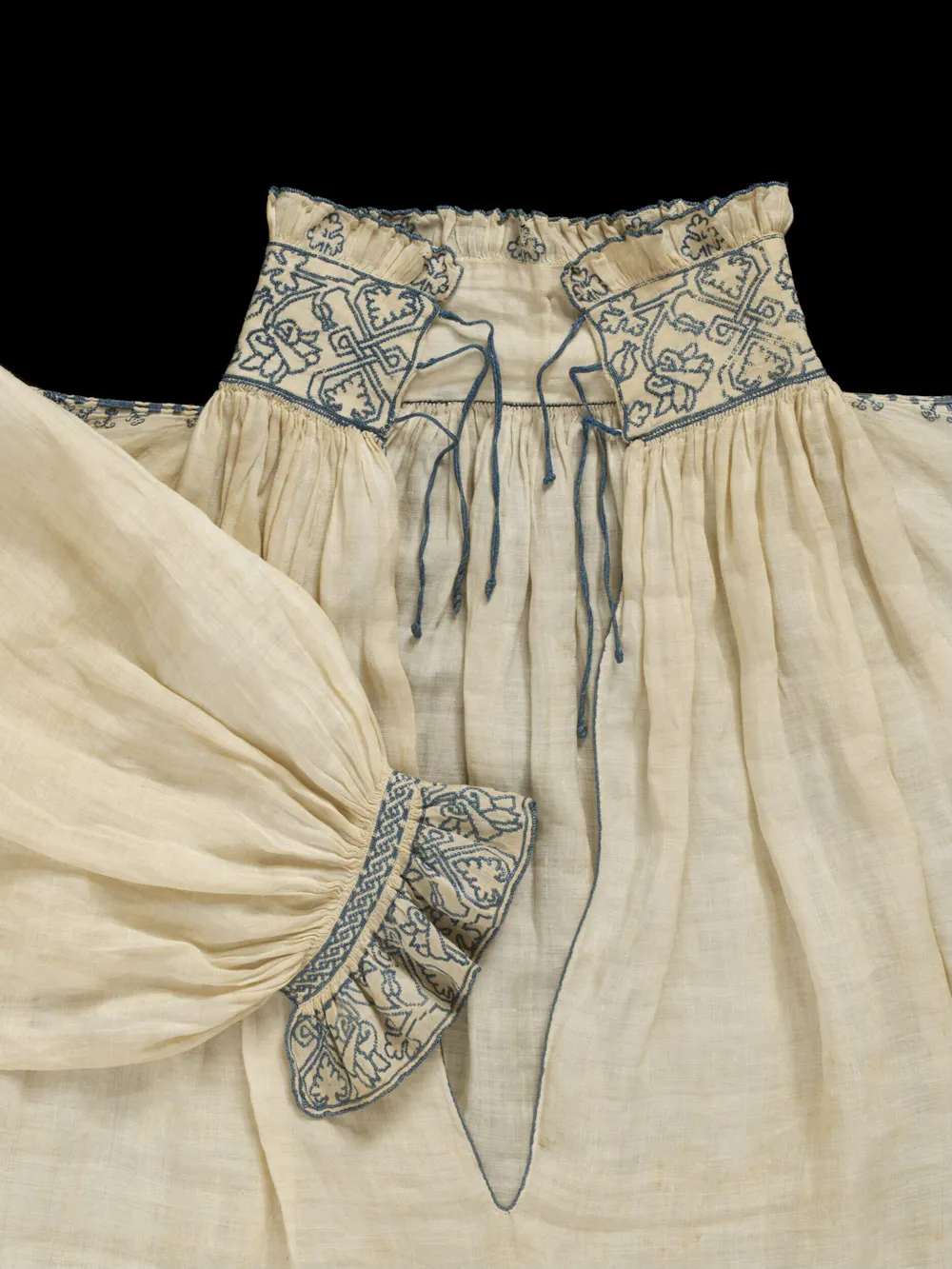
Linen was inexpensive, breathable and could be laundered daily. Contrary to popular belief, the Tudors were obsessed with cleanliness and hygiene. Linen absorbs sweat, bodily fluids and was believed to protect the skin from diseases such as the plague. Wearing and changing your linen shift daily was the best way to stay clean and protected from infection.

The collar on this linen shift, from around 1540, was larger so it could be seen under the outer garments.
©Victoria and Albert Museum, London, CC BY-NC

A fashionable trend of the Tudor period saw the collar on the linen shift become larger so it could be seen under the outer garments. A clean collar demonstrated that you could afford to change your shift and therefore had good hygiene.

You know what they say, cleanliness is close to godliness.

2. The ruff

If there is a single item of clothing that is most redolent of the Tudors, it’s the ruff.

The ruff was a pleated collar made from linen or lace and given its iconic stiff shape with starch. During the reign of Elizabeth I, large lace ruffs became an elaborate status symbol because they were difficult to set and impractical to wear which meant you had to have a lot of servants helping you.

Large, impractical ruffs – like the one in this 1615 portrait of a woman, possibly Elizabeth Pope – were a status symbol in Tudor England.
Yale Center for British Art

For Elizabeth I, the ruff was a significant source of power. The queen’s opulent ruffs commanded deference and situated her as the ultimate object in any room. In Elizabeth’s court, people came to her, not the other way around.

Dior gave the ruff a modern twist in their 2025 Fall–Winter collection, so it looks like they are already making a comeback.

3. Statement sleeves

In the Tudor period, sleeves were a separate garment that were attached while getting dressed in the morning. This allowed the wearer to pair them with different outfits and play around with fabrics, colours and styles.

The most popular style was the trumpet sleeve. This sleeve was narrow at the top of the arm and dramatically expanded in a cone shape over the elbow. A second sleeve would then appear underneath at the forearm.

This painting of Elizabeth I before her accession is dated between 1546 and 1547. The sleeves give the outfit a dramatic and voluminous appearance.
Royal Collection/Wikimedia Commons

This gave any outfit a dramatic and voluminous appearance with layers of luxurious textiles. See how this beautiful design looked on a young Elizabeth I.

A modern take on statement sleeves would be a great way to spice up any outfit.

4. Decorative techniques

Tudor tailors used a range of decorative techniques when making clothes. Paning, pinking and cutwork were just some of the more elaborate modes of garment construction but the most common was slashing.

Slashing involved cutting small slits into outer garments of velvet to reveal an inner layer of white silk. The layering and contrast of different colours not only created a striking and vibrant image but showed off your ownership of expensive textiles.

In this portrait of Henry VIII from between 1540–1547, you can see slashing on his doublet and sleeves.
Walker Art Gallery/Wikimedia Commons

You can see slashing on Henry VIII’s doublet (jacket) and sleeves in his famous portrait.

In 1991, this technique inspired Vivienne Westwood to produce the collection Cut and Slash, so it definitely has a place in the modern era.

5. The codpiece

Ok, this one is a bit of fun… but for Henry VIII the codpiece was no laughing matter. Starting out as a small triangular piece of material, by the early 16th century the codpiece had evolved into a padded, stiff and bejewelled item symbolic of virility and fertility.

Toxic masculinity was all the rage during the Tudor period, and Henry VIII was under immense pressure to maintain absolute control through his superior machismo.

As the king aged, his vigour waned and his failure to produce a male heir sent him into a crisis of masculinity. The display and exaggeration of his manhood through the codpiece was Henry’s only means of reasserting his masculine identity and fecundity.

Henry’s 1540 tournament armour gives a clear indication of just how exaggerated the codpiece became.

One thing is for sure, fashion in Tudor England was not a flippant pursuit. If the ever-enduring legacy of the Tudors can teach us anything, it’s that we should always dress to impress.

Grace Waye-Harris does not work for, consult, own shares in or receive funding from any company or organisation that would benefit from this article, and has disclosed no relevant affiliations beyond their academic appointment.

ref. From statement sleeves to the codpiece: 5 fashions which should come back from Tudor England – https://theconversation.com/from-statement-sleeves-to-the-codpiece-5-fashions-which-should-come-back-from-tudor-england-271507

Evening Report: https://eveningreport.nz/2026/02/03/from-statement-sleeves-to-the-codpiece-5-fashions-which-should-come-back-from-tudor-england-271507/

Off the tools: Men charged following burglary

Source: New Zealand Police

Two burglars never saw Police coming, after being rounded up after a construction site burglary this morning.

At around 2.30am a report was received about two men entering a work site in Hobsonville.

Detective Senior Sergeant Megan Goldie, from Waitematā Crime Squad, says a vehicle had been driven through gates at the Hobsonville Road site.

Tools and petrol were allegedly stolen from the site.

“A Crime Squad unit deployed into the area carrying out enquiries, with information on two vehicles involved,” she says.

“The unit came across a Hilux at a Westgate petrol station that had stopped for petrol after its alleged exploits.

“The vehicle was stopped, with a large quantity of tools located inside the vehicle.”

The 31-year-old man was arrested and has been charged with burglary.

Meanwhile, enquiries continued into the second vehicle allegedly involved.

Detective Senior Sergeant Goldie says the Hiace van had been tracked to the Avondale area.

“Our colleagues from Auckland City located the vehicle abandoned, locating the driver a short time later and arresting him.”

The 39-year-old man has also been charged with burglary, with both men due to appear in the Waitākere District Court today.

Detective Senior Sergeant Goldie says the arrests are, “a fantastic outcome from quick reporting to Police along with detailed information about vehicles involved.

“It’s yet another great example of Police staff from different areas working together to achieve the same outcome and holding this offending accountable.”

ENDS.

Jarred Williamson/NZ Police

LiveNews: https://nz.mil-osi.com/2026/02/03/off-the-tools-men-charged-following-burglary/

Northbound lane blocked, SH 1, Tamahere

Source: New Zealand Police

The northbound lane on State Highway 1 near Tamahere on the Waikato Expressway is blocked following a two-vehicle crash.

The crash was reported to emergency services just before 8am.

No injuries are reported.

The lanes are expected to be blocked for a short time, but motorists should consider alternative routes or delay travel.

ENDS

Issued by Police Media Centre

LiveNews: https://nz.mil-osi.com/2026/02/03/northbound-lane-blocked-sh-1-tamahere/

As Australia’s online harm crackdown reshapes the debate, NZ must find its own path

Source: The Conversation (Au and NZ) – By Claire Henry, Associate Professor in Screen, Flinders University

Getty Images

Around the world, lawmakers are grappling with how to better protect young people from online harms such as cyberbullying, sexual exploitation and AI-generated “deepfake” images.

Recent reforms overseas – notably Australia’s landmark move to restrict young people’s access to social media – have sharpened debate about how far governments should go.

Despite past and current efforts – including a government inquiry shortly due to report its final findings – New Zealand arguably lags other developed countries in tackling a problem that is growing more serious and complex by the year.

In 2026, the question facing the government is whether to cautiously follow overseas models, or to use this moment to develop a response better suited to its own legal, social and cultural context.

What is online harm?

Online harm can take many forms, including exposure to illegal material, AI-driven racial bias, and the non-consensual sharing of intimate images. As Netsafe highlights, online abuse and harassment can unfold across social media, messaging apps, email and text, and often involves repeated or sustained behaviour.

New Zealand’s legislative response has developed gradually over the past decade. A major step was the Harmful Digital Communications Act 2015, which introduced civil and criminal penalties for serious online abuse and established Netsafe as the approved agency for complaints and dispute resolution.

Since then, governments have attempted broader reform. In 2018, the Department of Internal Affairs launched a wide-ranging regulatory review, followed in 2021 by the Safer Online Services and Media Platforms review, which aimed to modernise online safety protections and oversight.

However, that process stalled and in May 2024 the review was terminated by Internal Affairs Minister Brooke van Velden. A year later, the government launched a new inquiry into “the harm young New Zealanders encounter online”.

In the meantime, New Zealand’s fragmented and increasingly outdated regulatory framework is struggling to keep pace with fast-evolving digital risks.

What can NZ learn from other countries?

Many submissions to the government’s latest inquiry urged New Zealand to learn from overseas experience, while others noted that not all of those solutions would work at home.

InternetNZ argued that as a small and relatively late mover, New Zealand can “piggyback” on reforms in larger markets, so long as it ensured they reflect the country’s “unique local context, both socially and practically”. The Inclusive Aotearoa Collective – Tāhono similarly stressed the need to protect sovereignty.

Others argued New Zealand should draw on its reputation for innovation and develop its own culturally appropriate approaches.

Amokura Panoho of Pou Tangata Online Safety, for instance, called for updating the Harmful Digital Communications Act to address emerging AI harms such as deepfakes, and creating new Māori-led reporting pathways tailored for young Māori to seek help. Advocates argue this could allow New Zealand to anticipate future risks rather than chase them.

Australia’s move to ban social media for under-16s has loomed large over the inquiry. While France and the United Kingdom are considering similar bans, there are concerns blanket age restrictions can be blunt instruments and that young people often find ways around age-verification systems.

This international focus was reinforced in the inquiry’s interim report, which drew heavily on models from Australia, the UK, Ireland and the European Union. But submitters also pointed to other lessons, including the UK’s Internet Watch Foundation, South Korea’s online safety framework and California’s youth privacy laws.

A further complication is that many international reforms remain largely untested. Australia’s Online Safety Act is still being rolled out in phases, while the EU’s Digital Services Act only entered full force in early 2024. As a result, evidence about their effectiveness remains limited.

The case for a national regulator

One of the clearest options emerging from the inquiry is the creation of a national online safety regulator: a model already adopted in several comparable countries, including Australia, the UK and Ireland.

In the UK, communications regulator Ofcom oversees the Online Safety Act 2023, while Australia’s eSafety Commissioner was granted expanded powers under the Online Safety Act 2021.

A 2021 Department of Internal Affairs report concluded that a central regulator in New Zealand could streamline oversight, provide a single point of contact and improve enforcement. The inquiry’s interim report reached a similar conclusion, pointing to the benefits of coordinated regulation and proactive “safety by design” rules.

But reform has been slowed by political caution, particularly around concerns about freedom of expression. The government’s preference for light-touch regulation has left gaps – notably in addressing emerging harms such as sexualised deepfakes – prompting ACT MP Laura McClure’s member’s bill aimed at closing some of those loopholes.

The inquiry’s final report, and the government’s response to it, offer a rare opportunity to reset direction. The challenge will be to move beyond piecemeal reform and design a system capable of keeping pace with rapid technological change, while placing the voices of young people and Māori at its centre.

Claire Henry receives funding from the Australian Research Council as a DECRA Fellow. She previously received a research grant from InternetNZ (2018) for an unrelated project on “Preventing child sexual offending online through effective digital media.”

Michael S. Daubs was commissioned by the Department of Internal Affairs to co-author the 2021 report with Peter Thompson.

ref. As Australia’s online harm crackdown reshapes the debate, NZ must find its own path – https://theconversation.com/as-australias-online-harm-crackdown-reshapes-the-debate-nz-must-find-its-own-path-274723

Evening Report: https://eveningreport.nz/2026/02/03/as-australias-online-harm-crackdown-reshapes-the-debate-nz-must-find-its-own-path-274723/

Spin remains the focus for Black Caps ahead of World Cup

Source: Radio New Zealand

Ish Sodhi during New Zealand Blackcaps training Andrew Cornaga/www.photosport.nz

It is no surprise that spin has been the feature of the Black Caps training sessions this week as they prepare for their opening game of the T20 World Cup.

Coming off a 4-1 loss to India in the recent T20 series, the New Zealand team moved to Navi Mumbai to continue their build-up for their World Cup clash with Afghanistan on Sunday.

Leg spinner Ish Sodhi was one of five slow bowling options in the New Zealand squad and he was likely to see action during the tournament.

The 33-year-old had played 137 T20 internationals since making his debut in 2014 and in this tournament he could become New Zealand’s most successful bowler in the format.

He sits on 162 scalps, just two behind Tim Southee.

Sodhi, who was the number one ranked T20 bowler in 2018, said they had taken a number of lessons from the recent India series.

“They (India) were amazing in their own home conditions,” Sodhi said.

“The wickets were really flat and the boundaries small and it might be a similar diet to what we have in this World Cup and so it was great for us to be exposed to those conditions.

“If we can maintain the intensity that we played that series in then hopefully it holds us in good stead for the tournament.”

New Zealand bowler Ish Sodhi. Andrew Cornaga / www.photosport.nz / Photosport Ltd 2025

Ten years ago Sodhi and fellow spinner Mitchell Santner made their T20 World Cup debuts in India. They both featured as two of the tournaments leading wicket-takers by taking ten each with Santner named in the tournament team.

With so much cricket played in India now, all the New Zealand players are familiar with conditions in the sub-continent and what to expect.

“At training today the boys wanted to face spinners and see what their boundary and single options were so it was really cool that everyone is training specifically for that.”

However, Sodhi said it was important that they remain adaptable.

New Zealand play the USA in a World Cup warmup game on Friday morning.

“They’re a niggly team with plenty of experience,” Sodhi said of the USA.

“Because they play in the MLC (Major League Cricket T20 competition) they’re exposed to some really high quality cricket.”

That game will again provide some valuable information on the local conditions ahead of their tournament opener against Afghanistan in Chennai on Sunday.

New Zealand and Afghanistan have only met each other twice in T20’s.

The Black Caps beat Afghanistan at the 2021 T20 World Cup, but were beaten by them at the 2024 tournament in the West Indies.

Afghanistan beat Scotland by 61 runs in a World Cup warmup game on Monday.

Black Caps T20 World Cup schedule

  • 8 February: 6.30pm v Afghanistan, Chennai
  • 10 February: 10.30pm v UAE, Chennai
  • 15 February: 2.30am v South Africa, Ahmedabad
  • 17 February: 6.30pm v Canada, Chennai

The top two teams from the four groups advance to the Super 8 stage where they will be placed into two groups of four teams each, and will play three matches against one another. The top two teams in each group will advance to the knockout (semi-final) stage.

The final was scheduled for March 9.

Sign up for Ngā Pitopito Kōrero, a daily newsletter curated by our editors and delivered straight to your inbox every weekday.

– Published by EveningReport.nz and AsiaPacificReport.nz, see: MIL OSI in partnership with Radio New Zealand

LiveNews: https://nz.mil-osi.com/2026/02/03/spin-remains-the-focus-for-black-caps-ahead-of-world-cup/

Stan Walker: ‘There’s a lot of chaos that’s happening

Source: Radio New Zealand

Stan Walker and rapper Nauti have joined forces with legendary US producer 9th Wonder — who has worked with the likes of Jay-Z and Mary J. Blige — to create ‘One Life’, a new single rooted in healing and unity.

The collaboration came together during an APRA songwriting camp, where the trio linked up with producer Bharu, as they bonded over culture and heritage.

“We just started talking about our lives and our stories and where we come from and our backgrounds for hours and then, bam, the song just happened real quick,” Walker told Afternoons.

This video is hosted on Youtube.

LiveNews: https://nz.mil-osi.com/2026/02/03/stan-walker-theres-a-lot-of-chaos-thats-happening/

Serious crash, SH 26, Newstead

Source: New Zealand Police

Police are responding to a single-vehicle crash on State Highway 26, Morrinsville Road in Newstead, reported just before 7am.

One person sustained serious injuries and is being treated by ambulance services.

The Serious Crash Unit has been notified.

Motorists are advised to take alternative routes as cordons are in place and emergency services work the scene. 

ENDS

Issued by Police Media Centre

LiveNews: https://nz.mil-osi.com/2026/02/03/serious-crash-sh-26-newstead/

Auckland Council looks at rule change to avoid flood buyout costs

Source: Radio New Zealand

A flooded house in Auckland in 2023. RNZ / Cole Eastham-Farrelly

There are 13 Auckland homes at risk of future flooding or landslides that could cost the region’s council an extra $14 million to buyout – a cost it is seeking to avoid with a policy change.

Auckland Council wants to increase the amount it can spend on retaining walls and lifting homes to make them safe – a move it said would be more cost effective than writing them off.

The houses were eligible for a buyout because the cost of building works was over and above the scheme’s agreed funding but that would leave council with a hefty bill.

It was one example of homes still in limbo three years on from the devastating storms in 2023, while close to 1200 with intolerable risk to life had been bought out.

On Tuesday councillors would discuss a report by council’s head of strategy and integration Tanya Stocks and recovery specialist Megan Howell recommending an 11th hour policy change to the scheme.

The change related to homes in the risk category 2P, of which 75 were in the early stage of having building works costed out in order to reduce risk to a “tolerable level”.

“Thirteen of the remaining 2P properties may exceed the grant threshold of 25 percent of the capital value of the property,” the reporter writers said.

“If this occurs, the Category 2P Property Risk Mitigation Scheme terms provide for the properties to be recategorised to a Category 3 buyout – even where the exceedance is only minor.

“This would…increase total programme costs, by up to an estimated $14 million, which would be significantly above the agreed co-funded budget.”

Damage from the Auckland Anniversary Weekend floods, from top left: Derek Judge’s Swanson home was flooded by the rapidly rising Waimoko Stream; houses in Swanson sit abandoned and vandalised in November; Andrew Marshall’s red-stricken house in Swanson is still being hit by vandals a year on from the floods; Julie Armstrong’s Northcote home was badly damaged by the flood waters. RNZ and supplied

Instead, Stocks and Howell recommend almost doubling what could be spent on building works to reduce risk to those homes – a cost that could mostly be soaked up within the scheme, leaving council with an estimated $1.2m to pay.

“Staff recommend that the Governing Body approve a policy change for the Category 2P Property Risk Mitigation Scheme to allow for grants of up to 40 percent of property capital value, at the sole discretion of the council in cases where it is assessed as the best option to achieve the 2P scheme objective and outcomes,” they said.

“This will remove the need to operate on a case-by-case ‘by exception’ approach and will remove the option for homeowners to choose to move to Category 3, even where there is a feasible mitigation for their property.”

If it was agreed to, any of the 13 homeowners who preferred a buyout would need to ask for a special circumstances review.

“Owners may be reluctant participants, with a preference to move to Category 3 buy-out due to reasons outside the scheme’s objectives (such as risks of nuisance flooding, potential lower property valuation and reduced development potential under Plan Change 120),” the report writers said.

Damage from the Auckland Anniversary Weekend floods, from top left: Derek Judge’s Swanson home was flooded by the rapidly rising Waimoko Stream; houses in Swanson sit abandoned and vandalised in November; Andrew Marshall’s red-stricken house in Swanson is still being hit by vandals a year on from the floods; Julie Armstrong’s Northcote home was badly damaged by the flood waters. RNZ and supplied

Tasha Gray is part of the Disaster Affected Residents Network, formerly known as the Auckland Stickered Residents Group, and is concerned about the proposed change to the scheme.

“There’s a real awareness that 2P [homeowners] are becoming more reluctant to go over that 25 percent [grant limit for building works] because they’re more aware of the risks for their property after this whole process has gone through.”

She said it had already been a long wait for homeowners.

“The implications for those people could be quite serious, there’s a lot of mental stress for people who are in this process. This is nearly three years of absolute pain and trying to be logical and work through council processes,” Gray said.

“To put this late change in the mix is increadibly distressing for those homeowners.”

Nina Mardell is also a member of the network and said it appeared to be a financial exercise.

“It feels unfair that they’ve got to the end of the process three years down the track and not everybody is being treated equally. I do understand that they’re running out of money but the people at the end are disadvantaged because the pot of money has run out.”

Waitakere ward councillor Shane Henderson said he had asked for more information ahead of the council meeting.

“I’ve been told that probaby the majority of people in that situation would prefer to be bought out because you’ve got insurance issues, you’ve got the trauma layered on top of that whenever there’s a heavy rain.

“There’s people out there who just want to get out of their homes and I totally understand that.

“The proposal is brought about by the financial constraints of the scheme

“We’ll have to find some new money if we don’t make this change, it’s not apparent where that will come from yet. The flipside is people are desperate to move on so it’s a very hard decision.”

Council’s group recovery manager, Mace Ward (File photo). RNZ / Cole Eastham-Farrelly

Council’s group recovery manager, Mace Ward, said the cost of work on properties to reduce such risk had varied and until now, council had used discretion case-by-case, which was provided for in the scheme.

“But over time, we’ve seen more homeowners prefer a buyout instead of wanting to complete the mitigation work at their property,” he said.

“With many of the Category 2P properties still finalising mitigation design and costs, there is risk that properties shift unnecessarily into Category 3, which increases the overall cost.”

Ward said the proposed change to the scheme provided a clearer path to resolving the remaining Category 2P cases in a reasonable and safe timeframe – council would have full discretion to approve grants of up to 40 percent of a property’s capital value.

“This will keep us focused on the best overall solution to address intolerable risk to life as soon as we can, while using public funding carefully,” Ward said.

“We will continue to work closely with Category 2P homeowners through the process.”

Sign up for Ngā Pitopito Kōrero, a daily newsletter curated by our editors and delivered straight to your inbox every weekday.

– Published by EveningReport.nz and AsiaPacificReport.nz, see: MIL OSI in partnership with Radio New Zealand

LiveNews: https://nz.mil-osi.com/2026/02/03/auckland-council-looks-at-rule-change-to-avoid-flood-buyout-costs/

National mission to launch sovereign satellite kept under wraps by officials

Source: Radio New Zealand

author:phil_pennington]

New Zealand, viewed from space. NASA/Goddard/NPP

Most of the work being done on a national mission to launch a sovereign satellite is being kept under wraps by officials.

An RNZ request under the Official Information Act (OIA) for the key documents came up mostly empty, with ministerial briefings either largely blanked out or withheld entirely.

The government’s 2024 aerospace strategy set a goal to “establish a national mission through the development, manufacture, launch and operation of one or more sovereign satellites”.

This was to collect data for the likes of protecting ocean zones and for “broader space domain awareness”. Tracking what is happening in space has become huge business, both commercially and militarily, worldwide.

Seven briefings were withheld and two briefings from last year were released though with large parts blanked out.

One in February put a sovereign satellite project under “higher-impact medium-term actions”, stating that a national space mission “is an opportunity to support the development of innovative products for future commercialisation and export”.

A later briefing in August left in just one line, “Develop our sovereign space capabilities with a national space mission” and redacted the rest.

New Zealand, including its defence force, relied on partners particularly in the Five Eyes intelligence network and notably the United States for access to space capabilities, including a network of US-run military satellites. Only a few ground-based assets like radars were operated within this country.

Australia in 2024 cancelled a multi-billion-dollar programme to create a military-grade satellite communications system, though it was reported last year to be trying again with a more slimmed-down project.

The NZ strategy sat behind a government push to double the advanced aerospace sector to $5 billion by 2030. It underlined how satellites were essential for daily life.

But the new OIA response from the Ministry of Business, Innovation and Employment (MBIE) shed no light on how any such sovereign satellite might be acquired.

Even the titles of three of the seven withheld briefings were not released; all of it held back on the grounds of protecting confidential advice from ministers or officials.

The title of one that was given, from last July, was, ‘Programme approach to a national space mission’, but the document itself was not released.

In a section of one of the two released briefings on improving trade access, all but this line was blanked out: “Increasing protectionism and the sensitive nature of dual-use technologies means there are barriers to international space trade.”

Dual-use tech could be used for both commercial and military purposes, such as satellite imagery gathered by commercial satellites over Ukraine and used to fight Russia.

The briefings sketched out other options for retiring Defence and Space Minister Judith Collins to push for growth, including that the government could consider buying locally if it needed space-enabled data or services. MBIE was expected to do a stocktake to identify gaps where the government could buy space services to fill data gaps.

The Minister for Social Development and Employment, Louise Upston, agreed to cross-portfolio work to look at barriers to developing an aerospace workforce.

“Existing initiatives, such as the Space Prizes and the Space Scholarship, bring profile to space career options – but will likely not be sufficient to spur largescale workforce growth,” said a briefing.

Sign up for Ngā Pitopito Kōrero, a daily newsletter curated by our editors and delivered straight to your inbox every weekday.

– Published by EveningReport.nz and AsiaPacificReport.nz, see: MIL OSI in partnership with Radio New Zealand

LiveNews: https://nz.mil-osi.com/2026/02/03/national-mission-to-launch-sovereign-satellite-kept-under-wraps-by-officials/