Eugene Doyle: Look where appeasing a bully has led the West – Greenland, and then?

COMMENTARY: By Eugene Doyle

Donald Trump is a classic example of why you don’t let bullies prosper. “Trump is cutting the last threads of the tattered cloth of ‘the rules-based international order’  — the self-serving system that touted international law as long as it didn’t apply to the US and its allies.

The Canadians, the Danes, the Panamanians and the rest of us should wake up to reality and see we are objects, we are mere “things” to the Americans, not allies with some deeply shared “values”. 

I wrote that in January 2025 in this article that I reproduce today. It provides a useful backgrounder, including historical precendents, to help us navigate through the times we are living through right now.

What do Panama, Canada and Greenland have in common? Could Trump be getting the US back to brass tacks, to a core strategy of dominating the Western hemisphere? Possibly, and he may be blowing away the fraudulent rhetoric about rules-based international order, territorial integrity, international law and the crusade to expand democracies.

Trump said this week that the US is prepared to use military force to assert control over Panama and Greenland.

“We need Greenland for national security purposes.  People don’t even know if Denmark has any legal right to it but even if they do they should give it up because I’m talking about protecting the free world,” Trump said.

The world’s largest island is bigger than France, Germany, Spain, the United Kingdom, Italy, Greece, Switzerland, and Belgium combined. It’s literally bigger than Texas (300 percent bigger) — and the US wants it.

“The US may pose a greater risk to the territorial integrity of the European Union than the Russians do. If they get antsy with the US, Trump will ‘tariff them’. Image: www.solidarity.co.nz

A greater risk
Think about that.  The US may pose a greater risk to the territorial integrity of the European Union than the Russians do. If they get antsy with the US, Trump will “tariff them”.

The Danes, like the rest of Europe, are frightened of the US. In response to Trump’s Greenland gambit, Foreign Minister Lars Lokke Rasmussen timidly said this week that Denmark was “open to a dialogue with the Americans on how we can cooperate, possibly even more closely than we already do, to ensure that American ambitions are fulfilled”.

To ensure American ambitions are fulfilled. And this was the country that gave us the Vikings. If Ragnar Lodbrok, Eric Bloodaxe or Bjorn Ironside had been around when Donald Trump Junior swooped into Nuuk for his photo op, his skull would have been used as a drinking tankard for a blót sumbl feast that same evening.

Top independent strategists have for years despaired of the strategic brainlessness of US foreign policy — the Midas Touch in reverse, as Professor Mearsheimer calls it.  Wherever they went — from Vietnam to Iraq, Afghanistan, Ukraine and Gaza — Americans embroiled themselves in conflicts of little strategic worth and left behind piles of bodies, millions of implacable enemies and a litany of failures.

President Trump . . . His rough woo-ing of Canada to become the 51st state, and his threat to use military force to seize both Greenland and the Canal, speak to a back-to-basics focus for American imperialism. Image: RSF

Trump’s rough woo-ing of Canada to become the 51st state, and his threat to use military force to seize both Greenland and the Canal, speak to a back-to-basics focus for American imperialism — a shift in US policy that will bring it closer to its core strategic interests.

That’s quite appropriate for a man who counts President Teddy Roosevelt (1901-09) as a role model. There is a whiff of the Rough Rider (Roosevelt’s cavalry which kicked over the Spaniards in Cuba in 1898) about Trump’s recent utterances.

Outside the American Museum of Natural History in New York you could see a magnificent statue of Teddy Roosevelt, cowboy kerchief around his neck, six-shooter hanging off his hip, astride a proud steed with two bare-chested Noble Savages — an African and an American Indian — walking on either side of the Great White Man.

Punkish metal spikes
I particularly like the slightly punkish metal spikes sticking out of his hair to stop birds crapping on his head.  After 82 years, the City finally woke up to the fact that this was a racist, colonialist trope and took the statue down in 2021.

It is ironic that just four years after doing so an even bigger monument to Roosevelt is going up: Trump redux is lifting entire passages out of the Roosevelt playbook.

Roosevelt greatly increased the influence and interests of the United States, building on the recent seizures of the Philippines, Puerto Rico, Hawai’i, Cuba and Guam.  He wanted to Make America Great and to do so he would,”speak softly and carry a big stick”.

Big stick diplomacy – the willingness to use the military – was increasingly unleashed to assert US hegemony and business interests.

General Smedley D Butler, author of War is a Racket, spent his entire 33-year career (1898-1931) enforcing the rules as defined by Theodore Roosevelt and his successors. Smedley eventually realised he was fighting as “a high-class muscle man for Big Business, for Wall Street and the bankers. In short, I was a racketeer, a gangster for capitalism.”

Like thousands of Marines he fought for the US in countries up and down the Americas, Caribbean and Asia, including Cuba (1898), Venezuela, Panama, Dominican Republic, Mexico, the Philippines, Haiti, Honduras, Nicaragua and China.

President Roosevelt’s greatest legacy was the building of the Panama Canal. The US intervened militarily in Panama to drive out the Colombians and “liberate” Panama so the US could build the Canal.

‘Literally as one man’
He said that the people of Panama rebelled against Colombia “literally as one man” — to which a senator retorted, “Yes, and the one man was Roosevelt!”

Is history repeating itself – as tragedy or comedy? Image: www.solidarity.co.nz

Is history repeating itself — as tragedy or comedy?  If Trump’s threats all sound either nuts or 19th century it’s because it is both those things — which doesn’t mean they won’t happen.

Here’s where it gets interesting.  I think Trump has a very good point for a number of reasons (clue: none of them relate to international law or respect for the sovereignty of nations).

Greenland has a ton of energy, fishing and mineral resources the Americans would love to lay their hands on. The Arctic maritime routes are slowly opening and if you look at a map of the Arctic you’ll realise the USA has very little real estate, to use Trumpspeak, up there and Russia has a vast amount.

The third reason is equally important: incorporating Canada and Greenland into the US would give the country an enormous boost at a time when it is slipping behind China in all critical areas.

According to the IMF, the Chinese have already overtaken the US in share of global GDP based on purchasing power parity (19-15 percent).  By 2035 this gap will likely explode out to 25 percent to 14 percent in Beijing’s favour.

How should the US respond?  Its current China containment strategy of sanctions, tariffs and threats are failing as China’s manufacturing and tech sectors greatly outperform the US.

Losing its proxy war
Military planners say the US would almost certainly lose a conventional war against China over Taiwan; the US is already losing its proxy war in Ukraine. A course correction seems inevitable.

Trump is cutting the last threads of the tattered cloth of “the rules-based international order” — the self-serving system that touted international law as long as it didn’t apply to the US and its allies.

The Canadians, the Danes, the Panamanians and the rest of us should wake up to reality and see we are “objects”, we are mere things to the Americans, not allies with some deeply shared “values”.

Trump is refreshingly candid: he wants stuff and he’s prepared to dispense with the preachy posturing that we got with Blinken and Biden.  America is not your friend.

Eugene Doyle is a writer based in Wellington. He has written extensively on the Middle East, as well as peace and security issues in the Asia Pacific region, and he contributes to Asia Pacific Report. He hosts the public policy platform solidarity.co.nz

This article was first published at Solidarity on 11 January 2025 under the title “A man, a plan, a canal:  Trump might be on to something”.

Article by AsiaPacificReport.nz

Evening Report: https://eveningreport.nz/2026/01/21/eugene-doyle-look-where-appeasing-a-bully-has-led-the-west-greenland-and-then/

Caitlin Johnstone: In this dystopia you can’t vote against wars. But you can gamble on when they’ll start

Report by Dr David Robie – Café Pacific.

COMMENTARY: By Caitlin Johnstone

I can’t get over the fact that people were casting bets on whether the US would bomb Iran the other day. It just says such dark things about the type of civilization we are living in.

In this dystopia, Americans are never given the option to vote for a president who won’t bomb foreign countries in wars of aggression. But they do have the option to gamble on when those bombs will be dropped.

They’re not allowed to vote against war, militarism and imperialism, but they can go to an app on their smartphone and place bets on how the war, militarism and imperialism will unfold.

Preventing your government from raining military explosives onto foreign countries full of civilians who are just trying to live their lives? No. Thumbs down. You don’t get to do that.

Pouring money into “prediction market” scams like Kalshi and Polymarket with bets on when those military explosives will end the lives of those foreign civilians? Yes. Thumbs up. You are encouraged to do that.

You’re allowed to get rich making an app which lets Westerners gamble on military atrocities of immense humanitarian consequence.


In this dystopia . . .                                              Video: Caitlin Johnstone

You’re allowed to get rich starting a company that manufactures missiles, sells those missiles to the US government, and then pays think tanks and lobbyists to convince US decision makers to use those missiles in gratuitous acts of mass military violence.

You’re allowed to get rich buying stocks in the arms industry and then funding the political campaigns of politicians who pledge to help start wars.

As long as it’s profitable and sits within the extremely broad parameters of acceptable liberal norms, it’s perfectly legal.

But when it comes to doing anything that might eat into those profits by making the world a less violent place, there’s not even a viable option at the ballot box.

Our world looks the way it looks because our entire civilisation is driven by the mindless pursuit of profit.

It’s profitable to start wars, so the wars never end.

It’s profitable for corporations to destroy the ecosystem and offload the costs of industry onto the environment, so it keeps happening.

It’s profitable for capitalists to keep wages down and worker’s rights at a minimum, so wealth inequality gets worse and worse.

It’s profitable for plutocrats to manipulate legislation and government policy using campaign funding and corporate lobbying, so the government gets more and more corrupt and oligarchic while society gets more and more unjust and oppressive.

As long as we have systems in place which cause mass-scale human behaviour to be driven by the pursuit of profit, things are going to keep getting more and more violent, abusive, poisoned, polluted, unjust, unhappy, and dystopian.

This will continue until we as a collective decide we’ve had enough and force new systems into place. Until then the object in motion shall remain in motion.

Caitlin Johnstone is an Australian independent journalist and poet. Her articles include The UN Torture Report On Assange Is An Indictment Of Our Entire Society. She publishes a website and Caitlin’s Newsletter. This article is republished with permission.

This article was first published on Café Pacific.

Evening Report: https://eveningreport.nz/2026/01/20/caitlin-johnstone-in-this-dystopia-you-cant-vote-against-wars-but-you-can-gamble-on-when-theyll-start/

It may not be perfect, but history shows Australia cannot turn its back on the UN

Source: The Conversation (Au and NZ) – By Jon Piccini, Senior Lecturer in History, Australian Catholic University

US President Donald Trump’s invitation of selected world leaders, including Prime Minister Anthony Albanese, to join a “Board of Peace” has sparked a predictable mix of deep concern and morbid humour.

One particular point of contention is that the proposed body, which Trump suggests could be a “more nimble and effective international peace-building body”, might undermine the United Nations’ role as the preeminent global institution.

Albanese has not yet said if Australia will accept Trump’s invitation. However, history suggests it would be unwise to join the new venture. Putting aside the grave legal and ethical risks of the proposed board, Australia has long exercised a constructive influence at the UN, which has reinforced rather than undermined national interests and bilateral partnerships.


Read more:
Should Australia join Trump’s ‘Board of Peace’? Here are 5 key points to consider


Australia at the founding of the UN

Australia was a founding member of the wartime alliance that became the “United Nations” in 1942. Labor Attorney-General H.V.“Doc” Evatt emerged as an unexpected champion of the “smaller nations” at the UN’s founding conference in San Francisco in April-June 1945.

Evatt’s success in achieving an expanded role for the General Assembly as a parliament of the world meant its “international prestige stands very high”.

‘Doc’ Evatt played a leading role in the founding of the UN.
National Archives of Australia

In 1946, Australia was elected to the first UN Security Council, and Evatt became president of the General Assembly in September 1948.

This was not unbridled internationalism, however. At the same time, Evatt worked assiduously to ensure Australia’s interests would be guaranteed. Under the UN Charter, Evatt happily reported to parliament on his return from the negotiations, “internal matters such as the migration policy of a state will not fall within the scope of the organisation”. Evatt had helped secure a seemingly watertight protection of “domestic jurisdiction” to protect the White Australia immigration policy.

Furthermore, Australia played an outsized role in crafting the 1948 Universal Declaration of Human Rights, one of the UN’s key documents. Australian representative in the drafting committee, ANZAC veteran William Hodgson, ensured aspects of the Labor government’s postwar agenda, including full employment and welfare, appeared in the document.

Importantly, none of this precluded Australia from strengthening bilateral and multilateral partnerships outside of, but not in conflict with, the UN. Examples of this include the ANZUS treaty (1951) and the South East Asian Treaty Organisation (1954).

Decolonisation and the UN

The UN of Evatt’s day changed radically in the era of decolonisation. New nations in Asia and Africa joined in droves, shifting the organisation’s focus to issues of anti-colonialism and racial discrimination.

On both counts, Australia was in a less than enviable position. However, it was able to use the UN as it found its place in a very new world – and eventually, as a forum to “sell” its progress.

On the one hand, Australia was empowered by the UN to bring Papua New Guinea to independence. Canberra’s lacklustre pace in achieving decolonisation saw Australia regularly targeted by both Soviet and non-aligned nations in the trusteeship council in the 1950s and 1960s.

However, by the late 1960s, and particularly under the Labor government of Gough Whitlam from 1972-5, the pace of independence accelerated. In the eyes of the UN, Australia went from colonial recalcitrant to dutiful nation builder when independence was achieved in 1975.

Whitlam’s government also brought an end to the White Australia Policy, which despite Evatt’s hopes, was indeed the subject of intense international criticism. It also signed on to numerous declarations, conventions and treaties, including the International Convention on the Elimination of all forms of Racial Discrimination.

Such engagement ensured that Australia, as Whitlam put it, “will enjoy a growing standard as a distinctive, tolerant, co-operative and well regarded nation”.

Punching above our weight

Australians have continued to play constructive and powerful roles at the UN until this day. Elizabeth Reid, Whitlam’s advisor on women, became director of the UN’s development program (1989-1998). Another Australian, James Ingram, become the first Australian head of a UN body when he assumed the role of executive director of the World Food Program (WFP) in 1983.

In the 1990s, Australia’s engagement with the UN became particularly pronounced. Australian Lieutenant-General John Sanderson led the 16,000 member United Nations Transitional Authority in Cambodia (1992-3). In 1999, after sustained protest, the Howard government agreed to head the UN’s International Force East Timor (INTERFET) operation, which brought an end to Indonesia’s bloody rule over East Timor. This in turn safeguarded the independence referendum carried out under the auspices of the UN.

The UN record on peace is less than stellar. But the record of the parties presently involved in the peace board is vastly less promising still. On a larger scale, the post-1945 international order that Australia played no small part in bringing about has been an unprecedented success in avoiding another global conflagration.

Is it perfect? Of course not. And Australia has often fallen dramatically short of its obligations to the United Nations, most recently in terms of refugee and Indigenous rights.

It was a comparative accident that Evatt found himself, and Australia, in a place to shape the UN in ways that advantaged smaller and middle powers. This board seems to offer a very different, and much less advantageous, vision of the world to a power like Australia.

Roland is an ARC Future Fellow.

Jon Piccini does not work for, consult, own shares in or receive funding from any company or organisation that would benefit from this article, and has disclosed no relevant affiliations beyond their academic appointment.

ref. It may not be perfect, but history shows Australia cannot turn its back on the UN – https://theconversation.com/it-may-not-be-perfect-but-history-shows-australia-cannot-turn-its-back-on-the-un-273896

Evening Report: https://eveningreport.nz/2026/01/20/it-may-not-be-perfect-but-history-shows-australia-cannot-turn-its-back-on-the-un-273896/

Should Australia join Trump’s ‘Board of Peace’? Here are 5 key points to consider

Source: The Conversation (Au and NZ) – By Amin Saikal, Emeritus Professor of Middle Eastern Studies, Australian National University; The University of Western Australia; Victoria University

US President Donald Trump has announced the formation of his “Board of Peace”, inaugurating the second phase of his 20-point peace plan for Gaza.

The board has already caused controversy. Moreover, the implementation of the second phase is set to be more complex and problematic than the first phase that forged a very shaky ceasefire between Israel and Hamas.

Australia has been invited to join the board. It has welcomed the advent of the board and second phase. But it has yet to state if it will accept the invitation. There are a number of issues for the Albanese government to consider here.

From the scant information available, the Board of Peace is to be chaired permanently by Trump, with a veto power. It is to be the ultimate decision-making authority in overseeing the application of the second phase.

Its initial members are largely made up of Trump loyalists, some of them well-known for their pro-Israel stance. In addition to Trump’s son-in-law Jared Kushner, US Secretary of State Marco Rubio and US Special Middle East Envoy Steve Witkoff, they include former British Prime Minister Tony Blair. It is not yet clear to what extent Israel has been consulted on the board or what its role will be.

Many Palestinians and their supporters distrust Blair for his “pro-Israeli” stance, which was evidenced when he headed the Quartet (comprised of the United States, Russia, the European Union and the United Nations). The Quartet was set up in 2002 to mediate the Israeli–Palestinian conflict, but was abandoned as ineffective in 2012. Blair is also widely criticised for his role in the 2003 US invasion of Iraq, which left the country in a mess.

No Palestinian is appointed to the board at this stage, but invitations to join the board have gone out to about 60 countries, with a reported membership fee of US$1 million (A$1.49 million) for three years and US$1 billion (A$1.49 billion) for a permanent seat.

The board’s charter outlines its pre-eminence in resolving conflicts, with no mention of Gaza or a two-state solution. This has led some critics to claim Trump envisions the body to function as an alternative to the UN Security Council, given his opposition to the UN and other international organisations.

The Palestinians were not consulted about the board, which appears to be a “colonial solution” imposed on the Palestinians, negating their right to self-determination.

Five critical issues need to be addressed in the second phase of the peace plan: stabilisation, governance, demilitarisation, Israeli withdrawal from Gaza, and reconstruction. Each one appears highly problematic to achieve.

1. Stabilisation. No international peacekeeping force has yet been established. Neither the size nor the composition of the force is finalised. Washington has been in discussions with several countries, but none has fully committed and received Israel’s approval.

Israel has already objected to the participation of two Muslim countries, Turkey and Pakistan. The only Muslim state that has indicated a commitment is Indonesia. One of the significant tasks of the force is to create security and train a Palestinian police force for maintaining civil order.

2. Governance. In the realm of governance, a 15-member technocratic committee for administration of Gaza has been designated, with the former deputy minister of reconstruction and development of the Palestinian Authority, Ali Sha’ath, named as its head. Sha’ath is a trained civil engineer and well-experienced for the job. But the committee has not been fully formed, although some Gazan figures, who are not linked to Hamas, have been approached.

3. Demilitarisation. Demilitarising Gaza and Israeli withdrawal will be the most contentious items. Under the plan, Hamas is obliged to totally disarm, but the group has always said it would do so when an independent Palestinian state comes into existence. Yet the US and Israel want Hamas removed immediately from the scene.

In fact, the peace plan makes no mention of a “two-state solution” or linkage between Gaza, the West Bank and East Jerusalem, which the Palestinians aspire to have as their future independent state. And Trump has said if Hamas refuses to disarm, there will be “hell to pay”.

4. Israeli withdrawal. Similarly, a thick cloud shrouds Israel’s position on total withdrawal from Gaza. Prime Minister Benjamin Netanyahu has never explicitly committed himself to a pullout. He has stressed Israel’s security and the need for its control of Gaza.

The Israel Defence Forces (IDF) still occupies 53–58% of the Strip, and since the start of the ceasefire, it has gained more territory beyond the designated yellow line, in repeated violations of the ceasefire. In the process, more than 450 Palestinians have been killed. Israel has blamed Hamas for killing three of its soldiers and for ceasefire breaches. It has also accused Hamas of deliberately delaying the return of the last hostage’s body, though it may be buried under rubble and might never be found.

5.Reconstruction. With Israel having dropped about 85,000 tons of bombs, destroying about 80% of Gaza, the task and cost of rebuilding the Strip will be gigantic.

An estimated US$70 billion (A$104.25 billion) is required, and as yet no country, including the oil-rich Arab states, has volunteered to make a substantial contribution. In the past, Trump has floated the idea of turning Gaza into a Middle East Riviera. Kushner, who is a favoured investor in the area and closely allied with some of the oil-rich Arab states, Saudi Arabia in particular, has mentioned the private sector could shoulder the heavy burden in this respect. However, nothing as yet is on the table.

Meanwhile, the two million displaced Gazans are in desperate need of food, shelter and health care, with more than one-third living in conditions of famine. The latest storms and floods have worsened their living conditions. Israel has not opened the Rafah crossing with Egypt, and has banned all humanitarian organisations that could ease the situation, including most importantly, the United Nations Relief and Works Agency. The Gazans’ desperation is beyond description.

Having said all this, the fate of the peace plan is very much in the hands of the all-powerful Trump. The president has a lot of leverage over Netanyahu and Israel, given all the help he has provided to ensure their survival. He is also in a position to lean heavily on Hamas and the three mediators – Egypt, Qatar and Turkey – to ensure the success of the plan.

But whether he will do this or allow Netanyahu, whom he has praised as a “war leader” without whom Israel would not “exist”, to sink the plan in pursuit of realising his ambition of “Greater Israel”, is an open question.

Amin Saikal does not work for, consult, own shares in or receive funding from any company or organisation that would benefit from this article, and has disclosed no relevant affiliations beyond their academic appointment.

ref. Should Australia join Trump’s ‘Board of Peace’? Here are 5 key points to consider – https://theconversation.com/should-australia-join-trumps-board-of-peace-here-are-5-key-points-to-consider-273794

Evening Report: https://eveningreport.nz/2026/01/20/should-australia-join-trumps-board-of-peace-here-are-5-key-points-to-consider-273794/

Bull sharks are spending longer in Sydney Harbour and other summer grounds. Here’s how you can stay safe

Source: The Conversation (Au and NZ) – By Vic Camilieri-Asch, Postdoctoral Research Fellow, Queensland University of Technology

Four people have now been bitten by sharks in the last two days in New South Wales, including three in Sydney Harbour. Two people are in critical condition.

The shark species responsible isn’t yet known. But some of these incidents likely involved the highly adaptable bull shark (Carcharhinus leucas). This unique fish species can tolerate a wide range of water salinity, from oceans to brackish estuaries, and even freshwater rivers.

Bull sharks have long been found in warmer Australian waters, ranging from south-west Western Australia, all the way around the Top End and down the east coast as far as the New South Wales-Victorian border.

The movements of bull sharks in Sydney Harbour have been studied for several years. Their presence is more likely when waters are warmer over summer. But they’re staying longer than before. Last year, researchers found that bull sharks were spending on average an extra day per year in their summer grounds (shallower coastal waters, estuaries and rivers) as ocean temperatures rise due to climate change.

Record heavy rains in Sydney flushed plenty of nutrient-rich water from farms and wastewater treatment plants into the river system, including the harbour. This nutrient runoff attracts more prey such as baitfish and larger fish, and in turn larger predators such as sharks. Stormwater also makes harbour waters murkier, which means that bull sharks rely more on hearing and electroreception than sight to locate food sources. This can lead to bites due to mistaken identity.

Although human activity (noise and movements) in the water can attract sharks, humans are not a food source for bull sharks. Almost all encounters and negative interactions from these sharks come from an exploratory bite. Unfortunately for those affected, the bites can be very serious.

What could be behind these incidents?

Bull sharks are unique among sharks in that they can tolerate fresh, brackish and salt water. Most other shark species don’t use estuaries or rivers as part of their home range or lifecycle. This ability to tolerate and adapt to different salinity levels is one reason bull sharks are found in both coastal waters and river systems around the world, including estuaries.

Once mature, female bull sharks will return to their home rivers to give birth to live young. Newborns are small adult replicas. As they grow, juvenile and sub-adult bull sharks travel down river systems and tend to live in the lower estuaries for the first five years of their life to avoid larger predators. During that time, they opportunistically feed on a range of prey to get bigger before moving into the open ocean.

Bull sharks are very opportunistic feeders. Scientists have found an astonishing variety of things in bull shark stomachs, such as wood, metal and other inorganic matter, though fish are their prey of choice.

Estuaries and harbours tend to have murkier water than the open ocean, as rivers often carry plenty of sediment and nutrients. This means bull sharks have to rely on senses other than sight, such as sound, which travels well underwater, smell, as well as their close-range ability to sense weak electrical fields caused by the movements of living creatures. Many shark bites are likely due to the habit bull sharks have of opportunistically biting in case it might be food.

Over the last week, pulses of stormwater have made Sydney Harbour murkier and more nutrient-rich, attracting baitfish and the predators who follow them.

Bull sharks, like other sharks, learn patterns quickly. Many species of shark have learned to associate the specific sound made by fishing boat engines with food. When fish are hooked or trapped in a net, sharks may be able to get a free feed. Dolphins do the same thing.

How can people stay safe?

Authorities have shut down at least 20 beaches in Sydney’s Northern Beaches for 48 hours.

This is a good move, as it will give the murkiness some time to clear. But it may take longer than this to fully clear.

As shark experts, we would recommend going further:

  • avoid swimming in murky water wherever possible
  • avoid swimming in Sydney Harbour after heavy rain
  • avoid surfing at nearshore beaches until the dirty water clears
  • avoid swimming where people are fishing, especially where fish cleaning occurs
  • avoid swimming where baitfish are common, including where other marine predators such as dolphins are hunting
  • monitor local council and state fisheries websites for updates on staying shark smart this summer.

It’s important not to overstate the risks. Almost all the negative interactions reported in the Australian database of shark incidents come from exploratory bites, or incidental bites of people fishing or even feeding sharks.

Queenslanders have had to adapt to the year-round presence of bull sharks in their rivers and coastal waters for many years. People don’t swim in bull shark hotspots such as the Gold Coast canals or the Brisbane River. Authorities recommend avoiding swimming and surfing up to a few days after heavy rain.

As the oceans warm, bull sharks are likely to spend more time in Sydney Harbour as well as other NSW estuaries. Sydneysiders and NSW residents may have to adapt to their extended presence.


Read more:
4 shark bites in 48 hours: how what we do on land may shape shark behaviour


Vic Camilieri-Asch receives funding from various state, national and international government organisations and foundations, consults for industry councils via a small consultancy (Shark Ethology Australia)

Bonnie Holmes receives funding from state and local government organisations and foundations

ref. Bull sharks are spending longer in Sydney Harbour and other summer grounds. Here’s how you can stay safe – https://theconversation.com/bull-sharks-are-spending-longer-in-sydney-harbour-and-other-summer-grounds-heres-how-you-can-stay-safe-273897

Evening Report: https://eveningreport.nz/2026/01/20/bull-sharks-are-spending-longer-in-sydney-harbour-and-other-summer-grounds-heres-how-you-can-stay-safe-273897/

To sustain prosperity as its population shrinks, China will have to invest big at home

Source: The Conversation (Au and NZ) – By Yixiao Zhou, Associate Professor in Economics and Director of China Economy Program, Australian National University

China’s economy met the government’s official growth target in 2025, with official figures showing real gross domestic product (GDP) expanded by 5%.

Exports played an outsized role in delivering this headline growth. Despite a simmering trade war with the United States, China finished up the year with a record-breaking trade surplus of US$1.2 trillion as it lifted exports to new markets in the rest of the world.

Yet behind these headline figures, China’s economy continues to face some stubborn headwinds. Consumer spending remains subdued. Exports – while strong – face mounting global uncertainty. And government expenditure is constrained by public sector debt pressures.

Adding to this, China’s population continued to shrink for the fourth straight year in 2025 as the birth rate reached a record low, reinforcing concerns an ageing population will hold back the economy in coming years.

A shrinking population isn’t necessarily incompatible with rising living standards. What matters is whether productivity growth can compensate for a smaller workforce.

For China, that means domestic investment, rather than consumption or expansionary government spending, is likely to be the key mechanism for sustaining growth.

Problems at home

Recent data suggest China’s weak household consumption is not merely a temporary, post-pandemic phenomenon but instead reflects deeper structural factors.

While China’s GDP growth reached its annual target in 2025, retail sales grew by only 0.9% year-on-year in December, the slowest pace since late 2022.

This highlights the fragility of consumer demand, despite policy measures aimed at supporting spending.

Although the services sector continues to expand and accounts for more than half of GDP, household consumption as a share of the economy remains low by international standards.

High savings rates, lingering uncertainty linked to the property downturn, and concerns about job and income security continue to weigh on spending decisions.

This is consistent with long-running trends identified in academic research. Policies to stimulate consumption can boost spending in the short term, but they have not fundamentally altered households’ preferences to save rather than spend.

Strong exports

Manufacturing output remained resilient, and net exports contributed significantly to overall expansion. This helped offset weak domestic demand.

China’s exports to the US did fall in 2025. But a shift to new markets in Southeast Asia, South America, Europe and Africa more than offset this decline.

However, China’s reliance on net exports as a source of growth is vulnerable. While exports contributed unusually heavily to growth in 2025, this pattern may be difficult to repeat amid protectionist pressures and potential tariff escalations.


Read more:
Have US tariffs failed to bite? China’s trade surplus hits a record US$1.2 trillion


Constraints on government spending

In theory, government spending could step in to stabilise demand. Right now, that’s difficult in practice.

Local governments face high debt burdens, falling revenues from land sales and rising pressures related to social programs and maintaining infrastructure.

This limits their capacity for large-scale government spending without making financial risks worse.

Despite this, China continues to generate very high national savings. In 2024, China’s national savings reached 43.4% of GDP. Meanwhile, consumption as a share of GDP – the reverse side of the savings rate – remained around 20 percentage points below the global average.

Turning savings into investment

If a country’s savings are not absorbed domestically through productive investment, they end up fuelling a current account surplus. This can expose an economy to tensions with trading partners.

In 2025, investment in fixed assets (long-term investments such as buildings and equipment) fell 3.8%, with property investment plunging by about 17%.

This signals both the scale of the investment decline in the real estate sector and the need to pivot investment toward higher-returning sectors, such as manufacturing, services and technology.

In the long run, channelling China’s high national savings into efficient domestic investment could have greater impact than government stimulus measures. That’s as long as capital is allocated to productive firms and sectors rather than bridges to nowhere.

A shrinking population

China’s shrinking population adds a further important dimension to this challenge. Population contraction is not necessarily incompatible with rising living standards.

But it creates a need to boost productivity, through technological progress, innovation and upskilling the labour force.

Official statistics already show technology-intensive services and high-value manufacturing segments are expanding faster than the rest of the economy.

China’s 2025 growth outcome masks a set of enduring structural realities. Consumer spending is likely to remain subdued, exports face increasing global uncertainty, and fiscal policy is constrained by debt burdens.

The key policy challenge, therefore, is not to reverse demographic trends at any cost. It is to accelerate the transition toward a more productive, capital- and knowledge-intensive growth model.

Yixiao Zhou does not work for, consult, own shares in or receive funding from any company or organisation that would benefit from this article, and has disclosed no relevant affiliations beyond their academic appointment.

ref. To sustain prosperity as its population shrinks, China will have to invest big at home – https://theconversation.com/to-sustain-prosperity-as-its-population-shrinks-china-will-have-to-invest-big-at-home-273894

Evening Report: https://eveningreport.nz/2026/01/20/to-sustain-prosperity-as-its-population-shrinks-china-will-have-to-invest-big-at-home-273894/

Valentino shaped the runway – and the red carpet – for 60 years

Source: The Conversation (Au and NZ) – By Jye Marshall, Lecturer, Fashion Design, School of Design and Architecture, Swinburne University of Technology

Valentino, who died on Monday at 93, leaves a lasting legacy full of celebrities, glamour and, in his words, knowing what women want: “to be beautiful”.

The Italian fashion powerhouse has secured his dream of making a lasting impact, outliving Karl Lagerfeld and Yves Saint Laurent.

Valentino was known for his unique blend between the bold and colourful Italian fashion and the elegant French haute couture – the highest level of craftsmanship in fashion, with exceptional detail and strict professional dressmaking standards.

The blending of these styles to create the signature Valentino silhouette made his style distinctive. Valentino’s style was reserved, and over his career he built upon the haute couture skills he had developed, maintaining his signature style while he led his fashion house for five decades.

But he was certainly not without his own controversial views on beauty for women.

Becoming the designer

Born in Voghera, Italy, in 1932, Valentino Clemente Ludovico began his career early, knowing from a young age he would pursue fashion.

He drew from a young age and studied fashion drawing at Santa Marta Institute of Fashion Drawing in Milan before honing his technical design skills at École de la Chambre Syndicale de la Couture Parisienne, the fashion trade association, in Paris.

He started his fashion career at two prominent Parisian haute couture houses, first at Jean Dessès before moving to Guy Laroche.

He opened his own fashion house in Italy in 1959.

His early work had a heavy French influence with simple, clean designs and complex silhouettes and construction. His early work had blocked colour and more of a minimalist approach, before his Italian culture really came through later in his collections.

He achieved early success through his connections to the Italian film industry, including dressing Elizabeth Taylor fresh off her appearance in Cleopatra (1963).

Elizabeth Taylor wearing Valentino while dancing with Kirk Douglas at the party in Rome for the film Spartacus.
Keystone/Getty Images

Valentino joined the world stage on his first showing at the Pritti Palace in Florence in 1962.

His most notable collection during that era was in 1968 with The White Collection, a series of A-line dresses and classic suit jackets. The collection was striking: all in white, while Italy was all about colour.

He quickly grew in international popularity. He was beloved by European celebrities, and an elite group of women who were willing to spend the money – the dresses ran into the thousands of dollars.

In 1963, he travelled to the United States to attract Hollywood stars.

The Valentino woman

Valentino’s wish was to make women beautiful. He certainly attracted the A-list celebrities to do so. The Valentino woman was one who would hold themselves with confidence and a lady-like elegance.

Valentino wanted to see women attract attention with his classic silhouettes and balanced proportions. Valentino dressed women such as Jackie Kennedy, Audrey Hepburn, Julia Roberts, Gwyneth Paltrow and Anne Hathaway.

His aristocratic taste inherited ideas of beauty and old European style, rather than innovating with new trends. His signature style was formal designs that had the ability to quietly intimidate – including the insatiable Valentino red.

Red was a signature colour of his collections. The colour provided confidence and romance, while not distracting away from the beauty of the woman.

French influence

Being French-trained, Valentino was well acquainted with the rules of couture.

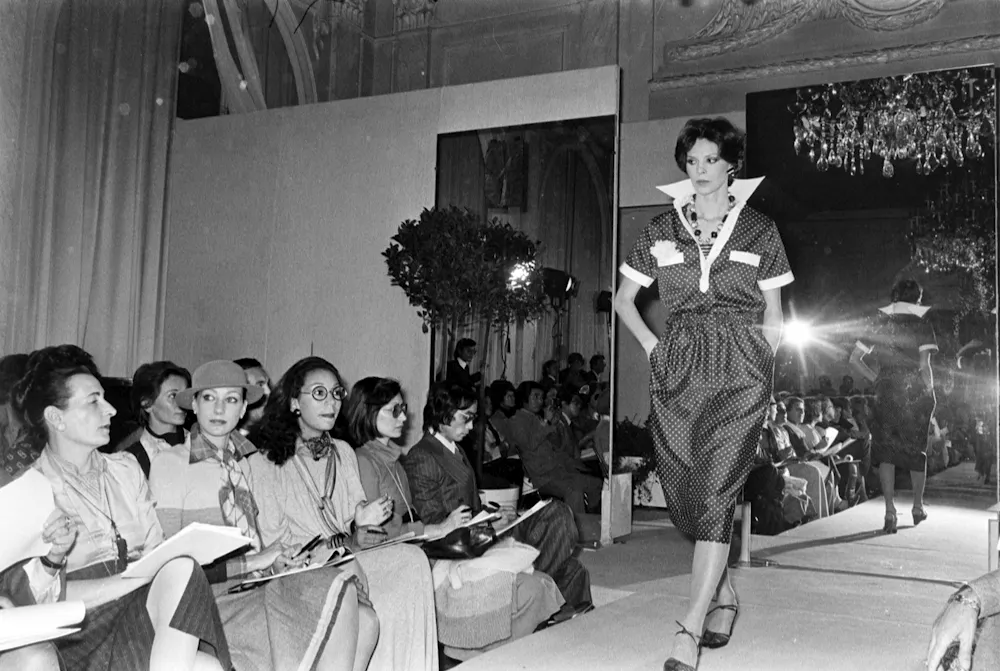
With this expertise, he was one of the first Italian designers to be successful in France as an outsider with the launch of his first Paris collection in 1975. This Paris collection showcased more relaxed silhouettes with many layers, playing towards the casual nature of fashion.

A model in the Valentino Spring 1976 ready to wear collection walks the runway in Paris in 1975.
Guy Marineau/WWD/Penske Media via Getty Images

While his design base was in Rome, many of his collections were shown in Paris over the next four decades. His Italian culture mixed with the technicality of Parisian haute couture made Valentino the designer he was.

Throughout his career, his designs often maintained a classic silhouette bust, matched with a bold Italian colour or texture.

Unlike some designers today, Valentino’s collections didn’t change too dramatically each season. Instead, they continued to maintain the craftsmanship and high couture standards.

Quintessentially beautiful” is often the description of Valentino’s work – however this devotion to high beauty standards has seen criticism of the industry. In 2007, Valentino defended the trend of very skinny women on runways, saying when “girls are skinny, the dresses are more attractive”.

Critics said his designs reinforce exclusion, gatekeeping fashion from those who don’t conform to traditional beauty standards.

The Valentino runways only recently have started to feature more average sized bodies and expand their definition of beauty.

The $300 million sale of Valentino

The Valentino fashion brand sold for US$300 million in 1998 to Holding di Partecipazioni Industriali, with Valentino still designing until his retirement in 2007.

Valentino sold to increase the size of his brand: he knew without the support of a larger corporation surviving alone would be impossible. Since Valentino’s retirement, the fashion house has continued under other creative directors.

Valentino will leave a lasting legacy as the Italian designer who managed to break through the noise of the French haute couture elite and make a name for himself.

The iconic Valentino red will forever be remembered for its glamour, and will live on with his legacy. A true Roman visionary with unmatched craftsmanship.

Jye Marshall does not work for, consult, own shares in or receive funding from any company or organisation that would benefit from this article, and has disclosed no relevant affiliations beyond their academic appointment.

ref. Valentino shaped the runway – and the red carpet – for 60 years – https://theconversation.com/valentino-shaped-the-runway-and-the-red-carpet-for-60-years-273891

Evening Report: https://eveningreport.nz/2026/01/20/valentino-shaped-the-runway-and-the-red-carpet-for-60-years-273891/

ER Report: A Roundup of Significant Articles on EveningReport.nz for January 20, 2026

ER Report: Here is a summary of significant articles published on EveningReport.nz on January 20, 2026.

4 shark bites in 48 hours: how what we do on land may shape shark behaviour
Source: The Conversation (Au and NZ) – By Shokoofeh Shamsi, Professor in Veterinary Parasitology, Charles Sturt University samriley/iNaturalist, CC BY-NC Beachgoers in Australia are on high alert following four shark incidents in New South Wales in 48 hours. On Tuesday morning, a surfer was bitten by a shark at Point Plumer, on the state’s mid-north

Deep sea mining is the next geopolitical frontline – and the Pacific is in the crosshairs
Source: The Conversation (Au and NZ) – By Viliame Kasanawaqa, Doctoral Researcher, Macmillan Brown Centre for Pacific Studies, University of Canterbury When the United States recently escalated its confrontation with Venezuela – carrying out strikes in Caracas and capturing President Nicolás Maduro – the moves were framed as political intervention. But the raid also reflected

Sexualised deepfakes on X are a sign of things to come. NZ law is already way behind
Source: The Conversation (Au and NZ) – By Cassandra Mudgway, Senior Lecturer in Law, University of Canterbury Yui Mok/Getty Images Elon Musk finally responded last week to widespread outrage about his social media platform X letting users create sexualised deepfakes with Grok, the platform’s artificial intelligence (AI) chatbot. Musk has now assured the United Kingdom

The way Earth’s surface moves has a bigger impact on shifting the climate than we knew
Source: The Conversation (Au and NZ) – By Ben Mather, ARC Early Career Industry Fellow, School of Geography, Earth and Atmospheric Sciences, The University of Melbourne Our planet has experienced dramatic climate shifts throughout its history, oscillating between freezing “icehouse” periods and warm “greenhouse” states. Scientists have long linked these climate changes to fluctuations in

Why Keir Starmer had to speak out against Trump over Greenland after staying quiet on Venezuela
Source: The Conversation (Au and NZ) – By Jason Ralph, Professor of International Relations, University of Leeds The Labour government came into office promising to “use realist means to pursue progressive ends”. US president Donald Trump’s recent actions over Venezuela and Greenland have tested Keir Starmer’s ability to deliver on that promise. When the prime

How George Orwell’s Nineteen Eighty-Four predicted the global power shifts happening now
Source: The Conversation (Au and NZ) – By Emrah Atasoy, Associate Fellow of English and Comparative Literary Studies & Honorary Research Fellow of IAS, the University of Warwick and Upcoming IASH Postdoctoral Research Fellow, the University of Edinburgh, University of Warwick Orwell’s dystopian masterpiece envisaged a world dominated by three rival blocs that are constantly

Research reveals a surprising line of defence against cyber attacks: accountants
Source: The Conversation (Au and NZ) – By Charlene Chen, Senior Lecturer in Accounting, Macquarie University Egor Komarov/Unsplash When Optus, Medibank and non-bank lender Latitude Financial were hit by separate cyber attacks in the past few years, millions of Australians felt the fallout: stolen personal data, disrupted services and weeks of uncertainty. Each breach raised

Lead, arsenic and other toxic metals abound in tattoo inks sold in Australia – new study
Source: The Conversation (Au and NZ) – By William Alexander Donald, Professor of Chemistry, UNSW Sydney Lucas Dalamarta/Unsplash In recent decades, millions of Australians have embraced body art – an estimated 30% of adults have a tattoo. Over a third of those with tattoos have five or more pieces. Trend reporting from industry and lifestyle

A year on from his second inauguration, Trump 2.0 has one defining word: power
Source: The Conversation (Au and NZ) – By Bruce Wolpe, Non-resident Senior Fellow, United States Study Centre, University of Sydney As Donald Trump celebrates the anniversary of his second inauguration as president of the United States and begins his sixth year in office, his greatest asset is power. He covets absolute power. The greatest threat

I think I’m grinding or clenching my teeth. Why? And can anything help?
Source: The Conversation (Au and NZ) – By Arosha Weerakoon, Senior Lecturer and General Dentist, School of Dentistry, The University of Queensland Andrea Piacquadio/Pexels Day or night, many of us grind or clench our teeth, and don’t even realise we’re doing it. Here are three questions to ask yourself. At least once a week, do

The yellow-legged hornet eradication is on track – but the next few months are crucial
Source: The Conversation (Au and NZ) – By Phil Lester, Professor of Ecology and Entomology, Te Herenga Waka — Victoria University of Wellington Jonathan Raa/Getty Images New Zealand now has a genuine chance to stamp out one of the most damaging invasive insects to reach our shores: the Asian yellow-legged hornet. But what happens over

Thinking of a tutor for your child? 5 things to consider first
Source: The Conversation (Au and NZ) – By Ben Zunica, Lecturer in Mathematics Education, University of Sydney SolStock/ Getty Images As the new school year approaches, many parents may be thinking about getting a tutor for their child. Media reporting estimates one in six Australian students get tutoring at some point in their schooling, to

Uncanny, curious and awesome: an expert in psychology breaks down what we feel in the face of Ron Mueck’s sculptures
Source: The Conversation (Au and NZ) – By Lisa A Williams, Associate Professor, School of Psychology, UNSW Sydney Ron Mueck Woman with Sticks 2009 (detail), mixed media, 170 × 183 × 120 cm, Collection Fondation Cartier pour l’art contemporain, Paris, acquired 2013 © Ron Mueck, photo: museum Voorlinden, Wassenaar, the Netherlands, Antoine van Kaam I

Most UPNG students don’t want independence for Bougainville, new survey shows
ANALYSIS: By Anna Kapil and Stephen Howes It is well known that the people of Bougainville want independence. In the 2019 referendum, 98.3 percent of them voted for it. And in 2025, Ishmael Touroma, a strong advocate of independence, was re-elected to the position of President of the Autonomous Region of Bougainville, further confirmation of

View from The Hill: Liberals tick off deal on hate crime measures
Source: The Conversation (Au and NZ) – By Michelle Grattan, Professorial Fellow, University of Canberra While federal parliament devoted Monday to emotion-filled Bondi condolence speeches, behind the scenes government and opposition inched to a deal to pass on Tuesday Labor’s fall-back measures relating to hate. Late Monday, the Liberal Party room ticked off on the

One year into Trump’s second term – repressive US president on track to join world’s worst press freedom predators
After winning re-election in 2024, Donald Trump promised to be a dictator “on day one”. When it comes to press freedom, he has kept his word, extending the war on the press he launched while running for his first term with grave attacks on access to reliable information worldwide. Reporters Without Borders (RSF), which monitors

Life after the ‘Big 4’: are tennis’ modern stars cutting through like they used to?
Source: The Conversation (Au and NZ) – By Robert Joseph Gill, Associate Professor in Media and Communication, Swinburne University of Technology, Swinburne University of Technology Tennis’ four Grand Slams (the Australian, French and United States Opens, as well as England’s Wimbledon tournament) attract millions of spectators and billions of viewers each year. Melbourne’s Australian Open

Citizen scientists are spotting more and more rare frogs on private land
Source: The Conversation (Au and NZ) – By Jodi Rowley, Curator, Amphibian & Reptile Conservation Biology, Australian Museum, UNSW Sydney The green and golden bell frog (Litoria aurea) Jodi Rowley, CC BY-NC-ND Almost two-thirds of Australia is privately owned. But most of our scientific understanding of how threatened species are faring comes from research done

ER Report: A Roundup of Significant Articles on EveningReport.nz for January 19, 2026
ER Report: Here is a summary of significant articles published on EveningReport.nz on January 19, 2026.

Evening Report: https://eveningreport.nz/2026/01/20/er-report-a-roundup-of-significant-articles-on-eveningreport-nz-for-january-20-2026/

Man arrested after Police vehicle rammed

Source: New Zealand Police

One man has been arrested after allegedly ramming the stolen vehicle he was driving into a Police unit.

Auckland Central Police responded to information just before 8.30pm on Tuesday, about a stolen hatchback vehicle being driven along Great North Road.

Inspector Grae Anderson, Auckland Central Area Commander, says the vehicle was tracked into the Grey Lynn area.

“Police camera operators tracked the vehicle’s movements to Tuarangi Road, and a unit carried out enquiries in the area,” he says.

“A unit came across the Toyota Vitz and attempted to carry out a traffic stop when it was allegedly rammed.”

The patrol vehicle was not seriously damaged but the Vitz fled the scene.

Inspector Anderson says a pursuit was initiated after the vehicle was seen entering the Northwestern Motorway towards the city.

The vehicle exited at Newton Road and headed towards Ponsonby.

“Police have brought this vehicle to a stop at the intersection of Karangahape Road and Pitt Street, with both occupants arrested without further incident,” he says.

The 36-year-old man will be facing charges of unlawfully taking a motor vehicle, failing to stop, reckless driving and assault with a weapon.

Inspector Anderson says, “it’s fortunate that none of our staff sustained any serious injuries as a result of this man’s reckless behaviour last night.

“I acknowledge the work of our people in bringing this matter to a swift conclusion without any further harm being inflicted.”

ENDS.

Jarred Williamson/NZ Police

MIL OSI

LiveNews: https://livenews.co.nz/2026/01/21/man-arrested-after-police-vehicle-rammed/

Mautohe Cathedral Cove closed due to rain, weather warnings

Source: NZ Department of Conservation

Date:  21 January 2026

MetService has issued a Red Heavy Rain Warning for Coromandel in response to the weather system moving down the northern half of the North Island, and is expected to dump up to 290 mm of rain on the peninsula today alone. The MetService’s rain warning is paired with a strong wind watch due to possible gales in exposed places.

DOC Coromandel Operations Manager Nick Kelly says it’s prudent to close tracks to Mautohe Cathedral Cove given the weather system’s impact – which now includes flooding across some parts of the district and its roading network.

“DOC’s priority for this site continues to be the safety of visitors and managing visitor risk. Poor weather exacerbates the landslide and rockfall risks at Mautohe Cathedral Cove.

“We strongly discourage people from visiting the cove while this weather system moves – the conditions make it unsafe.

“We do not want people getting hurt.”

Nick says the Mautohe Cathedral Cove closure is now in effect and will be in place until further notice. Decisions about whether it is safe to reopen tracks to the beach will be made once staff undertake site inspections and weather forecasts are assessed.

DOC will lift an alert on the Mautohe Cathedral Cove Track web page once it reopens.

Sea swells are expected to increase with the weather system and anyone planning to visit Mautohe Cathedral Cove by boat should check sea conditions first and consider the risks.

Mautohe Cathedral Cove is one of Coromandel and New Zealand’s most picturesque and iconic coastal locations, famous for its rock arch. However, land around the cove is known to be potentially unstable with a noted geological and landslide risk after heavy rain events.

DOC’s Trigger Action Response Plan for Mautohe Cathedral Cove guides decision-making for track closures at the site.

Contact

For media enquiries contact:

Email: media@doc.govt.nz

MIL OSI

LiveNews: https://livenews.co.nz/2026/01/21/mautohe-cathedral-cove-closed-due-to-rain-weather-warnings/

Weather live: Red warning as storm bringing gales, heavy rain to Northland, Coromandel

Source: Radio New Zealand

Follow the RNZ liveblog above for the latest updates.

A heavy rain warning for Northland and Coromandel Peninsula has now been upgraded to red, with hundreds of millimetres of rain forecast to fall on top of what has already accumulated.

It comes after days of downpours flooded areas of the north, washing out roads and cutting power.

People in Auckland and Waikato are also warned to expect strong gales through the day, as well as potential heavy rain across the region and in large parts of the South Island.

Follow the RNZ liveblog at the top of the page for the latest updates.

Sign up for Ngā Pitopito Kōrero, a daily newsletter curated by our editors and delivered straight to your inbox every weekday.

– Published by EveningReport.nz and AsiaPacificReport.nz, see: MIL OSI in partnership with Radio New Zealand

LiveNews: https://livenews.co.nz/2026/01/21/weather-live-red-warning-as-storm-bringing-gales-heavy-rain-to-northland-coromandel/

Newmarket shopkeeper stabbed in attempted Pokémon card theft

Source: Radio New Zealand

Three teenagers who allegedly stole items from a Hobby Lords store in Newmarket, as caught on CCTV. Hobby Lords / supplied

Three teenage boys have been arrested after the stabbing of a shopkeeper in Auckland’s Newmarket.

Senior Sergeant Matt Bunce said the three went boys into Hobby Lords on Broadway at about 5.40pm on Tuesday, and allegedly stole things before running.

He said the shopkeeper chased after them and managed to catch one of the boys on nearby Nuffield St, but was stabbed.

He was taken to Auckland City Hospital where his condition was reported as moderate.

Security guards arrived and managed to hold the 16-year-old while police caught up to the two other boys – both aged 13 – at the Newmarket train station.

The 16-year-old has been charged with aggravated wounding and the others referred to Youth Aid officers.

“Grabbing Gunpla and running out the door whilst laughing is not very cool,” the store said on its Facebook page, before being made aware one of its staff members had allegedly been stabbed.

“Any additional information will be greatly appreciated,” it added.

Photos appeared to show the alleged offenders carrying Pokémon and Gundam merch.

Senior Sergeant Bunce said he was appalled at the level of violence.

Sign up for Ngā Pitopito Kōrero, a daily newsletter curated by our editors and delivered straight to your inbox every weekday.

– Published by EveningReport.nz and AsiaPacificReport.nz, see: MIL OSI in partnership with Radio New Zealand

LiveNews: https://livenews.co.nz/2026/01/21/newmarket-shopkeeper-stabbed-in-attempted-pokemon-card-theft/

Activist News – Protest at today’s National Party caucus retreat – PSNA

Source: Palestine Solidarity Network Aotearoa

Palestine solidarity supporters will be outside the National Party caucus retreat this morning from 10am (Commodore Hotel, 449 Memorial Ave, Ōtautahi/Christchurch) to hold the party to account for complicity in Israel’s on-going genocide in Gaza.

“As election year opens we are determined to keep this issue before the government and the public”, says PSNA Co-Chair John Minto. “We will be continuing our demand for the government to sanction Israel for genocide”

In the face of mass killing and mass starvation of Palestinians in Gaza our Prime Minister Christopher Luxon and Foreign Minister Peters have been silent.

“This is the most important human rights issue of the 21st century – there is nowhere for National MPs to hide”

“The government has betrayed international law, the United Nations, the International Criminal Court and the International Court of Justice – the bedrock agencies of the government’s so-called “rules-based international order”

All those groups have called for action to hold the genocidal, apartheid state of Israel to account for its actions in Palestine but the government is looking the other way.

John Minto
Co-Chair
Palestine Solidarity Network Aotearoa.

MIL OSI

LiveNews: https://livenews.co.nz/2026/01/21/activist-news-protest-at-todays-national-party-caucus-retreat-psna/

Christopher Luxon throwing Chris Bishop under the bus on housing, says Chris Hipkins

Source: Radio New Zealand

Chris Hipkins (Labour) and Chris Bishop (National). RNZ / Marika Khabazi / Reece Baker

Chris Hipkins has accused the prime minister of starting this election year by “panicking” and throwing one of his senior ministers “under the bus”.

The Labour leader made the comments to Morning Report on Wednesday, ahead of the party’s post-break gathering in “wet and windy West Auckland”.

Prime Minister Christopher Luxon last week confirmed the coalition was considering weakening housing intensification laws in Auckland. The subject did not come up during his ‘State of the Nation’ speech on Monday.

Housing and RMA Reform Minister Chris Bishop last year directed Auckland Council to allow for greater housing and development intensification, particularly around rail stations, as the city prepared to open the long-awaited City Rail Link.

Auckland Council in September responded by approving plans that would allow up to 2 million homes in the city.

But Luxon’s apparent backtrack showed he was “running scared” and “willing to throw Chris Bishop under the bus”, Hipkins said.

“Chris Bishop has spent two years working on this plan, and he’s absolutely determined that it’s the right plan, and Christopher Luxon seems to be more interested in panicking rather than actually showing some loyalty to one of his most senior ministers.”

Luxon on Monday dismissed any talk of a clash with Bishop, saying they were in regular discussion.

“I don’t think there’s a problem when you actually say, ‘I’ve listened to feedback and I’m going to do something different about it on the basis of that.’”

David Seymour, deputy prime minister and leader of coalition partner ACT, expressed concern on Tuesday intensification would upset people in his electorate of Epsom, the country’s wealthiest, because high-rise buildings might end up “looking into everyone’s backyards and their swing sets and their pools”.

Hipkins said if Luxon and Bishop have changed the plan, they should “get on and tell New Zealanders what it is that they’ve been cooking up behind the scenes”.

“Because up until now, Chris Bishop is the person who’s been speaking for the government on the matter, and it seems that he’s now been sidelined.”

House prices have fallen since their peak in 2022, and rents have stabilised – and in some places, fallen – after years of almost unbroken above-inflation rises.

Asked if he would like house prices to fall, Hipkins said he wanted a “stabilisation in house prices… giving New Zealanders a chance for their incomes to catch up”.

“The current government aren’t focused on growing people’s incomes at all. They’re only focused on increasing the wealth of those at the top rather than the people who are working hard every day and aspiring to owning their own home.”

Asked if Bishop was “playing on your home ground” by overseeing improving housing affordability, Hipkins talked up his party’s capital gains and Future Fund policies to “ensure that people are investing in productive businesses rather than simply buying up all the available houses and forcing first-time buyers out of the market”.

Luxon said Bishop would “come forward with his views and explain that shortly”.

Paying for pay equity

One way the previous Labour-led government tried to boost incomes – particularly for historically underpaid sectors – was through 2020’s Equal Pay Amendment Act, which was gutted under urgency in early 2025, Luxon saying the changes would save the government “billions” of dollars.

Christopher Luxon and Finance Minister Nicola Willis. RNZ / Calvin Samuel

Labour has promised to restore pay equity, but still would not say how it would be paid for – Treasury’s estimate was that it would cost close to $13 billion over four years.

“We’ll set out before the election a balanced fiscal plan that will show how we will get New Zealand’s books balanced, something [Finance Minister] Nicola Willis has spent two-and-a-half years failing to do and there is no balance in sight. She still hasn’t figured out how to balance the books after her unaffordable tax cuts.

“We’ve been working our way through the costs of all of the commitments that we are making. I am determined that we will make a sensible, responsible set of commitments to the electorate this year that will be different to the current government.

“It will show that our priority of working New Zealanders and making sure that they get their fair share of the economic pie and that the economic recovery that Christopher Luxon keeps touting actually does arrive and it benefits everybody, not just those at the top.”

A portfolio reshuffle was looming, Hipkins said, particularly with the departures of Duncan Webb and Adrian Rurawhe.

“We very much are in this to win it. We think that the election is up for grabs, and we’re quite determined to offer New Zealanders a really compelling alternative.”

National is meeting in Christchurch, where Luxon is to announce this year’s election date.

Sign up for Ngā Pitopito Kōrero, a daily newsletter curated by our editors and delivered straight to your inbox every weekday.

– Published by EveningReport.nz and AsiaPacificReport.nz, see: MIL OSI in partnership with Radio New Zealand

LiveNews: https://livenews.co.nz/2026/01/21/christopher-luxon-throwing-chris-bishop-under-the-bus-on-housing-says-chris-hipkins/

Serious incident, Onehunga

Source: New Zealand Police

Please attribute to Inspector Jason Homan:

Police are responding to a serious incident in Onehunga.

Shortly after 11am Police received reports a person had received injuries consistent with a gunshot wound at a property on Arthur Street.

One person has been transported to hospital in a critical condition.

An increased Police presence will remain in the area while enquiries are underway.

Anyone with any information is asked to please contact Police via 105, either over the phone or online, and use the reference number P065151258.

Information can also be provided anonymously through Crime Stoppers online or through 0800 555 111.

ENDS.

Amanda Wieneke/NZ Police

MIL OSI

LiveNews: https://livenews.co.nz/2026/01/21/serious-incident-onehunga-2/

Government backs economic growth in Southland

Source: New Zealand Government

Southland is set for a major economic boost, with the Government committing a $3.1 million loan through the Regional Infrastructure Fund (RIF) to kickstart an industrial subdivision near Gore, Associate Minister for Regional Development Mark Patterson announced today.

“The 43-hectare development is a 50/50 partnership between Ngāi Tahu iwi authority Hokonui Rūnanga and Robertson Transport Limited. It tackles the critical shortage of large industrial lots in the Gore District and supports long-term prosperity for both partners and the wider Eastern Southland community,” Mr Patterson said.

The $13.6 million project, strategically positioned on State Highway 1, will transform underutilised farmland into a thriving industrial hub. It is expected to create up to 50 jobs during construction and attract industries such as fertiliser distribution, farm equipment services, warehousing, and retail.

“Importantly, this development will provide Hokonui Rūnanga with a sustainable income stream through long-term leases, enabling it to fund vital health and social services for the community,” Mr Patterson said.

The RIF is delivering the infrastructure Southland needs to diversify its economy and build resilience. It also tackles a critical shortage of prime industrial land in the Gore District, which needs an additional 100 hectares to meet future growth.

Southland already delivers 12 per cent of New Zealand’s pastoral exports with just two per cent of the population. This investment will help ensure the region’s economy continues to thrive,” Mr Patterson said.

Construction is expected to start in mid-2026, following rezoning and consents. 

This development marks the first stage of Hokonui Rūnanga’s 90-hectare master plan, with future stages set to include marae relocation, papakāinga housing, and a potential childcare facility.

MIL OSI

LiveNews: https://livenews.co.nz/2026/01/21/government-backs-economic-growth-in-southland/

David Beckham breaks silence after son Brooklyn cuts ties

Source: Radio New Zealand

The spat burst out into the open after Brooklyn Beckham, 26, accused his parents of being “controlling” and placing “countless lies” in the media to preserve the facade of a perfect family

Speaking to CNBC at the World Economic Forum in Davos, Sir David said he had tried to educate his children about the online world.

“Children are allowed to make mistakes, that’s how they learn. So that’s what I try to teach my kids,” he said. “But you know, you have to sometimes let them make those mistakes as well.”

Sir David made the comments during a general discussion about the risks of social media, having earlier avoided journalists’ questions about the saga.

Reports of tension between Brooklyn and his parents started soon after he wedded actor Nicola Peltz, the daughter of US billionaire Nelson Peltz, in 2022.

Brooklyn said for years he had made “every effort” to keep the matter private, but he now had no choice but to “tell the truth about only some of the lies that have been published”.

He said his parents had been “trying endlessly to ruin my relationship since before my wedding” and had pressurised him to sign away the rights to his name, a step he had refused.

In one of the most damaging accusations, he said his mother, former Spice Girl and fashion designer Victoria, had hijacked his first dance with his wife at his wedding.

“She danced very inappropriately on me in front of everyone,” he said, in a post on Instagram.

“I’ve never felt more uncomfortable or humiliated in my entire life,” he added.

Brooklyn’s post tossed a grenade into “Brand Beckham”, the multi-million-pound family business that traces its origin back to his soccer star father making his debut for Manchester United at the age of 17 in 1992.

Sir David cemented his position in the British establishment last year when he was awarded a knighthood at the age of 50 for his contribution to sport and charitable causes.

He won six league titles, two FA Cups and the Champions League with the club, before playing for Real Madrid, LA Galaxy, AC Milan and Paris Saint-Germain. He also captained England, winning 115 caps.

His 1999 marriage to Victoria Adams, ‘Posh Spice’ in the Spice Girls, united football with pop music to create ‘Posh and Becks’, a celebrity couple rivalled only by Britain’s royals in tabloid appeal.

– Published by EveningReport.nz and AsiaPacificReport.nz, see: MIL OSI in partnership with Radio New Zealand

LiveNews: https://livenews.co.nz/2026/01/21/david-beckham-breaks-silence-after-son-brooklyn-cuts-ties/

‘They’re hungry’: Shark warning to Kiwis after spate of Australian attacks

Source: Radio New Zealand

Riley ‘Sharkman’ Elliott swimming with a mako shark. Amber Jones

Beachgoers, swimmers and surfers are not immune to the risk of shark encounters when taking a dip in New Zealand waters, an expert says.

The advice comes amid high alert across the Tasman, following four shark attacks across New South Wales in less than 48 hours.

A 12-year-old boy was in intensive care, after sustaining critical injuries to both his legs in an attack near Shark Beach in Sydney’s eastern suburbs on Sunday.

Two attacks, both on Sydney’s northern beaches, then occurred in the space of a few hours on Monday.

A 27-year-old man was in a critical condition after suffering severe injuries to his legs at Manly’s North Steyne Beach. Earlier that day, an 11-year-old boy escaped injury, after a large bite was taken out of his surfboard at Dee Why.

A 39-year-old man also escaped serious injury in the latest shark attack at Point Plomer on the Mid North Coast on Tuesday.

The state government was working with Northern Beaches Council and Surf Life Saving NSW in response to the cluster of attacks.

Following a bout of bad weather, Australian experts said ocean conditions were ripe for shark activity, particularly bull sharks.

Marine biologist Professor Culum Brown of Macquarie University said sharks were drawn to freshwater flushes to feed on fish and dead animals, as they drifted down from rivers.

New Zealand shark scientist and conservationist Dr Riley ‘Shark Man’ Elliott has run a long-standing, tag-and-trace programme across the country.

Speaking to RNZ from a boat in Foveaux Strait, Elliott said the attacks were tragic, but also a reflection of growing population bases.

Sydney beach closed after shark attack. ABC News / Gavin Coote

“[Great white sharks] have been protected for several decades now and that should increase their numbers, but they do breed very slowly, so their numbers haven’t exploded,” he said.

“Human populations have grown dramatically and there’s more water recreation, more activities, more sports, more surf appliances. Innately, there’s more people in the water.”

Although shark attacks were not as common in New Zealand, compared to the warmer climes of Australia, other environmental factors heightened risk.

“Sharks don’t [hunt] people,” Elliott said. “Where they make mistakes is when they’ve been drawn into a food source, they’re hungry, the visibility’s poor and then people go in the mix.

“Urbanisation, sedimentation, agriculture, all these things… our harbours used to be crystal clear, now they’re muddy and gross.

“These animals are trying to hunt in that poor visual environment.”

New Zealand shark scientist and conservationist Dr Riley ‘Shark Man’ Elliott. Supplied

Elliott recommended avoiding swimming in periods following heavy rainfall, in river mouths, during dusk and dawn hours, and around ocean carcasses.

The conservationist had spotted three Australian-tagged great white sharks during his Fiordland expedition.

“Equally, some of the sharks I’ve tagged down here have gone to Australia, so they move very big distances,” he said.

A diver was flown to hospital, after being bitten by a shark – presumed to be a great white – at Dusky Sound in Fiordland National Park last April.

Shark sightings have also been reported in Auckland, Christchurch and Whangārei in recent weeks.

Elliott said shark attacks were tragic reminders that the ocean wasn’t a playground.

“If we want to co-exist in nature, we need to understand it, we need to respect it, we need to take care of it.”

Sign up for Ngā Pitopito Kōrero, a daily newsletter curated by our editors and delivered straight to your inbox every weekday.

– Published by EveningReport.nz and AsiaPacificReport.nz, see: MIL OSI in partnership with Radio New Zealand

LiveNews: https://livenews.co.nz/2026/01/21/theyre-hungry-shark-warning-to-kiwis-after-spate-of-australian-attacks-2/

Labour MP Adrian Rurawhe to retire from politics

Source: Radio New Zealand

Adrian Rurawhe RNZ / Angus Dreaver

Labour MP Adrian Rurawhe has announced he will retire from politics next month.

The former Speaker has been in parliament for more than a decade, starting in 2014 as the MP for Te Tai Hauāuru before being ousted by Te Pāti Māori MP Debbie Ngarewa Packer in 2023.

He was Speaker of the House of Representatives from August 2022 to December 2023.

He says he spent the summer thinking about whānau and church, and retiring now will allow him to be more involved.

“I want to express my gratitude to the people of Te Tai Hauāuru, the Labour movement, and the countless individuals and communities I have served over the past twelve years,” said Rurawhe.

“I also want to acknowledge my whānau for their continued support. I would never have become an MP without them, and I will be forever grateful.”

Labour leader Chris Hipkins said Rurawhe was respected across the House in his role as Speaker, he was a valued member of the Labour team, and a passionate advocate for Maori.

“I’d like to acknowledge Adrian for the significant contribution he has made to our team and to New Zealand.

“We will miss him and wish him all the very best as he moves away from the political arena.”

His last day will be Waitangi Day and he will be replaced by Georgie Dansey.

Sign up for Ngā Pitopito Kōrero, a daily newsletter curated by our editors and delivered straight to your inbox every weekday.

– Published by EveningReport.nz and AsiaPacificReport.nz, see: MIL OSI in partnership with Radio New Zealand

LiveNews: https://livenews.co.nz/2026/01/21/labour-mp-adrian-rurawhe-to-retire-from-politics/

Racist threats made to Asian communities accused of stripping Whangaparāoa rockpools

Source: Radio New Zealand

People harvesting sea life at Army Bay. Protect Whangaparoa Rockpools

Calls for Asians to be deported and threats of physical violence are among some of the latest social media comments aimed at people accused of stripping rockpools and breaching fishing rules.

On Saturday, at least a hundred people demonstrated at Army Bay in Auckland’s Whangaparāoa for the protection of local rock pools, and residents earlier told RNZ that rockpools were being stripped bare of sea life – including shellfish, or any animal life that lives in the pools.

The term “bucket people” has been widely used on social media to refer to those accused of over-harvesting, and many have anecdotally pointed to tourism buses and visitors, blaming them for the depletion of the rockpools.

The Ministry for Primary Industries (MPI) said Whangaparāoa has a recreational fishing compliance rate of 93 percent between November 1, 2025, and January 5, with 14 non-compliance incidents across 189 inspections conducted in the period – four involved excessive taking of shellfish (cockles), seven were for undersized snapper, two involved illegal netsetting, and non involved tour buses.

Over the past week, more posts on the controversy have appeared on Facebook pages, targeting the Asian community – including one person who wrote they were prepared to give a few “knuckle burgers and black eye rings” to those breaking the rules; there have also been several posts calling for the gatherers to be deported.

Meanwhile, there have also been posts by rockpools protection advocates calling out the racist comments and urging people to focus on the environmental cause.

On Monday, fisheries minister Shane Jones pointed to what he called “unfettered immigration” when interviewed on the topic, and said he’s seeking urgent advice from fisheries on the issues.

Asian New Zealanders nervous about racial tensions arising from rockpools issues

A Chinese New Zealander living near Whangaparāoa said he doesn’t personally collect shellfish, but is worried about the rising tensions over the issue.

The man, who did not want to be named, said he’s now nervous about taking his kids to the beach.

“Eventually we’ll get targeted, like if we go to the beach, even if we don’t bring the bucket, and we just relax on the beach, and people may come up and say something hurtful to me,

“My kids are going to grow up here in New Zealand, they’re going to contribute to society, what are they going to feel like? They’re going to be like ‘I’m surrounded by people who hate us only because of our looks’”, he said.

The man said he’s seen videos posted to social media by people filming the contents of people’s buckets, and urging people to throw things back into the ocean.

He said he feels it violates people’s private space and that the residents doing the patrolling shouldn’t be behaving like law enforcement.

He said Asian communities are left with the blame when the government has failed to revise the limits on gathering shellfish.

A Wellington woman, who posted a photo of her Chinese husband holding a bucket of mussels on Facebook earlier this month, was shocked to see dozens of racist comments under the post.

The woman said the photo came from a family outing to the beach with her in-laws and kids, and the mussels collected came under the limit for seven people.

She said the post explained their awareness of gathering limits, but that didn’t stop the abuse.

“It’s just like, ‘These Chinese people bring their family and hoard everything from New Zealand, they don’t know the rules, they should be deported’, those kinds of things,” she said, noting that about one of five of the over 260 comments were hurtful.

The woman said her family hasn’t been to the beach since the online abuse.

Rockpools protection advocate: no place for racism

Rockpools protection advocate Mark Lenton, who leads the “Protect Whangaparāoa Rockpools” group, said racism is not helpful to the cause and will not be tolerated on their Facebook page.

“There’s no place for this uneducated bigotry, which only amplifies a lack of intelligence, and it’s not a good look for the author,

“So look, we do not encourage it in any way, and any comments raised and deleted, and the author is banned,” he said.

Lenton said such comments are the quickest thing that will undermine their credibility as a group.

He said he’s been talking to gatherers at Army Bay and makes the point that even when people gather within the limits, the sheer volume of gatherers is causing problems for the marine ecology.

“We’re really focused on an attitude change here, we’re really trying to amplify conservation,” he added.

Lenton said he estimates that on any given day at low tide during the weekends, there may be 100 to 300 gatherers on the beach.

Researcher of Asians in Aotearoa: “bucket people” trope dehumanizing

Auckland based writer and researcher of Asian diasporas, Tze Ming Mok, said she’s concerned that certain ministers in government may be more interested in whipping up division against a small minority than they are in constructively addressing the issue.

Mok said the term “bucket people” is creepy and is yet another racial slur being created, which dehumanises communities.

“The stereotype of the rapacious Asian stripping the coastlines is a trope and a stereotype that has been wielded against us since at least the early 90s, and the thing is that we have approached this issue in good faith, constructive ways before,

“By building relationships between new migrants, government, iwi and local communities so we can all learn and educate each other, and protect our ecosystems together,” she said.

Meanwhile, Lenton said he didn’t think the term “bucket people” was discriminatory.

“The term bucket people does not discriminate by age, by gender, nor by race,

“It is simply a collective term that accurately describes people who rape and pillage rock pools and coastal sea life to fill their buckets,” he said.

Auckland-based university student of Chinese descent One Wang, who has an interest in researching the relationship between tauiwi and Te Tiriti o Waitangi, said the labelling and online bullying around the rockpools issues have diverted attention away from the environmental issue itself.

“At this point our focus should be on the whenua, on papatūānuku, and on moana, what people could help with is make information and education accessible to all people who interact with marine life, so they can do that responsibly,” said Wang.

Wang said it’s been devastating to see the environmental impacts on moana, but equally devastating to see how quickly blame has been directed at an entire ethnic group.

Ngati Manuhiri, whose rohe extends from Mangawhai to the Okura river mouth south of Whangaparāoa, has applied for a two-year-ban on harvesting shellfish from the city’s Eastern Coastline.

The minister is expected to make a decision next month.

Sign up for Ngā Pitopito Kōrero, a daily newsletter curated by our editors and delivered straight to your inbox every weekday.

– Published by EveningReport.nz and AsiaPacificReport.nz, see: MIL OSI in partnership with Radio New Zealand

LiveNews: https://livenews.co.nz/2026/01/21/racist-threats-made-to-asian-communities-accused-of-stripping-whangaparaoa-rockpools-2/