NZME back in profit as Herald, OneRoof and ZB deliver growth

Source: Radio New Zealand

RNZ/ Brad White

Media company NZME is back in the black with increased earnings, as it put the asset writedowns and tougher economy of a year ago behind it.

The owner of the OneRoof property platform, New Zealand Herald, and Newstalk ZB radio network said it was cautiously optimistic heading into 2026.

Key numbers for the year ended 31 December 2025 compared with a year ago:

  • Profit $13.1m vs $16.0m loss
  • Revenue $345.1m vs $350.2m
  • Operating earnings $62.3m vs $54.2m
  • Expenses $289.3m vs $300.5m
  • Full year dividend unchanged 9 cents per share

Chief executive Michael Boggs said the performance reflected “a huge amount of hard work” across the company, supported by easing inflation and improving business and consumer confidence.

“We’ve remained focused on our digital-first strategy, continuing to innovate and adapt to changing audience and client needs, we’ve reduced our costs, and we’ve simplified our structure to allow us to operate at pace, placing specialist support services under each of our three main business divisions.”

Revenue dipped slightly after the company closed 14 community newspapers at the end of 2024.

OneRoof delivered a strong year, with listings revenue rising 18 percent, lifting its operating profits by a third.

Its audio division – which includes Newstalk ZB – saw operating profits rise by 23 percent, and NZME said it was seeing positive momentum heading into 2026.

The publishing division, led by the NZ Herald, reported total subscriptions rising from 236,000 to 243,000, with digital-only subscriptions up 10 percent.

The company did not offer any earnings guidance for 2026, but chairperson Steven Joyce struck an upbeat tone.

“We have entered 2026 with a strong balance sheet, diversified revenue streams and strong market positions across audio, publishing and OneRoof, providing a solid foundation for future growth,” he said.

“The renewed momentum and focus we have built through 2025 positions us strongly for 2026 and beyond.”

Sign up for Ngā Pitopito Kōrero, a daily newsletter curated by our editors and delivered straight to your inbox every weekday.

– Published by EveningReport.nz and AsiaPacificReport.nz, see: MIL OSI in partnership with Radio New Zealand

LiveNews: https://nz.mil-osi.com/2026/02/24/nzme-back-in-profit-as-herald-oneroof-and-zb-deliver-growth/

Warriors co-captain Mitchell Barnett to leave at end of 2026 season

Source: Radio New Zealand

Mitch Barnett www.photosport.nz

New Zealand Warriors co-captain Mitchell Barnett will return to Australia at the end of the 2026 NRL season for personal reasons.

Club chief executive Cameron George confirmed today the 31-year-old Kangaroos and New South Wales front rower will be released from the final year of his contract.

It is understood the release is due to Barnett’s child’s medical needs.

Mitchell Barnett during pre-season training in January. Andrew Cornaga/Photosport

“We’re very sad to see this happen but Mitch and his family need to be back home,” George said.

“He has become such a big part of our club. We love having him here and we know how much he loves it, too, but it’s important he, Clare and their boys are back around their family support network.”

After recovering from knee surgery in 2025, Barnett has two career milestones in sight as he eyes the 2026 season.

Barnett’s first game of the season will be his 50th for the club, while he’s 23 games away from his 200th career NRL appearance.

The Warriors kick off their 2026 season with a clash with the Sydney Roosters at Go Media Mt Smart Stadium, 8pm on March 6.

Sign up for Ngā Pitopito Kōrero, a daily newsletter curated by our editors and delivered straight to your inbox every weekday.

– Published by EveningReport.nz and AsiaPacificReport.nz, see: MIL OSI in partnership with Radio New Zealand

LiveNews: https://nz.mil-osi.com/2026/02/24/warriors-co-captain-mitchell-barnett-to-leave-at-end-of-2026-season/

Queensland fruit fly could have ‘massive impact’ on fruit and vegetable crops

Source: Radio New Zealand

The single male fly was found in Mount Roskill. Supplied / Biosecurity New Zealand

The discovery of a Queensland fruit fly in Auckland presents a huge threat to growers and exporters, a horticulture sector advocate says.

A biosecurity operation is underway after the pest, which damages fruit and vegetables, was identified in a surveillance trap in the suburb of Mount Roskill on Wednesday morning.

Horticulture chief executive Kate Scott said while the fly did not pose a health risk to humans, an outbreak would have a significant economic cost.

“The horticulture sector is naturally concerned about the impacts of a new pest being established here and the impact that could have on our ability to produce a wide range of fruit and vegetables.

“The Queensland fly likes to call more than 200 fruit and vegetables home. That could have a massive impact on the quality of our fruit and vegetable crops.”

She warned the country would not be able to export to key markets if the pest took hold here.

But she was confident in New Zealand’s track record of eradicating harmful fruit flies.

“We certainly support the ramping up of trapping and inspections and the movement control areas that are to be implemented.

“We’ve certainly seen last year and in other previous instances where a quick and immediate response is rolled out, that we have been able to successfully contain any threat.”

Biosecurity staff were expected to be on the ground in Mount Roskill over the coming days.

“As part of our response protocol over the next 72 hours, we will be ramping up trapping and inspection, with daily checks in a 200-metre zone from the original find and checks every three days in a second zone out to 1500m,” Biosecurity New Zealand’s Mike Inglis said.

“You may notice increased activity in the neighbourhood as we go about inspections and trapping. Our field officers may ask to look at fruit trees on your property. They will always show you a form of official identification and will only enter your property with your permission.”

Instructions about restrictions in the affected area were expected to be made clear on Thursday.

In the meantime, Biosecurity asked Mount Roskill residents not to take whole fresh fruit and vegetables out of their property.

Sign up for Ngā Pitopito Kōrero, a daily newsletter curated by our editors and delivered straight to your inbox every weekday.

– Published by EveningReport.nz and AsiaPacificReport.nz, see: MIL OSI in partnership with Radio New Zealand

LiveNews: https://nz.mil-osi.com/2026/02/24/queensland-fruit-fly-could-have-massive-impact-on-fruit-and-vegetable-crops-2/

Hawke’s Bay water storage project a step closer

Source: Radio New Zealand

The proposed Heretaunga Water Storage Facility, would be a 27 million cubic metre dam on private land near Whanawhana, in Hastings District. Supplied

A massive Hawke’s Bay water storage project is one step closer, with geotechnical work having started as part of a feasibility study.

Investigations into the proposed Heretaunga Water Storage Facility, a 27 million cubic metre dam on private land near Whanawhana, near Hastings, have started to address its economic, technical, cultural and environmental viability.

The site would harvest peak water flows from within the catchment and the Ngaruroro River in winter and store the water for release into Heretaunga’s rivers and streams during periods of peak summer demand.

In 2023, an initial pre-feasibility study was completed by the Hawke’s Bay Regional Council with support from Kānoa the Regional Economic Development & Investment Unit, which has also funded the next step.

A local group of irrigators, commercial water users, mana whenua and municipal water suppliers took over the project late last year in November, forming a new company – Heretaunga Water Storage Limited – to oversee the feasibility study.

Interim chairperson and Hawke’s Bay grower Xan Harding said it would have two implications for the region.

“The dam itself, the project if it goes ahead, part of that water will be offsetting the existing environmental effects of existing activity and part of it will be available for new water.

“It’s improving existing environmental outcomes and it’s providing room for growth.”

Harding said investigations would also enable comparison with other water security options for the region.

“Hawke’s Bay is a water short region so we know through a combination of measures we need to deliver long term water security for the Heretaunga Plains.

“We need to pull all kinds of levers on both the supply and the demand side of the water equation to get there and water storage is part of that.”

Geotechnical work has started as part of a feasibility study. Supplied

Harding said while the focus of the group was on the feasibility of water storage for the region, that wasn’t to say other efforts like water use efficiency were not important.

He said there were no guarantee the Heretaunga Water Storage Facility project – previously estimated to be a $225 million build – would go ahead but it had the potential to deliver longterm certainty for growers, commercial water users and the Hawke’s Bay community.

“The feasibility assessment is a critical next step and in depth geotechnical and ecological work to support the feasibility assessment is well underway at site,” Harding said.

“We will continue through the feasibility assessment with a view to having this completed around the third quarter of this year, at which point we will make decisions around resource consenting.”

A key part of the Heretaunga Water Storage Facility proposal is that its development would be funded by those who benefit most from the water storage in a user-pays model.

It differs from that of the controversial Ruataniwha Dam proposal – rebranded as the Tukituki Water Security Project – which would see a dam built on the Makaroro River, a tributary of the Tukituki River.

Sign up for Ngā Pitopito Kōrero, a daily newsletter curated by our editors and delivered straight to your inbox every weekday.

– Published by EveningReport.nz and AsiaPacificReport.nz, see: MIL OSI in partnership with Radio New Zealand

LiveNews: https://nz.mil-osi.com/2026/02/24/hawkes-bay-water-storage-project-a-step-closer/

Recidivist shoplifter before courts, Thames

Source: New Zealand Police

Numerous hours of scouring video footage has led to the arrest of a woman in relation to retail crimes in Thames.

Yesterday, Police arrested and charged a 52-year-old woman following multiple shoplifting incidents dating back over the past month.

“This type of offending, especially at this large scale, has a big negative impact on our local businesses and I’m pleased with this outcome,” says Inspector Mike Henwood, Eastern Waikato Area Commander.

The woman was due to appear in Thames District Court today, charged with 20 counts of wilful trespass, and two counts of speaking threateningly.

“I commend the tenacious work of local Police staff to pull these, and other investigations, together to prosecute offenders.

“Recidivist retail thieves are not tolerated – by business owners, their honest customers, or Police – and this highlights Police’s commitment to target and hold these offenders to account,” Inspector Henwood says.

If you witness any retail crime, or any other crime, please call 111 if it is happening now or for historic offending, please make a report, with as much information as possible, either online at https://www.police.govt.nz/use-105 or by calling 105.

Information can also be provided anonymously through Crime Stoppers on 0800 555 111.

ENDS

Issued by Police Media Centre

MIL OSI

LiveNews: https://livenews.co.nz/2026/02/24/recidivist-shoplifter-before-courts-thames/

New Zealand announces more support for Ukraine, sanctions on Russia

Source: New Zealand Government

New Zealand will provide $8 million in new assistance for Ukraine and implement additional sanctions targeting Russia’s war machine, Foreign Minister Winston Peters has announced.

 “Russia’s illegal and unprovoked invasion, now entering its fifth year, has devastated Ukraine, destabilised Europe and impacted the security of our own region,” Mr Peters says. 

 “Russia’s relentless bombardment of civilian infrastructure this winter has hit Ukraine’s people hard, and this assistance demonstrates New Zealand’s continued solidarity. 

 “These contributions will help address urgent needs as a result of Russia’s brutal winter attacks on Ukrainian civilians and energy infrastructure.”

New Zealand will provide $5 million in humanitarian assistance to international aid partners supporting Ukrainian civilians badly affected by the war. 

 This brings New Zealand’s total humanitarian assistance to Ukraine to $45 million over the past four years. 

 A further $3 million will go to the World Bank-administered Ukraine Relief, Recovery, Reconstruction and Reform Trust Fund, which supports energy resilience and reconstruction. 

New Zealand is also implementing its 34th round of sanctions against Russia.

New measures include lowering the price cap on Russian crude oil and sanctioning 100 shadow fleet vessels.

“These are calculated steps to curtail crucial oil revenues fuelling Putin’s illegal war of aggression against Ukraine,” Mr Peters says.

New Zealand has also sanctioned actors from Belarus, Iran, and North Korea, alongside alternative payment providers, malicious cyber actors, and those supporting Russia’s military‑industrial complex. 

More information about sanctions, travel bans, and export controls against Russia, as well as diplomatic, military and economic support to Ukraine, can be found on the Ministry of Foreign Affairs and Trade website here.

MIL OSI

LiveNews: https://livenews.co.nz/2026/02/24/new-zealand-announces-more-support-for-ukraine-sanctions-on-russia/

PGG Wrightson increases half-year profit on back of increased sales

Source: Radio New Zealand

PGG Wrightson is a rural services company (file photo). Supplied

Rural services company PGG Wrightson (PGW) increased its half-year profit on the back of increased sales to a buoyant agricultural sector and farm exports.

Key numbers for the six months ended December compared with a year ago:

  • Net profit $17.3m vs $16.0m
  • Revenue $619.4m vs $570.3m
  • Operating earnings $46m vs $41m
  • Full year operating earnings guidance $64m
  • Interim dividend 4.5 cents per share vs 2.5 cps

The big driver of the company’s higher profit was the performance of its retail and water division, which covered sales to farms, orchards, and irrigation, which delivered 85 percent of group revenue.

PGW chairperson John Nichol said the company had seen growth through most parts of the rural sector, particularly in red meat, kiwifruit and apples, while improved earnings for farms flowed through to demand for other rural goods and services.

“The first half was characterised by favourable commodity pricing across a number of key segments for PGW’s customers.

“Improved on-farm profitability translated into demand for PGW’s livestock services, pasture renewal, agronomy, and animal health.”

Nichol said the company had also benefited from its diversification through the acquisition of an animal health products company, the launch of a range of agricultural chemicals, and the leasing of a research station in Hawke’s Bay.

The company’s agency group, which handled livestock sales, wool, and real estate sales, also reported stronger earnings as higher livestock, wool, and rural land prices increased demand.

The two sectors under pressure were wine and cropping with subdued demand weighing on sentiment and investment decisions.

Nichol said the second half of the year was expected to remain strong as the first with the broad rural sector set to continue strongly helped by high commodity prices, a soft currency, lower interest rates, and steady profits .

“Overall conditions across agriculture remain favourable, with most parts of the sector performing well, supported by firm global demand and strong commodity pricing.”

The company has forecast full year operating earnings of around $64m.

Sign up for Ngā Pitopito Kōrero, a daily newsletter curated by our editors and delivered straight to your inbox every weekday.

– Published by EveningReport.nz and AsiaPacificReport.nz, see: MIL OSI in partnership with Radio New Zealand

LiveNews: https://nz.mil-osi.com/2026/02/24/pgg-wrightson-increases-half-year-profit-on-back-of-increased-sales/

Mercury reports strong return to profit

Source: Radio New Zealand

Ngā Tamariki Geothermal Station. Supplied / Mercury Energy

Renewable energy generator and retailer Mercury has reported a strong return to profit, reflecting ongoing cost savings as well as investment in renewable energy projects.

Mercury chief executive Stew Hamilton said the company had invested 50 percent ($270 million) of the first half earnings in renewable energy and was on track to meet its full year underlying profit guidance of $1 billion, as well as operating costs of $370m – down 6.6 percent on the last year.

Key numbers for the six months ended December compared with a year ago:

  • Net profit $20m vs $67m loss
  • Revenue $1.66b vs $1.76m
  • Underlying profit $537m vs $418m up
  • Operating expenses $183m vs $207m
  • Interim dividend 10 cents per share vs 9.6 cps up 4%

[h Results overview

Hamilton said all three of Mercury’s large renewable developments, totalling $1b investment, were progressing on budget and on time.

He said the Ngā Tamariki Geothermal Station unit came online in January 2026, while stage two of Kaiwera Downs Wind Farm and Kaiwaikawe Wind Farm were both due to begin generating this year.

“Our disciplined strategic execution is delivering a strong performance today, while enabling us to invest significantly in new renewable generation for New Zealand, helping meet future demand growth and build resilience,” he said.

“We are on track to deliver on our plan of adding 3.5 terrawatt hours (TWh) of new generation by 2030.”

That was the equivalent of powering an additional 430,000 homes.

“Our contributions are supporting the fastest rate of renewable generation development in history, helping power economic growth over the next two decades,” Hamilton said.

“We are also investing significantly in our existing assets, with Karāpiro Hydro Station upgrade complete and plans to invest $590m in hydro refurbishment over the next decade.

“Enabling our customers to shift consumption and lower their costs is another key focus and we continue to provide additional support to our customers in need.

“We are facing into energy system challenges with confidence, including actively shaping and contributing to solutions for gas and firming, while helping deliver a bright future for New Zealand powered by an increasingly renewable energy supply.”

Outlook

“Our balance sheet remains strong, with capital headroom and prudent risk settings,” Hamilton said.

He said the full year underlying profit guidance of $1b was supported by above average hydro generation and lower operating costs, while the full year dividend guidance of 25 cps remained on track.

Sign up for Ngā Pitopito Kōrero, a daily newsletter curated by our editors and delivered straight to your inbox every weekday.

– Published by EveningReport.nz and AsiaPacificReport.nz, see: MIL OSI in partnership with Radio New Zealand

LiveNews: https://nz.mil-osi.com/2026/02/24/mercury-reports-strong-return-to-profit/

David Seymour says Andrew’s removal from line of succession not a priority

Source: Radio New Zealand

Deputy Prime Minister David Seymour. RNZ / Mark Papalii

Deputy Prime Minister David Seymour says his focus is on New Zealand and issues facing Kiwis – not on joining the chorus to remove Andrew Mountbatten-Windsor from the line of succession.

It comes after Australian Prime Minister Anthony Albanese wrote to British counterpart Keir Starmer to confirm his country’s support of removal.

Mountbatten-Windsor was stripped of his titles by King Charles III last year and hasn’t worked as a member of the royal family since 2019 over his ties to convicted sex offender Jeffrey Epstein.

However, he remained eighth in line to the throne.

The British government was considering passing a law to divest Mountbatten-Windsor of his succession rights after he was arrested by police last week, a UK official said.

Andrew Mountbatten-Windsor, pictured at Windsor Castle in April 2025, was arrested on Thursday. Max Mumby/Indigo/Getty Images via CNN Newsource

But Seymour wouldn’t be drawn into whether New Zealand would back the move, with more pressing priorities back home.

“I think we’ve got 99 problems most New Zealanders are facing right now,” he told First Up.

“This guy’s eighth in the line of succession, and these guys all seem to live to about 100.

“So, of all of the things that you could ask me about or we could be worried about right now, that’s probably a wee way down the list.”

Seymour said Australia had “obviously solved a few more problems” when quizzed if New Zealand had considered their position on the issue.

Good on them, he said.

Sign up for Ngā Pitopito Kōrero, a daily newsletter curated by our editors and delivered straight to your inbox every weekday.

– Published by EveningReport.nz and AsiaPacificReport.nz, see: MIL OSI in partnership with Radio New Zealand

LiveNews: https://nz.mil-osi.com/2026/02/24/david-seymour-says-andrews-removal-from-line-of-succession-not-a-priority/

Boycotts and big questions: What you need to know about the 2026 FIFA World Cup

Source: Radio New Zealand

New Zealand celebrate qualification for the 2026 Football World Cup. Shane Wenzlick / Phototek.nz

Explainer – The 2026 FIFA Football World Cup is taking place in the United States for the first time since 1994, with the country co-hosting the tournament alongside Mexico and Canada.

The lead-up to the competition, however, has seen some controversy, with football officials, political figures and fans sharing concerns about America’s current immigration crackdown and policies.

Here’s everything you need to know about the 2026 FIFA World Cup, the big questions being asked – and whether New Zealand is even considering a boycott.

So who’s actually talking about a boycott and why?

Former FIFA World Cup President Sepp Blatter recently made global headlines following his public support for fans considering boycotting the tournament.

“I think Mark Pieth is right to question this World Cup,” Blatter – who has faced scandals related to fraud – said in a post on X.

His comments came after Swiss defence lawyer and anti-corruption expert Pieth made it clear he supports a boycott in an interview with Swiss newspaper Tages-Anzeiger.

Pieth worked with FIFA on potential reforms just over 10 years ago while Blatter was president.

Former FIFA World Cup President Sepp Blatter. AFP

In the interview, Pieth said the US was in a “tremendous state of turmoil”.

“What we’re witnessing domestically – the marginalisation of political opponents, the abuses by immigration authorities, and so on – doesn’t exactly entice a fan to travel there.

“…there’s only one piece of advice for fans: Stay away from the USA! You’ll see it better on TV anyway.

“And: Upon arrival, fans should expect that if they don’t please the officials, they’ll be put straight on the next flight home. If they’re lucky,” Pieth told the Swiss paper.

Oke Göttlich, one of the vice-presidents of the German soccer federation, also told the Hamburger Morgenpost newspaper it was time to consider a boycott.

“We need to have this discussion,” Göttlich said according to the BBC.

In a post on X, French MP Eric Coquerel suggested the tournament be moved out of the US, while discussions of a boycott have also circled the UK’s House of Commons.

The calls come as the US face criticism and protest over its approach to immigration enforcement, travel bans, climate change and foreign policy positions relating to Venezuela, Greenland and Israel.

The killings last month of Renee Good and Alex Pretti by US Immigration and Customs Enforcement (ICE) agents in Minneapolis, Minnesota has also been central to many discussions of a boycott.

New Zealand players celebrate winning OFC Qualifiers Final at Eden Park Andrew Cornaga / www.photosport.nz

Is a boycott of the FIFA World Cup even possible?

According to Otago University sports scholar Dr Sebastian Potgieter, a boycott is possible – but not probable.

Potgieter, whose research focuses on history and social justice in and through sport, said countries who were dependent on the US for things like trade and services were unlikely to boycott.

“There were calls for the 2022 Qatar World Cup to be boycotted due to a litany of reasons – human rights violations of stadium construction labourers; state laws against homosexuality; concerns over bidding bribery; flagrant uses of sport to ‘wash’ the country’s image – yet for the most part, the only significant boycott to take place was that some networks refused to screen matches.

“Qatar carries vastly less global power than the US and in the era of things like Trump’s import tariffs, it’s hard to see any significant boycott taking place, such as teams relinquishing their participation.”

However, Potgieter said countries who do send their teams need to weigh up whether they can risk being interpreted as condoning US actions.

French medalists at the 1980 Olympic games face the cameras in front of Saint-Basil, Moscow Red Square, 1980. Many countries boycotted the 1980 Moscow Olympics. AFP

Has it happened before and what would it look like?

Many World Cups in just the past two decades have faced some form of controversy.

For example, Potgieter said, South Africa in 2010 undertook forced removals of residents to make way for stadium construction and Brazil in 2014 saw large-scale protests at public funds being spent on stadiums rather than healthcare, education and infrastructure.

But you’d have to go all the way back to the 1980 Moscow Olympics to find the most recent large-scale boycott of a major sporting event, he said. New Zealand officially supported the 1980 US-led boycott, which protested the Soviet invasion of Afghanistan.

Potgieter said if there was a 2026 World Cup boycott, it would be shaped by the type of boycott pursued.

“The most effective boycotts are those which combine cultural boycott – such as withdrawing from the World Cup – with economic or trade sanctions,” he said.

“The most likely form of boycott to take place is by individual objectors – people who would have travelled to or watched the tournament but decide against it.

“Undoubtedly, recent stories of US border security and detentions will sway some people to rather attend matches played in Mexico or Canada.”

According to The Flying Kiwis supporters group founder Matt Fejos, that statement rings true.

Fans celebrate, New Zealand All Whites v New Caledonia, FIFA World Cup 2026 -OFC Qualifiers Final at Eden Park, Auckland. Alan Lee / www.photosport.nz

What do Kiwi football fans think?

Of The Flying Kiwis’ supporters heading overseas for the World Cup, 240 will be attending the All Whites’ Los Angeles (LA) game, compared to 390 attending their Vancouver games.

“There is a lot more demand and interest to go to Vancouver than LA,” Fejos told RNZ.

Fejos is also heading over to support the All Whites at the World Cup. He believed a boycott of the tournament would be ineffective.

“It’s a very difficult conundrum.

“A boycott is only effective if there aren’t other people willing to pay lots of money to fill those seats, so I don’t see it as, kind of, a possible or probable situation.

“There’s a lot of people that care a lot about football, and they have travelled a lot… to support the All Whites so they are far less likely to decide to make a stand and not go, for example, because it means so much to them and they have been planning it for years and years.”

Fejos said New Zealand supporters were more aware of their safety and that the World Cup would be harder to get to than in the past.

FIFA President Gianni Infantino hands the Jules Rimet trophy to Donald Trump in the Oval Office on 22 August. Andrew Caballero-Reynolds/AFP/Getty Images via CNN Newsource

Is the US sportswashing?

Potgieter also pointed to the concept of sportswashing.

Sportswashing is defined as the practice of an organisation, government or country supporting or organising a sports event to improve its reputation.

Potgieter said mega sporting events – like FIFA World Cups – were renowned as a tool for sportswashing.

“These big tournaments emphasise unity and bringing the world together, and there is a lot of that rhetoric particularly around FIFA as the global game.

Spain’s Teresa Abelleira and Sweden’s Magdalena Eriksson during the FIFA Women’s World Cup semi-final between Spain and Sweden at Eden Park in Auckland, New Zealand, on August 15, 2023. AFP / Pontus Lundahl

“These tournaments are quite prevalent in creating particularly positive images for nations that might not have the best track record in terms of their political practices.”

He said it was “difficult” to say whether the US was purposely sportswashing.

“Whether it’s doing it purposely is perhaps less important, the effect could be that there is a public washing of the image.

“People get quite invested and emotional about these tournaments and that can have the potential to sort of obscure what’s the context or what’s the background against which these tournaments are taking place.”

New Zealand Football responds

In a statement, New Zealand Football suggested they were not considering a boycott and had “absolute faith” in FIFA.

“After working incredibly closely with FIFA as a co-host of their last international mega event, the FIFA Women’s World Cup 2023, we have seen at close hand the extent they go to deliver a tournament of this scale, and we have absolute faith in their ability to put on a brilliant FIFA World Cup 2026 in Canada, Mexico and the USA which we look forward to being part of.

“We saw approximately 10,000 ticket requests from Kiwis for our games, so we are excited about the prospect of having a sizable New Zealand contingency supporting us in Los Angeles, Vancouver, and beyond.”

New Zealand Football did not answer further questions.

Minister for Sport and Recreation Minister Mitchell said the decision to participate in international events sat with national sporting organisations, in this case New Zealand Football.

“These organisations are responsible for assessing risks and considering the safety and wellbeing of athletes and other staff.”

Sign up for Ngā Pitopito Kōrero, a daily newsletter curated by our editors and delivered straight to your inbox every weekday.

– Published by EveningReport.nz and AsiaPacificReport.nz, see: MIL OSI in partnership with Radio New Zealand

LiveNews: https://nz.mil-osi.com/2026/02/24/boycotts-and-big-questions-what-you-need-to-know-about-the-2026-fifa-world-cup/
Child seriously hurt after being hit by car in Christchurch driveway

Source: Radio New Zealand

RNZ

A child has been seriously injured after being hit by a car in Christchurch.

Emergency services were alerted to the crash on Ferry Road in the suburb of Woolston about 8.40am on Tuesday.

Police officers are standing guard at an address on the street.

A driveway and a Toyota Prius parked near the road have been taped off by officers.

St John sent an ambulance and a rapid response vehicle.

A spokesperson said one patient was assessed at the scene and taken to hospital in a serious condition.

Police could not confirm the child’s age.

“Police were notified of a crash involving a car and a pedestrian on Ferry Road, around 8.40am,” spokesperson said.

“The pedestrian has been transported to hospital by ambulance in serious condition. The road does not appear to be blocked.”

Sign up for Ngā Pitopito Kōrero, a daily newsletter curated by our editors and delivered straight to your inbox every weekday.

– Published by EveningReport.nz and AsiaPacificReport.nz, see: MIL OSI in partnership with Radio New Zealand

LiveNews: https://nz.mil-osi.com/2026/02/24/child-seriously-hurt-after-being-hit-by-car-in-christchurch-driveway/

Labour’s Chris Hipkins to wait until after Budget 2026 to make commitments

Source: Radio New Zealand

Labour leader Chris Hipkins says he wants to wait until nearly June to make any commitments following criticism of his State of the Nation speech from his political opponents.

On Monday, Hipkins promised a different Labour should they be elected in November, but he was offering up no new policy for now.

Criticism came in thick and fast, with ACT leader David Seymour labelling it “featherweight” and National’s deputy leader Nicola Willis desribing it as “a lot of words that amount to nothing“.

Hipkins told Morning Report, he’d set out his priorities which were around jobs, health, homes and the cost of living – but would not be announcing policy until Budget Day – May 28th.

Labour leader Chris Hipkins. (File photo) RNZ / Marika Khabazi

“When I make those commitments I want to know I can deliver on them. I want to wait until after the Budget so we know what we’re dealing with. I think that’s very responsible.”

Hipkins said more minor parties were able to promise whatever they wanted and regularly did so but they didn’t have to try and balance the overall budget.

He reiterated he was “absolutely committed” to setting a responsible set of promises Labour could deliver on.

“Fixing the long term challenges the country faces is absolutely my priority.”

Hipkins did not rule out the possibility of a minority government but said he wanted a bigger share of the vote than what had been seen recently.

“I’d love to get over 40 [percent]. If you look at the minority government’s we’ve had, John Key and Helen Clark have led minority governments… I would like to see Labour doing significantly better, the stronger our hand going into the discussions the better.”

He would not comment on which parties Labour would be willing to work with at this stage, but said that would be set out before the election.

“In the event you can’t reach a coalition agreement, minority government is an option we should leave on the table.”

Sign up for Ngā Pitopito Kōrero, a daily newsletter curated by our editors and delivered straight to your inbox every weekday.

– Published by EveningReport.nz and AsiaPacificReport.nz, see: MIL OSI in partnership with Radio New Zealand

LiveNews: https://nz.mil-osi.com/2026/02/24/labours-chris-hipkins-to-wait-until-after-budget-2026-to-make-commitments/

Thousands of NZ Businesses May Be Exposed Under New Contractor Law

Source: Press Release Service

Headline: Thousands of NZ Businesses May Be Exposed Under New Contractor Law

A major change to New Zealand employment law has come into force with the new Gateway Test, potentially exposing thousands of businesses using independent contractors to legal and financial risk.

The post Thousands of NZ Businesses May Be Exposed Under New Contractor Law first appeared on PR.co.nz.

LiveNews: https://nz.mil-osi.com/2026/02/24/thousands-of-nz-businesses-may-be-exposed-under-new-contractor-law/

Warrant to arrest: Tevita Lasa

Source: New Zealand Police

Police are working to locate Tevita Lasa, who has a warrant for his arrest and is wanted by Police.

Lasa, 35, is wanted by Police in relation to burglary and is known to frequent the Auckland City area.

It’s believed he is actively avoiding Police.

If you have seen him or have any information that may assist in locating him, please update us online now or call 105.

Please use the reference number 260118/6795.

Alternatively information can be provided anonymously to Crime Stoppers on 0800 555 111.

ENDS.

Holly McKay/NZ Police

LiveNews: https://nz.mil-osi.com/2026/02/24/warrant-to-arrest-tevita-lasa/

‘There had been discussions’: Phoenix coach was on borrowed time before quitting

Source: Radio New Zealand

Phoenix operations manager Shaun Gill (right) with general manager David Dome. Photosport

Former Wellington Phoenix coach Giancarlo Italiano was already on borrowed time before his resignation at the weekend.

Italiano quit after Saturday’s 5-0 loss to Auckland FC. The Australian had been with the Phoenix since 2019 and head coach since 2023.

On Monday, Phoenix academy boss Chris Greenacre was announced as his replacement for the foreseeable future.

Phoenix director of football Shaun Gill said Italiano was aware that the club wasn’t happy with the team’s slump in form which has them second from bottom on the A-League table with five wins from 18 games.

“We had been talking about the state of the team, the state of the performances and the results and there had been discussions internally at the club in the weeks leading into it and following that discussion with Chiefy (after the game) he made the correct decision to resign,” Gill told RNZ.

“Sport at the professional level is a results business and when the results are not going right then there needs to be change.”

Italiano took the club to their highest ever finish in the 2023-24 season when they ended the regular season in second place.

Giancarlo Italiano Photosport

Gill was asked if the call should have been made a year later when the Phoenix finished the 2024-25 in 11th place with just six wins from 26 games.

“There were some things in the 24-25 season that didn’t go to plan but at that time we were confident that Chief had taken some valuable learning’s and lessons and we thought he had the tools to be able to deliver this season.

Gill said the players continued to back Italiano.

“At no time was it evident that the dressing room had been lost, the players were fighting for Chiefy and Chiefy was fighting for the club and the players but ultimately the results have just not been there.”

The Phoenix men have sometimes been criticised by commentators and fans for promoting development players rather than spending money on imports. Gill admitted there had to be a balance.

“One of our key strategies for the past four years has been the development of the women’s programme and professional football in New Zealand for females and the pathway that has been created there,” he said.

Wellington Phoenix players celebrate a goal during their 7-0 win over Sydney FC in a A-League women’s match at Porirua Park, 2025. Photosport

“There has to be investment across all of those three areas (men’s and women’s teams and development teams) and development of young players and moving them into the first team and the sale of them is not a straight-line process. There will be some years where results struggle a little bit.

“But ultimately that has not been the case this season that the strategy of the football club is the reason for the results and we will continue to develop players.”

The Phoenix men host third placed Sydney FC on Sunday.

– Published by EveningReport.nz and AsiaPacificReport.nz, see: MIL OSI in partnership with Radio New Zealand

LiveNews: https://nz.mil-osi.com/2026/02/24/there-had-been-discussions-phoenix-coach-was-on-borrowed-time-before-quitting/

Larger-than-life DJ Mu immortalised in new Wellington mural

Source: Radio New Zealand

On the exterior wall of Wellington’s Jam Hair Company, where once stood a mural of English music legend David Bowie, now lies the image of a local legend – Fat Freddy’s Drop co-founder Chris Faiumu, who died suddenly last year.

Mark Williams from Fat Freddy’s Drop says the mural seems an appropriate way to pay tribute to Faiumu, known as DJ Mu or Fitchie.

“And of course doing it in his hometown of Wellington in the streets where he basically started his musical journey seemed really appropriate.”

– Published by EveningReport.nz and AsiaPacificReport.nz, see: MIL OSI in partnership with Radio New Zealand

LiveNews: https://nz.mil-osi.com/2026/02/24/larger-than-life-dj-mu-immortalised-in-new-wellington-mural/

Name release: Fatal crash, Lower Moutere

Source: New Zealand Police

Police can release the name of the man who sadly died following a crash on Waiwhero Road, Lower Moutere, on Wednesday 4 February.

He was Paul Daniel McKay, 42, from Motueka.

Police extend condolences to Paul’s loved ones.

Enquiries into the circumstances of the crash are ongoing.

ENDS

Issued by Police Media Centre

LiveNews: https://nz.mil-osi.com/2026/02/24/name-release-fatal-crash-lower-moutere/

Calls for a boycott of the 2026 FIFA World Cup are growing, but how realistic is one?

Source: The Conversation (Au and NZ) – By Noah Eliot Vanderhoeven, PhD Candidate, Political Science, Western University

The next major international sporting event, the 2026 FIFA Men’s World Cup hosted jointly by the United States, Canada and Mexico, is already garnering international scrutiny. There have been numerous calls to boycott it.

Calls for a boycott were amplified recently following U.S. President Donald Trump’s threats to annex Greenland from Denmark, prompting soccer officials in Germany and France to broach the possibility of both countries boycotting the tournament.

Both countries’ soccer federations have pushed back against calls to boycott the World Cup for now, although recent events in Minneapolis have heightened concerns about the U.S.’ role in hosting the tournament and what that will mean for visitors.

Former FIFA President Sepp Blatter — who was suspended by FIFA in 2015 and replaced by current FIFA president Gianni Infantino amid a corruption scandal he was later acquitted of — recently voiced concerns over the marginalization of political opponents and violent crackdowns on immigration in the U.S.

The World Cup has historically been an event that brings together fans from across the world. Many fans rely on tourist visas, and ICE is expected to be responsible for security at the World Cup. ICE’s director has refused to commit to pausing the agency’s operations during the tournament.

Human rights groups have raised concerns over whether World Cup visitors will be detained and handed to ICE if they engage in actions deemed critical of the U.S. government.

Boycotts at international sporting events

In the history of international sporting events, boycotts have been far less common than bans.

Austria, Bulgaria, Germany, Hungary and the Ottoman Empire were not invited to attend the 1920 Olympic games after losing the First World War.

South Africa was invited to the 1964 Tokyo Games but saw their invitation rescinded due to apartheid, and only rejoined Olympic competition in 1992. Rhodesia saw its invitation to the 1972 Games rescinded due to its government enacting a white supremacist regime.

Balloons fly over Olympians and spectators during the opening ceremony of the 1964 Summer Olympics at the National Stadium in Tokyo in 1964. (AP Photo)

Notably, both instances of rescinded invitations to the Olympic Games came after other African nations threatened to boycott the Games if South Africa and Rhodesia were invited to participate.

There were also partial boycotts at the 2022 Beijing Winter Olympics. Several nations announced a diplomatic boycott of the 2022 Winter Olympics to protest China’s mistreatment of the Uyghur Muslims, prohibiting many government officials from attending in an official capacity, while still permitting athletes to compete. Russia has been banned from most major international sports competitions since it invaded Ukraine in 2022.

However, the most famous boycott of an international sporting event occurred in 1980 ahead of the Summer Olympics in Moscow following the Soviet invasion of Afghanistan. More than 60 countries boycotted those Games, led by the U.S. In turn, 19 countries boycotted the 1984 Summer Olympics in Los Angeles, led by the Soviet Union and other Eastern bloc countries.

Yet there has never been a World Cup boycott by qualified teams on political grounds. In 1934, Uruguay famously chose not to travel to the second-ever World Cup in Italy because several European teams, including Italy, declined to travel to Uruguay for the inaugural tournament in 1930.

Prior to the 1966 World Cup, all African teams withdrew from qualifying in protest because FIFA had only allocated all of the teams from Africa, Asia and Oceania one combined place at the tournament. There were calls for Norway to boycott the 2022 Men’s World Cup in Qatar, but they did not qualify for the tournament.

How likely is a boycott?

As of yet, no leaders of major soccer federations have endorsed calls for their country to boycott the tournament, despite pressure from some executives and politicians. It would likely take decisive action from a federation head, akin to the action President Jimmy Carter took prior to the 1980 Summer Olympics in Moscow, to arrive at a country boycotting.

FIFA President Gianni Infantino, right, awards U.S. President Donald Trump with a FIFA Peace Prize during the draw for the 2026 soccer World Cup at the Kennedy Center in Washington, D.C., Dec. 5, 2025. (AP Photo/Chris Carlson)

Furthermore, given the relationship Trump has built up with FIFA president Gianni Infantino, the effect of a boycott, or any credible threats of one, on the United States’ immigration policy or hosting responsibilities would likely be rather limited, making a boycott an unpopular decision that may not achieve the desired goal of any boycotting nation.

Infantino attended Trump’s inauguration and controversially awarded Trump FIFA’s inaugural Peace Prize. More recently, he signed an agreement with Trumps’ Board of Peace on behalf of FIFA.

Infantino was also a staunch defender of Qatar’s building practices in the face of heavy human rights criticism and was willing to change FIFA’s policies at the last minute to acquiesce to Qatar’s demands for limited alcohol sales during the 2022 Men’s World Cup.

Trump could still escalate geopolitical tensions enough to spark further boycott discussions. But for now, a boycott remains unlikely, and even credible threats would likely do little to shift Infantino and Trump from the status quo.

ref. Calls for a boycott of the 2026 FIFA World Cup are growing, but how realistic is one? – https://theconversation.com/calls-for-a-boycott-of-the-2026-fifa-world-cup-are-growing-but-how-realistic-is-one-275785

Evening Report: https://eveningreport.nz/2026/02/24/calls-for-a-boycott-of-the-2026-fifa-world-cup-are-growing-but-how-realistic-is-one-275785/

Scrapping business class could halve aviation emissions – new study

Source: The Conversation (Au and NZ) – By Milan Klöwer, NERC Independent Research Fellow, University of Oxford

Air travel is famously one of the hardest sectors to decarbonise, and the number of air passengers keeps increasing. Electric planes and “sustainable” aviation fuels are still a long way off making a dent in the industry’s emissions – if they ever will.

But new research by me and my colleagues shows aviation could still cut its climate impact dramatically, simply by using planes more efficiently. In fact, rethinking cabin layouts alone could slash emissions by up to half.

From 1980 to 2019, the share of occupied seats in commercial air planes increased from 63% to 82%. Airlines already have strong commercial incentives to sell every seat – empty ones cost money as well as carbon.

For any given level of passenger travel, carrying more people on each flight means other planes can stay grounded and fewer flights are needed overall. It’s planes that make the big difference, not people – the additional weight of a passenger and their luggage is negligible relative to the aircraft and its fuel.

Aviation is responsible for 2%-3% of global CO₂, but its contribution to global warming is about 4% when secondary effects like condensation trails (which trap heat) are factored in. This impact is dominated by rich people flying frequently, often long-haul in business and first class or even private.

Efficiency in aviation is often thought of as an engineering challenge: how much thrust an engine generates for a given amount of jet fuel. But operational efficiency – the amount of passenger-kilometres per unit of CO₂ emitted – has received far less attention.

In our research, my colleagues and I calculated this operational efficiency for the year 2023, for every flight route, by airline, aircraft model and airport. We found that efficiency gains available in the short term could reduce aviation’s climate impact by more than half.

Short empty flights are the least fuel-efficient

On average, aviation emissions fell from around 260 grams of CO₂ per paying passenger-kilometre in 1980 to 90 grams in 2019. That’s a big difference, but for comparison, electrified rail powered by low-carbon energy can emit less than 5 grams.

Our analysis shows that CO₂ efficiency varies enormously across routes, regions, airports, airlines and aircraft models. Some flight routes emit more than 800 grams per passenger-kilometre, others less than 50. This variability is staggering but also yields a large potential to reduce emissions if efficiency across the industry increased towards that of the most efficient routes we analysed.

Among the highest emitting countries, many of the least efficient flights start or land in the US, followed by China, Germany and Japan. Inefficient flights are common elsewhere, particularly from or to smaller airports, and in Africa and Oceania, often exceeding 140g per passenger-kilometre.

By contrast, more efficient flights – below 100 grams per passenger-kilometre – are common in Brazil, India and south-east Asia, particularly on high volume routes. Europe contains a mix of both.

These differences can be explained by the share of occupied seats, the aircraft models used on a route and the cabin layout – especially the space allocated for business and first class.

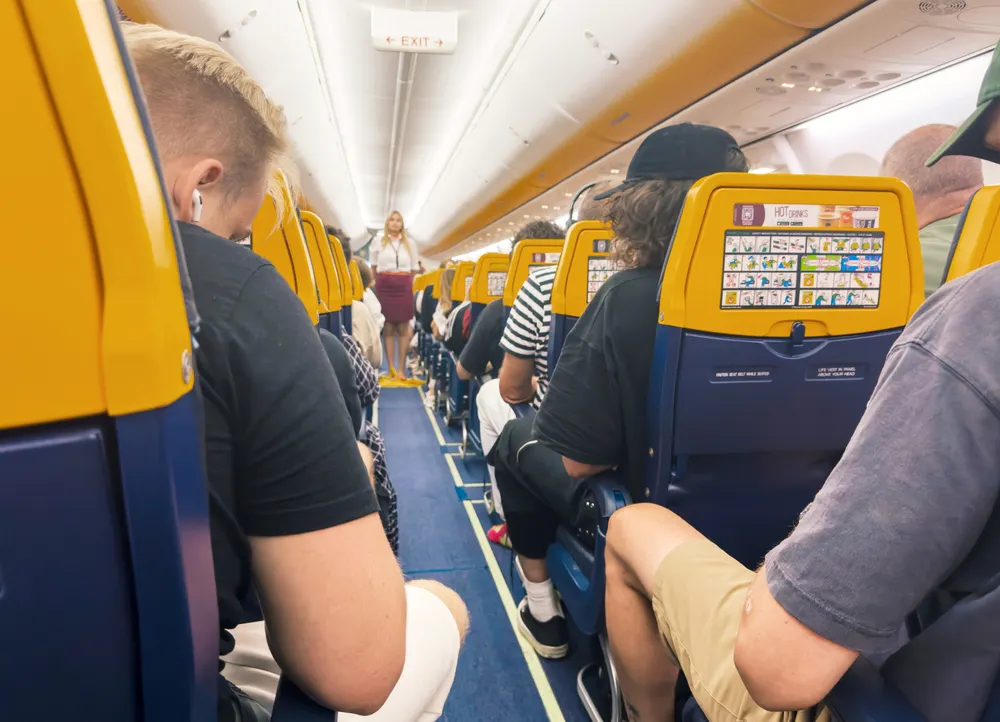
Budget airlines tend to be more efficient as they seat as many passengers as possible. Spacious business or first class seats are often removed and revenue is instead generated through services such as baggage, food or booking flexibility – all of which add little to flight emissions.

Budget airlines tend to fill their seats. Katarzyna Ledwon / shutterstock

We also found a few newer aircraft models to be the most efficient in operation (Boeing 787 Dreamliner and Airbus 320neo, both in several variants) averaging less than 65 grams of CO₂ per passenger-kilometre. However, they are not (yet) the most widely used, partly because aircraft typically remain in service for around 25 years.

Long-haul flights are on average more efficient than shorter flights. Take-off emissions only occur once, and larger aircraft with more seats are typically used on longer routes. For similar reasons, larger airports tend to have lower average emissions per passenger.

Increasing air travel efficiency

We modelled three hypothetical scenarios to illustrate the potential of certain operational changes, recalculating the total emissions after each change.

First, we increased the average passenger load factor from 80% to 95%. This alone would cut emissions by 16%, as fewer flights would be needed to carry the same number of passengers. While this is already in airlines’ interests, creating additional incentives – such as emissions-linked airport charges or fuel taxes – could encourage further gains.

Second, we imagined only the two most efficient aircraft (Boeing 787-9 and Airbus A321neo) were in operation. Aircraft cannot be replaced overnight, given their long service lives, and the industry hasn’t built enough 787-9 or A321neo yet anyway. But choosing already existing aircraft highlights the potential of replacing older aircraft with newer and more efficient ones – in our calculations, it would save between 27% and 34% of global emissions. This would also require overcoming logical and commercial constraints, again potentially incentivised by airport or fuel charges.

Third, we analysed the impact of an all-economy cabin layout. Business and first class seats are up to five times more CO₂-intensive than economy seating because they occupy far more space per passenger. Operating all aircraft at the manufacturers maximum seating capacity would reduce global aircraft emissions by between 26% and 57%.

There are already large differences between airlines. Some chose to set up their Boeing 777-300 ERs with more than 400 economy seats, while others have as few as 200, despite a maximum seating capacity of 550.

Our findings highlight how strongly aviation emissions are shaped by travel inequality between occasional economy fliers and frequent business and first class travellers. Many of those may complain about the inconvenience of economy class. But perhaps that’s not a bad thing: it could create an even stronger incentive to reduce the number of non-essential journeys.

ref. Scrapping business class could halve aviation emissions – new study – https://theconversation.com/scrapping-business-class-could-halve-aviation-emissions-new-study-275474

Evening Report: https://eveningreport.nz/2026/02/24/scrapping-business-class-could-halve-aviation-emissions-new-study-275474/

Misconduct in public office: three reasons why the case against Andrew Mountbatten-Windsor is so complex

Source: The Conversation (Au and NZ) – By Robert Hazell, Professor of British Politics and Government & Founder of the Constitution Unit, UCL

Following the arrest of Andrew Mountbatten-Windsor for possible misconduct in public office, both the palace and the government will be hoping that his case might be brought to a swift conclusion. There are three main reasons why this is unlikely.

1. The vagueness of the offence

The offence Mountbatten-Windsor is being investigated for – misconduct in public office – is famously vague. This complicates the task for the prosecution, who will have to devote more time and effort to understanding the elements of the offence, and then ensuring that they can prove each element.

Misconduct in public office is not set out in an act of parliament, it is an offence under the common law. The public office (accountability) bill (also known as the Hillsborough law) currently going through parliament is meant to give it a statutory definition. But that will be too late for any prosecution of Mountbatten-Windsor, which will have to be for the common law offence, developed in a series of court judgements going back centuries.

In medieval times, the offence was intended to catch those in trusted public office who did something to betray that trust. It later fell into disuse, but was recently revived to catch corrupt police officers whose misconduct (such as selling information to journalists) did not fit easily into well-established offences.

The court of appeal in 2004 reframed the judge-made law for modern times, summarising four elements of the offence. It must be committed by:

  • A public officer, acting as such, who

  • wilfully misconducts himself

  • to such a degree as to abuse the public’s trust in the office holder

  • without reasonable excuse or justification.

Readers must judge for themselves whether this makes the offence any less vague. In careful understatement, the Crown Prosecution Service guidelines state that “the offence should be strictly confined, and it can raise complex and sometimes sensitive issues”.

2. Multiple police forces involved

Mountbatten-Windsor was arrested by Thames Valley Police, but they are not the only force looking into revelations from the millions of documents in the Epstein files. Mountbatten-Windsor denies any wrongdoing in relation to Jeffrey Epstein.

The Metropolitan Police, Essex Police (for flights in and out of Stansted) and Surrey Police are also assessing claims. Some of those investigations are for possible trafficking into or outside the UK for sexual exploitation, which if proved would be offences under the Sexual Offences Act 2003. The National Police Chiefs Council has announced a national group to support the investigating forces.

Police enquiries will inevitably take some time. In addition to the scale of the Epstein files, when looking for evidence of misconduct in public office, the police will want to search through UK government files.

Mountbatten-Windsor was trade envoy from 2001 to 2011. Much of the evidence is likely to be retrieved from his emails and the files of agencies like UK Trade and Investment, and government departments like the Department of Trade (now Business and Trade), the Foreign Office, Cabinet Office and Number 10. Government record keeping is not what it was, and records from that long ago will take time to find and produce.

Mountbatten-Windsor, pictured here with ex-wife Sarah Ferguson, served as a trade envoy between 2001 and 2011. Neil Hall/EPA-EFE

3. Difficulties facing the CPS and the courts

If the police have gathered sufficient evidence, they will submit all the evidence to the Crown Prosecution Service. The CPS in turn will need time to consider whether there is a sufficient case to prosecute, for a common law offence whose definition is still vague and complex.

The CPS code states that they will only prosecute an alleged crime if there is a “realistic prospect of conviction”. This means that a jury, “properly directed in accordance with the law, will be more likely than not to convict the defendant of the charge”.

The main legal difficulties may lie in proving that when acting as trade envoy Mountbatten-Windsor was the holder of a public office, and that his conduct was such as to abuse the public’s trust. In trying to clarify the latter test, the court of appeal said that abuse of trust must amount to “an affront to the standing of the public office held. The threshold is a high one requiring conduct so far below acceptable standards as to amount to an abuse of the public’s trust in the office holder.”

The CPS will also need to liaise closely with the team investigating Peter Mandelson, who is also under investigation for alleged misconduct in public office, related to evidence that he passed confidential government information to Epstein. If the police pass a file on Mandelson to the CPS, there will be similarities in the evidential and legal difficulties in proving misconduct in each case.

It could be a very long time before any trial takes place. One of the biggest obstacles to a swift conclusion is the state of the courts. The recent review by retired senior judge Brian Leveson found a backlog of almost 80,000 cases awaiting trial in the crown court last September, and forecast the backlog would reach 100,000 cases by November 2027.

Some defendants are already being told their cases will not be heard until 2030. To avoid any further suggestions that Mountbatten-Windsor is above the law, his case may have to wait in the queue, just like everyone else’s.

ref. Misconduct in public office: three reasons why the case against Andrew Mountbatten-Windsor is so complex – https://theconversation.com/misconduct-in-public-office-three-reasons-why-the-case-against-andrew-mountbatten-windsor-is-so-complex-276556

Evening Report: https://eveningreport.nz/2026/02/24/misconduct-in-public-office-three-reasons-why-the-case-against-andrew-mountbatten-windsor-is-so-complex-276556/