The next major international sporting event, the 2026 FIFA Men’s World Cup hosted jointly by the United States, Canada and Mexico, is already garnering international scrutiny. There have been numerous calls to boycott it.
Calls for a boycott were amplified recently following U.S. President Donald Trump’s threats to annex Greenland from Denmark, prompting soccer officials in Germany and France to broach the possibility of both countries boycotting the tournament.
Human rights groups have raised concerns over whether World Cup visitors will be detained and handed to ICE if they engage in actions deemed critical of the U.S. government.
Boycotts at international sporting events
In the history of international sporting events, boycotts have been far less common than bans.
Balloons fly over Olympians and spectators during the opening ceremony of the 1964 Summer Olympics at the National Stadium in Tokyo in 1964.(AP Photo)
Notably, both instances of rescinded invitations to the Olympic Games came after other African nations threatened to boycott the Games if South Africa and Rhodesia were invited to participate.
FIFA President Gianni Infantino, right, awards U.S. President Donald Trump with a FIFA Peace Prize during the draw for the 2026 soccer World Cup at the Kennedy Center in Washington, D.C., Dec. 5, 2025.(AP Photo/Chris Carlson)
Furthermore, given the relationship Trump has built up with FIFA president Gianni Infantino, the effect of a boycott, or any credible threats of one, on the United States’ immigration policy or hosting responsibilities would likely be rather limited, making a boycott an unpopular decision that may not achieve the desired goal of any boycotting nation.
Trump could still escalate geopolitical tensions enough to spark further boycott discussions. But for now, a boycott remains unlikely, and even credible threats would likely do little to shift Infantino and Trump from the status quo.
If you’ve spent much time on the internet, you probably know how to yell “I was rooting for you!” The clip from “Cycle 4” (iykyk) of America’s Next Top Model which aired in 2005 went uncontrollably viral.
It became a foundational reality TV meme – an enduring moment that has fed pop culture for two decades.
Now, America’s Next Top Model is back in the headlines thanks to a three-part Netflix series, Reality Check: Inside America’s Next Top Model. This docuseries is supposed to offer a “look back at the reality show’s complicated legacy”.
In reality, there’s a clear self-serving intention here.
[embedded content]
A cultural juggernaut
Running from 2003 to 2018, each season or “cycle” of America’s Next Top Model (ANTM) follows a group of young women learning the skills of a top model. Each episode includes a task, a photoshoot and an elimination.
The first lineup of America’s Next Top Model hopefuls.Netflix
The series incorporated elements from other successful reality shows such as Fear Factor (with models posing in photoshoots with cockroaches, dripping in fish guts and wearing meat as clothes); Survivor (backstabbing cast mates and bitchiness) and, unfortunately, The Swan (drastic makeovers sometimes resulting in chemical burns or lengthy surgeries).
Created, produced and hosted by veteran supermodel Tyra Banks, ANTM taught millennials how to extend the neck, angle their face for the camera and “smize” (smile with the eyes).
[embedded content]
Who is to blame?
Those who held creative power on the show deliberately distance themselves from Banks in the documentary. Banks herself participates for seemingly no other reason than to soft launch a new season after eight years off air, and boldly justify her mistreatment of contestants.
Jay Manuel, ANTM Creative Director and judge – and consultant on this new documentary – claims “reality TV is a bitch. If it doesn’t bleed and lead it doesn’t work”. This is fundamentally untrue. There are many shows that don’t rely on the “villain edit”.
As an ex-participant on The Bachelor New Zealand, I have experienced first-hand the negative physical effects of being on such a show – as well as the fear of legal persecution and financial penalties for speaking out.
Documentaries that revisit old reality shows ought to be spaces for former contestants to share their experiences. That doesn’t happen here. There is no honest critique or reflection on the part of the production team. Instead, we see producers once again exerting their own narrative to counter contestant testimonials.
Last year’s Fit For TV: The Reality of The Biggest Loser was similarly problematic. Instead of explaining, apologising and taking accountability, the crew reasserted their power by using “it was a different time” as an excuse.
Banks offers no sincere apologies in Reality Check. At one point, she describes an apology in the past tense, and it’s not clear whether it was directly given to the contestant. “I have actually apologised for the issue with Dani,” she says, regarding past behaviour that coerced 2006 contestant Dani into getting dental surgery for a tooth gap.
Dani Evans, Cycle Six winner, was pressured to close her tooth gap.Netflix
In another “apology”, Banks doesn’t refer to the victim, Keenyah, by name: “Boo Boo. I am so sorry.” Tyra had fat-shamed and lectured Keenyah in a 2005 episode after Keenyah politely called-out on-set sexual harassment by a male model.
Cycle Four contestant Keenyah Hill faced criticism for her weight and eating habits.Netflix
Who, then, does Banks think is responsible for the harm inflicted on contestants?
Across three episodes, we hear “gen Z”, “social media”, viewers “that were demanding it”, co-creator Ken Mok, judge Janice Dickinson, UPN network President Dawn Ostroff, CW President Mark Pedowitz, CBS CEO Les Moonves, the fashion industry, the reality TV industry, “the culture at the time” and the contestants.
She blames everyone but herself.
Tyra Banks and lateral violence
In the documentary, Banks says her intention with ANTM was to respond to an industry that constantly demonstrated abuses of power throughout her career:
I wanted to fight against the fashion industry […] for this show to represent not all white, not all skinny, but just showing all the differences, and all the different types of beauties. I had a feeling that I was going to change the beauty world. This was my way to get back.
Tyra Banks may have aimed to challenge fashion’s harsh standards, but she often reinforced them.Sitthixay Ditthavong/AAP
Whether it was her ethnicity, weight, forehead, or media-fueled rivalry with Naomi Campbell, only once Banks was “established” could she speak of her experiences of mistreatment.
Despite this intention, Reality Check shows us how, once Banks accrued her own cultural capital, she took her frustration out on contestants rather than the industry. As journalist Zakiya Gibbons, an independent voice within the documentary, points out:
Tyra wants to challenge the fashion industry’s ideals around what is beauty, but is also still upholding ideologies and attitudes that oppressed her.
What Gibbons captures here is an example of lateral violence: when someone directs their rage at their own minority group, rather than their oppressor.
ANTM became Banks’ own sub-industry in which to dole out her harshest verbal and emotional violence on Black contestants. Her chosen forms of violence included body shaming, fat shaming, coercion into medical surgery, and verbal and emotional abuse.
A public relations project
Social media now allows former reality TV participants an unfiltered opportunity to speak their truth, despite the threat of non-disclosure agreements.
In 2023, former Real Housewives participant Bethenny Frankle banded together with other ex-Housewives in a “reality reckoning” against American TV network Bravo – exposing how even non-eliminating shows are unethical.
That same year, we saw the launch of the UCAN Foundation, a support and advocacy foundation for people on reality TV.
These were steps in the right direction. Reality Check is an example of a major platform giving airtime and an opportunity for redemption to the perpetrators of violence: it’s a step backwards.
There are already accusations that former ANTM contestants were notcompensated for appearing in the docuseries.
Live appearances, social media, and documentary exposé are the few remaining spaces where reality TV contestants can share experiences. They should not be reclaimed by producers.
Currently, the average new loan size for owner-occupied homes is about A$736,000. On a 30-year mortgage this size, an increase of 0.25 percentage points in the official cash rate could mean paying about $120 more each month.
When assessing home loan applications, lenders are required by law to check a borrower could still make their repayments if interest rates were to rise by a certain amount. This “serviceability buffer” is currently three percentage points.
Across the country, borrowers are showing remarkable resilience. At Commonwealth Bank, for example, Australia’s largest mortgage lender, latest results show 87% of home loan customers are ahead of their scheduled repayments.
That offers little comfort to other households already struggling to make ends meet who may not be able to find the extra money required to meet increased repayments.
So, what options are available when homeowners can’t stretch their budget any further?
Ask for help
If you’re experiencing mortgage stress, the first step should always be to talk to your lender – as soon as you realise you are not going to be able to make a payment, or if you have missed a payment.
It may be able to offer a pause on repayments for a short period, or negotiate reduced repayments for a few months.
However, this sort of assistance is aimed at helping with a short-term problem. If your mortgage repayments are unaffordable for the foreseeable future, you will need to look at other options.
Reach out to your lender as soon as possible, to see what help is available.Tatiana Syrikova/Pexels
Longer-term options
Your lender can help identify if there are other ways it can help reduce your repayments.
One option may be extending your loan term to reduce the repayments for the rest of the loan. A lender could also consider moving you into another product, such as an interest-only loan, to lower repayments.
Further assistance may be available in certain jurisdictions. For example, if you are in Queensland or the Australian Capital Territory, you might be able to access mortgage relief through state government schemes.
Looking at the bigger picture
If your mortgage is still unaffordable, and you want to keep your home, then you will need to cut back in other places to afford your repayments in the long term.
There are many guides to help get you started on finding ways to reduce your expenses.
If a particular household bill is of concern, you can also talk to utilities providers about your financial hardship and see if you can pay these bills in instalments.
Depending on your situation, there could be other options to help keep up with repayments, such as renting out a spare bedroom or parking space.
If you cannot manage your repayments, it might be time to consider selling. Generally, you will get a better price for your home if you sell it, rather than letting the bank take possession and selling it to recover any outstanding loan balance.
Again, it’s important to talk to your lender as it can arrange hardship assistance that allows you time to sell.
It’s important to act early
If you are struggling financially, your best bet is to talk to your lender. Ignoring your mortgage repayments will not make them go away, and will make your situation worse.
Early communication with your lender ensures it is aware of your financial hardship and can provide advice on how best to proceed.
You are not the first person to suffer financial stress, and you should know you are not alone. In 2024–25, there were more than 280,000 financial hardship notices (borrowers advising lenders they were struggling).
Lenders know your circumstances can change, so use your legal right to ask for support to help you manage your mortgage stress.
Help is available
If you or someone you know is in financial distress, support is available:
The National Debt Helpline provides free advice on how to manage your debt, and you can talk to a financial counsellor about your situation. The counsellor can help with budgeting and can also provide advocacy services to help you manage your debts.
For First Nations people, Mob Strong can provide legal advice and financial counselling.
The Financial Rights Legal Centre has tools to help you manage your debts and can provide free financial counselling or legal help.
Source: The Conversation (Au and NZ) – By Martin Kear, Sessional Lecturer, Department of Government and International Relations, University of Sydney
In the aftermath of the Bondi terrorist attack at a Hanukkah celebration that killed 15 people, the New South Wales government is moving toward banning phrases it argues incite hatred. The Queensland government has said it would do the same.
Chief among these are “globalise the intifada” and “from the river to the sea”.
The meaning and intent of both of these phrases are hotly contested between the Jewish and Muslim communities and their supporters.
The main reason they are so contentious is because they form part of the broader debate over the legitimacy of Israel and Palestine, and whether they can or should exist simultaneously in a two-state solution.
On one side, proponents of these phrases say they are expressions of Palestinian nationalism and their right to equality, freedom and dignity. They indicate support for Palestinians’ right to self-determination and their right to resist Israel’s nearly 60-year occupation of the West Bank, Gaza Strip and East Jerusalem, known as the Occupied Palestinian Territories, which the International Court of Justice has ruled is illegal.
On the other side, those arguing against these phrases say they are antisemitic because they incite violence towards Israel and Jewish people more broadly, and are catchcries for the destruction of Israel.
Given these binary positions and the legislative moves towards banning them, it is important to understand the history and nuances of the phrases, separate from the emotive rhetoric and, at times, disinformation surrounding this debate.
Globalise the intifada
One of the first times this phrase was reportedly used was at an anti-war protest in Washington in 2002.
It has become much more commonplace after Israel’s devastating response to Hamas’ October 2023 terrorist attacks. The war has caused the deaths of more than 75,000 Palestinians in Gaza and is being investigated by the International Court of Justice and the International Criminal Court for alleged war crimes, crimes against humanity and genocide.
Demonstrators participate in a solidarity rally with Palestine in Paris, France, February 2026.Mohammed Badra/AP
According to the American Jewish Committee, one of the oldest Jewish advocacy groups in the United States:
The phrase is often understood by those who are saying and hearing it as encouraging violence against Israel, Jews and institutions supporting Israel. While the intent of the person saying this phrase may be different, the impact on the Jewish community remains the same.
Key to understanding this phrase is the term “intifada”. In Arabic, the word means “uprising” or “shaking off”. There have been two intifadas against Israel’s occupation of the Palestinian territories, from 1987–93 and 2000–05.
Both intifadas were spontaneous eruptions of discontent and revolt by Palestinians against the violence, harassment, and social, political and economic deprivation they experienced in the Occupied Palestinian Territories.
Additionally, one of the primary motivations of the First Intifada was Palestinian frustration at the inability of the Palestine Liberation Organisation (PLO) to advance the cause of Palestinian statehood.
Notably, the violence of the First Intifada was confined to the Occupied Palestinian Territories and consisted mainly of stone throwing, tire burning, demonstrations and civil disobedience. According to the Jewish human rights group B’Tselem, around 1,400 Palestinians and 270 Israelis were killed.
The Second Intifada has more relevance to how the global Jewish community perceives the term “intifada” today. This is because the Palestinian groups Hamas, Fatah and Palestinian Islamic Jihad launched suicide attacks that deliberately targeted civilians in Israel. According to B’Tselem, more than 680 Israeli civilians and 3,300 Palestinians were killed during the violence.
A bus bombing in Haifa, Israel, in 2003.Wikimedia Commona
Israeli tanks in the streets of the Palestinian refugee camp of Jenin in the West Bank, April 2002.Wikimedia Commona
These attacks caused immense fear and feelings of vulnerability among Israelis. Jews were deliberately targeted – a hallmark of antisemitism.
Indeed, the very reason Israel exists is because of the institutionalised antisemitism and political persecution of Jews in Europe, which culminated in the Holocaust. This is the reason Theodor Herzlestablished the Zionist movement – the realisation that the only way European Jews could be free from this rampant violence and antisemitism was to have a state where they would form the majority. To Jews, this makes Israel more than simply a state – it is an ideal, a sanctuary – a place where they can feel safe.
The memory of the attacks during the Second Intifada – in concert with this long history of persecution and the Holocaust – drives the opposition to this phrase among many Jewish people.
However, Palestinian supporters argue that both intifadas were centred on expressions of Palestinian nationalism, their demands for statehood and resistance against Israel’s occupation.
There is a growing fear among Palestinians that the increasing permanence of Israel’s occupation and creeping annexation of the territories destroys any hope of achieving a state – a place where they can be safe from Israeli violence and persecution.
Therefore, Palestinian activists argue the phrase has legitimacy. According to Ben Jamal, leader of the UK’s Palestine Solidarity Campaign, the phrase is used as a “call for worldwide support for an end to the oppression of the Palestinian people through all means of legitimate resistance”.
He added:
That’s not a call for violence against civilians or Jewish people – and to say that is actually, in my view, a form of anti-Palestinian racism.
From the river to the sea
A similar debate rages over the meaning of the phrase “from the river to the sea”. Again, this taps into the broader debate concerning Palestinian nationalism and advocacy for a Palestinian state, with the full phrase being “from the river to the sea, Palestine will be free”.
The geography refers to the land between the Jordan River and the Mediterranean Sea where Israel and the Occupied Palestinian Territories now sit.
Many Israelis and Jews around the world believe the phrase is antisemitic because of the perception that the establishment of a Palestinian state extending across this entire territory would signal the destruction of Israel. This is not just the state, but more importantly, the ideal.
The phrase was first used around 1964 by the newly formed Palestine Liberation Organisation to advocate for a unitary Palestinian state along the borders of “Mandatory Palestine” – the administrative territory ruled by the British from 1920–48 – that would include Palestinians, Jews and Christians. This would mean the elimination of the state of Israel, but not the Jewish people.
But it’s necessary to unpack how the meaning has changed over time. A key question here: what is the geography of a future Palestinian state?
The PLO accepted the two-state solution in 1988, meaning it acknowledged that any future Palestine would consist only of the Occupied Palestinian Territories, meaning the West Bank, Gaza and East Jerusalem.
Hamas’ position on the phrase has also evolved over time. While its 1988 charter never mentioned the phrase specifically, it did state “[Hamas] will strive to raise the banner of Allah over every inch of Palestine.”
Hamas rejects any alternative to the full and complete liberation of Palestine, from the river to the sea. However, without compromising its rejection of the Zionist entity and without relinquishing any Palestinian rights, Hamas considers the establishment of a fully sovereign and independent Palestinian state, with Jerusalem as its capital along the lines of the 4th of June 1967 to be a formula of national consensus.
This refers to the ceasefire lines between Israel and the Palestinian territories before the Six-Day War in 1967, when Israel captured and occupied the Palestinian Territories.
Map of the Occupied Palestinian Territories (West Bank and Gaza Strip), marked by the Green Line, the demarcation line established after the 1948 Arab–Israeli War.Wikimedia Commons
Therefore, Hamas’ position is consistent with United Nations Security Council Resolution 242 (1967) that is used by the international community as the basis for the two-state solution.
The 2017 declaration also highlights the compromise position within Hamas between those who believe Palestine should exist “from the river to the sea” and those willing to tolerate a Palestine only in the Occupied Territories. Hamas now officially treats the former as a guiding principle, not an organisational objective.
As former Hamas Chairman Khaled Meshaal explained in 2017:
Even though we accept and welcome that eventuality of [the two-state solution], this does not mean we would have to recognise Israel or surrender our principle that all of Palestine belongs to the Palestinian people.
Given this, there is an argument that the term’s use is not a call for the destruction of the Israeli state and the expulsion of Jews, but a demand that Israel dismantle its illegal occupation and allow Palestinians the freedom to establish their own state.
Adding to the phrase’s controversy is the fact that Israel’s Likud party, led by Prime Minister Benjamin Netanyahu, used a variation of it in its 1977 party platform:
Between the Sea and the Jordan there will only be Israeli sovereignty.
Though Likud has dropped the phrase from its current platform, it continues to vehemently oppose any Palestinian state.
This brings us back to the central questions at the heart of the debate over these phrases.
Does support for the Palestinian people and Palestinian statehood, as expressed in these phrases, equate to the threat of violence against Israel as a state and an ideal, and against the Jewish people?
Or are they part of legitimate political debate about Palestinian self-determination?
As Australians, we face a stark choice about whether to criminalise these phrases. Favouring one side will only inflame tensions with the other. It will only entrench – not resolve – societal discord.
Charting a middle course based on democratic ideals will be difficult. Finding a way forward will require a level of political and moral courage from our leaders that has been sadly lacking since the current round of violence began more than two years ago.
In Burnt Norton, the opening section of T.S. Eliot’s Four Quartets, the poet moves down a passage “we did not take” and passes through a door “never opened” to arrive in a mythic rose garden. Here, in the thorny cradle of mournful innocence, a bird delivers the famous line:
humankind Cannot bear very much reality.
That inability to “bear much reality” reverberates in Claire-Louise Bennett’s experimental new novel, Big Kiss, Bye-Bye.
The novel dissects the mind of a young woman reckoning with the psychological upheaval of a romantic separation. As the unnamed narrator grieves and reflects, she unpicks the patchwork of illusions that sustained her relationship with a peculiar elderly man named Xavier.
At the centre of this thrillingly interior work, almost entirely denuded of sentimentality, is the collision of these two deeply self-involved characters, both of whom are more wedded to their fantasies about one another than their actual selves. One of the most intriguing elements of the novel is witnessing their failure to connect in the middle point between their incongruent psychological worlds.
Review: Big Kiss, Bye-Bye – Claire-Louise Bennett (Fitzcarraldo)
Bennett’s brilliant debut Pond (2015) wove together stories narrated by a reclusive woman living in a remote cottage in Ireland. Her second book, Checkout 19 (2021), was a novel that examined a young woman’s maturation through her engagement with literature, combining elements of autofiction and the Künstlerroman (artist’s novel) to navigate material that might have fallen flat in the hands of a writer with less flair and ambition.
The playfully titled Big Kiss, Bye-Bye is Bennett’s third book and her most desperate, intelligent and irreverent to date. It resonates stylistically with modernist predecessors in its scrutiny of consciousness and often overlooked complexities buried within the quotidian.
This characteristically modernist concern with the mind’s mysterious workings and its convoluted relationship with material reality is reflected in the narrator’s interest in dreams. She takes pleasure in recounting and interpreting her dreams to uncover the self-knowledge she believes they hold in uncanny suspension.
‘Some sort of Hell’
As in Bennett’s previous novels, the unnamed narrator at the centre of Big Kiss, Bye-Bye resembles the author. She is a writer at a similar age and stage of life. In the beginning, however, her occupation is an ancillary detail. The event that monopolises her attention and nervous energy is her recent separation from her beloved Xavier, with his dentures and his time-hardened eccentricities.
Early in the novel, it is revealed that the catalyst for the breakup was an email he sent about the narrator’s recently published book, in which he described her work as “some sort of Hell”.
With this email, a line is crossed. The plainness of Xavier’s lack of regard for her feelings is laid out so clearly and uncompromisingly that nothing can atone for his insensitivity. Any illusions the narrator might have nurtured about him being sensitive (albeit socially clumsy) are shattered.
What follows is a forensic examination of the illusions that fuelled their partnership. As the novel progresses through its solipsistic textual landscape, the narrator’s non-linear recollection of events provides intimate access to her time with Xavier. It is only with the clarity of hindsight that she is able to reconstruct a nuanced portrait.
Xavier is a wealthy Christian scientist with a limp grip on reality. He believes “sickness is an illusion” and that friendship is for children. When he and the narrator are together, he wants to be with her all the time. He cannot seem to fathom “why she did so many things that didn’t involve him”.
Beyond his neediness, Xavier is comically self-interested. He has written a book on the topic of himself, which he affectionately refers to as his “bio”. He dreams of having it made into a film. It contains intimate details about the narrator and he has no regard for why this might concern her.
A polite but painful man, Xavier has a penchant for undermining the narrator with compliments. When she hands him a copy of her book (the one he calls “some sort of Hell”), he notes “how smart it was”. He then turns straight to the author photo on the jacket and says “cute little ears”, shifting the focus away from her intellectual achievement and back to her physical appearance.
The extent to which illusions have sustained the partnership between the novel’s two unlikely lovers is perhaps most explict in their final encounter – depicted at the beginning of the work.
They attend the races. It is Lady’s Day – which, the narrator reflects, Xavier enjoys because “he likes to see women dressed up”. She is nevertheless certain that Xavier won’t stare at them, because “too much scrutiny might spoil the illusion of sophistication and Xavier isn’t interested in having his illusions dispensed with”.
The narrator reflects that Xavier is rather fond of illusions “and is of the opinion that there isn’t much else”:
“Life is an illusion,” he’ll say, “but then you already know that, don’t you.”
Yet he also believes his take on reality is authoritative. “I don’t see you as your friends see you,” Xavier tells the narrator. “I see you as you really are.”
She humours his belief, in what reads as an attempt to remain palatable.
Illusions reinforced
Throughout the novel, the narrator reinforces the illusions Xavier projects onto their relationship. At one point, she reassures him the dress she is wearing was purchased with money he gave her, even though it wasn’t.
She mulls over which flower arrangements she should buy at his expense – a detail makes her appear somewhat petulant. Xavier believes it is normal to spend a significant sum on a routine bouquet; the narrator desires a more modest arrangement. But she panders to his desire to provide for her and, in doing so, assists in preserving his fantasy. She permits him an artificial sense of accomplishment in supplying her with something that is not wanted.
The narrator shares Xavier’s tenuous grip on “reality”. Over the course of the novel, she comes to realise that she was more invested in the ideas she manufactured about Xavier than the man himself.
She confesses that her attachment had been “very much predicated upon” the idea of “staying close during his final days and hours”. Her belief in the statistical likelihood that she was destined to be “his last love” inspires a mock-heroic degree of psychological fortitude.
Along with the exquisite prose, one of the most satisfying elements of Big Kiss Bye-Bye is Bennett’s delicate depiction of the conflict that stems from the narrator’s competing desires. The feminist yearning for equality in a heteronormative partnership is sometimes incompatible with the more universal longing to be loved and desirable.
Beyond her reflections on her inflated sense of responsibility for Xavier, she examines her relationships with other men. This includes ruminating over a letter she receives from a past English teacher, which stirs dormant memories.
Despite her keen awareness of Xavier’s potent self-assuredness, the narrator struggles with her own sense of self-awareness. She confides that she is the type of writer who doesn’t like to be aware of herself when she is writing. She goes on to acknowledge that this is nonsensical, given that so many of her sentences begin with the singular pronoun “I”.
She is also self-aware enough to recognise that she is riddled with anxiety. She recalls a period in her life when she was convinced all the men in her world – even frail old Xavier – were trying to kill her. She acknowledges the creative impulse in this paranoia, reflecting that “all my life I’ve felt something was after me and to my own irritation I looked behind too often and kept seeing things”.
Again, the novel returns to the disjuncture between how things are and how the mind perceives them, and reminds us of the human tendency to seek shelter in illusions.
Following the arrest of Andrew Mountbatten-Windsor for possible misconduct in public office, both the palace and the government will be hoping that his case might be brought to a swift conclusion. There are three main reasons why this is unlikely.
1. The vagueness of the offence
The offence Mountbatten-Windsor is being investigated for – misconduct in public office – is famously vague. This complicates the task for the prosecution, who will have to devote more time and effort to understanding the elements of the offence, and then ensuring that they can prove each element.
Misconduct in public office is not set out in an act of parliament, it is an offence under the common law. The public office (accountability) bill (also known as the Hillsborough law) currently going through parliament is meant to give it a statutory definition. But that will be too late for any prosecution of Mountbatten-Windsor, which will have to be for the common law offence, developed in a series of court judgements going back centuries.
In medieval times, the offence was intended to catch those in trusted public office who did something to betray that trust. It later fell into disuse, but was recently revived to catch corrupt police officers whose misconduct (such as selling information to journalists) did not fit easily into well-established offences.
The court of appeal in 2004 reframed the judge-made law for modern times, summarising four elements of the offence. It must be committed by:
A public officer, acting as such, who
wilfully misconducts himself
to such a degree as to abuse the public’s trust in the office holder
without reasonable excuse or justification.
Readers must judge for themselves whether this makes the offence any less vague. In careful understatement, the Crown Prosecution Service guidelines state that “the offence should be strictly confined, and it can raise complex and sometimes sensitive issues”.
2. Multiple police forces involved
Mountbatten-Windsor was arrested by Thames Valley Police, but they are not the only force looking into revelations from the millions of documents in the Epstein files. Mountbatten-Windsor denies any wrongdoing in relation to Jeffrey Epstein.
The Metropolitan Police, Essex Police (for flights in and out of Stansted) and Surrey Police are also assessing claims. Some of those investigations are for possible trafficking into or outside the UK for sexual exploitation, which if proved would be offences under the Sexual Offences Act 2003. The National Police Chiefs Council has announced a national group to support the investigating forces.
Police enquiries will inevitably take some time. In addition to the scale of the Epstein files, when looking for evidence of misconduct in public office, the police will want to search through UK government files.
Mountbatten-Windsor was trade envoy from 2001 to 2011. Much of the evidence is likely to be retrieved from his emails and the files of agencies like UK Trade and Investment, and government departments like the Department of Trade (now Business and Trade), the Foreign Office, Cabinet Office and Number 10. Government record keeping is not what it was, and records from that long ago will take time to find and produce.
Mountbatten-Windsor, pictured here with ex-wife Sarah Ferguson, served as a trade envoy between 2001 and 2011.Neil Hall/EPA-EFE
3. Difficulties facing the CPS and the courts
If the police have gathered sufficient evidence, they will submit all the evidence to the Crown Prosecution Service. The CPS in turn will need time to consider whether there is a sufficient case to prosecute, for a common law offence whose definition is still vague and complex.
The CPS code states that they will only prosecute an alleged crime if there is a “realistic prospect of conviction”. This means that a jury, “properly directed in accordance with the law, will be more likely than not to convict the defendant of the charge”.
The main legal difficulties may lie in proving that when acting as trade envoy Mountbatten-Windsor was the holder of a public office, and that his conduct was such as to abuse the public’s trust. In trying to clarify the latter test, the court of appeal said that abuse of trust must amount to “an affront to the standing of the public office held. The threshold is a high one requiring conduct so far below acceptable standards as to amount to an abuse of the public’s trust in the office holder.”
The CPS will also need to liaise closely with the team investigating Peter Mandelson, who is also under investigation for alleged misconduct in public office, related to evidence that he passed confidential government information to Epstein. If the police pass a file on Mandelson to the CPS, there will be similarities in the evidential and legal difficulties in proving misconduct in each case.
It could be a very long time before any trial takes place. One of the biggest obstacles to a swift conclusion is the state of the courts. The recent review by retired senior judge Brian Leveson found a backlog of almost 80,000 cases awaiting trial in the crown court last September, and forecast the backlog would reach 100,000 cases by November 2027.
Some defendants are already being told their cases will not be heard until 2030. To avoid any further suggestions that Mountbatten-Windsor is above the law, his case may have to wait in the queue, just like everyone else’s.
Air travel is famously one of the hardest sectors to decarbonise, and the number of air passengers keeps increasing. Electric planes and “sustainable” aviation fuels are still a long way off making a dent in the industry’s emissions – if they ever will.
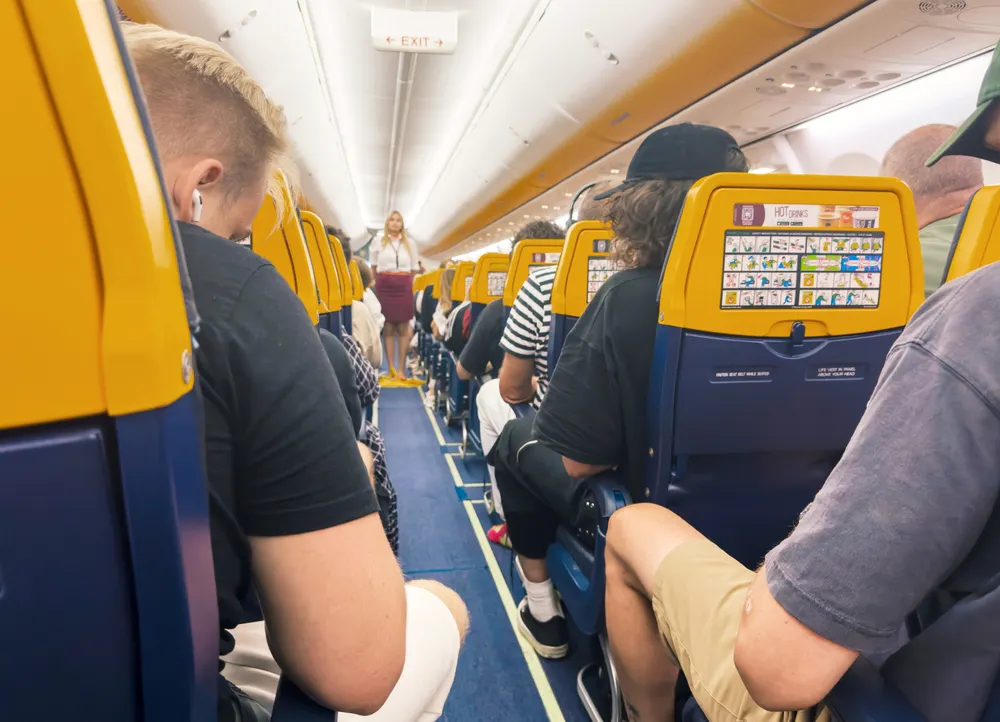
But new research by me and my colleagues shows aviation could still cut its climate impact dramatically, simply by using planes more efficiently. In fact, rethinking cabin layouts alone could slash emissions by up to half.
From 1980 to 2019, the share of occupied seats in commercial air planes increased from 63% to 82%. Airlines already have strong commercial incentives to sell every seat – empty ones cost money as well as carbon.
For any given level of passenger travel, carrying more people on each flight means other planes can stay grounded and fewer flights are needed overall. It’s planes that make the big difference, not people – the additional weight of a passenger and their luggage is negligible relative to the aircraft and its fuel.
Aviation is responsible for 2%-3% of global CO₂, but its contribution to global warming is about 4% when secondary effects like condensation trails (which trap heat) are factored in. This impact is dominated by rich people flying frequently, often long-haul in business and first class or even private.
Efficiency in aviation is often thought of as an engineering challenge: how much thrust an engine generates for a given amount of jet fuel. But operational efficiency – the amount of passenger-kilometres per unit of CO₂ emitted – has received far less attention.
In our research, my colleagues and I calculated this operational efficiency for the year 2023, for every flight route, by airline, aircraft model and airport. We found that efficiency gains available in the short term could reduce aviation’s climate impact by more than half.
Short empty flights are the least fuel-efficient
On average, aviation emissions fell from around 260 grams of CO₂ per paying passenger-kilometre in 1980 to 90 grams in 2019. That’s a big difference, but for comparison, electrified rail powered by low-carbon energy can emit less than 5 grams.
Our analysis shows that CO₂ efficiency varies enormously across routes, regions, airports, airlines and aircraft models. Some flight routes emit more than 800 grams per passenger-kilometre, others less than 50. This variability is staggering but also yields a large potential to reduce emissions if efficiency across the industry increased towards that of the most efficient routes we analysed.
Among the highest emitting countries, many of the least efficient flights start or land in the US, followed by China, Germany and Japan. Inefficient flights are common elsewhere, particularly from or to smaller airports, and in Africa and Oceania, often exceeding 140g per passenger-kilometre.
By contrast, more efficient flights – below 100 grams per passenger-kilometre – are common in Brazil, India and south-east Asia, particularly on high volume routes. Europe contains a mix of both.
These differences can be explained by the share of occupied seats, the aircraft models used on a route and the cabin layout – especially the space allocated for business and first class.
Budget airlines tend to be more efficient as they seat as many passengers as possible. Spacious business or first class seats are often removed and revenue is instead generated through services such as baggage, food or booking flexibility – all of which add little to flight emissions.
Budget airlines tend to fill their seats.Katarzyna Ledwon / shutterstock
We also found a few newer aircraft models to be the most efficient in operation (Boeing 787 Dreamliner and Airbus 320neo, both in several variants) averaging less than 65 grams of CO₂ per passenger-kilometre. However, they are not (yet) the most widely used, partly because aircraft typically remain in service for around 25 years.
Long-haul flights are on average more efficient than shorter flights. Take-off emissions only occur once, and larger aircraft with more seats are typically used on longer routes. For similar reasons, larger airports tend to have lower average emissions per passenger.
Increasing air travel efficiency
We modelled three hypothetical scenarios to illustrate the potential of certain operational changes, recalculating the total emissions after each change.
First, we increased the average passenger load factor from 80% to 95%. This alone would cut emissions by 16%, as fewer flights would be needed to carry the same number of passengers. While this is already in airlines’ interests, creating additional incentives – such as emissions-linked airport charges or fuel taxes – could encourage further gains.
Second, we imagined only the two most efficient aircraft (Boeing 787-9 and Airbus A321neo) were in operation. Aircraft cannot be replaced overnight, given their long service lives, and the industry hasn’t built enough 787-9 or A321neo yet anyway. But choosing already existing aircraft highlights the potential of replacing older aircraft with newer and more efficient ones – in our calculations, it would save between 27% and 34% of global emissions. This would also require overcoming logical and commercial constraints, again potentially incentivised by airport or fuel charges.
Third, we analysed the impact of an all-economy cabin layout. Business and first class seats are up to five times more CO₂-intensive than economy seating because they occupy far more space per passenger. Operating all aircraft at the manufacturers maximum seating capacity would reduce global aircraft emissions by between 26% and 57%.
There are already large differences between airlines. Some chose to set up their Boeing 777-300 ERs with more than 400 economy seats, while others have as few as 200, despite a maximum seating capacity of 550.
Our findings highlight how strongly aviation emissions are shaped by travel inequality between occasional economy fliers and frequent business and first class travellers. Many of those may complain about the inconvenience of economy class. But perhaps that’s not a bad thing: it could create an even stronger incentive to reduce the number of non-essential journeys.
Students using support services has surged, according to student leaders. (File photo)123RF
Student leaders say the rising cost of living is reshaping university life – and for some, putting tertiary study out of reach altogether.
Campus groups said demand for hardship help was climbing as students struggled to cover rent, food and power while balancing study and work.
At the Victoria University of Wellington Students’ Association, president Aidan Donohue said usage of basic support services had surged over the past year.
“We’re seeing students need support from other avenues to make up shortfalls in income,” he said.
“Rent, power, groceries – things you can’t choose not to buy – those are the key pressures.”
The association’s free community pantry ran out of funding before the end of last year after demand exceeded projections.
Donohue said international students were among those relying heavily on food parcels, alongside increasing use of free menstrual products and discounted rubbish bags.
“By far, cost of living is the biggest issue for students. It’s ultimately what decides if someone goes to university at all – or whether they stay.
“When you compare studying with living costs and a part-time job, you’re often worse off than working full-time on minimum wage.”
At the Waikato Students’ Union, president Seamus Lohrey, 22, said the financial strain had been consistent since the pandemic but remained acute.
“More and more students now need to get a job, but they’re expected to be full-time students,” he said.
“There’s a difference between having enough money to live – and enough to actually achieve in your study.”
Lohrey, a final-year law student, said many students were juggling study and work simply to survive.
Bond payments for flats were one of the biggest immediate costs, he said.
“A cheap bond would be $700 plus. For someone who’s meant to be a full-time student, that’s a lot of money.”
While it was difficult to quantify because of confidentiality, Lohrey said the demand for food support on campus was also clear.
“There is an incredibly large need and desire for food, which is concerning.
“If you don’t have the foundation there – food, warmth – you can’t actually access those high-level needs.”
Scott Tambisari, president of the Student Association Nelson Marlborough Institute of Technology, said demand and underlying need are growing locally.
“In 2025 we supported 421 students through hardship assistance. Of these, 134 students were referred to the local Foodbank that we partner with as they also needed support for their whānau. This is lower than our 2024 figures, where we supported 701 students through hardship, including 289 Foodbank referrals.
The reduction in help was not due to reduced need, but rather funding constraints, Tambisari said.
“We did not receive dedicated hardship funding in 2025 and instead relied on remaining funding and external grants to continue supporting students”.
And for many students, the pressure is personal and immediate.
Christchurch nursing student Sarah Evans, 33, said her student allowance covers her bills “pretty much to the dollar”, leaving only a small amount each week for food, fuel and other costs.
She could earn a limited amount before her allowance was reduced, leaving little incentive to work more hours.
“I’ve got about $4 left of my student allowance after bills,” she said.
Evans said she had borrowed money from family to buy essential course equipment and sometimes struggled to afford groceries.
“Last week I didn’t actually have enough money for food, so I had to borrow $50 just to buy basics like bread and pasta.”
“You start to weigh it up and think it might actually be better to go back to work and earn a living. You want to follow a passion, but you still need to survive.”
In Auckland, 22-year-old Trinity Alp said she moved from Whangārei to study but had struggled to find part-time work.
“I’ve applied for over 60 jobs. There’s just not enough part-time work going around for students to survive.”
With rent and bills to pay, she said food often became the last priority.
“Food comes last and that’s horrible because it’s one of the main things we need to survive,” she said.
“Some weeks I’ve only got $50 to $80 left for food. You start thinking, should I just drop out?”
Tertiary Education Minister Shane Reti said the government recognised cost-of-living pressures on students.
He said most tuition costs were publicly funded, with student payments adjusted each year for inflation.
“The government also funds Student Job Search, which provides free support to assist tertiary students with finding employment,” Reti said.
“Other government funded support includes training incentives to help sole parents, carers and disabled people access tertiary education, Working for Families Tax Credits to assist families with dependent children and accommodation support which is available to student allowances recipients who are living away from home.”
Meanwhile, the Ministry of Social Development said it had added staff and temporarily extended StudyLink call centre hours to manage demand.
Sign up for Ngā Pitopito Kōrero, a daily newsletter curated by our editors and delivered straight to your inbox every weekday.
– Published by EveningReport.nz and AsiaPacificReport.nz, see: MIL OSI in partnership with Radio New Zealand
One of the largest known stars in the universe underwent a dramatic transformation in 2014, new research shows, and may be preparing to explode.
A study led by Gonzalo Muñoz-Sanchez at the National Observatory of Athens, published in Nature Astronomy today, argues that the enormous star WOH G64 has transitioned from a red supergiant to a rare yellow hypergiant – in what may be evidence of impending supernova.
The evidence suggests we may be witnessing, in real time, a massive star shedding its outer layers, shrinking as it heats up, and moving closer to the end of its short life.
A very special star
WOH G64 was first discovered in the 1970s as as star of interest in the Large Magellanic Cloud, a dwarf galaxy orbiting the Milky Way.
It turned out the star was not only extremely luminous, but also one of the biggest ever discovered: more than 1,500 times the radius of the Sun.
In 2024, WOH G64 was the first star beyond our galaxy ever photographed in detail, thanks to the Very Large Telescope Interferometer. The image showed a clear dusty cocoon around the central giant star, which confirmed it was losing mass as it aged.
Image of WOH G64, taken by the GRAVITY instrument on the European Southern Observatory’s Very Large Telescope Interferometer (ESO’s VLTI).ESO/K. Ohnaka et al.
From supergiant to hypergiant, big is big
WOH G64 is a young star in the grand scheme of the cosmos, with an estimated age of less than 5 million years old. Unlike our Sun (currently about 4.6 billion years old), WOH G64 is destined to live fast and die young.
WOH G64 was born big, forming from a huge cloud of gas and dust collapsing until the pressure made it ignite. Like our Sun, it would have burned hydrogen in its core by nuclear fusion.
Later it would have expanded and burned helium, becoming what is called a red supergiant.
Not all supergiants become hypergiants. It’s been theorised that hypergiants form when very large stars quickly burn and evolve from burning hydrogen to burning helium.
During this transition, these stars start to shed their outer layers, while their cores begin to shrink inwards. Once a star becomes a hypergiant, it is destined for a quick death in the fiery explosion of a supernova.
What has caused this change seen in WOH G64?
So what happened to WOH G64 in 2014? The new study proposes that a large part of the original supergiant’s surface was ejected away from the star.
This may have been due to interactions with a companion star, which the authors have confirmed exists by looking at the spectrum of light from WOH G64.
Another theory: the star is getting ready to explode. We know stars this big will inevitably go kaboom, but exactly when it will happen can be hard to determine in advance.
One possible scenario is that the transition we’re seeing is due to a pre-supernova “superwind” phase. This in theorised to occur due to strong internal pulsations as the fuel in the core is spent quickly.
Only time will tell
Most stars live for tens of millions or even tens of billions of years. It was never a given we would witness and be able to document so much transformation in a star, let alone one outside our galaxy.
If we are lucky, we will see the death of WOH G64 in our lifetimes – not only providing an incredible intergalactic spectacle but also helping scientists complete the puzzle of this fascinating star.
Source: The Conversation (Au and NZ) – By James S. Crampton, Professor of Paleontology and Stratigraphy, Te Herenga Waka — Victoria University of Wellington
We know Aotearoa New Zealand is home to many geographically and biologically special features. Yet few of us know it also has its very own measure of “deep time”.
Like the periodic table, the geological timescale brings order to Earth’s deep history, measuring millions of years of time recorded in the rocks beneath our planet’s cities and towns, mountains and rivers.
It has been described by American writer Marcia Bjornerud as “one of the great intellectual achievements of humanity”.
For more than a century, New Zealand geologists and palaeontologists have maintained their own scale because the international timescale, developed largely in Europe and North America, has been difficult to apply elsewhere.
Even today, most boundaries in deep time are defined using fossils. Most New Zealand fossils, as with our living plants and animals, are found nowhere else.
The revised New Zealand version updates the ages of the timescale’s divisions and removes many long-standing ambiguities in how they are defined.
As a result, it will improve our understanding of both the geological gifts and the geohazards of life on the “shaky isles”.
Looking beyond the human timescale
In one sense, deep time is the antithesis of the short-term view that drives political and economic cycles.
To properly understand climate change, mass extinction or ice-sheet collapse – processes that carry profound implications for humanity hundreds to thousands of years from now – we need to step beyond the limited perspective of direct human experience.
This is also important for how we think about natural hazards.
For a volcano to erupt, tectonic plates must first align and magma must form deep within the Earth, rise toward the surface and evolve in underground chambers before any lava is finally released – a process that takes hundreds of thousands to millions of years.
Consequently, the Hunga Tonga–Hunga Haʻapai explosion was only a fleeting moment in a story that began long before humans settled in the Pacific, possibly before humans existed at all.
As scientists, we measure the pace of such processes using the geological timescale – and we want those measurements to be as precise as possible.
A land millions of years in the making
Why is this so important? Consider some major findings from recent studies that utilised the previous New Zealand timescale to determine the ages and rates of key events and processes.
One 2021 study mapped the widespread but largely buried volcanic system of Canterbury, characterising 185 volcanoes that have erupted at various stages over the past 100 million years.
These pulses of volcanism were shown to align with major tectonic events, including the breakup of the supercontinent Gondwana and later changes in tectonic plate motion.
The study showed how volcanic activity in New Zealand has repeatedly been shaped by deep, slow-moving plate-tectonic processes – and how present-day landscapes and seascapes can conceal a dynamic geological past.
Geological elements such as the Canterbury volcanic system are the basic building blocks of our island nation; the composition, arrangement and properties of such elements determine the distribution of resources and hazards within New Zealand.
Another recent study explored how long-term tectonic processes continue to shape modern earthquake hazards.
Focusing offshore from the eastern North Island, geologists examined how rocks and fluids behave along the boundary where the Pacific Plate is being forced beneath the Australian Plate at the seismically active Hikurangi Subduction Zone.
Their modelling suggests that unusually high underground fluid pressures can strongly influence how earthquakes behave, and that these pressures are driven mainly by tectonic squeezing over the past three million years, rather than simply by the weight of sediments piling up.
In other words, earthquakes in this region are shaped by geological processes that have been building for millions of years.
Measuring the past to understand our future
Deep time is equally important for understanding life on Earth.
Recent discoveries in the fossil record show that, three million years ago, close relatives of modern emperor penguins were living in a subtropical climate in the New Zealand region.
This finding challenges the assumption that these large penguins are forced to live along the icy coasts of Antarctica today by some climatic inevitability, and suggests other factors play a decisive role in shaping where species live.
Such understanding from the fossil record is key to predicting how life and species distributions might change in response to warming climate and disturbances to Earth systems.
In further separatestudies, researchers reconstructed 100 million years of geographic history of the largely submerged continent from which our home, New Zealand, emerges.
Their studies show how shifting landmasses, rising and sinking terrain and changing coastlines have shaped the iconic landscapes we see today.
Ultimately, deep time helps explain the origins of New Zealand’s distinctive plants and animals.
It frames how we think about using – and sustainably managing – the resources we depend on. And it underpins our understanding of geological hazards and what we can do to mitigate them.
Taken together, all of these studies show why having an accurate, up-to-date geological timescale matters – and why our actions today will affect the planet and our descendants for hundreds of thousands of years to come.
Source: The Conversation (Au and NZ) – By Euan Ritchie, Professor in Wildlife Ecology and Conservation, School of Life & Environmental Sciences, Deakin University
All animals need to eat to survive, grow and reproduce. To do so, they also need to avoid being eaten. This is a big challenge for many of Australia’s native mammals, because when they search for food, they must also escape the attention of introduced predators, namely, feral cats and red foxes.
Tragically, many have been unable to overcome this test of survival, becoming one of the 40 native mammal species driven to extinction since European colonisation.
But what happens if we reduce the numbers of introduced predators? Do our surviving native species think there is less risk of being the next meal for a cat or fox? How do they respond? And how might we tell? With peanut butter balls, of course!
Long-nosed potoroos are vulnerable to predation by non-native feral cats and red foxes.Leo Berzins/flickr, CC BY-ND
A deadly game of hide and seek
Natural environments contain predators and prey engaged in a deadly game of hide and seek, and – from the prey’s perspective – a landscape of fear. The extent to which the two groups are aware of each other and able to respond (hunting vs hiding and escape) varies across time and space. Prey might perceive some areas as a riskier proposition, such as more open habitats or times when predators are most active. They therefore reduce their activity to minimise the likelihood of being eaten.
But avoiding being eaten comes at an energetic cost. It may mean preferred areas or times to feed are reduced, which in turn limits rates of growth, reproduction and survival of prey species. Prey animals are constantly weighing up this tradeoff of risk vs reward as they go about their lives.
Tasty treats can assess risk appetite
We can’t know for sure how much animals fear being eaten, but we can assess it indirectly, through their willingness to eat. In our recently published study, we measured how much food animals don’t eat as a indicator of their fear of being eaten. The more food they give up, the greater the risk of predation those animals are assumed to perceive. These experiments are made easier by the fact many mammals are mad about gobbling up peanut butter.
French Island has long been fox free, but had thousands of feral cats. In 2010, authorities began a feral cat eradication, which made it a perfect place for our research.
Importantly, we were able to start our experiment prior to an eradication program of feral cats, which began in 2010 on French Island, Victoria. This means we were able to measure changes in long-nosed potoroos and eastern barred bandicoots habitat use and foraging as cat numbers and activity fell.
Feral cat activity per month at one site on French Island, south-eastern Australia, across a 2-year period during a cat eradication program. The red arrow indicates when the cat eradication program began and the blue arrows indicate when we undertook our GUD experiments.CC BY-NC-ND
So, on fox-free French Island, we placed balls of peanut butter, rolled oats and golden syrup into trays with soil and dug them into the ground, ensuring they were below the soil surface. We did this in more open grassland areas (likely riskier habitat, with less cover and protection from feral cats) and more densely vegetated areas (less risky habitat, due to increased cover).
We used camera traps to measure how often potoroos and bandicoots visited these feeding trays to dig up the tasty treats, and how much of the peanut butter balls they left behind in different habitats and at different periods throughout the ongoing feral cat eradication program.
A deadly game of feral cat and long-nosed potoroo, as revealed by our camera trap. We can confirm that this potoroo survived, this time.Te Ao Marama Eketone (Deakin University), CC BY-NC-ND
When feral cats are away, native animals play (more)
As the number of feral cats on French Island was reduced, potoroos and bandicoots used both open and closed habitat types more frequently, and they increased their activity, giving up less food over time. This suggests bandicoots and potoroos do recognise feral cats as a threat, and are able to fairly rapidly change their habitat use and foraging accordingly.
Aside from the obvious benefits of fewer feral cats killing and eating potoroos and bandicoots on French Island, our study suggests there may be substantial benefits for native wildlife — namely increased access to habitats and foraging opportunities — even before the ultimate longer-term goal of cat eradication can be achieved.
Our study’s results are encouraging. Outside the safe havens of invasive predator-free islands and fenced sanctuaries, feral cats are notoriously hard to eradicate from large areas, and there is a constant threat of their return.
To change this, new and more effective ways to control and eradicate feral cats are needed. But until then, reducing and keeping feral cat numbers lower, while also carefully managing habitats to benefit wildlife, can still give native animals the helping hand they need to survive.
We need to do all that we can to give Australia’s native mammals, including eastern barred bandicoots, a helping hand.Zoos Victoria, CC BY-NC-ND
We would like to acknowledge that this work was led by former Deakin University Honours student, Te Ao Marama Eketone, and it occurred on the unceded Country of the Bunurong/Boonwurrung peoples.
Source: The Conversation (Au and NZ) – By John (Eddie) La Marca, Senior Research Officer, Blood Cells and Blood Cancer, WEHI (Walter and Eliza Hall Institute of Medical Research)
If you’re feeling worn out or have suddenly lost some weight, your doctor might send you for a blood test.
Blood tests are a common way health-care professionals detect, diagnose, and monitor a range of medical conditions.
But can they help us detect more serious conditions such as cancer? Let’s dive into the research.
How do blood tests work?
Blood tests are a technique used in the field of pathology, which is the study of the nature and causes of disease.
Blood tests assess what cells, proteins, and molecules are present in the blood. Health-care professionals use them to monitor things like organ health, nutrition levels, immune system function, and the presence of some infections.
To test for anaemia, for example, you would take a blood test and count the number of red blood cells in that blood sample. Another example is blood sugar testing, which is used to measure the glucose levels of a patient with diabetes.
What can blood tests tell us about cancer?
Currently, we can’t reliably diagnose most cancers using a blood test. One major reason is it’s often difficult to distinguish between cancer cells and normal, healthy cells. This is especially true when it comes to early-stage tumours.
But blood test results can give us clues about whether certain cancers are present in the body. So how do they do this?
1. By revealing abnormalities in your blood
Blood cancers will often cause clear changes in the number and types of cells in the bloodstream. We can measure these changes using a complete blood count, also known as a “full blood examination”.
This type of blood test counts all the different types of cells present in the blood: red blood cells, white blood cells, platelets, and more. Blood cancers arise when your body produces an abnormal amount of any type of blood cell. White blood cells, which fight infection, are the most common example. So a high number of one or more of these cell types may suggest the presence of a blood cancer.
But complete blood counts aren’t enough to make a conclusive diagnosis of blood cancer. We need to perform other tests to confirm whether the problem is a cancer or a different disease. These tests may include a biopsy or imaging techniques such as an MRI, CT scan, or X-ray.
2. By identifying “tumour markers”
We can also use blood tests to detect specific proteins which cancer cells often produce in greater numbers. These proteins are known as “tumour markers”.
One example of a tumour marker is prostate-specific antigen. This antigen is a protein made exclusively by the prostate gland. A healthy male will have only a small amount of prostate-specific antigen in his blood. In contrast, a male with prostate cancer will often produce abnormally high levels of this antigen. In this way, the prostate-specific antigen can serve as a “marker” of prostate cancer.
There are many different tumour markers used to identify different cancers. However, measuring tumour markers is not a foolproof solution. This is because they can be influenced by other factors. For example, an injury to or inflammation of the prostate gland could cause prostate-specific antigen levels to increase. So your doctor may perform additional tests to confirm if a person has cancer.
For other types of cancer, blood tests can look for circulating tumour cells. Circulating tumour cells are produced when cancer cells break off from the original tumour and then enter the bloodstream. This usually only happens when a cancer reaches a more advanced stage and is metastatic, meaning it has spread to other parts of the body.
But this type of test is usually prognostic, rather than diagnostic. This means we can only use it to monitor the progression of a cancer which has already been diagnosed. So if a blood test does identify circulating tumour cells, it is best to conduct additional tests before proceeding with treatment.
So, are we close to creating a cancer-detecting blood test?
Unfortunately, we are yet to find a way to detect cancer with a single blood test. It’s a very difficult task, but researchers are making progress.
Circulating tumour DNA is a current topic of interest. These DNA molecules have mutations which distinguish them from healthy cells and can give information about the cancer they came from.
In one 2025 trial, Australian researchers measured the amount of circulating tumour DNA in 441 people with colon cancer to determine which patients would respond to chemotherapy. Another study from 2025 used circulating tumour DNA to monitor how 940 patients with lung cancer responded to different treatments.
One test did claim to successfully use circulating tumour DNA to detect more than 50 types of early-stage cancer. It’s known as the “Galleri test” and was first trialled in the UK in 2021. However, some experts have since raised concerns about the test’s effectiveness.
Researchers are also exploring other ways of using blood tests. In one 2025 study, Australian researchers adapted an existing test to use blood instead of tissue samples to identify known markers of ovarian cancer.
Another Australian study from 2025 investigated whether molecules other than proteins could serve as cancer markers. It found certain fats in blood can indicate if a patient with advanced prostate cancer will respond to treatment.
So, it looks like we’re still a while away from creating a cancer-detecting blood test. But with some time, effort, and robust research, it could be a possibility.
Source: The Conversation (Au and NZ) – By Amy Peden, NHMRC Research Fellow, School of Population Health and Co-founder UNSW Beach Safety Research Group, UNSW Sydney
It is swimming carnival season in Australia. This typically means children from about Year 2 and up are asked to swim a distance of 50 metres or one length of an Olympic-size pool – if they say they can.
As a parent of primary school kids, I recently went to my child’s carnival to show my support.
As a drowning prevention researcher, I was already well aware of the dire state of children’s swimming abilities – and so wasn’t expecting all children to be able to compete. But I was shocked to see numerous rescues during the day. This is where children are unable to finish events and need help to get out of the pool.
What is going on?
A drop in swimming ability
We know swimming ability is declining in Australia.
One in four schools no longer holds a swimming carnival at all, citing low swimming skills at the main reason. When they run carnivals, teachers estimate 50% of eligible children do not participate.
In a 2025 report, surveyed teachers told Royal Life Saving Australia almost half of Year 6 students cannot swim 50m and tread water for two minutes – the minimum water safety requirements for their age.
Parents reported 46% of children aged 11–12 (years 5 and 6) can’t swim 50m. An estimated 46% of children aged 7–14 do not have the minimum safety skills set for children aged 6.
Teacher survey responses identified about 31% of schools no longer offer swimming skills programs due to cost, resourcing and time. Parents report similar barriers to enrolling their children in private swimming lessons.
Are parents overestimating ability?
But the rescues at our school carnival led me to wonder whether there was something else at play.
At my child’s school, parents were asked to assess their child’s swimming ability on the carnival permission note. The information was used for lane allocation with weaker swimmers to race in outer lanes, closer to lifeguards.
So perhaps some parents were overly optimistic about how well their child can swim. Research shows parents often overestimate their child’s swimming ability and therefore underestimate their drowning risk.
But in defence of parents, children rarely have the opportunity to swim 50m, non-stop. Lessons are often held in smaller, learn-to-swim pools or those that are only 25m in length.
For residents in country areas with seasonal pools (like my home town), their outdoor 50m pools are also closed for half the year.
What can parents do?
So, as a country that’s supposed to be a “nation of swimmers” with a strong lifesaving history, how can we counter this decline and avoid children needing to be rescued at their carnivals?
Encourage parents to prioritise swimming lessons over other sports wherever possible. This recognises learning to swim is a non-negotiable life skill that both reduces drowning risk as well as opens up the joys of swimming for fitness and fun. Even if your child is in high school and you’ve let swimming lessons slide, it is not too late for them to learn and improve.
Check your child’s ability against the national standards. If you’re not sure their ability is where it should be for their age, consider some top-up lessons or a holiday intensive program.
Observe how your children are doing in swimming lessons. Ask for feedback from their teachers. Where are they up to in terms of water safety?
Get in the water with your child, preferably at a 50m pool. Swim alongside them and see how they go at completing a length non-stop. Explain what to do if they feel like they can’t make it, either practising floating on their back or holding onto a lane rope.
Nor do we want it to be just for the top swimmers. My kid’s swimming carnival was described as being for “competitive swimmers only”, which is part of a growing trend among schools.
Amid record drowning deaths in Australia, and during a summer when 79 people have lost their lives to drowning, ensuring our kids know how to swim safely has never been more important.
Only a quarter of people who have cardiac arrest in the community survive the trip to hospital, according to a new report by ambulance services.
Hato Hone St John and Wellington Free Ambulance have released the latest annual Out of Hospital Cardiac Arrest Report, saying “out-of-hospital cardiac arrests” (OHCAs) remain a major public health challenge.
Eighty-one percent of patients received CPR from a bystander, but only six percent received treatment with a defibrillator, otherwise known as an AED.
Twenty-four percent of patients survived to hospital arrival, and only 12 percent survived a month after the event – similar numbers to previous years.
Dr Elena Garcia, deputy clinical director at St John, said making sure people received timely CPR or AED access could be the difference between life or death.
“We know that patients who have recieved community defibrillation from an AED have more than double the odds of survival, so it’s just about getting them to the patients when they need them.
“It’s about having AEDs in communities all across New Zealand, and making sure they’re truly available in terms of being open to the community, 24/7 access, and unlocked.”
They were very straightforward to use, she said – the 111 call-taker could walk someone through it, or the AED itself would have an automated voice telling the first responder where to put the stickers and which buttons to press.
Deputy chief executive for clinical services at Hato Hone St John, Jon Moores, agreed that improving community confidence and capability remained essential, along with increasing awareness of early signs of cardiac arrest and the availability of AEDs.
Key metrics from the past five years regarding cardiac arrests outside of hospitals.Supplied / Hato Hone St John / Wellington Free Ambulance
Inequalities for women, Māori and Pacific peoples highlighted by data
The data showed Māori and Pacific peoples tended to have cardiac arrests more often, and earlier in life, along with people living in rural and higher-deprivation communities.
Hato Hone St John’s clinical evaluation, research and insights manager, Dr Sarah Maessen, explained Māori were 1.4 times more likely to suffer cardiac arrest and faced this risk a decade earlier in life than non-Māori.
Female patients had lower odds of survival at 50 percent, and were about 60 percent less likely to receive defibrillation from another member of the public than males.
Garcia said it was possible there was a fear of removing women’s clothing, or exposing them in an inappropriate way.
“Do what you can and help the patient, because they will be very glad to survive.”
Wellington Free Ambulance executive medical director Dr Erica Douglass said it worked to train people across the Wellington region in CPR and using AEDs through The Lloyd Morrison Foundation Heartbeat CPR Training programme.
“Last year close to 10,000 people across Greater Wellington and Wairarapa learnt this lifesaving skill,” she said. “This training is free of charge thanks to cornerstone partner Julie Nevett and The Lloyd Morrison Foundation who fund this essential programme.
“The data in this report shows us the positive impact bystander CPR and AED use has for chances of survival in a sudden cardiac arrest, and we encourage everyone to undertake training, know where their closest AED is and be ready to assist if needed.”
Key facts from the report
72 percent of cardiac arrests happen at home, 16 percent in public areas, and 4 percent in aged care facilities
43 percent of out-of-hospital events were attended by at least one GoodSAM responder
70 percent of those patients were male
94 percent of cardiac events were co-responded to and attended by Fire and Emergency
Median age of patients: Māori – 59 years; Pacific peoples – 60 years; non-Māori, non-Pacific peoples – 69 years
How can you help?
Take part in St John’s community education programme ‘[www.stjohn.org.nz/what-we-do/community-programmes/3-steps-for-life/ 3 Steps for Life]’ for one hour of free CPR and AED training.
Then sign up to [www.stjohn.org.nz/first-aid/lifesaving-apps/ GoodSAM], an app which alerts nearby people trained in CPR and defibrillation, when someone nearby is having a cardiac arrest.
Sign up for Ngā Pitopito Kōrero, a daily newsletter curated by our editors and delivered straight to your inbox every weekday.
– Published by EveningReport.nz and AsiaPacificReport.nz, see: MIL OSI in partnership with Radio New Zealand
Good old-fashioned Police work has ended in the arrest of a man wanted in relation to an aggravated robbery in New Lynn last week.
At about 1am on 16 February, four masked offenders entered a venue on Great North Road and stole a large amount of cash.
The group fled the scene in a stolen vehicle and a short time later were seen entering a second vehicle.
Detective Senior Sergeant Ryan Bunting, Waitematā West Area Investigations Manager, says that vehicle was located abandoned on Winstone Road, Mt Roskill.
“A substantial amount of money was recovered from inside the vehicle.
“Following this, our enquiries team reviewed CCTV from the area and spoke with a number of people.”
He says the information received led officers to pound the pavement, eventually locating an address of interest.
“Police executed a search warrant at a Mount Albert Road address and located a suspect hiding inside a closet.
“He has subsequently been charged with aggravated robbery and unlawfully using a motor vehicle.
“This was a great arrest, and we can’t rule out further arrests or charges.
“This is a great example of good old-fashioned Police work, getting great results and holding people to account.”
A 22-year-old man appeared in court on Friday and was remanded in custody to appear in Waitākere District Court this week.
Anyone with any further information is asked to please contact Police via 105, either over the phone or online, and use the file number 260216/2305.
Information can also be provided anonymously through Crime Stoppers online or through 0800 555 111.
Auckland streeties say they already get moved on by security guards, council workers and police.Nick Monro
Stay clean, don’t be seen – that’s the motto of many Auckland streeties who say they already get moved on by security guards, council workers and police.
Shopkeepers and business leaders wanted it and social agencies condemned it, but homeless people warned it raised the question of where they were supposed to go.
Kevin lived rough for about a decade before moving into an apartment provided by a social agency in Auckland four years ago.
He described his experience like this: “Hustle – having unidentified struggle to live equally.”
Kevin still knew many people who slept rough.
“Not all the ones want to take the cup and ask for money, some of them are just walking around town biding time looking for refuge or sanctuary of some kind, or looking for help.”
Prime Minister Christopher Luxon earlier said police were capable of dealing with the issues and the orders would give police another tool to address anti-social behaviour.
Breach an order, and it risked a fine or three month jail term.
Rough sleepers are asking where they are meant to go.Nick Monro
Kevin said it should be the job of an agency already supporting rough sleepers.
“Why not another organisation because that uniform has a presentation, using that uniform and the police may not want to be doing this.”
A woman who had been homeless for just over a year in Auckland, whom RNZ agreed to keep anonymous, said there were fewer areas in the central city to hang out in.
She went by the motto – stay clean, don’t be seen.
“They have absolutely done everything in their power to move us away from the public areas, they’ve taken all the chairs, the tables, shut down the toilets so that we’re concentrated in certain areas.”
She said it was not easy getting off the streets because there was a lack of suitable housing – she preferred street life to boarding houses.
“We all recognise that we all have a lot of the same issues and we can’t reintegrate back into society because we didn’t fit there in the first place,” she said.
“So now pushing us into certain areas, not being able to be here at a certain time, you can’t lie down in Auckland city central business district at all.”
Moving someplace else would not be easy.
“The whole question in the beginning, where are we meant to go to? Where’s the designated area?
“They can try and move us on but there’s other ways around it, because we’re still able to be here, we still have nowhere else to go.”
Justice Minister Paul Goldsmith’s office said police were expected to connect people given move-on orders with the support they may need.
Newmarket Business Association chief executive Mark Knoff-Thomas.supplied
Newmarket Business Association supported the introduction of move-on orders, as long as the problem was not shifted from street to street.
Its chief executive Mark Knoff-Thomas said businesses did need help dealing with persistent anti-social behaviour outside their premises.
Kevin has a roof over his head now, but worried about those who did not, who could be asked to move on.
“They can’t give you a home so you’re going to take your trolley and move on, go somewhere else and move on, I think this is going to happen.”
The changes proposed by government would have to go through a legislative process before coming into effect.
Sign up for Ngā Pitopito Kōrero, a daily newsletter curated by our editors and delivered straight to your inbox every weekday.
– Published by EveningReport.nz and AsiaPacificReport.nz, see: MIL OSI in partnership with Radio New Zealand
AFP PHOTO /ROCKET LAB/KIERNAN FANNING AND SIMON MOFFATT
Follow Our Changing World onApple, Spotify, iHeartRadioor wherever you listen to your podcasts.
New Zealand is number three in the world for rocket launching – posing some tricky questions.
It is a stat that tends to catch people off guard. When it comes to the number of orbital rocket launches, New Zealand sits behind two super-powers.
“There’s the US and China, and New Zealand. As far as the number of launches departing our shores,” says Mark Rocket, chief executive of Kea Aerospace – and yes, he changed his name to match his passion.
Dr. Philipp Sueltrop (Chief Technology Officer) Mark Rocket (CEO Kea Aerospace) Megan Woods, Lianne DalzielRNZ / Nate McKinnon
With Rocket Lab clocking up launch after launch from the Mahia Peninsula – the 71st blasted off on 27 January – this country has quietly become a serious player in what is being called the third space age.
The space ages
The first age gave us the Apollo moon landing. The second brought the Space Shuttle and the International Space Station. Now, plummeting costs and a convergence of new materials and computing power have opened the door to a wave of commercial operators.
Mark puts it simply: internet entrepreneurs who made their money in tech decided to chase their space dreams. Elon Musk with Space X, Jeff Bezos and Blue Origin.
AFP
Tech bros turning into space bros, bankrolling the so-called “Democratisation of Space”- putting hundreds of rockets, satellites and celebrities into orbit,
Who can forget Katy Perry stepping out of a Blue Origin capsule after her return to earth, kissing the ground and feeling “super connected to love”?
The democratisation of space
But is “democratisation” really the right word? Dr Priyanka Dhopade, a senior lecturer in mechanical and mechatronics engineering at the University of Auckland, isn’t so sure.
She points out that while there are roughly 12,000 operational satellites in low Earth orbit, about two-thirds are controlled by Starlink and Elon Musk.
“Even though there are a lot more people involved, more companies, more governments, the power to access space and provide critical services like internet is actually more concentrated than we think,” she says.
Dr Priyanka Dhopade, research lead of the Sustainable Space Initiative, University of AucklandSupplied
The better term, Priyanka reckons, might be the commoditisation or transactionalisation of space – “but it’s not as catchy.”
The murky world of space politics
Whatever you call it, the boom has brought complications. Chief among them is the thorny question of dual-use technology – where the same satellite that monitors wildfires one day might track people for security purposes the next.
“What is and isn’t dual use technology is becoming increasingly murky,” Priyanka warns. “Our critical space services, you know, things like crop monitoring, disaster response, GPS, are increasingly entwined with issues of national security.”
That tension was on full display when protesters chained themselves to doors at last year’s Aerospace Summit in Christchurch, with 30 arrested. Peace Action Ōtautahi said they were protesting the industry’s ties with overseas militaries.
Tiana Yazici, Founder, Chair & CEO of Nonprofit AeroAI Global Solutions.Supplied
Space law expert Dr Tuana Yazici, who has worked with the UN Office for Outer Space Affairs, says banning dual-use technology isn’t realistic. What matters is regulation – but the most relevant international treaty dates from 1967, and there’s no “space police” to enforce anything.
Then there’s the sheer volume of stuff hurtling around up there. Priyanka notes there are 130 million pieces of space debris, with satellites already performing multiple collision-avoidance manoeuvres each month.
Without coordinated traffic management, she says, the risk of Kessler Syndrome – a cascading chain reaction of collisions that could render entire orbits unusable – grows steadily more real.
New Zealand has taken some steps. Aerospace New Zealand signed the Washington Compact last year, committing to sustainability and transparency. But with the 2025 Defence Force procurement plan earmarking $300-600 million for space capabilities, the boundary between civilian and military is likely to keep blurring.
Mark Rocket thinks the country needs to talk about it – openly.
“I think it’s really important for New Zealand to have a public discussion about how we use aerospace technology and defence technology going forward. You know, the world is changing and we need to have a dialogue about the future. I don’t think we really have had that dialogue yet.”
With a seat at the top table of the new space race, it’s a pressing conversation.
Sign up to the Our Changing World monthlynewsletterfor episode backstories, science analysis and more.
– Published by EveningReport.nz and AsiaPacificReport.nz, see: MIL OSI in partnership with Radio New Zealand