Lee Kum Kee Sauce Serves as Platinum Sponsor of the 2026 Chinese New Year Festival & Market Day

Source: Media Outreach

AUCKLAND, NEW ZEALAND – Media OutReach Newswire – 16 February 2026 – Lee Kum Kee Sauce (“Lee Kum Kee”), the global leader of Asian sauces and condiments, marked a successful debut as the Platinum Sponsor of the 2026 Chinese New Year Festival & Market Day in Auckland. Co-hosted by the Auckland Chinese Community Centre (ACCC) and Channel 33, this festival was held on 14 February 2026, in celebration of the upcoming Year of the Horse, bringing together families, community groups, and cultural performers.

The Lee Kum Kee booth draws strong crowds at the 2026 Auckland Chinese New Year Festival & Market Day.

Set against the backdrop of the Auckland Showgrounds, the festival featured over 200 specialist stalls offering traditional Chinese hot delicacies, festive foodstuffs and traditional arts and crafts, attracting over 20,000 visitors. The extensive entertainment programme included lion dances, traditional Chinese songs and performances that brought the spirit of the celebrations to life.

Lee Kum Kee set up a captivating booth experience for festivalgoers of all ages, allowing them to explore an extensive range of sauces through delectable tastings, exclusive promotional sales, and the exciting “Chopstick Lucky Dip” prize-giving game, which drew enthusiastic participation throughout the event.

A visitor tries his luck by drawing chopsticks from the luck dip game.

Gary Hui (left), Business Development Director – Oceania of Lee Kum Kee Sauce, presents a cheque to the ACCC as a Platinum Sponsor of the event.

In serving the local community, Lee Kum Kee aims to bring traditional festive moments to life. Gary Hui, Business Development Director – Oceania of Lee Kum Kee Sauce, remarked, “Spring Festival represents family, togetherness, and the joy of sharing meals. We are proud to support an event that reflects these values. Whether you are discovering new tastes or enjoying familiar favourites, we hope this festival brings joy and connection to all.”

(Fourth from left) Vincent Wong, President – APAC of Lee Kum Kee Sauce, pictured with the New Zealand market team at the booth.

A trusted household name for generations, Lee Kum Kee is renowned for its authentic Asian sauces that inspire home cooking and festive dining. Through on-going community partnerships and cultural celebrations, Lee Kum Kee remains committed to supporting local communities while promoting Chinese culinary culture worldwide through the joy of food.

https://www.LKK.com

Hashtag: #LeeKumKee #LKK

The issuer is solely responsible for the content of this announcement.

– Published and distributed with permission of Media-Outreach.com.

LiveNews: https://livenews.co.nz/2026/02/16/lee-kum-kee-sauce-serves-as-platinum-sponsor-of-the-2026-chinese-new-year-festival-market-day/

World champion Luca Harrington qualifies for big air final

Source: Radio New Zealand

Luca Harrington of New Zealand at the Winter Olympics, 2026. www.photosport.nz

Wānaka freeskier Luca Harrington has qualified for the final of the big air at the Winter Olympics.

Harrington finished fifth after three rounds of qualifying, with the top 12 from the 29 entrants progressing through to Wednesday’s final.

The 2025 big air world champion was in 12th place after the first run with a score of 84.25 after completing a right double cork 1440 and back with a 1260 with safety grab.

The 21-year-old followed that up with a switch right triple cork 1800 with a two handed grab in his second run to score 92.00 and move up to fifth overall.

He then finished with a right-side triple cork 1980 safety grab in his third run to score 87.75.

His combined two best runs scored 179.75 while American Mac Forehand finished top with 183.00.

“Felt really good, came in with a plan and executed the plan,” Harrington told Sky Sports afterwards.

“I’ve been really working hard on that first trick I put down and it didn’t get rewarded the way I wanted it to. It’s been one of the hardest tricks I’ve ever worked through so that was a bit of a shame to see.”

Harrington admitted his bronze in the slopestyle last week did affect him.

“It was hard to mentally get back into the swing of things and focus up to work my hardest in big air, but by the third night of training I was feeling really good again.

“No matter how this goes I’m just so honoured to be here and hopefully put down a good show in finals as well.”

Fellow New Zealanders Ben Barclay finished 19th and Lucas Ball 24th in qualifying.

Earlier on Monday Queenstown skier Alice Robinson finished eighth in the giant slalom.

And Dane Menzies and Zoi Sadowski-Synnot topped their respective snowboarding slopestyle qualifying.

The women’s slopestyle final is scheduled for 1am Wednesday morning (NZT) with the men’s on Thursday at 12:30am (NZT).

Sign up for Ngā Pitopito Kōrero, a daily newsletter curated by our editors and delivered straight to your inbox every weekday.

– Published by EveningReport.nz and AsiaPacificReport.nz, see: MIL OSI in partnership with Radio New Zealand

LiveNews: https://nz.mil-osi.com/2026/02/16/world-champion-luca-harrington-qualifies-for-big-air-final/

Freightways sees first half profit lift as economy turns around

Source: Radio New Zealand

The company saw its bottom line profit increase by 17 percent. Supplied

Courier and information management company Freightways posted a strong first-half result as economic conditions improve in New Zealand, while Australia was steady.

Key numbers for the six months ended December compared with a year ago:

  • Net profit $52.5m vs $44.7m
  • Revenue $718.2m vs $662.1m
  • Operating earnings $96.5m vs $86.0m
  • Interim dividend 21 cents per share vs 19 cps

Freightways saw its bottom line profit increase by 17 percent, while revenue rose 9 percent. It said cash generation was strong and strengthened its balance sheet, while reducing net debt by 6.7 percent.

The company is seen as a bellwether stock, and owns brands including NZ Couriers, Post Haste, Big Chill Distribution and TIMG.

Its express package and business mail division saw improved earnings and margin growth.

“Performance was supported by same-customer volume growth, net market share gains and pricing actions implemented at the start of the financial year,” the company said.

Its information management and waste renewal division, which includes TIMG, saw a “mixed performance”, Freightways said.

“Revenue was broadly flat for the half year, while EBITA (operating earnings) grew modestly, reflecting lower digitisation activity and the exit of unprofitable Product Destruction revenue streams,” it said.

Freightways said cost inflation remained moderate, and its cost base had “stabilised”, particularly labour costs, amid cooling wage inflation.

“We expect a steady improvement in same-customer volumes in the second half of FY26, particularly in New Zealand, driven by a level of economic recovery.”

Sign up for Ngā Pitopito Kōrero, a daily newsletter curated by our editors and delivered straight to your inbox every weekday.

– Published by EveningReport.nz and AsiaPacificReport.nz, see: MIL OSI in partnership with Radio New Zealand

LiveNews: https://nz.mil-osi.com/2026/02/16/freightways-sees-first-half-profit-lift-as-economy-turns-around/

Halberg Awards: World champions expected to dominate

Source: Radio New Zealand

George Beamish of New Zealand in the Men’s 3000m Steeplechase at the 2025 Tokyo Athletics World Championships in Japan Athletics New Zealand / Photosport

World champions are likely to dominate the 63rd Halberg Awards in Auckland on Monday night.

Athletics and snow sports dominate the finalists in the two individual categories.

High jumper Hamish Kerr and 3000m steeple chaser Geordie Beamish are both included among the five nominees for the men’s award after winning gold medals at the world athletics championships in Tokyo.

Other men’s contenders are golfer Ryan Fox, who won twice on the PGA Tour, All Whites captain Chris Wood, who scored 20 goals for Nottingham Forest in the Premier League and free-skier Luca Harrington, who clinched Big Air world championships gold.

There are six women’s finalists, including free-skier Zoi Sadowski-Synnott, who bagged a third snowboard slopestyle world title and alpine skier Alice Robinson, who won New Zealand’s first medal at an alpine ski world championships – silver in the giant slalom.

Cyclists Niamh Fisher-Black (world championships road race silver medallist), Sammie Maxwell (mountain bike world series cross country champion), Jorja Miller (Black Ferns sevens world series winner) and Erin Routliffe (US Open women’s doubles tennis champion) are also in contention.

All finalists for sportswoman, sportsman, team and para-athlete/team are eligible for the supreme award.

The 2024 sportsman of the year was Hamish Kerr, with Dame Lydia Ko named the supreme winner.

Snowboarder Zoi Sadowski-Synnott of New Zealand. JAMIE SQUIRE / AFP

Halberg Award finalists

Sportswoman of the Year: Niamh Fisher-Black (cycling road), Sammie Maxwell (cycling-mountain bike), Jorja Miller (rugby union), Alice Robinson (snow sports-alpine ski racing), Erin Routliffe (tennis), Zoi Sadowski-Synnott (snow sports-snowboarding).

Sportsman of the Year: Geordie Beamish (athletics-track), Ryan Fox (golf), Luca Harrington (snow sports-freeskiing), Hamish Kerr (athletics-field), Chris Wood (football).

Para Athlete/Para Team of the Year: Lisa Adams (Para athletics-field), Danielle Aitchison (Para athletics), Devon Briggs (Para cycling-track), Cameron Leslie (swimming), Nicole Murray (Para cycling-track).

Team of the Year: Auckland FC (football), Black Ferns Sevens (rugby sevens), New Zealand Black Sox (softball), New Zealand Kiwis (rugby league), Men’s Team Pursuit: Nick Kergozou, Tom Sexton, Keegan Hornblow and Marshall Erwood (cycling-track), Ben Taylor and Oliver Welch (rowing).

Coach of the Year: Brendon Cameron (Para cycling-track), Hamish McDougall (snow sports-freeski), Mike Rodger (rowing), James Sandilands (athletics), Cory Sweeney (rugby sevens).

Emerging Talent: Lily Greenough (cycling-BMX), Finley Melville Ives (snow sports-freeski), Zoe Pedersen (swimming and surf lifesaving), Sam Ruthe (athletics), Braxton Sorensen-McGee (rugby union).

Sign up for Ngā Pitopito Kōrero, a daily newsletter curated by our editors and delivered straight to your inbox every weekday.

– Published by EveningReport.nz and AsiaPacificReport.nz, see: MIL OSI in partnership with Radio New Zealand

LiveNews: https://nz.mil-osi.com/2026/02/16/halberg-awards-world-champions-expected-to-dominate/

All Blacks Du’Plessis Kirifi and Jordie Barrett to captain Hurricanes

Source: Radio New Zealand

Du’Plessis Kirifi of New Zealand celebrates his try, New Zealand All Blacks v France. Brett Phibbs/www.photosport.nz

The Hurricanes have named All Blacks Du’Plessis Kirifi and Jordie Barrett as co-captains for the 2026 Super Rugby Pacific season.

It marks the first time that Barrett has been named in a captaincy role at the Hurricanes, adding to his leadership credentials as All Blacks vice-captain.

Kirifi, who has picked up an injury in training and is set to miss the Hurricanes opening match of the season against Moana Pasifika on Friday night, returns to the role after he was named as a Hurricanes co-captain for the first time last season.

“It’s a great honour to be backed by the coaches and playing group to co-captain the side alongside Du’Plessis this season,” Barrett said.

“Playing for the Hurricanes has always meant a lot to me and I’m confident we have the squad to have a successful season. We have a great group of leaders who I know will support Du’Plessis and I throughout the season, and we can’t wait for the competition to begin.”

Jordie Barrett dives over but the try is disallowed. Wallabies v New Zealand All Blacks, 2024 Rugby Championship and Bledisloe Cup test match, Accor Stadium, NSW, Australia, Saturday 21st September 2024, Copyright David Neilson / www.photosport.nz David Neilson

Kirifi is looking forward to captaining the team alongside his fellow former St Francis Douglas Memorial College student.

“Leading the Hurricanes alongside Jordie is not only an honour, but extremely humbling. The love I have for this team, the region, and its people is immense, and I’m excited for the challenge that’s in front of us and what we can do together.

“O le ala i le pule o le tautua. The pathway to leadership is through service. We can’t wait to serve this team and its people to the best of our abilities.”

Barrett, 28, first played for the Hurricanes against the Sunwolves in 2017 and has made 111 appearances and scored 794 points for the club.

Kirifi, also 28, made a try-scoring debut against the Waratahs in 2019 and has since become a mainstay in the Hurricanes squad, featuring in 93 matches.

“The co-captains are an exciting pair,” Hurricanes head coach Clark Laidlaw said.

“They are two outstanding professionals, Hurricane men through and through, who are super competitive around their performance. They connect really well across the team on and off the field, and they bring a different lens to our environment.”

Together, Kirifi and Barrett head a five-man leadership group known as Ngā Kaitiaki, alongside last year’s co-captains Brad Shields, Asafo Aumua and Billy Proctor.

“We feel Ngā Kaitiaki needs to lead the club between the five of them. With Jordie and Dupes as the co-captains, we believe it’s a really strong leadership model,” Laidlaw said.

“We’re all working well together behind-the-scenes in pre-season to drive the group forward. Jordie’s come back in with a real enthusiasm after being away, and Dupes is quite similar, apart from picking up a little niggle in pre-season.

“He came back early from his All Blacks rest and was training particularly well, so once Dupes is fit again and they’re both on the field and leading the team, it will be exciting. We’re looking forward to it.”

The Hurricanes open their 2026 Super Rugby Pacific campaign against Moana Pasifika in Wellington on Friday night.

Sign up for Ngā Pitopito Kōrero, a daily newsletter curated by our editors and delivered straight to your inbox every weekday.

– Published by EveningReport.nz and AsiaPacificReport.nz, see: MIL OSI in partnership with Radio New Zealand

LiveNews: https://nz.mil-osi.com/2026/02/16/all-blacks-duplessis-kirifi-and-jordie-barrett-to-captain-hurricanes/

O-Week in Dunedin: Police and university to monitor ‘feral’ student behaviour

Source: Radio New Zealand

Castle Street in Dunedin on a Sunday morning during O-Week. RNZ / Tess Brunton

Police and the University of Otago will be monitoring student behaviour, with concerns about another year of out-of-control and dangerous behaviour during Orientation Week (O-Week).

It has prompted the university to start meeting with some of the larger, named flats to discuss expectations for the year and how to party safely.

By Sunday afternoon, Castle Street was quiet, but the signs of Saturday’s pre-O-Week ‘Flo-Week’ blow-out remained with shattered glass, bottles, boxes and rubbish lining the road.

Some Castle Street flats had cardboard on their lower windows in what appears to be an attempt to protect them from damage RNZ / Tess Brunton

Second year students Charlie, Hunter and Hugo hosted Saturday night’s Castle Street bash, saying hundreds of people attended.

Hunter said there was a bit of pressure to host, so the six flatmates pooled their money and paid a company for the gear and set up.

Charlie said they also had security and wristbands to control who could go inside.

Hugo said out-of-towners could be okay, but not when they got too rowdy.

Someone had smashed a bottle into a window because they thought they could, he said.

Hunter said people did not seem to understand that people lived in these flats.

They acknowledged the street was in a sad state, with Charlie saying the red rubbish bin was full in a day between the six flatmates and the glass bin might only last 30 minutes on a night out.

Charlie said the flat had met with university staff as part of the new initiative.

“It was actually real good, and they kind of just were like ‘we know what you’re here to do’. They’ve got it run pretty well.

“They know it’s not the tidiest place to live. No one’s living in the best conditions but we’re all choosing to be here and they told us they can give us more rubbish bins, talked about obviously getting on roofs with what happened last year, and couch fires and stuff.”

Castle Street in Dunedin on a Sunday morning during O-Week. RNZ / Tess Brunton

Second years Kyra and Pippi were excited for O-Week.

Police have called some of the behaviour “feral”, which Pippi reckoned was fair.

“I think it’s definitely feral. But I think that’s just how everyone wants it to be. People know that Flo-Week you kind of just like go all out for a couple of weeks. But then tame it out throughout the rest of the year,” Pippi said.

Since September, two young men have been critically injured from falls – including from the roof of a Castle Street flat.

Pippi said people liked the thrill of climbing on roofs.

“It definitely is dangerous and bad… but it is very common. You just see people on roofs at almost every house but I think people get a bit of a shock once they hear the bad stories about it. Like, we heard a pretty tragic story and so it’s honestly scared us all.”

Kyra was glad the university shared information about staying safe.

“It’s also really good that there’s like police around, controlling everyone… when it gets really rowdy and stuff, so it like makes people feel more safe.”

They both had friends down for Flo-Week, and said it was good to have visitors and others to meet as long as they did not trash the flats.

First years Amy and Ruby just moved into a uni hall, saying there has already been meetings about safety.

Amy was glad the university was proactive about it, saying it meant they felt more comfortable asking for help.

“I think it’s real cos they know exactly what we’re doing and I mean they help us do it safely rather than turn their heads the other way and pretend it’s not happening,”

Ruby was not surprised about the state of Castle Street, describing it as disgusting and filthy.

“I guess that’s just what Castle Street’s all about.”

Castle Street in Dunedin on a Sunday morning during O-Week. RNZ / Tess Brunton

University vice-chancellor Grant Robertson said they proactively told students about safe partying and how they were expected to behave. That included staying off roofs.

“We’re really clear that students need to stay off roofs. The tragic consequences of that are clear for everybody. We make that clear in all of our communications with students.”

He was pleased that flatmates from about 40 of the larger, named flats had met with the proctor as part of the new initiative, which he said made sure they were all on the same page.

The university did not support out-of-towners joining the frivolities as they could be difficult to manage, Robertson said.

“Many times they behave quite differently than students who know that Dunedin is their home.”

Flats were made aware this could be an issue and there was support for them if there were any issues, he said.

“Police have obviously got a role to play there because ultimately what is facilitated and allowed comes down to what the police are prepared to put up with given that these are private residences where these parties are being held.”

A major step forward would be to take out the glass, and the university had submitted to the local Alcohol Plan for that to happen, he said.

Castle Street in Dunedin on a Sunday morning during O-Week. RNZ / Tess Brunton

More than 4000 first-year students were welcomed over the weekend.

The Otago University Students’ Association is hosting a range of events for O-Week, which kicked off on Monday. Association president Daniel Leamy said they would be safe, inclusive environments for all students.

“Student Support is also always open to assist students as needed, and will have the Are You OK teams on the ground at events,” he said.

“We must also be cognisant of a select few creating a bigger story for the masses. Most students have a great week.”

The association actively encouraged students to choose cans over glass and recycle responsibly, promoted registering parties in advance in partnership with Good One and actively participated in clean-up days as a signatory to the Sophia Charter, he said.

Sign up for Ngā Pitopito Kōrero, a daily newsletter curated by our editors and delivered straight to your inbox every weekday.

– Published by EveningReport.nz and AsiaPacificReport.nz, see: MIL OSI in partnership with Radio New Zealand

LiveNews: https://nz.mil-osi.com/2026/02/16/o-week-in-dunedin-police-and-university-to-monitor-feral-student-behaviour/

Prime Minister Christopher Luxon ‘open’ to looking at bed tax in a second term

Source: Radio New Zealand

Prime Minister Christopher Luxon’s announcement about a plan to establish an LNG import facility, and the levy to fund it, has been badly received. Marika Khabazi / RNZ

Christopher Luxon has continually ruled out a bed tax, despite frequent calls from Auckland mayor Wayne Brown to implement one.

Brown’s argument has been that a bed night levy on visitors, separate to the International Visitor Conservation and Tourism levy, would help fund destination marketing and events.

Luxon was speaking to Morning Report after the announcement a State of Origin match will be played at Eden Park in 2027, co-funded by Auckland Council Events and the government’s Major Events Fund.

He said a bed tax was something the government would take a look at in a second term.

“We’re not considering it for this term, but we’re open to looking at it, again, next term. So we’ll do that process,” Luxon said.

Luxon said the country needed to “step up our competitiveness” on major events, and the government was putting in an amount of money comparable to Australian states.

“As you can see, we’re winning major events, and we’ve got quite a few coming right across the whole of New Zealand.”

Luxon said every dollar spent led to around $3.20 back into the local economy.

Brown was still making calls for a bed tax as recently as last week.

“The government can’t bring itself to do that yet, so that they’re raiding tourists at the border. And then central government will tell us how we spend on things, which is something we don’t like,” Brown told Morning Report.

“All these big events want some money up front. And if we have the bed night levy we will have the money up front.”

Brown has previously said a 2.5 percent bed tax would raise $27 million, and allow Auckland to compete with cities like Sydney, which has a bed night levy.

Wayne Brown MARIKA KHABAZI / RNZ

Local Government New Zealand (LGNZ), Tourism Holdings chief executive Grant Webster, [https://www.rnz.co.nz/news/national/574936/hotel-bed-tax-in-auckland-could-boost-tourism-fund-major-events Heart of the City chief executive Viv Beck, and former Air New Zealand chief executive [https://www.rnz.co.nz/news/business/571315/air-new-zealand-s-profit-falls-amid-rising-costs-and-engine-maintenance

Greg Foran], have also expressed support for a bed tax.

In August 2024, a Curia poll commissioned by LGNZ found strong support for a bed tax.

One thousand people were asked “How should the local infrastructure and services that tourists use should be paid for?”

Only 8 percent said rates should pay for the lot, with 34 percent saying tourist fees and charges should be used instead, and 45 percent wanting a combination of the two. Another 13 percent were unsure.

Sign up for Ngā Pitopito Kōrero, a daily newsletter curated by our editors and delivered straight to your inbox every weekday.

– Published by EveningReport.nz and AsiaPacificReport.nz, see: MIL OSI in partnership with Radio New Zealand

LiveNews: https://nz.mil-osi.com/2026/02/16/prime-minister-christopher-luxon-open-to-looking-at-bed-tax-in-a-second-term/

Hamilton residents face shake-up in how they pay for water

Source: Radio New Zealand

Carla Johnstone, a Hamilton resident whose household is taking part in a water meter trial. RNZ / Libby Kirkby-McLeod

Hamilton residents are facing a shake-up in how they pay for water.

National water reforms meant the city had to move away from the way residents had always paid for water – through their rates based on capital value – to either a set charge or a user pays model.

The new local water authority, Iawai, hoped a water meter trial, due to start in part of the city, would help find a way forward.

Carla Johnstone’s busy Hamilton household tried to think about their water use.

“I grew up really trying to conserve water in Australia,” she said.

They took simple steps such as turning the tap off when brushing their teeth, while balancing it with enjoying life.

“It’s quite nice to have come here and not have had to worry about it so much, and having two young children who like to play outside with the hose, it’s nice to not have to be so conscious of it,” she said.

Andrew Parsons from the water authority, Iawai. Supplied

As the city did not have water metering, she really didn’t know what her household used – but she soon would.

Her family was one of hundreds taking part in a water metering trial in Hamilton East.

Johnstone was generally supportive of the idea that the city might introduce metering.

“It could be beneficial to people and the city,” she said, citing the role metering played in helping identify leaking pipes.

Andrew Parsons from Iawai, the new water authority set up by Hamilton City and Waikato District, said metering water in the area of Hamilton where the Johnstones lived would come with many challenges – which wasn’t a bad thing.

“The good part for me about Hamilton East is that it’s an older area, there’s established trees in the berm, there’s a mix of pipes under the ground,” he said.

That more challenging infrastructure environment would hopefully mean the trial collected lots of helpful data.

A water metering trial is underway in Hamilton East. 123rf

Parsons said doing a trial did not mean a decision to move to water metering had been made.

“This is not a decision to roll out meters across the whole city, it is more an information gathering phase so we can understand the costs, what works from a customer perspective and what might work from a business perspective.”

The alternative to user paid water metering, however, was a fixed price model, which Parsons said could come with some poor financial consequences.

Under that model every household would pay the same amount for water, whether they were a single person in an apartment or a family of six with a pool and spa.

Wintec principal civil engineering academic staff member (water) Maryam Moridnejad said metering was fairer than both the current way of paying and a set price.

“You’re paying for water anyway at the moment, you are paying through your property rate. If the meters go ahead you are going to pay based on your actual usage,” she said.

It would also be expected to lead to water conservation – making the water Hamilton had go further.

“People will be surprised with how much water they use per person,” she said.

Moridnejad said data showed people in Hamilton used 1.5 times more water per person than residents of Tauranga – where water had been metered for several decades.

Maryam Moridnejad believes metering is a fair way of paying for water. RNZ / Libby Kirkby-McLeod

She said the country needed to face up to its water challenges and treat water as a precious resource.

“In New Zealand we are going towards water scarcity in future; we have been ignoring our water resources and the infrastructure of water for so long and they are now at a very critical point.”

Andrew Parsons from Iawai said they were looking forward to the results of the water meter trial and would soon consult with the public on a 10-year water services strategy.

Sign up for Ngā Pitopito Kōrero, a daily newsletter curated by our editors and delivered straight to your inbox every weekday.

– Published by EveningReport.nz and AsiaPacificReport.nz, see: MIL OSI in partnership with Radio New Zealand

LiveNews: https://nz.mil-osi.com/2026/02/16/hamilton-residents-face-shake-up-in-how-they-pay-for-water/

Why Auckland’s bug problem is getting worse

Source: Radio New Zealand

A sign warning of yellow-legged hornets on the North Shore in Auckland. RNZ / Isra’a Emhail

From ants inside clothing packages from Australia to potentially deadly European hornets, Auckland has recently become a hotspot for unwanted insects from overseas.

Aucklander Jayd Graham, 21, was disgusted to find ants inside the sealed packaging of one of two dresses she ordered from Australia.

“I opened the package in my room. The first dress was completely fine. But then I opened the second dress and started seeing ants all over my bed. In the package with the second dress, there were eggs and ants crawling everywhere. I literally ran outside and chucked it on the ground.

“I was like, that’s disgusting, and my mates said I should make a video on TikTok.”

Biosecurity officers confirmed the ants were an Australian species already present in New Zealand.

In response to RNZ’s questions about whether the package had ants in it upon arriving in New Zealand, Biosecurity acknowledged that some unwanted pests can slip through the border security system.

Graham said the clothing brand she ordered from, which did not respond to RNZ’s request for comment, ultimately replaced her order and gave her a voucher.

Meanwhile, also in Auckland, Biosecurity staff are searching for yellow-legged hornets and their nests after the invasive pest, which wreaks havoc on overseas agriculture, was spotted in the country for the first time in 2025.

To date, 51 queen yellow-legged hornets and 61 nests have been found on Auckland’s North Shore.

Retired Hawke’s Bay beekeeper, Peter Berry. Supplied

A retired Hawke’s Bay beekeeper, Peter Berry, who worked in the industry for about 50 years, said the possibility of a wider outbreak was still worrying.

“If these things get away, the problem will be huge. And it won’t just be for the environment or for beekeepers, because they make life really unpleasant for anybody who bumps into them. People will die, and people will be severely injured by these things, and certainly lots and lots of people will be terrified.

“We really need to keep an eye out throughout the whole country because they are so easily spread.

“As I understand it, they’re fairly like the wasps we’re used to seeing that hibernate in lumps of firewood over the winter. If a queen wasp has got into one of those lumps of firewood, in the bumper of somebody’s car, or under a tarpaulin somewhere, then it could be anywhere in the country.”

He said the economic cost of a nationwide outbreak would be worse than anything he dealt with during his career.

“For the whole country, you’re probably talking billions of dollars lost.

“Wasps are bad enough. The German and the common wasp used to cost us when we were a business something like $100,000 a year.

“And when the number of those gets up in a rural environment, they just eat everything. And there’s nothing left for the birds to eat. So something a lot worse than them, that would be an absolute bloody disaster.”

He said harmful species entering the country was not ideal, but almost inevitable.

“We have gaps in our biosecurity the size of containers. A queen yellow-legged hornet is half the size of your little finger. And it’s very, very difficult to find something like that. Obviously better and cheaper to stop them in the first place, but without curtailing trade, it’s virtually impossible.”

“I’d love to have better biosecurity, but the main thing is if it gets here, that they do something about it.”

A yellow-legged hornet trap. RNZ / Marika Khabazi

The government had committed $12m to cover the cost of the hornet response until the end of June 2026.

Berry said that the investment was absolutely worth it.

“If you can catch it when it’s small and jump on it and spend millions of dollars to kill it while you’ve only got a couple of hundred of them, it’s an awful lot cheaper than ever trying to wipe out tens of thousands.

“I think they could possibly spend some more time trying to just check around over the whole of the country to make sure that there isn’t something popping up. But I think you’ll find that pretty well every beekeeper in the country will be looking.”

Fruit fly battle ongoing

In the central Auckland suburb of Mount Roskill, biosecurity staff were also trying to eradicate an obnoxious fruit fly from Australia.

Restrictions on the movement of fruit and vegetables are in place in the area after a single male Queensland fruit fly was found in a surveillance trap in January.

Kris Robb, the manager at Clyde Orchards, was hopeful that the fruit fly would not get to them in the South Island.

Clyde Orchards Manager, Kris Robb. Supplied

“It’s obviously concerning to the industry, but personally, I think we’ve got full faith in the processes in place to be able to contain it.

Our biosecurity measures are as strong as any country in the world. They do the best job they can to stop these incursions. It’s just unfortunate that the odd bug gets through. That’s a risk of a global economy.”

There have been 15 previous incursions of different fruit fly species in Auckland and Northland since 1996, and all have been successfully eradicated.

Queensland fruit fly. Supplied / Biosecurity New Zealand

In a statement to RNZ, Biosecurity said only a small number of pests made it through the border, and that this was the first time the yellow-legged hornet had been detected here.

“It is impossible to eliminate the risk of live organisms getting past the border without stopping all trade and travel – something that would be unacceptable to most New Zealanders.

“Even with fully closed borders, some pests and diseases would still reach New Zealand through natural means such as wind, ocean currents or migratory species. Because some risk will always exist, Biosecurity New Zealand’s approach is to reduce this to an acceptable level.”

It said there were multiple safeguards in place to stop harmful pests from getting into the country.

“Biosecurity New Zealand operates a multilayered defence system that works offshore, at the border, and within New Zealand to stop harmful pests from entering the country. The system includes strict import rules for potential risk goods (eg. produce), screening of cargo, passengers, mail and vessels, detector dog teams, and surveillance programmes, including more than 36,400 insect traps nationwide.

“High-risk sites such as ports and approved facilities that receive international cargo are routinely inspected. Any insects detected that could pose a biosecurity risk are tested and dealt with immediately.”

Sign up for Ngā Pitopito Kōrero, a daily newsletter curated by our editors and delivered straight to your inbox every weekday.

– Published by EveningReport.nz and AsiaPacificReport.nz, see: MIL OSI in partnership with Radio New Zealand

LiveNews: https://nz.mil-osi.com/2026/02/16/why-aucklands-bug-problem-is-getting-worse/
Onehunga shooting: Police seize shotgun during search

Source: Radio New Zealand

Police seize shotgun during search of Māngere property. Supplied/Police

A shotgun has been seized during a search of a Māngere property, as part of the ongoing investigation into a shooting in Onehunga last month.

Police were called to a house on Arthur Street on 16 January following reports several people had arrived at a house and fired shots toward the front of the home.

A man inside the home was shot and critically injured.

Police are yet to confirm whether they believed the gun, found during the search of a Māngere property on Friday, was used in the shooting.

Detective Senior Sergeant Matt Bunce said they recovered a shotgun and ammunition.

“The public will appreciate we can’t share the details of the work ongoing, however we have a dedicated investigative team that is working to hold those involved to account for what happened that day.”

A 43-year-old man appeared in Auckland District Court at the weekend, charged with unlawful possession of a firearm as well as unlawful possession of ammunition.

Bunce called for any information that could help the ongoing investigation.

Sign up for Ngā Pitopito Kōrero, a daily newsletter curated by our editors and delivered straight to your inbox every weekday.

– Published by EveningReport.nz and AsiaPacificReport.nz, see: MIL OSI in partnership with Radio New Zealand

LiveNews: https://nz.mil-osi.com/2026/02/16/onehunga-shooting-police-seize-shotgun-during-search/

Minister to attend AI Impact Summit in India

Source: New Zealand Government

Science, Innovation and Technology and Universities Minister Dr Shane Reti will visit India this week to attend the flagship artificial intelligence (AI) Impact Summit, strengthening international AI partnerships and unlocking opportunities for New Zealand. The theme for the summit is ‘AI for People, Planet and Progress’.

“Attendance at this summit ensures New Zealand has a seat at the table, along with senior international Ministers and officials, to help shape global AI standards, while providing opportunities to strengthen international partnerships and drive economic growth,” Dr Reti says.

“As highlighted in the New Zealand AI Strategy, AI has enormous potential to lift productivity and grow our economy, with some estimates predicting that generative AI alone could add $76 billion, around 15 per cent of GDP, by 2038.

“Our government is focused on unlocking economic opportunity through AI adoption, while ensuring appropriate guardrails. That’s why we are investing up to $70 million over seven years to support innovative AI research and applications, develop world-class expertise, and sharpen New Zealand’s competitive edge.

“This visit is also a chance to strengthen our science, innovation and technology relationships and promote New Zealand as an outstanding destination for international education.

“India is a growing powerhouse in science and technology. While New Zealand already has strong links between universities and research organisations, there is significant potential for greater research collaboration between our two countries. 

“International education partnerships bring students and export earnings into New Zealand, while AI adoption will lift productivity, support higher incomes, and help drive economic growth.”

While in India, Dr Reti will attend the AI Impact summit, meet with science and education counterparts, engage with leading technology firms and undertake a range of education focused engagements. Dr Reti departs New Zealand on 14 February and returns on 21 February.

MIL OSI

LiveNews: https://livenews.co.nz/2026/02/16/minister-to-attend-ai-impact-summit-in-india/

Name release: Waiohiki fatal crash

Source: New Zealand Police

Police can release the name of the man who sadly died following a crash on Korokipo Road, Fernhill, on Friday 9 January.

He was Patutai Patterson Kire, 60, from Flaxmere.

Police extend condolences to Patutai’s loved ones.

Enquiries into the circumstances of the crash are ongoing.

ENDS

Issued by Police Media Centre

LiveNews: https://nz.mil-osi.com/2026/02/16/name-release-waiohiki-fatal-crash/

Wellington Water chair’s resignation ‘right thing to do’ – Mayor Andrew Little

Source: Radio New Zealand

Wellington mayor Andrew Little. RNZ / Mark Papalii

Wellington’s mayor says he has confidence in Wellington Water’s current leadership, after its chair resigned in the wake of the Moa Point crisis.

Nick Leggett stepped down on Sunday, saying the failure at the Moa Point treatment plant was deeply serious and had affected the environment, public health and the community.

Last week the plant failed – sending millions of litres of raw sewage into Cook Strait per day.

Mayor Andrew Little said Leggett’s resignation was the right thing to do, and he believed the remaining directors could lead work on restoring the plant.

“Particularly the deputy chair person who is going to be stepping up – Bill Bayfield – I have confidence they [the directors] will continue to lead the organisation to respond effectively, they have to do that in conjunction with Wellington City Council.”

Little said Leggett made the decision to resign, and that it was “the right thing to do”.

“Wellington Water has I think been struggling with some public confidence issues for some time, this further incident doesn’t help. And it’s not a question of blame, it’s about indicating the organisation accepts the seriousness of it.”

File photo. Nick Leggett. RNZ / Angus Dreaver

Little said he spoke with Leggett last week, who raised with him that he was considering resigning.

He said the priority now was for the organisation to set about fixing the plant.

“The focus now though has to be on Wellington Water being supported to get the recovery done, and an assessment of the damage and a plan for reinstating it, and that’s got to be top priority and that’s my expectation as what they’ll be focusing on.”

Sign up for Ngā Pitopito Kōrero, a daily newsletter curated by our editors and delivered straight to your inbox every weekday.

– Published by EveningReport.nz and AsiaPacificReport.nz, see: MIL OSI in partnership with Radio New Zealand

LiveNews: https://nz.mil-osi.com/2026/02/16/wellington-water-chairs-resignation-right-thing-to-do-mayor-andrew-little/

Six-monthly company reporting season hoped to start to reflect turnaround in economy

Source: Radio New Zealand

Investment firm Forsyth Barr said 2025 looked to have ended on a strong note and it would be looking for revenue and profit margin growth. RNZ

The six-monthly company reporting season is about to start, with high hopes that earnings will start to reflect the turnaround in the economy.

Investment firm Forsyth Barr said 2025 looked to have ended on a strong note and it would be looking for revenue and profit margin growth.

“Many NZ corporates have had three-plus years to right size their businesses, therefore how they speak to operational improvements, cost control, and operating leverage will be key,” Forsyth Barr analysts said.

“This season will be the first litmus test.”

Sharesies head of data and analytics Jordan Cunningham said its customer base would be looking closely at the dividend payout of the big four power companies – Meridian, Contact, Mercury and Genesis.

“Expectations going into this earning seasons are quite subdued, but we think that our investors will be looking to New Zealand stocks in particular for dividends, if they’re looking for that growth potential for New Zealand.”

Power companies were also regarded as defensive stocks, often able to avoid or withstand market volatility.

Cunningham said only about 15 percent of the funds invested on the platform were in NZX-listed companies, with strong support from Air New Zealand, Auckland Airport and Spark.

“Despite that strong US focus, there really is still growing trading in New Zealand, and a really strong buy-to-sell ratio… In recent months for every dollar sold $1.50 was bought.”

The good, the bad, the ordinary

Forsyth Barr expected about 40 percent of reporting companies to have a positive outlook, including speciality milk company A2 Milk, healthcare and pet food firm EBOS, Port of Tauranga and casino operator SkyCity, despite its torrid time in recent years.

A similar proportion was likely to have a neutral outlook, with a handful of companies with potential to disappoint the market.

Among them was the national carrier Air New Zealand, which was expected to deliver a first-half loss, but with hopes of a more positive second-half outlook.

Forsyth Barr senior analyst Matt Montgomerie said companies most exposed to the economic cycle and which were hard hit by the recession such as building product firms, retailers, and service businesses might surprise on the upside.

He said many of the firms had aggressively cut costs, but might not be in a hurry to start spending again.

“This reluctance to re-expand costs creates strong operating leverage … As a result, net earnings growth during upswings can surprise to the upside, often materially outpacing consensus expectations.”

Window on recovery

Amova Asset Management head of equities Michael Sherrock said company reports should provide a steer on the economic turn around, with companies such as transport firm Freightways something of a bellwether.

“For the likes of Freightways, what is customer volume growth looking like? Six months ago, they started to see some pickup in that customer volume growth. How that’s tracking since they last updated the market.”

“The likes of SkyCity as well, somewhat cyclically exposed, but also some regulatory type of issues as well.”

Sherrock, the casino and hotel operator, has been required to implement carded play on pokie machines, and has just taken over the International Convention Centre, which would be pointers for the company’s future earnings.

Others to watch included Fletcher Building, pharmaceutical supplier and pet retailing chain EBOS and Sky Television.

“The market will be very, very focused on (EBOS) given that stock (price) has fallen … on the back of a disappointing result last year. They’ve got a new CEO. What are they telling the market ? And hopefully it’s a positive story, and there’s no disappointments.”

He said Sky TV would be watched to see if it delivered on plans to pay a dividend this year.

Sign up for Ngā Pitopito Kōrero, a daily newsletter curated by our editors and delivered straight to your inbox every weekday.

– Published by EveningReport.nz and AsiaPacificReport.nz, see: MIL OSI in partnership with Radio New Zealand

LiveNews: https://nz.mil-osi.com/2026/02/16/six-monthly-company-reporting-season-hoped-to-start-to-reflect-turnaround-in-economy/

Wellington Water chair’s resignation ‘right thing to do’ – Mayor Anderw Little

Source: Radio New Zealand

Wellington mayor Andrew Little. RNZ / Mark Papalii

Wellington’s mayor says he has confidence in Wellington Water’s current leadership, after its chair resigned in the wake of the Moa Point crisis.

Nick Leggett [ttps://www.rnz.co.nz/news/national/586892/wellington-water-chair-nick-leggett-resigns-over-moa-point-sewage-disaster stepped down] on Sunday, saying the failure at the Moa Point treatment plant was deeply serious and had affected the environment, public health and the community.

Last week the plant failed – sending millions of litres of raw sewage into Cook Strait per day.

Mayor Andrew Little said Leggett’s resignation was the right thing to do, and he believed the remaining directors could lead work on restoring the plant.

“Particularly the deputy chair person who is going to be stepping up – Bill Bayfield – I have confidence they [the directors] will continue to lead the organisation to respond effectively, they have to do that in conjunction with Wellington City Council.”

Little said Leggett made the decision to resign, and that it was “the right thing to do”.

“Wellington Water has I think been struggling with some public confidence issues for some time, this further incident doesn’t help. And it’s not a question of blame, it’s about indicating the organisation accepts the seriousness of it.”

File photo. Nick Leggett. RNZ / Angus Dreaver

Little said he spoke with Leggett last week, who raised with him that he was considering resigning.

He said the priority now was for the organisation to set about fixing the plant.

“The focus now though has to be on Wellington Water being supported to get the recovery done, and an assessment of the damage and a plan for reinstating it, and that’s got to be top priority and that’s my expectation as what they’ll be focusing on.”

Sign up for Ngā Pitopito Kōrero, a daily newsletter curated by our editors and delivered straight to your inbox every weekday.

– Published by EveningReport.nz and AsiaPacificReport.nz, see: MIL OSI in partnership with Radio New Zealand

LiveNews: https://livenews.co.nz/2026/02/16/wellington-water-chairs-resignation-right-thing-to-do-mayor-anderw-little/

Onehunga shooting: Police seize firearm in ongoing investigation

Source: New Zealand Police

Police are continuing to make progress in investigating a shooting in Onehunga last month.

The Auckland City Organised Crime Unit has been investigating the incident on Arthur Street on 16 January 2026.

Detective Senior Sergeant Matt Bunce says the investigation team executed a search warrant at a Māngere property on Friday.

“Our detectives were supported by the Armed Offenders Squad, in which we have recovered a shotgun and ammunition,” he says.

“At this stage we are unable to confirm this firearm was involved in the original offending.”

Police have charged a 43-year-old man with unlawful possession of a firearm as well as unlawful possession of ammunition.

He appeared in the Auckland District Court over the weekend.

“We have no tolerance for blatant violence involving firearms in our community,” Detective Senior Sergeant Bunce says.

“The public will appreciate we can’t share the details of the work ongoing, however we have a dedicated investigative team that is working to hold those involved to account for what happened that day.”

Detective Senior Sergeant Bunce continues to call for any information to assist the ongoing investigation.

If you can assist, update Police online now or call 105 using the reference number 260116/9278.

Information can also be provided anonymously via Crime Stoppers on 0800 555 111.

ENDS. 

Jarred Williamson/NZ Police

MIL OSI

LiveNews: https://livenews.co.nz/2026/02/16/onehunga-shooting-police-seize-firearm-in-ongoing-investigation/

Why your brain has to work harder in an open-plan office than private offices: study

Source: The Conversation (Au and NZ) – By Libby (Elizabeth) Sander, MBA Director & Associate Professor of Organisational Behaviour, Bond Business School, Bond University

Since the pandemic, offices around the world have quietly shrunk. Many organisations don’t need as much floor space or as many desks, given many staff now do a mix of hybrid work from home and the office.

But on days when more staff are required to be in, office spaces can feel noticeably busier and noisier. Despite so much focus on getting workers back into offices, there has been far less focus on the impacts of returning to open-plan workspaces.

Now, more research confirms what many suspected: our brains have to work harder in open-plan spaces than in private offices.

What the latest study tested

In a recently published study, researchers at a Spanish university fitted 26 people, aged in their mid-20s to mid-60s, with wireless electroencephalogram (EEG) headsets. EEG testing can measure how hard the brain is working by tracking electrical activity through sensors on the scalp.

Participants completed simulated office tasks, such as monitoring notifications, reading and responding to emails, and memorising and recalling lists of words.

Each participant was monitored while completing the tasks in two different settings: an open-plan workspace with colleagues nearby, and a small enclosed work “pod” with clear glazed panels on one side.

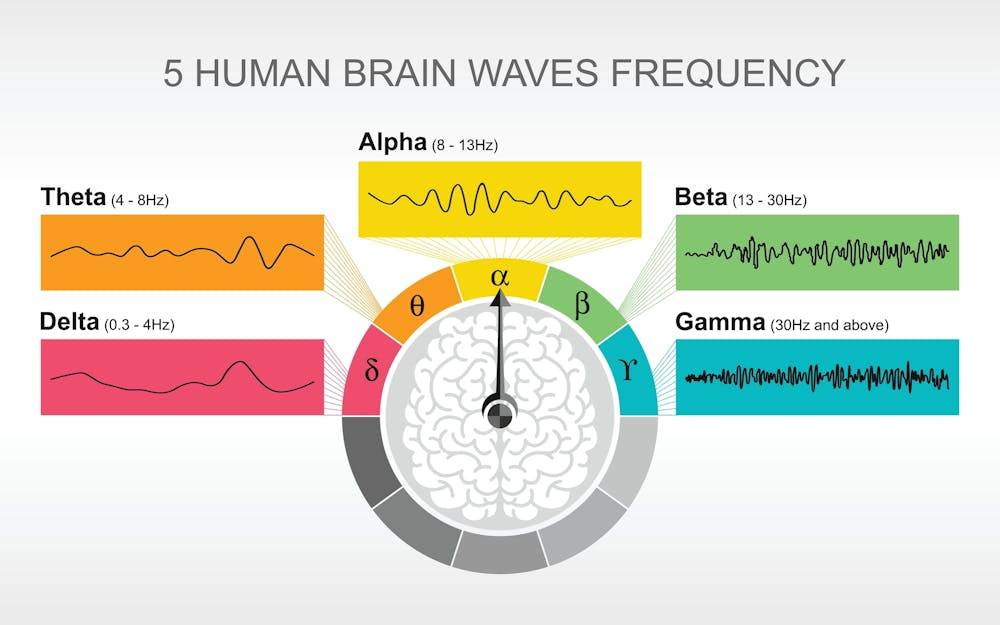
The researchers focused on the frontal regions of the brain, responsible for attention, concentration, and filtering out distractions. They measured different types of brain waves.

Brainwaves are grouped into five different wavelength categories. Shutterstock

As neuroscientist Susan Hillier explains in more detail, different brain waves reveal distinct mental states:

  • “gamma” is linked with states or tasks that require more focused concentration
  • “beta” is linked with higher anxiety and more active states, with attention often directed externally
  • “alpha” is linked with being very relaxed, and passive attention (such as listening quietly but not engaging)
  • “theta” is linked with deep relaxation and inward focus
  • and “delta” is linked with deep sleep.

The Spanish study found that the same tasks done inside the enclosed pod vs the open-plan workspace produced completely opposite patterns.

It takes effort to filter out distractions

In the work pod, the study found beta waves – associated with active mental processing – dropped significantly over the experiment, as did alpha waves linked to passive attention and overall activity in the frontal brain regions.

This meant people’s brains needed progressively less effort to sustain the same work.

The open-plan office testing showed the reverse.

Gamma waves, linked to complex mental processing, climbed steadily. Theta waves, which track both working memory and mental fatigue, increased. Two key measures also rose significantly: arousal (how alert and activated the brain is) and engagement (how much mental effort is being applied).

In other words, in the open-plan office participants’ brains had to work harder to maintain performance.

Even when we try to ignore distractions, our brain has to expend mental effort to filter them out.

In contrast, the pod eliminated most background noise and visual disruptions, allowing participant’s brains to work more efficiently.

Researchers also found much wider variability in the open office. Some people’s brain activity increased dramatically, while others showed modest changes. This suggests individual differences in how distracting we find open-plan spaces.

With only 26 participants, this was a relatively small study. But its findings echo a significant body of research from the past decade.

What past research has shown

In our 2021 study, my colleagues and I found a significant causal relationship between open-plan office noise and physiological stress. Studying 43 participants in controlled conditions – using heart rate, skin conductivity and AI facial emotion recognition – we found negative mood in open plan offices increased by 25% and physiological stress by 34%.

Another study showed background conversations and noisy environments can degrade cognitive task performance and increase distraction for workers.

And a 2013 analysis of more than 42,000 office workers in the United States, Finland, Canada and Australia found those in open-plan offices were less satisfied with their work environment than those in private offices. This was largely due to increased, uncontrollable noise and lack of privacy.

Just as we now recognise poorly designed chairs cause physical strain, years of research has shown how workspace design can result in cognitive strain.

What to do about it

The ability to focus and concentrate without interruption and distraction is a fundamental requirement for modern knowledge work.

Yet the value of uninterrupted work continues to be undervalued in workplace design.

Creating zones where workers can match their workplace environment to the task is essential.

Responding to having more staff doing hybrid work post-pandemic, LinkedIn redesigned its flagship San Francisco office. LinkedIn halved the number of workstations in open plan areas, instead experimenting with 75 types of work settings, including work areas for quiet focus.

[embedded content]

For organisations looking to look after their workers’ brains, there are practical measures to consider. These include setting up different work zones, acoustic treatments and sound-masking technologies, and thoughtfully placed partitions to reduce visual and auditory distractions.

While adding those extra features in may cost more upfront than an open plan office, they can be worth it. Research has shown the significant hidden toll of poor office design on productivity, health and employee retention.

Providing workers with more choice in how much they’re exposed to noise and other interruptions is not a luxury. To get more done, with less strain on our brains, better design at work should be seen as a necessity.

ref. Why your brain has to work harder in an open-plan office than private offices: study – https://theconversation.com/why-your-brain-has-to-work-harder-in-an-open-plan-office-than-private-offices-study-274946

Evening Report: https://eveningreport.nz/2026/02/16/why-your-brain-has-to-work-harder-in-an-open-plan-office-than-private-offices-study-274946/

Ōtorohanga flooding: The silver lining amongst devastation, damage and disarray

Source: Radio New Zealand

An Ōtorohanga man in his 80s is devastated by the damage and disarray at his flooded home after the weekend weather event – save the silver lining of a saved pet goat and an heirloom teddy bear that survived the waters.

Kio Kio Station Road resident Colin Payne had to be rescued by a boat, after floodwaters came through his property in the early hours of Saturday, when the region received between 150 to 300 millimetres of rain.

He said he had a feeling on Friday night that things could get bad when the water came up to his gate, which prompted him to move his campervan to a friend’s house in the town centre before returning home.

Payne slept at about 9.30pm, not expecting that floodwaters would gush through his property, and also not knowing about the state of emergency declared in Ōtorohanga around 1am.

He woke up about 4.30am to find his bed surrounded by water.

A family heirloom teddy bear from Colin Payne’s great great grandfather. RNZ / Marika Khabazi

The only thing Payne managed to pull out of the water before his rescue boat came – besides his medication and clothes – was an heirloom teddy bear and its chair, which was inherited from his great-great-grandparents.

Returning to check on his house for the first time on Sunday, Payne struggled to come to terms with the rooms with knocked over fridges, a fallen TV, and sentimental items strewn over the muddy floors, in rooms where they would have floated for hours.

“Coming in and seeing the mess here is a bit devastating, 85 years of collections … personal stuff and family stuff and heirlooms,” said Payne.

“How do you describe it… I mean daunting, devastated, everything, just suddenly your life’s expired in a sort of roundabout way, if you understand what I mean, from an asset … the biggest trick is you gotta be very careful walking around in the silt because it’s very slippery.”

Colin Payne said he’s devastated to see 85 years worth of collections and family heirlooms drenched by floodwaters. RNZ / Marika Khabazi

A silver lining amidst the chaos of his flood-damaged home and having to write off his drowned vehicle – Payne was relieved to find out that his pet goat Sophie survived, thanks to the help of neighbours.

“At least my good friend Sophie’s been rescued, that’s my favourite friend, my goat.”

Colin Payne and his partner Frances Rawlings. RNZ / Marika Khabazi

Payne’s partner, Frances Rawling – who was not at the house that night – said it was hard to know where to begin when faced with the mammoth task of cleaning up.

“Once the mould sets in… it’s hard to imagine being here again,” she said.

The couple said they have a house in Te Kuiti where they can stay in the meantime.

RNZ / Marika Khabazi

On Sunday morning the rain resumed, and a community member with a quadbike came to help take Payne’s two steers to a safer place.

Craig Janett, who had been helping out, said he felt for the Kio Kio Station Road residents.

“A lot have been lost, one bloke down here lost all his lifestyle block… lost all their stock, washed away, just devastation, the river, the rubbish in the river, the drums, just everything rubbish.”

Payne was moved by the kindness of the community.

A washed over bridge off Kio Kio Station Road. RNZ / Marika Khabazi

“Kio Kio Station Road, K-K-S-R stands for kind, caring, supportive residents, and believe me, that applies to everyone in this street.

“Here’s two people coming this morning and taking my stock away… I know damn well that they’ll be well looked after and they’d take them away and put them onto safer ground, and that’s the kind of community we have in K-K-S-R.”

Sign up for Ngā Pitopito Kōrero, a daily newsletter curated by our editors and delivered straight to your inbox every weekday.

– Published by EveningReport.nz and AsiaPacificReport.nz, see: MIL OSI in partnership with Radio New Zealand

LiveNews: https://nz.mil-osi.com/2026/02/16/otorohanga-flooding-the-silver-lining-amongst-devastation-damage-and-disarray/

Households and the Reserve Bank’s official cash rate decision

Source: Radio New Zealand

How soon is the official cash rate (OCR) likely to start to increase? And will any hint of it send what banks charge higher?

For many homeowners and households, that will be the main thing on their minds when the Reserve Bank issues its next update this week.

It cut the OCR to 2.25 percent in November, but what captured the most attention was the indication that it did not necessarily think it would cut rates much further.

Market attention turned to when the rate might start to lift, and wholesale rates increased, taking banks’ home loan rates with them.

  • Reserve Bank governor sends message markets gone too far
  • Reserve Bank Governor Anna Breman took the unusual step of warning that it might have been an overreaction.

    In recent days though, all the main banks have again shifted their longer-term rates higher, as inflation worries continue to simmer.

    ANZ senior economist Miles Workman said any insight the bank gave into the future path of interest rates would be key for most households.

    “Swap rates have lifted meaningfully since the November MPS (monetary policy statement) as markets have reassessed the outlook for monetary policy following the inflationary vibe across recent data releases.

    “And that’s put upward pressure on fixed mortgage rates. The February MPS is an opportunity for the Reserve Bank to signal whether it thinks that move is justified by recent data and its updated economic outlook. Households may also be listening closely to what the bank says about the inflation and labour market outlooks, given cost of living pressures remain and the labour market is still soft.”

    Mike Jones, chief economist at BNZ, said the Reserve Bank would need to walk a fine line between signalling the OCR would not stay as low for as long as previously thought, and not sending financial markets higher on the expectation of future increases.

    “There will probably be a hat tip from the bank to the fact the economic recovery is growing in momentum, but equally confirmation that a period of low interest rates is still part of the plan to ensure it gets going proper and current spare capacity is soaked up.

    “There does appear to be some concern out there about whether recent lifts in wholesale and retail interest rates might lean against the fledgling economic recovery. The bank will also be wary of this, but it’s also important to note most mortgage borrowers soon to experience a mortgage rate reset will be rolling on to a rate more favourable than previously. So, there’s still some of the lagged impacts of previous rate cuts to come through.”

    He said households would probably also want to see confirmation that the bank still thinks inflation will return to about 2 percent later this year.

    Westpac chief economist Kelly Eckhold said it would also be interesting to watch Breman‘s first press conference.

    “It will be the first opportunity we get to understand what sort of things she thinks are important, how she chooses to express the trade-offs that she inevitably has to deal with when deciding what to do with policy. Ultimately, is she dovish? Is she hawkish? What sort of factors and variables is she going to make more prominent when explaining to people what she’s doing?”

  • New Reserve Bank Governor Anna Breman talks to Corin Dann
  • He said the market had already priced in a lot of cash rate rises this year.

    “It’s not to say that it’s impossible that they could price in more, but it feels like the hurdle, the bar is set quite high to really have those rates have to go up much further.

    “Perhaps, if she was to say that a September rate hike might be something that’s a realistic possibility, that could be the sort of thing that would leave the market to obviously fully price that in, and maybe even start speculating about an earlier move than that. But it strikes me as relatively unlikely, and that instead she might talk about the possibility of a rate rise at the end of the year. And, you know, possibility could have a capital P or a small p, depending on the nature of the discussion that’s around it.”

    He said households might also be interested in what the Reserve Bank expects of house prices.

    “We’re not really forecasting a house-price led recovery. We’ve got 4 percent [increase in house prices] this year, which is close to where the Reserve Bank was forecasting them at the end of last year.

    “What does she think about that? Does she think that the fortunes of the housing market are tightly tied to the fortunes of the broader economy, or not?”

    Westpac last week changed its forecast. It still expects a first increase in November, but then increases at each meeting between February and September 2027.

    “We’ve basically upgraded the growth forecasts, so that means excess capacity will get used up a bit more quickly based on our revised view,” Eckhold said.

    “We think once they get going they’ll move a bit more quickly, because by the end of the year, if the growth outlook that we are depicting has panned out then it won’t really be appropriate to have interest rates in the 2 percents.”

    Sign up for Money with Susan Edmunds, a weekly newsletter covering all the things that affect how we make, spend and invest money.

    Sign up for Ngā Pitopito Kōrero, a daily newsletter curated by our editors and delivered straight to your inbox every weekday.

    – Published by EveningReport.nz and AsiaPacificReport.nz, see: MIL OSI in partnership with Radio New Zealand

    LiveNews: https://nz.mil-osi.com/2026/02/16/households-and-the-reserve-banks-official-cash-rate-decision/

    Auckland’s Eden Park to host State of Origin match in 2027

    Source: Radio New Zealand

    Watch above: Prime Minister Christopher Luxon, Auckland Mayor Wayne Brown and Tourism Minister Louise Upston announce the deal.

    A State of Origin match will be played in Eden Park in Auckland in 2027 following three years of high-level talks with the NRL and the Australian Rugby League Commission.

    It is expected that 50,000 fans will pack the stadium for the Queensland versus New South Wales match.

    Auckland Mayor Wayne Brown said securing State of Origin reflected the city’s strength as a major sporting centre.

    “From the outset, Auckland made it clear we wanted to bring State of Origin to our city, and we’ve worked hard to secure it,” he said in a statement.

    “We know how to host major events, and we know the value they bring. This match will mean full hotels, busy restaurants and bars, and thousands of visitors experiencing everything our region has to offer.”

    Hamiso Tabuai-Fidow of the Maroons celebrates after scoring a try during the State of Origin game two match between the Queensland Maroons and the NSW Blues. AAP / Photosport

    Hosting State of Origin is expected to attract more than 10,000 international visitors from Australia, generate nore than 50,000 international visitor nights, and inject an estimated $17.4 million into the Auckland economy.

    Australian Rugby League Commission chairman Peter V’landys AM said the historic clash would give New Zealanders the opportunity to experience the intensity of the game’s greatest rivalry.

    “Rugby league is the number one sport in Australia and the Pacific, and the growth we have seen in New Zealand over recent years has been nothing short of extraordinary,” V’landys said.

    Sir Graham Lowe, the only New Zealander to coach a State of Origin team as a former Queensland coach, said the occasion would be one to remember.

    “Kiwis are excited about State of Origin, but there are only a few of them that have had the opportunity to actually watch it live. This will be a fantastic occasion for Auckland,” he said in a statement.

    The 2027 fixture is being co-funded in partnership by Auckland Council Events and the New Zealand Government via the Major Events Fund.

    Sign up for Ngā Pitopito Kōrero, a daily newsletter curated by our editors and delivered straight to your inbox every weekday.

    – Published by EveningReport.nz and AsiaPacificReport.nz, see: MIL OSI in partnership with Radio New Zealand

    LiveNews: https://livenews.co.nz/2026/02/16/aucklands-eden-park-to-host-state-of-origin-match-in-2027/